In a nutshell, ‘picture talk’ is using an image to maximise repetitions on a target structure.
The success of picture talk relies both on the image itself and the questions asked. A truly compelling image is one that is quirky, and offers opportunities to use the target structure in both statements and questions.
Read to the end to find links to demo videos, blog posts and more…
How To Set Up a Picture Talk?
Picture Talk #1
A picture talk can be simply an image which is shown to students to generate scaffolded and fully comprehensible discussions that either introduce a target structure &/or to get repetitions on the target structure. For preliterate learners, when introducing a target structure, relying on ‘point & pause’ is often not a viable option. Picture Talks are super helpful for overcoming this when working with preliterate learners.
Picture Talk #2
Another successful way to set up a picture talk is to cover the cognate in the image. To what extent, you cover the cognate, will depend on your learners. If the covered cognate is ambiguous, I like to leave a bit of the image showing as a hint. Covering up the cognate opens it up for student contributions which can then be restated as repetitions incorporating the target structure.
Targeting the verb ‘eat’, using the image below of Bluey eating, you could ask…..
1. What is Bluey eating?
2. Bluey is eating………(pause)?
3. Bluey is eating a taco (or substitute with another cognate)?
4. Is Bluey eating a taco or an ice cream?
The number of questions you ask will depend on a million factors including the cohort, the time of day etc. When ready, you simply remove the image and restate the sentence using the target structure!! Input, input, input for the win! I do this in PowerPoint as it is so easy to insert and then fade out each shape. Covering the cognate is so popular with young learners and gives them such a huge confidence boost when they guess correctly the hidden cognate.
Picture Talk # 3
Recently I discovered the image below on one of the Bluey Facebook groups for adults! It has so much potential for another way to picture talk! It would be so easy to create this format using 4 well known characters and 4 cognates that relate easily to the target structure. The cognates (written in the target language) could be true answers, they could be totally unknown or could be focusing on the negative only. With older students, I would encourage the use of the ‘maybe’ (in Indonesian ‘mungkin’) and/or, again depending on the cohort, ‘not possible’ (in Indonesian ‘tidak mungkin) when commenting on the contributions of their peers.
Would love to hear Picture Talk works for you in your context! Comment below and share your experiences and ideas!!
A huge, huge thank you to Moya for sharing this amazing link (see below)! It contains significantly more detail, links to YouTube demo videos plus so much more.
I have just finished making my first ever TikTok video and was so surprised how easy it was. Admittedly my first creation is very basic, and already I am keen to explore tips I can use to make the next clips more appealing. If you have any tips, please, please comment below!
The clip is of a song that I may use with my year 4’s this term for the term 2 ‘transportasi’ (transportation) topic. As a text for this topic, I am now torn between 3 possibilities. Here they are:
Pak Budi naik apa ke Sekolah
Sepeda motor Pak Budi rusak.
“Saya naik apa ke sekolah?” dia berkata.
Pada hari Senin dia naik becak ke sekolah.
Pada hari Selasa dia naik bus ke sekolah.
Pada hari Rabu dia naik delman ke sekolah.
Pada hari Kamis dia naik mobil temannya ke sekolah.
Pada hari Jumat dia naik sepeda ke sekolah.
Pada hari Sabtu dia berjalan kaki ke sekolah
Pada hari Minggu dia memperbaiki sepeda motornya.
Pada hari Senin Pak Budi bisa naik sepeda motornya lagi ke sekolah.
Pak Budi senang sekali.
2. Jangan Naik Skooter di Sekolah (written by Ibu Anne) Here is the parallel story for her story:
3. Naik, naik ke puncak Gunung (traditional childrens song)
I love this traditional song because of the memories I have of listening to my children learning and singing it with our guides as we climbed Mount Batur when they were only 6 and 8 years old!
Issues I have with many of the YouTube clips for traditional Indonesian childrens songs include: – animated characters have anglo appearances eg eye shape etc, – the audio &/or visual can be poor quality, -the background is often animated and again sadly, does not truly represent beautiful and incredible Indonesia. See the above clip and consider the mountain they are climbing (in a car!!) to your memories from Indonesia. How cool would it be if they were actually climbing a volcano!! IKR
Which all explains why I decided to google how to make a TikTok video and found this:
Based mostly on target language that your students already know and understand.
Only includes 2-3 unfamiliar words which become the target structures.
Incorporates repetitions of the target structures.
Has a quirky & unexpected ending.
Characters are ones your students recognise – either one they love e.g. SpongeBob, or ones they detest e.g. Elsa (Frozen).
Settings are well known places from their local area e.g. MacDonalds, Sydney Opera House, Horseshoe Bay. Don’t translate places; Proper names are the same regardless of the language.
Incorporates cognates. This will depend firstly on your target language, secondly on your story and importantly, thirdly on your student’s prior knowledge. e.g. durian is not a food that my students would recognise whereas stroberi (strawberry) is instantly recognisable.)
The story length is appropriate for the age of the students. This is critical for maintaining engagement during the student acting and to cater for their reading levels when reading the story.
comprehension, all of which are essential for language acquisition.
To ignore any of the 8 features, will inevitably disadvantage your students. I’ve discovered it’s better to start too simple and then while co-creating with students, add any known language that students contribute and add it to the both the current version and the parallel story.
For examples of great stories, check out the list of stories by clicking on the link above. When looking at these or other people’s stories, adapt the language for your students. It is important you only use them exactly as they are if it suits your context. There is no single way to use CI as we all have unique students, unique school expectations and unique teaching styles. When sharing stories based on any of the stories listed, always credit the original author!
Note I firstly apologise that the stories listed in the Scope And Sequence are mostly only available in Indonesian. I am slowly translating them into English! If there is one that has potential and Google translate isn’t helping, please get in contact and I will happily translate that story for you!
It exceeded all of my expectations!! I hardly know where to start to share a few reflections, so let me . firstly start with with Diane Neubauer and Annabelle Williamson (La Maestra Loca), who had us all in absolute awe of their amazing CI teaching skills and their unflagging positivity. Diane and Annabelle both had a profound impact on the learners and observers in the labs.
Here is a comment shared by an attendee after dropping in on a language lab with Diane:
In a 90 minute lesson, I experienced moving from hearing at first onlyincomprehensible noise, before reaching sufficient comprehension towards the second half of the lesson where without realising it, I had pulled out my phone, following the instruction Diane had given to her students , and was googling where in Australia you can find pandas! I couldn’t believe it!
Secondly, I cannot go any further without thanking both Teri Wiechart and Margarita Pérez Garcia from the bottom of my heart. Both not only presented workshops (Teri in particular was superb – she delivered a truly amazing introduction to CI workshop after only a few days’ notice), they both also offered coaching and/or teaching support to anyone keen to dig deep and teach a new CI skill to ‘learners’. If you would like more information on the Coaches for Coaching course Teri runs, please comment below and I will put you in touch with Teri. I have done it twice and highly recommend it for anyone working in a leadership role in a language faculty.
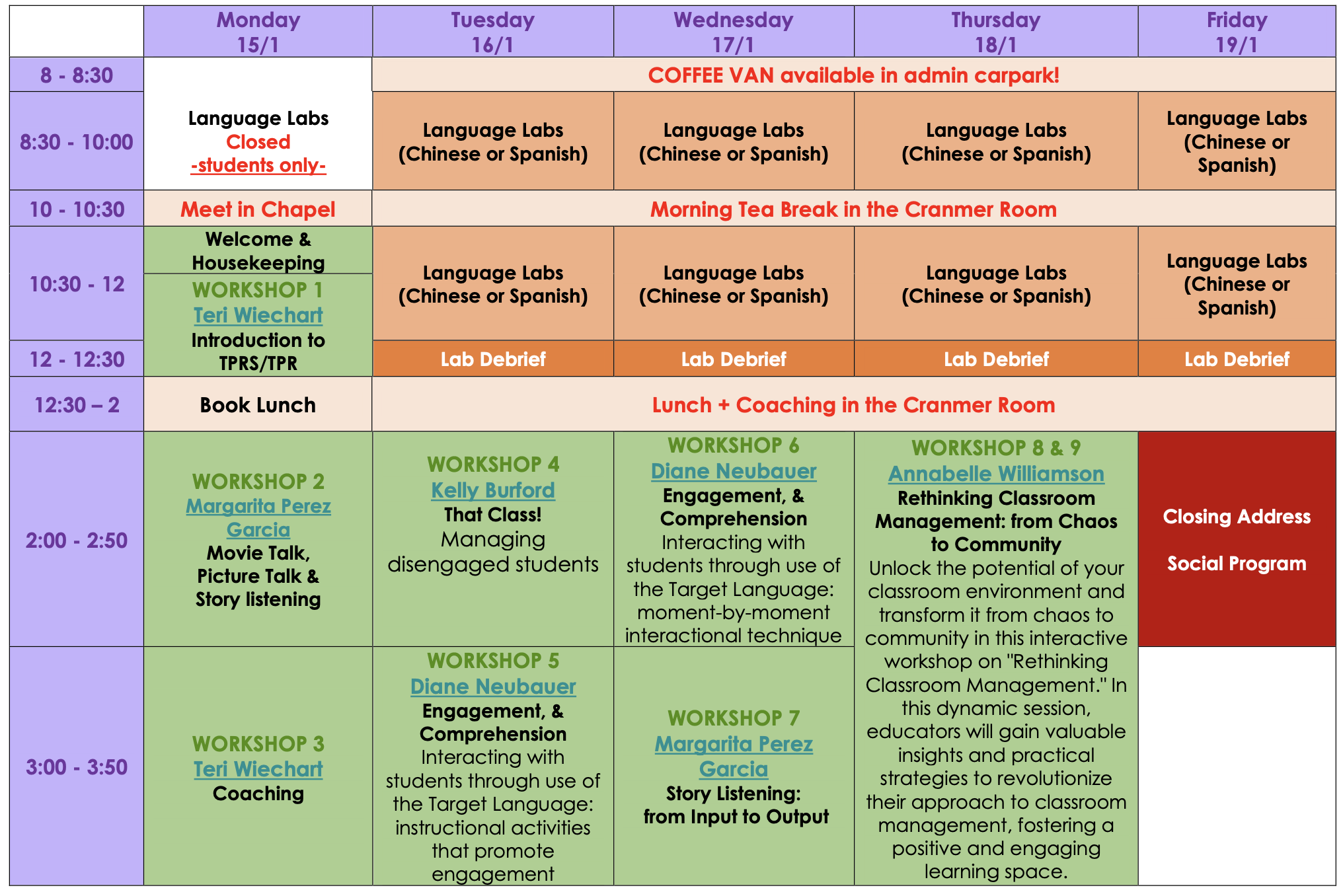
As you can see from the conference prgram, the day was largely split into two sections. The 3 hour morning session was broken into 2 language labs, a break and then finished with the language lab debrief. The afternoon began with a 90 minute lunch/ coaching and finished with two workshops.
Language Labs
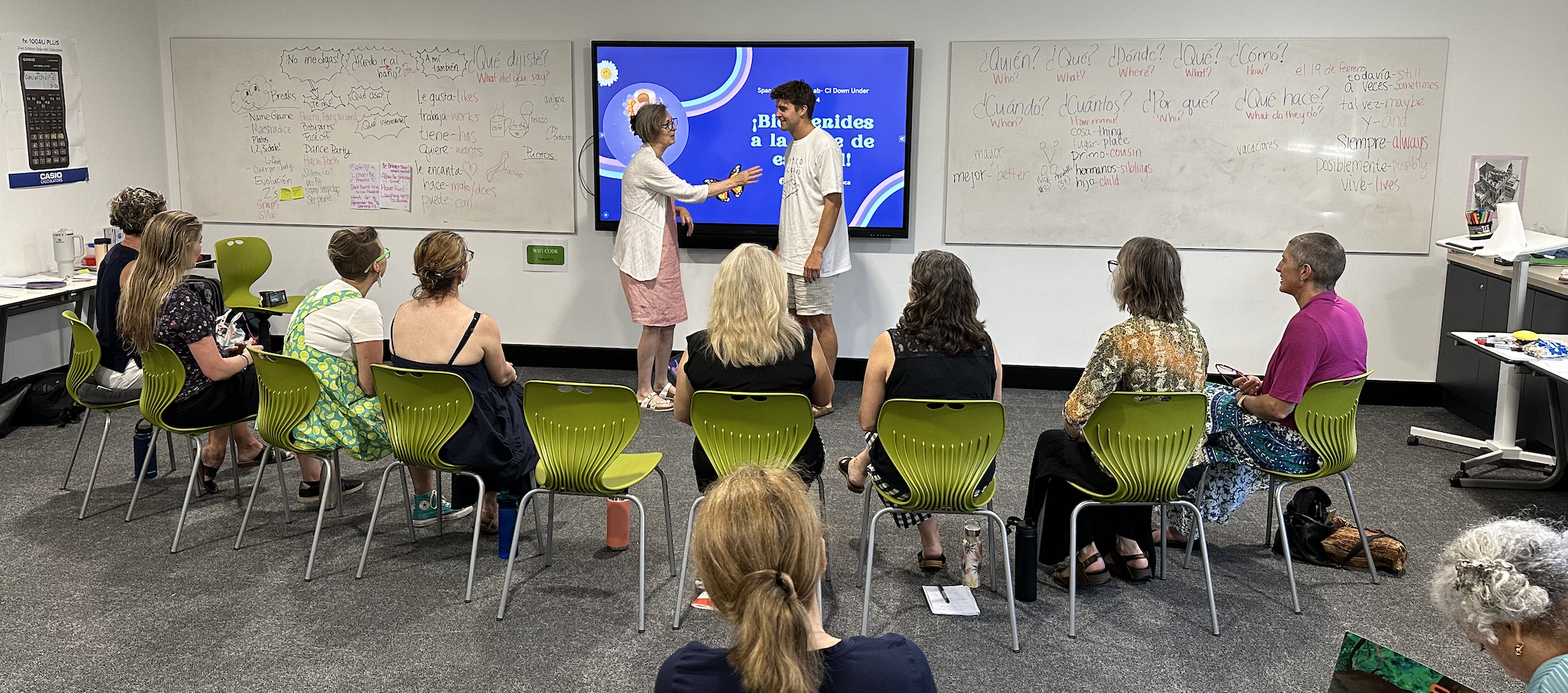
To my knowledge, this conference was the first ever in Australia to include language labs. The first language lab I attended was in Agen, France as a learner with Daniel Dubois in his Breton language lab. The second time I had the opportunity to go to language labs again was at iFLT18 in Cincinatti, Ohio. Here, I observed several labs with various teachers teaching a variety of languages ranging from Russian to Latin. It was memorable observing legendary teachers in action after many years of purely reading about them from afar. While I observed several labs over this week, only one made a deep and lasting impression. Read all about it here!!
Language Labs are significantly better (in my opnion) than workshops for learning how to improve your teaching practise. Instead of someone presenting a workshop explainingstep by step hot to do a skill using PowerPoint, in a language lab, you can either experience learning the skill as a learner or watch it being taught as an observer. Often, explanations leaves out an important detail, yet when you have the chance to see a skill or activity being explained to a class of learners, the instructions are considerably clearer. Thus, after observing 12 hours of language labs, the skills, ideas and learning we attendees experienced far exceeded that which would have been covered through12 hours of individually presented workshops. Observing language teaching with real learners is the most complete way for us language teachers to improve our practice. Language labs also provide teachers with the opportunity to hear from the learners, a rare yet valuable aspect. After the second lab each day, a debrief is held. During this half hour, both learners and observers can reflect and share their experiences or interact with the teacher to either ask questions or comment. Annabelle wrote notes with hyperlinks during the debriefs which she shared with all attendees. WooHoo!
After one week back, here is a list of what I have tried already:
Classroom Jobs Instead of making a big deal out of assigning jobs as I used to do, I am imitating Annabelle’s style and assigning the jobs as I need them and choosing someone intentionally rather than randomly through class dojo. It gives me such joy watching my students face when I match them with a job. This is also a much quicker process, which with only one lesson per week, is an added bonus. So far, I have a door closer, a time keeper (my new classroom clock randomly stops, so I asked a student to give me a heads up when we had 10 mins left of the lesson). The job I can’t wait to assign is the clicker person. This person will be responsible for keeping an eye out for where I put the clicker down. When I ask, “Dimana kliker” (Where is the clicker), they will remain seated, and point to my laser pointer saying either ‘disini’ (here) or ‘disana (there). This job is pure genius.
Turn and Talk This is the perfect comprehension check or brain burst (mini brain break) and was amazing introducing it during week one. After I explained what students do when they hear me say ‘diskusi’ (discuss) + see my fingers doing crab claws, (insert the ASL crab claw) pic I said to the class twice, “Bu Cathy mau satu stick”. I paused and then did crab claws while repeating diskusi + Bu Cathy mau satu stick very slowly several times. After a few seconds, I next said someone’s name, followed by saying ‘Bahasa Inggris?’ (English?) and then the Indonesian sentence again. Like this, “Lyla, Bahasa Inggris ya? Bahasa Inggris. Bu Cathy mau satu stick. Lyla then translated it into English, Bu Cathy wants a stick. What a fabulous way to hold comprehension checks on familiar structures after a long holiday break.
The name game (add link) Tried this brain break with my year three students and they loved it. For week one, I had the whole class playing in one group, but now that they know how it runs, I will break them into smaller groups next week which will definitely increase engagement even more!!
What new idea did you try with your students last week? How did it go, and will you tweak it next time? I look forward to reading about your week one!
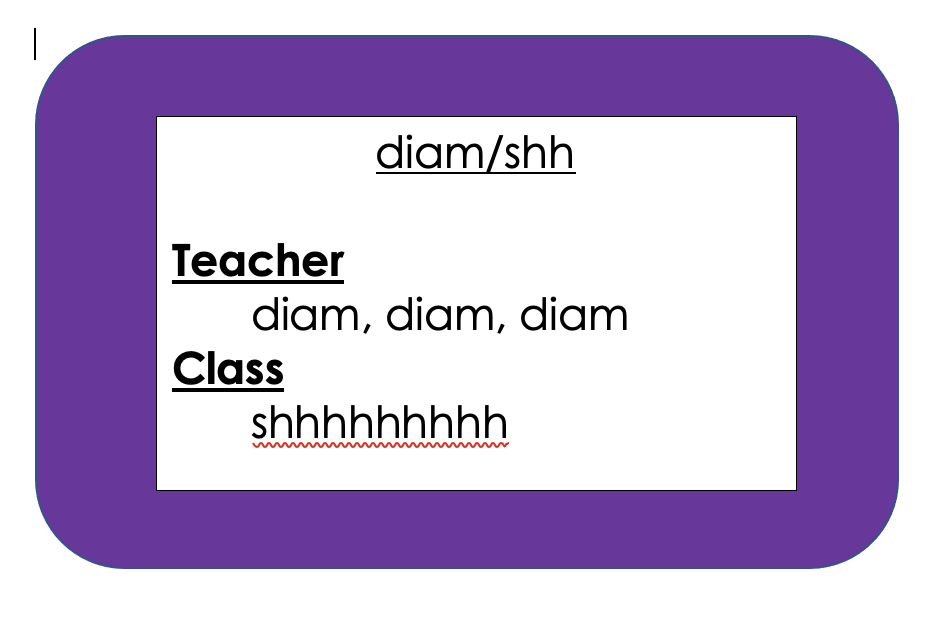
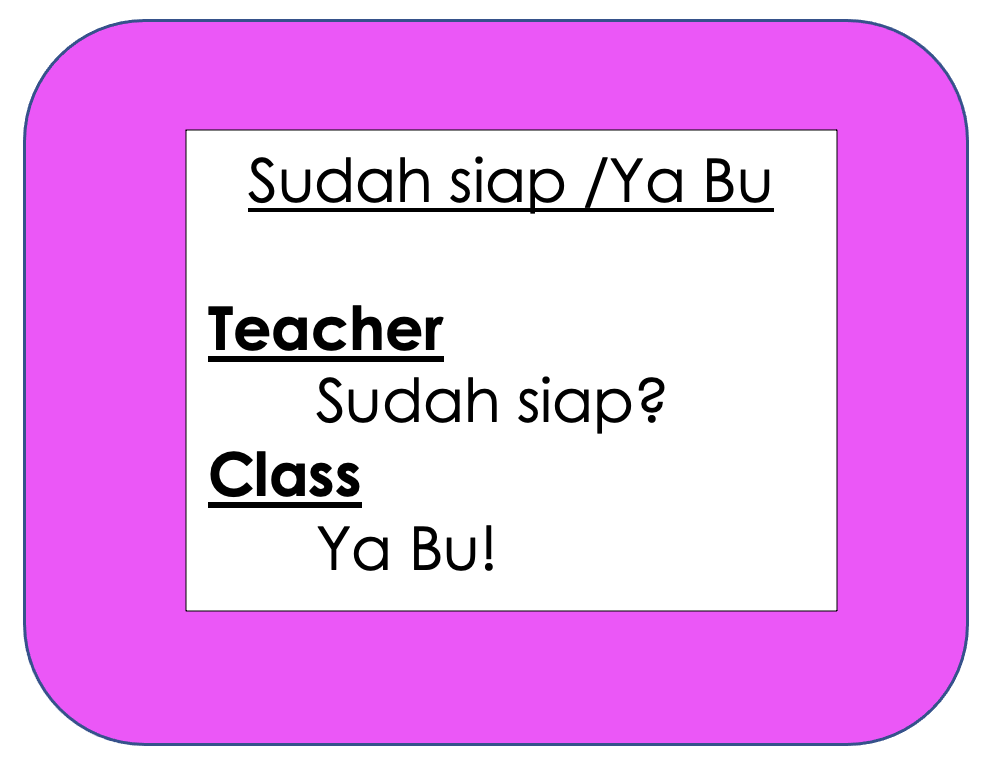
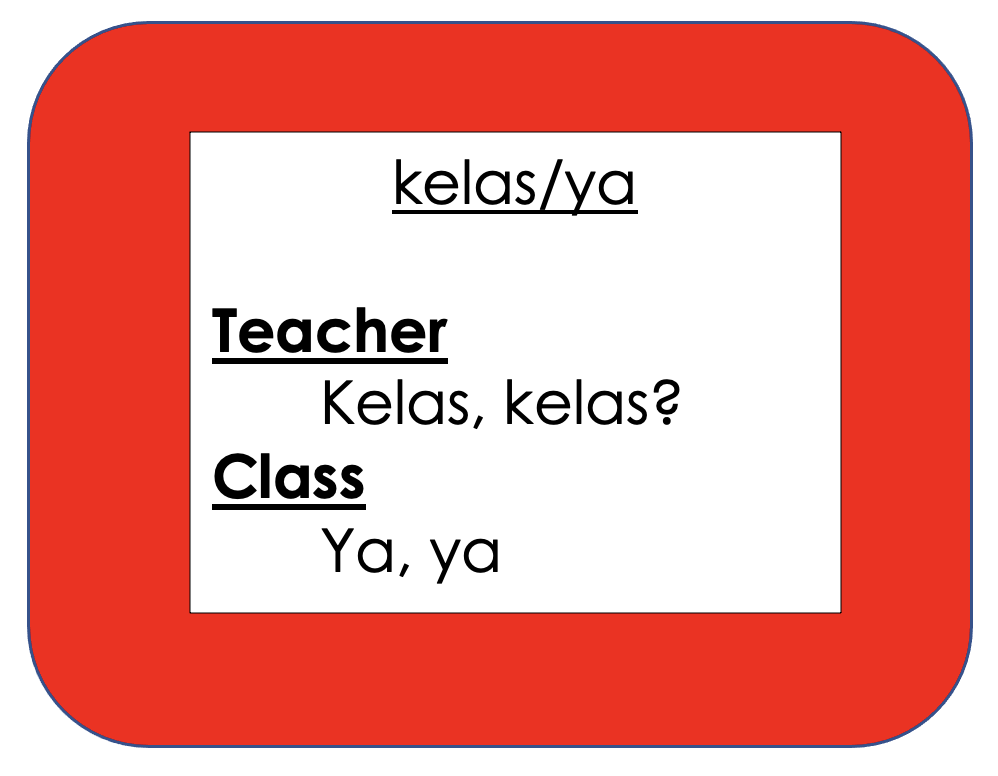
No matter what the age of your students, call and response are awesome for getting the whole class to stop and listen!
They work like this: the teacher says a word or phrase and upon hearing it the class choruses a response and then magically look towards the teacher ready for an instruction. With brand new classes, I don’t introduce a call and response until all other behaviour management systems are working smoothly. Until then, I use the 1, 2, 3 song (taught in lesson 1) and sing until all students are singing with me.
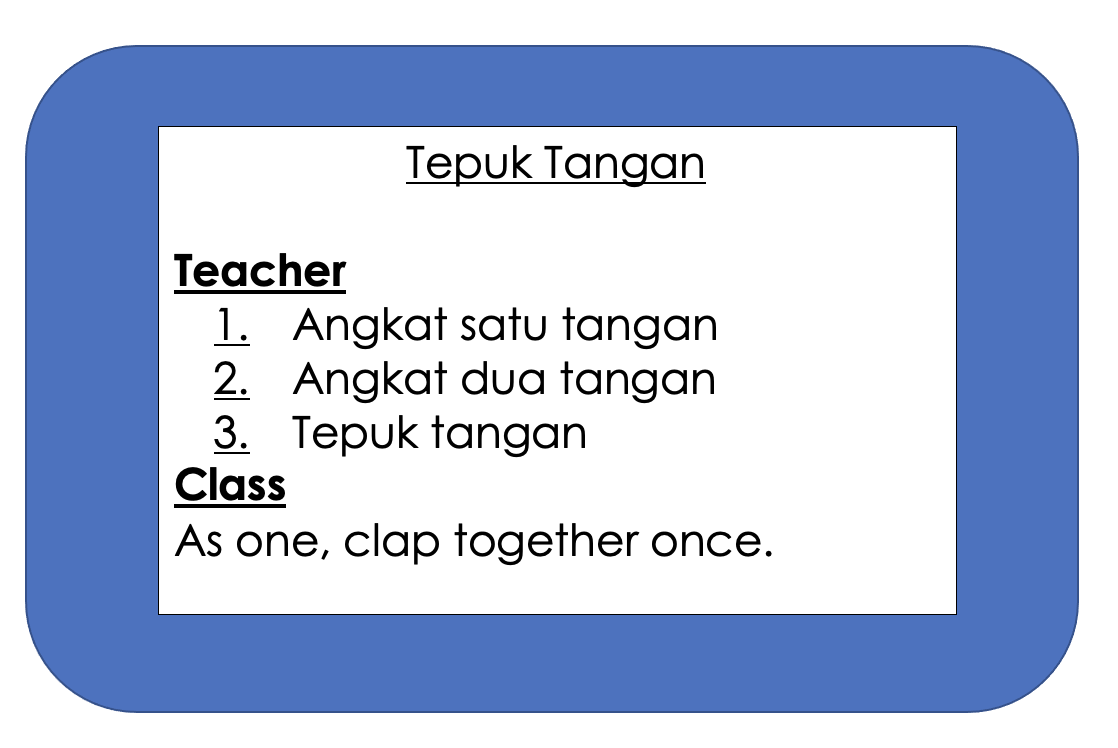
The first call and response I usually introduce is the following:
When saying it, I pause between lines to make sure all students are keeping up with the instructions. If it is noisy, I will go through it once to get everyone attention and then repeat it. With very young learners, I modify the instructions by removing the word ‘angkat’ so that it becomes: satu tangan, dua tangan, tepuk tangan.
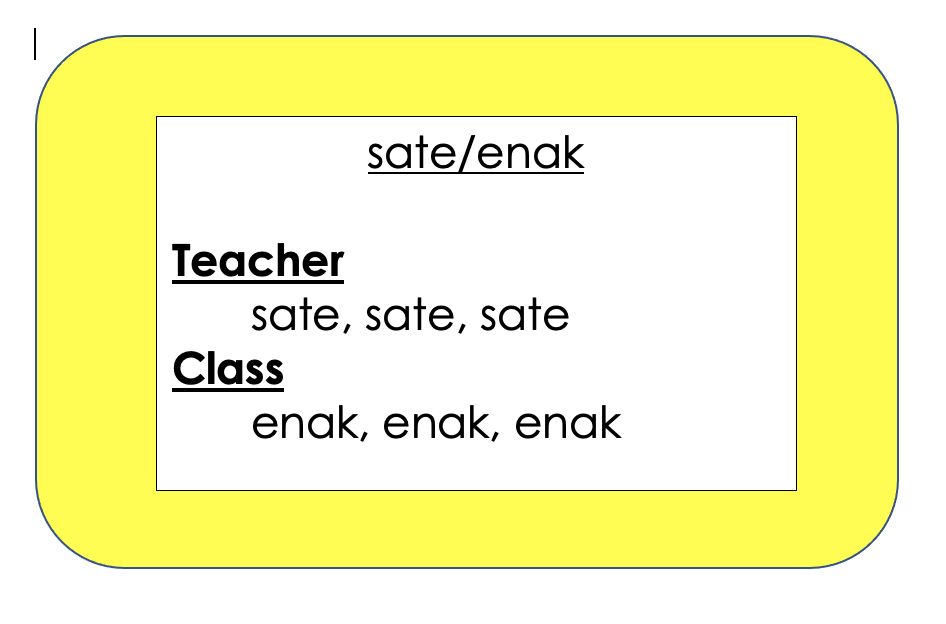
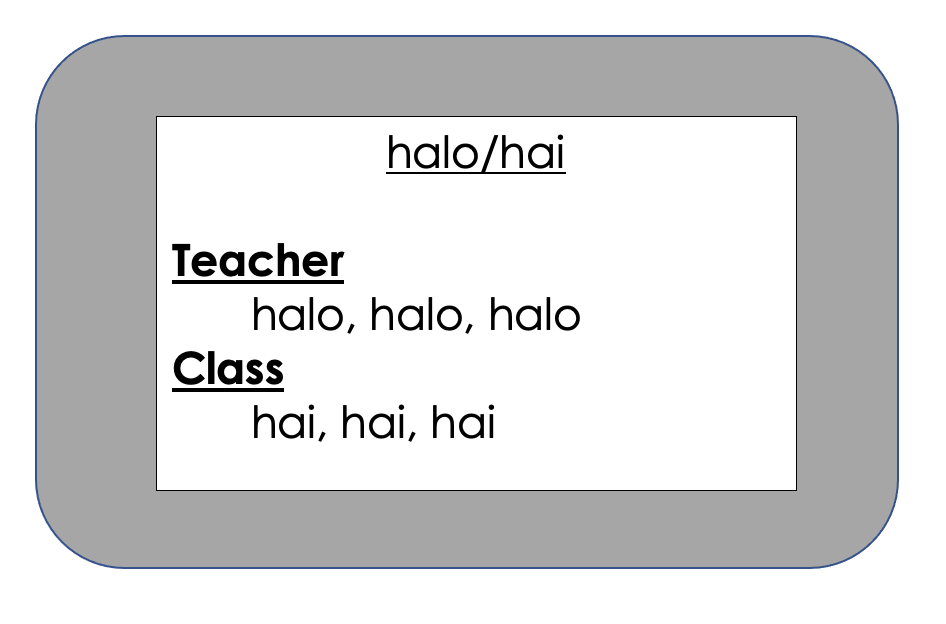
Here are a few more that can be introduced to students in preparation for upcoming stories or for review. My all time favourite that has worked so, so well with all year levels is this one:
I absolutely love this call and response. It is short and effective. When first introducing this one, I explain that the echo must be exactly the same as the original. If I say it slowly, it must be echoed slowly, if sang, the echo must also be sung etc. It is also incredibly helpful during lessons. If someone puts up the stop sign for karena, all that is required for me to say karena three times and with automaticity. The student inevitably echos, ” because, because, because” with a giant smile on their face!
This is similar to karena, except that before saying but, but, but, students stand up and each time they choral echo ‘but’, they slap their bottom, right, left, right. Students absolutely love this one and it certainly has a lot going for it however I have only done this one with students (and families) I knew very well.
That is all I can think of that have been successful and I am currently investigating new ones that could be used with upcoming topics as bonus repetitions of target structures. Here are a few that I might have some potential!
Thanks to the discussion of Facebook, here are a few more!
Have you realised how much I enjoy Languages education research? I consider myself incredibly fortunate to have had the opportunity to begin my Masters of Education; Languages fulltime as it gave me time to broaden my understandings of language learning and teaching. I am also incredibly thankful that I studied simultaneously with a wonderful TCI/TPRS colleague, Bu Heather, as it allowed us to discuss various aspects of Languages research from a TCI/TPRS perspective.
Yesterday I attended the 2022 MLTA NSW conference with one of my brilliant colleagues, Bu Asti. We were delighted to hear Steve Smith speak. I first heard him talking on Liam Printer’s The Motivated Classroom podcast. I highly recommend listening to Liam’s podcasts– they contain a great balance of research and practical ideas for language teachers working with middle primary aged students and above. Can you imagine how ecstatic I was when Steve Smith began his webinar by introducing us to memory research and how it applies to Languages!
Staying on top of research requires not only considerable time but also a certain headset. In this post, I will focus generally on outlining how memory works through teasing out iconic research, some of which dates back to 1885! I hope while reading this, you can reflect on your own teaching practise to determine the extent your practice aligns with accepted understandings of memory.
This post attempts to explore aspects of the research Steve discussed in his webinar. I have found memory research so useful and I wished I had known more about it earlier in my teaching career. I have expanded on several of the points Steve made using either the book ‘Cognitive Psychology and Instruction’ (Bruning, Schraw & Norby. 2011) or relevant SLA (Second Language Acquisition) research. I hope this post is readable and most of all, helps you understand why informed practice leads to sucessful learning!
Steve Smith has taught French in the UK for 30+ years. He has co-authored several books with Gianfranco Conti, one of which is “Memory; What Every Language Teacher Should Know’ ($45.54 on Amazon). What a great title! Here he is with his wife talking briefly about this book.
Ebbinghaus
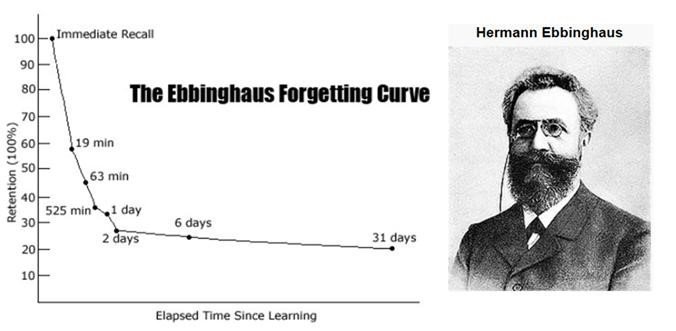
Steven began the webinar by explaining Ebbinghaus’ Forgetting Curve which illustrates how quickly newly introduced information fades over time. Isn’t it astouding!
Ebbinghaus also hypothesised on the link between stress and remembering; something I think we would all agree with. Removing stress from learning is imperative. For many students, speaking/writing (output) can be stressful. For me, as a new learner, speaking in the target language produces an instant memory blank! Stephen Krashen‘s theory of second language acquisition is based on five hypotheses; one of which is the Affective Filter Hypothesis. This hypothesis states that several factors including low motivation, low self-esteem, anxiety, introversion, and inhibition impact on acquisition. Thus, the ideal state for language learning is when the affective filter is so low that learners are completely unaware that they are immersed in the target language.
For language teachers, being aware of Ebbinghaus’ research is critical. To avoid new vocabulary fading, fast, quirky repetitions will significantly help to delay the ‘decay’. In a TCI/TPRS lesson, this can be achieved through numerous comprehensible questions and answers in the target language to incorporate the target structure in ways that appeal to and/or are meaningful to the learners. With my young learners, I love doing this with quirky images of cognates that faciliatate discussion incorporating the target structure.
Knowledge
Steven then outlined the two types of knowledge; explicit (declarative) and implicit (procedural) and how each leads to either language learning or language acquisition. Explicit knowledge is that which is learned explicitly e.g. the rule i before e except after e. Implicit knowledge is that which we learned unconsciously e.g. the specific order of adjectives for English. Steven then asked us if declarative knowledge can become procedural knowledge, i.e. will explicitly teaching grammar rules help students communicate in the target language? To answer this question, I encourage you to try this: speak in your first language without using the letter ‘a’. Try it for a few seconds and then reflect on the hard work your brain did to achieve that!! Stephen Krashen’s Monitor Hypothesis explains that learning rules explicitly creates an ‘editor’ which monitors output through planning, editing, and correcting. It made your output considerably more onerous, doesn’t it? Could you feel your brain planning, editing and correcting while speaking? Thus, implicit learning ie, listening to comprehensible target language will lead to acquisition whereas teaching language rules is only necessary for language learning. Through understanding the difference between explicit and implicit teaching, we can determine if our main teaching goal as a language teacher is building proficiency or building knowledge! Both have value, but the balance is heavily weighted towards implicit teaching if proficiency is the goal.
Memory Models
The scientific study of memory began with Ebbinghaus (1850-1909). While no one yet knows precisely how the brain stores memory, most memory researchers agree on several points:
Working Memory and Long Term Memory are separate systems.
Attention is extremely limited. The mental energy necessary for thinking and understanding is huge and overloading working memory will impact learning.
Cognition includes both automaticity and controlled processing (implicit/explicit).
Processing information is influenced by many factors including prior knowledge, context, emotional state etc.
Memory models vary in many ways. Consider the following model:
Atkinson & Shiffrin, 1968
The modal memory model (see image above) is easily the most commonly understood model of memory. There are significant variations between models yet all agree that the dotpoints outlined earlier are vital for planning and teaching. I believe they should underpin all our teaching and if we do not understand or implement the research findings, we are likely failing our students. Blunt but true!
Memory Understandings
Here is a summary of the research regarding the three major systems of memory (ie Sensory Memory, Working Memory and Long Term Memory). While reading the following, consider the implications for language learning:
The main systems of memory are Sensory Memory, Working Memory, and Long Term Memory. Information is first stored in Sensory Memory then moved to Working Memory where with attention, it can be cogitated upon &/or manipulated to make sense. (Remember when you spoke without using an ‘a’? That all happened in Working Memory!) Long Term Memory is where information is stored for long periods and can be retrieved consciously (explicit memory) or unconsciously (implicit memory).
1. Sensory Memory and Working Memory both have an extremely limited capacity and time limit for holding information. Miller (1956) suggests that adults can hold approximately 7 plus or minus two pieces of information in working memory. Interference, decay and new information impacts the time input remains in these two memory systems. Atkinson and Shiffrin (1971) claim that new information stays in Sensory Memory and/or Working Memory for just 15 – 30 seconds. New information can only be kept in Working Memory longer through rehearsal e.g., repeating them verbally.
2. There is are two subsystems within Working Memory that each either manage verbal or visual input, distributing the processing load equally and operating simultaneously without impacting on the other. If anything, they appear to increase the likelihood in moving information from Working Memory to Long Term Memory. Consider the value of using images and/or props when introducing target structures!
3. Teaching that fails to recognise the characteristics of Cognitive Load Theory (overloading Working Memory) results in cognitive overload. Cognitive overload is when the brain hits the wall because the brain was given too much new information with insufficient rehearsal/repetition opportunities. The implications of cognitive overload impact not only on decreased student outcomes but will also negatively impact on student motivation and engagement levels.
After outlining relevant memory research, Steven then offered many suggestions for activities that will help learners build memory. Here are a few of his ideas for building phonetic memory:
Track the Sound – read a text to students who listen and count each time they hear a particular phonetic blend.
Minimal Pairs – words with similar sounds (e.g. ada/apa) are used in comprehensible sentences for students to identify which one was said.
Correct Transcription – provide learners with a close (text with words missing) and for each missing word, provide several answers for students to choose from. Gaps are filled in while listening to teacher read.
Mind Reading – Brainstorm (retrieve) target structures and teacher writes them on the board. Teacher writes one a mini whiteboard and students choose the one they guess the teacher chose.
Sentence Chaos – teacher writes a number of sentences on the board. Students in groups of three appoint a referee. The job of the referee is to read the sentences from the board in a different order. The other two take it in turns to say the sentences in the new order.
Steven recommends teaching ‘chunks’ rather than single words and states that phrases are more useful for communication and also strengthen the likelihood of retrieval. To support retrieval, he recommends using sentence builders as a ‘Do Now’ activity. I have used ‘Do now’ tasks with older classes as they keep students occupied if I am greeting students at the door or setting up for their lesson. ‘Do Nows’ are a type of warmup that helps student brains move into the flow of Indonesian. Here is a French example that Steve shared (apologies to the fellow sitting in front!). For this task, Steve instructs students to work with a partner to create sentences using the ‘chunks’ in the grid. They can add or change one or two new details or change the tense.
If you are interested in further ideas for retrieval practice, check out here episode 6 from Liam Printer’s podcast titled ‘Retrieval Practice: 11 zero-prep strategies for an engaged classroom’.
Once again, a huge thankyou to the wonderful MLTA NSW committee for delivering a fabulous conference with quality local presenters (shout out to Katherine Brownlee) and international presenters.
If you too enjoy research and would like to chat about something you’ve either discovered or read about in this post, don’t hesitate to get in touch!
I have just finished my first week of teaching Indonesian at my new site. Yes, that’s right, I’ve moved again, and it was the best decision I ever made. After resigning from DECD SA and on the advice of several good friends, I applied for and won a job in Sydney! It has been refreshing working with staff who have my back!!
The main attraction of this job (other than being in NSW), was the potential of being a dedicated TCI/TPRS junior primary teacher. I absolutely love working with JP students – their motivation and engagement is off the chart and consequently their progress is insane. They don’t get hung up on making mistakes, and they give everything and anything a go. It is so rewarding beginning with students usually start with no Indonesian and yet by semester two, our lessons can be 95% in Indonesian!
As always, I have started with Jim Tripp’s “Pleased to Meet You” story. It’s the perfect story to start with – regardless of age – for laying the foundation for future lessons being 95% in Indonesian.
I also love TPR (Total Physical Response) as both a means for keeping students moving and for acquiring verbs. Our first lesson this week introduced berjalan kaki (walk), stop and duduk (sit). Offering young students’ frequent opportunities to move is the secret to increased focus. It sounds like an oxymoron but frequent brain breaks effectively manage wriggles. TPR is a brilliant brain break as not only does it get students up and moving, but also introduces students to structures that will eventually occur in stories e.g. pelan/cepat (slow/fast), berdansa (dance), menyanyi (sing), berlari (run). TPR is a win:win!
Another aspect I introduced last week into my first lesson is calling the roll with Class Dojo. Assessment wise, the data is incredibly helpful for students who are regularly absent from lessons (MiniLit, MultiLit, extra curricula), but it also has another major advantage. It provides me with regular opportunities to target “Apa kabar?” (how are you?) which is usually the first question my students are asked when greeted by Indonesian friends and colleagues. I begin with the basics; firstly baik-baik saja (fine), then lumayan (ok) & finally kurang baik (not so good). These three structures are incredibly versatile and thus are excellent foundation structures.
I strongly believe that we should choose early structures wisely. Look for ones that are easy to say (consider the difference between pronouncing paham and mengerti for early learners), ones that provide a base upon which future structures/ grammar popups can be based e.g. senang sekali (word order) and for intercultural understanding opportunities e.g. kurang baik (less than good). I love ‘lumayan’ (so-so) as it is amazingly versatile. Not only is it useful for explaining how you’re feeling, but is also can be used with adjectives e.g. lumayan besar (sort of big).
Thus, once the basics have been acquired, the roll is the perfect way to introduce other feeling structures that will come up in future stories e.g. lapar (hungry), haus (thirsty), panas (hot), dingin (cold), ngantuk (sleepy) etc.
With JP classes, the aim of the roll is purely acquiring a wide variety of structures, however with MP & UP classes, the aim changes to building automaticity. This is done through adding challenge by timing classes. This starts with classes each lesson trying to beat their own class high score before introducing a whole school challenge to see which class can call the roll the fastest. Can you see the structures needed for this? Brilliant hey?
I really hope that even though my posts will now come from a JP perspective, you will gain ideas regardless. Maybe, in reverse, you will see ways in which what I write about could be adapted into meeting the needs of your cohort. In actual fact, all language learners have the same needs regardless of their age!
Going through the Indonesian iPad yesterday before handing it back brought back so many memories of my year at KAS. I’d really like to share a few with you!
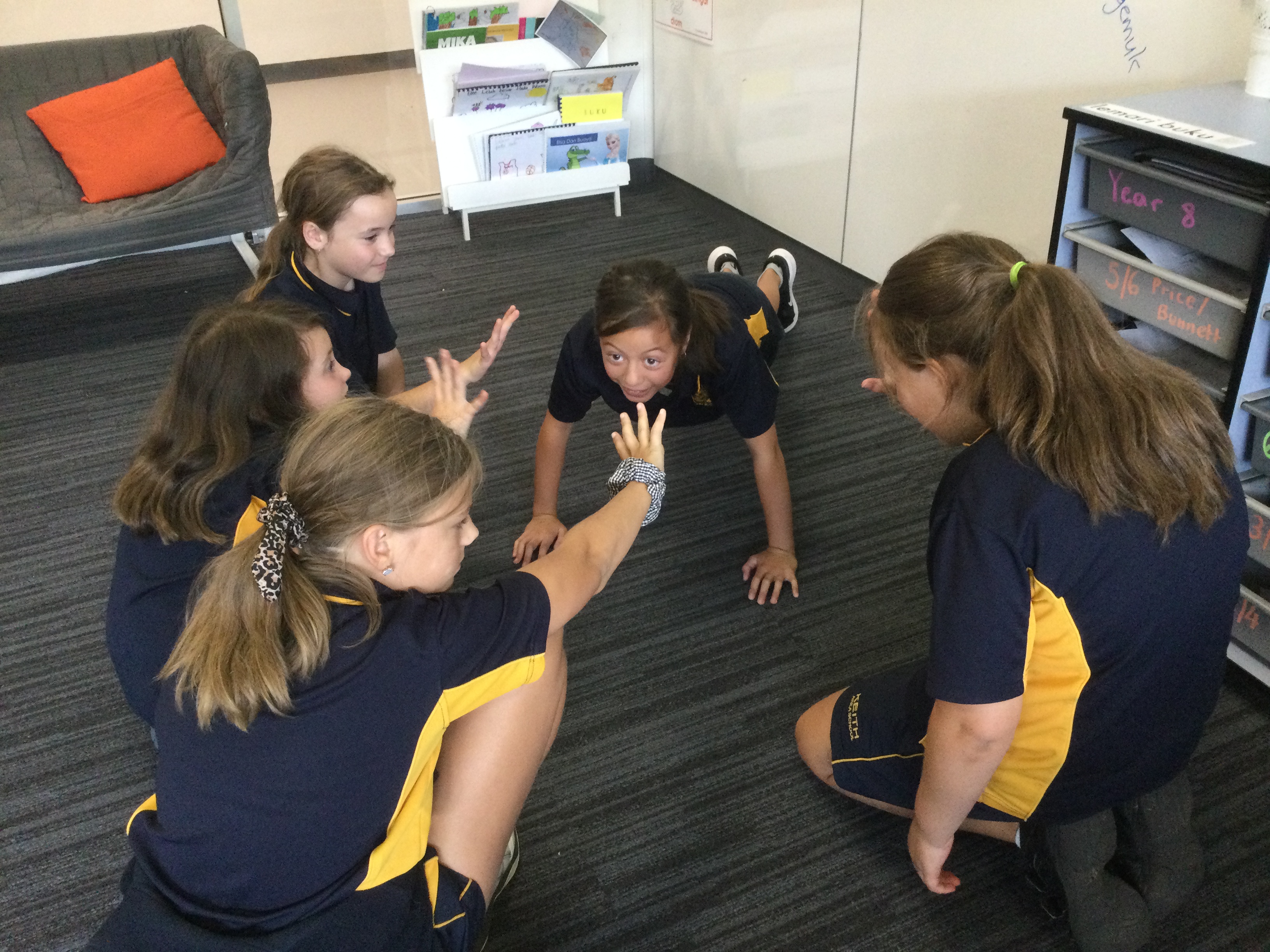
In first term, I did the ‘Murid Nakal’ story with middle primary. I absolutely love this story – great for acting and also perfect for reviewing behaviour management structures in the target language! I did change the ending this year because being at a new school and not knowing the staff or community, wanted to avoid recrimination for using a story that includes smacking! My 2021 version changed the hitting to push ups which worked but was nowhere near as funny! Here are some pictures of a lesson where we used Martina’s freeze frame idea.
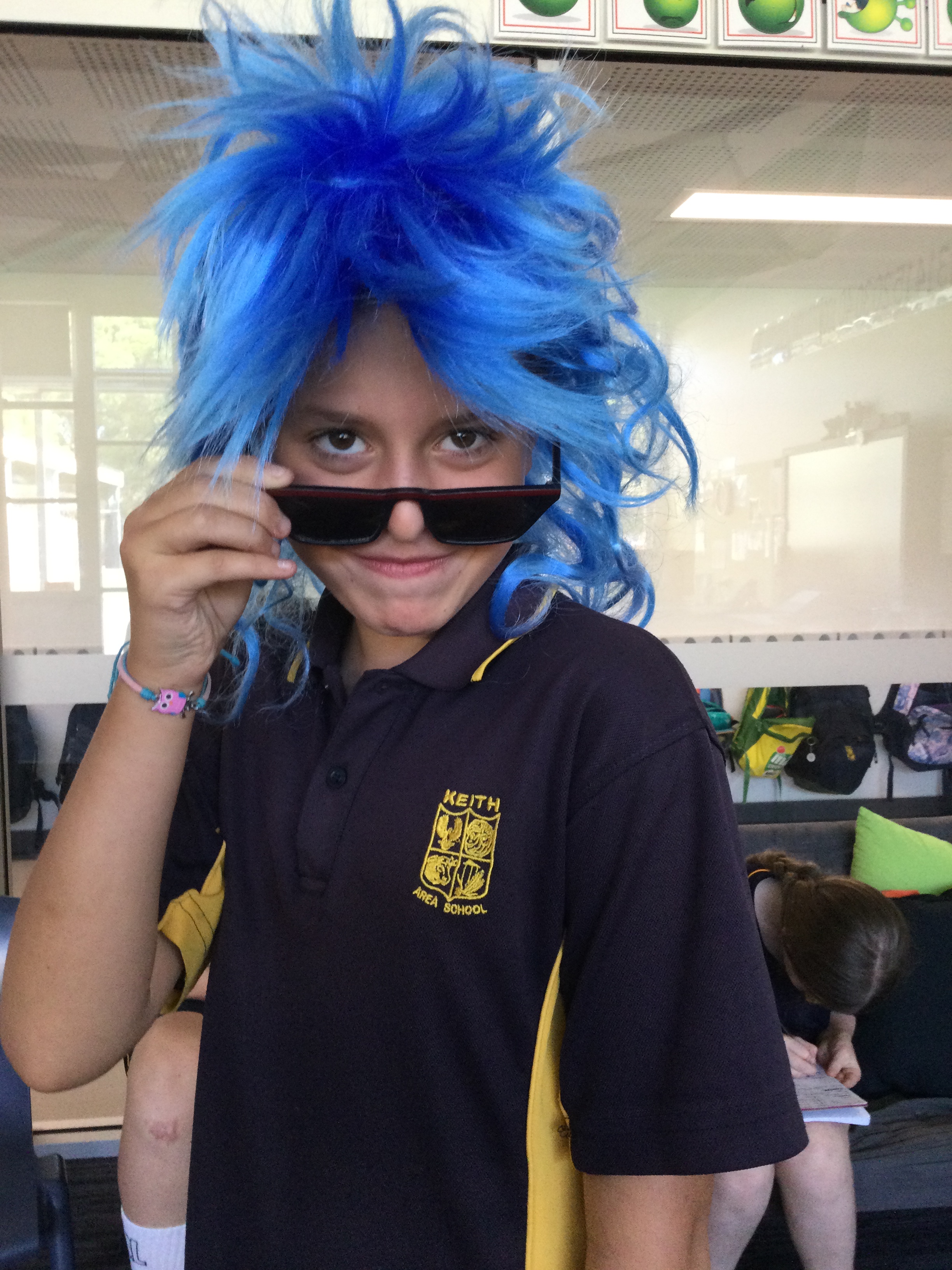
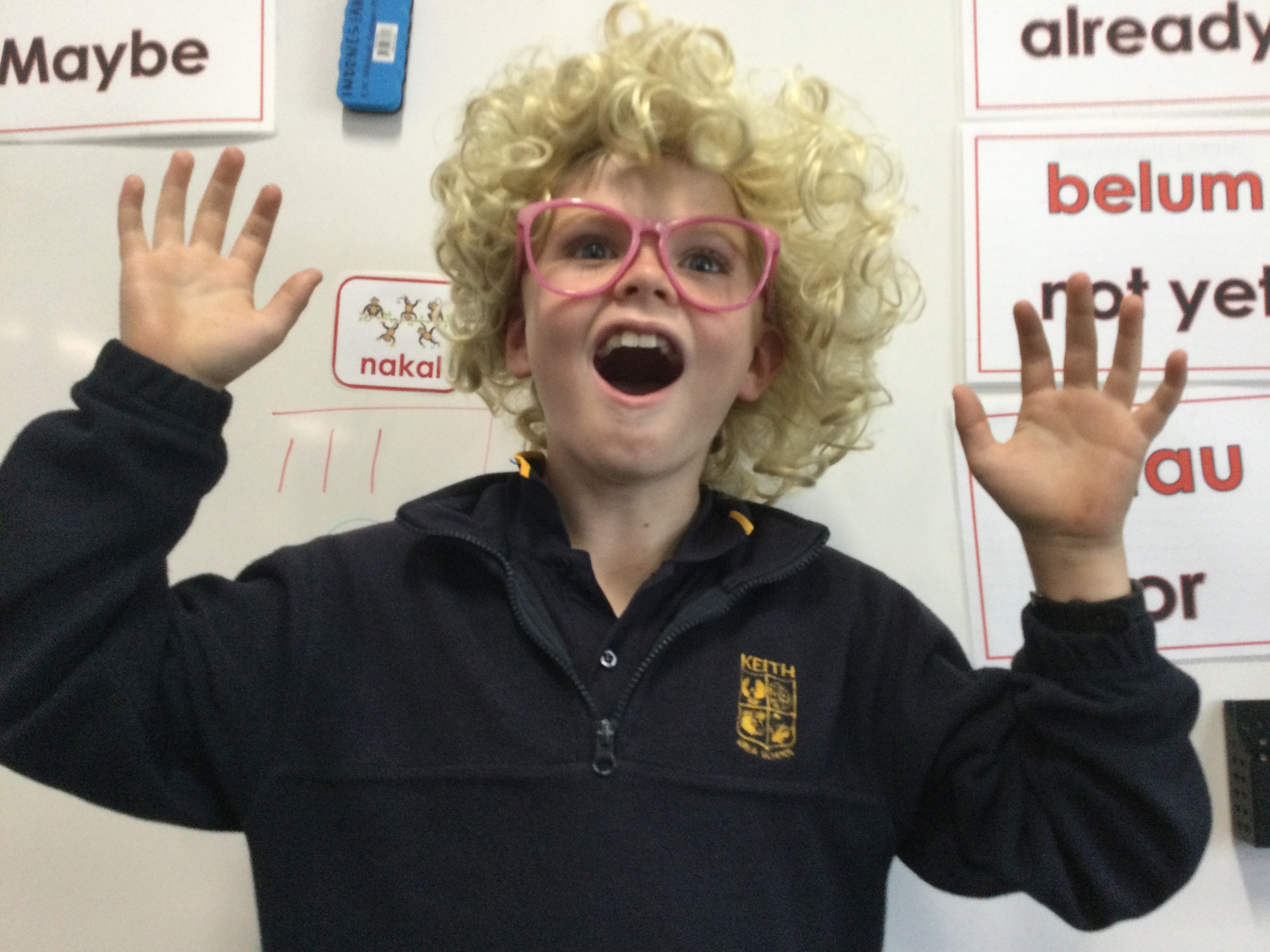
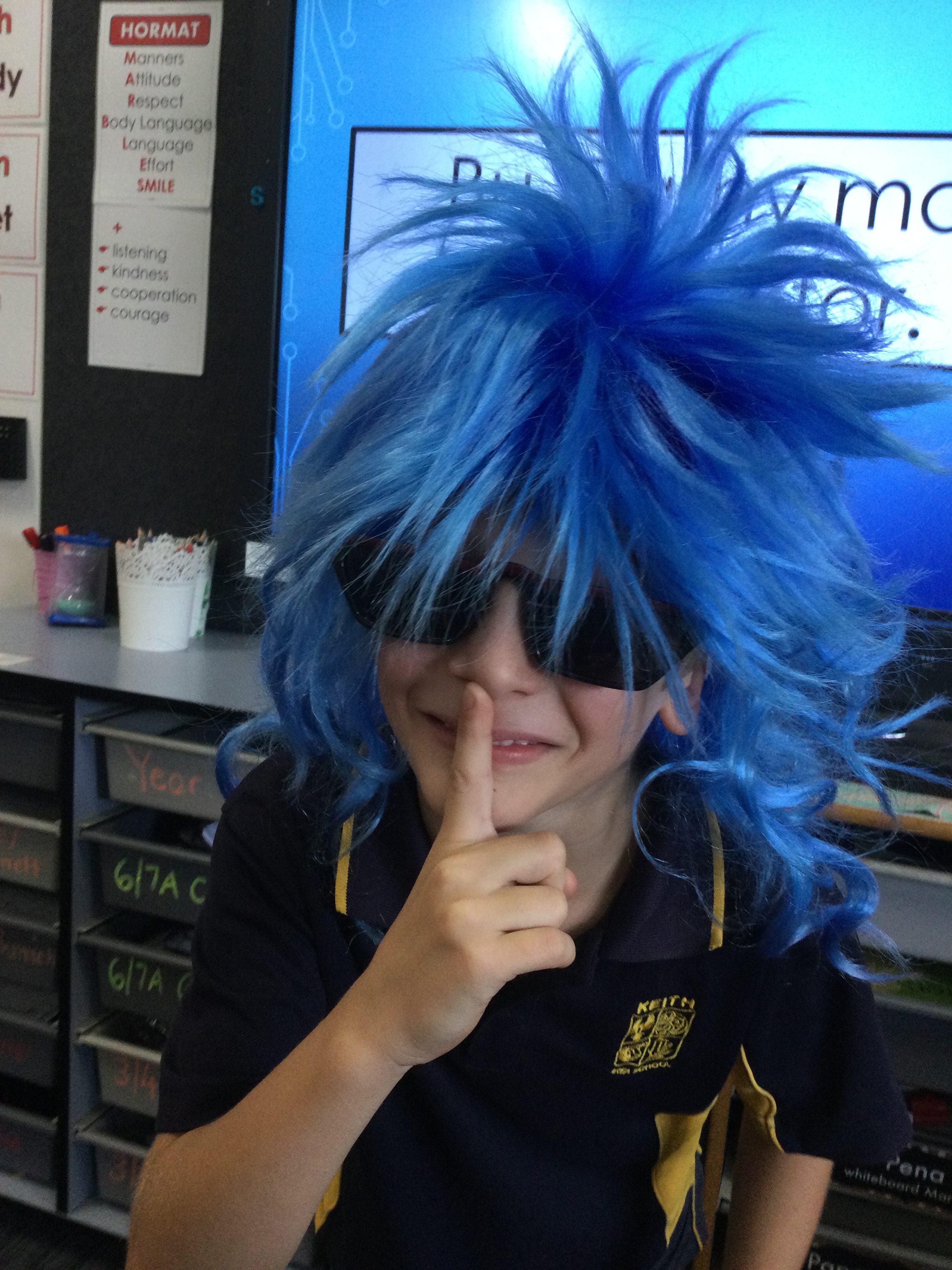
In term 2, the next story middle primary did was the Tutup Pintu story. The students absolutely loved acting with the wigs my daughter gave me. Acting out the story is enjoyable as it not only provides the students with the opportunity to create their own class version but also gives the more outgoing students a chance to be outrageous which is extremely entertaining. In fact, being entertaining is one of my criteria that any student auditioning must demonstrate. Other criteria include following the storyline exactly as it is determined by the class and only speaking when your character has a line. Here are some of my amazing actors:
Year 4/5 Tutup MulutYear 3/4 Tutup MulutYear 2/3 Tutup Mulut
Kursi Luar Biasa
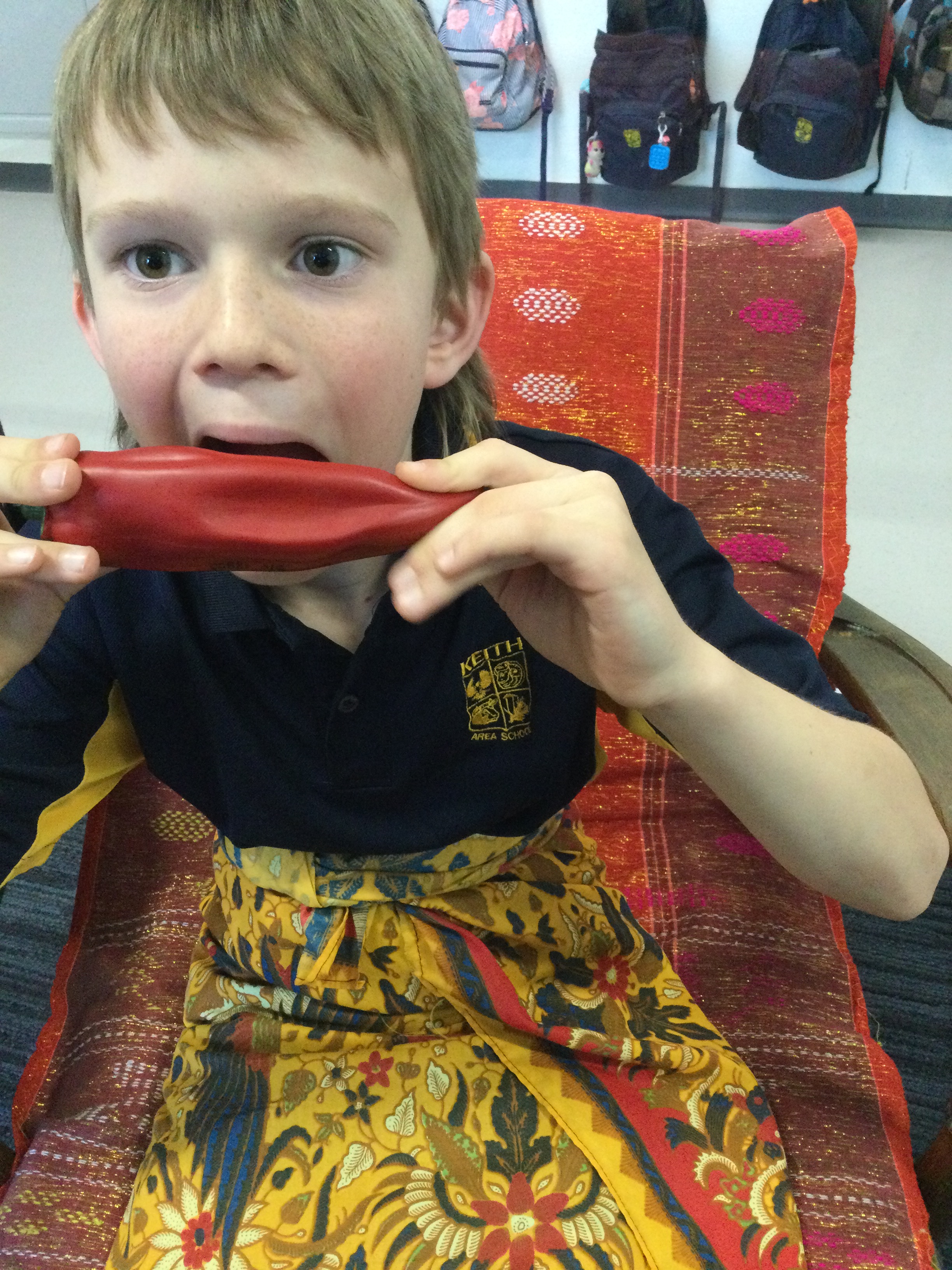
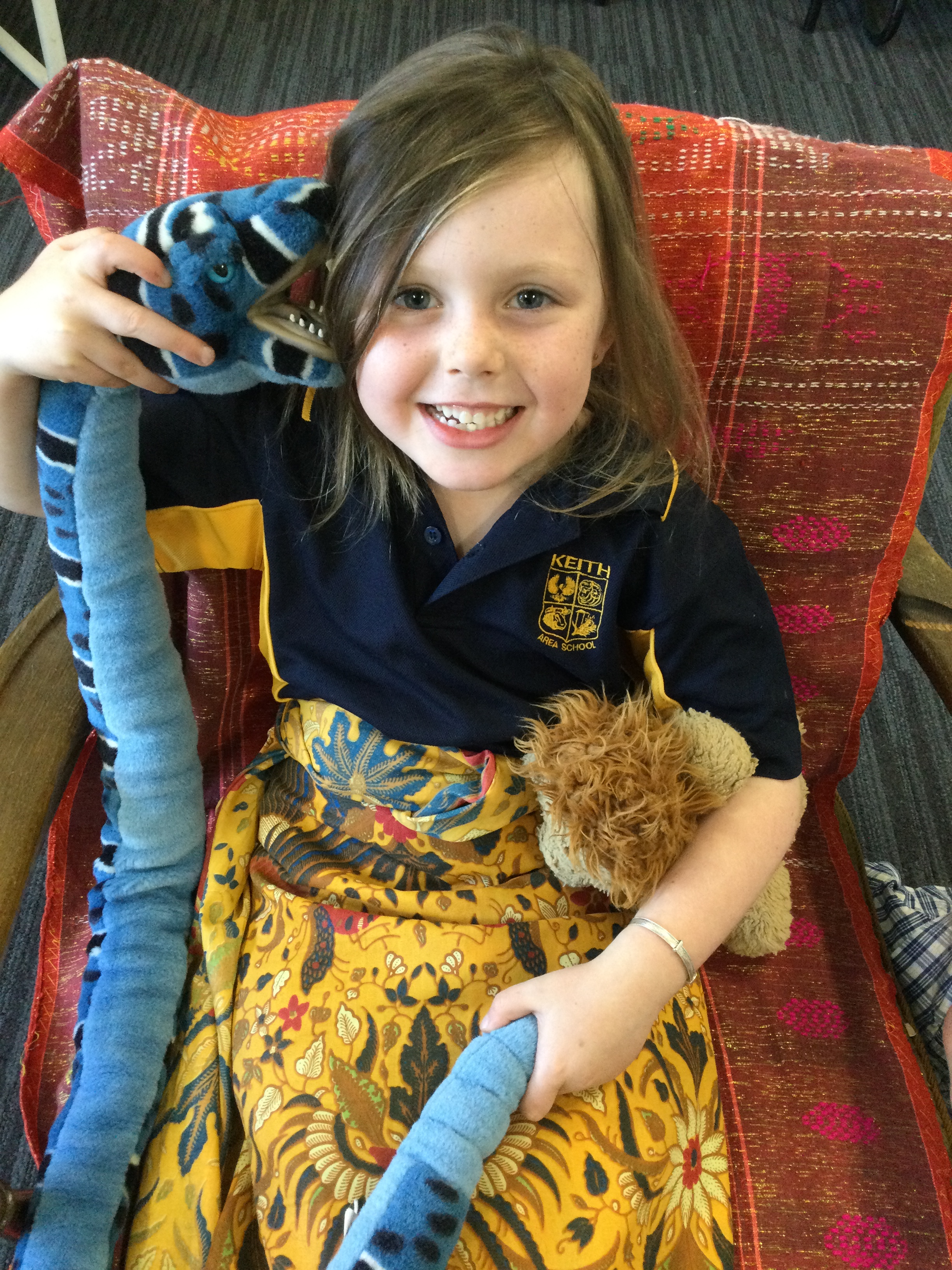
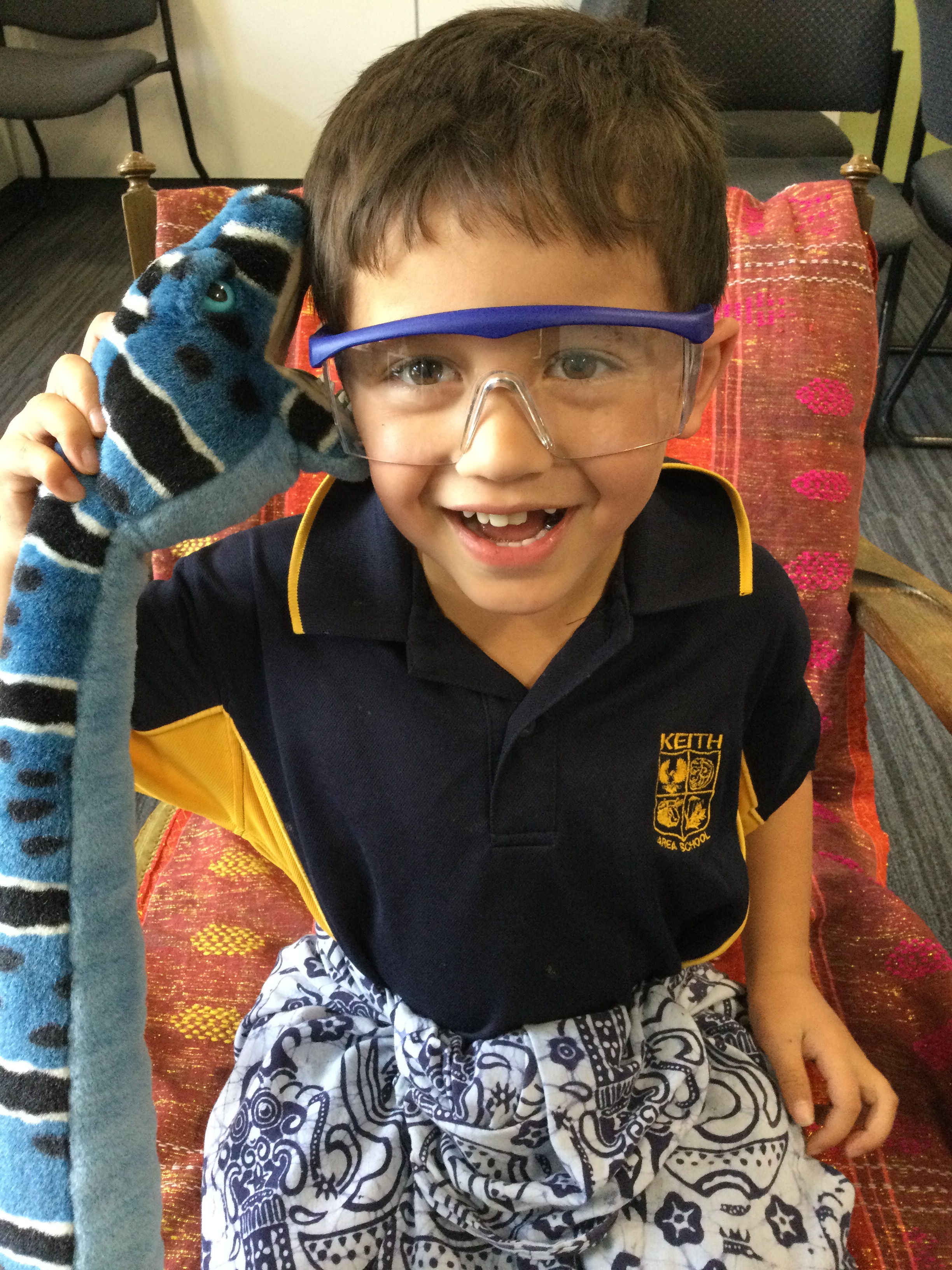
All year levels love KLB! I’ve particularly had success this year with JP classes. It is the perfect vehicle to spotlight one student with quirky questions using target structures. This term they did Catharina’s Ular story, so I enjoyed asking students ‘mau’ sentences incorporating ‘ular’ , ‘atau’ and alternatives based on previous story structures or cognates. I have two snake props, so students could choose between ular besar dan ular cobra! Another question that worked this term was introducing the concept of sarong. This provided discussion about the difference between sarongs for males/females. To begin, I just asked if students , “Mau pakai sarong laki-laki atau sarong perempuan?” After a few weeks, I added the question, “Mau pakai sarong ungu atau sarong kuning?” Great way to limited colours in a meaningful way. I then added the alternative of glasses. “Mau pakai sarong atau kaca mata?” While ‘kaca mata’ is not a cognate, I chose it because not only do I have a selection of different colours but as someone who was embarrassed to wear my glasses at school, I love ways to connect with those students who also wear them!! In the last photo, you’ll notice a Foundation student wearing a sarong and a pair of glasses. He answered my question with, “sarong DAN kaca mata!!” I was thrilled!!
Have you heard of this term? I first heard about it while studying my Masters in Education (shout out to Flinders Uni) and it is a theory that resonates beautifully with TCI/TPRS. The reason this is on my mind at the moment is due to an amazing presentation by David Morkunas that primary staff watched yesterday for PD. Hard to believe that at that point David had taught for almost 4 years!! Loved how he used established education research to underpin his teaching practice. He states that the site he works at “prides itself on delivering evidence-based instruction” (ref: http://pamelasnow.blogspot.com/2020/08/i-now-understand-that-for-many.html). There is no way I was familiar with education research in my third (almost fourth) year of teaching and can only do so now as a result of postgraduate study! While his presentation is aimed at classroom teachers, the underlying message is extremely pertinent for all teachers. It focuses on the understanding that learning is solely about transfering knowledge to long term memory. For language teachers, this sums up our job succinctly. Our students arrive in our classroom with generally zero L2 (the language we teach) and our job becomes linking their prior knowledge (L1), to building up a solid mental representation of the L2 in ways that transfer it to long term memory (acquisition) without overloading working memory. As David states, this can only be done effectively when cognitive overload (overloading working memory) is avoided otherwise there becomes an increased potential for poor student learning outcomes. The most important message of this post!!
David in this video outlines spaced practice, the idea of regular repetition as opposed to cramming, interleave practice, varying the learning topics rather than a single focus, and finally retrieval practice, the practice of retrieving knowledge from long term memory and working with it in working memory. How beautifully does this sum up why TCI is such a successful approach for language learning! David, through Ebbinghaus’ forgetting curve, illustrates how moving knowledge from long term memory to working memory strengthens memory. Look at how the vertical gradient lifts with each repetition!!
During his presentation, I tried to remember (long term memory to working memory: smiley face) how I incoporate the three types of practice within my teaching. Here are some of the strategies I use:
Spaced Memory Limiting target structures is the fundamental key to this step. Once a story has been selected/written, it is VITAL that it is tweaked to ensure it contains no more than three new structures. Wherever possible, replace unfamiliar language with cognates or familiar vocabulary/phrases. More than three new structures and the possibility for cognitive overload increases and the chances for successful knowledge transfer to long term memory decreases. VPQA (visual personalised questions and answers): I love finding quirky pictures that deliver opportunities for circling and personalisation. For example, when introducing the structure topi (hat) for Judy Dubois’ story ‘Jaket Terlalu Besar’ (The too big Jacket), I found hilarious pics on google images of hamburger hats, hotdog hats, donut hats, etc. which worked perfectly for JP Indonesian students as it gave reps on the structure topi through cognates of food items that are easy to personalise using retrieval practice for familiar language (mau, makan {want,eat})!
Mata-mata (spy): The credit for this technique goes to Ibu Sharon Mann. Again like most TCI strategies, we all do them differently (and that’s totally ok) so inevitably my version differs to the way in which Sharon did this years ago when I was observing her. (Side note: I can’t recommend observations highly enough!) On a PowerPoint slide, I write a small number (10 – 12ish) of structures that we’ve covered or are covering. This slide is purely for me. I ask the students to turn around so their back is to the slide and I move so that the class is between me and the slide. Firstly I say each L2 word and accompany it with its gesture and ask students to echo me in L2. Secondly I go through the L2 words one at a time and gesture yet students echo me in L1 with each gesture. Standing next to me are two students whose sole jobs is to watch the class to choose an amazing student to whom they will give a sticker. I can glance up at the slide behind them when I need to. For me, this prompt is essential as I am so forgetful. The words are strategically added during planning as they cover a mini list of words to review; either because they will come up during the lesson or because I’ve noticed that a particular word needs more repetition to strengthen its transfer to student long term memory.
Calling the Roll – I use class dojo to call the roll. First term, this is about establishing routines, vocabulary structures and cultural norms. Gradually I introduce aspects of challenge for older students including class time challenges (who can call the roll the fastest) and by term 4 we are making up hilarious stories about why a student is absent which is then repeated to the student when they next turn up to class!
Interleave Practice This practice also represents exactly how TCI is planned and taught. A TCI language lesson incorporates variety and in no way represents block teaching i.e. a solid focus on just one topic. While our subject is taught in lesson blocks, and the focus may be on a single vocabulary item (particularly in a JP context), lesson practice adapts with the age of our students. For JP students, an up/down approach is essential. This looks like 5 minutes of stationary focus followed by 5 minutes of movement for 5 year olds and increases incrementally for each age group. Movement can take the form of brain breaks, All the World’s a Stage, TPR, singing and dancing. For older students, brain breaks don’t need to last 9/10/11 minutes, a brain burst may all that is needed. Planning a TCI lesson also incorporates a variety of ‘activities’ (not the best choice of word, but hey, it’ll do for now). Rather than plugging away to achieve the set lesson outcomes, TCI lesson plans include a blend of both targeted and focused attention to gain maximum repetitions of the target structures as well as offering students contribution opportunities through long term memory retrieval. The first is definitely teacher led however the latter is student directed following the direction of student input/output. The balance between teacher led ‘activities’ and student directed ‘activities’ is heavily weighted towards the latter. The teachers role here is to model, scaffold, restate (repeat student output correctly in a way that celebrates their contribution) and have fun!
Retrieval Practice Almost everything we do in a TCI classroom incorporates retrieval practice. This is why language learning is so exhausting and needs constant brain breaks for successful learning. It uses a significant amount of brain energy to retrieve knowledge and then to manipulate it in working memory. I highly recommend learning a new language asap if it has been a while for you. My foray into Spanish last year with the wonderful Margarita Perez has made a huge impression on me both as a teacher and a learner. My brain is aching now just thinking about it!! Here are a few ideas from my lessons that enhance retrieval practice:
Kursi Luar Biasa (special person interviews) – Credit for this goes entirely to Bryce Hedstrom. I love how the questions used in KLB offer linguistic and cultural opportunities. The questions facilitate students searching long term memory for acquired structures before manipulating them within working memory to output totally original sentences. Soooo cool.
Calling The Roll – see above
Brain breaks – Love, love, love using brain breaks that require students to listen to simple comprehensible instructions using acquired structures. My favourite go to is satu kaki (one foot). it is simply asking students to stand on one leg and see who can stand for twenty seconds! I then count to twenty in Indonesian and we then celebrate those is still standing. The second time, to ramp up the challenge, students swap legs and for the third time, they close their eyes. The first time this is played, safety rules are given in English to ensure no one is hurt. The last version can have arms waving madly!! Thus there is no wobbling, no hopping, and also a remiinder that it is just a game and if you get bumped, tidak ada masalah (no problem)!
Comprehension Checks – Celebrating those students who comprehended through long term memory retrieval to working memory.
Story Asking – class created stories based on student contributions underpined by comprehension.
Circling – asking yes/no, sudah/belum, either/or questions supporting comprehension through pointing and pausing acknowledges the hard work happening in students’ working memory.
Gestures – establishing gestures with classes, for some students will help prompt their working memory and assist with acquisition. This is a great tool for differentiation.
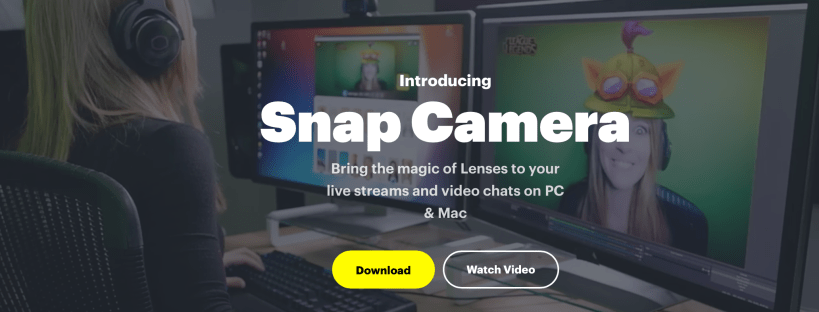
Thanks to Senora Anna (aka Ibu Anne ), I recently discovered the lure of Snap Camera. I absolutely love it. Not only is this a platform that has enormous potential for creating quirky videos and images; it is also the perfect place to visit if you need a laugh. I challenge you to check out a few of the unusual ways you can alter your face and not crack a smile!
I whole heartedly believe in the potential benefits of flipped learning; where student learning continues out of the classroom. Flipped learning offers bonus input for language learners as it can be accessed whenever the learner chooses and in ways that best suits their own learning. For my students, I prefer to create videos and upload them to my YouTube channel for students to watch either with their class teacher or by themselves after school. I like that videos can be stopped, replayed or slowed down by the learners. Videos also give the opportunity for input to be delivered both aurally and visually.
Creating videos is fun but also confronting for me because while I love creating videos, I find it challenging speaking facing into a camera! I understand that for my students, my familiar face and voice lowers their affective filter, however up until discovering Snap Camera, my inner critical voice generally found a reason to avoid this. If you look through my videos, you’ll quickly see that my older videos have me firmly behind the camera!
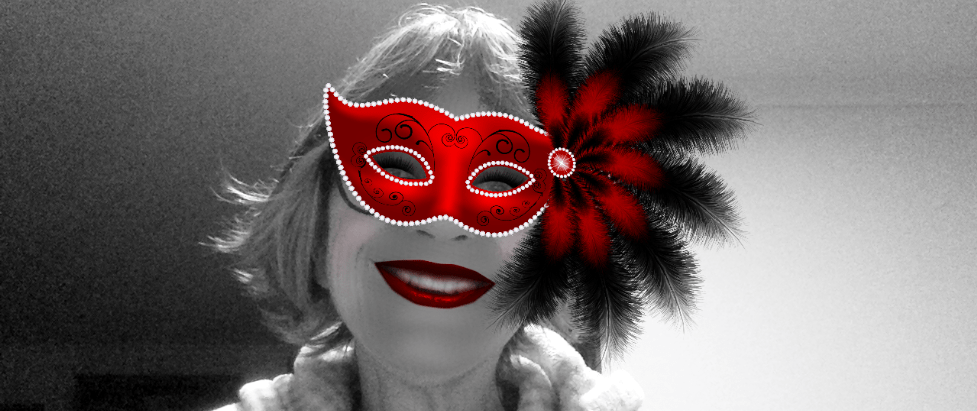
However, Snap Camera is so quirky that being in front of the camera is no longer a major hurdle. How can something so quirky and appealing to learners, not be maximised? Just opening Snap Camera and exploring some of the options will consistently put a smile on your face as it does for me because it is a platform that has many options to ‘enhance’ or totally alter our appearance and/or background. These options range from the sublime to the ridiculous and it is the latter which are the most entertaining.
If I have tempted you to experiment with Snap Camera, the first thing to do is download and install it.
Once installed, either type something into the search bar that could be either easily recognised by your learners &/or is a cognate. I have discovered all sorts of quirky characters ranging from biscuits to Spiderman!
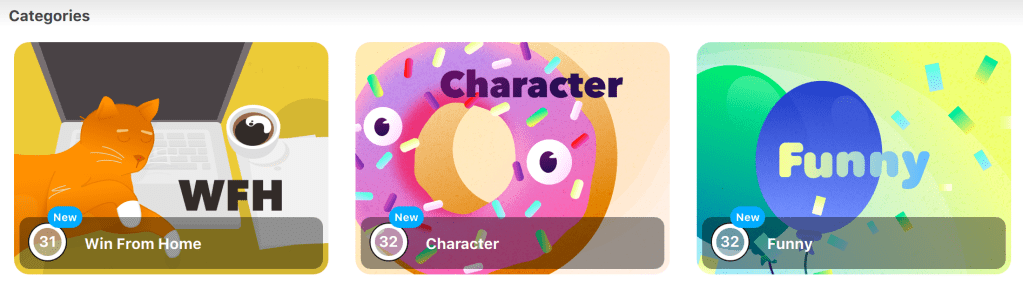
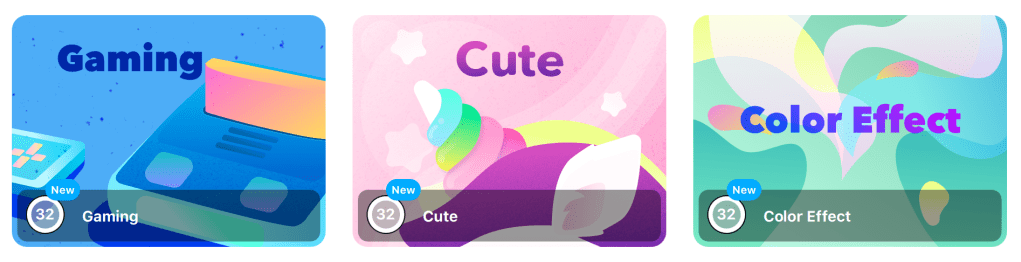
Or choose an option from one of the following categories:
This will certainly put a smile on your dial!
An added bonus is when you have snap camera and Zoom open at the same time, your Snap Camera image will carry through to your Zoom meeting! I’ve gathered from facebook posts that Zoom isn’t the only platform that supports Snap Camera, so experiment with which ever platforms you are using. Share the quirkiness and help distract others momentarily from the craziness of 2020.
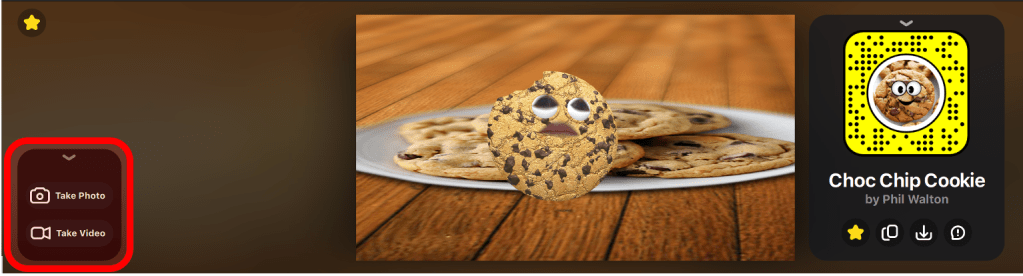
Below are two videos I made recently for my junior primary students. Both target TPR recent structures including melompat (jump), cepat (fast) and pelan (slow). They were recorded directly into Snap Camera which is super easy to access (see red box below).
I really like that you can delete or save immediately after recording as can be seen above.























 Indonesian Teacher Reflections