How to sustain interest with young learners?

I subscribe to the Edutopia newsletter which occasionally has excellent articles. I particularly like any dealing with aspects of memory however this article – Getting (& Keeping) Young learners Attention, caught my eye.

After reading the article, right down the bottom was the option of asking the AI tool to summarise the ideas from the article!!

Below is the edited version of the AI summary so that it targets language teaching specifically:

  1. Visual Hooks: Use video clips, picture walks, and images to capture students’ attention. For example, show a quirky image or a photo taken of a student in a previous lesson and use it for circling & thus repetition of target structures.
  2. Interactive Hooks: Engage students with activities like Kursi Luar Biasa, where a student is invited to sit on the special chair and be deferred to throughout the lesson. The joy of this is immeasurable with egocentric young learners.
  3. Audio Hooks: Incorporate songs, jokes, riddles, or rhymes to make lessons more engaging. Use or adapt song lyrics or nursery rhymes to ensure comprehensibility.
  4. Environmental Hooks: Use props and puppets during lessons. For example, use puppets to tell a story, to speak to & interact with students using repetitions, or to use props to support classroom expectations, for students to demonstrate comprehension (ie asking in the TL, do you want the big hamburger or the small hamburger?) or to ramp up story acting.
  5. Board Messages: interesting inclusion for pre literate students however we will have students with emerging literacy and any opportunity to celebrate this should be grasped with two hands. Instead of messages though, I have consistent behaviour management signs that are always on display in the exact same place & I refer to each when necessary by tapping on it with my finger & saying the word (eg making eye contact with someone doing the right thing, pointing to the pandai sign & saying clearly ‘pandai’) whenever needed. Never fails both as a positive classroom management tool & a way to sneak in repetitions.
  6. Adaptable Hooks: Customize these hooks to suit different grade levels, cohorts, and student groups, ensuring they are relevant and engaging for your specific classroom needs.

Link to original article: https://www.edutopia.org/article/getting-keeping-attention-early-learners

Picture Talk…….


What is a Picture Talk?

In a nutshell, ‘picture talk’ is using an image to maximise repetitions on a target structure.

The success of picture talk relies both on the image itself and the questions asked. A truly compelling image is one that is quirky, and offers opportunities to use the target structure in both statements and questions.

Read to the end to find links to demo videos, blog posts and more…

How To Set Up a Picture Talk?

Picture Talk #1

A picture talk can be simply an image which is shown to students to generate scaffolded and fully comprehensible discussions that either introduce a target structure &/or to get repetitions on the target structure. For preliterate learners, when introducing a target structure, relying on ‘point & pause’ is often not a viable option. Picture Talks are super helpful for overcoming this when working with preliterate learners.

Picture Talk #2

Another successful way to set up a picture talk is to cover the cognate in the image. To what extent, you cover the cognate, will depend on your learners. If the covered cognate is ambiguous, I like to leave a bit of the image showing as a hint. Covering up the cognate opens it up for student contributions which can then be restated as repetitions incorporating the target structure.

Targeting the verb ‘eat’, using the image below of Bluey eating, you could ask…..

1. What is Bluey eating?

2. Bluey is eating………(pause)?

3. Bluey is eating a taco (or substitute with another cognate)?

4. Is Bluey eating a taco or an ice cream?

The number of questions you ask will depend on a million factors including the cohort, the time of day etc. When ready, you simply remove the image and restate the sentence using the target structure!!
Input, input, input for the win!
I do this in PowerPoint as it is so easy to insert and then fade out each shape. Covering the cognate is so popular with young learners and gives them such a huge confidence boost when they guess correctly the hidden cognate.

Picture Talk # 3

Recently I discovered the image below on one of the Bluey Facebook groups for adults! It has so much potential for another way to picture talk!
It would be so easy to create this format using 4 well known characters and 4 cognates that relate easily to the target structure. The cognates (written in the target language) could be true answers, they could be totally unknown or could be focusing on the negative only. With older students, I would encourage the use of the ‘maybe’ (in Indonesian ‘mungkin’) and/or, again depending on the cohort, ‘not possible’ (in Indonesian ‘tidak mungkin) when commenting on the contributions of their peers.


Would love to hear Picture Talk works for you in your context!
Comment below and share your experiences and ideas!!


A huge, huge thank you to Moya for sharing this amazing link (see below)! It contains significantly more detail, links to YouTube demo videos plus so much more.

Enjoy….

Kawai Resources.com

TikTok

I have just finished making my first ever TikTok video and was so surprised how easy it was. Admittedly my first creation is very basic, and already I am keen to explore tips I can use to make the next clips more appealing. If you have any tips, please, please comment below!

The clip is of a song that I may use with my year 4’s this term for the term 2 ‘transportasi’ (transportation) topic. As a text for this topic, I am now torn between 3 possibilities.
Here they are:

  1. Pak Budi naik apa ke Sekolah

Sepeda motor Pak Budi rusak.

“Saya naik apa ke sekolah?” dia berkata.

Pada hari Senin dia naik becak ke sekolah.

Pada hari Selasa dia naik bus ke sekolah.

Pada hari Rabu dia naik delman ke sekolah.

Pada hari Kamis dia naik mobil temannya ke sekolah.

Pada hari Jumat dia naik sepeda ke sekolah.

Pada hari Sabtu dia berjalan kaki ke sekolah

Pada hari Minggu dia memperbaiki sepeda motornya.

Pada hari Senin Pak Budi bisa naik sepeda motornya lagi ke sekolah.

Pak Budi senang sekali.

2. Jangan Naik Skooter di Sekolah (written by Ibu Anne)
Here is the parallel story for her story:

3. Naik, naik ke puncak Gunung (traditional childrens song)

I love this traditional song because of the memories I have of listening to my children learning and singing it with our guides as we climbed Mount Batur when they were only 6 and 8 years old!

Issues I have with many of the YouTube clips for traditional Indonesian childrens songs include:
– animated characters have anglo appearances eg eye shape etc,
– the audio &/or visual can be poor quality,
-the background is often animated and again sadly, does not truly represent beautiful and incredible Indonesia. See the above clip and consider the mountain they are climbing (in a car!!) to your memories from Indonesia. How cool would it be if they were actually climbing a volcano!! IKR

Which all explains why I decided to google how to make a TikTok video and found this:

@ugc_vasudha

Here’s how to sync up your videos with any TikTok trending sounds. This is a how to/tutorial on how to create your UGC videos. #ugctutorial#ugcvideoexample#ugchowtogetstarted#ugchowtogetstarted#tiktokeditor#howtoeditvideos#howtoedittiktokvideos#boysaliar#exampleugc

♬ original sound – Vasudha | UGC Creator

So using her instructions, here is my first ever TikTok clip:

All tips and suggestions warmly accepted!!

Please comment below!!


What Makes A Perfect CI Story?

A perfect CI story has several critical features:

  1. Based mostly on target language that your students already know and understand.
  2. Only includes 2-3 unfamiliar words which become the target structures.
  3. Incorporates repetitions of the target structures.
  4. Has a quirky & unexpected ending.
  5. Characters are ones your students recognise – either one they love e.g. SpongeBob, or ones they detest e.g. Elsa (Frozen).
  6. Settings are well known places from their local area e.g. MacDonalds, Sydney Opera House, Horseshoe Bay. Don’t translate places; Proper names are the same regardless of the language.
  7. Incorporates cognates. This will depend firstly on your target language, secondly on your story and importantly, thirdly on your student’s prior knowledge. e.g. durian is not a food that my students would recognise whereas stroberi (strawberry) is instantly recognisable.)
  8. The story length is appropriate for the age of the students. This is critical for maintaining engagement during the student acting and to cater for their reading levels when reading the story.
  9. Incorporates high frequency vocabulary.

The reasons these are critical for a great story is that it ensures our stories cater for:

To ignore any of the 8 features, will inevitably disadvantage your students. I’ve discovered it’s better to start too simple and then while co-creating with students, add any known language that students contribute and add it to the both the current version and the parallel story.

‘Scope And Sequence Stories’ page (link).

For examples of great stories, check out the list of stories by clicking on the link above. When looking at these or other people’s stories, adapt the language for your students. It is important you only use them exactly as they are if it suits your context. There is no single way to use CI as we all have unique students, unique school expectations and unique teaching styles. When sharing stories based on any of the stories listed, always credit the original author!

Note
I firstly apologise that the stories listed in the Scope And Sequence are mostly only available in Indonesian.  I am slowly translating them into English! If there is one that has potential and Google translate isn’t helping, please get in contact and I will happily translate that story for you!

Wow! The CI Down Under Conference was Truly Amazing.

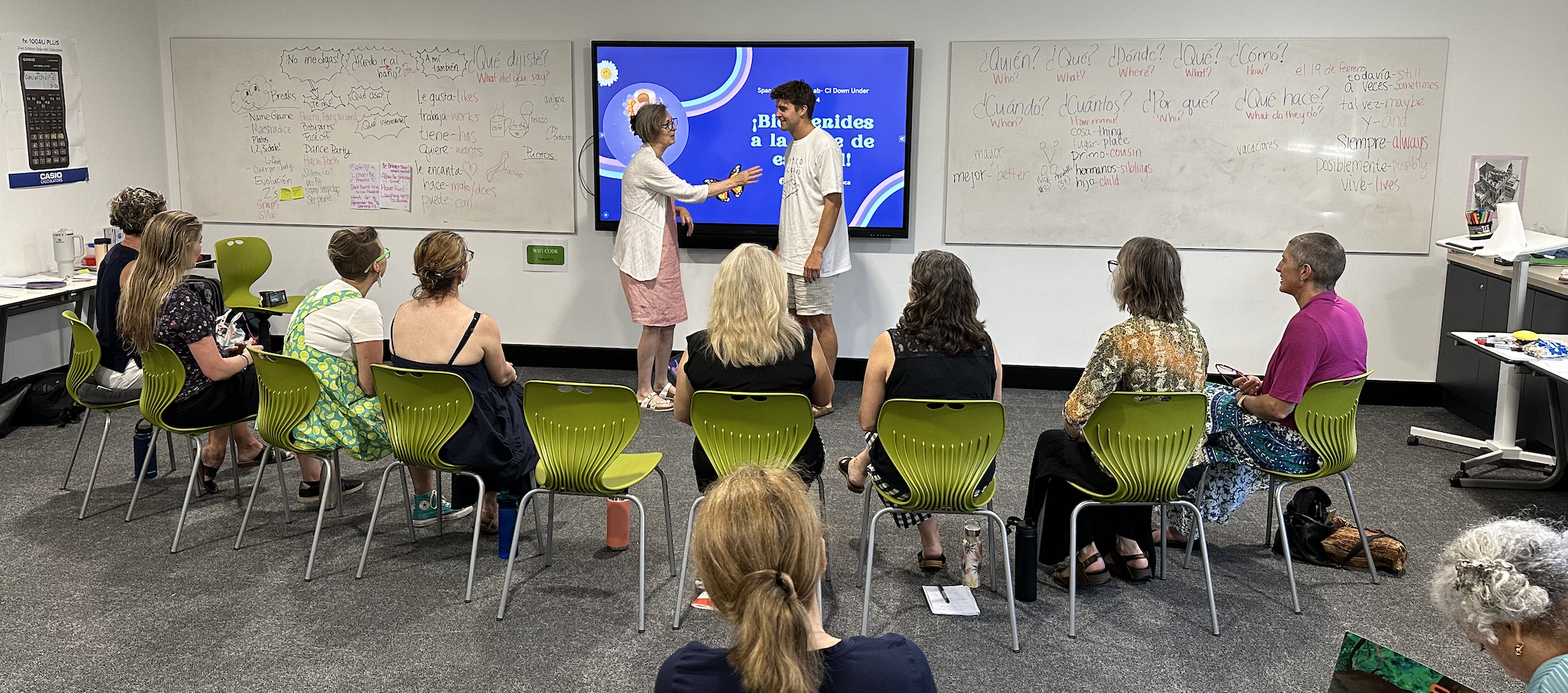
It exceeded all of my expectations!! I hardly know where to start to share a few reflections, so let me . firstly start with with Diane Neubauer and Annabelle Williamson (La Maestra Loca), who had us all in absolute awe of their amazing CI teaching skills and their unflagging positivity. Diane and Annabelle both had a profound impact on the learners and observers in the labs.

Here is a comment shared by an attendee after dropping in on a language lab with Diane:

In a 90 minute lesson, I experienced moving from hearing at first only incomprehensible noise, before reaching sufficient comprehension towards the second half of the lesson where without realising it, I had pulled out my phone, following the instruction Diane had given to her students , and was googling where in Australia you can find pandas! I couldn’t believe it!

Secondly, I cannot go any further without thanking both Teri Wiechart and Margarita Pérez Garcia from the bottom of my heart. Both not only presented workshops (Teri in particular was superb – she delivered a truly amazing introduction to CI workshop after only a few days’ notice), they both also offered coaching and/or teaching support to anyone keen to dig deep and teach a new CI skill to ‘learners’.  If you would like more information on the Coaches for Coaching course Teri runs, please comment below and I will put you in touch with Teri. I have done it twice and highly recommend it for anyone working in a leadership role in a language faculty.

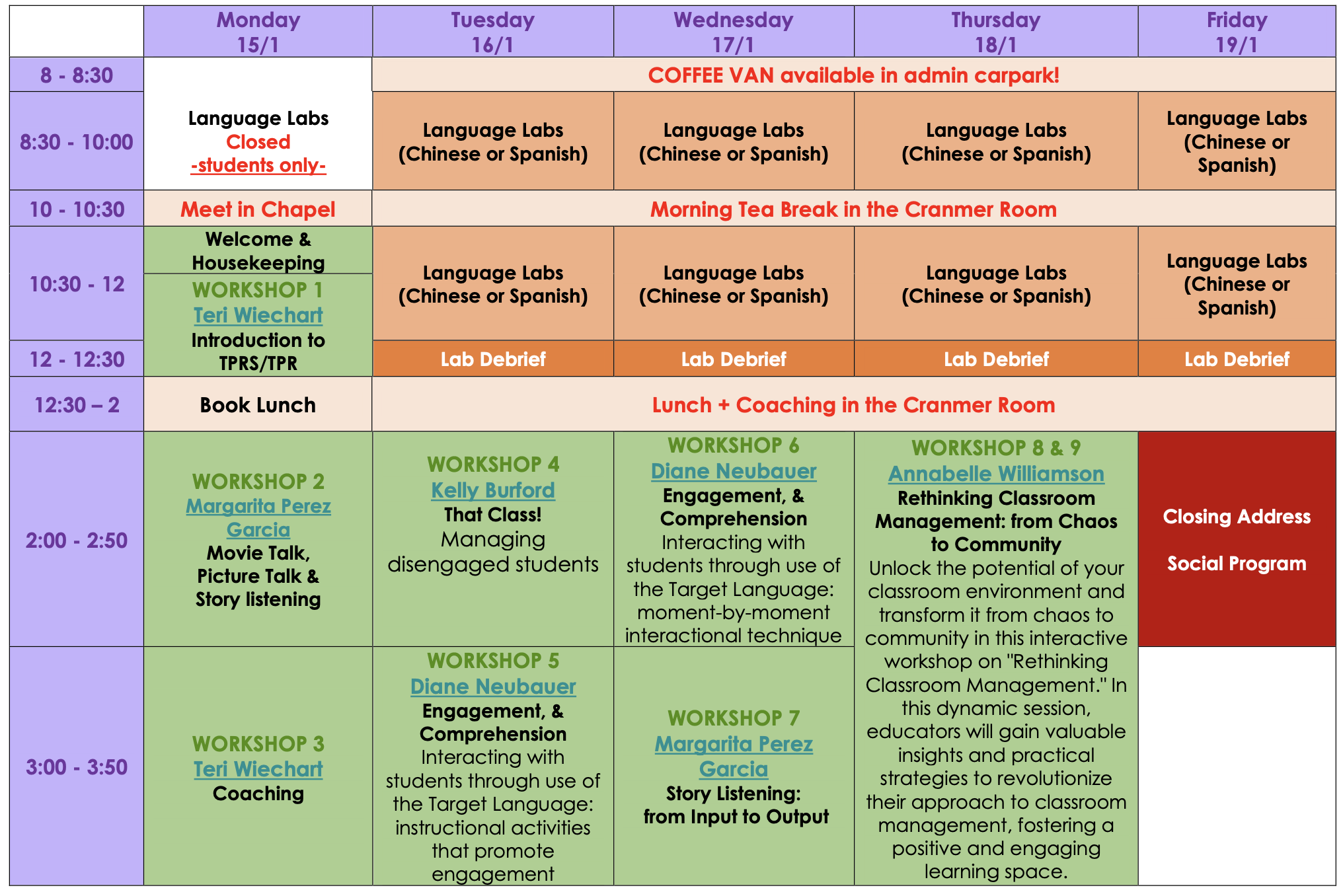
As you can see from the conference prgram, the day was largely split into two sections. The 3 hour morning session was broken into 2 language labs, a break and then finished with the language lab debrief. The afternoon began with a 90 minute lunch/ coaching and finished with two workshops.

To my knowledge, this conference was the first ever in Australia to include language labs. The first language lab I attended was in Agen, France as a learner with Daniel Dubois in his Breton language lab. The second time I had the opportunity to go to language labs again was at iFLT18 in Cincinatti, Ohio. Here, I observed several labs with various teachers teaching a variety of languages ranging from Russian to Latin. It was memorable observing legendary teachers in action after many years of purely reading about them from afar. While I observed several labs over this week, only one made a deep and lasting impression. Read all about it here!!  

Language Labs are significantly better (in my opnion) than workshops for learning how to improve your teaching practise. Instead of someone presenting a workshop explainingstep by step hot to do a skill using PowerPoint, in a language lab, you can either experience learning the skill as a learner or watch it being taught as an observer. Often, explanations leaves out an important detail, yet when you have the chance to see a skill or activity being explained to a class of learners, the instructions are considerably clearer. Thus, after observing 12 hours of language labs, the skills, ideas and learning we attendees experienced far exceeded that which would have been covered through12 hours of individually presented workshops. Observing language teaching with real learners is the most complete way for us language teachers to improve our practice. Language labs also provide teachers with the opportunity to hear from the learners, a rare yet valuable aspect. After the second lab each day, a debrief is held. During this half hour, both learners and observers can reflect and share their experiences or interact with the teacher to either ask questions or comment. Annabelle wrote notes with hyperlinks during the debriefs which she shared with all attendees. WooHoo!

  1. Classroom Jobs
    Instead of making a big deal out of assigning jobs as I used to do, I am imitating Annabelle’s style and assigning the jobs as I need them and choosing someone intentionally rather than randomly through class dojo. It gives me such joy watching my students face when I match them with a job. This is also a much quicker process, which with only one lesson per week, is an added bonus. So far, I have a door closer, a time keeper (my new classroom clock randomly stops, so I asked a student to give me a heads up when we had 10 mins left of the lesson). The job I can’t wait to assign is the clicker person. This person will be responsible for keeping an eye out for where I put the clicker down. When I ask, “Dimana kliker” (Where is the clicker), they will remain seated, and point to my laser pointer saying either ‘disini’ (here) or ‘disana (there). This job is pure genius.
  2. Turn and Talk
    This is the perfect comprehension check or brain burst (mini brain break) and was amazing introducing it during week one. After I explained what students do when they hear me say ‘diskusi’ (discuss) + see my fingers doing crab claws, (insert the ASL crab claw) pic I said to the class twice, “Bu Cathy mau satu stick”. I paused and then did crab claws while repeating diskusi + Bu Cathy mau satu stick very slowly several times. After a few seconds, I next said someone’s name, followed by saying ‘Bahasa Inggris?’ (English?) and then the Indonesian sentence again. Like this, “Lyla, Bahasa Inggris ya? Bahasa Inggris. Bu Cathy mau satu stick. Lyla then translated it into English, Bu Cathy wants a stick. What a fabulous way to hold comprehension checks on familiar structures after a long holiday break.
  3. The name game (add link) Tried this brain break with my year three students and they loved it. For week one, I had the whole class playing in one group, but now that they know how it runs, I will break them into smaller groups next week which will definitely increase engagement even more!!

Brain Breaks With La Masestra Loca @ CI Down Under

During the recent January CI Down Under ’24, I will be forever grateful to Ibu/ Senora Anne for convincing me to be a learner in Annabelle’s spanish language lab. It was an INCREDIBLE experience!

As I now plan for the week 1 lessons for my students, I have reached a point where I need to add a brain break. Looking at the photos of the complete list of Annabelle’s brain breaks uploaded to the conference facebook page by Lily & Prue, it quickly became clear that I couldn’t remember how many of them ran. So while waiting for help with two (silencio & snaps), here they are with instructions, mostly taken either from Annabelle’s blog, La Maestra Loca or her YouTube channel, also conveniently called La Maestra Loca!

I have firstly added a link to her very first brain break post, which explains the why and the how as well as adding a few bonus brain breaks!

Here they are in the order they appeared on the board…


2024 CI Down Under Conference – Sydney

Are you interested in learning more about TCI or TPRS?

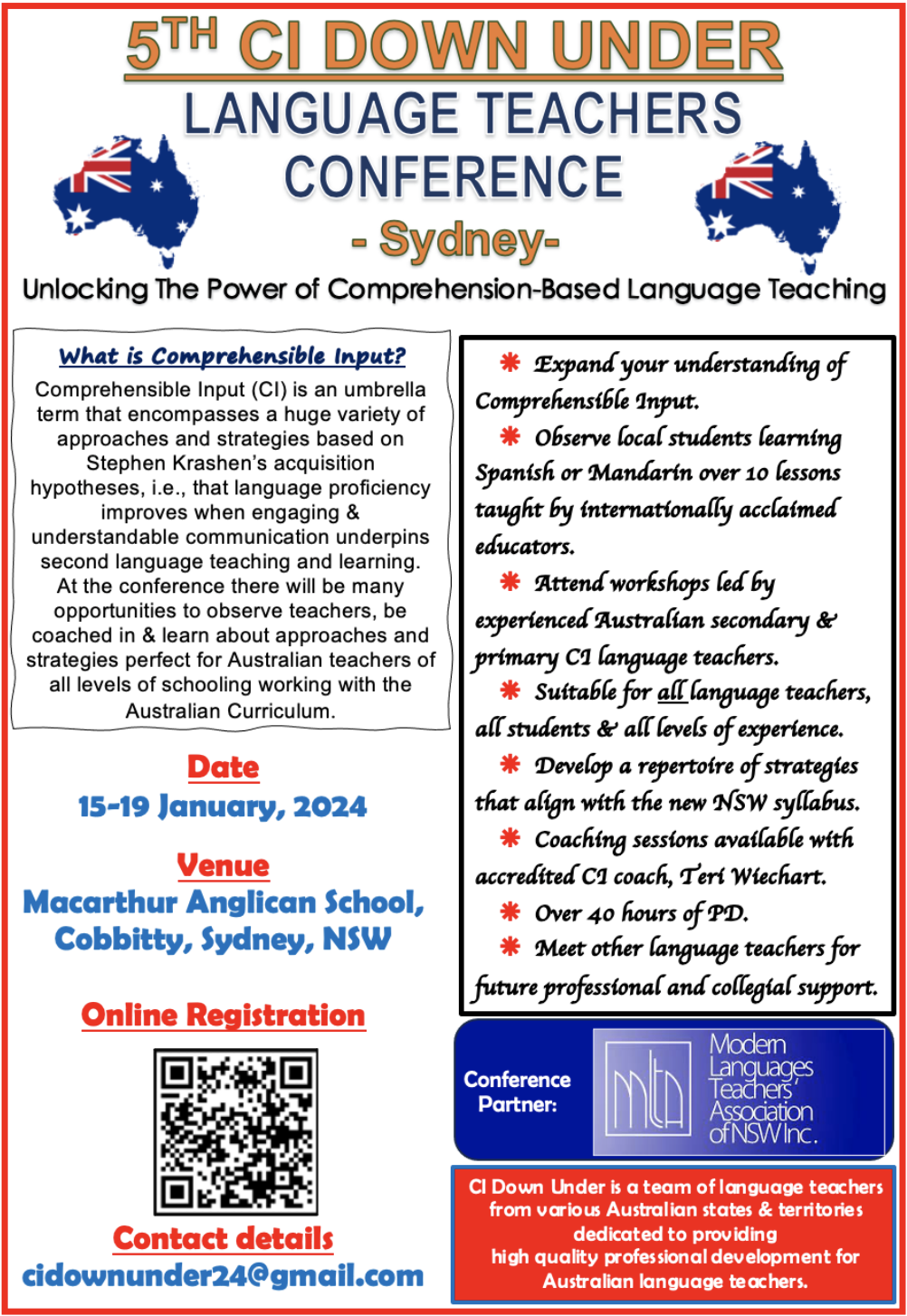
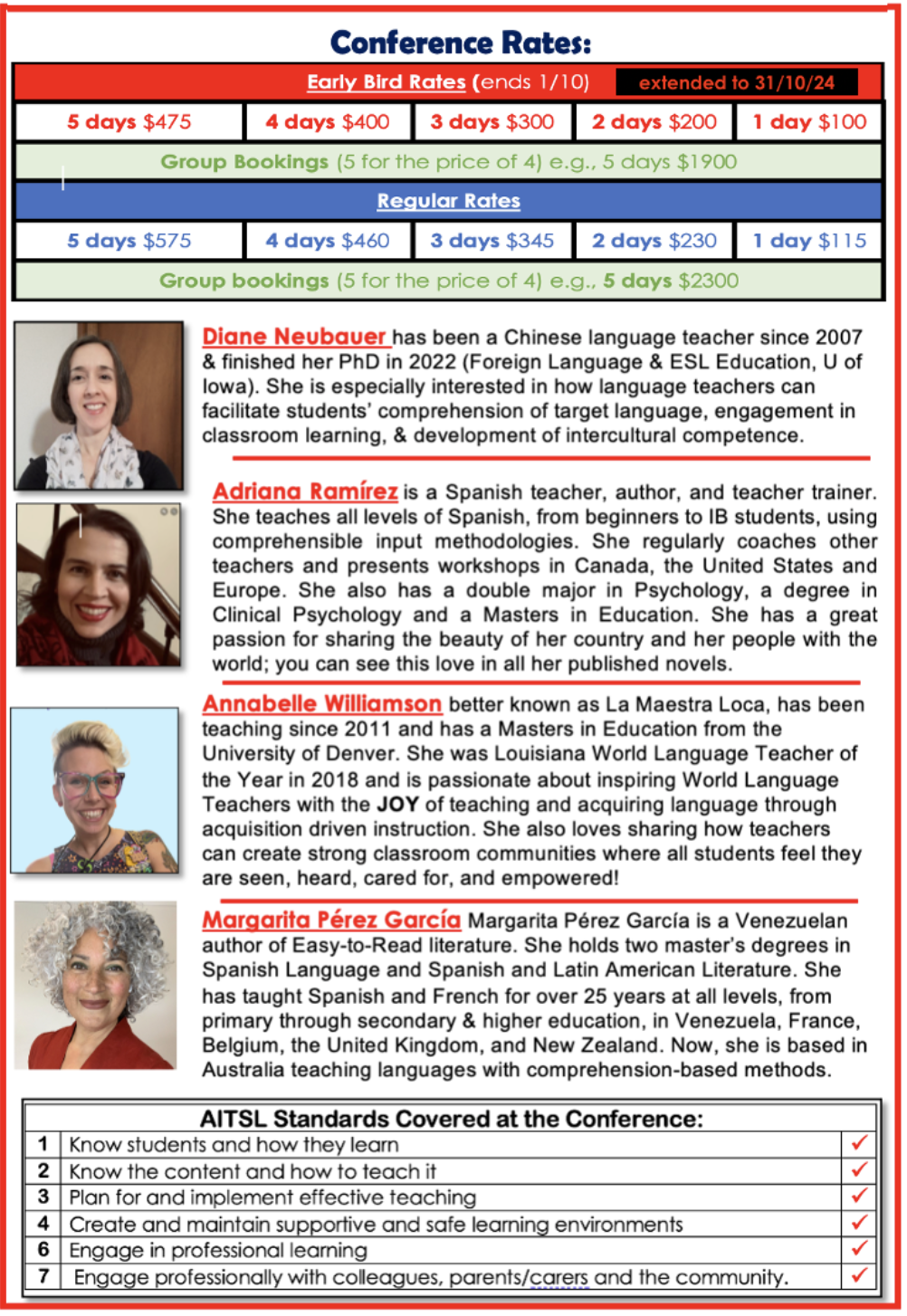
Come to the 5 day conference next January and not only learn about it but also observe it in action. Three highly experienced language teachers will be demonstrating a range of comprehensible input strategies teaching mostly beginners either Spanish or Mandarin. There is nothing more powerful than observing a teacher working with a genuine beginners class for consecutive lessons. You can choose to observe strategies addressing every aspect of language teaching with either primary or secondary students.

For further details, contact the committee using the email on the flyer.

Be quick!! Early bird registration ends in 10 days!!

The Unfair Game

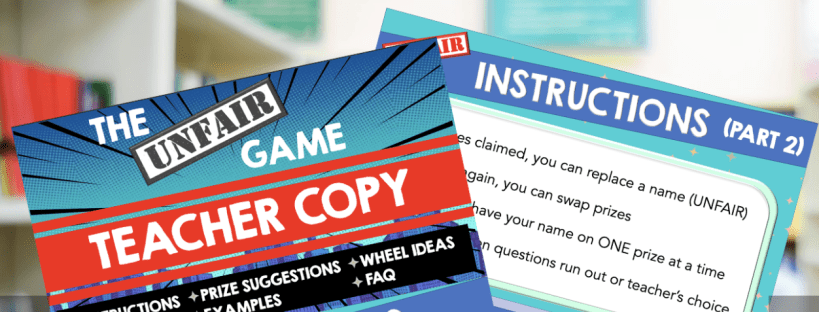
Going through my overflowing inbox, I discovered an email from Kenny’s Classroom with information about the Unfair Game. If you follow the link, you will be find details on how to access free instructions and an editable template. The reason I am sharing this with you is because I have tried this several times with little success and now I realise why.

The secret is the whacky prize pool. I had no idea just how important this is until I reflected upon why the Unfair Game went so spectacularly badly with a previous year 8 class. I set the students up in teams who then had to compete for points. Unfortunately this over competitive cohort totally burned me so badly I moved the powerpoint to a folder on my hard drive, with no intention of ever opening it again. Now after reading these instructions, I can see where I went wrong…..

Students love the unexpected! What teenager wouldn’t get a kick out of quirky prizes!! Have a look at these suggestions:

Genius isn’t it? This would work with all levels; from junior primary to secondary! It just might be the perfect activity for an end of term activity full of sneaky repetitions, a relief day or just because!!

Brain Break – So Much Potential!

I found this YouTube clip during the holidays:

Marina menari di menara (Marina dances in the tower) or in other words – the perfect way to have fun with word order incorporating target structures while standing, singing and doing the actions for each word.

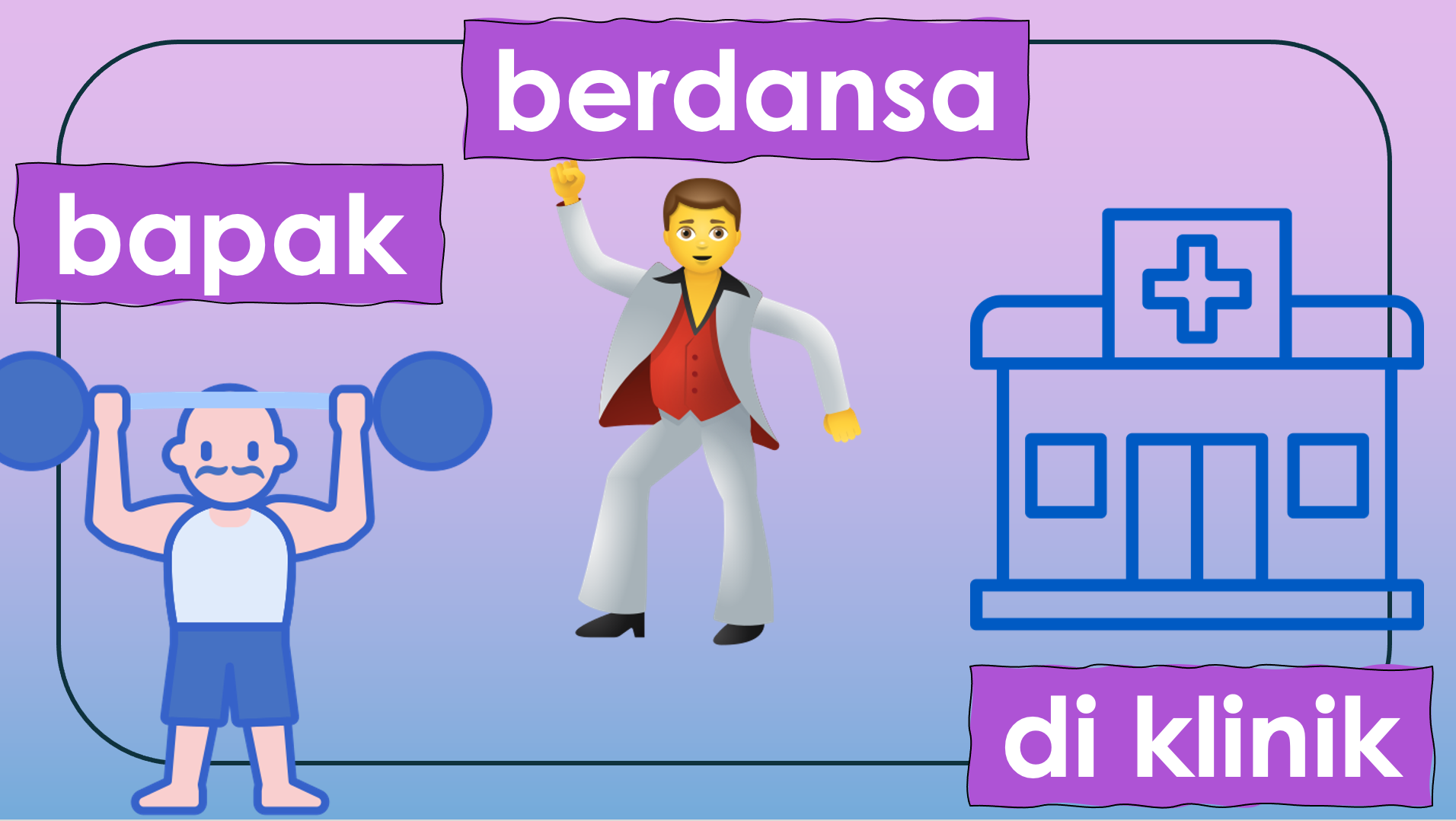
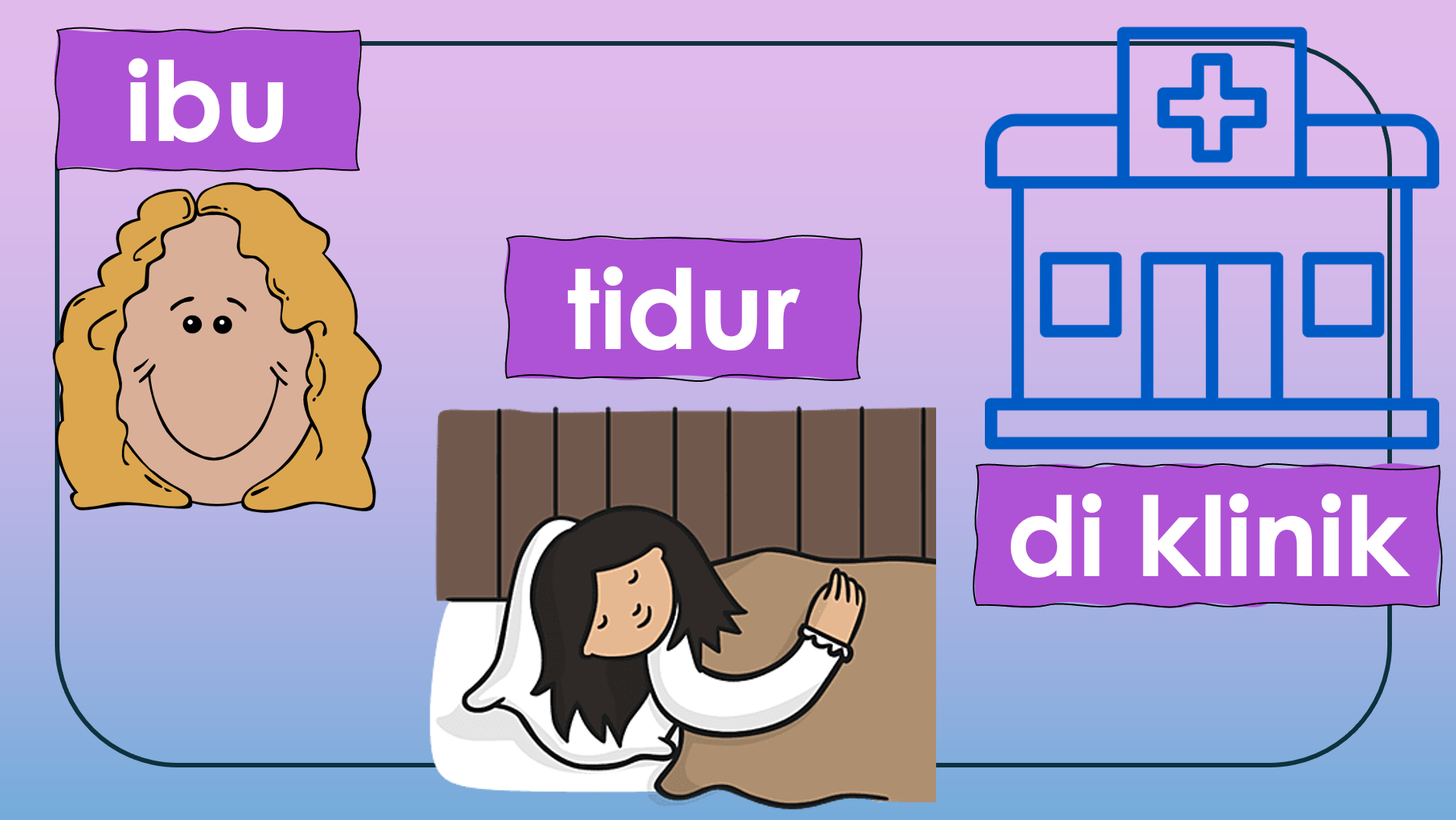
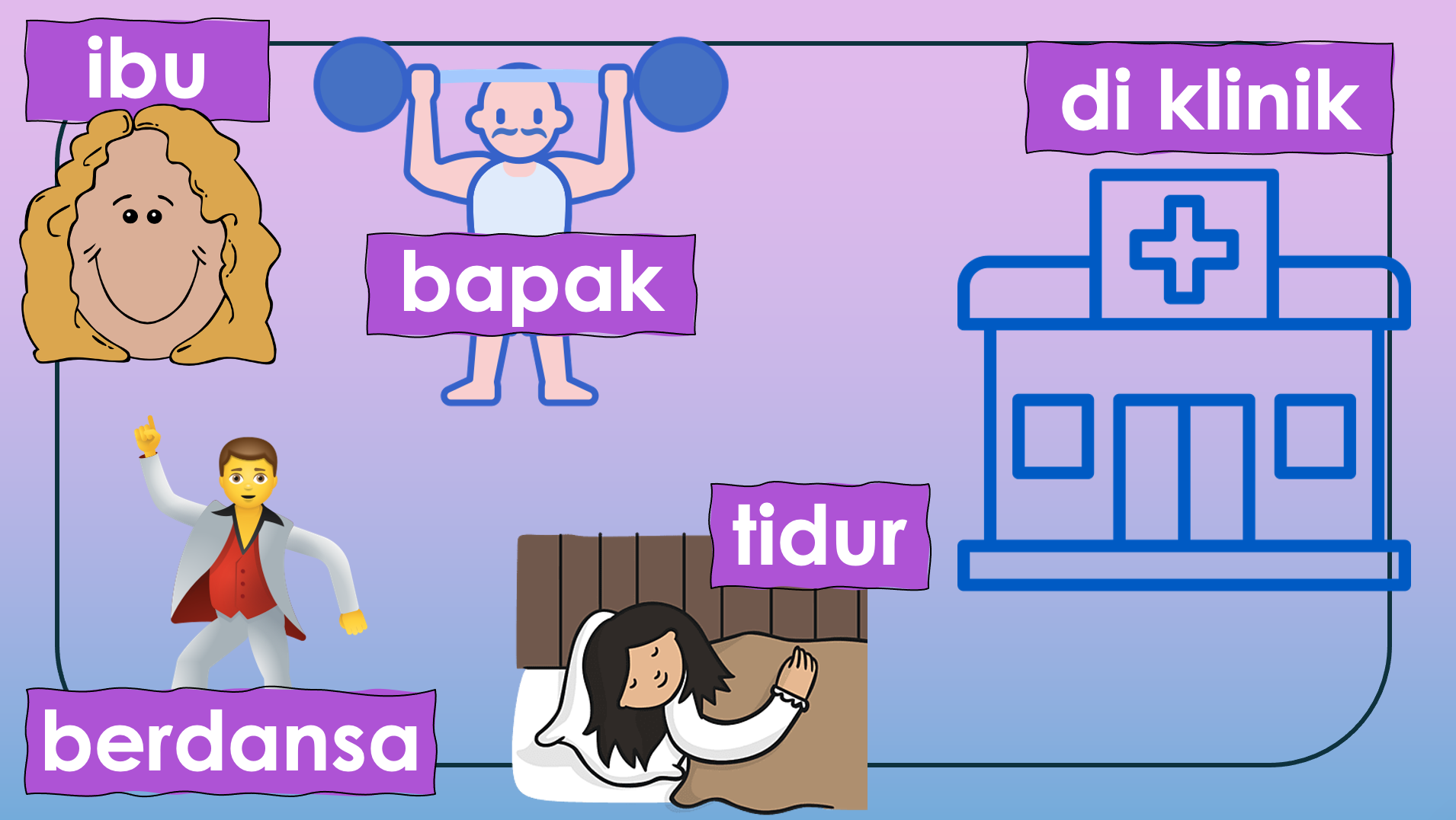
This term my year 2 target structures include immediate family vocabulary (ibu, bapak, adik, kakak) and tidur (sleep). Thus this brain break lends itself perfectly to getting reps on all. The tune reminds me of ‘She’ll be coming round the mountain.” When creating your own, I highly recommend including a cognate in the phrase. For my context, my year 2 students are familiar with ‘klinic’ and the idea of their parents do these actions in the clinic, will hopefully add a level of quirkiness! However, you may need to get reps on a place, so your cognate could then be either the who or the what.

This week, I hope my year 2’s have fun with this brain break using the following lyrics and slides.

Slide 1

Bapak berdansa di klinic
Bapak berdansa, bapak berdansa,
Bapak berdansa di klinic.

Slide 2

Ibu tidur di klinik
Ibu tidur di klinik
Ibu tidur, ibu tidur,
Ibu tidur di klinik

Slide 3
The final slide will be where I will mix it up, pointing to the images as I say them!
For example, Bapak tidur di klinik or Ibu berdansa di klinic.

The levels of challenge you could add to this are endless. Once my students are familiar with the brain break, I will play with the word order.
eg
ibu tidur di klinik,
di klinik ibu tidur,
ibu tidur, ibu tidur,
ibu tidur di klinik.

Enjoy!

Call and Response Collection..

No matter what the age of your students, call and response are awesome for getting the whole class to stop and listen!

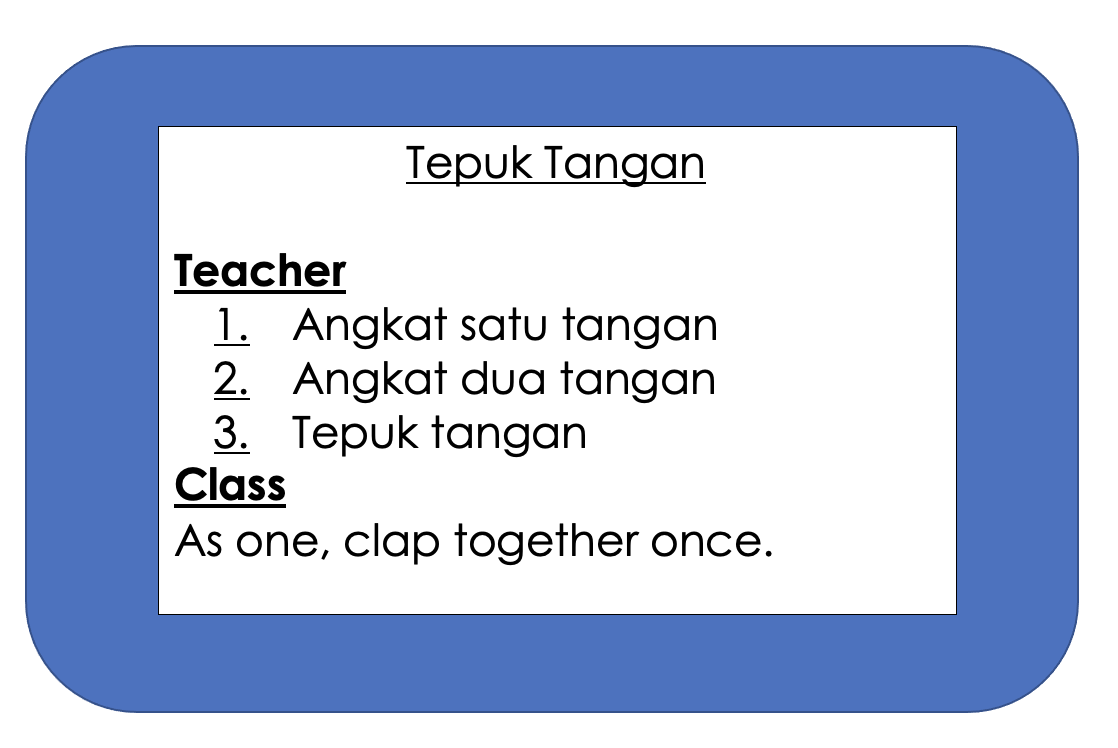
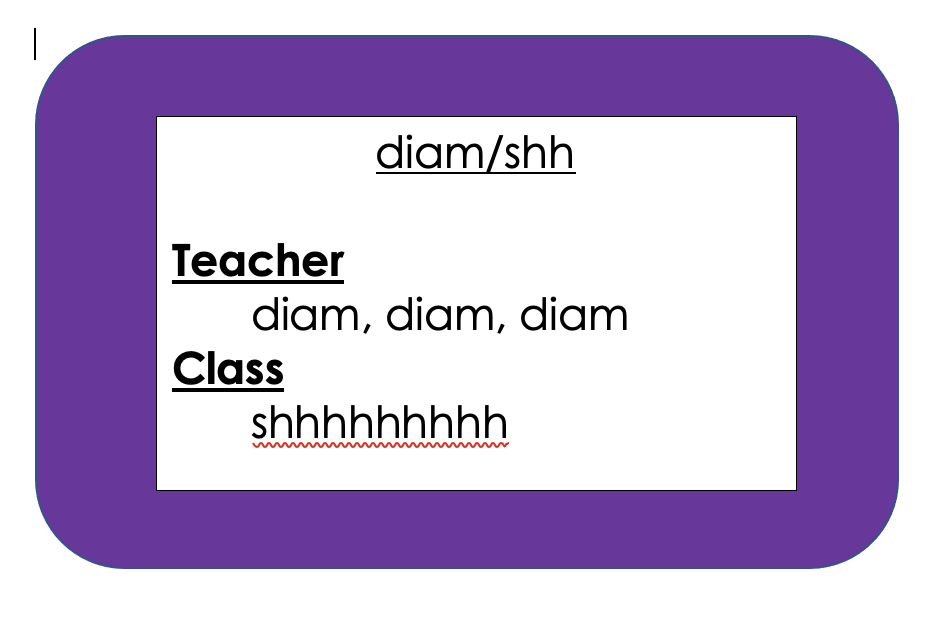
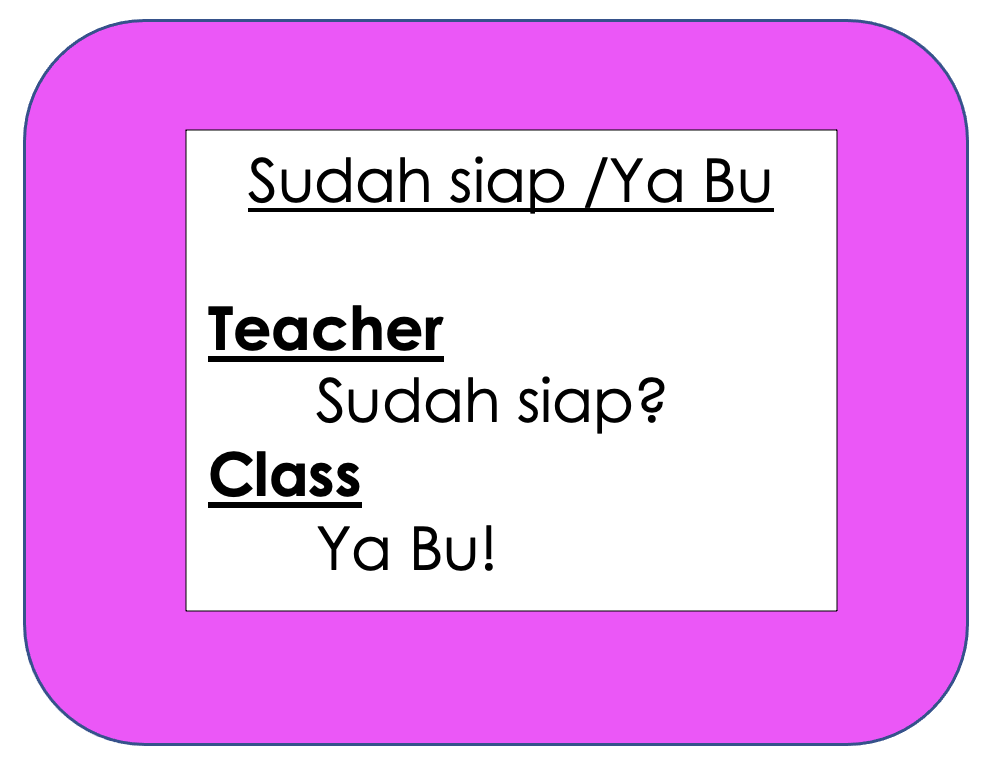
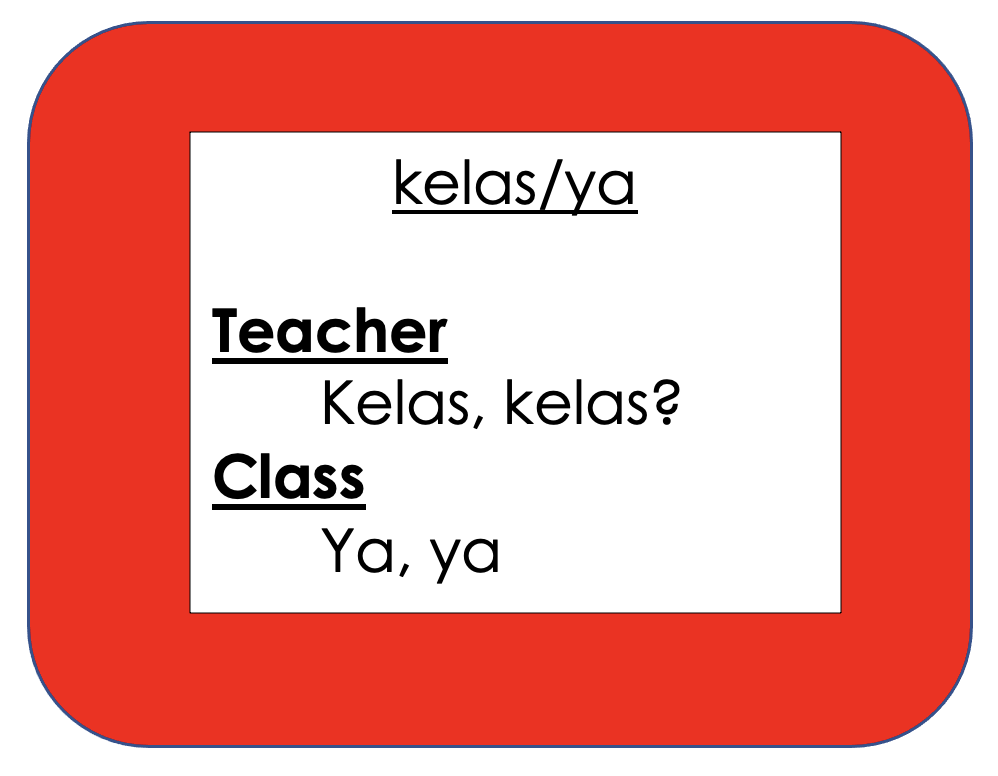
They work like this: the teacher says a word or phrase and upon hearing it the class choruses a response and then magically look towards the teacher ready for an instruction. With brand new classes, I don’t introduce a call and response until all other behaviour management systems are working smoothly. Until then, I use the 1, 2, 3 song (taught in lesson 1) and sing until all students are singing with me.

The first call and response I usually introduce is the following:

When saying it, I pause between lines to make sure all students are keeping up with the instructions. If it is noisy, I will go through it once to get everyone attention and then repeat it. With very young learners, I modify the instructions by removing the word ‘angkat’ so that it becomes: satu tangan, dua tangan, tepuk tangan.

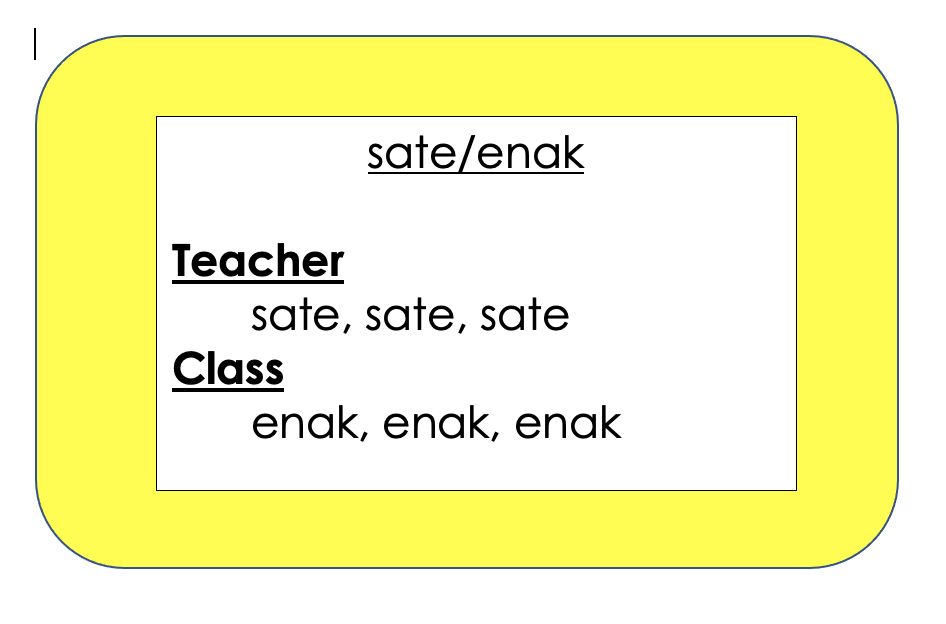
Here are a few more that can be introduced to students in preparation for upcoming stories or for review. My all time favourite that has worked so, so well with all year levels is this one:

I absolutely love this call and response. It is short and effective. When first introducing this one, I explain that the echo must be exactly the same as the original. If I say it slowly, it must be echoed slowly, if sang, the echo must also be sung etc. It is also incredibly helpful during lessons. If someone puts up the stop sign for karena, all that is required for me to say karena three times and with automaticity. The student inevitably echos, ” because, because, because” with a giant smile on their face!

This is similar to karena, except that before saying but, but, but, students stand up and each time they choral echo ‘but’, they slap their bottom, right, left, right. Students absolutely love this one and it certainly has a lot going for it however I have only done this one with students (and families) I knew very well.

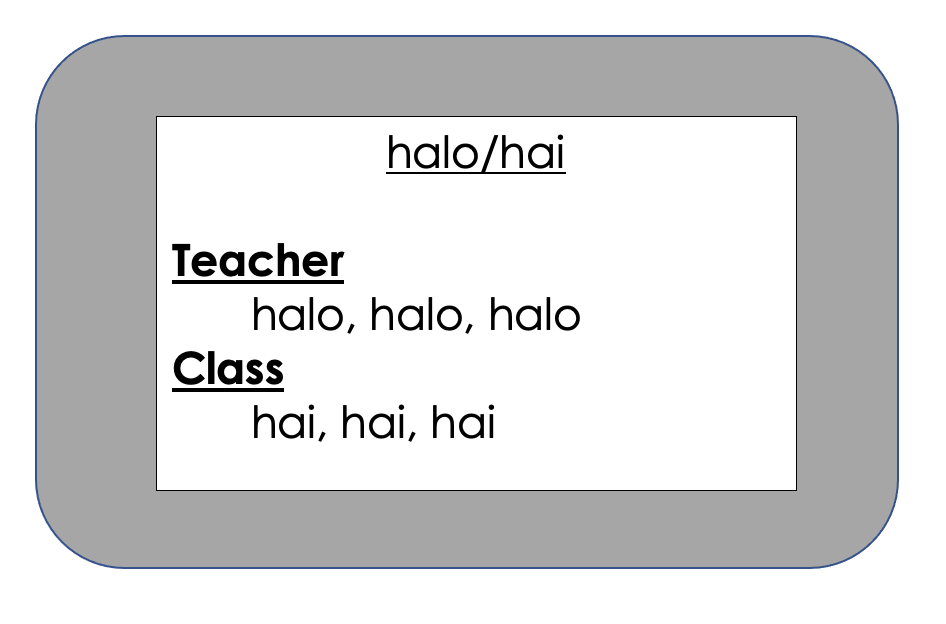
That is all I can think of that have been successful and I am currently investigating new ones that could be used with upcoming topics as bonus repetitions of target structures. Here are a few that I might have some potential!

Thanks to the discussion of Facebook, here are a few more!

The following 2 are from Heidi P:

Thanks to Siobhan H for this one: