Yes, you have read that correctly!!
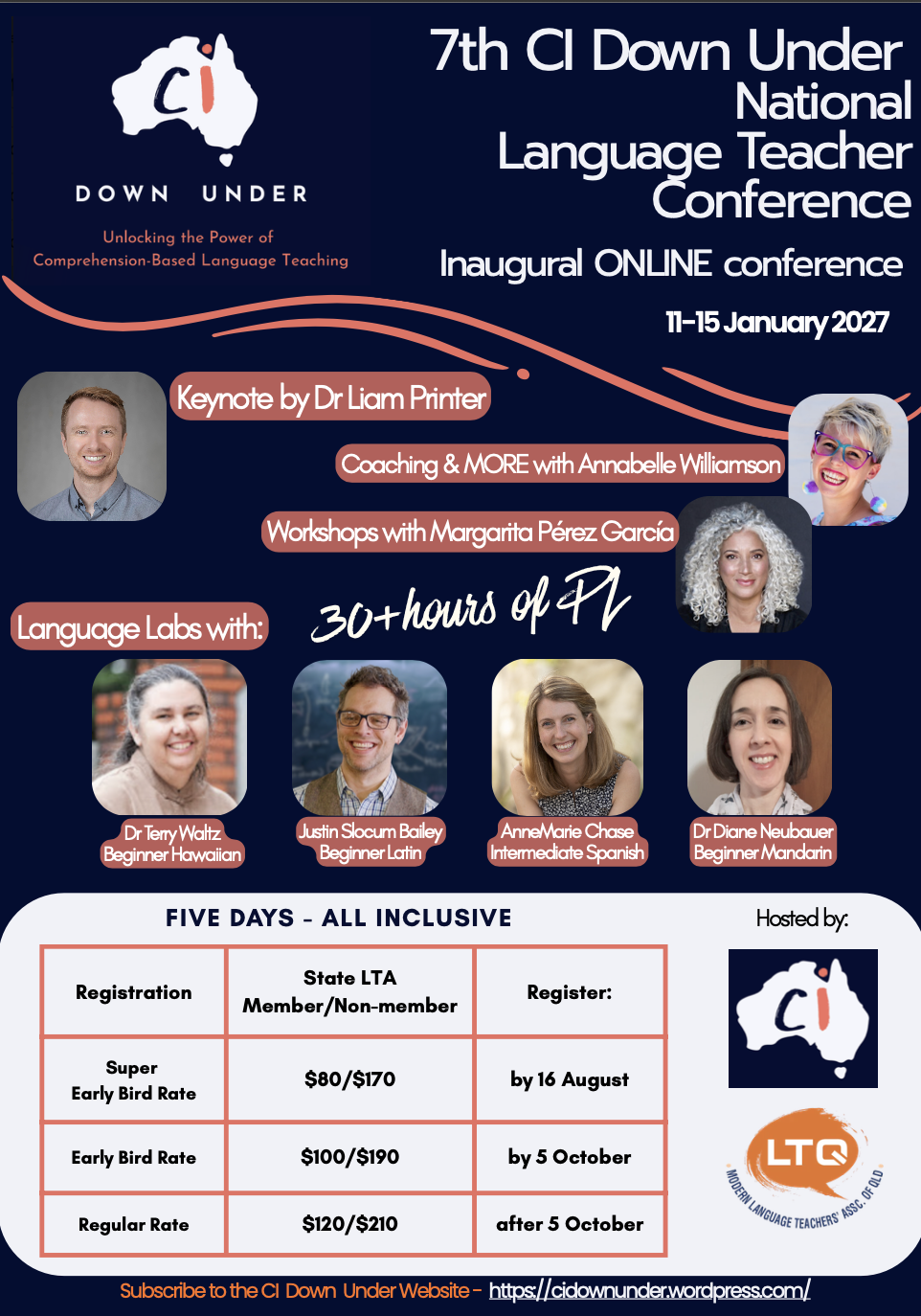
Registration for the inaugural online CI Down Under Conference is now open!!
Register here: https://www.ltq.asn.au/
Subscribe to the website and never miss an update: https://cidownunder.wordpress.com/
Yes, you have read that correctly!!
Registration for the inaugural online CI Down Under Conference is now open!!
Register here: https://www.ltq.asn.au/
Subscribe to the website and never miss an update: https://cidownunder.wordpress.com/
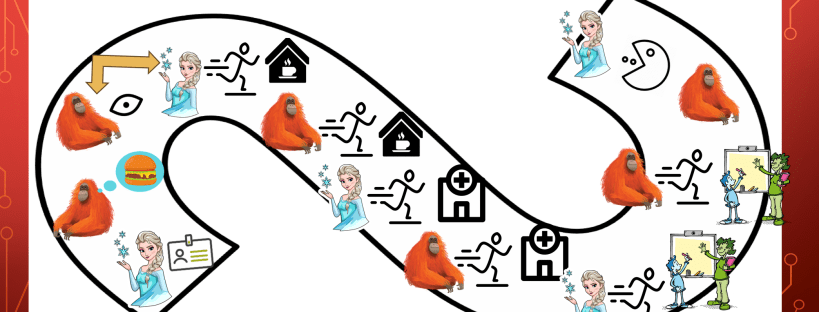
Every time I used parts of Talk for Writing (TfW) in my Language lessons, watching my preliterate students experience success with retelling stories in Indonesian was so rewarding. The beauty of this strategy is the way in which it offers ways for preliterate learners to successfully ‘read’ and ‘re-read’ a familiar story and because learners are ‘reading’ images, the retelling is not limited to the text as it would be in a written story; it is limited only by the learners level of acquisition! Doesn’t this blow your mind when you take into account the young age of preliterate learners!
So, I would like to now take you through a breakdown of how this is done this over a ten week term, with one lesson per week. I really hope you can see that teaching our preliterate learners, our most enthusiastic and fearless cohort of learners, should not be limited to colours and numbers because they too can benefit enormously from Acquistion Driven Instruction (ADI).
Before I start though, it is important to undertand how the story I am using for this post fits into my Indonesian program. In my Scope and Sequence, this story, Elsa Makan Elsa (Crocodile eats Elsa), is the third I will teach the students in their first year of Indonesian. The preceding stories are Pleased To Meet You (Jim Tripp) and The Spongebob Story (Linda Li). Both can be found here.
As limiting vocabulary is vital for language acquistion, you may be surprised to read through my yearly list of Target Structures (TS) for the my reception (prep) learners. However the most significant aspect of my scope & sequence is that each story builds on from the preceding one with all structures being either high frequency (top 10) or vital for a story (eg buaya/crocodile). Thus, my students will already have encountered several of the TS’s before beginning this story.

The story ‘Buaya Makan Elsa’ (The crocodile ate/eats Elsa) is based on a Carol Gaab story.
Ada buaya.
Buaya lapar.
Buaya lihat Elsa.
Buaya mau makan Elsa
Elsa berlari ke (your town/city/suburb).
Buaya berlari ke (your town/city/suburb).
Elsa berlari ke (your school).
Buaya berlari ke (your school).
Elsa berlari ke kelas Bahasa Indonesia.
Buaya berlari ke kelas Bahasa Indonesia.
Buaya makan Elsa.
Translation:
There’s a crocodile.
The crocodile is hungry.
The crocodile see Elsa.
Elsa berlari ke (your town/city/suburb).
The crocodile runs to (your town/city/suburb).
Elsa berlari ke (your school).
The crocodile runs to (your school).
Elsa berlari ke kelas Bahasa Indonesia.
Buaya berlari ke kelas Bahasa Indonesia.
The crocodile eats Elsa.
Target Structures (The vocabulary I will target this term)
buaya/crocodile
lapar/ hungry
lihat/sees
berlari ke/runs to
makan/eat
In lessons 1 – 3, I introduce the target structures and through Total Physical Respsonse (TPR), Kursi Luar Biasa (Special Person Interviews), Picture Talk, and calling the roll asking, Apa Kabar? (How are you?) learners receive fun and compelling repetitions of each.
For example, in lesson 2, I will introduce the Target Structure ‘lapar’ (hungry). I will do this firstly before I call the roll. I will point to the poster on the wall, say the word, do the gesture (rubbing my tummy with big eyes) and tell the meaning. I do not ask students to guess the meaning as sometimes this has led to future confusion. Its so much better to establish the meaning clearly and then get as many reps saying it with the gesture throughout the upcoming lesson. I always begin lessons calling my class roll on class dojo, asking each student, “Apa Kabar?” (How are you?) If a student hesitates, I might ask them, “Jenny lapar? Kelas, Jenny Lapar!” If Jenny shakes their head, I restate, “Jenny tidak (not) lapar!” Then again check in with Jenny, “Jenny tidak lapar?” Sometimes I will also award pandai points for students using the structure confidently in context – especially if the pandai points need boosting!
After sitting listening to the roll, we immediately head into TPR to get students moving. Here I get reps on past target structures eg stand, walk, dance, jump, and then add lapar, and then introduce makan. Again by saying the word, showing the gesture and then establishing meaning. I will include phrases like makan (students mime eating), makan es krim (students mime eating an ice cream), makan hotdog, makan buaya (Aduh Bu Cathy!) Sneaky rep for buaya and follow up with a comprehension check for meaning!!
In Kursi Luar Biasa, I will have a huge bag of cognate food props eg hotdog, hamburger, ice cream, avocado, broccoli, buaya, etc and will include in the individual student interview input based on hungry and eat. Eg Jenny lapar? Jenny mau makan hotdog? Jenny tidak mau makan hotdog? Oke. Jenny mau makan es krim? Ohh, Jenny mau makan es krim. Pete, kasih Jenny es krim. Wow, Jenny pandai!! Jenny berkata, terima kasih Pete!! After I have found several food items that Jenny wants, I take a photo of Jenny pretending to eat one or all and that photo will be used for next lesons picture talk to get more reps on hungry & eat!
Depending on time, I also like to include a series of quirky pictures I’ve found on Google images for additional reps on the lesson target structures. I begin with a photo of someone holding a food cognate eg pizza. I will ask questions about it eg laki-laki atau perempuan? (boy or girl?) Laki-laki lapar? Laki-laki mau makan brokoli? and so on. I usually have 4-5 pictures ready in case any fall flat and then next, I ramp it up by having a shape covering the item the person/animal is holdiing/eating in the picture. This leads to questions including; anjing (dog) atau buaya? Buaya makan apa? Buaya makan apel? Ya, Buaya tidak makan apel. Buaya makan stroberi atau hotdog? Then removing the shape and celebrating with the students who guessed correctly! Young learners absolutely love guessing games and they are perfect for repetitions of target structures.
By lesson 4, the students are ready to listen to the story. I love story asking with student actors and the class love watching the acting especially if there are quirky props involved. Dont forget to remind your students that if they are not comfortable wearing, saying or looking funny, they might prefer to be in the audience. Using the actors, I tell the story slowly getting as many reps as possible, doing lots of comprehension checks (with the audience, not the actors), and asking actors to redo their acting if it did not clearly demonstrate meaning. It is important not to rush through the acting. It is the first time the class has heard the story and it is critical they comprehend it completely. Also, with colourful wigs, funny clothes, huge hats, &/or masks, the audience will definitely not complain watching a scene several times! They will be so engaged, they won’t realise they’ve been sitting still and fully focused on the story!
Straight afterwards, allowing the actors to choose whether they continue with the props or not, the entire class is asked to stand in a huge circle for part 2 of All The World Is a Stage (ATWAS). I have blogged about this here (scroll down to (variation # 2). Students now have the opportunity to not only get moving but also demonstrate their own amazing acting skills.
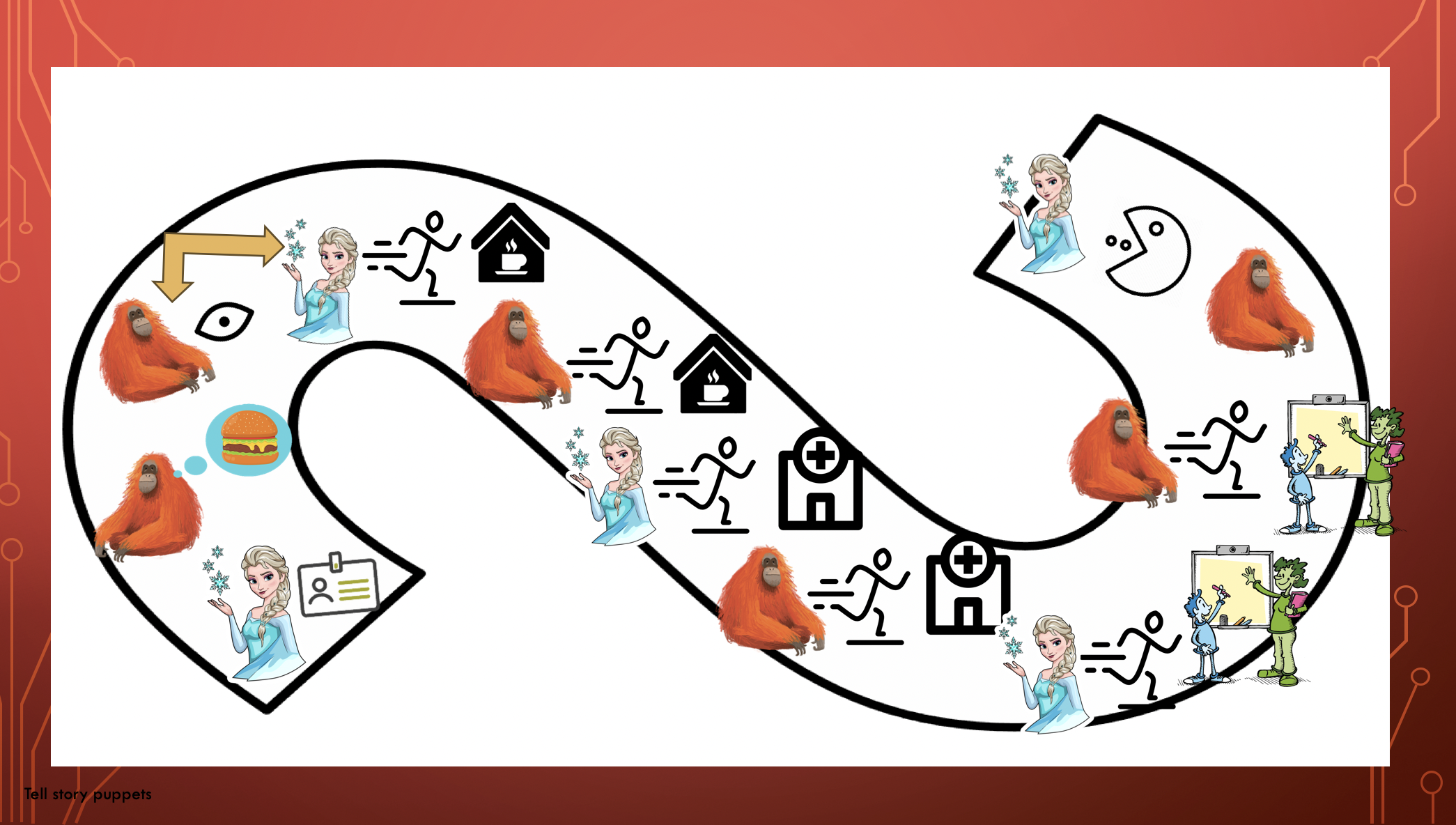
After students have watched the story with actors and acted it out themselves, they get their first taste of the story told with images. I firstly read it to them while pointing to the images that represent the target structures of the story. At this stage I encourage my students to only listen and understand; I do not want them choralling with me as it’s important that the first telling is accurate. The second time I read it, I invite students to choral read with me if they’d like to.
Note: The story below is technically a parallel story which should NOT be used for the first read through if sticking to the original version. It is though, a story I have used previously and demonstrates how stories can be adapted easily to include certain curriculum items.
Lesson 5 includes the third and final ATWAS variation where students in pairs act out the story one more time. This variation is quite time consuming but well worth it. The way in which I do this can be read in this post (scroll down to Variation 3) which serendipitously is based on the Elsa story!! It’s worth reading to the bottom of that paragraph to discover a popular twist on ending this TPR variation!!
After the final ATWAS variation, I show a YouTube clip of the story. I absolutely love making these clips and uploading them to my youtube channel for students to access after school or in the holidays. Thankfully students thoroughly enjoy watching them because showing the clips gives you the teacher, a little breathing space!
Below is the clip for the Elsa dan Ortangutan story version:
The last part of this video is a read through of the story using the Backwards S from above. I try to consistently point to the images that represent each target structure as I am telling the story. Directly after the video, I project a copy of the Backwards S up on to the screen to use for more repetitions of the story. This time I encourage students to join in with me for the retell. The initital retell is told at a slower pace, including repetitions & comprehension checks as needed. Celebrate student engagement and effort with pandai points!! After a few slow run-throughs, I like to invite a student to come out the front and demonstrate their awesome reading skills. This offers students an opportunity to shine and you will be amazed at just how well they can retell the story through reading. I like to record my superstars – not only is it impressive evidence to share at parent teacher evenings, but it can also be shared with theirs and other classes for bonus repetitions! Watch them puff up with pride!!
A final note about the student retells; because they offers valuable story repetitions, it is ok to softly choral read with the student if they require it and its also totally ok to provide the target structures if they look for support. It is all about building confidence through success!
During Lesson 6, in preparation for the assessment task next lesson, I hand out a copy of the Backwards S story to all students. I encourage them to find a comfy spot and try to read the story quietly to themselves. I circulate checking in with students, encouraging them to read through as often as time permits. Then following this, students swap the complete Backwards S of the story for an edited version where one aspect of the story is replaced with a blank circle. For example, for this story, the circle shape could replace one of the characters plus give students the choice at the end of who will eat who. If using the circle for a new location, I advise being sneakily prescriptive with young’uns, ensuring that acepted suggestions are ones that have simple representations/logos eg golden arches, otherwise students will spend too much time with their masterpieces and a perfect product is not what this is all about. Here are some images from a different story (similar to this one) with the circle replacing the food used in the original story.
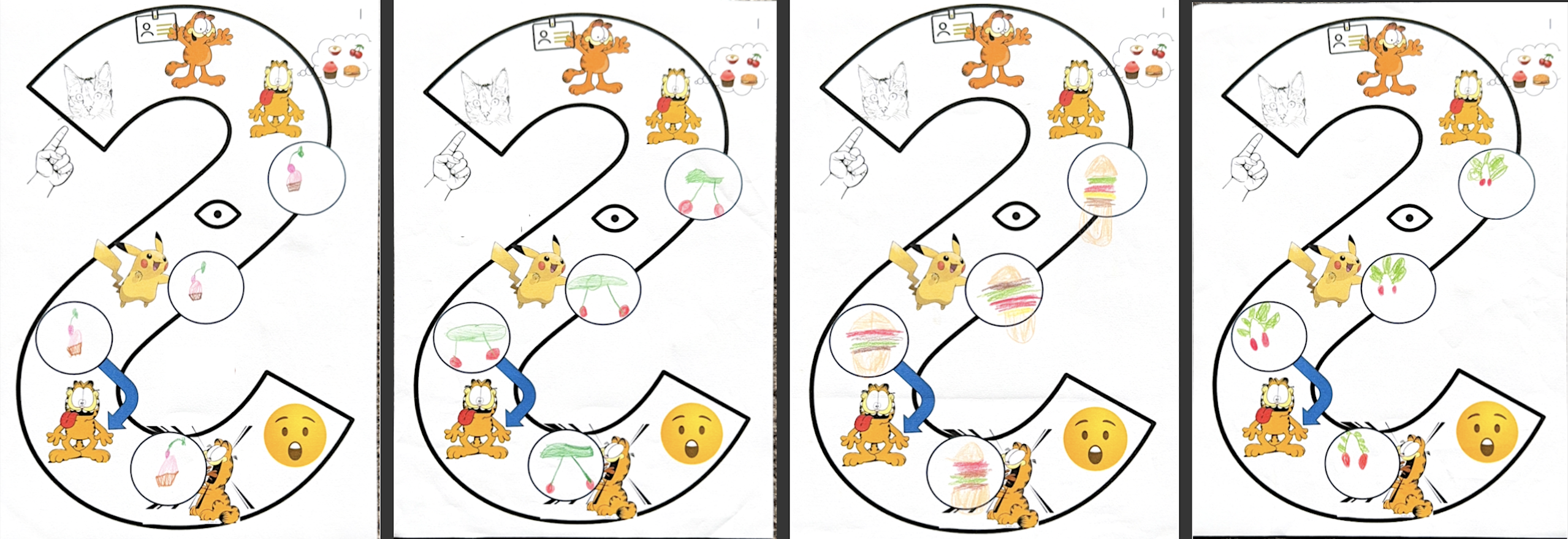
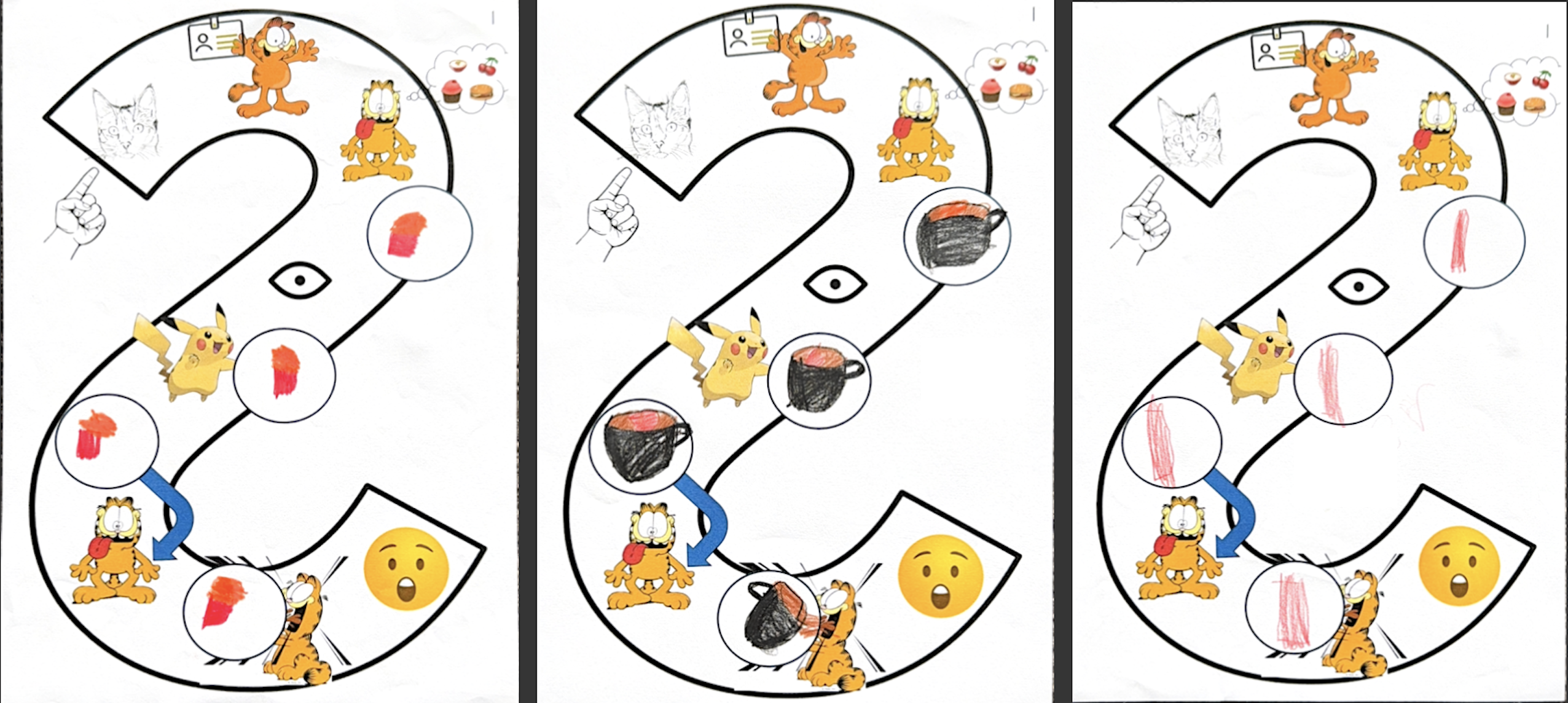

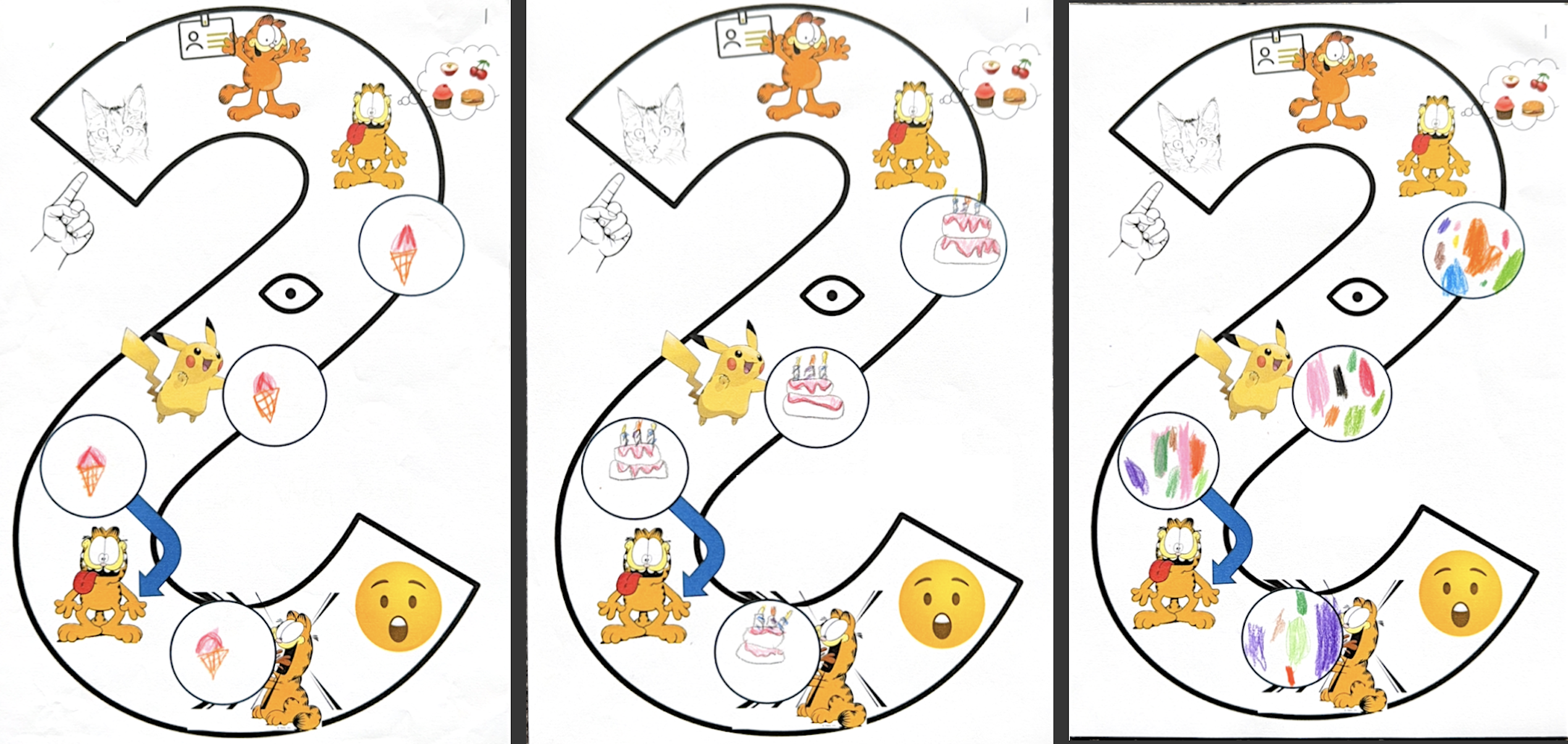
Aren’t the illustrations gorgeous? I love that some of them food illustrations are puzzling however as they are only for the creator, all that matters is that the illustrator can identify their illustration during the retell that follows the task completion! Here I encourage students to maximise their lesson time reading and re-reading this story to themselves during this lesson in preparation for next lesson when they will be recording themselves reading the story independently.
In Lesson 7, students will complete an assessment task whereby they will read either their created story or the class story (student choice) while recording themselves on a device. If not recording their face, remind students to begin with their name and class for future reference!! Some students will inevitably struggle with this task and need support however, those who complete it independently, must on completion, complete a silent activity (FVR, DEAR, colour by number) with the emphasis on silent so as not to drown out those still on task.
A video clip of a paralell story can be shown as everyone finishes up and moves to the front of the room in preparation for the lesson to continue.
Here is a few sound bite of a 5 year old student’s retell assessment:
Inevitably, there will be several students who for a multitude of reasons were either absent or did not complete the assessment task the previous week, so lesson 8 offers them time to rectify this and as would have been done in the previous lesson, before beginning the task, invite students to join in the choral reading of the story several times as a class before inviting students who have completed the assessment task, to read it independently for all to enjoy.
Then to celebrate the end of the assessment, play a post story game, Duplo. This is always a winner with my students and not only does it offer multiple opportunities for story reps but it also encourages discriminating listening. Students sit in a circle with a huge pile of Duplo pieces (or other brands of connecting large blocks) in the centre. Students listen carefully to the teacher retelling the story sequentially. If the sentence told by the teacher is incorrect, they cannot touch the duplo. Instead we together discuss why the sentence was incorrect and ask students to offer the correct sentence. When the sentence is correct, students may each take one piece of Duplo. I love this game because by the time students have more than a few pieces of Duplo, they enjoy listening while their hands are busy creating using the Duplo. This game is also the perfect opportunity to talk about kindness, sharing and accepting compliments.
With the end of term, Lesson 9 and 10 focus on editing and illustrating mini booklets of the class story. Each student receives a mini booklet and at the end of week 10, are encouraged to take the mini booklet home to read it to as many people as possible, plus their pets, any garden statues and a tree in their garden! These booklets offer learners opportunities to demonstrate their awesome Indonesian proficiency to impressed family members and also for MORE input during the holidays!
Before they start illustrating the booklet, they will be instructed to write their name on every page wherever there is a blank line. This gives them practice writing their name and in doing so, makes them the star of their story!! Once this is completed, students illustrate each page with each illustration matching the text. This doesn’t take up the whole lesson unless the students are exhausted and anything else is beyond them. Otherwise, games like Siapa Nama? (guessing who is under the sarong?) or senam penguin are my students goto favourites.
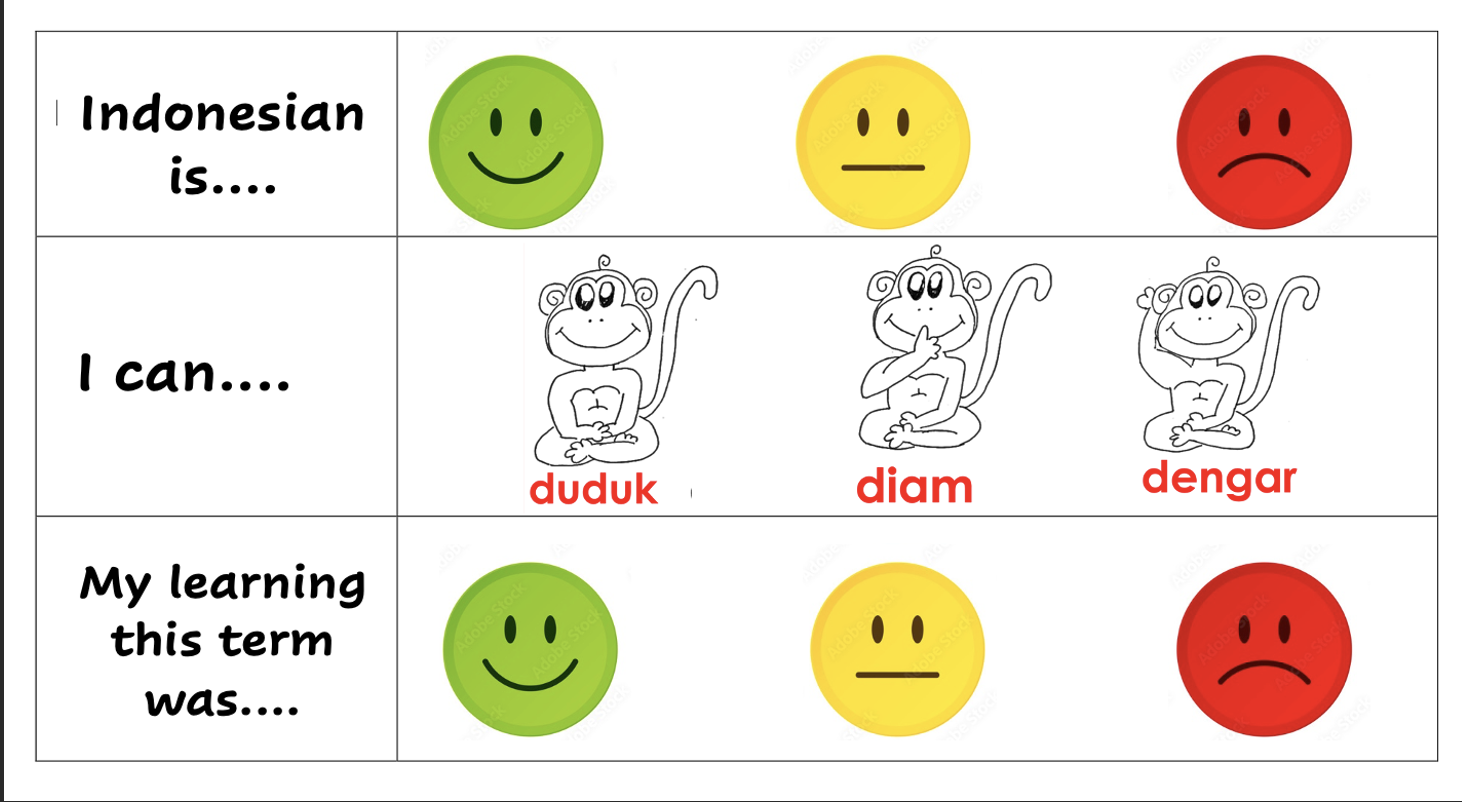
A student self reflection survey is a good way to finish the term. It is a tricky concept for preliterates who find it challenging to reflect back over the term. Consequently, I usually only set a few questions which we read together and they ‘respond’ by colouring either a happy emoji, a ‘lumayan’ (ok) emoji or a kurang baik (sad) emoji. The hardest concept to explain though is that there is no right or wrong answer unless you are copying your friends sheet!
I really hope this post has been helpful although, I am horrified at how long it is!! Kudos to all who made it this far!!
Please drop me a comment if there is anything that needs a clearer explanation or if I have skipped something totally!! I do have a week by week term outline for this story which I am happy to share with anyone who would like a copy! Either email me, message me through facebook or comment below!!
In a nutshell, ‘picture talk’ is using an image to maximise repetitions on a target structure.
The success of picture talk relies both on the image itself and the questions asked. A truly compelling image is one that is quirky, and offers opportunities to use the target structure in both statements and questions.
Read to the end to find links to demo videos, blog posts and more…
Picture Talk #1
A picture talk can be simply an image which is shown to students to generate scaffolded and fully comprehensible discussions that either introduce a target structure &/or to get repetitions on the target structure. For preliterate learners, when introducing a target structure, relying on ‘point & pause’ is often not a viable option. Picture Talks are super helpful for overcoming this when working with preliterate learners.
Picture Talk #2
Another successful way to set up a picture talk is to cover the cognate in the image. To what extent, you cover the cognate, will depend on your learners. If the covered cognate is ambiguous, I like to leave a bit of the image showing as a hint. Covering up the cognate opens it up for student contributions which can then be restated as repetitions incorporating the target structure.
Targeting the verb ‘eat’, using the image below of Bluey eating, you could ask…..
1. What is Bluey eating?
2. Bluey is eating………(pause)?
3. Bluey is eating a taco (or substitute with another cognate)?
4. Is Bluey eating a taco or an ice cream?

The number of questions you ask will depend on a million factors including the cohort, the time of day etc. When ready, you simply remove the image and restate the sentence using the target structure!!
Input, input, input for the win!
I do this in PowerPoint as it is so easy to insert and then fade out each shape. Covering the cognate is so popular with young learners and gives them such a huge confidence boost when they guess correctly the hidden cognate.
Picture Talk # 3
Recently I discovered the image below on one of the Bluey Facebook groups for adults! It has so much potential for another way to picture talk!
It would be so easy to create this format using 4 well known characters and 4 cognates that relate easily to the target structure. The cognates (written in the target language) could be true answers, they could be totally unknown or could be focusing on the negative only. With older students, I would encourage the use of the ‘maybe’ (in Indonesian ‘mungkin’) and/or, again depending on the cohort, ‘not possible’ (in Indonesian ‘tidak mungkin) when commenting on the contributions of their peers.

Would love to hear Picture Talk works for you in your context!
Comment below and share your experiences and ideas!!
A huge, huge thank you to Moya for sharing this amazing link (see below)! It contains significantly more detail, links to YouTube demo videos plus so much more.
Enjoy….


I have just finished making my first ever TikTok video and was so surprised how easy it was. Admittedly my first creation is very basic, and already I am keen to explore tips I can use to make the next clips more appealing. If you have any tips, please, please comment below!
The clip is of a song that I may use with my year 4’s this term for the term 2 ‘transportasi’ (transportation) topic. As a text for this topic, I am now torn between 3 possibilities.
Here they are:
Sepeda motor Pak Budi rusak.
“Saya naik apa ke sekolah?” dia berkata.
Pada hari Senin dia naik becak ke sekolah.
Pada hari Selasa dia naik bus ke sekolah.
Pada hari Rabu dia naik delman ke sekolah.
Pada hari Kamis dia naik mobil temannya ke sekolah.
Pada hari Jumat dia naik sepeda ke sekolah.
Pada hari Sabtu dia berjalan kaki ke sekolah
Pada hari Minggu dia memperbaiki sepeda motornya.
Pada hari Senin Pak Budi bisa naik sepeda motornya lagi ke sekolah.
Pak Budi senang sekali.
2. Jangan Naik Skooter di Sekolah (written by Ibu Anne)
Here is the parallel story for her story:
3. Naik, naik ke puncak Gunung (traditional childrens song)
I love this traditional song because of the memories I have of listening to my children learning and singing it with our guides as we climbed Mount Batur when they were only 6 and 8 years old!
Issues I have with many of the YouTube clips for traditional Indonesian childrens songs include:
– animated characters have anglo appearances eg eye shape etc,
– the audio &/or visual can be poor quality,
-the background is often animated and again sadly, does not truly represent beautiful and incredible Indonesia. See the above clip and consider the mountain they are climbing (in a car!!) to your memories from Indonesia. How cool would it be if they were actually climbing a volcano!! IKR
Which all explains why I decided to google how to make a TikTok video and found this:
So using her instructions, here is my first ever TikTok clip:
All tips and suggestions warmly accepted!!
Please comment below!!
A perfect CI story has several critical features:
The reasons these are critical for a great story is that it ensures our stories cater for:
To ignore any of the 8 features, will inevitably disadvantage your students. I’ve discovered it’s better to start too simple and then while co-creating with students, add any known language that students contribute and add it to the both the current version and the parallel story.
‘Scope And Sequence Stories’ page (link).
For examples of great stories, check out the list of stories by clicking on the link above. When looking at these or other people’s stories, adapt the language for your students. It is important you only use them exactly as they are if it suits your context. There is no single way to use CI as we all have unique students, unique school expectations and unique teaching styles. When sharing stories based on any of the stories listed, always credit the original author!
Note
I firstly apologise that the stories listed in the Scope And Sequence are mostly only available in Indonesian. I am slowly translating them into English! If there is one that has potential and Google translate isn’t helping, please get in contact and I will happily translate that story for you!

It exceeded all of my expectations!! I hardly know where to start to share a few reflections, so let me . firstly start with with Diane Neubauer and Annabelle Williamson (La Maestra Loca), who had us all in absolute awe of their amazing CI teaching skills and their unflagging positivity. Diane and Annabelle both had a profound impact on the learners and observers in the labs.
Here is a comment shared by an attendee after dropping in on a language lab with Diane:
In a 90 minute lesson, I experienced moving from hearing at first only incomprehensible noise, before reaching sufficient comprehension towards the second half of the lesson where without realising it, I had pulled out my phone, following the instruction Diane had given to her students , and was googling where in Australia you can find pandas! I couldn’t believe it!
Secondly, I cannot go any further without thanking both Teri Wiechart and Margarita Pérez Garcia from the bottom of my heart. Both not only presented workshops (Teri in particular was superb – she delivered a truly amazing introduction to CI workshop after only a few days’ notice), they both also offered coaching and/or teaching support to anyone keen to dig deep and teach a new CI skill to ‘learners’. If you would like more information on the Coaches for Coaching course Teri runs, please comment below and I will put you in touch with Teri. I have done it twice and highly recommend it for anyone working in a leadership role in a language faculty.

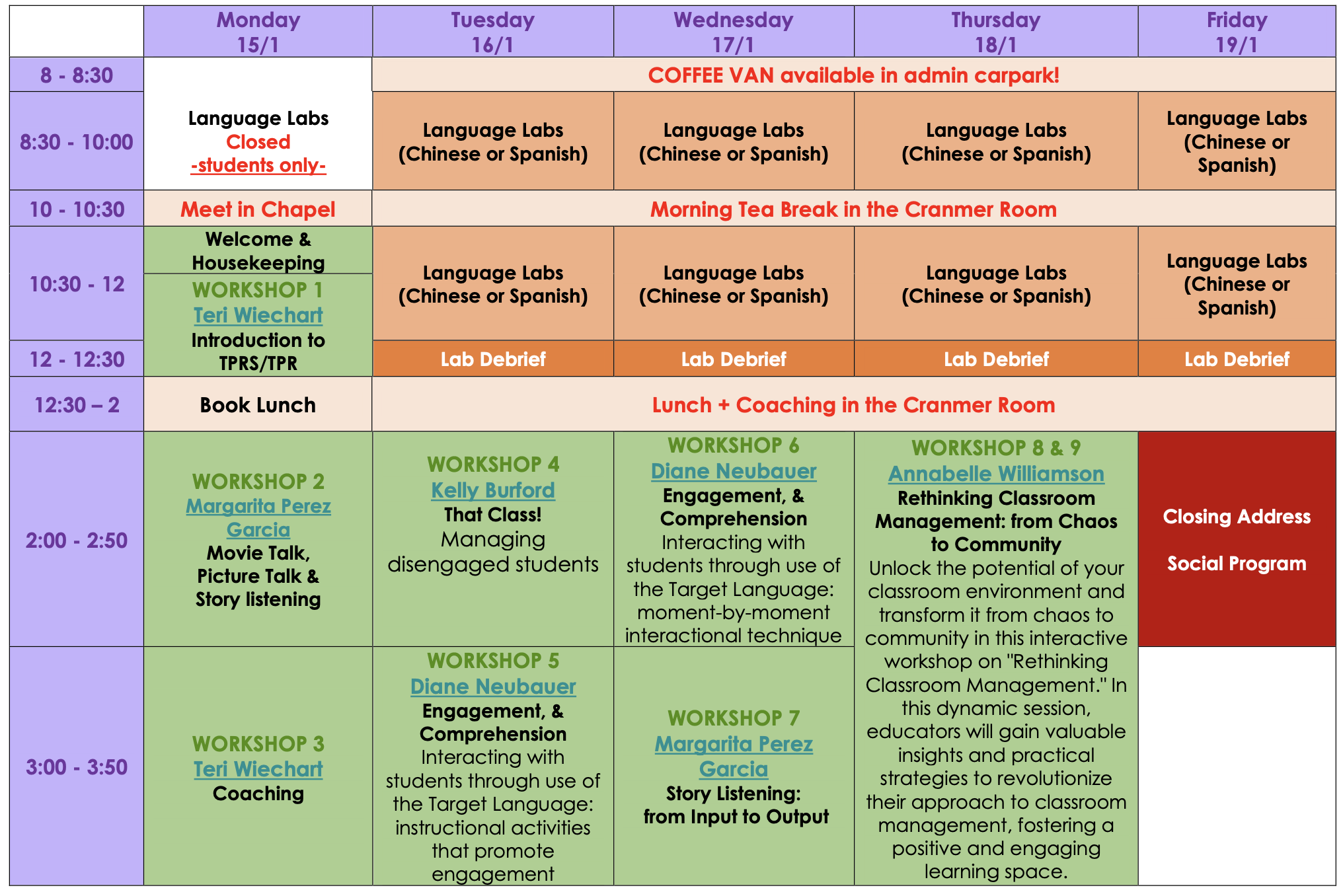
As you can see from the conference prgram, the day was largely split into two sections. The 3 hour morning session was broken into 2 language labs, a break and then finished with the language lab debrief. The afternoon began with a 90 minute lunch/ coaching and finished with two workshops.
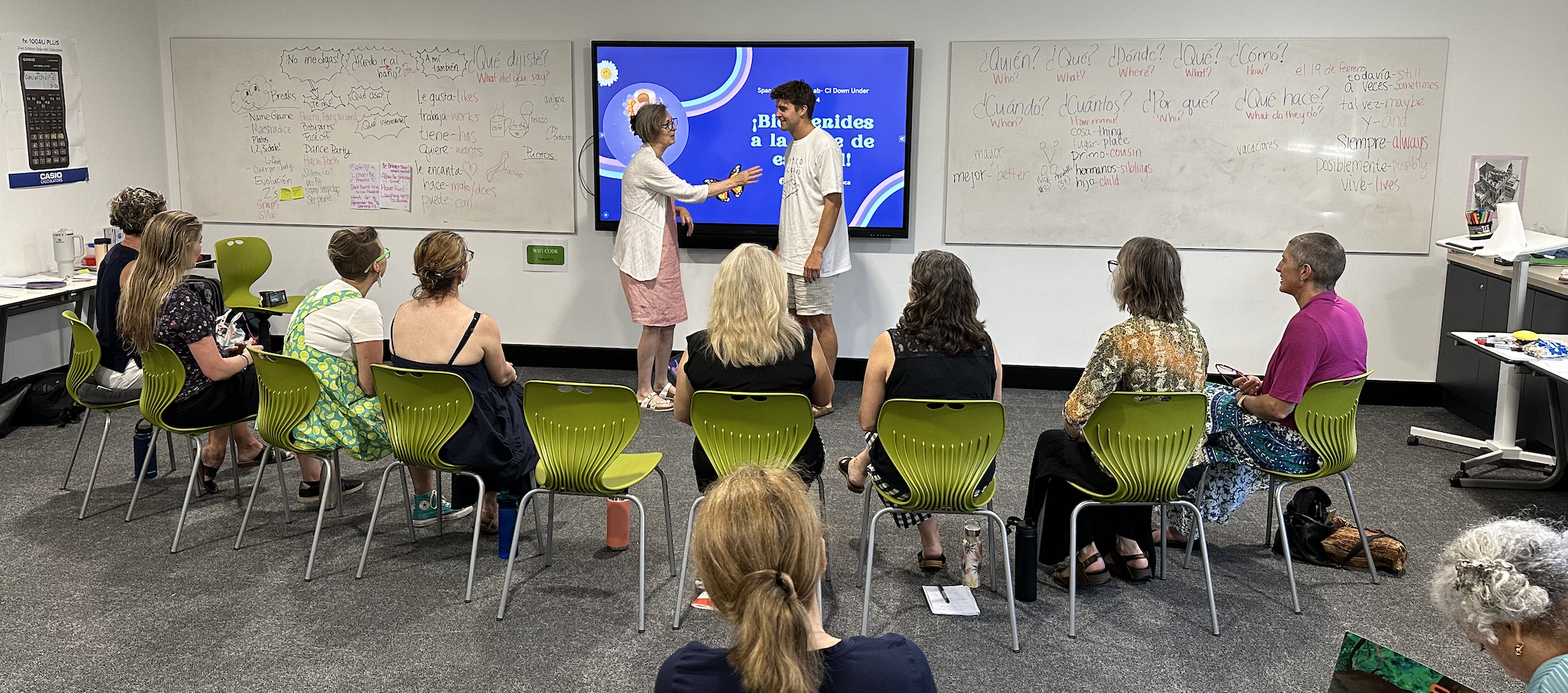
To my knowledge, this conference was the first ever in Australia to include language labs. The first language lab I attended was in Agen, France as a learner with Daniel Dubois in his Breton language lab. The second time I had the opportunity to go to language labs again was at iFLT18 in Cincinatti, Ohio. Here, I observed several labs with various teachers teaching a variety of languages ranging from Russian to Latin. It was memorable observing legendary teachers in action after many years of purely reading about them from afar. While I observed several labs over this week, only one made a deep and lasting impression. Read all about it here!!
Language Labs are significantly better (in my opnion) than workshops for learning how to improve your teaching practise. Instead of someone presenting a workshop explainingstep by step hot to do a skill using PowerPoint, in a language lab, you can either experience learning the skill as a learner or watch it being taught as an observer. Often, explanations leaves out an important detail, yet when you have the chance to see a skill or activity being explained to a class of learners, the instructions are considerably clearer. Thus, after observing 12 hours of language labs, the skills, ideas and learning we attendees experienced far exceeded that which would have been covered through12 hours of individually presented workshops. Observing language teaching with real learners is the most complete way for us language teachers to improve our practice. Language labs also provide teachers with the opportunity to hear from the learners, a rare yet valuable aspect. After the second lab each day, a debrief is held. During this half hour, both learners and observers can reflect and share their experiences or interact with the teacher to either ask questions or comment. Annabelle wrote notes with hyperlinks during the debriefs which she shared with all attendees. WooHoo!

No matter what the age of your students, call and response are awesome for getting the whole class to stop and listen!
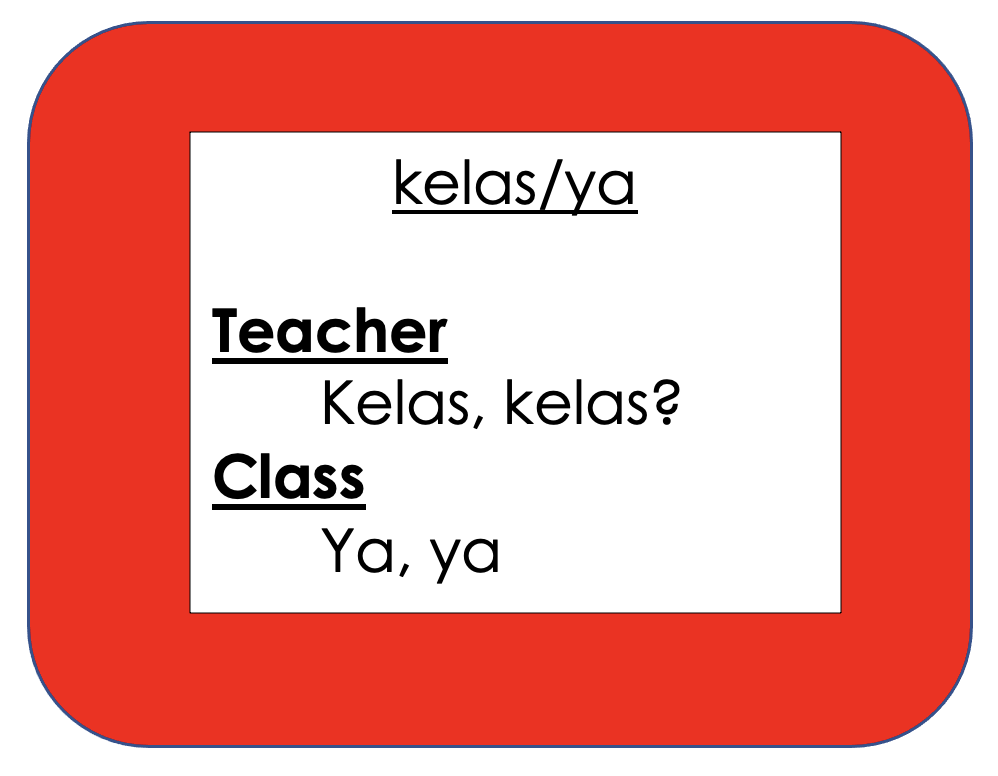
They work like this: the teacher says a word or phrase and upon hearing it the class choruses a response and then magically look towards the teacher ready for an instruction. With brand new classes, I don’t introduce a call and response until all other behaviour management systems are working smoothly. Until then, I use the 1, 2, 3 song (taught in lesson 1) and sing until all students are singing with me.
The first call and response I usually introduce is the following:
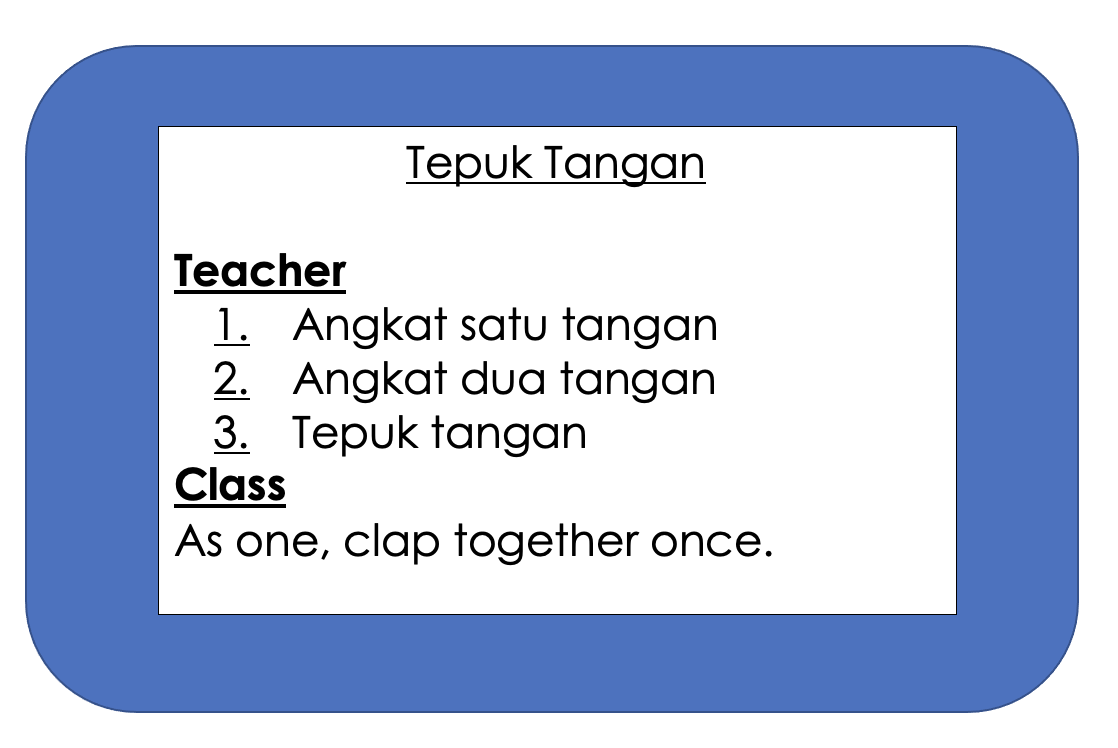
When saying it, I pause between lines to make sure all students are keeping up with the instructions. If it is noisy, I will go through it once to get everyone attention and then repeat it. With very young learners, I modify the instructions by removing the word ‘angkat’ so that it becomes: satu tangan, dua tangan, tepuk tangan.
Here are a few more that can be introduced to students in preparation for upcoming stories or for review. My all time favourite that has worked so, so well with all year levels is this one:

I absolutely love this call and response. It is short and effective. When first introducing this one, I explain that the echo must be exactly the same as the original. If I say it slowly, it must be echoed slowly, if sang, the echo must also be sung etc. It is also incredibly helpful during lessons. If someone puts up the stop sign for karena, all that is required for me to say karena three times and with automaticity. The student inevitably echos, ” because, because, because” with a giant smile on their face!

This is similar to karena, except that before saying but, but, but, students stand up and each time they choral echo ‘but’, they slap their bottom, right, left, right. Students absolutely love this one and it certainly has a lot going for it however I have only done this one with students (and families) I knew very well.
That is all I can think of that have been successful and I am currently investigating new ones that could be used with upcoming topics as bonus repetitions of target structures. Here are a few that I might have some potential!
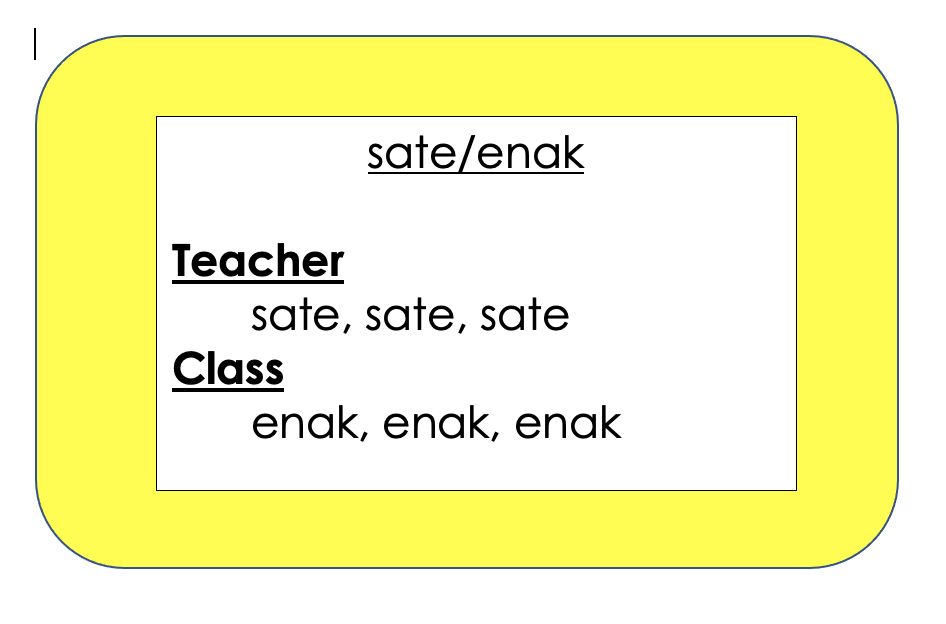
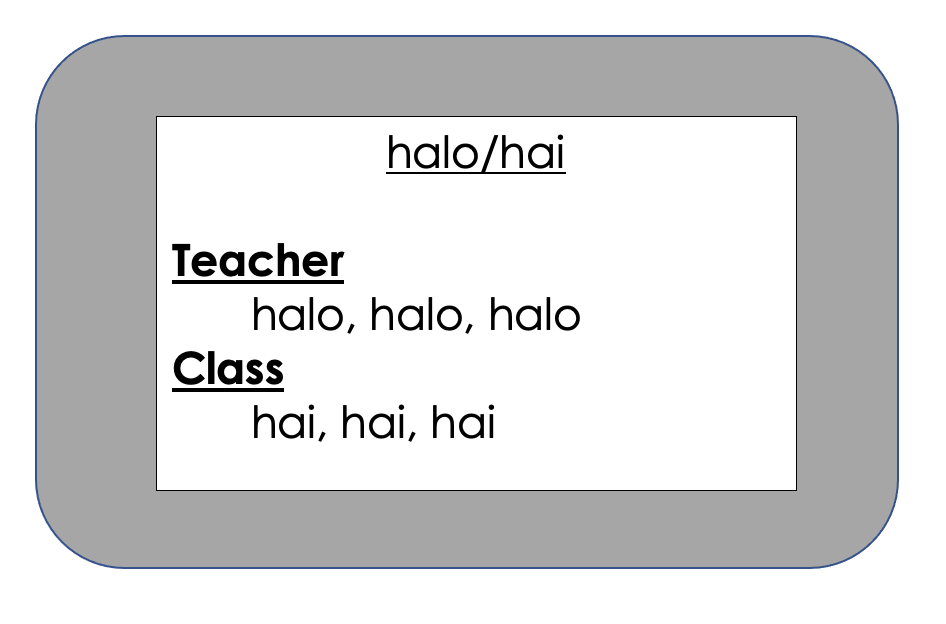
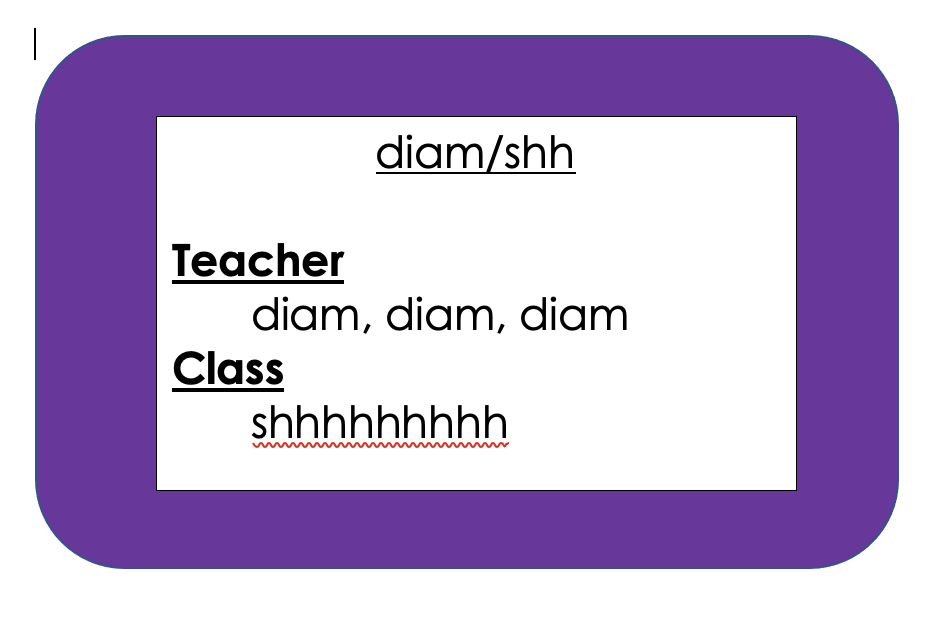


Thanks to the discussion of Facebook, here are a few more!
The following 2 are from Heidi P:
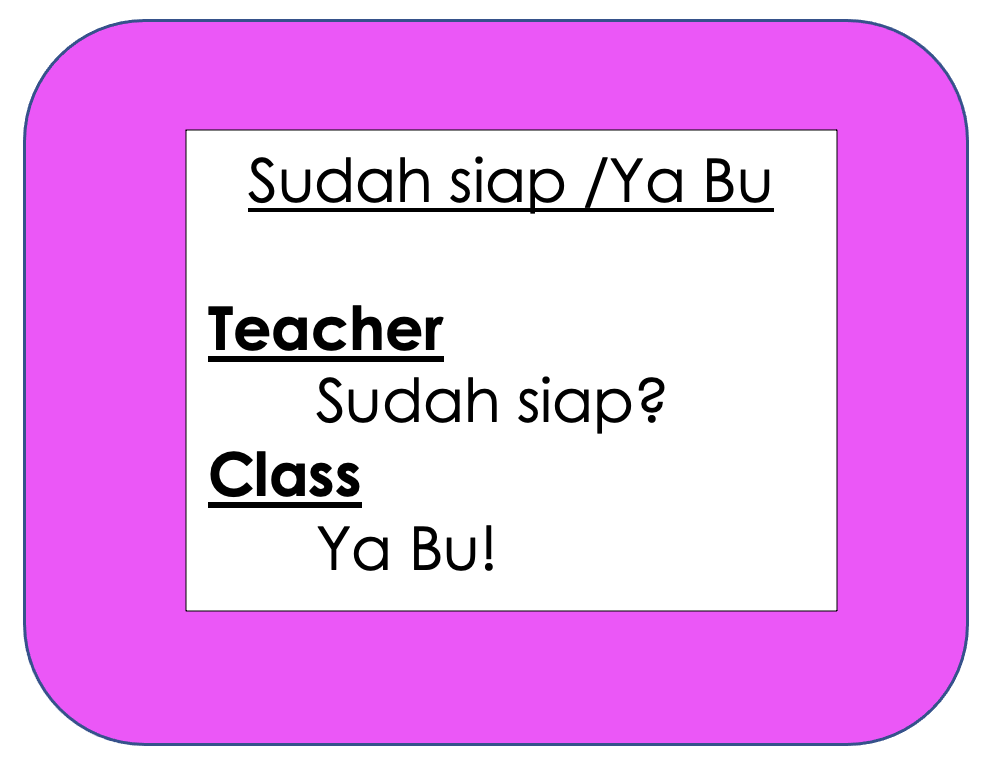

Thanks to Siobhan H for this one:

Have you realised how much I enjoy Languages education research? I consider myself incredibly fortunate to have had the opportunity to begin my Masters of Education; Languages fulltime as it gave me time to broaden my understandings of language learning and teaching. I am also incredibly thankful that I studied simultaneously with a wonderful TCI/TPRS colleague, Bu Heather, as it allowed us to discuss various aspects of Languages research from a TCI/TPRS perspective.
Yesterday I attended the 2022 MLTA NSW conference with one of my brilliant colleagues, Bu Asti. We were delighted to hear Steve Smith speak. I first heard him talking on Liam Printer’s The Motivated Classroom podcast. I highly recommend listening to Liam’s podcasts– they contain a great balance of research and practical ideas for language teachers working with middle primary aged students and above. Can you imagine how ecstatic I was when Steve Smith began his webinar by introducing us to memory research and how it applies to Languages!
Staying on top of research requires not only considerable time but also a certain headset. In this post, I will focus generally on outlining how memory works through teasing out iconic research, some of which dates back to 1885! I hope while reading this, you can reflect on your own teaching practise to determine the extent your practice aligns with accepted understandings of memory.
This post attempts to explore aspects of the research Steve discussed in his webinar. I have found memory research so useful and I wished I had known more about it earlier in my teaching career. I have expanded on several of the points Steve made using either the book ‘Cognitive Psychology and Instruction’ (Bruning, Schraw & Norby. 2011) or relevant SLA (Second Language Acquisition) research. I hope this post is readable and most of all, helps you understand why informed practice leads to sucessful learning!
Steve Smith has taught French in the UK for 30+ years. He has co-authored several books with Gianfranco Conti, one of which is “Memory; What Every Language Teacher Should Know’ ($45.54 on Amazon). What a great title! Here he is with his wife talking briefly about this book.
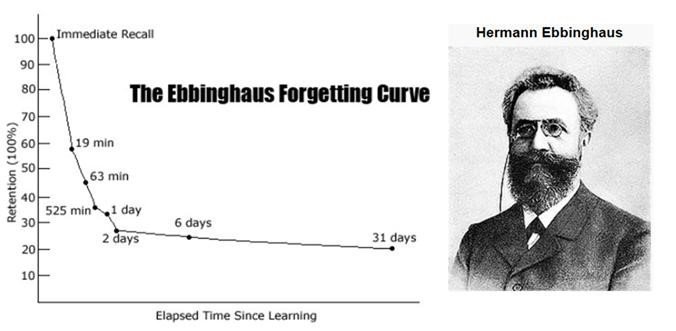
Ebbinghaus
Steven began the webinar by explaining Ebbinghaus’ Forgetting Curve which illustrates how quickly newly introduced information fades over time. Isn’t it astouding!
Ebbinghaus also hypothesised on the link between stress and remembering; something I think we would all agree with. Removing stress from learning is imperative. For many students, speaking/writing (output) can be stressful. For me, as a new learner, speaking in the target language produces an instant memory blank! Stephen Krashen‘s theory of second language acquisition is based on five hypotheses; one of which is the Affective Filter Hypothesis. This hypothesis states that several factors including low motivation, low self-esteem, anxiety, introversion, and inhibition impact on acquisition. Thus, the ideal state for language learning is when the affective filter is so low that learners are completely unaware that they are immersed in the target language.
For language teachers, being aware of Ebbinghaus’ research is critical. To avoid new vocabulary fading, fast, quirky repetitions will significantly help to delay the ‘decay’. In a TCI/TPRS lesson, this can be achieved through numerous comprehensible questions and answers in the target language to incorporate the target structure in ways that appeal to and/or are meaningful to the learners. With my young learners, I love doing this with quirky images of cognates that faciliatate discussion incorporating the target structure.
Knowledge
Steven then outlined the two types of knowledge; explicit (declarative) and implicit (procedural) and how each leads to either language learning or language acquisition. Explicit knowledge is that which is learned explicitly e.g. the rule i before e except after e. Implicit knowledge is that which we learned unconsciously e.g. the specific order of adjectives for English. Steven then asked us if declarative knowledge can become procedural knowledge, i.e. will explicitly teaching grammar rules help students communicate in the target language? To answer this question, I encourage you to try this: speak in your first language without using the letter ‘a’. Try it for a few seconds and then reflect on the hard work your brain did to achieve that!! Stephen Krashen’s Monitor Hypothesis explains that learning rules explicitly creates an ‘editor’ which monitors output through planning, editing, and correcting. It made your output considerably more onerous, doesn’t it? Could you feel your brain planning, editing and correcting while speaking? Thus, implicit learning ie, listening to comprehensible target language will lead to acquisition whereas teaching language rules is only necessary for language learning. Through understanding the difference between explicit and implicit teaching, we can determine if our main teaching goal as a language teacher is building proficiency or building knowledge! Both have value, but the balance is heavily weighted towards implicit teaching if proficiency is the goal.
Memory Models
The scientific study of memory began with Ebbinghaus (1850-1909). While no one yet knows precisely how the brain stores memory, most memory researchers agree on several points:
Memory models vary in many ways. Consider the following model:

The modal memory model (see image above) is easily the most commonly understood model of memory. There are significant variations between models yet all agree that the dotpoints outlined earlier are vital for planning and teaching. I believe they should underpin all our teaching and if we do not understand or implement the research findings, we are likely failing our students.
Blunt but true!
Memory Understandings
Here is a summary of the research regarding the three major systems of memory (ie Sensory Memory, Working Memory and Long Term Memory). While reading the following, consider the implications for language learning:
The main systems of memory are Sensory Memory, Working Memory, and Long Term Memory. Information is first stored in Sensory Memory then moved to Working Memory where with attention, it can be cogitated upon &/or manipulated to make sense. (Remember when you spoke without using an ‘a’? That all happened in Working Memory!) Long Term Memory is where information is stored for long periods and can be retrieved consciously (explicit memory) or unconsciously (implicit memory).
1. Sensory Memory and Working Memory both have an extremely limited capacity and time limit for holding information. Miller (1956) suggests that adults can hold approximately 7 plus or minus two pieces of information in working memory. Interference, decay and new information impacts the time input remains in these two memory systems. Atkinson and Shiffrin (1971) claim that new information stays in Sensory Memory and/or Working Memory for just 15 – 30 seconds. New information can only be kept in Working Memory longer through rehearsal e.g., repeating them verbally.
2. There is are two subsystems within Working Memory that each either manage verbal or visual input, distributing the processing load equally and operating simultaneously without impacting on the other. If anything, they appear to increase the likelihood in moving information from Working Memory to Long Term Memory. Consider the value of using images and/or props when introducing target structures!
3. Teaching that fails to recognise the characteristics of Cognitive Load Theory (overloading Working Memory) results in cognitive overload. Cognitive overload is when the brain hits the wall because the brain was given too much new information with insufficient rehearsal/repetition opportunities. The implications of cognitive overload impact not only on decreased student outcomes but will also negatively impact on student motivation and engagement levels.
After outlining relevant memory research, Steven then offered many suggestions for activities that will help learners build memory. Here are a few of his ideas for building phonetic memory:
Steven recommends teaching ‘chunks’ rather than single words and states that phrases are more useful for communication and also strengthen the likelihood of retrieval. To support retrieval, he recommends using sentence builders as a ‘Do Now’ activity. I have used ‘Do now’ tasks with older classes as they keep students occupied if I am greeting students at the door or setting up for their lesson. ‘Do Nows’ are a type of warmup that helps student brains move into the flow of Indonesian. Here is a French example that Steve shared (apologies to the fellow sitting in front!). For this task, Steve instructs students to work with a partner to create sentences using the ‘chunks’ in the grid. They can add or change one or two new details or change the tense.

If you are interested in further ideas for retrieval practice, check out here episode 6 from Liam Printer’s podcast titled ‘Retrieval Practice: 11 zero-prep strategies for an engaged classroom’.
Once again, a huge thankyou to the wonderful MLTA NSW committee for delivering a fabulous conference with quality local presenters (shout out to Katherine Brownlee) and international presenters.
If you too enjoy research and would like to chat about something you’ve either discovered or read about in this post, don’t hesitate to get in touch!

I have just finished my first week of teaching Indonesian at my new site. Yes, that’s right, I’ve moved again, and it was the best decision I ever made. After resigning from DECD SA and on the advice of several good friends, I applied for and won a job in Sydney! It has been refreshing working with staff who have my back!!
The main attraction of this job (other than being in NSW), was the potential of being a dedicated TCI/TPRS junior primary teacher. I absolutely love working with JP students – their motivation and engagement is off the chart and consequently their progress is insane. They don’t get hung up on making mistakes, and they give everything and anything a go. It is so rewarding beginning with students usually start with no Indonesian and yet by semester two, our lessons can be 95% in Indonesian!
As always, I have started with Jim Tripp’s “Pleased to Meet You” story. It’s the perfect story to start with – regardless of age – for laying the foundation for future lessons being 95% in Indonesian.
I also love TPR (Total Physical Response) as both a means for keeping students moving and for acquiring verbs. Our first lesson this week introduced berjalan kaki (walk), stop and duduk (sit). Offering young students’ frequent opportunities to move is the secret to increased focus. It sounds like an oxymoron but frequent brain breaks effectively manage wriggles. TPR is a brilliant brain break as not only does it get students up and moving, but also introduces students to structures that will eventually occur in stories e.g. pelan/cepat (slow/fast), berdansa (dance), menyanyi (sing), berlari (run). TPR is a win:win!
Another aspect I introduced last week into my first lesson is calling the roll with Class Dojo. Assessment wise, the data is incredibly helpful for students who are regularly absent from lessons (MiniLit, MultiLit, extra curricula), but it also has another major advantage. It provides me with regular opportunities to target “Apa kabar?” (how are you?) which is usually the first question my students are asked when greeted by Indonesian friends and colleagues. I begin with the basics; firstly baik-baik saja (fine), then lumayan (ok) & finally kurang baik (not so good). These three structures are incredibly versatile and thus are excellent foundation structures.
I strongly believe that we should choose early structures wisely. Look for ones that are easy to say (consider the difference between pronouncing paham and mengerti for early learners), ones that provide a base upon which future structures/ grammar popups can be based e.g. senang sekali (word order) and for intercultural understanding opportunities e.g. kurang baik (less than good). I love ‘lumayan’ (so-so) as it is amazingly versatile. Not only is it useful for explaining how you’re feeling, but is also can be used with adjectives e.g. lumayan besar (sort of big).
Thus, once the basics have been acquired, the roll is the perfect way to introduce other feeling structures that will come up in future stories e.g. lapar (hungry), haus (thirsty), panas (hot), dingin (cold), ngantuk (sleepy) etc.
With JP classes, the aim of the roll is purely acquiring a wide variety of structures, however with MP & UP classes, the aim changes to building automaticity. This is done through adding challenge by timing classes. This starts with classes each lesson trying to beat their own class high score before introducing a whole school challenge to see which class can call the roll the fastest. Can you see the structures needed for this? Brilliant hey?
I really hope that even though my posts will now come from a JP perspective, you will gain ideas regardless. Maybe, in reverse, you will see ways in which what I write about could be adapted into meeting the needs of your cohort. In actual fact, all language learners have the same needs regardless of their age!
Going through the Indonesian iPad yesterday before handing it back brought back so many memories of my year at KAS. I’d really like to share a few with you!
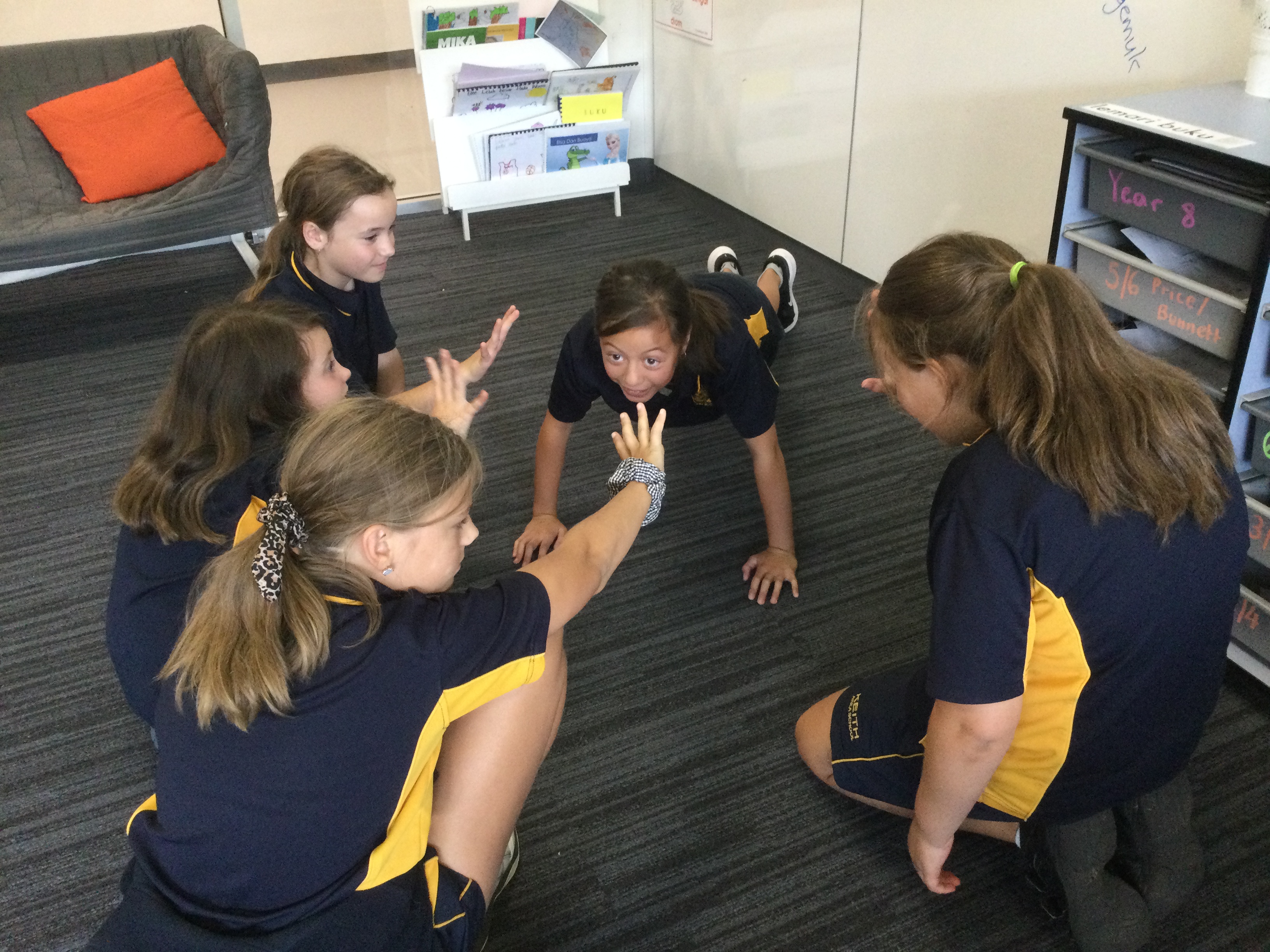
In first term, I did the ‘Murid Nakal’ story with middle primary. I absolutely love this story – great for acting and also perfect for reviewing behaviour management structures in the target language! I did change the ending this year because being at a new school and not knowing the staff or community, wanted to avoid recrimination for using a story that includes smacking! My 2021 version changed the hitting to push ups which worked but was nowhere near as funny! Here are some pictures of a lesson where we used Martina’s freeze frame idea.

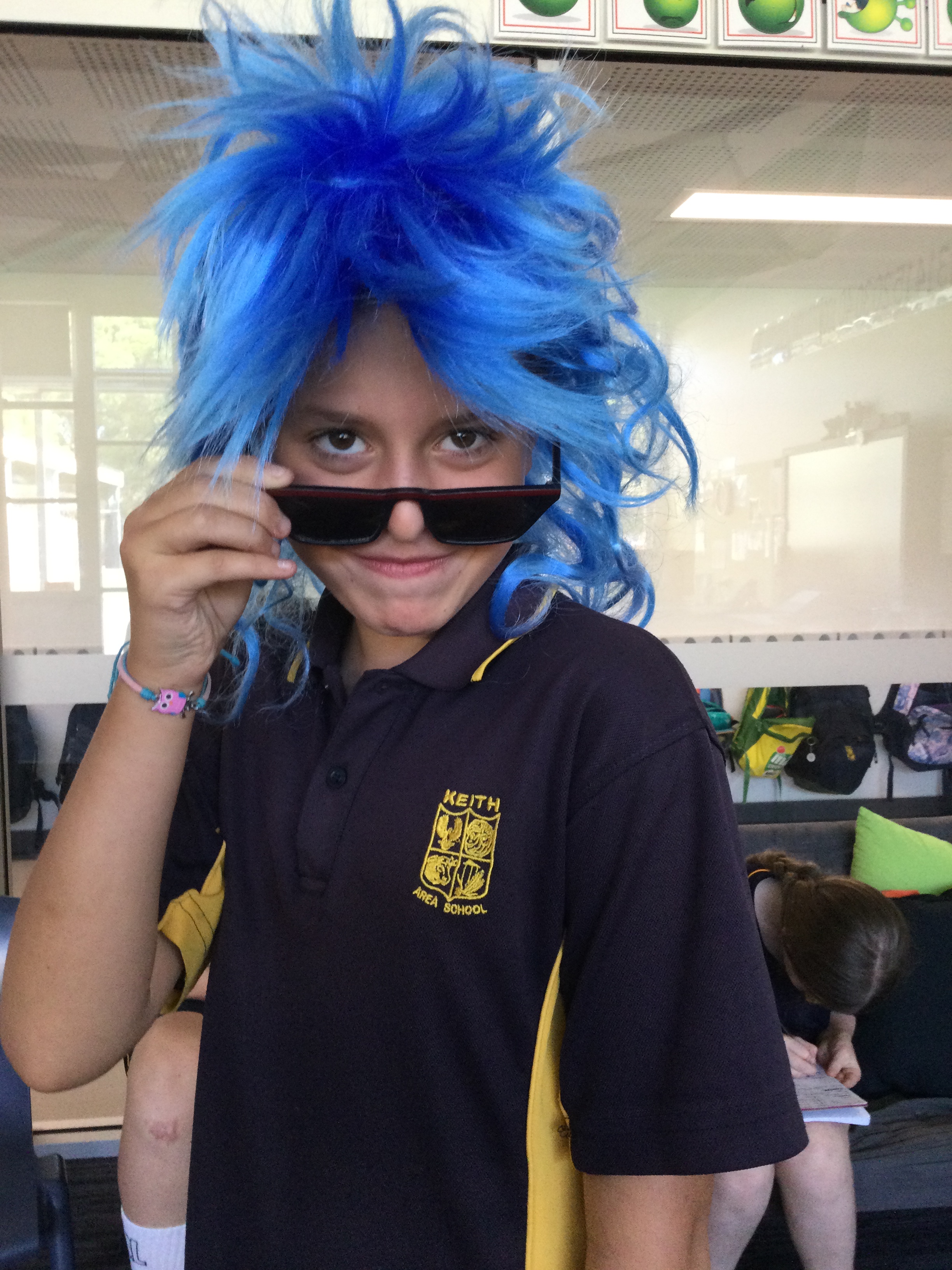
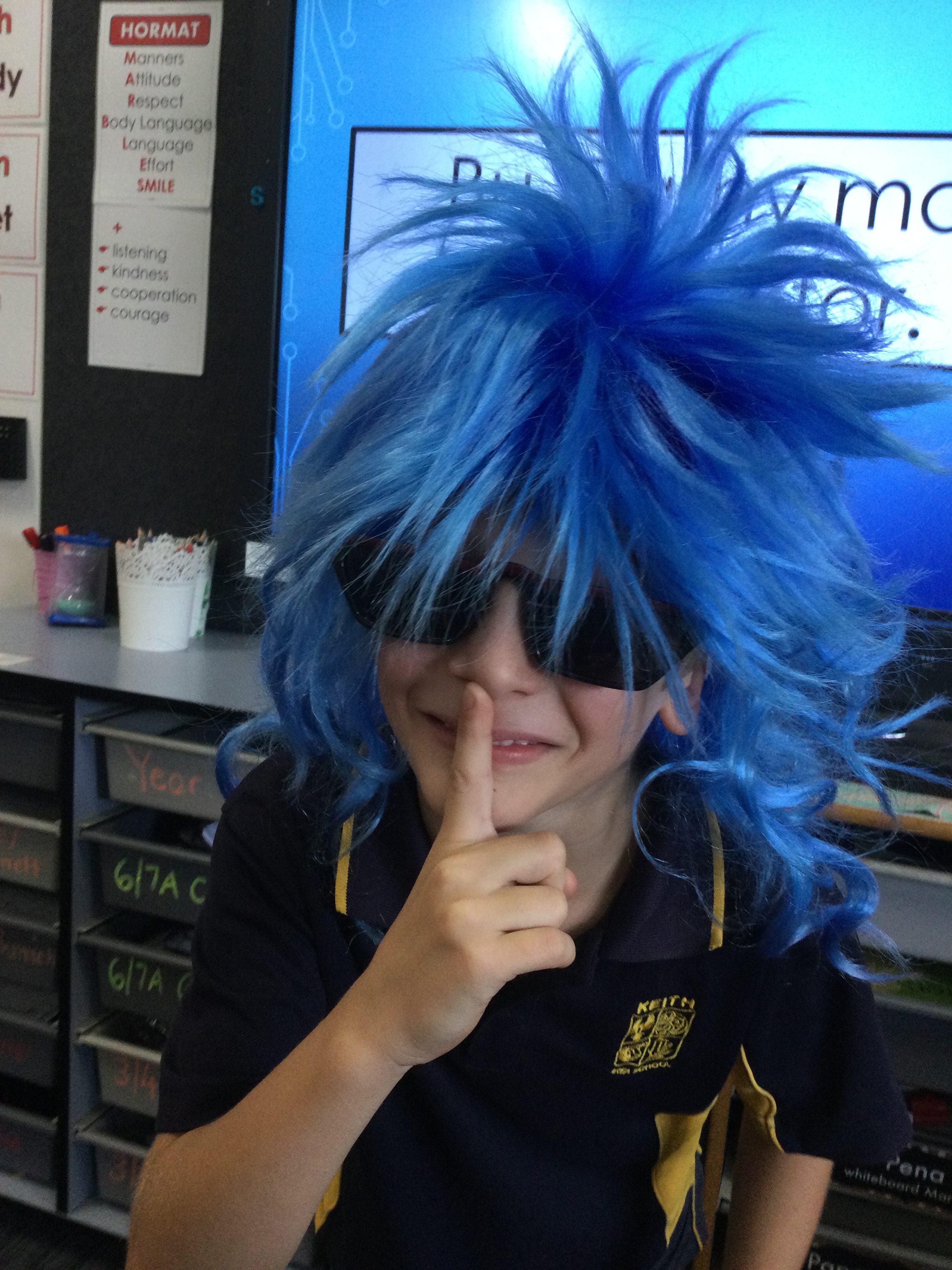
In term 2, the next story middle primary did was the Tutup Pintu story. The students absolutely loved acting with the wigs my daughter gave me. Acting out the story is enjoyable as it not only provides the students with the opportunity to create their own class version but also gives the more outgoing students a chance to be outrageous which is extremely entertaining. In fact, being entertaining is one of my criteria that any student auditioning must demonstrate. Other criteria include following the storyline exactly as it is determined by the class and only speaking when your character has a line. Here are some of my amazing actors:

Year 5/6 Movie Talk – Hadiah

Kursi Luar Biasa
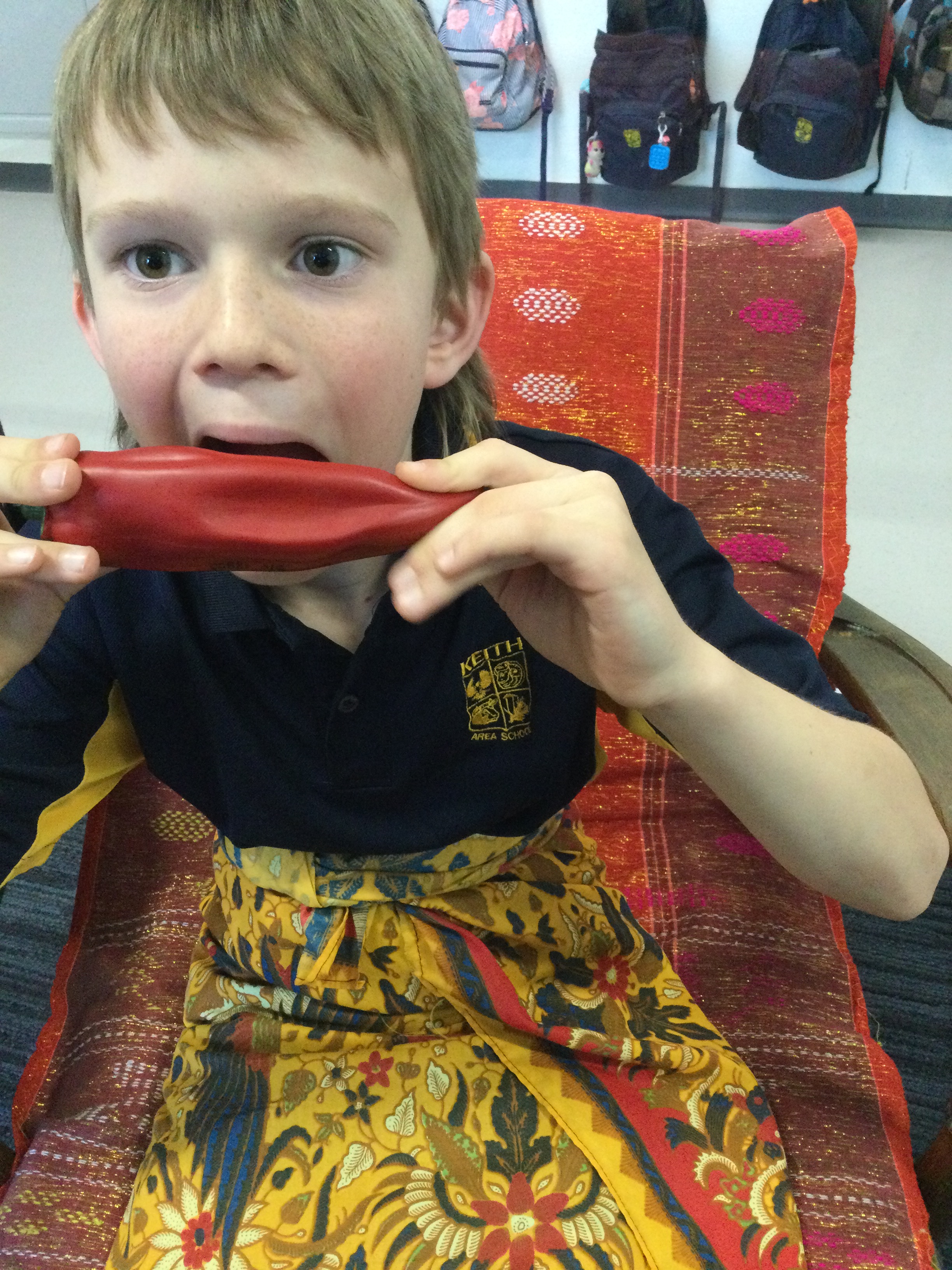
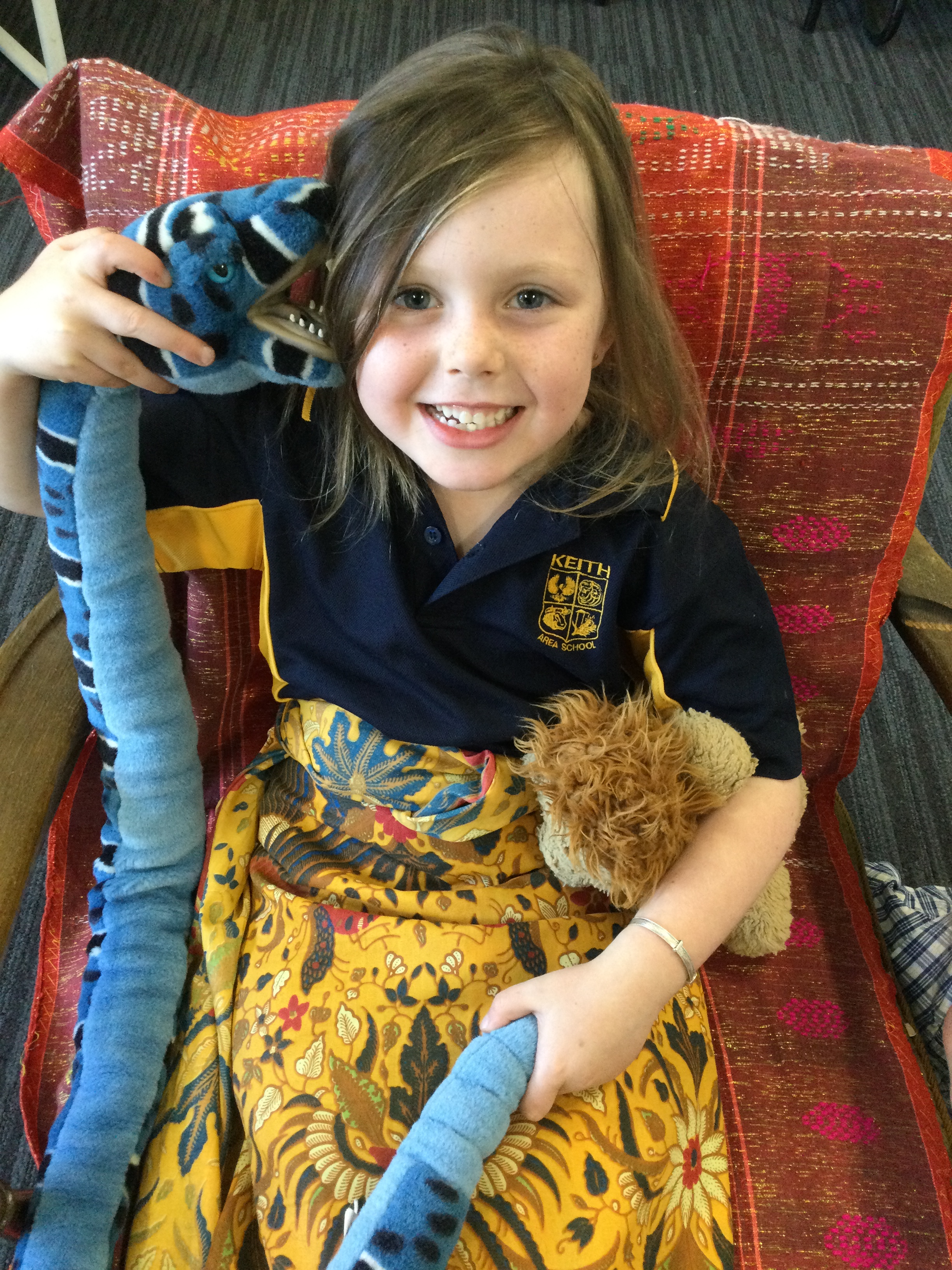
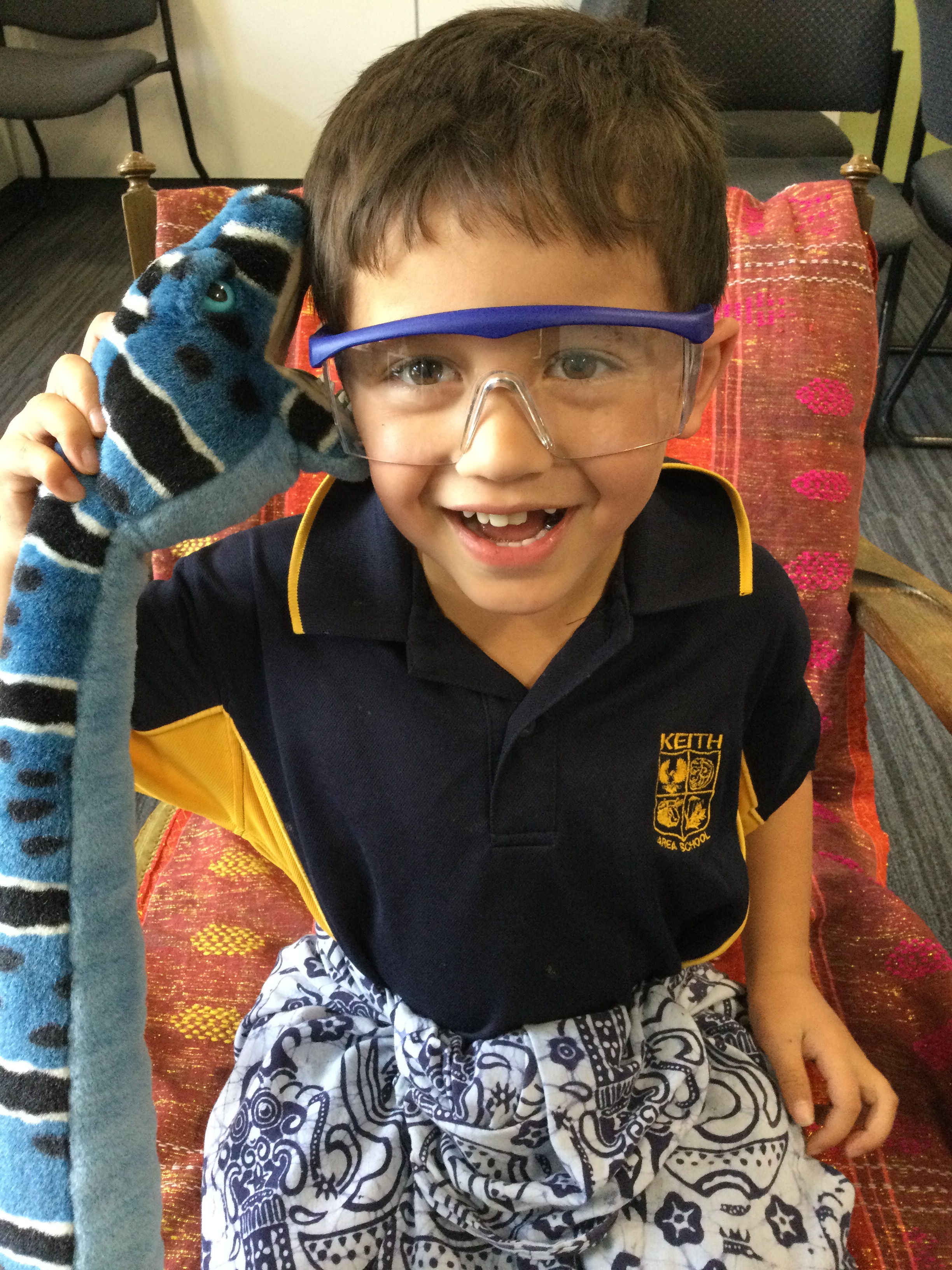
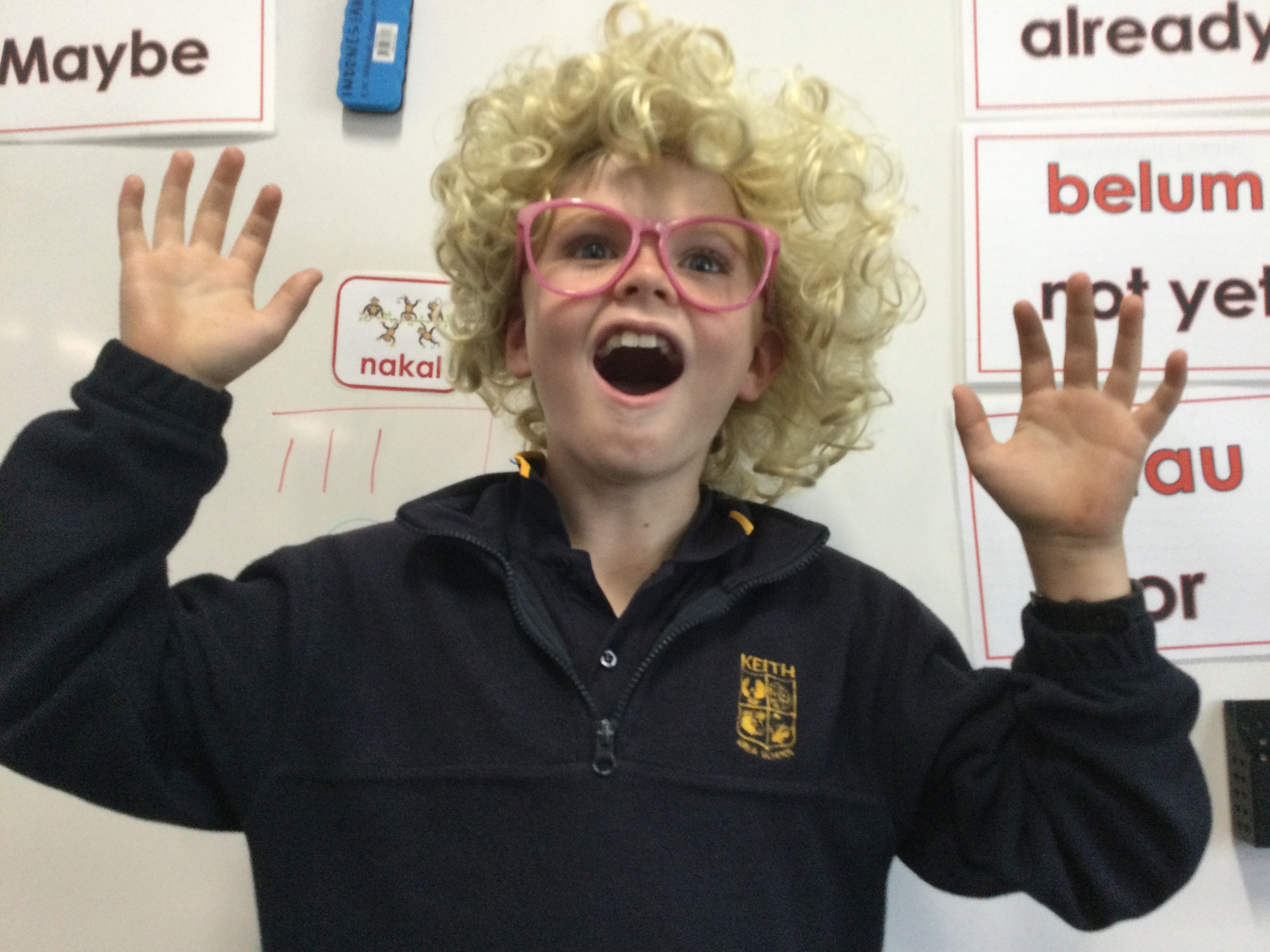
All year levels love KLB! I’ve particularly had success this year with JP classes. It is the perfect vehicle to spotlight one student with quirky questions using target structures. This term they did Catharina’s Ular story, so I enjoyed asking students ‘mau’ sentences incorporating ‘ular’ , ‘atau’ and alternatives based on previous story structures or cognates. I have two snake props, so students could choose between ular besar dan ular cobra! Another question that worked this term was introducing the concept of sarong. This provided discussion about the difference between sarongs for males/females. To begin, I just asked if students , “Mau pakai sarong laki-laki atau sarong perempuan?” After a few weeks, I added the question, “Mau pakai sarong ungu atau sarong kuning?” Great way to limited colours in a meaningful way. I then added the alternative of glasses. “Mau pakai sarong atau kaca mata?” While ‘kaca mata’ is not a cognate, I chose it because not only do I have a selection of different colours but as someone who was embarrassed to wear my glasses at school, I love ways to connect with those students who also wear them!! In the last photo, you’ll notice a Foundation student wearing a sarong and a pair of glasses. He answered my question with, “sarong DAN kaca mata!!” I was thrilled!!