PQA, Point & Pause, Circling – Weeks 1-3

This term I have been exploring the TPRS/CI pedagogy with my year 5’s and the year 5/6’s- basing it all around Ben Slavic’s book, “TPRS in a Year”. I read somewhere, probably in his book, a good way to start is to focus on new aspect/skills, one by one, and in doing so, one hopefully can develop a basic level of proficiency within a year.
My first week’s focus was PQA – Personalised Questions and Answers. This skill is important for getting to know the students personally and is especially valuable at the start of a new school year with brand new students. Interestingly, even though I have been teaching most of my students all of their primary years, there is still a lot I don’t know about each of the three hundred and thirty five students I teach. This understanding of PQA only gelled recently and thus instead of PQA in my first week, I mistakenly focused on circling. Last week my focus was ‘point and pause’. When pointing to new structures or the important question word posters, give students the time to grasp the word and its meaning by not speaking for at least 4-5 seconds. I could actually hear the ‘kerthunk’ Ben Slavic talks about when pointing and pausing for students. This week, I will be focusing on circling again however this time I have added a few extra pointers to help develop it even further.
Each weekend in preparation for the upcoming weeks lessons, I write a mini script for my TPRS lessons based on a segment of the master dialogue that I wrote in the holidays. The master is a work in progress and goes roughly like this:
S (Seller)- Good morning
C (Customer) – Good morning
S How are you
C good thanks
S What would you like to buy?
C I would like to buy fried rice
S OK
C How much is fried rice?
S ten dollars
C OMG. That is too expensive.
S How much?
C five dollars.
S OK. How many would you like?
C two please. How much is that?
S ten dollars.
C Ok, Thank you
S You’re welcome
C/S Goodbye

In week one, the target structures were:
1.mau beli apa? – What do you want to buy?
2. Saya mau beli ….. – I want to buy …….
3. penjual – seller/shop keeper

In week two, the target structures were:
1. berapa – how many
2. katanya – he/she said

And in week three the target structures will be:
1.terlalu mahal – too expensive
2.berapa satu? – how much for one?

Student progress has been very slow so far but I only have two fifty minute lessons with each class per week and one of those lessons clashes with choir which affects a handful of students. At the beginning of the term, I explained that any work missed due to choir, was not going to be revised in any great depth during the following lessons and if students thought this was going to be too difficult then they would need to think very carefully before deciding to continue with choir. Several of them wisely made the decision to drop choir, but there are still about four from one class and two from the other. I also have to keep reminding myself that my students are only ten years old and that going slowly is VERY important. It is far more important to have comprehensible input than rush to meet the looming deadline of having the entire script completed by the end of term.
My weekly scripts take a small section of the above dialogue and focus on just that part. Here is my teacher script for next week to give you an idea of what I am talking about.
Lesson # seven
Focus Structures: Berapa satu – how much for one (fried rice)
Astaga. Terlalu mahal – OMG, that is too expensive

Good morning students.
I want to go to market. oooh
Who wants to go to market?
That’s right, Bu Cathy wants to go to market.
Where do I want to go?
That’s right, Bu Cathy want to go to market.
At the market, I want to buy fried rice. ooooh
What do I want to buy?
That’s right students, Bu Cathy wants to buy fried rice.
Do I want to buy fried rice or yellow rice?
That’s right students. Bu Cathy wants to buy fried rice.
Why do I want to buy fried rice?
Ss to suggest a reason to which I will rephrase in a complete sentence eg That’s right, I am hungry.
Ask the students, How much for one fried rice? Choose the most ridiculous answer.
One fried rice is one hundred dollars. oooh
How much is the fried rice students?
That’s right, The fried rice is one hundred dollars.
What do you think, is that good or not?
That’s right students, one hundred dollars is too expensive
OMG, that is too expensive.
Where is the rice seller? Choose a student to be the seller and call them to the front.
repeat dialogue:
C Good morning Mrs/Mr
S Good morning. What would you like to buy?
C I would like to buy fried rice. How much for one fried rice?
S one hundred dollars.
C OMG That is too expensive. How about (5) dollars?
S OK. gives fried rice to customer and receives money
C Thank you
S You’re welcome
C/S Goodbye

Repeat this dialogue using hands as puppets a la Senor Howard.

~~~~~~~~*******~~~~~~~~~*******~~~~~~~~*******~~~~~~~~~~~*****

I have found that I need my script to be extremely detailed and also close to hand for when I reach a point and forget what comes next because my mind has gone blank. I learned that the hard way. I also read through the script just before the lessons which luckily are back to back, to have it fresh in my mind as well. If during class, I walk off without my script and backtrack for it, not one student has made a comment. They understand that I am a learner too and need my notes which is lovely.

In the very first lesson, I planned a brain break activity to get students up and moving after sitting and listening for so long and it turned out to be a huge winner. It is so incredibly popular that it is now requested at the start of every lesson by both classes. I wrote on paddle pop sticks either penjual …….. or mau beli ………… ensuring that there is a pair for each item.
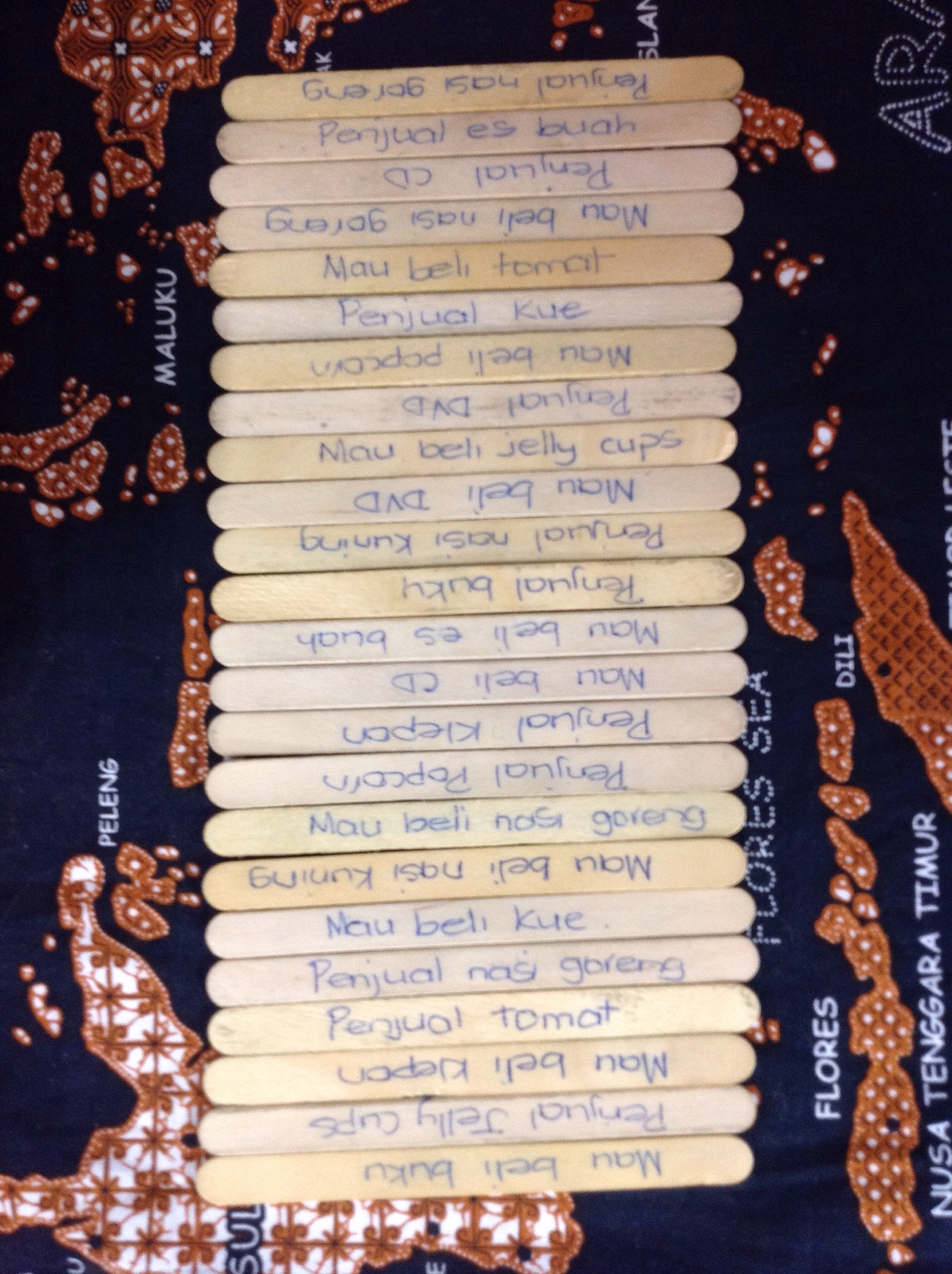
IMG_0828.JPG
The vocabulary for the items is lifted straight from the pasar stalls that classes are each organising for the end of the term. The paddle pop sticks are in a jar and students choose a random stick.
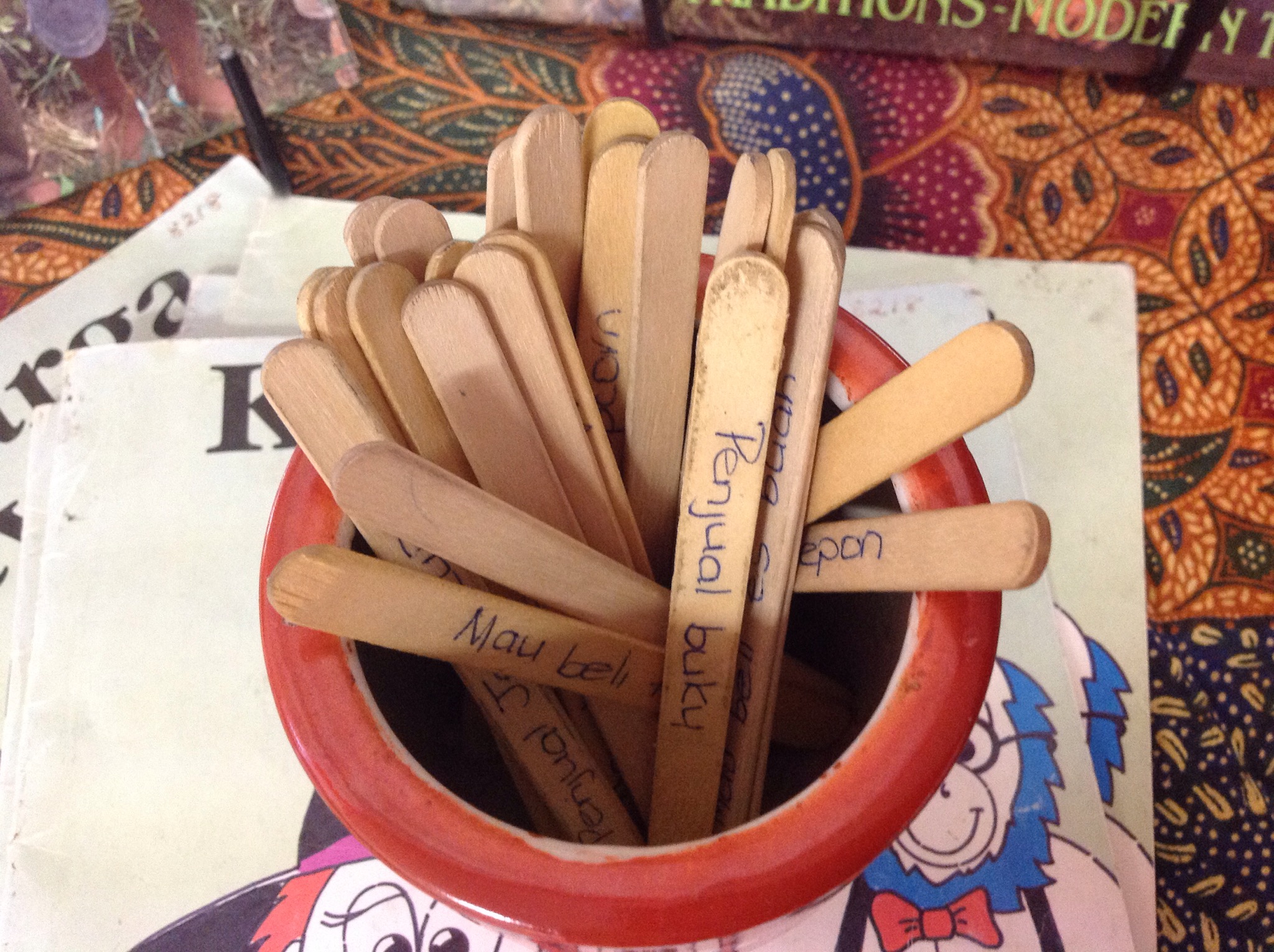
IMG_0825.JPG
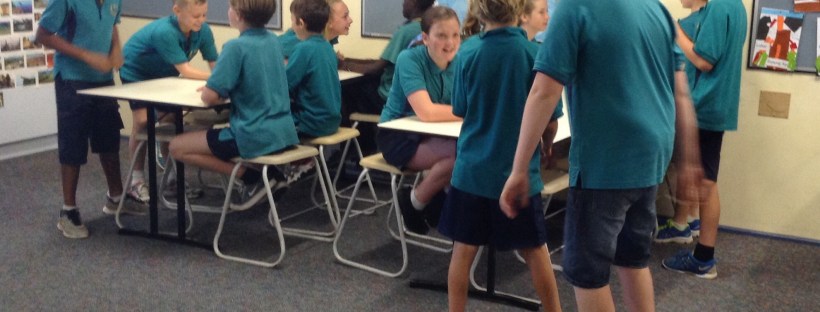
If they are a penjual they sit at a table and wait for a customer and if a customer, sit on the floor and wait till everyone is ready. Customers then have to move around to converse with each seller until they find the seller selling the item they are looking for. Students converse using the dialogue covered earlier in the lesson repetitively. When they find their pair, they complete the dialogue and then the customer chooses either sits on the floor waiting for the others to finish or continues asking other sellers to practise further the structures.
So easy to organise and so much fun. I usually join in if there are left over pop sticks which gives me the perfect way to assess the language of individual students.

It’s Not Personal!

I want to apologise to friends and family for my recent preoccupation and online silence. I confess that it is entirely due to my latest obsession; TPRS/CI. Getting my head around this pedagogy has been so absorbing and has left little spare time for anything else. It’s all I can think about! Scary. I rarely drop into Facebook these days, Pinterest friends haven’t seen me for over a month, WWF games are nowhere near as frequent and at school recesses and lunch times are the perfect time to quickly watch a troubleshooting youtube video pinpointing the skill I am currently focusing on and needing extra clarification.

This is largely because in the school holidays I discovered two yahoo groups; one called moretprs

IMG_9111.PNG
and another called elementarytprs.

IMG_9112-0.PNG
The former is full on and if I don’t check my emails regularly, I can be overwhelmed by up to 50 emails weekly. While most who post on this yahoo group are American high school Spanish teachers, often the big names of TPRS also check in and add their perspectives which is really cool. The elementarytprs group is very quiet by comparison which is a shame as I think I would connect more with other language teachers applying TPRS with younger students who have limited TL vocabulary.
The topics currently being covered by the moretprs group are largely above my TPRS head, however they none the less help slowly but surely fill in the gaps of my TPRS knowledge. Up until very recently, acronyms such as ACTFL, FVR, TPRS/CI & PQA were foreign but are now meaningful, thanks to this group. Trending topics currently include the usefulness of language labs (most agree iPads/iPods are far more versatile), the value of teaching thematically (not recommended by TPRS guru’s) and the recommended rules to implement during storytelling. Another aspect of this group I really like is the balance of theory and practice and how each supports each other. Here is a great blog post which demonstrates this.
Once my emails are checked, I then open my WordPress blog reader. Here I read the latest posts written by language teachers from all over the world who are all at different milestones on their TPRS/CI journey. Each post has its own focus and inevitably includes links to other blogs and so my blog roll constantly increases! I love discovering new WordPress blogs because they are the easiest to follow but more and more bloggers are choosing other platforms which are not and some don’t even include the option to follow! So I have bookmarked them however have yet to work out how to check them regularly. There are definitely not enough hours in the day!
While it is great to read about other teachers and their successes, as a newbie with no local (let alone national that I know about) support network, I was becoming discouraged as I feel like I am going around and around in circles (no pun intended!!) and not sure how or where I can improve. So it made a huge impression on me when I read this blog post which finished with the following:

IMG_9110.PNG

I immediately responded to which she replied with the encouragement for me to keep plugging away because while experts agree that it can take up to 3 years to develop proficiency with TPRS, bad TPRS is still significantly better than the alternative! Music to my ears and balm for my soul.

So, now my friends, hopefully you have a clearer understanding of why I have been ‘offline’ lately and can understand why my routine has changed! It’s not personal!

Astaga! What A Story!

On a high after my first lessons exploring TPRS pedagogy, I was really motivated to take it one step further and explore the skill of storytelling. A google search quickly confirmed that I would need to write my own story (Mainly Spanish and European Language stories available) so that it contained the exact language I wanted to target as well as incorporating already familiar vocabulary and sentence structures from previous unit of work.
After much thought, the story came to me one evening while walking the dogs! This is always the perfect time for me when thinking about any aspect of my writing, I work through blog posts, student dialogues, film scripts, in fact, just about anything and everything – and the best thing is that because it is just me with the dogs, once the idea has gelled, I can then say it aloud and hear how it sounds.
I wanted my story to ;
1. incorporate some language from terms 1 & 2 (myself & school),
2. incorporate some of the language we had circled the previous week (kenalkan),
3. be succinct
4. incorporate students
5. have a twist at the end
6. be easily performed
When it came together, I was so excited. I quickly returned home so that I could write it down while it was still fresh in my mind.
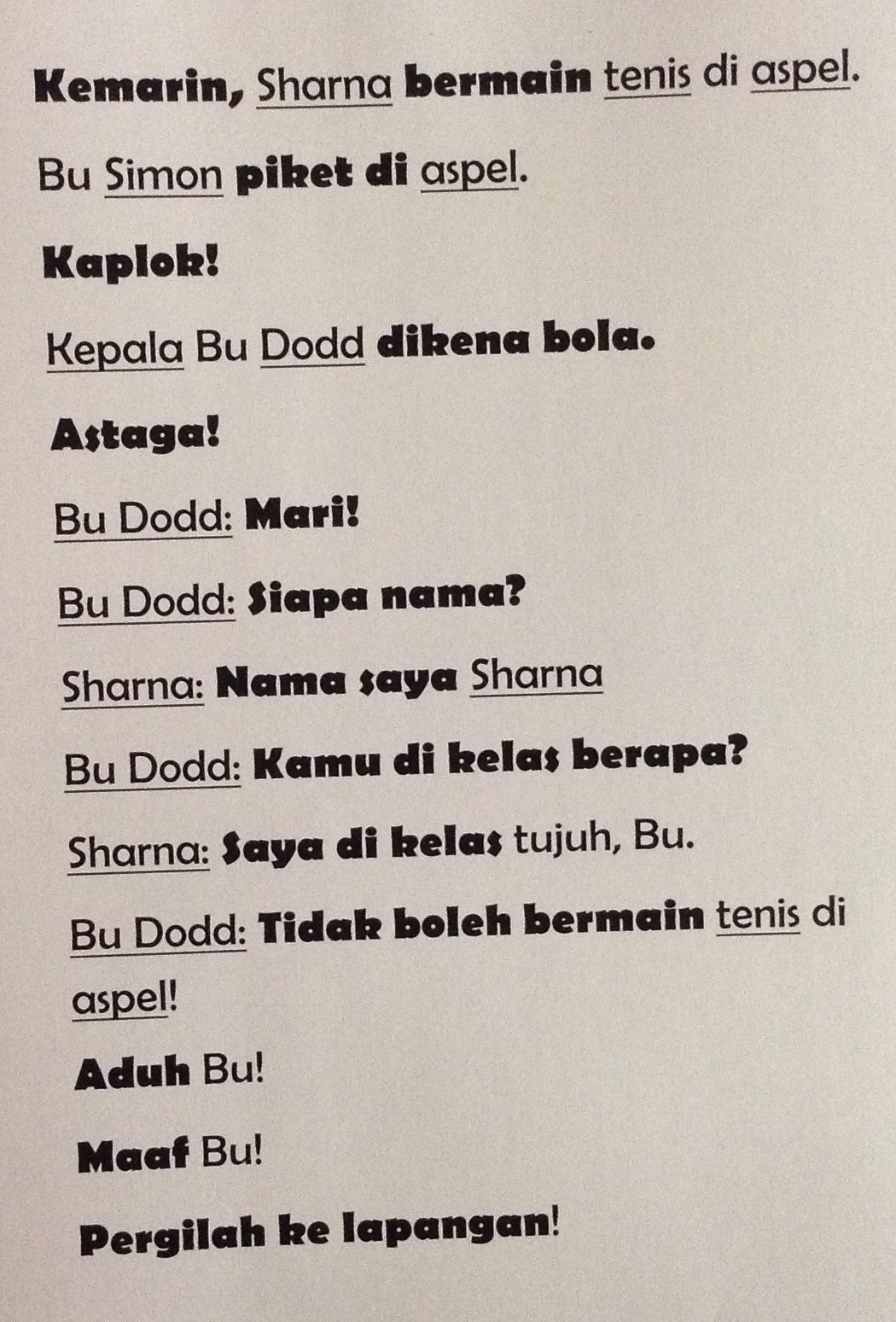
Here it is:
astaga digital

Before the first lesson, I identified the vocabulary that would be unfamiliar yet vital for comprehension:
dikena
pergilah
piket
tidak boleh
bermain
mari &
kamu
and wrote them up on the board before students arrived for class.

We then began the first lesson by focusing on the pronunciation of these new words. I next wrote the meaning for each word alongside it and asked the class to suggest a gesture for each. This was lots of fun and students were very creative. The gesture I particularly liked was for ‘piket’ (yard duty) which was the enactment of putting the duty vest on. Simple yet effective. Once the gestures were each firmed in our minds, I began circling with, “Saya bermain hoki.” Colby bermain kriket? Tayla bermain apa? Once students had relaxed with this familiar line of questioning, I invited a student to become my first actor, with, “Mari!” I then asked him, “Oscar bermain apa?” to which he replied, “Saya bermain futball.” As a class we then repeated this using gestures for each word. I then began the story and asked Oscar to mime each sentence. The first sentence included the word, “aspel” (asphalt) – vocabulary from 2nd term – and at that point in time I was surprised that not one student remembered this word which to my ears, even sounds like asphalt!! However later it became clear that as they knew it was against the rules to play football on the basketball court, they had automatically disregarded that option!! Funny really as this was the basis of my story!! (i.e. A student doing the wrong thing!)
Next, a second actor was invited to the ‘stage’ and we began the 2nd line of the story. As a class we agreed on which teacher the actor was portraying and then she mimed the gestures as I spoke the next aspect of the story.
The third line, being an action word, also hadn’t been added to the initial list of vocabulary because it was oenapapatic and I had correctly assumed that students would easily work out its meaning.
At this point in the story, I stopped and repeated these 3 lines of the story with a fresh couple of actors. Once the first actors had demonstrated the action, others became keener to volunteer which was pleasing. For the next actors, we changed the sport, the teacher on duty (pop-up for Pak & Bu with this point) and the location.
This repetition was valuable, however as our lessons are 50 minutes, I started to run out of time. So unfortunately the latter half of the story was not circled anywhere near enough for my satisfaction and consequently we didn’t even cover the final stage of the story where the twist was! Oh well….

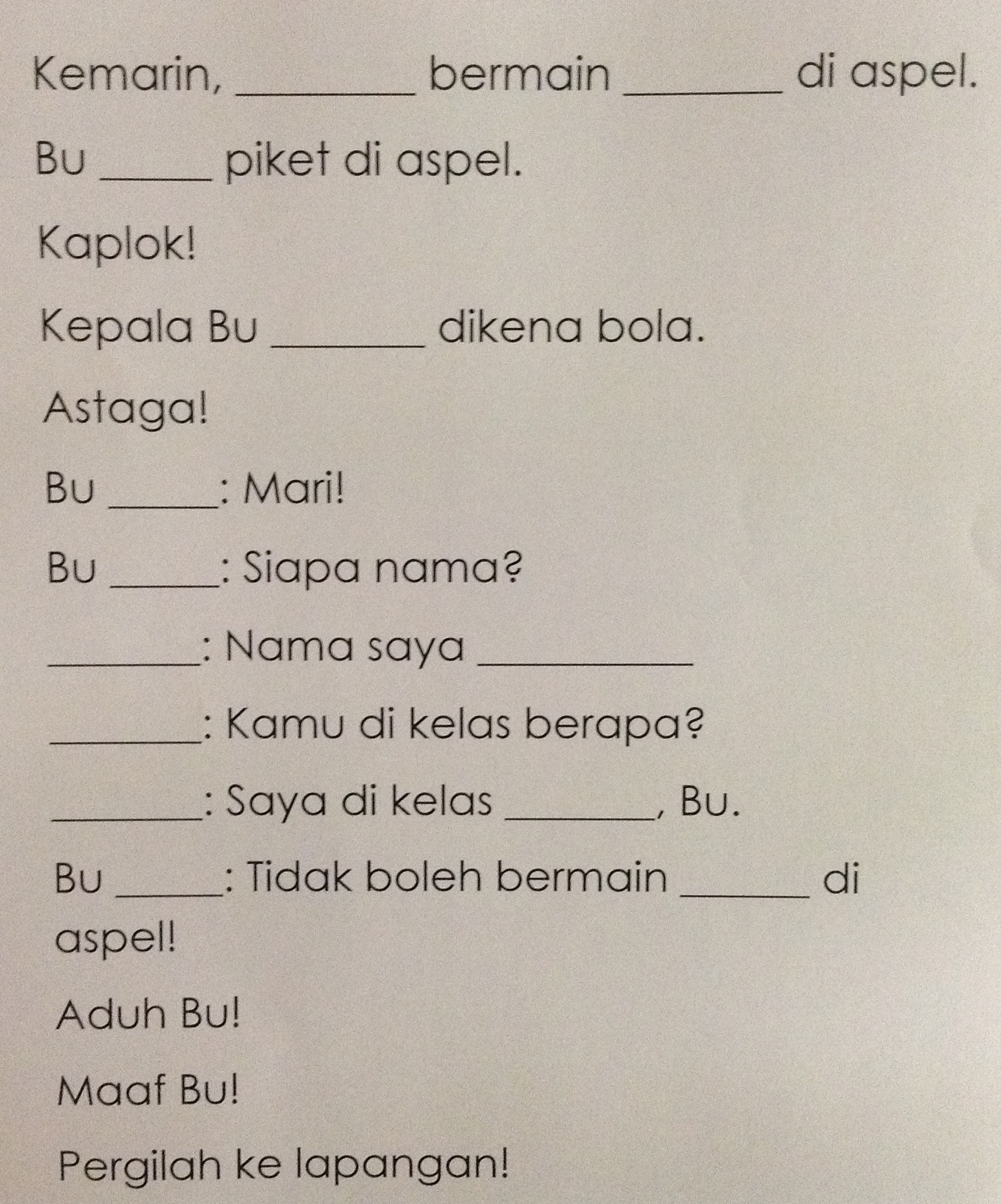
For the second lesson (and final lesson for term 3), I instructed students to form groups of 2-3, and then gave each a cloze of the first part of the story.
astaga cloze

Even though I only had this one lesson of 50 minutes to achieve quite a lot, I have discovered that having a tight timeline when working with iPads, actually motivates most students to stay on task.
Their task for the lesson was:
complete the cloze
use the app puppet pals to create an enactment of the dialogue.
use themselves as the characters (not the clipart looking characters provided by the app)
upload to camera roll when finished.

Overall, I was extremely satisfied with this extension activity with the story – mainly because of the enormous amount of oral language each student was uttering. While most groups did not finish the task, I wasn’t too disappointed with that aspect. For me, the main aim of this lesson, was to provide students with an engaging way of manipulating and repeating the sentence structures we had worked on till it became firmly entrenched in their minds. Walking around and listening to groups recording their voices reinforced just how successful iPads can help in achieving this. Some groups edited and edited and edited, each time having to repeat their lines over and over and over again until each group member was satisfied with not only the pronunciation and expression but also importantly that the actions matched the words! Even now, 3 weeks on, students still remember lines from the story. Yesterday Jamie, clutched his leg and claimed, “Saya dikena Oscar!”. How awesome is that! (linguistically not the fact that Oscar had actually deliberately bumped his leg!)
Now enjoy a few of the finished projects: