Kursi Luar Biasa

I read of an idea in which individual students enjoy being interviewed just before Sharon pointed out that we haven’t fully covered aspects of the 3-4 & 5-6 curriculum regarding student personal information.  To me the idea of a special star student seemed a terrific way to not only cover this aspect of our curriculum but would also give middle and upper primary students the chance to shine and enjoy the limelight answering questions about themselves to a captive audience.

I have also been toying with the idea of how to widen student knowledge of Indonesian exclamations, so I decided to combine both together with ‘murid luar biasa’ and translated it to students as ‘the awesome student’ however this didn’t feel right, so in the second week I changed it to kursi luar biasa and for some reason, it felt better. Luar biasa is now the new Indonesian catch phrase and has been used constantly – to my delight!

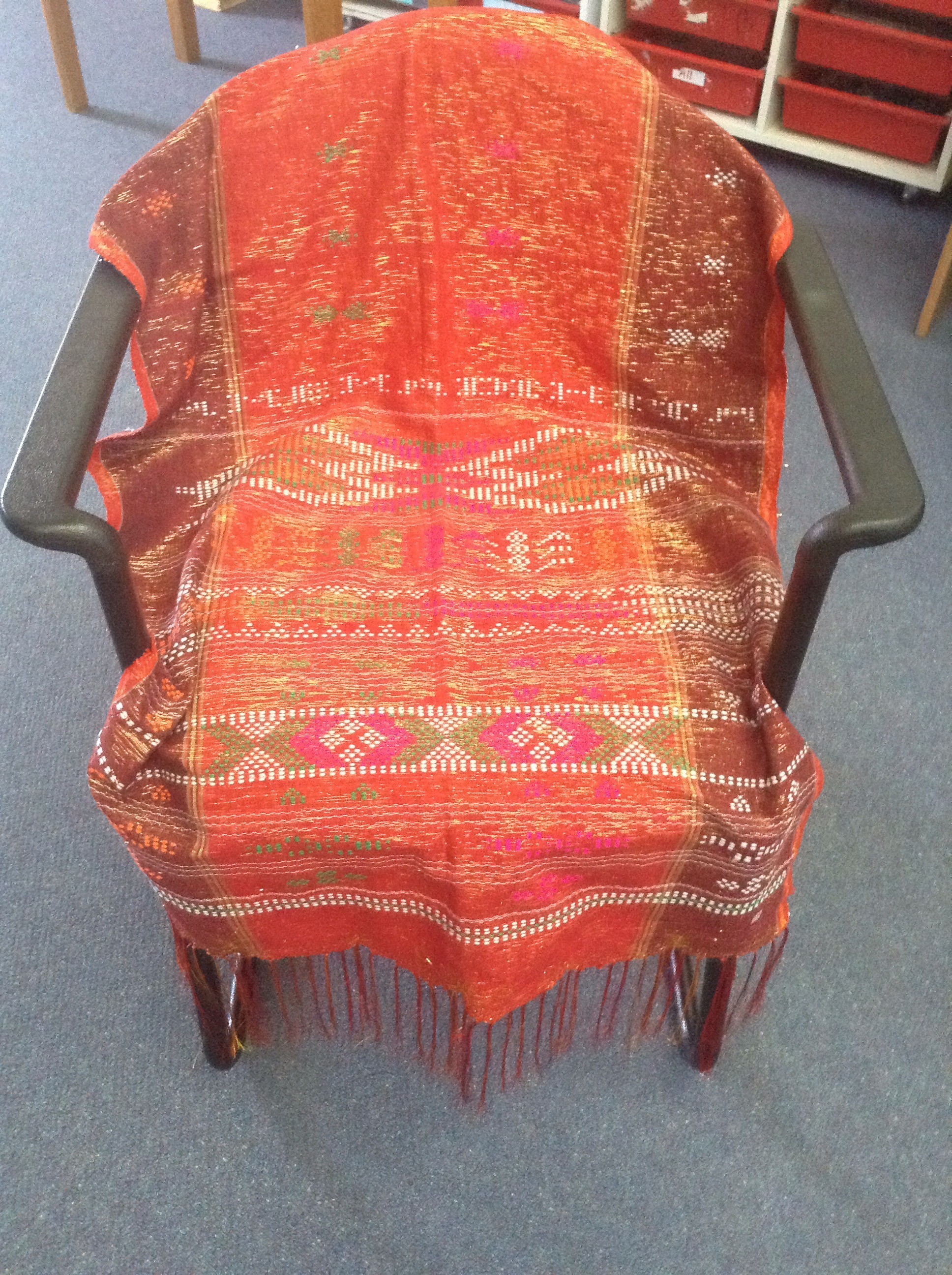
I took the secretary chair and covered it with the beautiful Batak shawl Pak Pahot gave me in February and transformed it into the kursi luar biasa.

  I explained to students that anyone can sit in the chair with ‘first in, best dressed’ (rewards students who get to class on time) however once they’ve had a turn, they can not sit in it again util everyone who wants a go has done so.
While I only trialled the kursi luar biasa for 2 weeks, it was hugely successful. I began with our stock kenalkan questions and was pleasantly relieved just how much students have remembered even though we haven’t had a ‘kenalkan’ focus since term 1 2014!! This reaffirms my belief in the power of TCI/TPRS.  Next I started thinking of other questions I could ask students and that proved challenging. Questions that incorporated language structures they were familiar with and ones that students could answer using just the language they have acquired so far.

While I had thought my questions were largely lame, all students who have chosen to sit in the kursi luar biasa chair must disagree with this because there has been no shortage of volunteers. What I have enjoyed in particular is the opportunity to talk to  just one student and learn something surprising about them. I learned that one of my families has a pet snake, which was compelling for the class as well as for me!! It was pure gold because I could circle this information to include other students by asking if they too owned a snake, who was scared of snakes, have you seen a snake, are there snakes at school etc. E.g. Jodie sudah lihat ular di sekolah or  Jamie mau lihat ular di sekolah? Another student told us using ‘gado gado’ that her budgie had died that morning because her grandmothers dog had killed it. I’d never have known if not for her choosing to sit in the chair that day. But the most heart warming part of this was when the entire class said with compassion, “kasihan” that I knew the kursi luar biasa is well worth continuing with.

The session goes for as long as I feel that I  have whole class engagement and once I run out of questions or the class starts getting restless, we stop and move on. It is the perfect way to ask students personal questions in context and get repetitions of this language. I am looking forward to honing my questioning  techniques next year as well as developing a bank of questions which not only rely on known language structures but also lend themselves to open-ended answers.

Questions I have used so far include:

Tinggal dimana?

Umur berapa?

Siapa nama?

Kelas berapa?

Punya adik?

Punya kakak?

Siapa nama adik/ kakak/ ibu/bapak?

Punya anjing/kucing/tikus/burung?

Suka warna apa?

Suka makan apa?

Kemarin kemana?

Mau punya apa?
Feel free to add suggestions!!

End of Term 4 Reflections

Fourth term is just about to finish; just one more week to go. It has flown by so quickly! As I’ve written several times, this term I focused on the traditional tale, Kancil & Buaya. During the last holidays our hub group met to adapt the story so that the vocabulary in the story was largely comprehensible for our students as well as introducing a few new structures. I think we did a great job with it and although much longer than any of our previous stories, was enjoyed by my year R – 6 students. 

My tweaked adapted version: 

Kancil berjalan kaki ke sungai.

Kancil lihat mangga di sebelah sungai.

Kancil lapar dan mau makan mangga.

Kancil tidak bisa berenang.

Kancil lihat banyak buaya di sungai.

Kancil lihat banyak buaya lapar di sungai.

Bagaimana kancil bisa makan mangga?

Kancil berkata, “Halo Buaya! Ada berapa buaya di sungai?”

Buaya berkata, “Tidak tahu!”

Kancil berkata, “Saya manu menghitung. Ayo buaya, antri.”

Buaya antri.

Kancil melompat dari buaya ke buaya dan menghitung.

Satu, dua, tiga, empat, lima, enam, tujuh, delapan, sembilan, sepuluh.

Kancil berlari dan tertawa.

Kancil makan mangga.

Buaya marah.

Kancil terlalu pandai.

Isn’t that an awesome adaptation? The vocabulary for the original story was so complicated! It is so rewarding to turn an incomprehensible story into a comprehensible story! 

I then parred  the story down even further for junior primary students. Their simplified version looked like this:

Kancil berjalan kaki.

Kancil lihat mangga.

Kancil mau makan mangga.

Kancil lihat buaya.

Kancil berkata, “Saya mau menghitung buaya. Ayo buaya, antri.”

Buaya antri.

Kancil melompat dari buaya ke buaya dan mengitung.

Satu, dua, tiga, empat, lima, enam, tujuh, delapan, sembilan, sepuluh.

Kancil makan mangga.

Kancil senang sekali.

Each week, I focused on a new structure from the above story and incorporated it into the JP story. It became an embedded reading! The most useful structure was undoubtedly ‘tidak tahu’. What a great phrase! I love how students have acquired ‘tidak tahu’ so thoroughly and use it appropirately in conversations!

My major reflection regarding this story is that it would be a great story for first term when we have 11 weeks rather than fourth term which is more like an 8 week term! There is so much potential for this story. I feel like we barely skimmed the surface of its potential.

To finish up the terms work, students did a free write and played the word chunk game last week and then this week I am going to experiment with Kahoot! using my 6 ipads. I have created a 20 question game to review the story. Feel free to open Kahoot! and search for Kancil dan Buaya. While there, have a look at the Dadar Gulung review game I made for my 6/7’s. It was such a success! It turned a group of year 7’s who are too cool for school, around last week. They begged to play it 3 times!! The amount of repetition was awesome. I did have a few connectivity issues which I emailed Kahoot! about. They have replied already, so I will discuss their comments with our IT guru tomorrow to see what needs to be done before Tuesdays lessons. 

iFLT and NTPRS!

Martina Bex's avatarThe Comprehensible Classroom

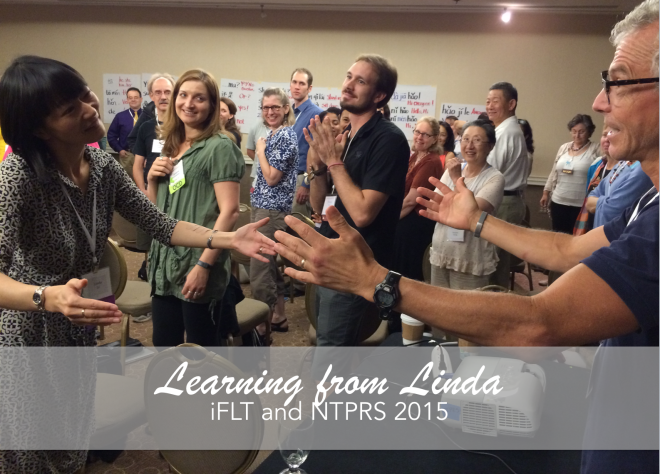
That’s a wrap! The big summer CI conferences are done. It was a busy two weeks for me and for many other presenters and attendees that were present at both conferences. I am exhausted, overwhelmed with new ideas, and nostalgic thinking back on all of the new friends that I made that I won’t see for another year.

I have a few posts planned for some ‘big’ ideas from the conferences, but for now I’ll focus on the basics: how to help your students succeed when you are providing any form of oral input (story asking, PQA, etc.)

Screen Shot 2015-08-06 at 11.40.35 AM

When I first learned TPRS/CI, I did so sitting in Russian demos by Michele Whaley. I always thought that I was really good at learning languages–you know, a really fast processor! As it turns out, Michele is just a really, really great teacher. Over the years, I have discovered that I’m not a fast…

View original post 764 more words

How to do Picturetalk

cstolztprs's avatart.p.r.s. q&a

Other thanMovietalk, Picturetalk is the single-best “add-on” to T.P.R.S., and an amazing strategy for non-c.i. teachers. It reinforces already-taught vocabulary and grammar, and is also a superb way to introduce new vocab pre-story.

Picturetalk– what Ben Slavic calls “Look and Discuss”– is simple, easy, low-prep and effective. Here arethree ways to do Picturetalk.

a) Find a picture online which contains the “things”– people and actions– in your most recent story. So, if your story is about a poor Guatemalan kid who wants something to eat, you find a picture of that, or (say) a picture of a homeless person.

b) If you have never taught the vocab you want to use, write on board (or project it) along with translation. Make sure the kids know what the words mean.

c) Project the picture, make statements, and ask questions about the picture and about the things you’ve said…

View original post 1,008 more words

Indonesian early readers captivate kids and teachers

Reena Balding's avatarAyo! Let's go!

Michelle Dudley, the Australian author of the Our Jakarta Series that was reviewed in an earlier post, graciously agreed to answer my questions about how her series of 30 books came about.

What inspired you to write the Our Jakarta Series? Had you written other books before (or since)?

Michelle Dudley, Yangon, February 2015 Michelle Dudley, Yangon, February 2015

Our Jakarta Series bilingual box setI taught at the British International School Jakarta (BIS) in their very first pre-school in 1993 and 1994 and again from 2003 to 2007, initially part time, then full time in Reception and in Pre-School. The school has a strong focus on early literacy and as a teacher of young children I was always trying to find ways to inspire, challenge and connect real life experiences and the printed word with the young children from many nationalities in my class. The school also had a policy whereby the classroom teacher had to listen to each child read every…

View original post 1,951 more words

Week 4 Reflections

For various reasons, I wasn’t able to pre-read my scripts before each of the TPRS lessons last week. Usually, I sit in my classroom over lunch and refresh in my mind both my pre written scripts (see last weeks post) and watch TPRS YouTube videos which both helps me focus on the TPRS skill I will be targeting as well as confirming for me the benefits of TPRS. However last week, the year 6/7 classes were cooking (klepon) and while this only involved 2 classes, the running around ensured I clocked up well over 10,000 steps those days!
Facing year 5’s and 6’s holding my script in one hand while furiously trying to remember the gist of it so I didn’t have to keep looking at it and at the same time keeping the momentum going was very challenging. In fact so challenging, I felt very flat after both lessons (which were back to back lessons). On review, I realised I had failed everyone with my total dependence on my scripts ; both myself and the students. It had been a hodgepodge.
So for their next lessons, I ditched my scripts and followed my gut. I like to think I have a reasonable feel for the basic (VERY BASIC) concepts of PQA, so instead of focusing on my script, in both lessons, I was confident enough to build a dialogue using student input. My first request was to give our actor a name. Suggestions included many names I have never heard before. I went with one because I liked the sound of it; Stampy Longnose. Apparently he is a well known YouTuber! With the structure being ‘mau beli’ (wants to buy), we decided where Stampy Longnose wanted to go and what he wanted to buy. It was loads of fun and lots of laughs. I found that lesson so much more enjoyable.
With my second class, I tried something very different. After reviewing together the language structure (same as first class), I asked them to pair up and create a shopping dialogue. I gave them some planning and rehearsal time and then we listened to those who wanted to share. I gave no other information and interestingly not one pair used paper to create their dialogue. I was blown away by their grasp of all the language we have covered this term. One student, who has previously consistently struggled in Indonesian lessons, excelled. She worked with a partner who was absent last week, so their dialogue reflected mainly her learning and it was brilliant. She even used ‘terlalu mahal’ (too expensive) appropriately and with no prompting!! When I consider students like E, who are blossoming with TPRS pedagogy, it reinforces to me the huge positives of teaching a language this way.

Next week I want to focus on:
1. Teaching to the eyes
2. Determining the ‘Barometer Student’ in each class &
3. Speaking sllllooooowwwwlllllyyy…….

How was your week?

Using Chatterboxes In Indonesian Lessons

What a great idea this is! Imagine the questions that could be written under the flaps and also the range of possibilities for the top 2 flaps. The possibilities are endless and have so much potential.
I now want to make my own YouTube video with a native Indonesian speaker making a chatterbox and giving the instructions in Indonesian. Great for a focus on language structures such as lipat, menulis dan potong,.

Most of us remember these from our childhood. But how many of us remember what they are called. I asked my facebook followers what names they used for this in English or Spanish. Here’s what we got:

http://spanishplans.org/2014/11/04/making-a-fortune-teller/

Halo Boss – English Borrowings In Indonesian by Ivana Amerl

I highly recommend this link if you are interested in the language of Indonesia. I discovered it when searching for cognates!!

It is very interesting and includes information about the following:

• A brief history
• Indonesian in the 3rd millennium
Era globalisasi and international words in Indonesian
• Modern living and English loan words
• What’s your name?
• False friends
• Further reading
• Next in the series

Friday’s Featured Language: Indonesian

Wouldn’t something simple like this be great on school websites to not only promote our Language programmes but also to give some background and history.

polyglossic's avatarpolyglossic

I am very excited to present my newest regular feature: Friday’s Featured Language! Every Friday I will be featuring an audio clip and text translation from a real native speaker of a language.  This will give speakers an opportunity to share a little bit about their language with us, and will give us an opportunity to hear what the language really sounds like!  Did I mention I’m really excited about this project? (Sorry for the excessive use of exclamation points in this post!)

My very first featured speaker is Thiyani, a native speaker of Indonesian (or bahasa Indonesia).  Thiyani grew up monolingual in Indonesia and now lives in the USA.  She speaks English in her day-to-day life, but in her home she speaks English, Indonesian, and Javanese.  She says what she likes about language in general is “its connection to culture.”

Indonesian is the national language of Indonesia, where…

View original post 272 more words