Using the Book Creator app in the Indonesian Classroom

Last term, the middle primary classes continued their focus on our school with the aim of creating a digital book about PEPS for our sister school. After listening to recommendations from other teachers about the best app to use, I settled on Book Creator for several reasons. A main one being that one of the teachers who recommended it was also using it, so it made sense that we explored it together.

Each of the 4 classes had specific areas of our school to focus on, to ensure that each area was covered. Then, from those, students could chose one for their own writing. Each class then brainstormed for ways in which to incorporate a verb in a very simple sentence about school areas. I wrote them all down and then as a class, we translated each of the sentences. Most classes ended up with a sentence similar to, “I like playing in the gym” which translates nicely: ‘Saya suka bermain di aula’. Each class then voted on the sentence they preferred and they then had to write a sentence about their area using the model that they had both chosen & translated! This worked very well because it gave the more capable students scope for imagination and creativity and for those struggling with aspects of literacy, provided them with a sentence they could either use entirely or change very slightly.

I then introduced the iPads that I had bought with my grant monies. With the first class, I walked them through the basics of Book Creator, but luckily the following day we had a student free ICT focus day where we discussed how students can develop 21st Century skills by working it out by all themselves. So with the next class, I gave out the iPads and the only heads up I gave them was the name of the app and what had to be included in their book – a front cover, their sentence written in English & Indonesian and a recording of them saying their sentences. I encouraged them to firstly try themselves, if that failed, then to try 2 more things before asking a friend. I was the absolute last option – mainly because I was also learning how to use it. For the first Book Creator lesson with each class, I finished the lesson with the students all sitting on the floor in a circle with the iPads. This allowed those still working to continue working while listening. In this forum, students who either were still stumped on an aspect had the opportunity to ask publicly or even better, for students who had discovered something really cool, to share it with the others. I remember vividly one class where a student had worked out how to enlarge the text, change the font and change the colour of a page and as that student shared, everyone was following along and experimenting with their own ‘book’! It was so exciting.

Students very quickly grasped the finer points of Book Creator. Students originally were in teams of 2-4 as there are only 5 iPads in the Indonesian classroom. I did this mainly to encourage collaboration, but with a task such as this was, more than 2 students to an iPad meant that the waiting time was too for some of them, so I ended up borrowing the recently purchased bank of 8 which improved the student/iPad ratio significantly.
It wasn’t till the holidays that I had a chance to look at the final products. I then learned that one of the features available in Book Creator is that the books can be combined, so I had this great idea where I could amalgamate all the books into one large book, but this great idea was disbanded very quickly when I discovered that to combine books, all books had to have the same page format and be on the same iPad. I also discovered that to combine, the first book has to include the front cover for them all as all subsequent front covers are not included.Still, it is a great idea and one that could be very useful.

Following are some of the things I love about using Book Creator in the classroom:
– If project has sound, it can be exported entirely to ibooks, the camera roll or even emailed (the quality deteriorates with this last option)
– airdropping to another iPad’s camera roll is possible & very easy
– If exported as a PDF, sound is lost
– Not only can students record their voices, they can also video themselves and import that into a project!
-Students can import photos or draw pictures
– to add to a blog, upload straight to Youtube!

If I could change aspects of Book Creator, all I would do is:
-To export projects from iPad to iPad so that projects can be combined

Finally here is a note to self for the next time I use Book Creator in the Indonesian Classroom:
1. Remind students not to use their surnames
2. Have students using the same iPad to use the same page for each project, so the combine pages is an option.
3. The title of a book must reflect the content of the book and the title and author names also need to be written underneath each project.
4. Each project would look finished with a back cover – maybe incorporating a kenalkan!

Have you used Book Creator in the Indonesian classroom successfully? My students all absolutely loved it and have repeatedly asked when we are next using iPads again!

Mystery Skype – Can It Be Successful In Australia?

I recently bought 4 iPads using the SA e-partnerships with our sister school grant monies and these have increased my total number of iPads in the Indonesian room to 5, which although is awesome, still means a 1:6 ratio of iPads to students. Our one Skype session with our sister school was very successful and after reading about one class having several Skyping conversation happening simultaneously in a classroom, I have visions of that happening in the Indonesian classroom before the end of the year with our sister school, Bakti Mulyar 400, using the iPads!

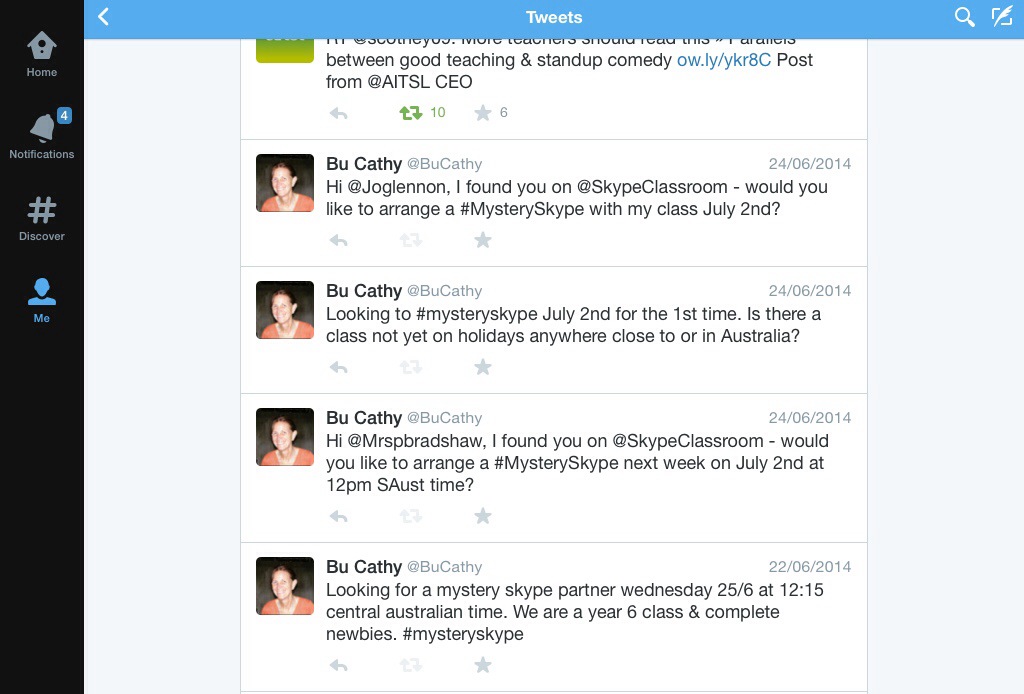
But in the meantime, I began exploring another way to use Skype in the Indonesian classroom. Early this term, 3 fellow teachers and our principal attended the EduTech conference in Qld and their tweet about mystery skype appealed to me. I immediately went online and read up about it.

20140712-113826-41906445.jpg
How exciting. Asking yes/no questions to discover the location of another class! I could instantly see the benefits of undertaking this with students or an individual in Indonesia. It sounded brilliant, so I began the next step of finding a Mystery Skype partner.
I firstly looked at the pages of those in Indonesia who had listed themselves as being interested in Mystery Skype.
20140712-181943-65983292.jpg I chose all up about 10 and sent them all either an email or a tweet. Not one replied.
It seemed that finding someone in Indonesia to mysteryskype is not straight forward and that is for many reasons. Foremost because I began as the Indonesian school year was about to finish hence all schools, staff & students were caught up with national exams, report writing and end of year functions. Then, as soon as the school year finished, Ramadan and school holidays began!

Selamat menjalankan bulan suci Ramadhan untuk semua keluarga saya yang beragama muslim dan untuk semua temanku tersayang.. semoga kalian semua mendapatkan berkat terbaik dibulan puasa ini.

Thanks to the wonderful Ayu Ambrini for the awesome translation.
So, to get around this, I next wrote a generic invitation on Twitter using the hashtag #mysteryskype.

20140712-182542-66342548.jpg And again no one except for @MysterySkype replied and they were just reminding me where to look for partners, but that was all. So disappointing but I persevered.
At this point I realised that I probably should consult with the 2 upper primary classes I had in mind for mystery skyping and determine their level of enthusiasm. They agreed it was amazing and are very keen to try it but you could have knocked me over with a feather when both classes unanimously decided to delay mystery skyping till term 3 so that they could complete their current project! My constant reminders of time management must have had some impact!
This took the pressure off, but I continued to stalk @mysteryskype on Twitter and finally I made contact with a teacher in Beijing which was sooo exciting. No sooner had I shared the exciting development with colleagues, it fell through. That teacher is off to Poland now, so unless his class are happy to mystery skype at some ungodly hour, I will have to sadly pass on his offer of giving it another go.
I then had the brainwave of finding an Indonesian class somewhere else in Australia. I contacted Penny Coutas, a high school Indonesian and ICT teacher in WA, only to discover that WA and many other state education departments block Skype!! Here is a QLD Languages teachers blog post about this.
It is now the mid year holidays in Australia and it feels teachers all around the world are currently on holidays! While Australian teachers are busy with midyear planning, American teachers are busy preparing mysteryskype sessions for their new school year. So strange!
On appsgonefree today I found the time.is app which is fantastic for discovering the cities and countries that are the best time wise for us to mystery skype with. Interestingly Vladivostok would be perfect!! Wonder what their internet connection is like! 20140712-110720-40040239.jpg

So I am going to continue my search for classes or individuals who are not on school holidays and hopefully have the opportunity to organise a mystery Skype lesson for later in the term.

One of the aspects of mystery Skyping that I just love the sound of and am so keen to explore is that it relies heavily on student collaboration. The idea of having all students working together in ‘committees’ with a student supervisor overseeing it all is something I can’t wait to both witness and experience. I also acknowledge that this is not something that all students will comprehend nor be entirely comfortable with, so am prepared to work with classes beforehand to ensure its success. If only I could be more confident about locating people to mystery Skype with because, I could easily do a whole terms work on it. It fits in beautifully with the Languages Curriculum in regard to creating global citizens.
I am really interested to hear from other Australian teachers who have successfully Mystery Skyped.

Using ICT with the Australian Curriculum T & D

My head is still spinning after a fantastic day full of pedagogically challenging ideas. Congratulations and kudos to Kathy Turley, Sandy Warner, Brenton Hudson & Jodie Allsop for their efforts and organisation.

20140617-191015-69015637.jpg

The day was divided up into 3 sessions. Selena Woodward led the first 2 sessions which left me totally exhausted physically and mentally! She began with a prezi presentation which I especially enjoyed as it is the first time I have seen one ‘in action’. The main focus of the first session was Google Earth and how to use it in the classroom to support the Geography and History curriculums. We learned how to create a tour, how to tweak the available properties, how to save it and then enjoyed sitting back and looking at the tours made by others. Writing it down like that makes it sound so straight forward and easy, yet I was totally washed out at lunch and could barely summon the energy to enjoy the delicious wraps provided!
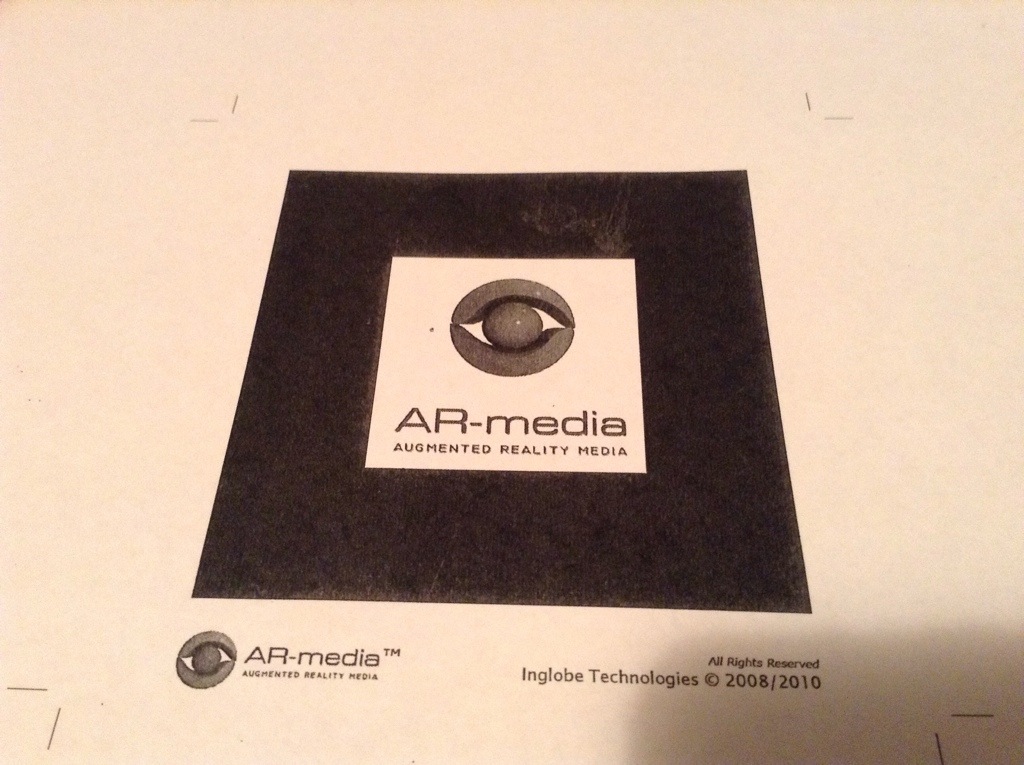
During the 2nd session, we had planned to explore timelines, yet all agreed it was better to use the time to better master Google Earth. Right at the end of her session, Selena introduced us to AR Media Player which gave most of us our first ever opportunity to explore ‘augmented reality’. It was soooo cool. Using the ARPlayer app, we viewed this graphic

20140617-133307-48787261.jpg

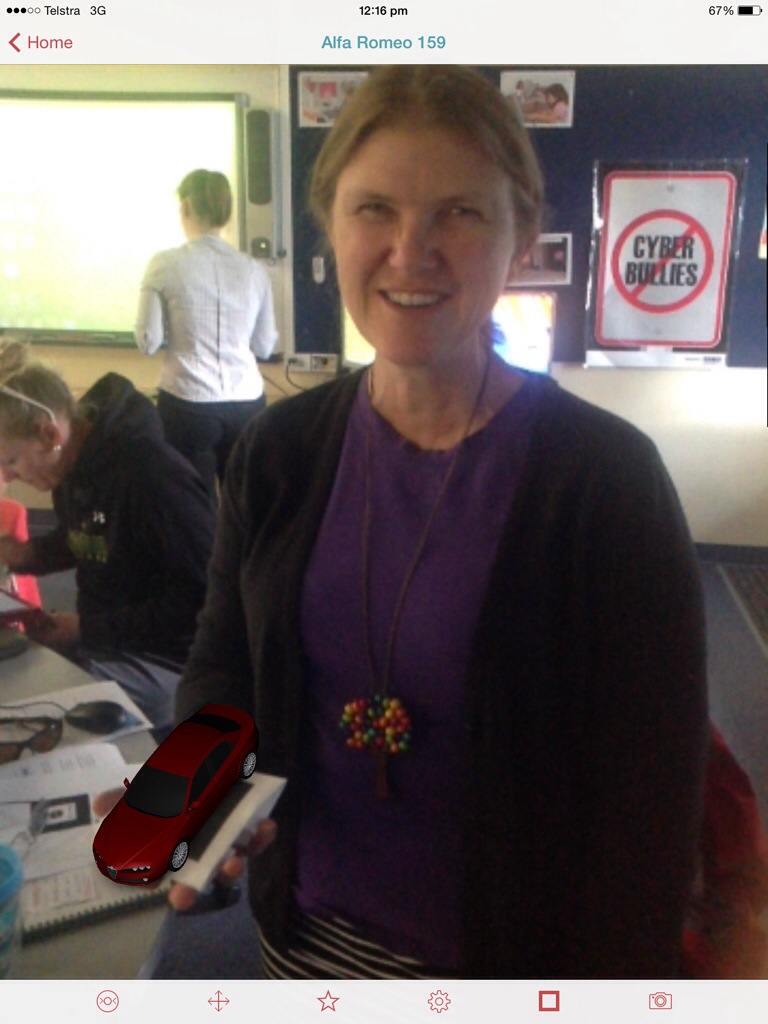
and suddenly on top of the graphic, a beautiful alfa romeo appeared.
Here is a photo of Sandy holding it!

20140617-191103-69063873.jpg

Turns out there are a variety of options available, yet sadly none are directly authentically Indonesian however there is also an option to create your own, so that would have to be the next obvious direction worth exploring! The shark one was awesome and we discovered that once the shark image is on the screen, you can rotate the image using your fingers!

The afternoon session was led by our PEPS team fresh back from the EduTech conference and all bursting with wonderful experiences to share with us all. We began with a drawing exercise which demonstrated very well how teacher can sometimes unwittingly stiffle creativity. Next we watched a Sugata Mitra video from TedTalk (totally recommend that you google this) about his computer hole in the wall experiment which naturally would be fascinating to replicate in Indonesia! We were also given the opportunity to think about our classroom spaces and how we could improve them to further foster creativity & collaboration.

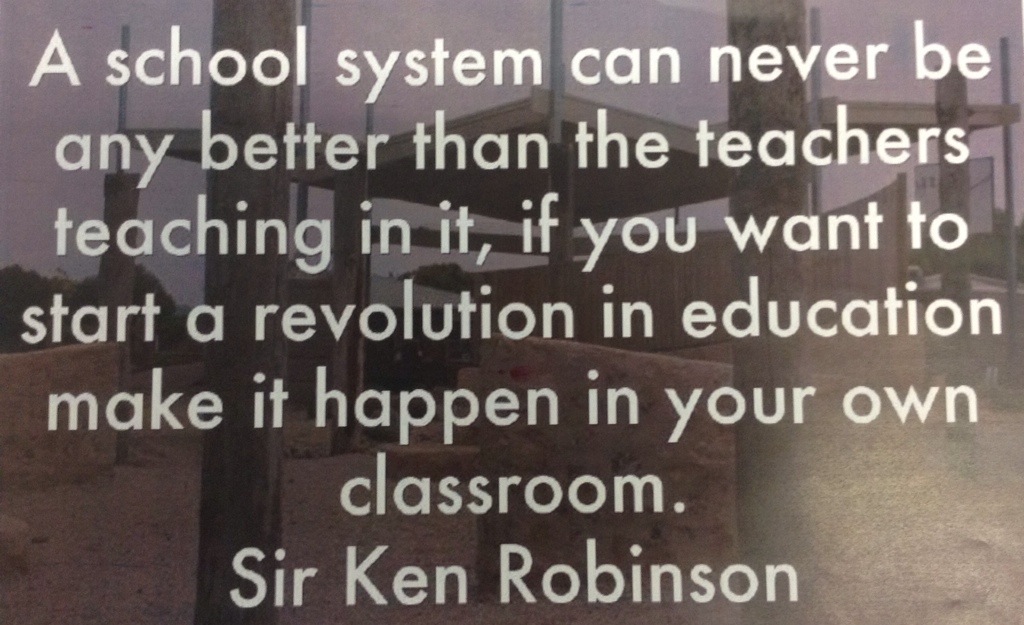
However it was the session run by our principal which really hit the spot for me. He posted a quote in last weeks staff bulletin:

20140617-160954-58194092.jpg
which really challenged me as a language teacher. How can a language teacher not teach content? How do we develop student proficiency without teaching content? He then introduced the concept that teaching today is not about imparting information, it is all about teaching 21st Century skills.
We were then invited to look at the General Capabilities, focusing on the Key Processes. We underlined all the key processes and I ended up with a list of words like:
reproduce
recognise
develop
understand
observe,
imitating
describing
predicting
comparing
translating
connecting
experimenting
reflecting
monitoring
performing.
Focusing on these words, it became clearer for all of us that any program based on these skills would be incredibly engaging and far more relevant for todays students than purely focusing on the content. It also ties in beautifully with globalisation and creating world citizens which is what underpins the entire Australian Curriculum.
What a fantastic day and perfect timing for me, with our time spent with Andrea only a few weeks ago!

20140617-161523-58523233.jpg

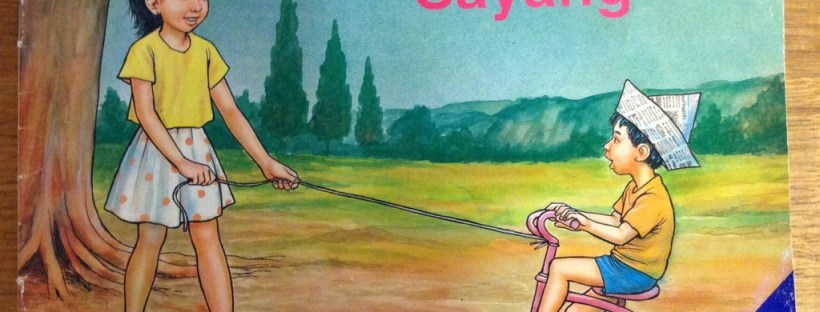
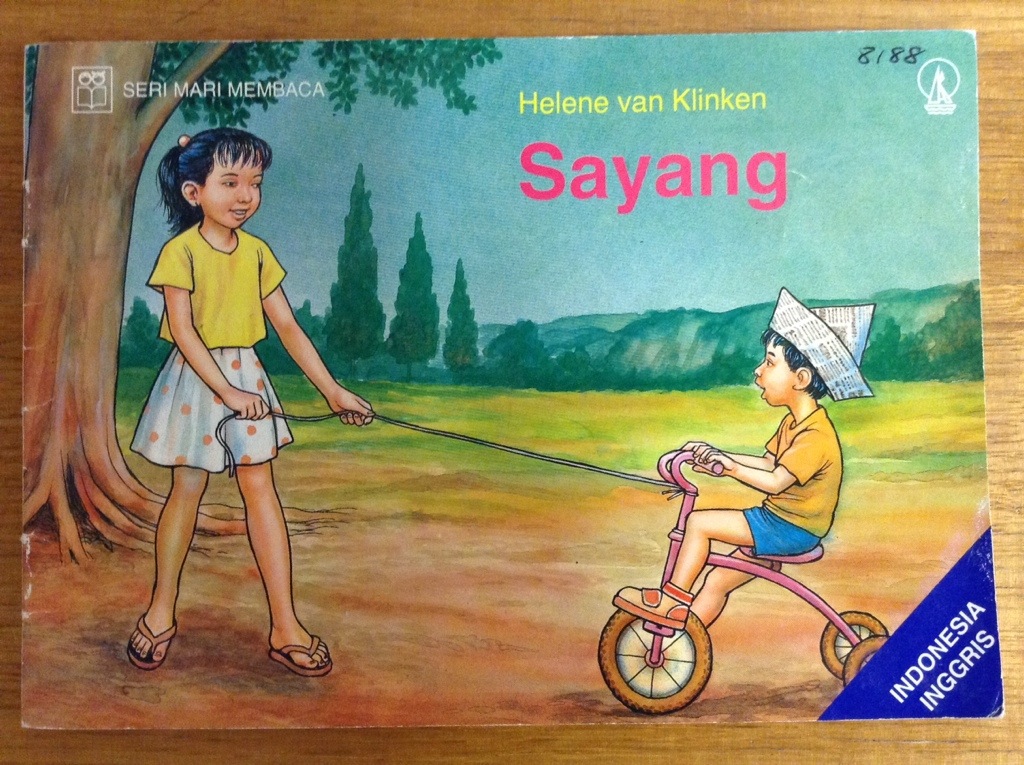
‘Sayang’ written by Helene van Klinken

Last term, the junior primary classes looked at the text, “Sayang” as part of their study about keluarga. The book is one of books in the Seri Mari Membaca, a series which I believe is out of print now.

20140503-145552.jpg
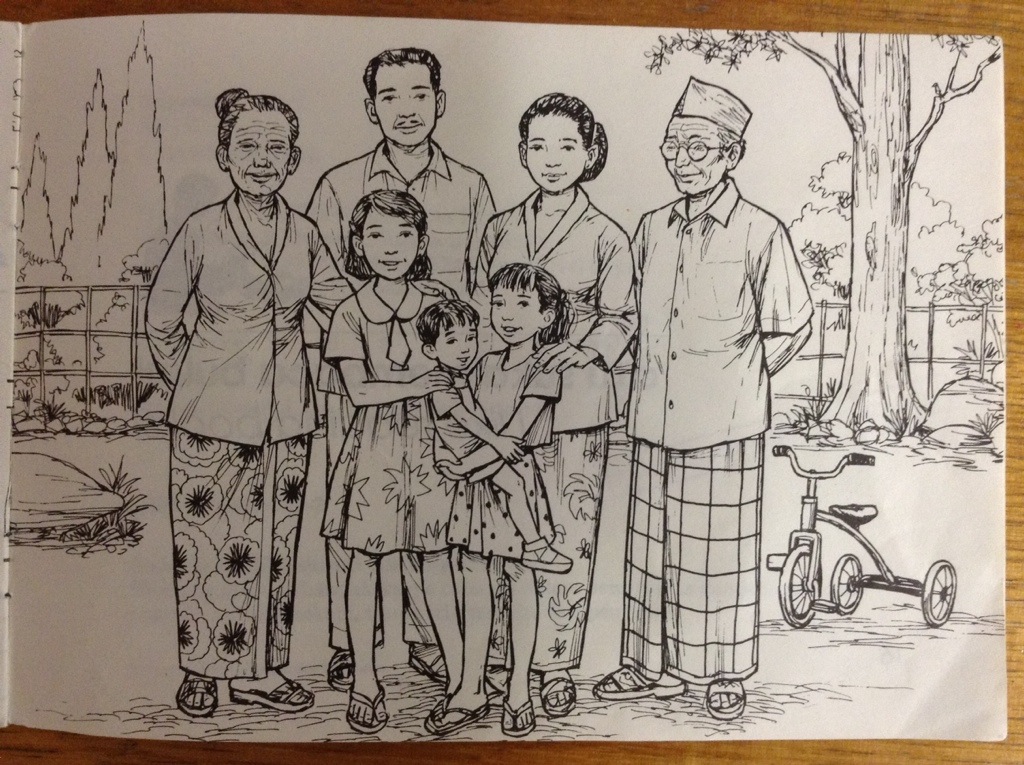
The illustrator of “Sayang” is Sutarno and it is the illustrations that I love most about this book.

20140503-150332.jpgI love that the illustrations are of Indonesian people in an Indonesian setting and they are not westernised. I acknowledge that they are a bit stereotyped however, as it is not a negative stereotyping, it should provide a good opportunity for discussion.
The text in my copy has been altered by a previous Indonesian teacher who seemingly wasn’t comfortable introducing the word “aku”!

20140503-150720.jpg
As these books are tiny (21cm x15cm), I decided to create a notebook file of the story for my students to make it more appealing. I photographed each illustration and then wrote my own text as I wanted to utilise the opportunity to introduce verbs, names and keluarga vocabulary. As Helene van Klinken has done in all her books, I kept the text repetitive to make the text as comprehensible as possible. For example, for the page about her mother, I wrote;
Ini Ibu saya.
Namanya Setia.
Ibu memasak di dapur.
Saya sayang Ibu.
I then asked an Indonesian friend to read the story while I recorded her doing so and attached each segment to the relevant page. This was a brilliant idea on so many levels. Firstly, my students were able to listen to a native speaker, which they absolutely loved. Secondly, Bu Mei read the last sentence of each page by putting stress on “sayang” (just as we would say, I loooove my mum) which fortunately emphasised the very word that was the point of the story! Thirdly, it was brilliant because it saved my voice! I could sit back for each of the 6 classes and just click on the picture and Bu Mei’s voice would fill the room and had us all spell bound!
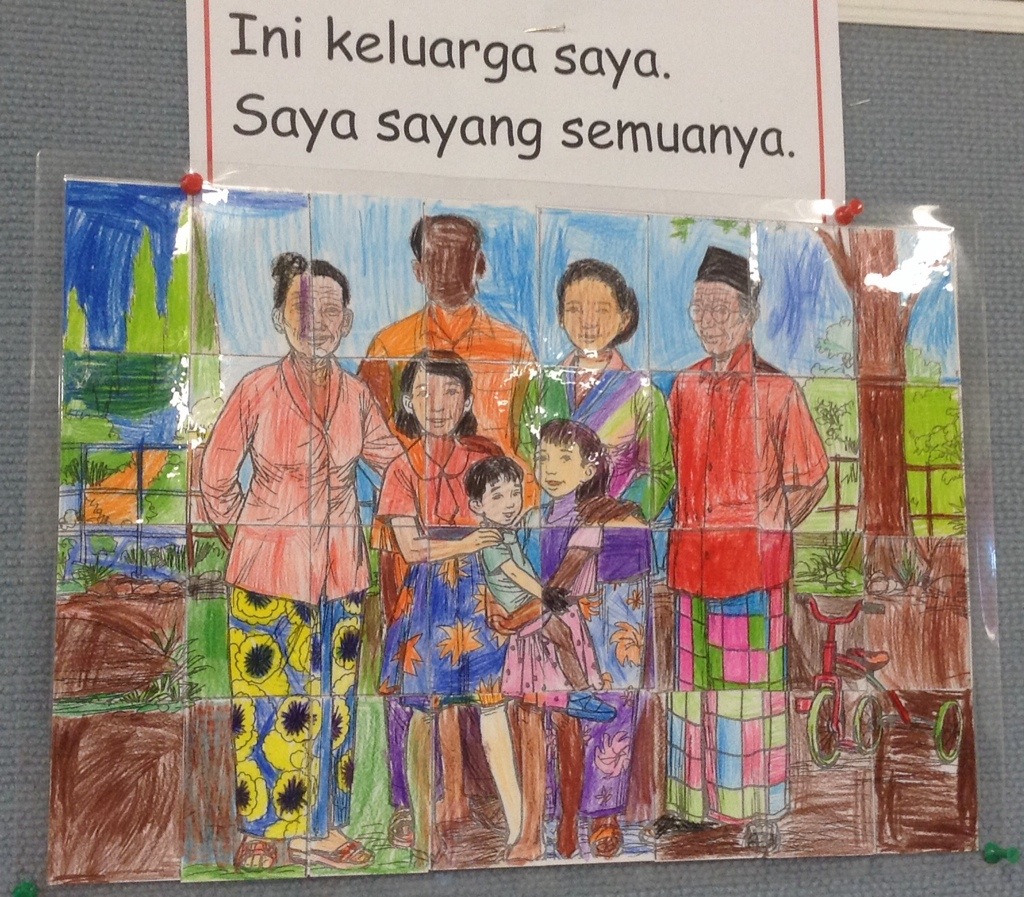
Each time we focused on this story, students commented on the lack of colour in the pictures, so during week 10, I photocopied each illustration and enlarged it to A3. I then drew an 8×4 grid over each one and this was photocopied again as the master. Each class was assigned one of the picture grids, which was cut up into 32 rectangles. Each student was given one of the rectangles to colour in. The first class to complete this task provided me with the best example of why it is important to sit with others who are working on the same part of the picture!! Some of the following classes did an excellent effort and worked so cooperatively together. The pictures have all been laminated and are now up on a display board above a table where I often heard students discussing them while working on their work last week.

20140503-153815.jpg

20140503-153831.jpg

Term One Reflections

First term was a very long 11 weeks. It began with me readjusting to teaching 4 days a week as opposed to traveling 7 days a week and finding time to blog was challenging and the longer I left it, the easier it was to find reasons why I was too busy! So here goes….
My first 5 weeks back are a bit of a blur as that was how long it took me to get back on my feet and cope with the exhaustion of both teaching and doing the preparation needed to teach. It also took me 5 weeks to rediscover the balance of what was needed for a 50 minute lesson with each year level!
HIghlights for the term include the following:
1. Bu Maylanny’s visit.
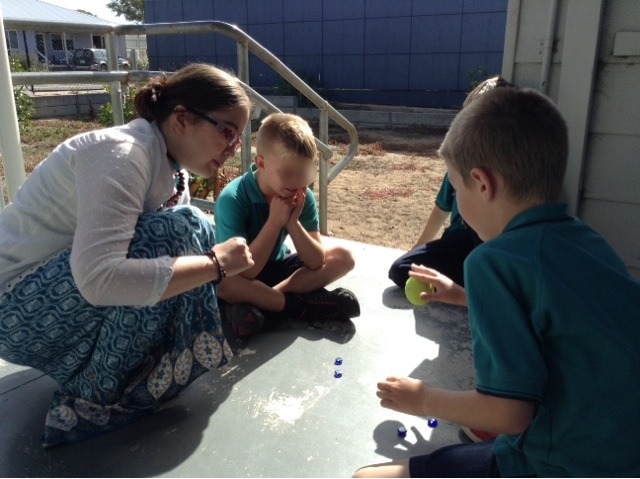
Bu Maylanny is a university lecturer from Bandung (West Java) and her 2 week stay was nowhere near long enough. Her visit was organised by the wonderful Pak Nyoman at APBIPA. She spent 2 days with us at PEPS and I still have students telling me how disappointed that they missed working with her in class. She taught us how to play bekel ( an Indonesian game very similar to knuckles except with a ball).

20140426-144324.jpg

20140426-144621.jpg
We played this with several classes and they all really enjoyed the challenge. Very tricky picking up beads with one hand and bouncing and catching a ball in the other!
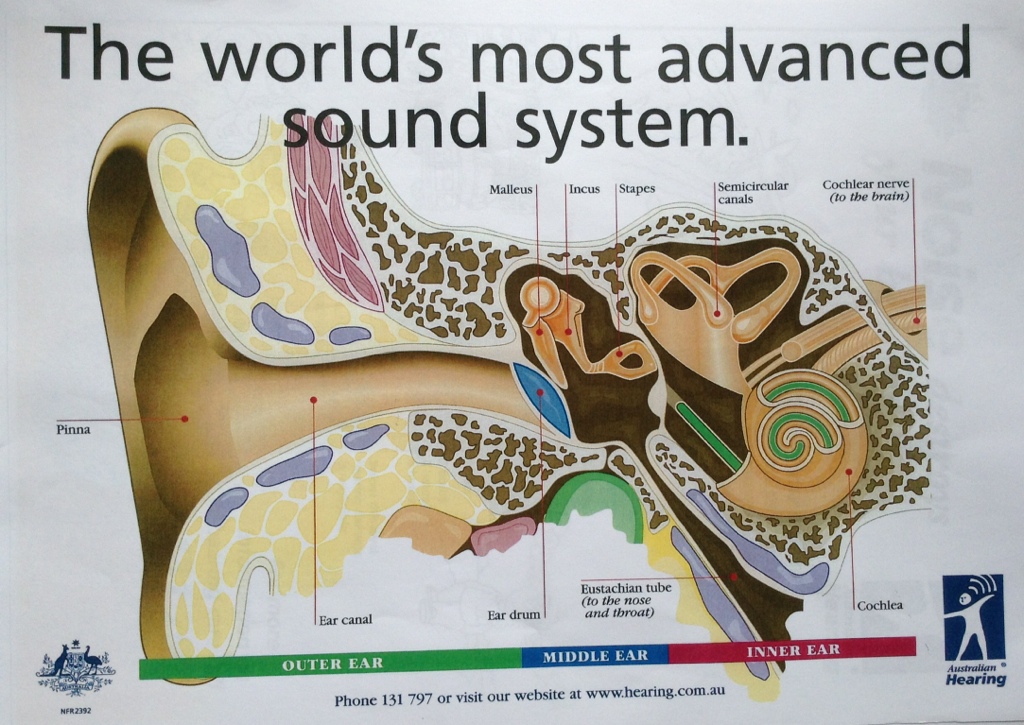
2. Hearing Impaired Worksop; “Supporting Students With Hearing Impairment”

20140426-145524.jpg
I am very lucky to have a sound field system in my classroom complete with microphone. There are several hearing impaired students at our school however I find that using the sound field system benefits everyone as when learning new vocabulary every one can hear clearly and it also benefits my voice enormously as I can just speak normally instead of having to talk loudly all day. I used to have huge problems with my throat and voice and thanks to the sound field system, this has largely been eliminated.
The one thing that I brought away with me from the workshop regarded the use of smart boards. I use mine constantly both for introducing and revision and it was pointed out to us at the workshop that smart boards are usually used in darkened rooms. My room has blockout curtains on one side and there is no doubt my hearing impaired students would have difficulty trying to lip read to support their hearing while simultaneously looking at the smart board!! Can’t believe I hadn’t considered this already!
3. State Grant for Establishing a Sister School
The schools on the south coast all applied for this grant and we were all successful which is sooo exciting. We each won $2000 which will go towards buying ipads so that students can communicate with our sister school next term about “sekolah”.
4. Congklak
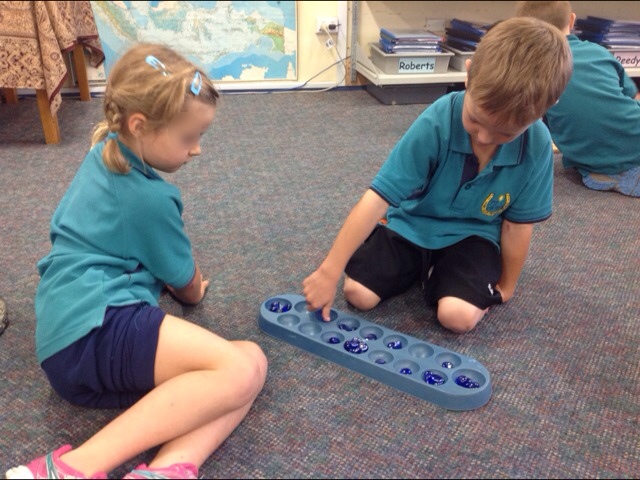
This term I finished up with teaching all the junior primary and middle classes how to play congklak. It is a game I have only usually taught upper primary students but have realised that years 1-3 can also play it and enjoy it. It was hugely popular with all students!

20140426-155002.jpg

Indonesian Teacher Visitor Program with APBIPA

Last Sunday I collected Pak Yasa from the airport. He is the first and last teacher visiting the Fleurieu primary government schools in 2013 because I am about to head off on LSL travelling around Indonesia. (Follow my travel blog Jalan Jalan with Bu Cathy!)
Pak Yasa is from Bali and is the 6th teacher we have hosted through this program. APBIPA is a business run largely by Pak Nyoman in Bali which among man things, targets teacher quality as well as teaching English programs. Through the teacher quality arm of his business, he coordinates Indonesian teachers who are from schools which value their teachers experiencing western teacher methodology.
For our Indonesian language programs here on the south coast, this program is perfect for many reasons. We have an Indonesian visitor in our schools for 2 weeks who becomes a film star legend whom all students want to talk to and this provides students with real authentic reasons for using Indonesian over that fortnight. We also get the opportunity to talk to Indonesian people face to face and as most are muslim, it has been a brilliant way to demystify any previously held stereotypes. The most obvious example is the jilbab. At first it was what students noticed first about our visitors and wanted to ask about however now we find that students barely comment on jilbabs at all!
In 2012 we hosted 5 teachers: Pak Usman from Sumbawa, Bu Indra from Sumatra and Pak Agus from Bali in Semester 1 and then in Semester 2 we hosted Pak Asep and Bu Valentina from Jakarta. The best thing for our schools about this program is that Pak Nyoman does all the organising. After our experiences with the BSALC grant which involved us organising times, flights, visa, passports; basically every aspect of the teacher visits, ourselves, joining the APBIPA program has been a dream. He does it all. All we have to do is meet the teachers at the airport, provide accommodation (hosted), plan their visit across 3 sites, organise a weekend of sightseeing which always incorporates a visit to Urrumbirra Wildlife Park where they can hand feed kangaroos and have their photo taken with koalas, then return them to the airport for their flight home. It is a full on fortnight for us all but is always highly enjoyable and chokkerblock full of amazing memories. We usually try to fit in an evening of Indonesian cooking where we all get together with the Indonesian teachers who do all the cooking and us westerners being the kitchen hands! Always delicious and fun!
As the other 2 primary schools have ongoing language programs (multiliteracy currently) which although highly engaging and worthwhile, involve high levels of teacher preparation and energy, I willingly do the organisation for the visiting teachers. This involves keeping an eye on my emails so that I can respond quickly when Pak Nyoman contacts Australian schools seeking willing participants. We then, via email, find a mutually suitable date which is compatible with both the Australian and Indonesian school calendar. For us it mainly ensures they visit during term time and for the Indonesian schools, it mainly ensures they are avoiding exam and reporting commitments. Once dates are set, Pak Nyoman emails me information about the teachers (biodata) which I forward on to Annie & Sharon. I then write a timetable for their stay so that we all have equal access to the teachers on the various days we work and for the days none of us are working, we offer the teachers to classroom teachers or if that is not an option, I contact the highschool to see if they can accommodate them for a day preferably with a teacher who teaches a similar subject.
We usually share the hosting commitments over our 3 sites. This is to give us time with the teacher beforehand so we can plan together our upcoming days and it also helps with transportation to and from school. Occasionally staff from school have hosted our visitors but generally we host the ourselves. In some ways it is a fantastic opportunity for staff and families to come face to face with our visitors and interact with them in their own homes, but it is also a valuable time for us with our preparations, so hopefully with our upcoming sister school agreement we will be able to do both!
Overall it is a fantastic program and one we all throughly enjoy being a part of. Our students have gained so much from our many visitors. For a full on 2 weeks with innumerable benefits to the language classroom, I highly recommend it to all and find it is worth all the organisation.

Lupa, Lupa, Ingat

In 2011, year 6/7 students spent a term focusing on the song Lupa Lupa Ingat by Kuburan, . The aim of the term was to make our own song video. Students were divided into committees, each with their own area of expertise, eg., backup singers, filming, musicians, makeup/costumes, etc. The finale was a whole school performance.

The filming was done with flip cameras and then edited in Windows Movie Maker.