Term 2 Story – Lucy Mau Jaket

This term we have been working towards the story recommended to us by Catharina. We are about to head into week 5 and not counting week 3 (our cultural break with Ibu Mia), we have been working towards this story for 3 weeks. Here is my version of the story:

Ada perempuan.
Nama perempuan Lucy
Lucy dingin.
Lucy tidak punya jaket.
Lucy mau pakai jaket.
Lucy lihat laki laki kecil.
Nama laki laki Will.
Will punya jaket tetapi jaket Will terlalu kecil.
Lucy lihat Pak Hudson. (Our principal, who has kindly lent us an enormous jacket especially for this story)
Pak Hudson punya jaket tetapi jaket Pak Hudson terlalu besar.
Lucy lihat Jane.
Jane punya jaket dan jaket Jane pas.
Jane kasih Lucy jaket.
Lucy pakai jaket.
Lucy berkata, “terima kasih Jane.”
Jane berkata, “Sama sama.”

The names of the 2 central characters are flexible and when I first told the story last week to classes I chose names of students who were prepared to act out the story and for whom the props would fit according to the story! Naturally this didn’t always go to plan, but mostly the students pretended and went along with the story!!

In the first weeks of term, I introduced the structures terlalu besar, terlalu kecil and pas, trialing the concept of visual PQA which I read about on Ben Slavic’s website. See this post for more information. I continue to refer to and add to the notebook file as I go along. It truly has been an engaging  technique for introducing and/or reviewing structures.

After I was reasonably confident students had acquired the above structures, I then introduced the cognate, jaket and the verb ‘pakai’. As I also want students to be aware of the vocabulary for other forms of clothing preparation for their freewrite next week, I chose ‘topi’ as in term 4 when we have a compulsory hat wearing policy and ‘sepatu’ because with winter almost here, I need to prepare for the seasonal after recess & lunch JP student requests to remove muddy shoes!

Thus I introduced the structures:

pakai topi
pakai jaket &
pakai sepatu

and established gestures that represented each. I have now incorporated a TPR session into all my lessons to both reinforce and review the gestures we have established so far. As Catharina has found with her students, Simon says (Bu Cathy berkata in my case) is one of their favourite games and once students become complacent, Catharina recommends ramping it up by saying one thing and doing the gesture of another. My students ABSOLUTELY love it too!! Go figure!

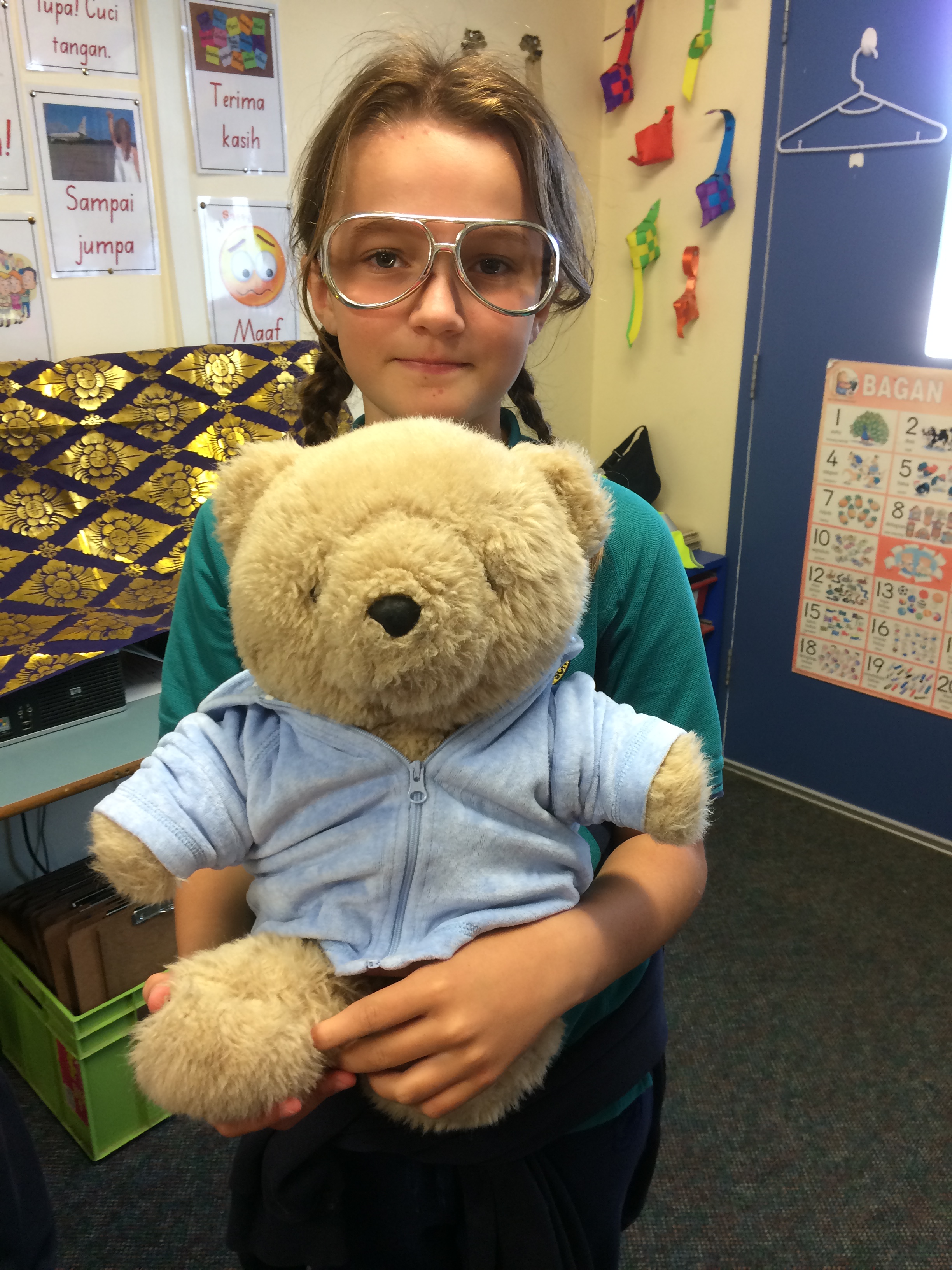
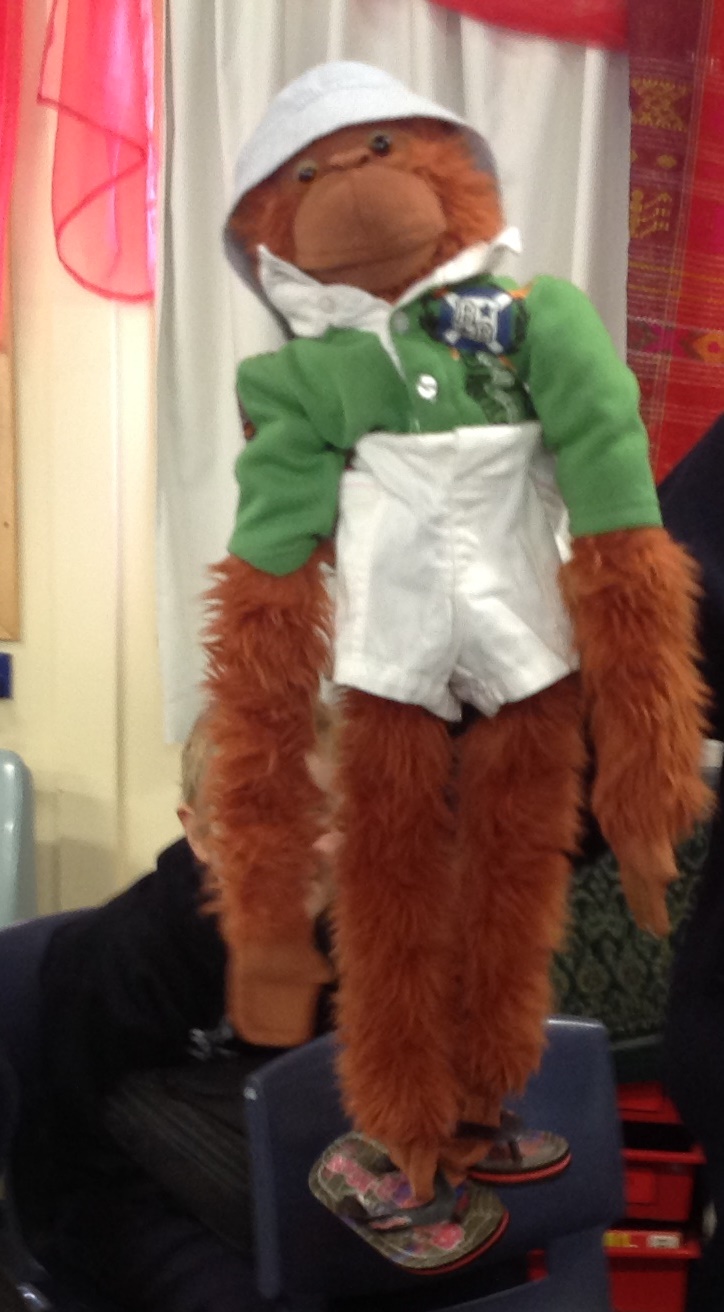
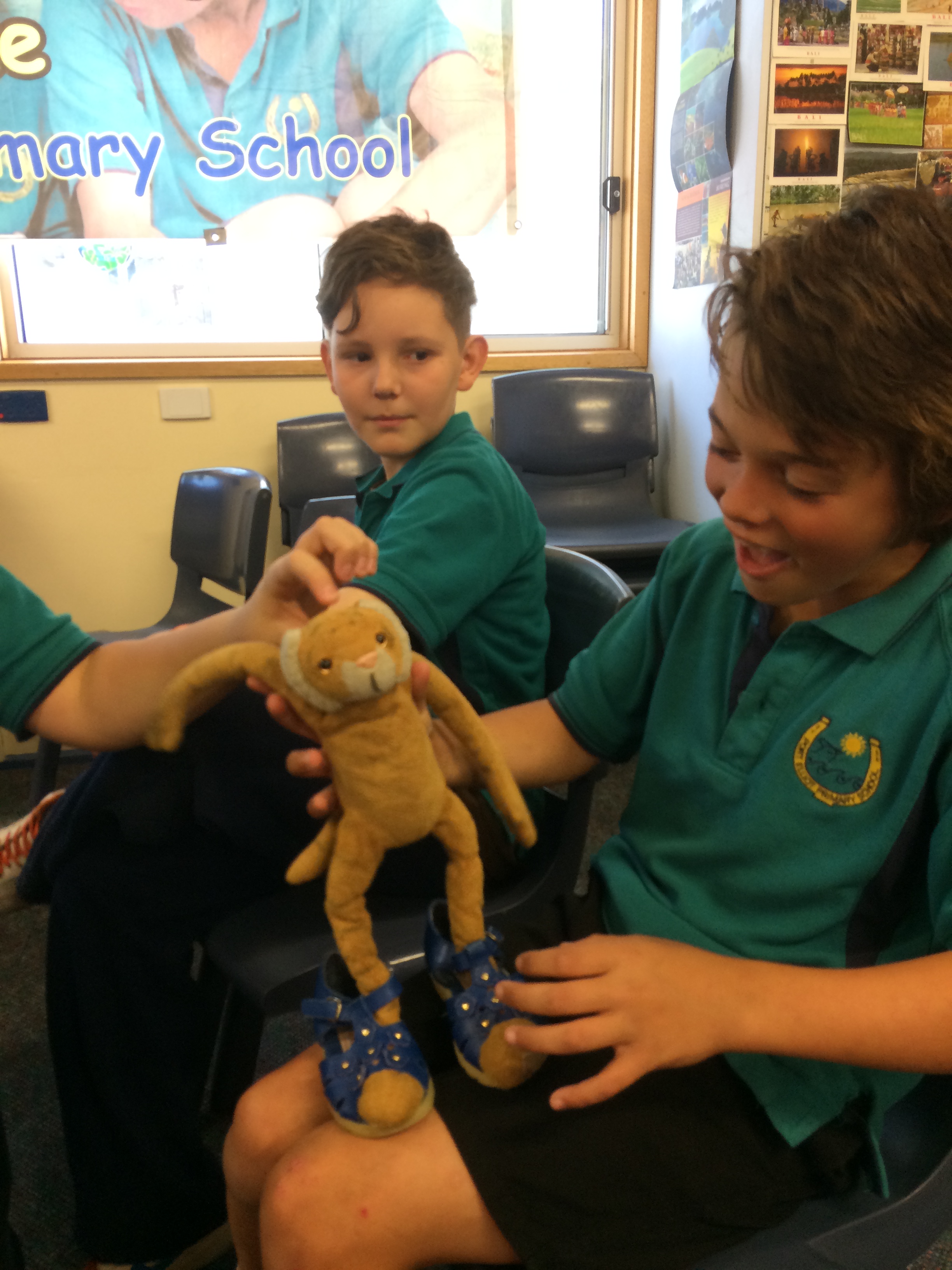
A fun activity I did was put together a collection of soft teddies, monkeys and orangutans as well as a pile of baby clothes. In small groups, students had to dress a teddy and then come to a consensus about whether the clothing was terlalu besar, terlalu kecil or pas. It was hilarious and students from all year levels had a ball. While there was a lot of English in the overall dressing of the teddies, the discussion about the clothing was 100% in Indonesian which was awesome. I also had a ‘tukang foto’ who took photos of groups once they had all agreed on the clothing size/fit. If we had time, I asked groups to show us their teddies and then tell us all what was terlalu besar, terlalu kecil atau pas. Some groups incorporated the vocabulary of other forms of clothing using the posters I had up on the white board but the main aim was to get repetitions on the target structures. The following lesson, I put up some of the following  photos taken  by the tukang foto on the smartboard to provide an opportunity to combine the reps of all target structures while circling.

IMG_0973


IMG_1830

IMG_1831


IMG_0993


IMG_1834


This week we are going to focus firstly on the story via retells, readings, and then in the second lesson, I might try one of these TCI activities that I have found in my emails from the moretprs listserve. The activities are:

  1. Draw & Guess – Each student to choose one line from the story and then illustrate it on a clear board. When all are finished, students will be invited to come to the front of the class and the rest of the class have to guess which line from the story it illustrates! Source: Niki Tottingham
  2. Flyswatter – choose 4 (or more) illustrations from the above activity. Arrange them on the floor in the middle of a circle. Hand out flyswatters to 4 students. Say one of the sentences from the story and students have to swat the picture that matches the line from the story. Best of 3 wins. Source Todally Comprehensible Latin
  3. Noisy Pictionary –  2 teams  – Everybody is in one of the teams and everybody participates. One artist from each team comes to the board. Show them  a sentence from the story. They then run to the whiteboard and draw the phrase for their team mates who scream out the sentence it is. Point to the team who first match the sentence with the illustration. (While this sounds a great game – I am wondering if it might be easier to manage if each group takes it in turns and they are timed. I also like the  idea of drawing it on the smartboard so that I can save a digital copy of the illustrations!) Source: Bryce Hedstrom.
Global Workshop via Skype

Last Friday, Sharon, Annie & I were again fortunate to have the opportunity to workshop with the marvellous Catharina, an experienced junior primary TCI  practitioner. Due to South Australia leaving summer time and the USA beginning summertime, we met at 9am Friday morning (Aust) and 7:30pm Thursday evening (USA). Catharina’s school year is coming to an end, just4 weeks left of the school year, so we doubly appreciated the time Catharina gave us! Such an exhausting time. Last Friday, we were also joined by Rosslyn from INTAN. Rosslyn is the 2015 (and inaugural) INTAN hub group liaison officer and joined us to see what our hub group gets up to!! 

  
As always our skype workshop with Catharina left us buzzing. We began by bringing Catharina up to date with recent lesson plans and being the end of week 1, we filled her in with what we had each done in preparation for our new story:

Ada perempuan.
Nama perempuan Lucy.
Lucy dingin.
Lucy mau pakai jaket.
Jaket Pak Hudson terlalu besar.
Jaket bayi terlalu kecil.
Jaket Bu Cathy pas.
Lucy berkata, “Terima kasih Bu Cathy.”
Bu Cathy berkata, “Sama sama.”


In  my case, I had focussed on the target structures of perempuan & laki laki with my junior primary classes. I once gain used the laminated PQA cards recommended by Catharina during our very first skype workshop. These A4 laminated cards include 2014 school staff photos as well as a few well known identifites like Batman, Spongebob & Harry Potter. I revisited ‘Siapa nama’ as well as asking, “Batman laki laki atau perempuan?” At the end of the lesson, I did a quick listen and draw using the brilliant clear folders. I also incorporated some TPR into the lesson because one of my term goals is to increase student acquisition of classroom instructional vocabulary (sit down, stand up, turn off the lights, sit in a chair etc). We began with duduk, berdiri dan putar and the instructions included sentences such as, “Laki laki duduk’ & “Perempuan berdiri dan putar.” If time, we played a quick game of Simon says (Bu Cathy Berkata) which they all adore and constantly beg for!


Once we had all finished talking about our week, we began asking Catharina specific questions about using TPRS with junior primary students. Our lessons are much longer than Catharina’s and our class sizes are also double, yet the basic principles remain the same. Catharina stresses that variety is the key when teaching junior primary students. Here are some of the great ideas Catharina shared with us:

  1. Duplo – Have a big pile in the middle of the student circle. Retell the story the class has been working on, sentence by sentence. If the sentence given by the teacher is correct, students may take one piece of duplo from the centre pile. As they collect and listen, they can start building something using their peices of duplo. If the sentence given by the teacher is incorrect and the student took a piece of duplo from the pile, they not only have to return the piece they just took but also get a penalty and have to surrender one of their other pieces too! 
  2. When retelling a story, have the whole class join in with the acting. All students are allotted one of the characters in the story and they each act their part during the retelling. 
  3. TPR – When playing Simon says, give students lives so that they remain involved and continue to respond to the directions rather than sitting out. Don’t forget to trick students by purposely doing the wrong action! 
  4. Throwing & catching a soft ball when asking specific students questions. Allows teacher to differentiate. 
  5. Take photos of students acting to be used later for revision, discussion and retelling!  
  6. Look at the Youtube video Valentines Day – perfect for movie talk. 
  7. Great brain break is to act out the alphabet! Students using their whole body stand up and make each letter of the alphabet while saying each letter. This would be great for familiarising students with the different sounds made by the Indonesian alphabet. 
  8. Catharina presents to each student at the end of each school year, a 1/4 sized A4 book which she has put together herself containing all the stories they have covered through the year! The stories are illustrated with student drawings that she has collected throughpout the year. What a great way to encourage students to read and continue having contact with the language over the holidays. 

While our skype workshop was only for 50 minutes, we got so much from it. We then moved to a spare classroom to talk to Rosslyn. We gave her some basic information about TPRS/TCI as well as outlining our other collaborative projects. We look forward now to reading her article which will be published in the next INTAN newsletter! My hope is that we can tweak teachers interest in TCI! 

If you too are interested in learning more about TCI, see this previous post.

Term 1 Reflections

As term 1 draws to a finish, I have been looking back over my first dedicated block of teaching Indonesian using TCI . It has been a steep learning curve yet at the same time deeply satisfying. I have learned just as much as the students!! Here are the major gems that I would like to share with you from my short journey thus far:

  1. Props – Don’t ever underestimate the power of props. When I copied Sharon’s brilliant idea of using a bottle of Sprite to tell the story: 

Jessie haus
Jessie mau minum Sprite
Ella punya Sprite
Ella kasih Jessie Sprite
Jessie minum Sprite.

I was blown away with the total and utterly mesmorised attention of the classes from year 2 right up to year 7! Even when the Sprite finished, students insisted I refill the bottle with water, so we could continue. Even with water, students were still highly engaged and following the dialogue closely. It not only hooked the actors, but hooked the other students too as they decided whether Ella would give Jessie a drink of Sprite and if not Jessie, then who would be given a small drink of Sprite. It is definitely worth taking the time to organise props for lessons with all year levels. Not only do students beg for repetitions, but it is so much more fun too for everyone. I have never laughed so much with students!! 

    2. Public Holiday Pitfalls  –  Usually I begin my week with the year 4’s and they are a great bunch of students to ‘trial’ my middle/upper lessons with. They give me the opportunity to fine tune my plan before facing the year 6/7’s the following day. While I enjoyed my first Easter long weekend in many years (our Ed Dept usually cleverly incorporates them into our mid semester break), I forgot to keep this in mind and consequently yesterday’s lesson with one of the year 6/7 classes was a disaster. With this class I need to be one step ahead of them. Maybe Trashball or something similar would have been a better plan for a challenging class in week 11.. 

  3. Trial by Error – A exhausting yet necessary aspect of teaching and a fact that I (and any learner) needs to philosphically and practically accept. I’ve read that it can take up to 2-3 years for a teacher to acquire competency using TCI methodology. This is what keeps me going! There are many fantastic blogs and websites full of TCI brilliant ideas and suggestions. Gleaning through them all to find ideas suitable for teaching primary students and then trialling it requires a huge step out of my comfort zone and so much energy. Yet each step is an important and integral aspect of the entire journey.  I must keep reminding myself to continue plodding steadily along the TCI path and not to expect too much too soon! 

4. Dehydration – TCI requires so much teacher talk and I have discovered that I am so much more dehydrated at the end of my days than I was ever before. I have tried to keep up my fluids over the day but haven’t been successful consistently with this yet. I get so engrossed in the lesson that I totally forget to stay hydrated. The most successful stategy I had was finishing my 750ml drink bottle at the beginning of recess and lunch on my way to the staff room but lately even that has fallen by the wayside. Any suggestions gratefully accepted! 

5. The Importance of Developing A Personal Learning Networks (PLN) –  The core of my PLN consists of Annie & Sharon, my Indonesian colleagues who teach in nearby schools, together with Catharina, our mentor who teaches French in New Jersey. The middle layer of my PLN consists of teachers who teach Indonesian and have been following this blog or my tweets. Their input has been invaluable and I have truly appreciated their comments and  feedback. While there are common aspects between different languages, there are also certain aspects that are unique and therefore those who teach and  speak Indonesian have that special eye through which to  understand my reflections and experiences. They too are are coming to grips with our new Indonesian Curriculum to be implemented fully in 2016, another valuable persepctive. The outer layer of my PLN consists of all the TCI language teachers who post on their own blogs or on websites like Ben Slavic’s. There is definitely a gap for me between the middle and outer layers purely because most of the teachers in the outer layer are secondary teachers and none of them teach Indonesian. Yet, they are still a major and important part of my PLN as they have such a wealth of knoweldge and experience that I am truly in awe of them. Without this special group of people, my first term of TCI could have finished so differently. Whenever I felt like I had hit a brick wall and I couldn’t see where to go next, someone would be there to encourage and help. Annie and Sharon have been awesome and once again I am so fortunate to work so closely with 2 teachers who readily joined me on this journey. Our frequent Friday meetings were invaluable opportunities to share lessons that worked well and thus give us each the inspiration and encouragement to continue. Our Skype sessions too, with Catharina have been incredible. Each time we all  took copious notes. It is so amazing to have the opportunity to speak with a junior primary teacher about TCI and how to apply it with very young students. Now that term 1 has almost finished, we are really looking forward to our next Skype call with Catharina. While we usually only speak for an hour, each call is jam packed full of awesome suggestions and information. She truly is an amazing and inspirational teacher  to have in my PLN and a huge thankyou must go to Ben Slavic for initially suggesting it! 

6. Lesson Planning – On looking back through my lesson plans, I have definitely learned that while it is good to have a few brain breaks up my sleeve, it is also important to keep my planning simple. My initial lesson plans from the first weeks were very long and were a great example of over plannning which is a good way to start! I tried to cover everything at first and then realised that it was not only unrealistic but also pushing the students too quickly. Narrow and deep is the TCI catch cry for a very good reason and this is what underpins the success of TCI over the methodologies I used previously. 

7. Patience is a Virtue – When reading blog posts written by other teachers who also use TCI, I have to keep reminding myself that comparing my students (or their lesson outcomes) with theirs is pointless. My students & i have only just started so it is natural that we can’t yet have impromptu detailed conversation that are 100% comprehensible. It is of greater importance that we start with the Indonesian version of the super list of verbs sourced from frequency lists and accept that initial discussions will be be very basic. 

8. Humour – At a point about mid-term, I reached a point where everything gelled. Suddenly I relaxed and started to enjoy myself with the students. At that point I realised that it was the first time I have ever laughed so much WITH  my year 7 students. Previously, any hilarity got out of hand and ended with me having great difficulty bringing them back on track without loosing that sense of connection. Yet with TCI, we laugh together at the ridiculous  scenarios the students suggest and then act out. Not only do students have fun, call out and be totally silly, but because it is all in Indonesian, it is amazing and all students are totally mesmorised and engaged thus keeping it manageable!  

9. Tight Timelines have Vanished – Previously, my term outline was tightly planned and in order for me to achieve my term outcomes, every lesson was precious and heaven help anyone who interfered with my schedule!! Taking sick leave was avoided and any additional offered non contact time was reluctantly refused because my planning didn’t have much flexibility. This has all blown away with TCI as everything is based upon student aquisition which is a  huge unknown. Once we know what the target structures will be, out planning will focus on that until we, the teacher, deem the students ready to progress to the next step. Consequently, with our upcomiing APBIPA visitor, Bu Mia, I feel far more relaxed and am really looking forward to her time in our school. Students will be able to experience a cultural lesson with her and this will also give them impromptu and authentic opportunities to practise and demonstrate their acquired Indonesian to date.

I am so looking forward to term 2 and having the opportunity to apply all that I have discovered. I also hope that my reflections give other Indonesian teachers the encouragement to consider trialing aspects of TCI in their classrooms. Last year, I dabbled just by experimenting with a few activities that sounded interesting and that is how I urge you to start too. While I am nowhere close to TCI mastery, I am nontheless, very happy to help any Indonesian language teacher if you would like to discover more about TCI. Ask away and if I don’t know the answer,, someone from my amazing PLN will certainly help!!

Preparing For the 2015 School Year

/home/wpcom/public_html/wp-content/blogs.dir/a1e/48203868/files/2015/01/img_9356.jpgWith the onset of the 2015 school year approaching, I have been preparing for my formal launch into TPRS. While I did put my toe in the water last term (2014), it was more like a young visitor on their first visit to Disneyland with only a limited amount of time; having to race around franticly trying as many attractions as possible before the time was up!
The 2015 school year by comparison, will be the start of an infinite time period and thus my approach will be entirely different. Instead of my frantic, ‘try anything and everything ‘ approach, I hope to take very small steps and enjoy having the time to savour each one, to thoroughly appreciate and grasp the skills of TPRS/CI.
I teach Indonesian to all students at my school – reception to year 7. Reception in South Australia is the year between kindergarten (preschool) and year 1. These year levels are broken down into 3 bands – junior primary (R-2), middle primary (3-5) & upper primary (6-7). Frustratingly, the Australian Curriculum regards the year 7 as middle school, i.e., secondary school, but in South Australia, most year 7’s are still located in primary schools and are thus considered upper primary, even though their curriculum differs significantly from the year 6 curriculum especially in areas of time allocation for subject areas. Still, that is another issue…
In 2014, my experimentation with TPRS/CI was with the middle and upper primary classes. This was for many reasons, the main one being that most TPRS/CI methodology is aimed at secondary students and teachers. Just about all of the pedagogy is applicable in the middle and upper primary setting which is why I am super excited about beginning TPRS/CI formally this year.
These holidays I have been reading voraciously about TPRS/CI. While time consuming, I totally recommend this to anyone interested in learning more about this pedagogy. Blogs and the yahoo group moretprs are a truly great place to start. If you are still keen to take it one step further, then without a doubt I recommend joining Ben Slavic’s WordPress website. It costs about AUD$5-$6 a month (depending on the value of the Australian dollar) which a paltry amount considering the breadth of resources this gives you access to. For me, so far, the most valuable thing has been ‘meeting’ Catharina, a junior primary French teacher. Her posts are insightful, practical and so encouraging. It is no wonder everyone speaks so highly of her. Already I have gleaned many useful pointers about how I will start off with my junior primary students. Probably the most useful advice she has given so far regards the vocabulary to focus on with these year levels initially. The vocabulary includes; yes/no, thank you, hello/goodbye, there is/there are (ada), as well as classroom management language eg. sit/ stand/ talk/ to name a few. While I do cover the initial list, it is the 2nd list that I am most excited about teaching because it includes language that is repeated over and over in all classrooms, so therefore it makes so much sense for it to be taught early on thoroughly.
While American teachers return to school tomorrow, Australian teachers have another 3 weeks of summer holidays. In this time I will;
1. Finish reading ‘Stepping Stones to Storytelling’
2. Finish setting up my classroom
3. Begin reading ‘PQA in a Wink’
4. Blogging – reading and writing
5. Set up Skype coaching workshops with experienced TPRS/CI teachers
6. Plan my first unit of work with all band levels
7. Fleurieu Indonesian Teachers Hub Group Meetings

What are your plans for the rest of the holidays?

Bring on 2015……

I am so fortunate to ‘work’ with such a wonderful group of Indonesian teachers. “Work” is in inverted commas because as Senorfernie puts it, we are largely “departments of 1″and work at different school sites. Fortunately the primary Indonesian teachers down here in our neck of the woods are just as passionate about teaching Indonesian as I am. All the more impressive as they also manage family commitments and businesses on top of their teaching load! I salute them.
Our hub group meets every holiday to plan upcoming units of work, to share ideas and resources and for Australian Curriculum training & development. We have noticed how our sharing has changed significantly over the past few years. Originally we would come to our meetings laden with text books, worksheets and video/DVD’s. Now we bring laptops and/or iPads and everything we swap is digital! Sharon introduced us all to the beauty of hard drives and now we can’t imagine how we coped previously without one!
We met yesterday (mid term!) for ACARA T & D. Our mission was to plan a unit of work that aligns with our new curriculum for term 1 2015, so that we can collect work samples from our students for moderation. When Annie first raised the plan, I had misgivings because I was unsure how it would fit in with my TPRS plans for 2015. I was worried that I would have to choose between collaborating and TPRS. Then I changed my mind and considered the possibility and benefits of being able to collect data to compare TPRS methodology with traditional non-TPRS methodology.
Imagine my surprise and delight when all teachers present at the hub group meeting yesterday expressed interest in learning more about TPRS and are really keen to start incorporating it into their teaching in 2015!! A fellow teacher who has also recently discovered TPRS has described our passion for TPRS as bordering on obsessive and that we are more like evangelists. Even though I was severely sleep deprived yesterday, advocating TPRS proved to be an instant antidote!
Together we planned an 8 lesson unit which will lend itself beautifully to a TPRS introduction as well as consolidating the language students will need for introducing themselves during skype sessions with our sister school that we are hoping to participate in ahead of their visit in September. The assessable task we have planned is for students to create a dialogue using specific targeted language and then in groups of 3 make an iMovie which will be assessed by their peers.
It aligned beautifully with the Indonesian Curriculum and the discussion we had finalising this was useful as it helped us all refresh our knowledge of the new curriculum terminology as well as sharing pointers we have picked up recently at either conferences or from school based training.
The day flew by and when Sharon mentioned she would have to leave soon to do the school pick up run, we all were amazed to realise that except for a very brief lunch interlude (thank you Annie for the delicious chickpea salad) we had been working solidly for 5 hours!

TEACHING INDONESIAN IN SOUTH AUSTRALIA

I have just found this article on the APBIPA website which was written several years ago. It is quite timely as both Ibu Sharon & Ibu Trees are currently visiting Pak Agus in Singaraja and working with the students at his school! The lasting effects of such a visit are never ending not only for the adult participants but even more importantly, for their students.

Fourteen Days of Teaching Indonesian in South Australia

Agus Jaya Parhyuna (SMKN 1 Singaraja)
Usman Ismail (SMKN 1 Kota Bima)

The following is a short report on a two-week teaching experience in four schools Adelaide by Pak Agus and Pak Usman. They joined our new program: Indonesia-Australia School Attachment Program – specially designed for SMK, SMA and SMP teachers. This is a joint program between APBIPA Bali and SMKN 3 Denpasar (representing Directorate of Vocational High School), Ministry of Education and culture. The first part of teh report is by Pak Agus and the second is by Pak Usman.

It is very interesting to know not only what they experience in Australia but also how they have felt about Bahasa Indonesia and about being a native speaker of Indonesian in the middle of Australians teachers and students of Bahasa Indonesia.

IMG_8855-0.JPG

1. “I would like to tell you about my experiences with the Indonesia-Australia School Attachment Program on the Fleurieu Peninsular, South Australia. Before going overseas I needed to catch up with current trends teaching methodology of Indonesian as a second or foreign language (known as BIPA), the Australian cross cultural issues, 4 different schools where I would teach Indonesian and typical Australian way of life.

It was like a dream visiting that giant continent for the first time. There were many and long steps I went through to be admitted in the program including: applying for my visa and passport, organizing a letter of invitation from the school in Adelaide and a sponsor letter from SMKN 1 Singaraja. I would never have imagined how I could manage all these just by myself considering I am only a high school teacher. Fortunately, there is an association in Bali (APBIPA Bali) that assisted me with all the necessary preparation, e.g., BIPA teaching methodology courses, introduction to Australian culture, child protection programs and many kinds of Indonesian teaching techniques and games.

I was so lucky to be hosted by three kind and friendly families. They live in a beautiful, quiet coastal, rural area in South Australia. Sometimes the sea breezes cooled me while I was fishing during my spare time. Moreover, almost all families have pets and look after them as they look after each other. They feed and bath their pets regularly. Every day I ate something different and I really appreciated their willingness to help me learn about Australian cooking. I enjoyed trying so many new types of fresh fruits and vegetables.

School started at 8.55am and finished at 3:00pm on Monday to Friday. Some students walked to school, others were driven by their parents. Punctuality is valued and mandatory for all staff and students. There is a high commitment among students and teachers in the process of teaching and learning. Staff and students bring their own lunch from home. We ate our lunch together at lunch time in the staff room with a cup of tea or coffee or a glass of water or milk. Staff and students rarely buy food from the school canteen for price and health reasons. Students learn Mathematics, English, Indonesian, Sport, History, Performing Arts, Visual Art, Spelling, Society and Environment, Science, and well as many other subjects. The teachers are so warm and friendly towards each other and towards students. Assessment is done compassionately as is student punishment for those who don’t follow the school rules.

The people on the Fleurieu Peninsular live in harmony with their environment and each other including Aboriginal peoples, animals, and many kinds of native plants. Everything is so different, but the differences shouldn’t create conflicts. Instead, they create a wonderful and harmonious rainbow in the sky. I am so grateful and blessed to have experienced these all.”

2. “Puja dan puji syukur kami panjatkan kehadirat Tuhan yang Maha Esa, karena kami telah dengan sukses kembali ke Negeri ini setelah melaksanakan satu tugas mulia: memperkenalkan bahasa dan budaya Indonesia kepada sejumlah siswa di Adelaide. Saya dan dua teman lain (Pak Agus dari Bali dan Ibu Indra dari Palembang) mendapat kesempatan mengajar di empat sekolah: Port Elliot Primary School, Victor R-7 School, Goolwa Primary School dan Victor Harbor High School.”

Kami tiba pada hari Minggu, 11 Maret 2012 dan dijemput oleh Ibu Trees dan Ibu Katty di bandara Adelaide dengan sangat luar biasa setelah melakukan perjalanan selama 7 jam 30 menit dari Denpasar via Sydney. Selanjutnya, kami dijamu makan siang oleh Pak Tony, keluarga besar dari Ibu Katty, dan dari sini kami dijemput oleh keluarga angkat masing-masing.

Selama satu minggu pertama di host kami masing-masing dilayani dengan baik dan dihormati. Mereka megganggap kami sebagai satu keluarga besar. Kami diperkenalkan pada seluruh keluarga besarnya dijamu makan malam dan diperkenalkan budaya mereka dan terjadi diskusi tentang budaya kita dan mereka yang berhubungan dengan lingkungan tempat tinggal dan lingkungan sekolah. Di rumah begitu hangatnya perbincangan kami sewaktu makan bersama, sebuah perbincangan tentang lingkungan di mana manusianya betul-betul saling menghargai, saling percaya, dan menghormati.

Kami bertiga bergiliran mengunjungi empat sekolah yang berbeda selama dua minggu. Kami bersepakat bahwa para siswa di ke empat sekolah sangat antusias berbahasa Indoensia dengan kami, penutur asli yang khsus datang untuk mereka. Kami senang bisa melihat penerapan prinsip dan norma pendidikan yang berjalan dengan sangat baik. Prinsip ‘reward and punishment’ juga dikelola dengan sangat apik.

Ruang kelas untuk Bahasa Indonesia ditata sedemikian rupa yang menggambarkan peta budaya Indonesia dari Sabang sampai Merauka. Kami pun menangis terharu dan merinding karena mereka begitu menghargai Bahasa dan budaya bangsa kita, Indonesia. Ternyata di ruang ini kami bisa merasakan sisi-sis indah Indonesia yang sebenarnya.

Kesan penting lainnya adalah bahwa mereka menyatakan program ini sangat singkat sehingga mereka berharap agar program seperti ini akan berlanjut.”

Original source of article:http://www.apbipabali.org/home/2-blog/74-teaching-indonesian-in-adelaide.html

Languages Curriculum Workshop

A couple of Sundays ago, three Indonesian teachers from the Fleurieu Indonesian teachers Hub Group met with Andrea Costen, an Indonesian teacher currently working in 2 Adelaide High school settings.
The 3 of us have, for varying reasons, been impatient to begin our investigation of the Languages Curriculum and therefore have been planning this meeting for months. While INTAN has/had a curriculum forum planned for later this term, we invited Andrea to come and give us an introduction beforehand and now we are so glad we did.
We met at one of our homes which was lovely because while we were learning, we could listen at times and lift our eyes to the beautiful grounds and views that surrounded her home. It was a glorious day, and the view simply was the icing to the cake and just added to the discussion that was happening inside.
We each had a copy of the revised draft Australian Curriculum: Languages Indonesian.all 93 pages of it! I had forgotten that it actually includes 2 pathways and we only really needed the first – Foundation to Year 10 Sequence however it was valuable to also have a copy of the Years 7 – 10 (Year 7 Entry) Sequence too and understand where it fits in!
We began the workshop by peppering Andrea with questions mainly about programming and other nuts and bolts aspects of applying the curriculum in the classroom. With 2015 looming fast, we explained our urgency. All 3 of us will have or have had significant amounts of leave over 2013-2015 and we each are concerned about the resulting gaps which will impact on its application and implementation in the classroom.
However Andrea immediately put us at ease by informing us that it was recently brought to her attention that 2015 has been identified as being a year of familiarisation and at this stage the Languages Curriculum will not be mandated until 2016. Music to our ears!

Andrea next introduced us to the language in the curriculum, the layout and illustrated her points with examples from her own teaching. It was so inspiring.

We began our journey through the Languages Curriulum at the very beginning with the Band Descriptors which describe the learners.

There are 2 major strands
– Communicating &
– Understanding.

The sub-strands for Communicating are:
Socialising
Informing
Creating
Translating
Reflecting

& for Understanding are:
systems of Language
Language Variation and Change
Role of Language & Culture

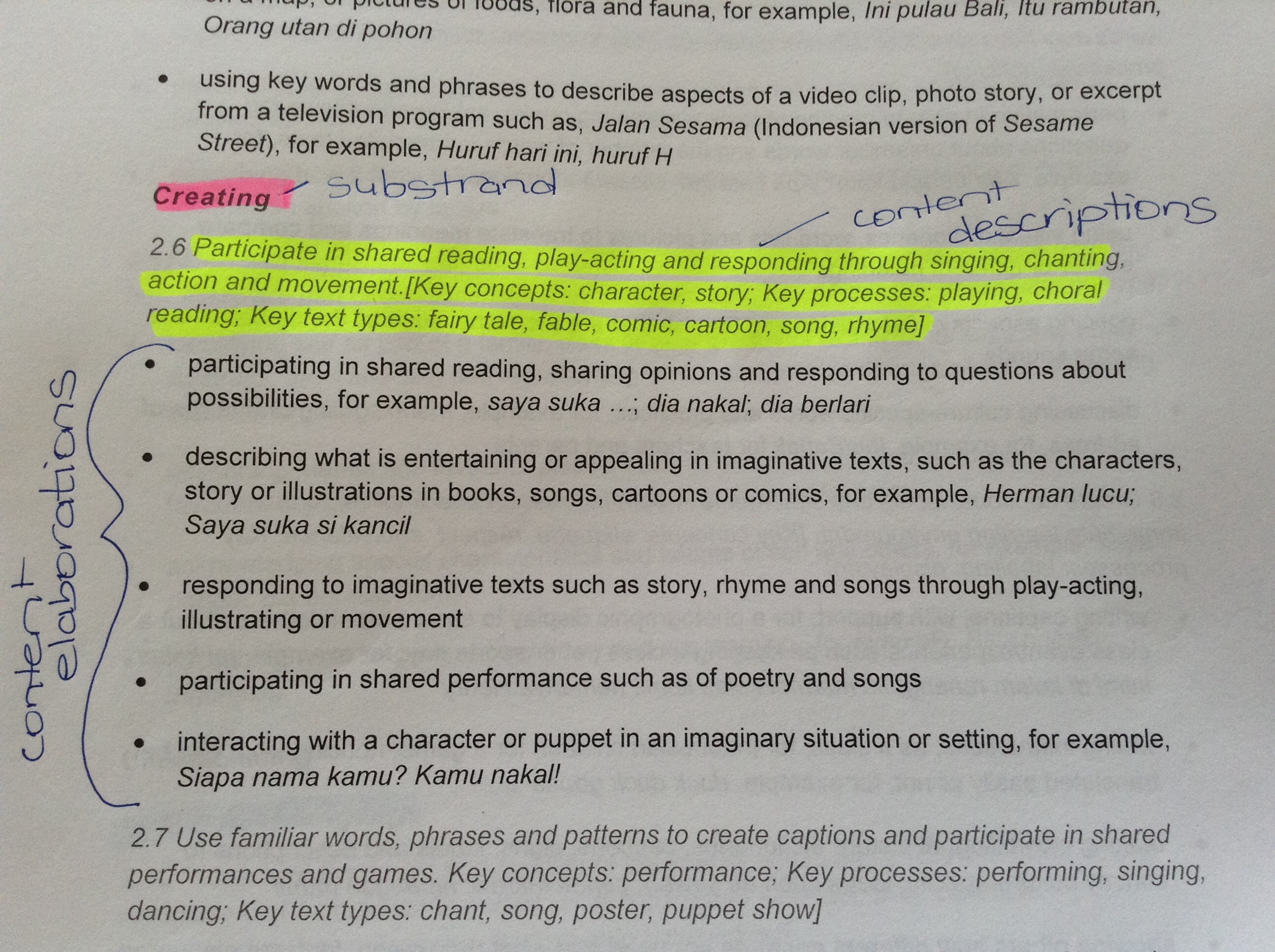
Content Descriptions are the compulsory and required content elements whereas the Content Elaborations are purely illustrative suggestions.image

I emerged from the workshop busting with enthusiasm to trial some of her ideas the following week! I also emerged with pages and pages of notes which I will edit and include because I am hoping others will find them interesting and thought provoking too.

‘Identity’ is a concept underpinned throughout the entire Curriculum. This helps remove the ‘strangeness’ & foreignness’ from language teaching which in turn increases tolerance. Teachers use language & culture ‘hooks’ to connect their students.

Intercultural teaching is big picture thinking and not the 5 F’s. It promotes deeper thinking and understandings.

Instead of having a set task for each class to complete to represent and measure the learning covered during a term theme, could we at the primary level instead pose an inquiry question based on what teacher and students believe to be the most important understanding we want to know as a result of the term theme? For example, What role does schooling play in the community? Or, How do we take care of ourselves and others? How do we promote good health?

Language teaching should be about encouraging thinking rather than about providing answers.

This can be achieved by asking students about what we need to know and then listing the points which can then be ticked off as they are each covered. It could also include asking students to contribute to the list of key vocabulary to be introduced/revised. I love this idea. I do begin each topic with a list of vocabulary which is often targeted through flashcards and games. I have in the past simply added any student initiated words however I realise that this in itself demonstrates how teacher centric my teaching is. This is going to be extremely challenging for me with my current stye of teaching yet also very exciting and leads perfectly to my next dot point.

In learning about the new Languages Curriuclum, Indonesian teachers should play with the shift in thinking rather than in the shift in programming. The shift is in pedagogy.

Know your students. Andrea gave examples of how she had surveyed her students to discover what other languages they had learned or already spoke. This is definitely something I would like to investigate further with my students. I asked my upper primary classes the following Monday about this and discovered that not only did we have students who spoke Punjabi and Greek, but one of our recently returned students from the APY lands speaks Pititjantjara! That was very exciting because a group of Year 6-7’s are currently preparing for a 10 day school bus trip to the AYP Lands! It also gave students the opportunity to consider what level of fluency gives you the right to say you speak a language. Being able to say “Aloha” does not make one fluent in Hawaiian!

Andrea then finished off with some homework tasks for us. Here they are:

1. Look at the ACARA website and familiarise ourselves with it. Look through one of the subject areas and explore how everything is set out because that is how the Languages Curriculum will be.

2. Design a profiling tool to get to know our students. Andrea shared hers, a survey she asked all students to complete.

3. Look at the achievement standards and look at how they are sequenced and build in complexity.

Once again, a huge thanks to Andrea for meeting with us down here on the Fleurieu and providing us with so much information on the revised Curriculum- Indonesian.