Sharing Awesome Links – Membagi Ide Luar Biasa….

One of the blogs I follow is Brilliante Viernes by Maris Hawkins and often she shares links to sites she  has discovered. It is such a cool idea!! Lately I have found so many brillant posts and sites, that I really want to share them with you. If you like this format, let me know in the comment section below!

  1. My student teacher, Hannah, is keen to try a movie talk this week with our junior primary classes to introduce the target structures ‘bisa berenang’ and ‘bisa melompat’. We found a funny video of a dog (link to be added soon) jumping into a pool which will be the basis for the movie talk. Just by chance there is a current thread on moretprs about movietalk which included a link to this amazing video of Eric Herman giving a movie talk demo. I love the way he tells the story as well as seemlessly asking questions. I can’t wait to try another movie talk now!
  2. Other movie talk links include a handout by Eric Herman and posts by Chris Stoltz and glesismore. Sharon Hellman has also recommended a lovely video which I love.
  3. Look at all these amazing demo videos by Eric Herman! The reason I recommend Eric Herman is that he teaches both primary level students as well as high school students.
  4. Senor Fernie has recently published a post about story telling & writing with primary students. It includes some awesome ideas I can’t wait to try next term.
  5. I love this number lesson idea on the Adventuras Nuevas blog.
  6. This is a video demonstrating a story telling technique that I want to watch in full when I have some time because I think aspects of it could be applicable in the primary classroom!!
  7. The Indoinspired blog post about kancil’s. There is also a facebook page you can follow/like which I recommend  because  you’ll find all sorts of gems there!! You can also follow indoinspired on Twitter! 
  8. Did you hear about the tiny ‘dragon‘ discovered in Indonesia?
  9. I read this article about traveling by angkot on Twitter and Facebook. It’s a great read!
  10. Margaret & I head off next week to Sumatra to visit our partner school in Medan for the first time. We aim to develop ways our students can connect via the internet as well as explore the feasibility of organising a staff trip in 2016. Follow my travel blog (written for my students) to read about our experiences! We will be staying a week in Medan before heading off on a study tour to Jakarta & Jogjakarta. Ayo….

    Almost Midterm Reflections

    The end of week four has just arrived, thankfully, as I am so exhausted. Our community has a variety of nasty viruses in circulation at the moment which has had in some classes, a devastating affect. I just hope the sore throat I feel coming on is just the result of my previous class which consists of several challenging students!

    This term, I approached my story slightly differently to how I have done so before. The main target structure for the current story is bisa (can/ to be able to do something) but I also wanted menyanyi (sing) & mencium (kiss/smell) to be taught explicitly too because both are great TPR words. I love the way Eric Herman uses TPR,to introduce target structures and know that I will be able to get good mileage from both words during brain breaks.

    I firstly focused on bisa. This took about 2-3 lessons. I began by focusing on the skills and abilities that students identified having and then had a fun lesson asking students, “Siapa bisa handstand?” If students raised their hand, I then asked them, “Billy bisa handstand?” and if they didn’t raise their hand I would go right up to the student, look them in the eye and then ask suspiciously, “Jill bisa handstand?” I then circled their answers briefly before inviting the student to the center of the chairs which were arranged in a U for this lesson. The student then did the handstand and I was able to get many repetitions of bisa. Billy bisa handstand? Billy atau Bobby bisa handstand etc! One class asked me, “Bu Cathy bisa handstand?” To which I answered,”Tidak bisa.” yet they insisted I show them, so we all had a good laugh because I could barely got my feet off the ground. More repetitions of tidak bisa!!  Such a fun and relaxed lesson.

      
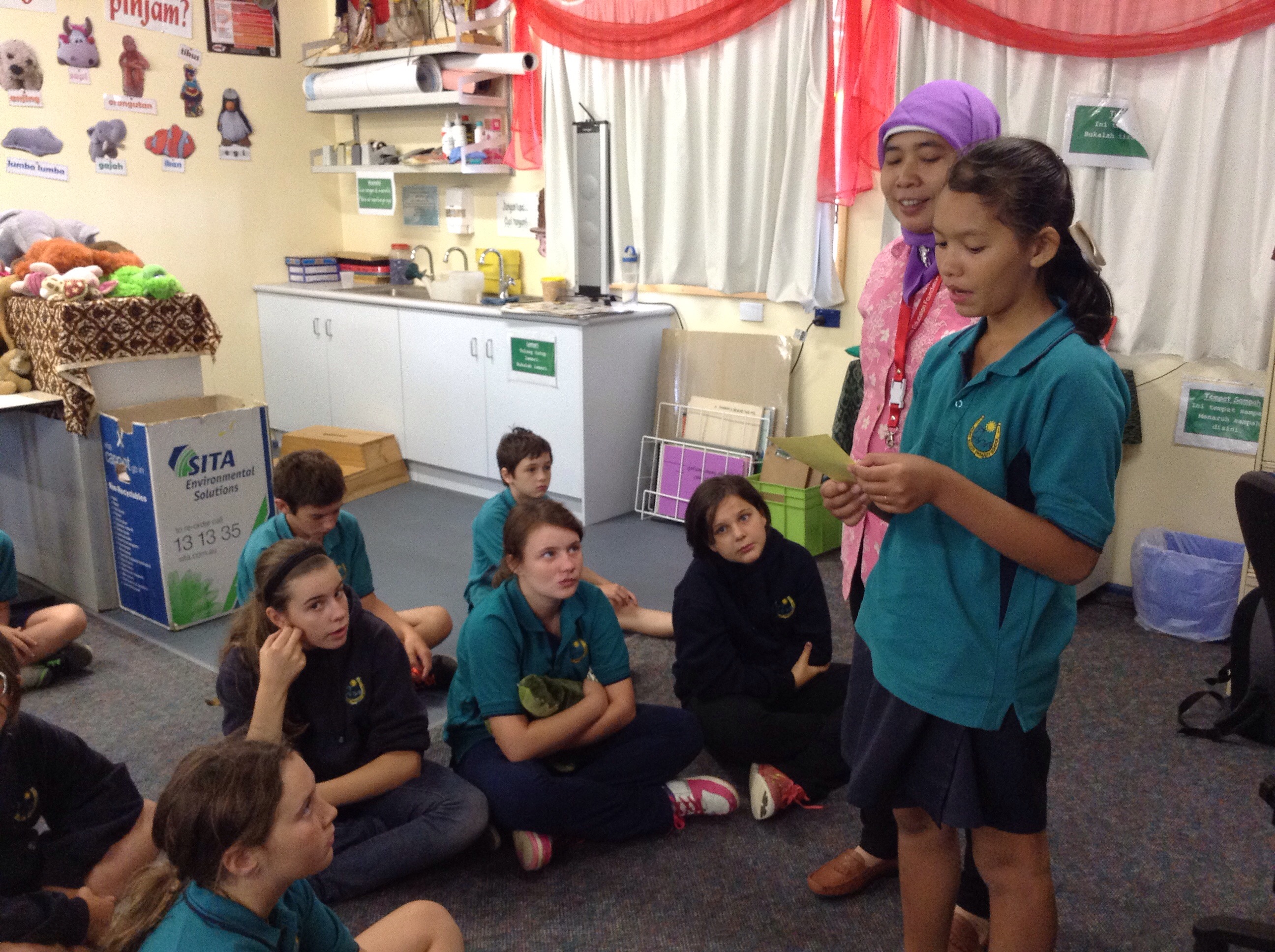
    My lesson on mencium was a culture break – because it was largely in English. We talked about the differences between mencium and kiss/smell and also why in Indonesian, mencium means to kiss and to smell. This collaborative blog has a post which clearly explains the various ways in which Indonesians greet each other. I had students pair up and practise hand shaking (gentle and finishing on your heart), mencium (cheek to cheek while doing a gentle smell/sniff) and also kasih hormat kepada guru (holding the teachers hand to the students forehead). We also demonstrated all 3 greetings at a whole school assembly with a group of young students finishing up the demonstration by showing respect to our principal. It was a hoot.

    I  next did Martina Bex’s wordle activity as outlined in my previous post. The link to this and other activities is on the new TCI activity page, found in the top band of the homepage. All these activities meant the lead in to the story took much longer than it did in terms one and two. Because bisa is such an important word in Indonesia and comes up constantly in a variety of contexts, I really believe it was vital to devote several lessons focusing on it. Also now that I am into my second semester of TCI, I feel a lot less pressure to cover topics/target structures quickly which has been a wonderful revelation. It is so empowering to be able to focus on student acquisition as apposed to keeping up with a rigid term overview. 

    Word Race Stories

    I had thought I would ask the story early in the term just like I have done in the past and just have the unfamiliar vocabulary written in a list on the board so that when it came up, I could ‘point and pause’ it. At our last hub meeting, Sharon suggested introducing the word ‘bisa’ during the first lesson as a lead up to telling/asking the story in the next. However, with the late introduction of the gesture in week 1, I decided to spend the next lesson on ‘bisa’ as well to introduce and consolidate the target structure and gesture.

    My second lesson then became the pre-story lesson with a mini focus on the vocabulary that would be used in the story. I scrolled through the marvellous Martina Bex’s blog, The Comprehensible Classroom, and found her suggested activity called Word Race Stories.

    I created a word cloud with the vocabulary from the story:

    word cloud bisa story

    This activity starts with me calling out a word in English and they had to find its Indonesian equivalent. The competition between the students in their pairs was fierce yet everyone engaged with this activity. Such a fun way to review vocabulary. The first time I played this, it was chaotic as I followed Martina’s suggestions exactly. Sharon’s idea for students to purely point at the word with their finger was heaps more manageable than students trying to be the first to highlight it with their pen!

    With my middle primary students, we finished off the activity by each pair looking at the words in the word cloud and then writing a sentence they thought could be in our new story. Yet with my year 6/7’s today, I tried for the first time the followup suggestion that Martina suggested. In their pairs, students had to think about the words in the word cloud and then write a sentence that could start a story using only words from the word cloud. Once everyone had finished their first sentence, they had to swap pages with another pair. Each pair then read the previous sentence and wrote a second sentence below that followed on from the first and used only words found in the word cloud. We then repeated this about 6 times. Each sheet was then returned to the original authors whose job was to edit the story and write the final sentence. I then read out as many stories as I could which everyone enjoyed! This was a very interesting exercise for several reasons even though I need to state that TPRS/TCI programs are about student receiving heaps and heaps of input and activities such as these should not be the backbone of our teaching.

    Here are some of the stories that were produced:

    story one

    John dan Lucy punya hotdog.

    Lucy berkata, ‘John, saya mau hotdog.”

    John kasih Lucy dua hotdog. 

    Lucy tidak mau dua hotdog.

    Joh makan satu hotdog.

    story two

    Ada laki laki.

    Nama laki laki Lucy.

    Nama perempuan John.

    John mau mencium.

    Lucy tidak mau mencium

    John kurang baik.

    story three

    Ada laki laki dan perempuan.

    Nama laki laki John dan nama perempuan Lucy.

    John dan Lucy makan dua hotdog.

    Lucy berkata, “Saya mau minum.”

    Lucy dan John mencium.

    Overall the stories were written with correct word order and demonstrated a good grasp of all vocabulary, even mencium which we haven’t talked about yet. The most interesting point from all the stories was how little ‘bisa’ was used!! In total it was used twice! I wonder if this will change once we have told the story?

    Now that we have had 2 lessons focused on bisa, I would like to organise my next lesson on ‘mencium’. The meaning of this word is a great opportunity to talk about intercultural language. While non Indonesians use the word ‘mencium’ to mean to kiss, its meaning is also to smell because that is how female friends traditionally ‘kiss’. You put your cheeks together on one side and sniff gently before repeating on the other side. Have you watched Indonesians smell babies too? Australians do it too, yet we don’t truly inhale the baby scent as an Indonesian does. There is a real skill to it, I believe!!

    Ibu Mia From Batam, Kepulauan Riau

    This week my students are enjoying a chance to interact with and learn from Ibu Mia, an Indonesian high school English teacher from Batam, Kepulauan Riau. She will be in our area for 3 weeks, spending a week at each of our schools. Her visit has been entirely coordinated by Pak Nyoman from APBIPA and we are so, so fortunate to able to particiapte in this program. Through APBIPA, we have hosted teachers from Sumbawa, Bali, Sumatra, Jakarta, Kalimantan, Bandung and now Batam. What a fantastic way for my students to experience the diversity of Indonesia. 

    We learned many interesting facts about Batam. Some of which are:

    • Even though it is a tiny island, the population is roughly similar to Adelaide; 1 million. 
    • It is only 35 minutes from Singapore by ferry and Ibu Mia has often taken her sons to Singapore for a day trip!
    • There are 1500 students and 90 teachers at her school, SMK 1 Batam.
    • Batam was only founded in the 70’s and then developed in the 80’s as a centre for free trade.
    • Batam has a good selection of high class hotels, one of which is a restored cruise ship!
    • There are 7 domestic harbors and 2 international harbors in Batam.
    • Batam has beautiful beaches.
    • Batam has a huge industrial sector.
    • Ibu Mia lives in Batam Centre.
    • There is a ‘Welcome to Batam” sign which is exactly like the Hollywood sign in California.
    • Batam’s skyline resembles any develped city’s skyline. Multi-story buildings and freeways. 

    This visit has been so enjoyable for me for a variety of reasons. Usually I teach as per usual and my visitor co-teaches i.e., assists with modeling pronunciation, extra facts etc. However this time, the focus of the lessons this week has been Ibu Mia, thus being a cultural brain break for all of us. While lessons largely reverted back to the 90% English/10% Indonesian ratio, it was so interesting and informative that it wasn’t an issue and we still managed to where possible incorporate the target structures for this term and students enjoyed plenty of opportunity to demonstrate their growing ability to speak in Indonesian with many classestotally impressing Ibu Mia! So exciting!! I couldn’t help pointing out to the older classes, that the level of communication we used with Ibu Mia was far above that which we have used with any previous visitor. 

    Our recent acquisition of pakai was very useful and we enjoyed the opportunity for many repetitions with all the classes due to discussions about why students thought Ibu Mia was Indonesian (as opposed to be being Korean, American, Spanish etc). They all said that had they seen her in the street, they would guess she was Indonesian because of the clothes she was wearing which led beautifully back to our circling:

    • Ibu Mia pakai topi? bukan
    • Ibu Mia pakai jaket? bukan
    • Ibu Mia pakai sepatu? ya
    • Ibu Mia pakai apa?

    This then led to a discussion about her clothing. Students learned the word for her Muslim dress (gamis) and her  head scarf (jilbab). I have a selection of jilbabs from Kalimantan, so we dragged them out which led to many questions from students about jilbabs. The questions were hysterical and I wish I could have recorded them all. It was so hard keeping a straight face! Questions included:

    • How do you put on a jilbab?
    • Do you sleep in your jilbab?
    • How do you get your hair cut if you can’t take it off in public? 
    • What is that thing under your jilbab? (ciput)
    • What happens if someone comes to your door that is not family and you are not wearing your jilbab?


      The most amazing thing about all the questions was that they were all respectful! Not one student made a negative comments about any aspect of Islam. I am so proud of my students. Ibu Mia was so relieved. She showed me an article from her local paper for which the headline which roughly means: Ibu Mia is a ittle bit worried about visiting Australia On The Heels of The Bali NIne Executions.

        
      Her friends all warned her that Australians would harrass her because of the executions and that it was a terrible time to visit Australia. Many also suggested she reconsider wearing a jilbab in Australia or at least wear a smaller one. Thankfully she did not listen to their advice!! At our school and in our local community she experienced exactly what I experienced while traveling in Indonesia amidst the telephone spying scandal: most of  the hullaballoo is political and hyped up by the media. The general public are largely cynical consequently and thus when a visiting national from that country is polite and personable (as Ibu Ma definitely is), it dissolves any animosity one may have for their nation and is brilliant for breaking down the stereotypes that events such as these perpetuate. 

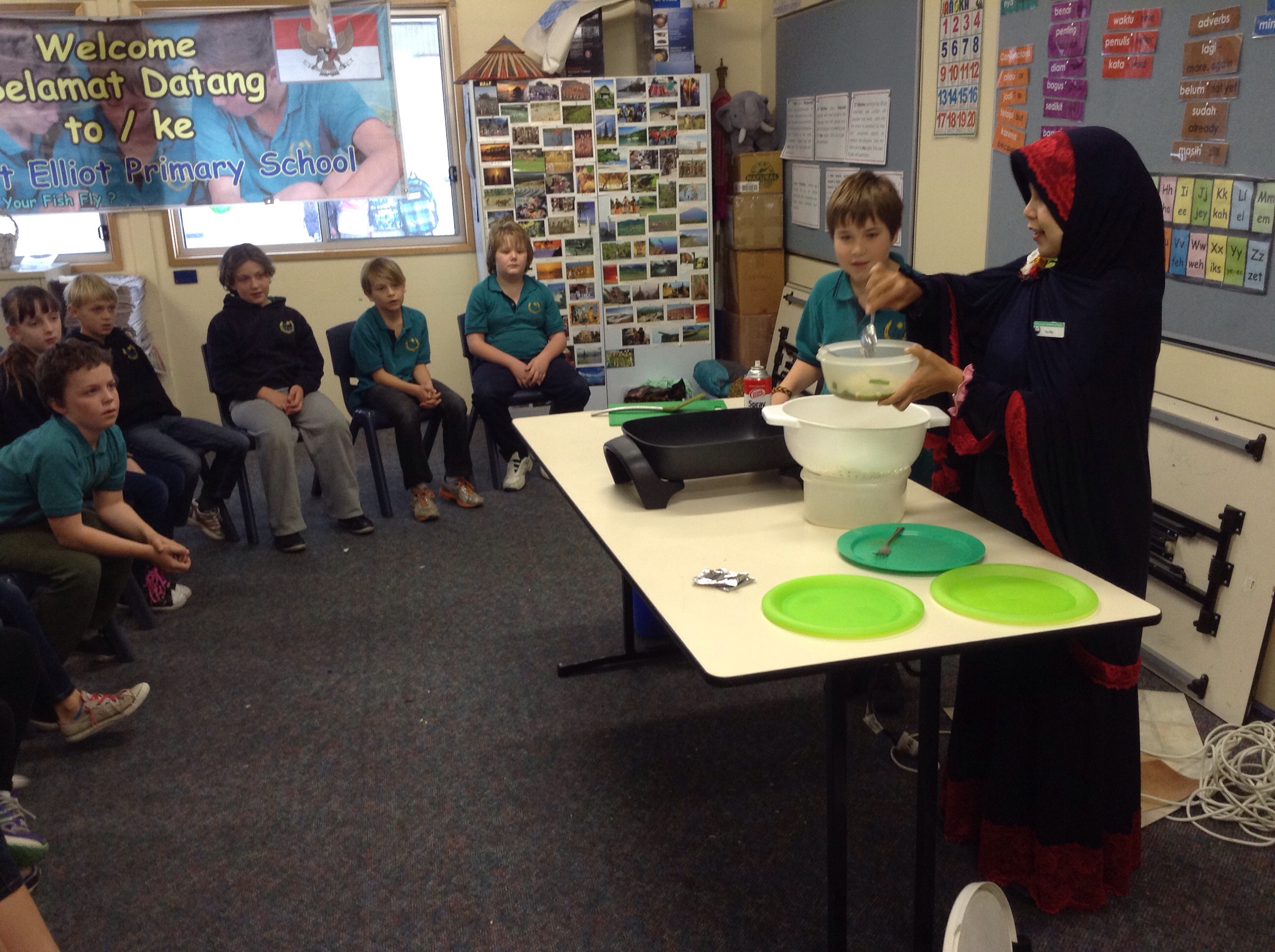
      The classes that have 2 lessons a week, were treated to a cooking demonstration for their second lesson. Ibu Mia, not only loves cooking but she is an awesome cook. We brainstormed one evening after school for recipes that are quick, easy and will surely be popular with students. Ibu Mia suggested her own recipe of Mie Goreng Telur A La Ibu Mia which is a popular snack she makes for her sons when they are hungry. We found all the ingredients at our local grocery shop and she was especially delighted that we could buy the extra spicy chilli sauce made by ABC!! Needless to say the small noodle pancakes were a huge success. Students could choose to have theirs with saus tomat, sambal atau tidak pakai saus. The entire cooking lesson was a double bonus because where possible Ibu Mia used the target structures that students have learned this year. It was awesome that Ibu Mia understood the power of TPRS/TCI so quickly. Her circling required that all students to listen, look & respond! It was so cool. Her language to the students included:

      • Kasih Ibi Mia gunting
      • Siapa mau menjadi assistan Ibu Mia?
      • Apa ini? 
      • Kasih Ibu Mia telur. Apa telur? Ya, telur egg!! Jade, kasih Ibu Mia dua telur. Berapa telur?
      • Berapa murid di kelas ini?
      • Ayo, Menghitung! They would then count with her while she tricked them by going fast sometimes and slow sometimes.
      • Garamnya (apa garam? Ya, garam salt) Garamnya terlalu besar, terlalu  kecil atau pas?
      • Siapa mau makan mie goreng telur pakai saus?

      Terima kasih IIbu Mia. PEPS will miss you!

        Ayo, Menghitung!

          Term 1 Reflections

          As term 1 draws to a finish, I have been looking back over my first dedicated block of teaching Indonesian using TCI . It has been a steep learning curve yet at the same time deeply satisfying. I have learned just as much as the students!! Here are the major gems that I would like to share with you from my short journey thus far:

          1. Props – Don’t ever underestimate the power of props. When I copied Sharon’s brilliant idea of using a bottle of Sprite to tell the story: 

          Jessie haus
          Jessie mau minum Sprite
          Ella punya Sprite
          Ella kasih Jessie Sprite
          Jessie minum Sprite.

          I was blown away with the total and utterly mesmorised attention of the classes from year 2 right up to year 7! Even when the Sprite finished, students insisted I refill the bottle with water, so we could continue. Even with water, students were still highly engaged and following the dialogue closely. It not only hooked the actors, but hooked the other students too as they decided whether Ella would give Jessie a drink of Sprite and if not Jessie, then who would be given a small drink of Sprite. It is definitely worth taking the time to organise props for lessons with all year levels. Not only do students beg for repetitions, but it is so much more fun too for everyone. I have never laughed so much with students!! 

              2. Public Holiday Pitfalls  –  Usually I begin my week with the year 4’s and they are a great bunch of students to ‘trial’ my middle/upper lessons with. They give me the opportunity to fine tune my plan before facing the year 6/7’s the following day. While I enjoyed my first Easter long weekend in many years (our Ed Dept usually cleverly incorporates them into our mid semester break), I forgot to keep this in mind and consequently yesterday’s lesson with one of the year 6/7 classes was a disaster. With this class I need to be one step ahead of them. Maybe Trashball or something similar would have been a better plan for a challenging class in week 11.. 

            3. Trial by Error – A exhausting yet necessary aspect of teaching and a fact that I (and any learner) needs to philosphically and practically accept. I’ve read that it can take up to 2-3 years for a teacher to acquire competency using TCI methodology. This is what keeps me going! There are many fantastic blogs and websites full of TCI brilliant ideas and suggestions. Gleaning through them all to find ideas suitable for teaching primary students and then trialling it requires a huge step out of my comfort zone and so much energy. Yet each step is an important and integral aspect of the entire journey.  I must keep reminding myself to continue plodding steadily along the TCI path and not to expect too much too soon! 

          4. Dehydration – TCI requires so much teacher talk and I have discovered that I am so much more dehydrated at the end of my days than I was ever before. I have tried to keep up my fluids over the day but haven’t been successful consistently with this yet. I get so engrossed in the lesson that I totally forget to stay hydrated. The most successful stategy I had was finishing my 750ml drink bottle at the beginning of recess and lunch on my way to the staff room but lately even that has fallen by the wayside. Any suggestions gratefully accepted! 

          5. The Importance of Developing A Personal Learning Networks (PLN) –  The core of my PLN consists of Annie & Sharon, my Indonesian colleagues who teach in nearby schools, together with Catharina, our mentor who teaches French in New Jersey. The middle layer of my PLN consists of teachers who teach Indonesian and have been following this blog or my tweets. Their input has been invaluable and I have truly appreciated their comments and  feedback. While there are common aspects between different languages, there are also certain aspects that are unique and therefore those who teach and  speak Indonesian have that special eye through which to  understand my reflections and experiences. They too are are coming to grips with our new Indonesian Curriculum to be implemented fully in 2016, another valuable persepctive. The outer layer of my PLN consists of all the TCI language teachers who post on their own blogs or on websites like Ben Slavic’s. There is definitely a gap for me between the middle and outer layers purely because most of the teachers in the outer layer are secondary teachers and none of them teach Indonesian. Yet, they are still a major and important part of my PLN as they have such a wealth of knoweldge and experience that I am truly in awe of them. Without this special group of people, my first term of TCI could have finished so differently. Whenever I felt like I had hit a brick wall and I couldn’t see where to go next, someone would be there to encourage and help. Annie and Sharon have been awesome and once again I am so fortunate to work so closely with 2 teachers who readily joined me on this journey. Our frequent Friday meetings were invaluable opportunities to share lessons that worked well and thus give us each the inspiration and encouragement to continue. Our Skype sessions too, with Catharina have been incredible. Each time we all  took copious notes. It is so amazing to have the opportunity to speak with a junior primary teacher about TCI and how to apply it with very young students. Now that term 1 has almost finished, we are really looking forward to our next Skype call with Catharina. While we usually only speak for an hour, each call is jam packed full of awesome suggestions and information. She truly is an amazing and inspirational teacher  to have in my PLN and a huge thankyou must go to Ben Slavic for initially suggesting it! 

          6. Lesson Planning – On looking back through my lesson plans, I have definitely learned that while it is good to have a few brain breaks up my sleeve, it is also important to keep my planning simple. My initial lesson plans from the first weeks were very long and were a great example of over plannning which is a good way to start! I tried to cover everything at first and then realised that it was not only unrealistic but also pushing the students too quickly. Narrow and deep is the TCI catch cry for a very good reason and this is what underpins the success of TCI over the methodologies I used previously. 

          7. Patience is a Virtue – When reading blog posts written by other teachers who also use TCI, I have to keep reminding myself that comparing my students (or their lesson outcomes) with theirs is pointless. My students & i have only just started so it is natural that we can’t yet have impromptu detailed conversation that are 100% comprehensible. It is of greater importance that we start with the Indonesian version of the super list of verbs sourced from frequency lists and accept that initial discussions will be be very basic. 

          8. Humour – At a point about mid-term, I reached a point where everything gelled. Suddenly I relaxed and started to enjoy myself with the students. At that point I realised that it was the first time I have ever laughed so much WITH  my year 7 students. Previously, any hilarity got out of hand and ended with me having great difficulty bringing them back on track without loosing that sense of connection. Yet with TCI, we laugh together at the ridiculous  scenarios the students suggest and then act out. Not only do students have fun, call out and be totally silly, but because it is all in Indonesian, it is amazing and all students are totally mesmorised and engaged thus keeping it manageable!  

          9. Tight Timelines have Vanished – Previously, my term outline was tightly planned and in order for me to achieve my term outcomes, every lesson was precious and heaven help anyone who interfered with my schedule!! Taking sick leave was avoided and any additional offered non contact time was reluctantly refused because my planning didn’t have much flexibility. This has all blown away with TCI as everything is based upon student aquisition which is a  huge unknown. Once we know what the target structures will be, out planning will focus on that until we, the teacher, deem the students ready to progress to the next step. Consequently, with our upcomiing APBIPA visitor, Bu Mia, I feel far more relaxed and am really looking forward to her time in our school. Students will be able to experience a cultural lesson with her and this will also give them impromptu and authentic opportunities to practise and demonstrate their acquired Indonesian to date.

          I am so looking forward to term 2 and having the opportunity to apply all that I have discovered. I also hope that my reflections give other Indonesian teachers the encouragement to consider trialing aspects of TCI in their classrooms. Last year, I dabbled just by experimenting with a few activities that sounded interesting and that is how I urge you to start too. While I am nowhere close to TCI mastery, I am nontheless, very happy to help any Indonesian language teacher if you would like to discover more about TCI. Ask away and if I don’t know the answer,, someone from my amazing PLN will certainly help!!

          Week One Bridge Program at PEPS

          What a week! Our Bridge partners returned home with Marg & I Saturday night and after a good nights sleep, Sunday was spent catching up on washing and looking at a few of our local tourist attractions.

          IMG_9725

          IMG_9726

          IMG_9727 I had hoped to grab some time to program but other than a quick look, it didn’t happen. Thankfully I had done some the week before I left. We all went to bed absolutely exhausted again Sunday night and would’ve preferred having one more day before heading back to school!

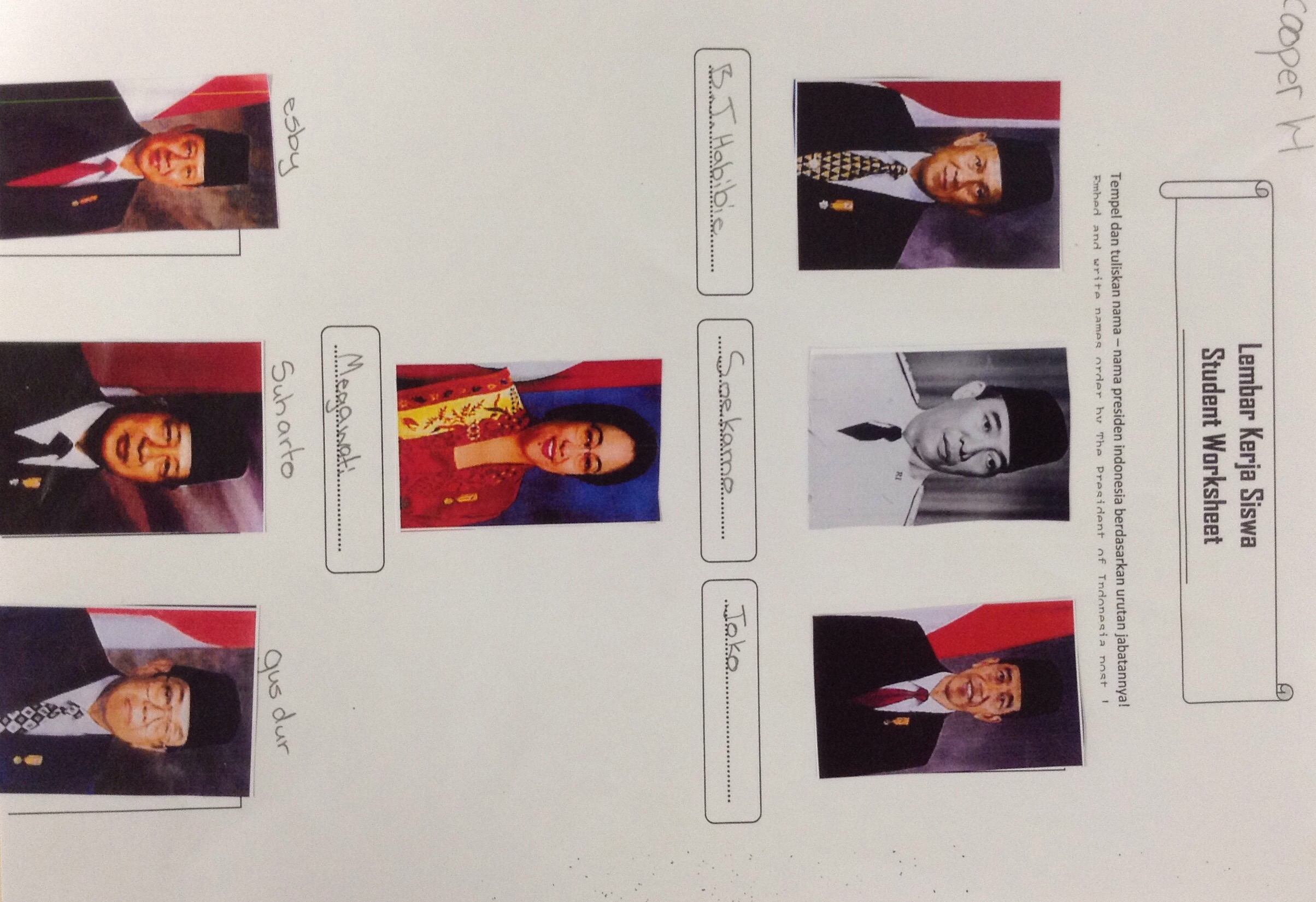
          On Monday, I decided to teach as per usual to give Pak Pahot & Ibu Eliza the opportunity to observe TCI methodology in the Indonesian classroom. I didn’t say anything beforehand, other than to warn them that I don’t teach Indonesian the way other language teachers in Australia do, as I thought it would be easier to answer any questions afterwards. However, I was disappointed later when there were no questions or comments. I later realised that both Pak Pahot and Ibu Eliza are classroom teachers, not language teachers! After school we discussed the schedule for Tuesday. Both said they had lessons that they’d like to teach. Ibu Eliza had brought a lesson about the 7 presidents and Pak Pahot wanted to teach younger students about 10 native Indonesian fruits. This worked out perfectly with the timetable for Tuesday as the 2 year 6/7 classes were first and the last two lessons were firstly a year 1 class and then a year 2/3 class, so we headed to the SSO room to prepare for our lessons using the PC’s which was easier than getting them onto the school wifi.

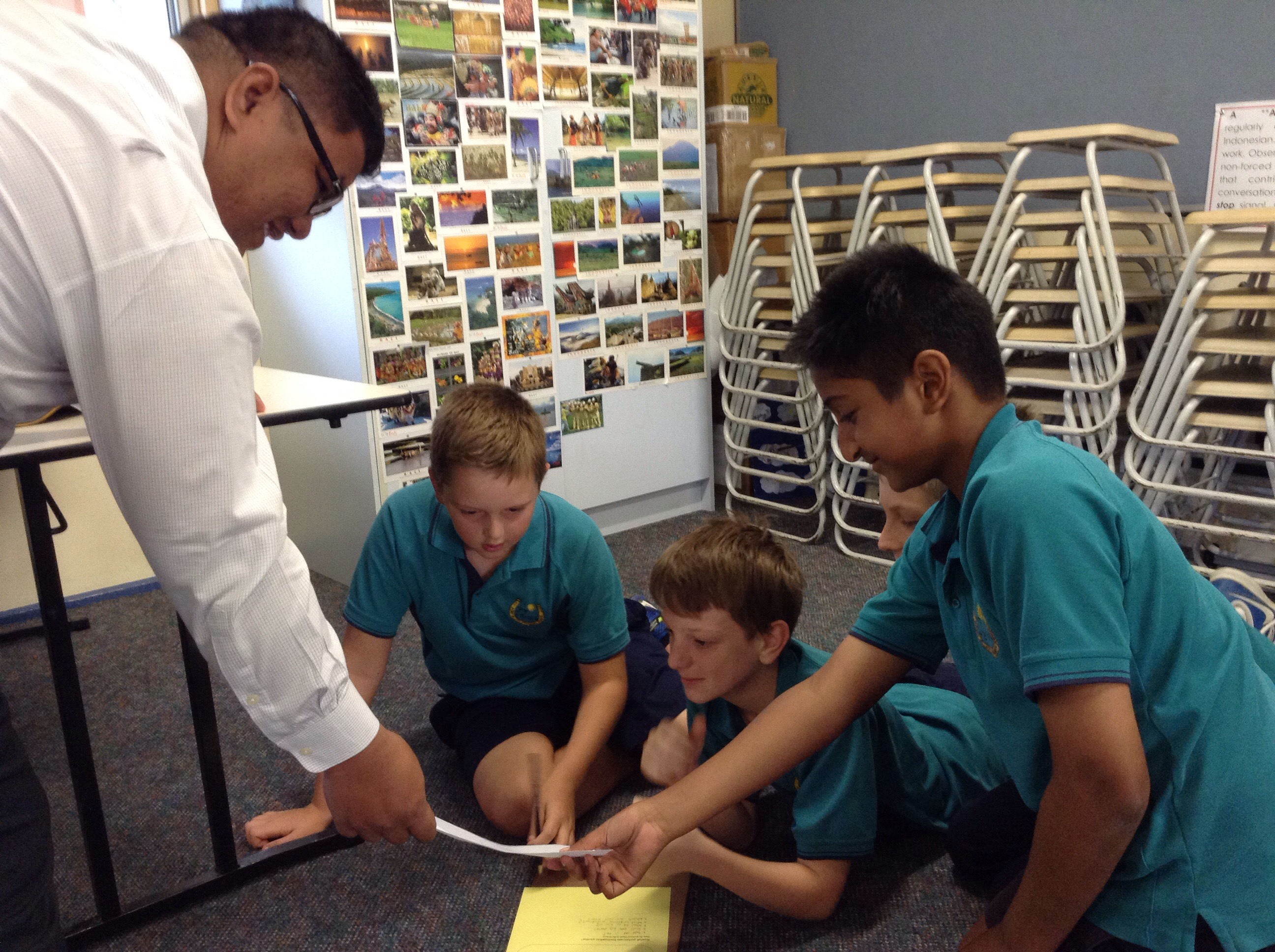
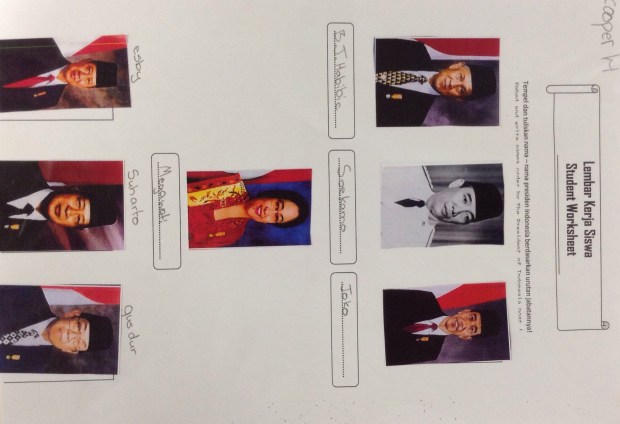
          Consequently Tuesday was a lovely day for us all. I supported both teachers for 4 of the 5 lessons I usually teach on Tuesdays with translations and classroom management while students thoroughly enjoyed being taught bilingually. Ibu Eliza’s lesson had several components to it and in retrospect would have been less rushed if we had spread it over 2 lessons, yet because we had so much to get through in 50 minutes, they didn’t have any time to get distracted. Students were divided into 7 groups and then given a page with a small picture of one of Indonesia’s past or present presidents at the top. Under the picture, students had to write down 5 questions they would like to know about that president. The questions written by students were varied and ranged from what is his/her name? to: Was he/she a popular president? Each group then had to choose one of their questions and then they were given a paragraph of information about the president they were focusing on. Students had to read through the information to find the answer to their question. Any other information they discovered was written underneath a picture on another sheet handed out to groups. Had we enough time, Ibu Eliza had hoped that each group could share what they had learned about each president, however we were getting close to the end of the lesson, so we jumped straight into the next step which was to hand out another sheet with 7 boxes and 7 pictures of each of the 7 presidents and have students glue them on in order of presidency writing their names down underneath. By the 2nd lesson, Pak Pahot had simplified this for students by numbering each picture on the back! Students then had to ask each other for names of each president. The students responded well to this lesson and as the students needed to work quickly there was little time for off task behaviours. I did enjoy a quick discussion with one group who had Joko Widodo. They asked me to confirm if he was the current president who supported the death penalty. When I confirmed that it was, they then all had a really great discussion on their own opinions. I was so impressed with their comments and that they didn’t all agree yet respected each others opinions.
          IMG_9687

          IMG_9686

          After recess, in my non contact time, Sandy, the year 3 teacher, Skyped us for a mystery Skype. The original plan had been to do the mystery Skype from Sydney but for many reasons, this didn’t happen. Because the aim of a mystery Skype is to guess the location of the other ‘school’, we couldn’t tell anyone at all where Pak Pahot and Ibu Eliza come from beforehand!! We sat in the Indonesian room while the Year 3’s remained in their room, each with maps of Indonesia in their laps. There first question was, “Do you live in the Northern Hemisphere?” which was a great one as it eliminated so much of Indonesia and didn’t take them long to hone in on Medan! It was lots of fun even though the poor students were confused when I asked them to look at us and in doing so turned their back on us as the webcam was on the PC yet we were projected up onto the smart board!! Sorry guys!!

          IMG_9698
          The students then asked a few questions including;
          What are your houses made from? Cement and bricks
          Do you have any pets? Pak Pahot has a dog called Whitefang and Ibu Eliza has fish and chooks.
          What do you do in your spare time? Reading and cooking
          What musical instruments do you play? Pak Pahot plays the guitar, the organ and angklung
          Do you have any children? Pak Pahot has a 9 month old son named MIchael.
          Who do you live with? Pak Pahot lives with his wife, his son and 3 younger brothers whereas Ibu Eliza lives with her husband and niece. Sandy has blogged about the Mystery Skype in more detail on her class blog. Read the post here and read what the students wrote about the experience!

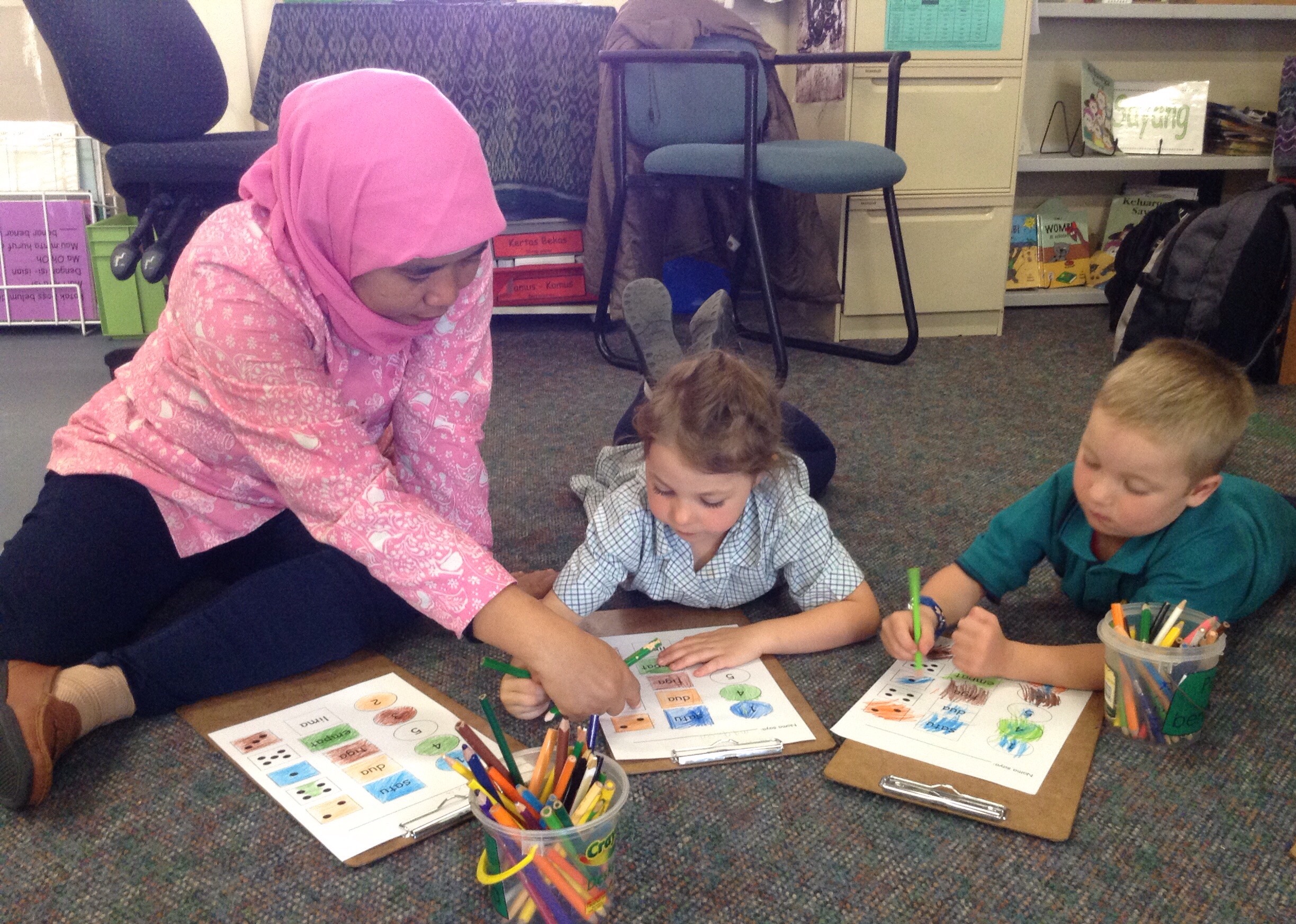
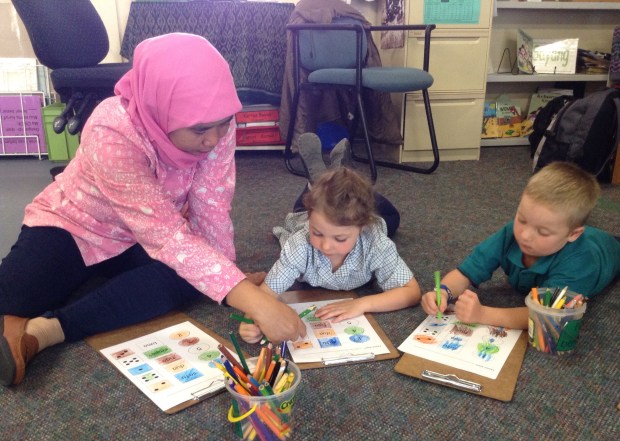
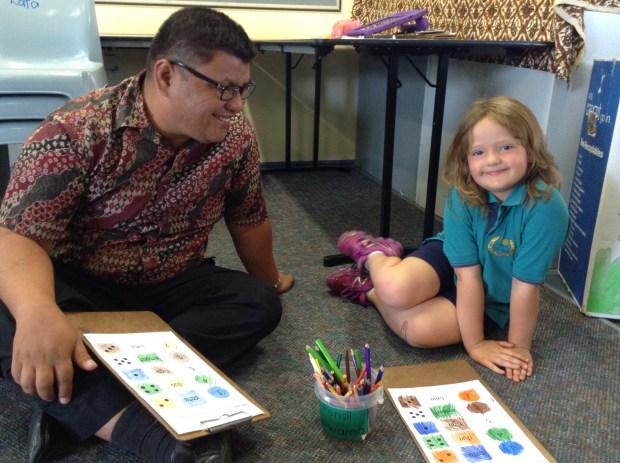
          My one and only lesson I taught that day was introducing reception students to the numbers 1-5 and then it was lunch time.
          IMG_9678

          IMG_9681

          After lunch, Pak Pahot showed a powerpoint he had put together of the 10 fruits he wanted to focus on. He explained that there are over 400 different varieties of fruit in Indonesia and no matter where you are in Indonesia, you will come across a huge selection to enjoy We then looked at the powerpoint and learned what they are called in Indonesian and for many students, we also learned what they are called in English!! Fruits included banana, starfruit, soursop, durian, rambutan and mangosteen. Students then worked in groups to match 5 of the fruits to their Indonesian names using pencils. Each group was then asked to stand up. One student held the sheet while the second student pointed to each of the fruits and the third student said their name in Indonesian. Students were fascinated with the variety of fruit available and surprisingly quite a few have tasted them either here in Australia or on holidays in Indonesia.

          IMG_9705

          IMG_9706

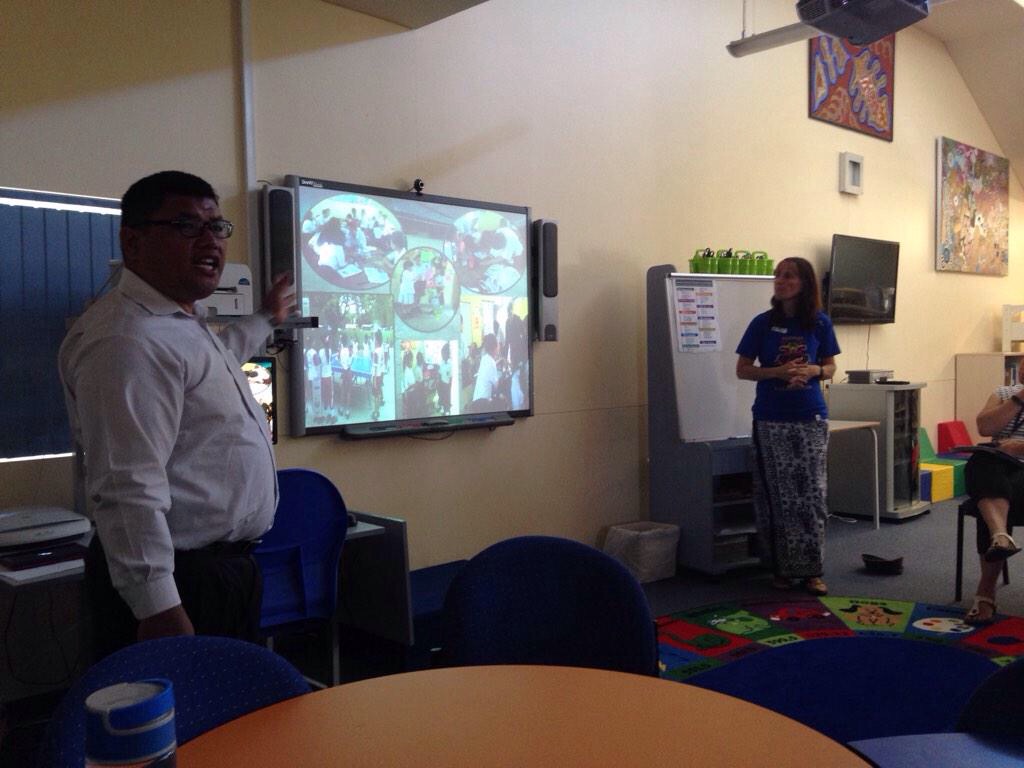
          We then had just enough time to fill up our drink bottles before presenting at the staff meeting. I introduced both our visitors, explained about the Bridge Project and then Pak Pahot presented a powerpoint presentation about his school, his students and the various programs running at their school.
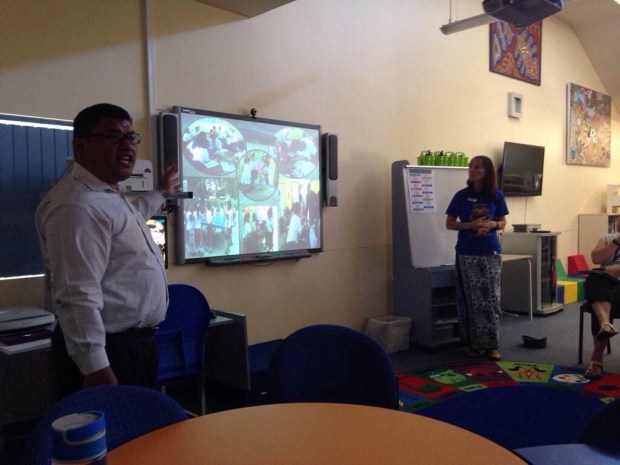
          IMG_9723Afterwards there was a brief question and answer opportunity where teachers asked specifics about special education programs, how remedial students are catered for (after school), the school day, etc. I then briefly introduced staff to the AEF website which is an amazing resource for Asia & Australia’s Engagement with Asia. It’s about to be updated too!! I also circulated a timetable for teachers to nominate blocks where Pak Pahot and Ibu Eliza could come in and observe lessons.

          The rest of the week was spent by visiting various classrooms which ranged from receptions to year 7’s and covered most subject areas, including PE!! The Sports Day warmup in particular was a huge hit!

          IMG_9730The only subject Pak Pahot has yet to observe and is really keen to see is science, so a note in the daybook will hopefully tick that box for him.

          Yesterday they spent quite a bit of time with the Year 5/6’s in Mrs Roberts class to work on ‘biodata’ letters for students in Ibu Elizawati’s class. We looked at one of the ones that Ibu Eliza had brought with her which was all in Indonesian and then looked at the various dot points our students would include in their own biodata.
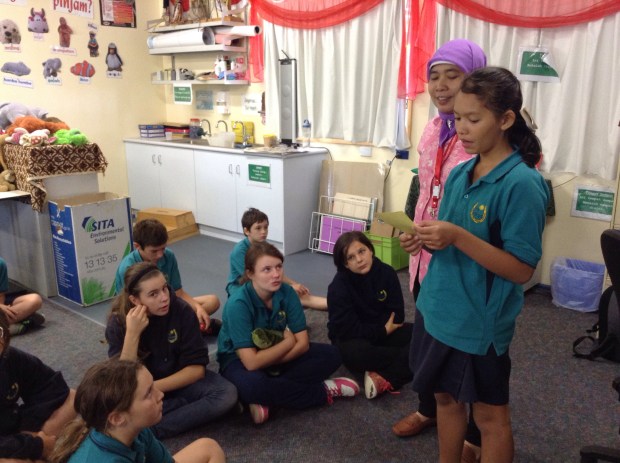
          IMG_9714Interestingly, two culturally different aspects arose!! Our students want to add their beloved family pets as they are considered parts of our family and secondly most of the students in the year 5/6 class either don’t have a religion or did not know what religion they are!! What a contrast to Indonesian students!! When I asked Pak Pahot what students could write if they don’t have a religion he was at first confused!! Such a foreign concept for Indonesians!!

          Thursday finished with a whole school assembly which was attended by a large number of parents as it was being run by the year 2/3 class. After welcome to country and the national anthem, Pak Pahot & Bu Eliza had everyone riveted with a Batak song and dance. The applause at the end was incredible and a true indication of how much we all thoroughly enjoyed the performance.

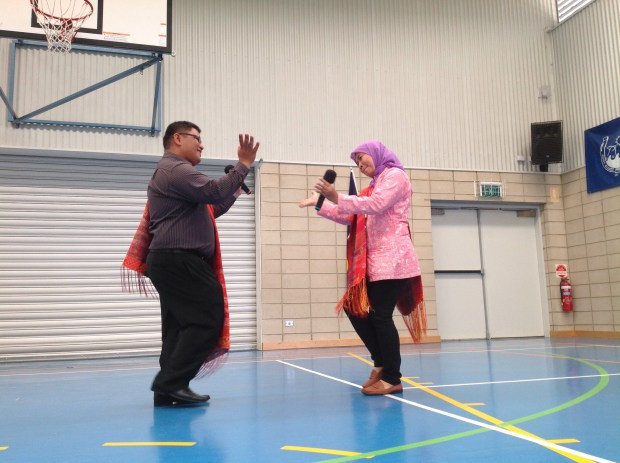
          IMG_9732

          IMG_9728

          After school we were invited to drop in to Sandy’s house to get a tour of their chili garden. The look on Pak Pahot’s and Ibu Eliza’s face when they realised just how many chili bushes there were was priceless. I too was impressed and particularly enjoyed the delicious sambal Ibu Eliza made to go with our fish that night!
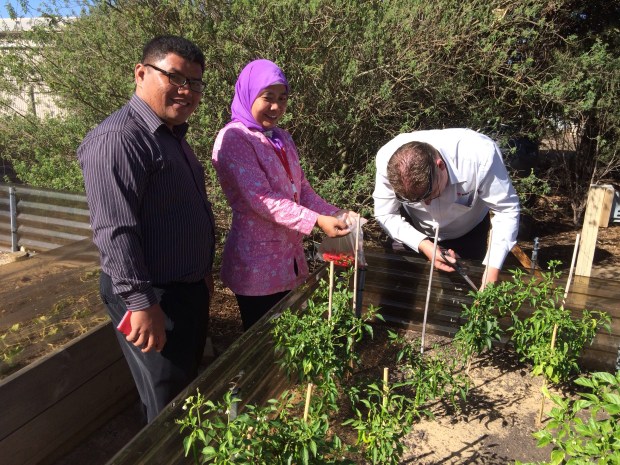
          IMG_9717

          IMG_9718

          As I don’t work Fridays, today we are enjoying a lazy morning and then we will head in just before recess to join Marg and her year 5/6’s for a Skype call to Port Macquarie where the other 2 teachers from Medan are being hosted. The last lesson on the timetable is choir which I doubt wild horses couldn’t keep Pak Pahot from attending!!

          To round off the week, we went out to dinner and Pak Pahot enjoyed tasting kangaroo!
          IMG_9722

          Our Week In Sydney with The Bridge Project

          What an amazing week we’ve just had here in Sydney for the Bridge Project. While we sit at the airport waiting for our flight, doing a last minute catch up with Erin and Mel who are also hosting 2 partner teachers from Medan, I’ll try to give you a brief picture of our full on 4 day training and development.
          Marg & I first met our partner teachers, Pak Pahot & Bu Elizawati, in the breakfast queue at the Novatel. Pak Pahot is a year 2 teacher and Bu Elizawati is a year 6 teacher at a school called SDN 025443 Medan Barat which apparently is rated number 1 in Medan. Of the 400 odd students who apply to enrol each year, only 100 are selected!
          IMG_9638-0

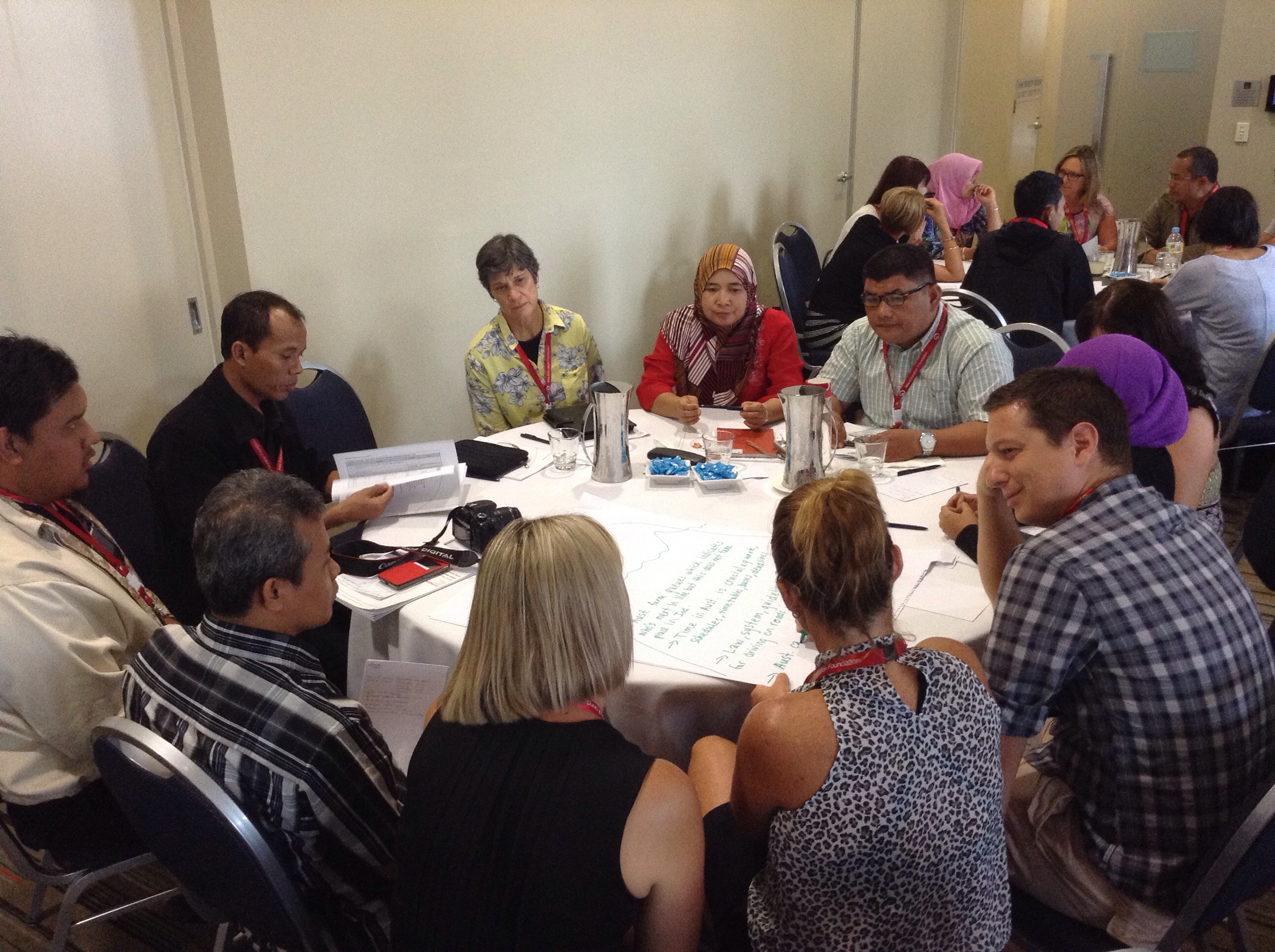
          Over the past 4 days there has been a strong emphasis on collaboration, planning and communication. Presenters recommended a variety of ways in which we can achieve all 3 successfully with our partner schools and time was provided to not only make a start on them but also so that we could familiarise each other with our school calendars, so that any planned projects avoid school holidays, religious festivals and national exams.

          IMG_9639We also spent time discussing cultural differences. Our partner teachers have already noticed differences with punctuality, environmental pride, traffic and the differences between Indonesia and Australia with the use of right hands to pass items.

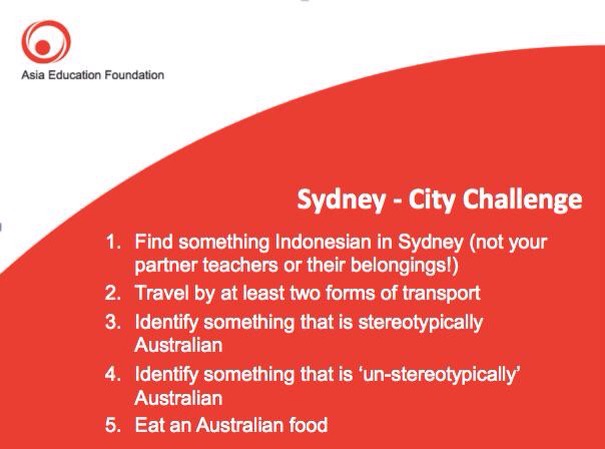
          Thursday afternoon, we were given a challenge:

          IMG_9675This was a brilliant and fun way for all of us to explore Sydney. The resulting photos on Twitter were varied and the shared experiences were vast. Check out #bridgeproject!!

          IMG_9648

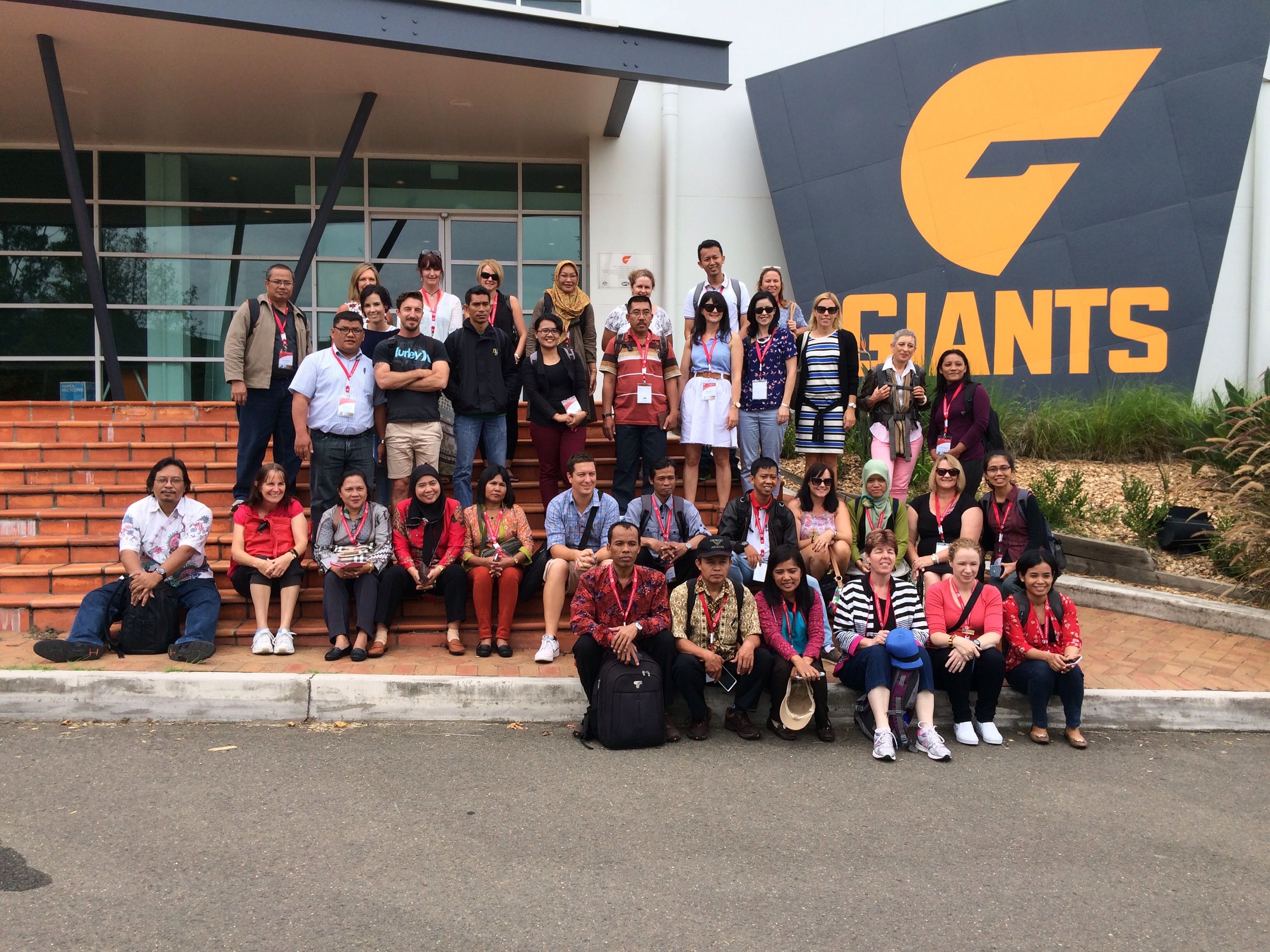
          Another fun outing was lunch at the local Giants stadium.

          IMG_9662After lunch, 2 of the stalwarts (proud muslims) explained about the various programs they run which target disengaged youth and promote education. Very impressive. Afterwards, we enjoyed a tour through the facilities:

          IMG_9664

          IMG_9666

          IMG_9667

          Presenters over the 4 days included Mike Bartlett & Danielle Leggo, education officers from from Sydney Olympic Park (SOP). The program they run there is truly amazing and caters towards both local and distance students. It largely focuses on sport, agriculture & sustainability and can be accessed either face to face or by video conferencing. Thirty thousand students annually access the ranger led Australian curriculum aligned activities learning about the local wetlands and other local habitats and there is also an online Koori classroom! One great suggestion from Michael was to set up a collaborative project to study the migratory birds that fly from Siberia to Australia, transiting Indonesia! For further information about SOP, regardless where you are globally, check out their website and youtube channel. They are currently searching for non Australian classrooms interested in an international 2015 netball challenge.

          Joedy Wallis from AEF, divided the group so that the Australian teachers and the Indonesian teachers could each focus on their own curriculums to identify areas compatible for collaboration as well as identifying goals and outcomes for student learning. She pointed out the areas of the curriculum covered by the bridge project include:
          literacy
          numeracy
          ict capability
          critical and creative thinking
          personal and social capability
          ethical understanding
          ICL (Intercultural Understanding)
          which together create successful learners, confident and creative individuals and active informed citizens.
          Joedy outlined some history behind the inclusion of the ‘Asia and Australia’s Engagement with Asia’ priority in the new Australian curriculum. The global shift which has lead to policy changes and the Melbourne Declaration, first signed in 2008 (changes advocated by AEF) provided the impetuous behind our Bridge partnership meeting this week. This promotes student acquisition of 21st century skills. all beneficial for Australia; socially, culturally and economically.

          IMG_9645
          Joedy promoted twitter to all, encouraging all teachers to sign up and discover just how amazing it is for professional learning and sharing. She also promoted the AEF website (which is currently undergoing a huge update to become even bigger and better), the AEF newsletter and #AEFchat on twitter (details on the website) which currently run monthly but will happen more frequently if the number of teachers on twitter increases.

          Julie Lindsay from Flat Connections presented on Thursday for 2/3 of our day focusing on the challenges connected with our partnership schools beyond face to face and how to sustain global connections and collaborations. She raised an important point about the need for deep global learning and the importance of constructing a legacy. Encouraging teachers to think deeply and creatively so that whatever project our students create, it will be their legacy.
          Julie suggested a variety of online tools through which this could be achieved:
          1. Ning.com (not free) which is a multimedia networking tool was recommended highly by Julie for asynchronis communication if both schools can not be online at the same time.
          2. voicethread.com – highly recommended. students can record their voices along a given video/photo
          3. Wikispacess – where students and teachers can collaborate on projects
          4. blackboard collaborate – students present for 1-2 minutes about their learning to an international audience.
          5. globalyouthdebates.com asynchronous global debates between classrooms
          6. wevideo
          7. Animoto
          8. Edmodo – private; great tool for creating discussions)
          9. Hangouts
          10. Skype
          11. Padlet – a private forum for groups to share

          Before any actual planning, it is critical all teachers agree on a cyber safety policy and have in place an agreement to monitor all students.
          Projects could be based on a range of activities:
          interpersonal
          research (joint?)
          problem solving – kerja sama tentang kebanjiran?? find something in common and explore issues!! eg rivers, sea,
          artifact and co-creating (eg making video alone or by collaborating with partner students)
          connect
          communicate
          collaborate
          create

          Most of the suggested project ideas would be entirely undertaken in English which would create opportunities for deep ICL for classroom teachers. Julie suggested students take the learning home (al la flipped classroom style although she didn’t name it!) which gave me the idea of tasking students to record themselves teaching their parents ‘siapa nama’ & ‘nama saya”. Could create a funny yet educations video about specific target language!
          Other flipped ideas that arose over the 4 days included a flat Stanley project whereby students make a puppet of themselves and then send it to their partner school who then takes it with them in their every day life photographing everything and creating a journal which is then returned to their partner school either digitally or by snail mail. Another idea I really love which would be perfect for a look and discuss activity is called, A View From Your Window. Tasking students to take a photo from a window at home and then writing a caption about it.
          Julie’s presentation was chocker block full of suggestions with little time to fully explore and trouble shoot. Most teachers felt totally overwhelmed and this confirmed for me just how fortunate we are at PEPS to not only have had a ICT Coordinator for the past 3 years but to have someone of Kathy’s high expertise and dedication in the position. Teachers were also concerned about poor tech support on return to their schools, which again for Marg & I, is rarely an issue!! Our highly capable tech team of Darryn & Kathy is second to none! What they don’t know isn’t worth knowing!! One principal told us about a class set of computers still in boxes at their school because they only get 2 hours of tech support per week!!
          The second part of Julie’s time with us was task based. We had to create a digital story with our partner teachers. I quickly wrote a script which I then typed up in Pages and emailed to Marg, Pak Pahot & Bu Eliza. Using Puppet Pals, we quickly made a film entirely in Indonesian about the transport we used in Sydney yesterday which Pak spiced up with some evil laughs!! We uploaded it to Youtube and then pasted the link on the Bridge Padlet to share with everyone.

          IMG_9674

          Pak Donny, the Indonesian translator and coordinator, constantly stressed in his translations, that the partnership is all about our students and should benefit them not the teachers and that all projects must keep that in mind! There was also a huge push to encourage Indonesian teachers to review their learning style (methodology) so as to adopt more western aspects. I can see that encouraging students to ask questions, to be more confident in exchanging opinions has benefits but it is a huge cultural shift and with it comes other aspects of western culture. Other factors which must be considered is that class sizes at our partner school are enormous. Classes range from 34 to 46, Class rooms too are not large and school furniture is also not conducive to more ‘creative’ styles of learning. I can see benefits in encouraging a methodology shift but would like to explore ways in which it can be done that are more sympathetic culturally. It makes me feel like a missionary rather than an educator.
          It had been an amazing week, meeting teachers from almost every state. We have swapped email addresses and Skype handles as well as following each other on twitter so that we can keep in contact and help each other with any upcoming challenges this year as well as sharing our successes. Marg in particular was brilliant with this. She has already arranged a Skype call with Mel & Erin this coming Friday!! Another teacher has offered to set up a Facebook page for us all and Aaron will create another Padlet too. The September study tour will be a reunion for those of us who sign up for it!

          Goodbye Sydney!

          IMG_9673Thank You so much to everyone involved for such a memorable week and in particular to Pak Aaron, Ibu Bonnie & Pak Donni.

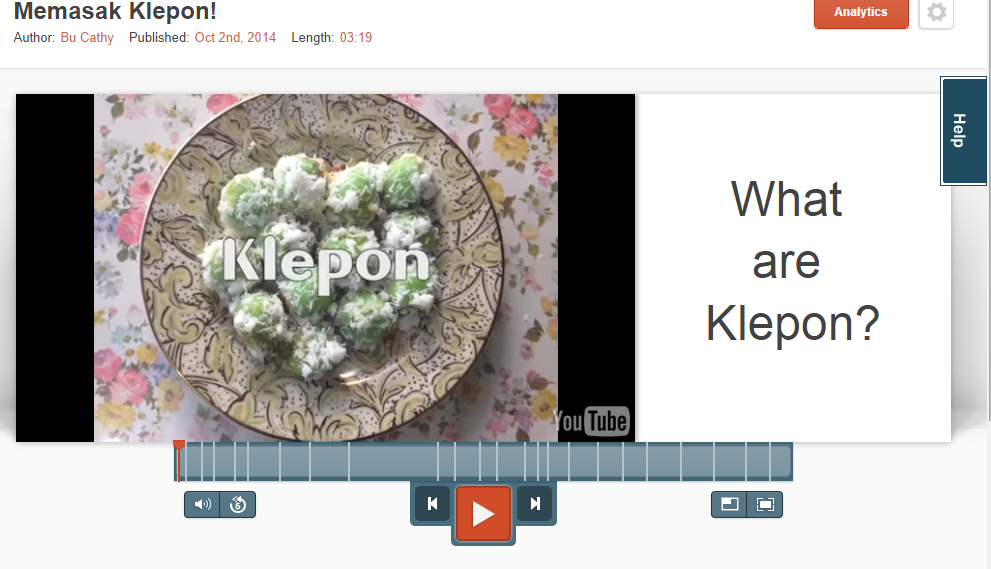
          Playing around with Zaption

          zaption pic

          Have you discovered Zaption yet? It is a fun way to present a video and has heaps of potential for Language classrooms. I love that you can choose whether the video stops, or the text just goes over the top while the video continues. There is also a blackout option, which is really handy when you find the perfect clip but it has a tiny unsuitable part that needs cropping out.

          Here is a one of mine that I have created for my upper primary students, who are about to embark on a cooking theme.

          However, I have a feeling you may have to login first:

          Memasak Klepon

          TEACHING INDONESIAN IN SOUTH AUSTRALIA

          I have just found this article on the APBIPA website which was written several years ago. It is quite timely as both Ibu Sharon & Ibu Trees are currently visiting Pak Agus in Singaraja and working with the students at his school! The lasting effects of such a visit are never ending not only for the adult participants but even more importantly, for their students.

          Fourteen Days of Teaching Indonesian in South Australia

          Agus Jaya Parhyuna (SMKN 1 Singaraja)
          Usman Ismail (SMKN 1 Kota Bima)

          The following is a short report on a two-week teaching experience in four schools Adelaide by Pak Agus and Pak Usman. They joined our new program: Indonesia-Australia School Attachment Program – specially designed for SMK, SMA and SMP teachers. This is a joint program between APBIPA Bali and SMKN 3 Denpasar (representing Directorate of Vocational High School), Ministry of Education and culture. The first part of teh report is by Pak Agus and the second is by Pak Usman.

          It is very interesting to know not only what they experience in Australia but also how they have felt about Bahasa Indonesia and about being a native speaker of Indonesian in the middle of Australians teachers and students of Bahasa Indonesia.

          IMG_8855-0.JPG

          1. “I would like to tell you about my experiences with the Indonesia-Australia School Attachment Program on the Fleurieu Peninsular, South Australia. Before going overseas I needed to catch up with current trends teaching methodology of Indonesian as a second or foreign language (known as BIPA), the Australian cross cultural issues, 4 different schools where I would teach Indonesian and typical Australian way of life.

          It was like a dream visiting that giant continent for the first time. There were many and long steps I went through to be admitted in the program including: applying for my visa and passport, organizing a letter of invitation from the school in Adelaide and a sponsor letter from SMKN 1 Singaraja. I would never have imagined how I could manage all these just by myself considering I am only a high school teacher. Fortunately, there is an association in Bali (APBIPA Bali) that assisted me with all the necessary preparation, e.g., BIPA teaching methodology courses, introduction to Australian culture, child protection programs and many kinds of Indonesian teaching techniques and games.

          I was so lucky to be hosted by three kind and friendly families. They live in a beautiful, quiet coastal, rural area in South Australia. Sometimes the sea breezes cooled me while I was fishing during my spare time. Moreover, almost all families have pets and look after them as they look after each other. They feed and bath their pets regularly. Every day I ate something different and I really appreciated their willingness to help me learn about Australian cooking. I enjoyed trying so many new types of fresh fruits and vegetables.

          School started at 8.55am and finished at 3:00pm on Monday to Friday. Some students walked to school, others were driven by their parents. Punctuality is valued and mandatory for all staff and students. There is a high commitment among students and teachers in the process of teaching and learning. Staff and students bring their own lunch from home. We ate our lunch together at lunch time in the staff room with a cup of tea or coffee or a glass of water or milk. Staff and students rarely buy food from the school canteen for price and health reasons. Students learn Mathematics, English, Indonesian, Sport, History, Performing Arts, Visual Art, Spelling, Society and Environment, Science, and well as many other subjects. The teachers are so warm and friendly towards each other and towards students. Assessment is done compassionately as is student punishment for those who don’t follow the school rules.

          The people on the Fleurieu Peninsular live in harmony with their environment and each other including Aboriginal peoples, animals, and many kinds of native plants. Everything is so different, but the differences shouldn’t create conflicts. Instead, they create a wonderful and harmonious rainbow in the sky. I am so grateful and blessed to have experienced these all.”

          2. “Puja dan puji syukur kami panjatkan kehadirat Tuhan yang Maha Esa, karena kami telah dengan sukses kembali ke Negeri ini setelah melaksanakan satu tugas mulia: memperkenalkan bahasa dan budaya Indonesia kepada sejumlah siswa di Adelaide. Saya dan dua teman lain (Pak Agus dari Bali dan Ibu Indra dari Palembang) mendapat kesempatan mengajar di empat sekolah: Port Elliot Primary School, Victor R-7 School, Goolwa Primary School dan Victor Harbor High School.”

          Kami tiba pada hari Minggu, 11 Maret 2012 dan dijemput oleh Ibu Trees dan Ibu Katty di bandara Adelaide dengan sangat luar biasa setelah melakukan perjalanan selama 7 jam 30 menit dari Denpasar via Sydney. Selanjutnya, kami dijamu makan siang oleh Pak Tony, keluarga besar dari Ibu Katty, dan dari sini kami dijemput oleh keluarga angkat masing-masing.

          Selama satu minggu pertama di host kami masing-masing dilayani dengan baik dan dihormati. Mereka megganggap kami sebagai satu keluarga besar. Kami diperkenalkan pada seluruh keluarga besarnya dijamu makan malam dan diperkenalkan budaya mereka dan terjadi diskusi tentang budaya kita dan mereka yang berhubungan dengan lingkungan tempat tinggal dan lingkungan sekolah. Di rumah begitu hangatnya perbincangan kami sewaktu makan bersama, sebuah perbincangan tentang lingkungan di mana manusianya betul-betul saling menghargai, saling percaya, dan menghormati.

          Kami bertiga bergiliran mengunjungi empat sekolah yang berbeda selama dua minggu. Kami bersepakat bahwa para siswa di ke empat sekolah sangat antusias berbahasa Indoensia dengan kami, penutur asli yang khsus datang untuk mereka. Kami senang bisa melihat penerapan prinsip dan norma pendidikan yang berjalan dengan sangat baik. Prinsip ‘reward and punishment’ juga dikelola dengan sangat apik.

          Ruang kelas untuk Bahasa Indonesia ditata sedemikian rupa yang menggambarkan peta budaya Indonesia dari Sabang sampai Merauka. Kami pun menangis terharu dan merinding karena mereka begitu menghargai Bahasa dan budaya bangsa kita, Indonesia. Ternyata di ruang ini kami bisa merasakan sisi-sis indah Indonesia yang sebenarnya.

          Kesan penting lainnya adalah bahwa mereka menyatakan program ini sangat singkat sehingga mereka berharap agar program seperti ini akan berlanjut.”

          Original source of article:http://www.apbipabali.org/home/2-blog/74-teaching-indonesian-in-adelaide.html