Sharing Awesome Links – Membagi Ide Luar Biasa….

One of the blogs I follow is Brilliante Viernes by Maris Hawkins and often she shares links to sites she  has discovered. It is such a cool idea!! Lately I have found so many brillant posts and sites, that I really want to share them with you. If you like this format, let me know in the comment section below!

  1. My student teacher, Hannah, is keen to try a movie talk this week with our junior primary classes to introduce the target structures ‘bisa berenang’ and ‘bisa melompat’. We found a funny video of a dog (link to be added soon) jumping into a pool which will be the basis for the movie talk. Just by chance there is a current thread on moretprs about movietalk which included a link to this amazing video of Eric Herman giving a movie talk demo. I love the way he tells the story as well as seemlessly asking questions. I can’t wait to try another movie talk now!
  2. Other movie talk links include a handout by Eric Herman and posts by Chris Stoltz and glesismore. Sharon Hellman has also recommended a lovely video which I love.
  3. Look at all these amazing demo videos by Eric Herman! The reason I recommend Eric Herman is that he teaches both primary level students as well as high school students.
  4. Senor Fernie has recently published a post about story telling & writing with primary students. It includes some awesome ideas I can’t wait to try next term.
  5. I love this number lesson idea on the Adventuras Nuevas blog.
  6. This is a video demonstrating a story telling technique that I want to watch in full when I have some time because I think aspects of it could be applicable in the primary classroom!!
  7. The Indoinspired blog post about kancil’s. There is also a facebook page you can follow/like which I recommend  because  you’ll find all sorts of gems there!! You can also follow indoinspired on Twitter! 
  8. Did you hear about the tiny ‘dragon‘ discovered in Indonesia?
  9. I read this article about traveling by angkot on Twitter and Facebook. It’s a great read!
  10. Margaret & I head off next week to Sumatra to visit our partner school in Medan for the first time. We aim to develop ways our students can connect via the internet as well as explore the feasibility of organising a staff trip in 2016. Follow my travel blog (written for my students) to read about our experiences! We will be staying a week in Medan before heading off on a study tour to Jakarta & Jogjakarta. Ayo….

    Indonesian Teachers Meeting With The District Curriculum Advisor

    One of the local Indonesian teachers, Cheryl, organised a meeting with our District Curriculum Advisor , Mel Jones, and generously allowed Hannah (my student teacher) & myself to gate crash the workshop. With the implementation of the Indonesian curriculum (and thus reporting to it) in 2016, our familiarisation time has almost finished. While other teachers seem to have been overwhelmed with curriculum support, there has been little available for language teachers, especially, it seems for regional language teachers. Up to now, the only training we’ve accessed was organised inhouse. We invited Andrea to workshop our hub group last year and Intan also has helped where possible at our Intan conferences and AGM’s. Intan members also received an email this week from our marvelous and generous Intan president, Brent, advertising the following seminar for next Friday:

    At our hub meeting yesterday, we followed the link to the above seminar excitedly, and then groaned as we looked at the price; $286!! With my annual T & D budget of $50, the difference is exorbitant. Hopefully if we ask our principals to contribute the difference with curriculum monies, it might be possible?? My principal in particular has been very supportive considering the inequitable amount of training available for specialist teaching staff.

    So the possibility of sitting down to a locally held workshop specifically for Indonesian teachers to  help us “unpack” the curriculum, assess how well we’ve covered it to date in our classrooms and then design an assessment task that will help with reporting to parents and for moderation was too good to be missed.

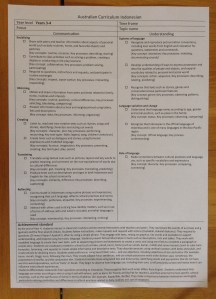
    We began by looking at the content descriptors in each of the substrands for F-2 and on a grid, writing the ways in  which they have been covered this year. This is how I filled mine in and considering it was done very quickly and off the top of my head, I was thrilled with the result:

    Socialising – calling the roll daily and asking students ‘apa kabar?’

    – Activities eg listen and draw, arranging song/story lines into the correct order

    – songs

    – brainbreaks iincorporating gestures and movement (eg kasi game, Bu Cathy berkata, )

    – class instructions eg. cari satu teman, matikan lampu, Bu Cathy mau mengabsen, duduk di ekonomi (my room is set up like an airplane – kelas satu, kelas 2 & ekonomi),

    – TPR (Total physical Response)

    Informing – asking/telling stories

    – target structures (new vocabulary) eg finding them in the text

    – rearranging song lines and then singing the song together

    – acting out songs/ stories

    – illustrating song/story phrases

    –  discussing the size of the jacket – terlalu kecil/terlalu besar/pas

    – Movie talk  – eg Mr Bean

    Creating    – acting stories/ songs

    – writing shared class stories

    – TPR

    – songs

    – rearranging the song lines and siunging together

    -making a shared class book – eg Sekolah Saya (year 3’s making it for our partner school)

    Translating – comprehension checks

    – word walls

    – displays eg seragam sekolah, Boleh saya pinjam?, numbers,

    – introducing target structures using visual pictures eg a picture of a cicak with the word  ‘cicak’ written underneath it, the same for dinding, jendela, kursi & pintu.

    –  greeting adults who enter my room Pak/Bu

    – presenting at assembly the different ways in which Indonesians greet each other

    – contributing to class displays of ‘cicak di jendela’ & ‘cicak di dinding’

    – grammar pop ups eg ‘c’ (cicak) is always pronounced ‘ch’

    Reflections – cognates eg pizza, sprite, hotdog, jaket, hamburger etc

    – etiquette eg  mencium means to kiss and to smell, kasi hormat,

    –  cultural manners eg pointing, gesturing come here,

    – the gender vs age difference (we are more focused on gender however age is of greater significance for Indonesians)

    Systems of Language –  TPRS step 1 – introducing  the target structures eg repeat the TS in various voices  modeling the trilling of the ‘r’, the pronouciation of ‘c’, the short vowels etc.

    – personalisation eg jaket Ebony terlalu besar? Ebony pakai jaket?

    – basing stories around high frequency verbs eg makan, minum, pakai, kasi, punya and using these verbs in sentences which are meaningful and relevant to the students.eg Caleb mau  minum sprite? John mau pakai jaket?

    – incorporating question words and negatives into my circling. eg. cicak di dinding. cicak di dinding atau cicak di jendela? cicak di pintu? cicak dimana?

    – introducing conjunctions eg students answering apa kabar? with panas dan haus.

    – using the roman alphabet to write the target structures on the board.

    Language Variation & Change – Students ‘kasi hormat  kepada’ visitors appropriately.

    – All visitors to our room are greeted using Pak/Bu

    – use and discuss the cognates in stories

    – greeting the first class of the day with selamat pagi and the rest with selamat siang. Encouraging students to greet Indonesian teachers out of class reinforces this.

    Role of Language & culture – meeting our many Indonesian visitors throughout the year and understanding that Indonesian is their national language.

    – Asking ‘Boleh saya Bahasa Ingriss?” before using in English in class.

    – playing games like hom pim pah & batu, kertas, gunting to choose participants.

    – choosing texts about cicaks, kancils, orangutan.

    – greeting teachers appropriately eg hand to their forehead.

    How great is that!! TCI, TPRS & TPR complement the Indonesian curriculum beautifully!!

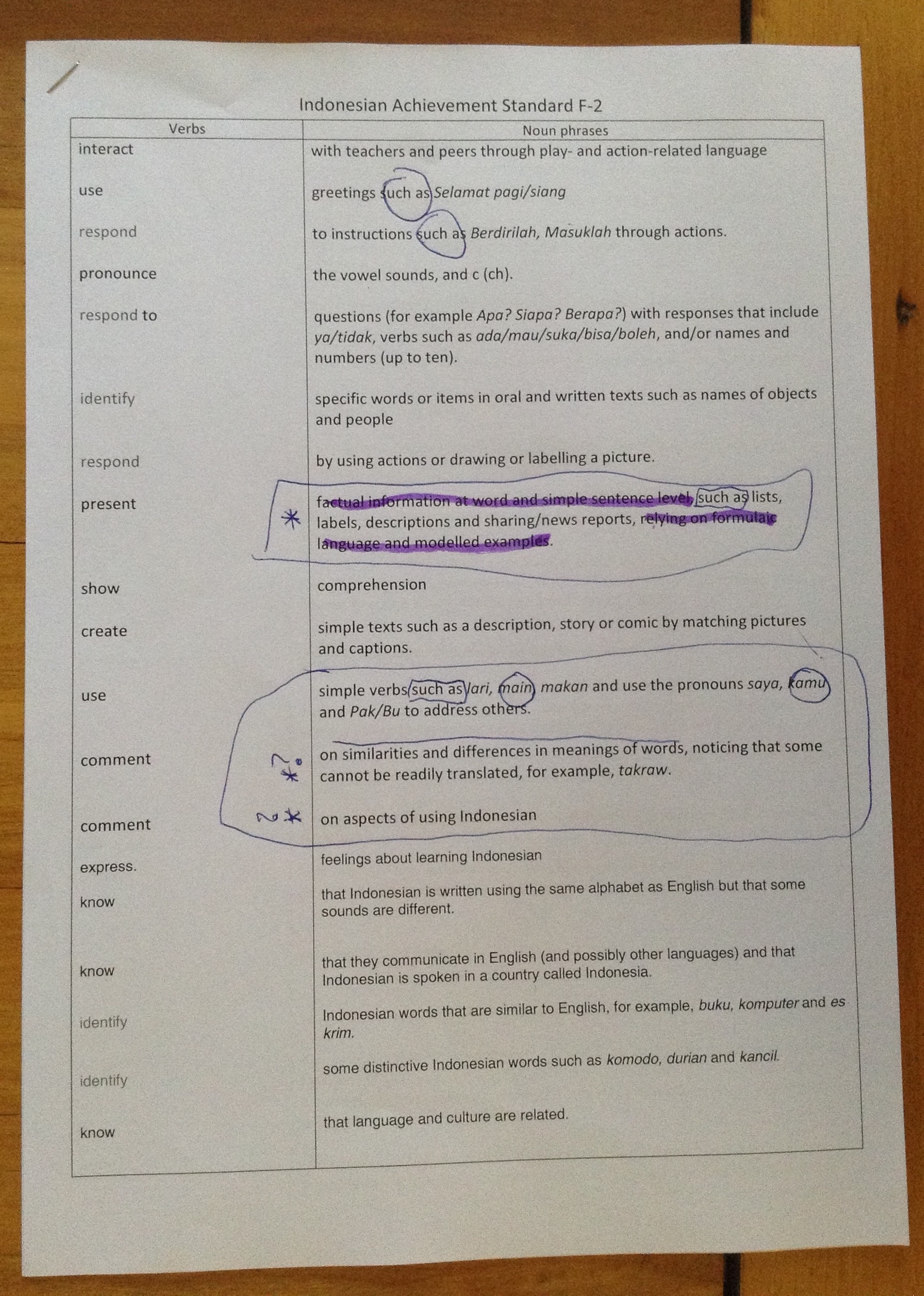
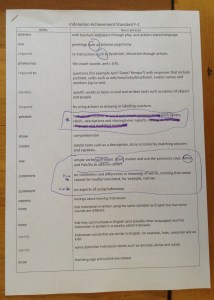
    We next moved onto the Indonesian Achievement Standards. Mel had already ‘unpacked’ it for us and this is what it looks like: (excuse my scribbling!)
    image

    We went through this together and discussed it with Mel. We had several questions for her which she will follow up for us:

    1. Does the wording ‘such as’ mean for example or does it mean that the vocabulary include must be covered?

    2. What does the ‘similarities and differences in meanings of words’ mean?

    3. What does “comment on aspects of using Indonesian’  mean for teaching junior primary students?

    4. We also want to know how a F-2 student can present a news report in Indonesian!!! (more to the point, why?)

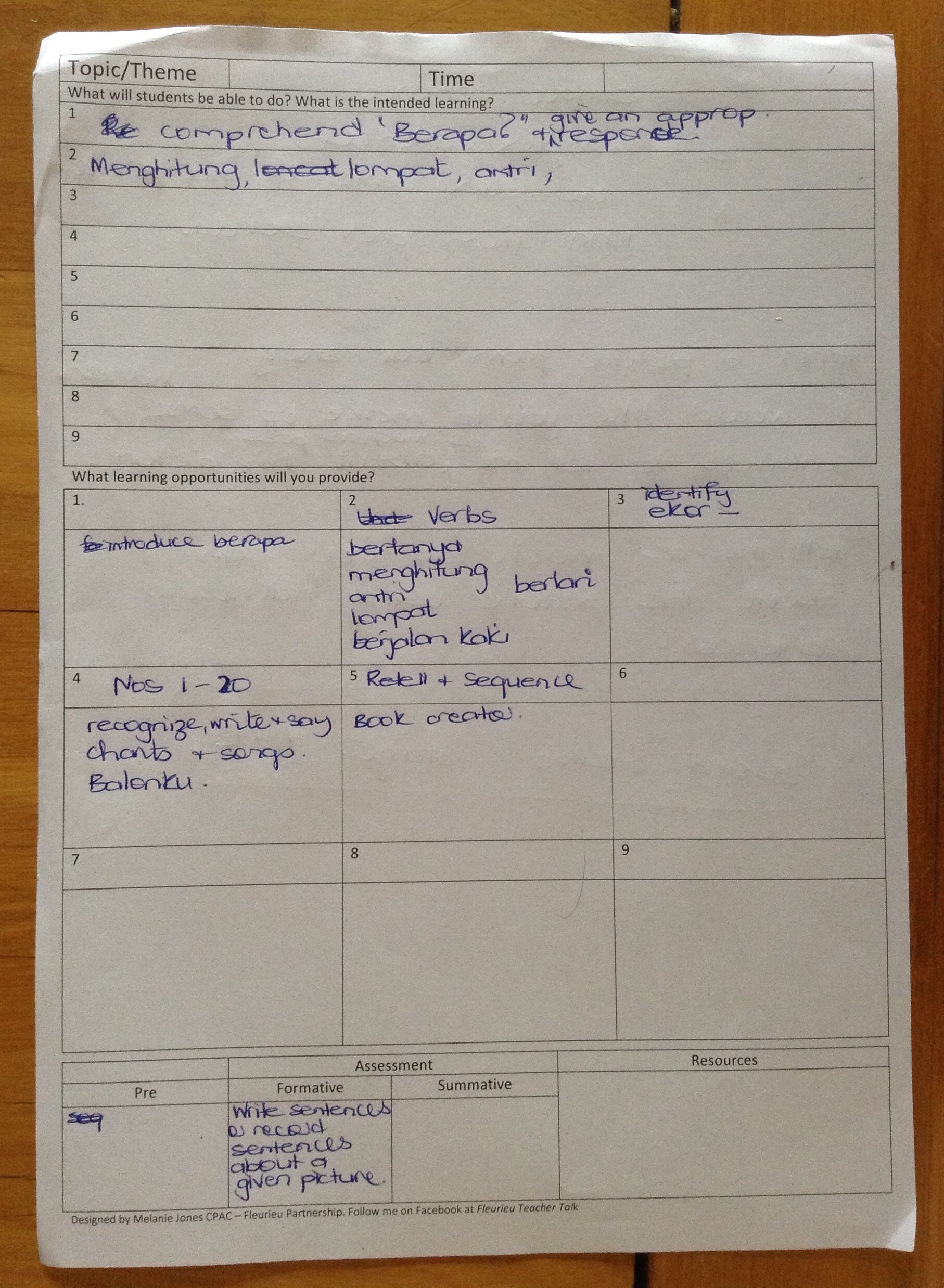
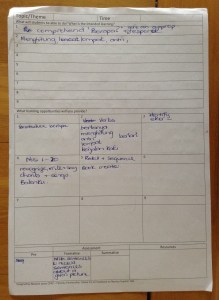
    Following on from understanding the achievement standards, the next component of this workshop was to learn how to use the achievement standards and the content descriptors to plan a unit of work. We realised then that we haven’t yet met to plan term 4. Sharon suggested using a kancil story from Siara Siswa which we all agreed had great potential as students love the wily kancil. Mel gave us a proforma which helped to break down all the aspects of the curriulum that could be covered via the kancil story. Here is my sheet:
    image

    After realising just how much potential this story has, we put our heads together to create an assessment task that is appropriate for F-2 students and will provide them with the opportunity to demonstrate a variety of achievement levels.

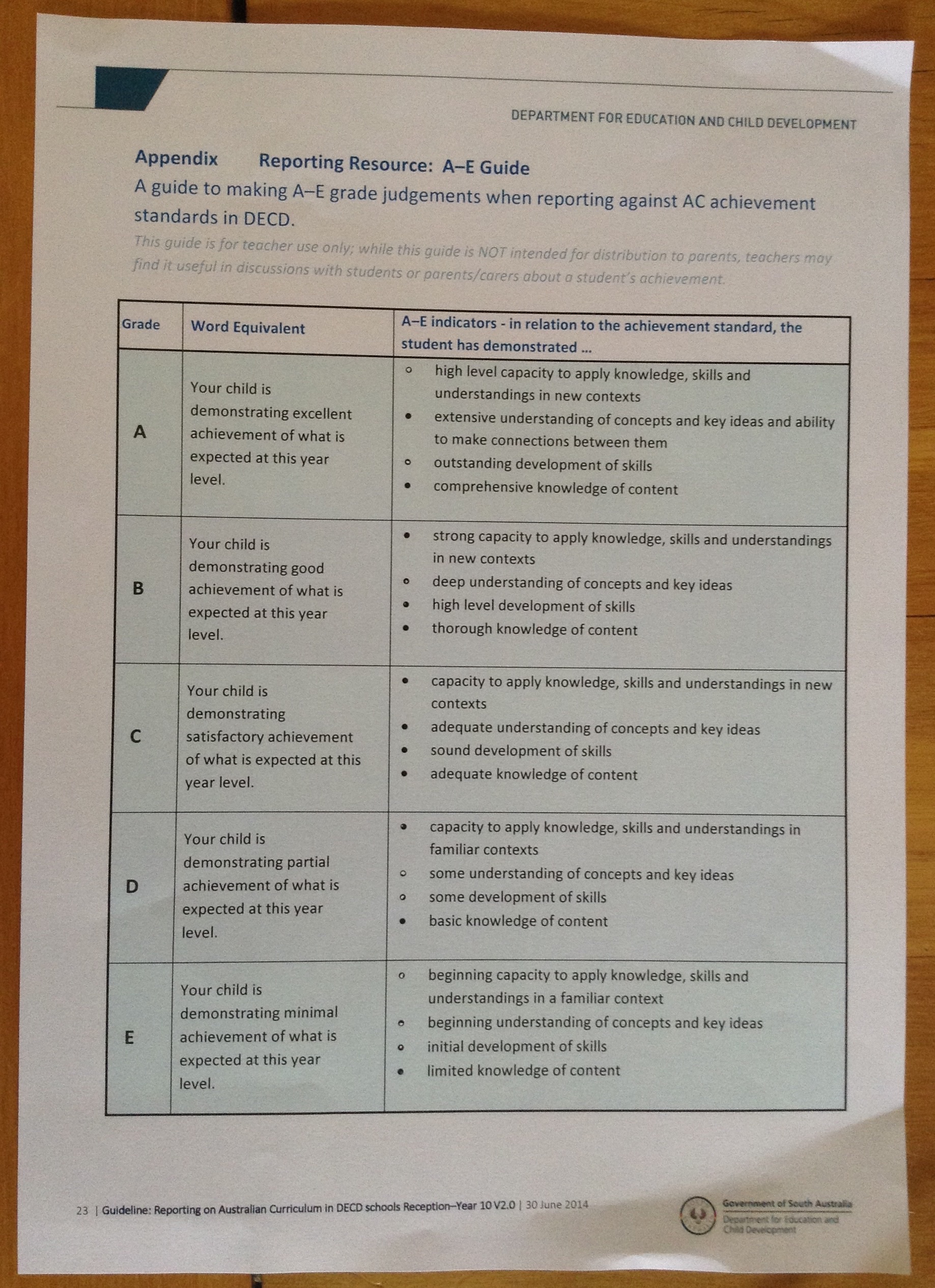
    Mel shared this to help us:

    image

    We pointed out that it didn’t truly apply when using TCI to teach Indonesian  For example we took ‘name’ and demonstrated that if we asked a student, “ini pensil atau ini cicak?” while holding up a pencil, how could that be ‘lower intellectually’ challenging for language students? One could argue that circling operates at a lower intellectual challenge level yet because it is all conducted in Indonesian, that surely is requires a higher intellectual challenge!  Still it was food for thought.

    Creating an assessment task definitely was a higher intellectual challenge!! We could all suggest many ways in which students could demonstrate pproficiency at a ‘C’, yet it was harder to provide students with an assessment task that provided them with the opportunity to demonstrate above average achievement. We wracked our brains and thankfully Sharon suggested showing students a picture from the Kancil story and asking them to tell the teacher as much as possible about the picture using Indonesian. The sentences would be graded:  ‘C’ if the student could accurately describe the picture using simple yet correct sentences, ‘B’ if the student could accurately describe the picture using complex sentences and an ‘A’ if the student accurately described the picture using complex sentences incorporating additional vocabulary from previous stories and class work.

    Other sheets that Mel shared with us included:
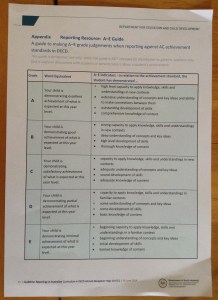
    image image

    The one on the right also comes in all other year levels and will be available soon (hopefully early next year) digitally and the boxes can be checked off!

    If you want any more iinformation  or would like your own copies of any of the handouts we received, please contact Mel on Fleurieu Teacher Talk on Facebook.


    The Australian Curriculum – Indonesian

    I have spent numerous hours looking through the new ACARA Indonesian curriculum using a TPRS/TCI headset. The more I explore it the happier I am, particularly because of the high frequency of the word ‘communication’. 

    In the Preamble:

    Rationale

    Through learning languages, students acquire:

    communication skills in the language being learnt

    -an intercultural capability, and an understanding of the role of language and culture in communication

    – a capability for reflection on language use and language learning.

    And:

    Learning languages:

    • extends the capability to communicate and extends literacy repertoires.
    • strengthens understanding of the nature of language, of culture, and of the processes of communication
    • develops intercultural capability
    • develops understanding of and respect for diversity and difference, and an openness to different experiences and perspectives
    • develops understanding of how culture shapes worldviews and extends learners’ understanding of themselves, their own heritage, values, culture and identity
    • strengthens intellectual, analytical and reflective capabilities, and enhances creative and critical thinking.

    The overall Aims are given as:

    Aims

    The Australian Curriculum: Languages aims to develop the knowledge, understanding and skills to ensure students:

    • communicate in the target language
    • understand language, culture, and learning and their relationship, and thereby develop an intercultural capability in communication
    • understand themselves as communicators.

    Then in the explanation of strands and sub strands, while ‘communication’ is the first of the two strands of language learning, it begins to become clear that the Indonesian curriculum reinforces the belief that comprehension is achieved through analysing aspects of language:

    Strands and sub-strands

    The content of the Australian Curriculum: Languages is organised through two interrelated strands which realise the three aims. The two strands are:

    • Communicating: using language for communicative purposes in interpreting, creating and exchanging meaning
    • Understanding: analysing language and culture as a resource for interpreting and creating meaning.

    The strands reflect three important aspects of language learning:

    • communication
    • analysis of aspects of language and culture
    • reflection that involves
      • reflection on the experience of communicating
      • reflection on comparative dimensions of the languages available in students’ repertoires (for example, the first language in relation to second language and self in relation to others).

    One puzzling fact about the Indonesian curriculum though is that while it recognises the importance of communication, the word ‘proficiency’ does not appear anywhere and the word ‘fluency’ appears just once for students in years F-7:

    Years 5 and 6

    Years 5 and 6 Band Description

    Indonesian language learning and use

    ….. They (students) extend their oral fluency by focusing on sentence-level intonation and stress.

    Surely the goal of a language program is to develop proficiency in that language?

    Observations of TCI in The Indonesian Classroom

    What a day it was yesterday! I was incredibly nervous, because I was going to be observed by an Indonesian teacher colleague who was curious to see TCI in action after attending the TCI workshop we’d run at the Intan conference earlier this month.

    The previous day I’d attempted to ask a story for the first time. I chose one of the year 7’s classes because the older students have really blossomed with TCI. Yet it wasn’t  that successful, for reasons which are so much clearer in hindsight. I wanted the class to rewrite their own version of Catharina’s story, “Tidak ada Mulut” (No mouth). We began as I usually do by asking, “Ada perempuan atau ada laki laki?” (Is there a boy or is there a girl?), yet this class didn’t want to have a gender, so instead I introduced the word, ‘orang’ (person) which is a great word to know.  We next decided upon the names of the two characters, Lesley (a name which could be either gender) and Big Jezza.  Here is how the story began…

    Ada orang. Nama orang Lesley. Lesley tidak punya kepala. Lesley tidak bisa minum dan makan. Lesley tidak bisa menyanyi dan Lesley tidak bisa…. (There’s a person named Lesley. Lesley doesn’t have a head. Lesley can’t eat or drink. Lesley can’t sing and Lesley can’t….)

    At this stage, I was expecting them to suggest verbs from the word wall. Yet with circumlocution, one of the students pointed out (in Indonesian) that if Lesley couldn’t eat or drink, then Lesley also wouldn’t be able to pooh. The class was all in agreement. I was torn! Was I asking the story or was I telling the story? I then remembered a fellow TCI junior primary teacher saying that the most popular story topics that hook JP students are blood, teeth & selfies. As this was student led, and the word they wanted was a word that, one could argue, could be very useful when traveling in Indonesia, I gave the word a parent would use with their toddler – eh eh  (each pronounced ‘e’ as in egg). It immediately became the word of the day and became very difficult to complete the story! It wasn’t till the next lesson that I was able to guide them to finally agreeing on an ending to their story which included a little more than just ‘eh-eh’.  I had great difficulty keeping them inbounds – they were determined that there was a blockage – and unfortunately this meant the story contained a lot of totally unfamiliar vocabulary; yet the students were thrilled with the end result.

    Here is how we finished it:

    ….dan Lesely tidak bisa eh-eh.

    Ada satu lagi orang. Nama orang Jeza Besar. Jeza Besar punya tiga kepala. Jeza Besar bisa makan tiga es krim. Jeza Besarkasih Lesley dua kepala.

    Tenggorok Lesley tertutup dengan eh-eh. Lesley  mau minum kopi es. Lesley berkata, Saya mau minum.” Lesley makan kepala kedua. Tenggorok Lesley tidak tertutup lagi.

    IMG_0799

    So with that story experience fresh in my mind together with the pressure that comes from being observed, I was not totally confident to try asking a story with the other year 6/7 class. To make the story asking process smoother, I used a story I wrote a few weeks ago called “Tidak ada Kaki”. Whereas with the first class, I encouraged them to choose the missing body part, this time I stated it, which meant the level of ‘asking’ was minimised because I imagined it would be safer! Here is the story they created:

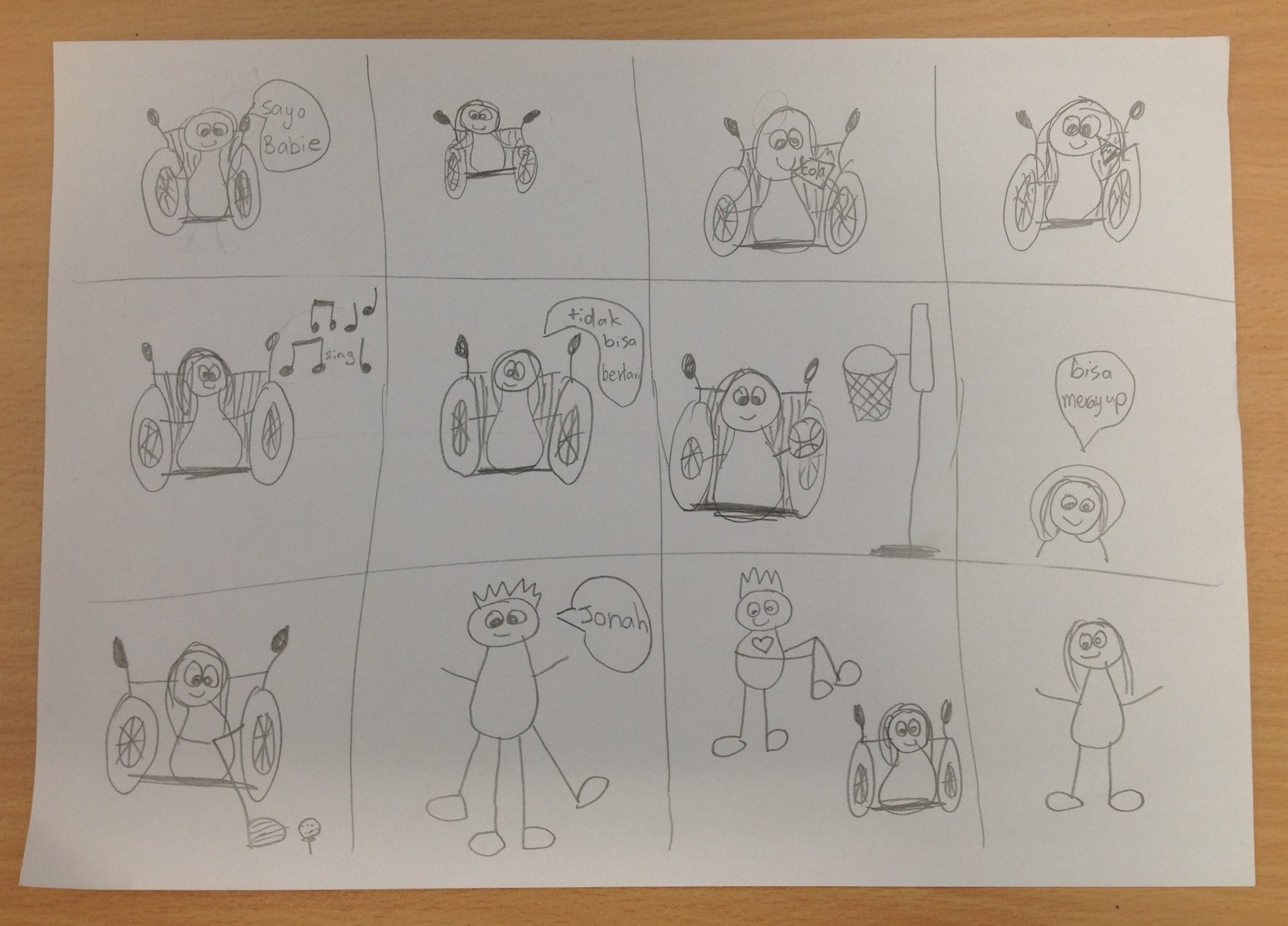
    Ada perempuan. Nama perempuan Barbie dan Barbie tidak punya kaki. Kasihan Barbie. Barbie tidak bisa berjalan kaki. Barbie bisa minum. Barbie bisa makan pizza. Barbie bisa menyanyi. Barbie tidak bisa berlari tetapi Barbie bisa bermain bola basket dan Barbie bisa merayap. Barbie bisa bermain golf.

    Ada laki laki. Nama laki laki Jonah. Barbie tidak punya kaki dan Jonah punya empat kaki. Jonah bisa berjalan kaki. Jonah bisa berlari. Jonah bisa merayap.

    Jonah baik hati. Jonah kasih Barbie dua kaki. Barbie bisa berjalan kaki. Barbie bisa berlari dan Barbie bisa merayap.

    IMG_0798

    illustrated by Ruby

    Translation: There’s a girl named barbie and Barbie doesn’t have any legs. Poor Barbie. Barbie can’t walk. Barbie can drink. Barbie can eat pizza. Barbie can sing. Barbie can’t run but Barbie can play basket ball and Barbie can crawl. Barbie can play golf.

    There’s a boy named Jonah. Barbie doesn’t have legs and Jonah has 4 legs. Jonah can walk. Jonah can run. Jonah can crawl.

    Jonah is kind hearted. Jonah gave Barbie two legs. Barbie can walk. Barbie can run and Barbie can crawl.

    Beforehand, we had organised some props: a wheelchair, a sarong to cover Barbie’s legs and a pair of stuffed stockings. The story progressed beautifully. As usual, I had no trouble sourcing volunteers for the actors. Firstly Cooper was Barbie and he happily sat in the wheelchair with a sarong covering his legs. He acted his part beautifully. Beth (not her real name)  then jumped at the chance to be the second actor. Her face dropped slightly when I brought out the stuffed stockings, yet she bravely continued and helped tie them around her waist. The girls were madly gesturing to her to pull the ‘legs’ to the side so they didn’t hang in front of her legs. The boys meanwhile, were in hysterics. Beth was such a good sport; she continued to act out her part even though she realized that the whole class (and teachers) were laughing so hard, we all had tears in our eyes. With 2 long shapes swinging around her legs, she walked and ran back & forth on the narrow catwalk through the audience, but it was the demonstration of the crawling that undid the audience. There is no way I can describe it to you and do it justice. I was just so happy I had 2 other adults in the room who can verify just how funny this acting of this story turned out!!

    After the 6/7 lesson, the day continued well with all classes beautifully demonstrating why I love TCI. Students gestured whenever I said something they didn’t understand (& also when they did understand because they enjoy the attention they get for gesturing!), students of all ages asked, “Boleh saya Bahasa Indonesia?” if they wanted to say something that was beyond their level of Indonesian and in particular, that all classes can now respectfully greet visitors in Indonesian.

    I was on such a high afterwards. It was brilliant that the lessons had all gone smoothly and also that Kay was so impressed with what she’d observed. Her feedback was generous and very encouraging. Yet, I do wonder just how my interpretation of TCI compares with officially trained TCI teachers in the USA. I hope I’m not too far off the mark and until I can attend one of the conferences, I console myself with the famous TPRS quote; “Bad TPRS is better than no TPRS”!!

    Getting Started

    Starting with TCI pedagogy in the Languages classroom is extremely challenging. It can start off well with everything progressing smoothly and then suddenly it falters. It is a tough transition and it takes a bucket load of resilience to continue on the TCI track. If you are one of the many just beginning your journey, it is important to know that an up and down track is completely normal. Everyone has experienced it. PLease don’t give up – the TCI community is like a huge family and there are many places you can go for  help when you hit a rough patch. 

    On the moretprs listserve, there was a thread recently called ‘Then What?’ Here are two contributions which hopefully will help you continue past your next roadblock:

    New teachers are still concentrating on keeping the many ping-pong balls of TPRS or TCI in the air. Going slow, three-fers, shadow items, checking comprehension, adding a detail, managing behavior, leaving time for assessment, teaching to the eyes…They do not need to have to think about what to teach next; they are still working on how to teach next. This is why I recommend learning classic TPRS and learning it well before “branching out” to other forms of TCI, and why I recommend that new teachers use an existing TPRS textbook if one is available. It is enough to have to worry about maintaining 100% comprehensibility while also managing a roomful of students and dealing with teaching in today’s public schools. Just my opinion, though. 

    Terry Waltz

    For me, the biggest hurdle to overcome was how to sustain it and how to connect everything that we learned in the series of class stories, and I have often heard the same sentiment echoed by other newbies. Helping teachers to find and work with high frequency word lists is a good starting point; so is connecting them with existing curriculum for those languages for which it exists. A lot of us started out doing random stories and then invested in a curriculum to help guide us before eventually abandoning it as we found our own style and became comfortable working with our own students to create content. As Terry said, just learning and practicing the basic skills is enough to fill a teacher’s plate; so trying to figure out what to do and when and for how long can be REALLY overwhelming and can distract from the road to mastery of those skills. Eventually they too might toss aside the curriculum, and that’s great. It’s important to tell them that they aren’t going to become Master TPRS teachers overnight. I’ve often heard the time period ‘3 years’ tossed around as the amount of time it takes for you to really feel like you’ve got your feet under you (if not longer!). Don’t be too hard on yourself! And expect to feel frustrated and like a failure at times. And when you do, reach out to your PLN to get back on your feet 🙂

    Martina E. Bex

    World Languages Curriculum Consultant

    The Comprehensible Classroom

    As Martina stated, your PLN (in my case, my hub group), should be the first place to turn to. For me, my  hub group have been wonderful. When I hit road blocks, Annie & Sharon gave me ideas and encouragement which enabled me to see where to go next. If you don’t have a TCI PLN/Hub Group, then I recommend joining an online PLN. The moretprs listserve is a great place to start but beware, you will be inundated with emails. The trick is to be very selective and delete anything that is not relevant. I  have picked up many ideas through this listserve, even if it seems I am the only Indonesian teacher out of the 7000 members! Most times, if you have a question/comment, long time members are very happy to  help you get started. Another point to be aware of is that almost all members are based in the States, so their needs are 6 months ahead or behind us here in Australia. At the moment they are all focused on starting a new school year and all that entails. 

    Another excellent online option, particularly for high school teachers, is Ben Slavic’s website for a small monthly fee. Again based in the States (& now India) and thus can be very quiet over their summer holidays or when their school  year is about to start or finish.

    If these options don’t appeal to you, feel free to contact me here on my blog. I am more than happy to help you with aspects of TCI if I can, and if beyond me, I will seek guidance from other experienced TCI practicioners on your behalf.

    The most important thing to remember on your TCI journey is that it will be very challenging and it is not a methodolgy that comes easily to us all. Yet, it is such a powerful way to teach languages that it is well worth the rocky, bumpy road. 

    Almost Midterm Reflections

    The end of week four has just arrived, thankfully, as I am so exhausted. Our community has a variety of nasty viruses in circulation at the moment which has had in some classes, a devastating affect. I just hope the sore throat I feel coming on is just the result of my previous class which consists of several challenging students!

    This term, I approached my story slightly differently to how I have done so before. The main target structure for the current story is bisa (can/ to be able to do something) but I also wanted menyanyi (sing) & mencium (kiss/smell) to be taught explicitly too because both are great TPR words. I love the way Eric Herman uses TPR,to introduce target structures and know that I will be able to get good mileage from both words during brain breaks.

    I firstly focused on bisa. This took about 2-3 lessons. I began by focusing on the skills and abilities that students identified having and then had a fun lesson asking students, “Siapa bisa handstand?” If students raised their hand, I then asked them, “Billy bisa handstand?” and if they didn’t raise their hand I would go right up to the student, look them in the eye and then ask suspiciously, “Jill bisa handstand?” I then circled their answers briefly before inviting the student to the center of the chairs which were arranged in a U for this lesson. The student then did the handstand and I was able to get many repetitions of bisa. Billy bisa handstand? Billy atau Bobby bisa handstand etc! One class asked me, “Bu Cathy bisa handstand?” To which I answered,”Tidak bisa.” yet they insisted I show them, so we all had a good laugh because I could barely got my feet off the ground. More repetitions of tidak bisa!!  Such a fun and relaxed lesson.

      
    My lesson on mencium was a culture break – because it was largely in English. We talked about the differences between mencium and kiss/smell and also why in Indonesian, mencium means to kiss and to smell. This collaborative blog has a post which clearly explains the various ways in which Indonesians greet each other. I had students pair up and practise hand shaking (gentle and finishing on your heart), mencium (cheek to cheek while doing a gentle smell/sniff) and also kasih hormat kepada guru (holding the teachers hand to the students forehead). We also demonstrated all 3 greetings at a whole school assembly with a group of young students finishing up the demonstration by showing respect to our principal. It was a hoot.

    I  next did Martina Bex’s wordle activity as outlined in my previous post. The link to this and other activities is on the new TCI activity page, found in the top band of the homepage. All these activities meant the lead in to the story took much longer than it did in terms one and two. Because bisa is such an important word in Indonesia and comes up constantly in a variety of contexts, I really believe it was vital to devote several lessons focusing on it. Also now that I am into my second semester of TCI, I feel a lot less pressure to cover topics/target structures quickly which has been a wonderful revelation. It is so empowering to be able to focus on student acquisition as apposed to keeping up with a rigid term overview. 

    Word Race Stories

    I had thought I would ask the story early in the term just like I have done in the past and just have the unfamiliar vocabulary written in a list on the board so that when it came up, I could ‘point and pause’ it. At our last hub meeting, Sharon suggested introducing the word ‘bisa’ during the first lesson as a lead up to telling/asking the story in the next. However, with the late introduction of the gesture in week 1, I decided to spend the next lesson on ‘bisa’ as well to introduce and consolidate the target structure and gesture.

    My second lesson then became the pre-story lesson with a mini focus on the vocabulary that would be used in the story. I scrolled through the marvellous Martina Bex’s blog, The Comprehensible Classroom, and found her suggested activity called Word Race Stories.

    I created a word cloud with the vocabulary from the story:

    word cloud bisa story

    This activity starts with me calling out a word in English and they had to find its Indonesian equivalent. The competition between the students in their pairs was fierce yet everyone engaged with this activity. Such a fun way to review vocabulary. The first time I played this, it was chaotic as I followed Martina’s suggestions exactly. Sharon’s idea for students to purely point at the word with their finger was heaps more manageable than students trying to be the first to highlight it with their pen!

    With my middle primary students, we finished off the activity by each pair looking at the words in the word cloud and then writing a sentence they thought could be in our new story. Yet with my year 6/7’s today, I tried for the first time the followup suggestion that Martina suggested. In their pairs, students had to think about the words in the word cloud and then write a sentence that could start a story using only words from the word cloud. Once everyone had finished their first sentence, they had to swap pages with another pair. Each pair then read the previous sentence and wrote a second sentence below that followed on from the first and used only words found in the word cloud. We then repeated this about 6 times. Each sheet was then returned to the original authors whose job was to edit the story and write the final sentence. I then read out as many stories as I could which everyone enjoyed! This was a very interesting exercise for several reasons even though I need to state that TPRS/TCI programs are about student receiving heaps and heaps of input and activities such as these should not be the backbone of our teaching.

    Here are some of the stories that were produced:

    story one

    John dan Lucy punya hotdog.

    Lucy berkata, ‘John, saya mau hotdog.”

    John kasih Lucy dua hotdog. 

    Lucy tidak mau dua hotdog.

    Joh makan satu hotdog.

    story two

    Ada laki laki.

    Nama laki laki Lucy.

    Nama perempuan John.

    John mau mencium.

    Lucy tidak mau mencium

    John kurang baik.

    story three

    Ada laki laki dan perempuan.

    Nama laki laki John dan nama perempuan Lucy.

    John dan Lucy makan dua hotdog.

    Lucy berkata, “Saya mau minum.”

    Lucy dan John mencium.

    Overall the stories were written with correct word order and demonstrated a good grasp of all vocabulary, even mencium which we haven’t talked about yet. The most interesting point from all the stories was how little ‘bisa’ was used!! In total it was used twice! I wonder if this will change once we have told the story?

    Now that we have had 2 lessons focused on bisa, I would like to organise my next lesson on ‘mencium’. The meaning of this word is a great opportunity to talk about intercultural language. While non Indonesians use the word ‘mencium’ to mean to kiss, its meaning is also to smell because that is how female friends traditionally ‘kiss’. You put your cheeks together on one side and sniff gently before repeating on the other side. Have you watched Indonesians smell babies too? Australians do it too, yet we don’t truly inhale the baby scent as an Indonesian does. There is a real skill to it, I believe!!

    2015 Intan Conference – Adelaide, SA

    Yesterday (last Saturday) saw about 40 – 50 Indonesian teachers gather together at the Education Development Center in Hindmarsh for our annual conference. It was organised, as always, by our hardworking Intan committee and included many wonderful opportunities for us to belajar/mengajar (learn/teach) each other. Bersatu kita maju (United we progress)
    The day began with the presentation of a goody bag upon registration. Each year the goody bag is heavier and heavier! This year’s bag contains mostly promotional information. The ones I think look interesting and have earmarked for perusal include :
    The guide for the upcoming OzAsia festival,
    Two magazines – Indomedia & Indobulletin
    Information about the Treasure Ships exhibition at the SA Art Gallery
    Outreach Education
    Menu for Ketut’s Kitchen 95A O’Connell St, North Adelaide
    Notepad from the Credit Union SA
    Flyer about the Jembatan Project – a Flinders University initiative
    A flyer for Michelle Kohler’s book, Teachers as Mediators in the Foreign Language Classroom (will check my class budget)
    Adelindo Flyer – Great to learn there is a local business that repairs angklung! (link)
    Flinders University 2016 Postgraduate programs list (definitely on my bucket list)
    Language Perfect poster – world championship in 2016!! Offering $25,000 prize money – well worth investigating!!
    Amansar journeys of discovery and learning flyer – hopefully soon our short sighted state government will realize the extent to which they are short changing language programs by refusing to sanction school trips to Indonesia. In the meantime, I look at this flyer and imagine a future where I can travel with my students to Indonesia….
    Indo Ink order form
    Asia Bookroom booklet – particularly interested in the ‘Our Jakarta’ series. Are they anywhere near the quality of the amazing books printed and published through Dyatmika School???
    Lote Teaching Aids – catalogue, pen, keychain, bookmarks and sticker selection.
    Not bad hey? Bagus kan?
    After Brent informed us about the location of the amenities and the evacuation procedures, he welcomed Uncle Frank Wanganeen to welcome us to country.IMG_1975 Uncle Frank spoke briefly about his contact with his language – the Gana Language and his country – Narrunga. He told us that he had grown up in Adelaide during a time when there were unpleasant consequences for those heard speaking in the Gana language. Consequently it wasn’t till he was an adult that he could learn Gana. In the 1980’s there was a conscious movement to revive Aboriginal languages and today there are many resources available specifically aimed at teaching and learning Aboriginal languages, including YouTube videos!! Uncle Frank then acknowledged his ancestors and welcomed us to the land upon which the conference is being held both in the Gana language and in English! A beautiful start to our conference. I always find the welcome to country moving.
    After Barbara Hatley was invited to officially start the conference,IMG_1978 Brent outlined all the reasons why the Intan conference is highly valued amongst Indonesian teachers. These reasons include the ability to collaborate, network, for professional development and to discover useful resources. Brent next officially launched the Intan website and outlined a Treasure Hunt competition cleverly designed to motivate us to investigate the website.
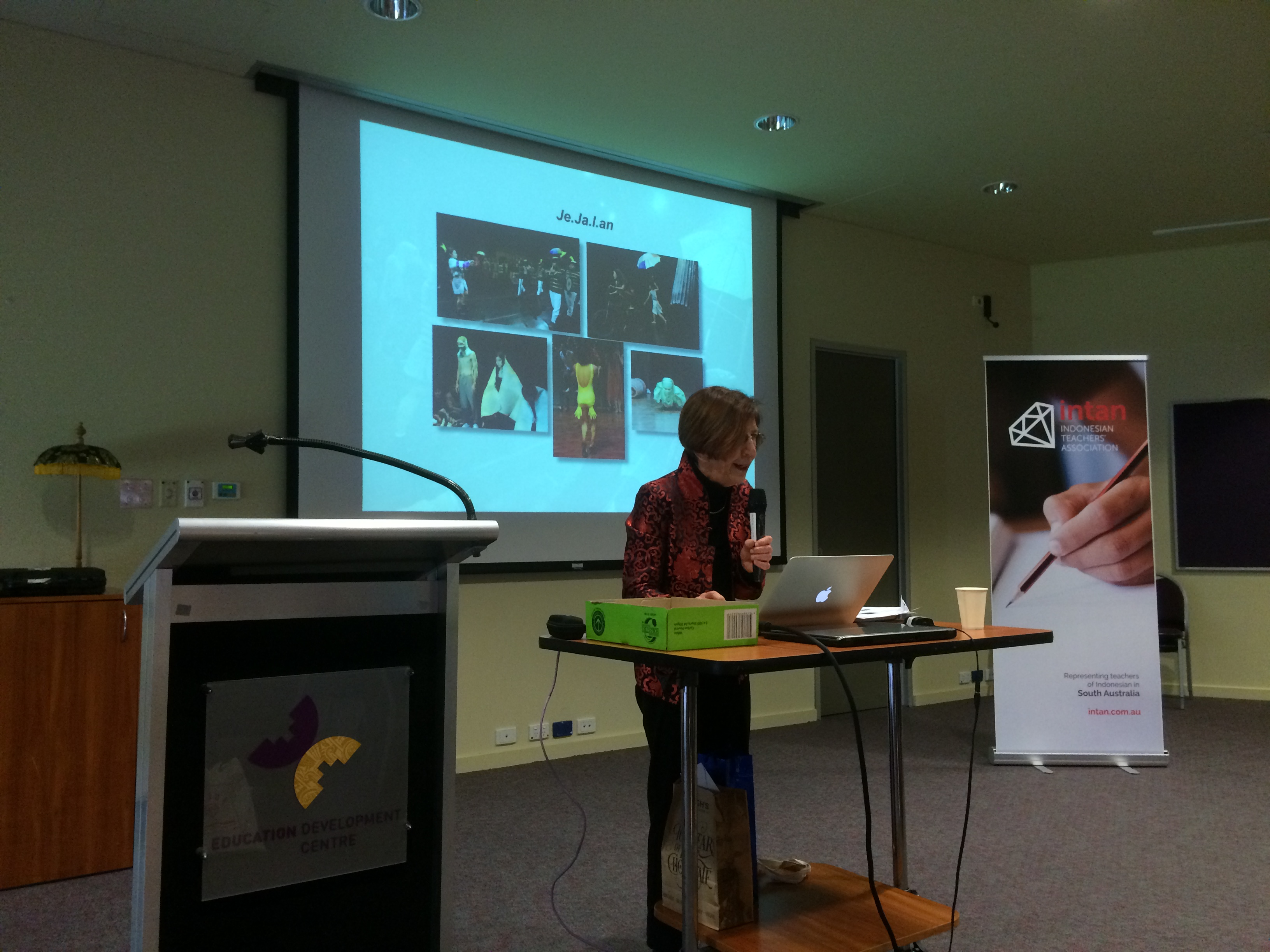
    He then again introduced Barbara Hatley from the University of Tasmania IMG_1983who spoke about the role of theater and drama in Indonesian society both historically and in the present day. It was a fascinating presentation including photos and video snippets of a group called Teater Garasi who will be performing in the OzAsia Festival.
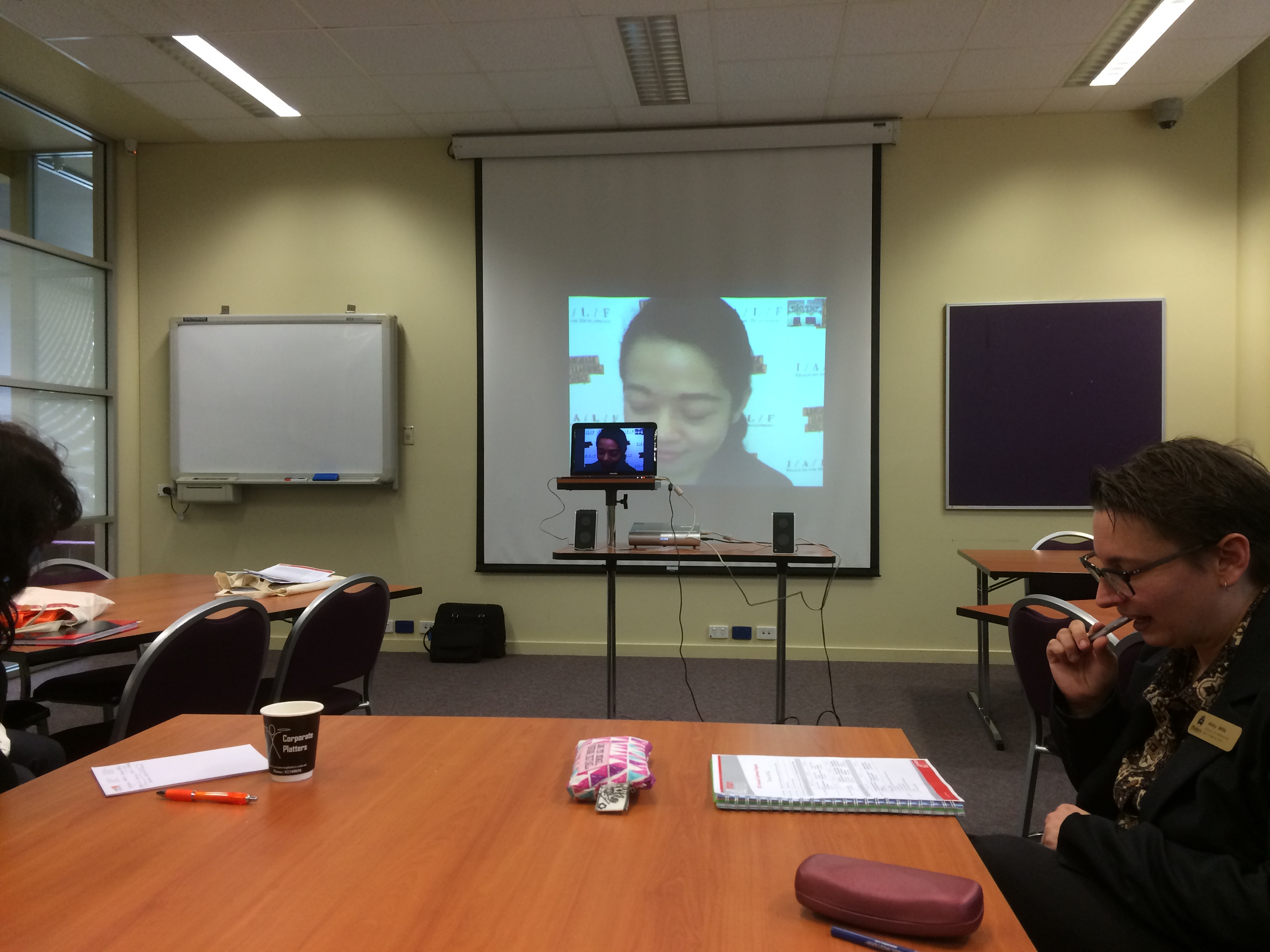
    The next sessions were the ‘back by popular demand’ proficiency workshops. This year, the committee was very innovative, as the 3 workshops were provided by the AILF in Bali via Skype! IMG_1990The 3 workshops catered for different levels of proficiency and focused on quite different topics. The novice workshop focused on traditional games, the intermediate workshop topic was the mudik tradition, (the returning home to family after Ramadan), and the advanced workshop focused on modern day slang. As it was hard to choose, Annie, Sharon and I each went to one and on the trip home outlined all that we covered. Each workshop was led by a native Indonesian speaker and other than a few wifi connectivity issues, it was a great initiative. Ibu Putu Ayu Asri who led our session has promised to email a copy of the PowerPoint she used for our session. I am looking forward to receiving it as I only got the main slang words written down! Here are a couple of the ones I loved:
    Lo = anda
    Rempong = repot
    PD = percaya diri
    Semangat dong! = cheer up
    Ciyus = serious/seriously?
    Capcus = cepat, cepat
    Sip = right/ok
    Cekidot = check it out
    KEPO = Knows Every Particular Object (knowitall)
    BT = bad tempered
    ilfil = ill feeling
    ABG = Anak Baru Gede (teenager)
    Jomblo = single
    Aren’t they seriously bagus banget???
    Following straight after the proficiency workshops was the first of 2 lines of available workshops. This first line included the workshop we presented on Teaching Indonesian with Comprehensible Input. This is the first time we have ever presented anywhere, so unsurprisingly we were nervous yet it made such a difference to be presenting together as a team. Our workshop ran for 45 minutes which wasn’t anywhere near long enough to do the topic justice, yet hopefully was long enough to give participants a taste of TCI. The workshop ran smoothly and to be honest, is a blur. We began with Sharon introducing each of us and then giving a bit of history about us and our hub group. We then showed 3 of Diane Neubauers videos (see here, here and here) as we believe that the impact of TCI is stronger with an unfamiliar language. We then began a TPRS lesson from term 1 which centered on Catharina’s Taylor Swift story. Annie demonstrated step 1 and introduced the target structures and modeled how to choose the gestures. Sharon told the story and then I pointed out the new page on my blog where I have been collating a list of TCI activities, some of which are perfect to do after telling the story. I then attempted to give a circling demonstration (which included a total mental blank on how to model 3-1) and then we finished up with questions while a slide show of students learning with TCI activities in our classrooms was projected up behind us. We fielded many questions including
    How to extend the 4%ers (gave Diane Neubauer’s suggestion of offering jobs)
    How to use TCI in high school where the curriculum is very structured and inflexible (explained that this too is an issue for TCI secondary teachers in the states who have various ways of dealing with this)
    Overall the feedback we received afterwards was incredibly warm and encouraging. Following immediately after our session was lunchtime, which we gave us some extra time to chat with those who had more questions. Excitingly for me too, I got to meet 2 of my followers, one of whom has also been trialing TCI in her classroom!! Lovely to put faces and names to a few of my followers!!
    We were all treated to a delicious lunch where the carnivores could choose between rendang and ayam goreng while the vegetarians enjoyed tempeh, cap cai and pecel – all served, naturally, with rice.
    After this feast, we next could choose to attend a further selection of workshops. Sharon, Annie & I divided ourselves again between Brent’s workshop on assessment and evaluation and Daniel Bradbury’s Number workshop.

    IMG_2002Brent’s workshop began with a focus on the aims of the Indonesian Curriculum.
    The aims are:
    1. Communicate….
    2. Understand language & culture……
    3. Understand oneself as a communicator…
    I understand the first 2 aims and agree they are important aims for a language curriculum but have difficulty getting my head around the third. I need to research it in order to understand exactly what it means and then hopefully it will be clearer as to why it is listed as one of the overall aims. Personally, I feel that it should be in the health curriculum!! What do you think???
    Brent then shared with us how he has identified each and all of the Achievement standards and demonstrated how they all link back to the content descriptors. He also shared with us several items developed by staff from his site. These include a very detailed rubric that his school site has put together which they use to grade student work, a suggested F- year 2 curriculum demonstrating how thematic units of work can be devised to achieve curriculum objectives.
    The conference finished up with short presentations from various groups.
    Pak Budi talked about the Jembatan project which aims to build bridges between Indonesia and Australia. IMG_2015He mentioned that in 2016, 2 internships will be available. Must keep that in mind!!
    Chris from Indofest very kindly interrupted his tennis game to speak to us. Indofest, an annual Indonesian festival, has been running since 2008. It is usually held earlier in the year in Rymill Park however this year it will be held on October 5th in the Migration Museum, Art Gallery, State Library, SA Museum precinct and most importantly, there will be free parking in Adelaide all day long.
    Helen Munro from The Orangutan Project (TOP) spoke. She is the current education officer and is available to visit schools. IMG_2018A variety of programs are available and can be designed to complement a variety of topics and age groups.
    Jodie Edwards reminded us about the OzAsia festival which will be held the day before Indofest. This year it includes several exciting Indonesian performances.
    Rosslyn Oldfield encouraged us all to get together with our hub groups. Hub Groups are support groups for teachers and are an informal gathering for teachers to support each other and learn from each other! Just like a teachmeet. There is definitely interest for a hub group meeting on the Fleurieu, so we asked people to nominate the best week day and have tentatively organised our next meeting to be in week 5, term 4.
    The conference finished up with the drawing of the raffle which is always lots of fun as there were over 25 prizes!! First prize was generously donated by Amansar Travel and Diane was extremely thrilled to win a prize which included various day trips in and around Malaysia.
    A huge thank you to the brilliant Intan committee and hats off to acknowledge that yet again, the conference was highly successful. So: yes Brent; it definitely did meet our expectations!
    Makasih semua

    Black Box Videos

    Below is a video which I highly recommend if you are interested in learning and understanding more about Krashen’s hypotheses which underpins Teaching with Comprehensibvle Input.

    Videocast 3 – The Comprehensible Input Hypothesis

    The above videocast is the third in a series and below are the first two in the series:

    videocast 2 – Mental Representation & Skill

    videocast 1- Methodological Principles for Language Teaching

    Senor wooly – Spanish Teacher Extraordinaire 

    How cool is Senor Wooly? He has made lots of resources for students & spanish teachers  who for a fee, can access them all. The videos are fabulous and while designed for high school students, are so humorous, they would appeal to primary students equally.

    Have you heard of anyone creating resources such as these for Indonesian students and teachers?  Materials which are engaging and compelling for students and provide the perfect medium for providing comprehensible input in the Indonesian classroom. If so, please add a comment below.