A Day With Stephen Krashen

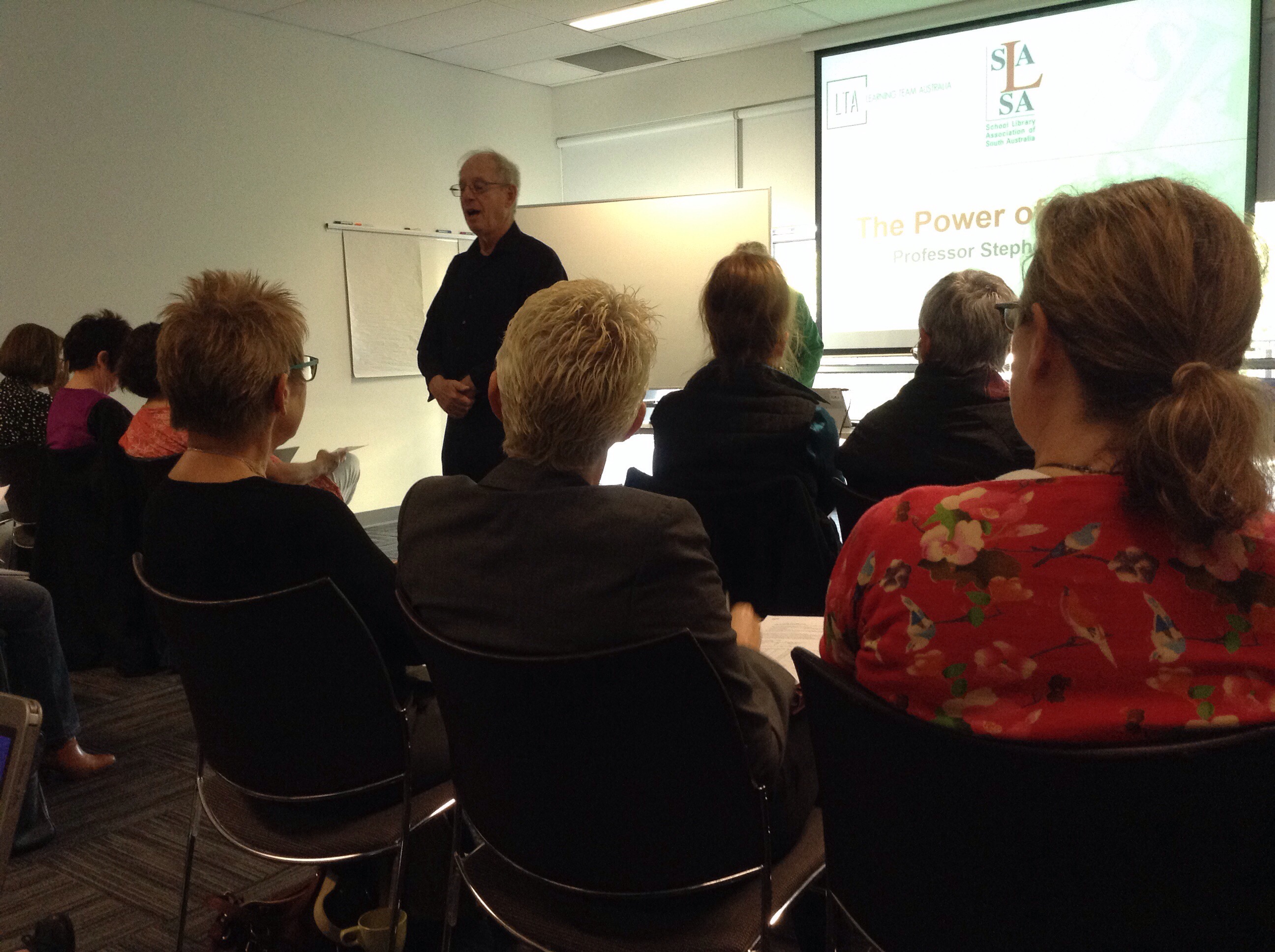
What an amazing day we had yesterday in Adelaide – I’m still absolutely blown away by the entire experience! Imagine having the opportunity to listen to Stephen Krashen speak in Australia? I hardly know where to start to give you even a taste of what the day was like. That we attended at all came about purely by chance after learning just last week tthrough the MLTAWA newsletter that he is on an Australian “Power of Reading” Tour organised by the Australian Library Association. We each bought a ticket even though his presentation would be largely aimed at librarians because the opportunity to listen to him speak was just too precious to pass up. We had our fingers crossed that aspects would be useful but not in our wildest dreams imagined just how brilliant it would be. 
   

Why were we so excited about hearing Stephen Krashen speak? Quite simple really. He is the mastermind behind TPRS. The TPRS/TCI methodology we use in our Indonesian program is based on his theory of second language acquisition and supported by his many years of research. Here is a brief bio from amazon.com:

To those familiar with the field of linguistics and second-language acquisition, Stephen Krashen needs no introduction. He has published well over 300 (BC- closer to 500 actually) books and articles and has been invited to deliver more than 300 lectures at universities throughout the United States and abroad. His widely known theory of second-language acquisition has had a huge impact on all areas of second-language research and teaching since the 1970s. 

So you can imagine our absolute delight upon learning that Adelaide was one of the stops on his Australian tour and in no way did he disappoint us. Our day began at 7am as we headed off to Adelaide and finished 12 hours later, yet every minute was absolutely and undeniably brilliant. He is a relaxed and entertaining speaker.

  
While his presentation was pitched at librarians, sprinkled throughout were many TPRS references and he also spoke at length about Free Voluntary Reading (FVR) – equally important in a second language classroom.  Absolutely everyone we spoke to throughout the day took so much from his presentation. I sat between a young librarian from a local council library and a Year 12 English teacher and they were both totally rapt throughout. 

During the first break, I went up and introduced myself explaining that I was one of 3 TPRS teachers in his audience. He was so excited to meet Australian TPRS teachers. He had no idea that there is a small group of us here in Australia. He encouraged us all to follow aand post questions on the iFLT/ NTPRS/CI Teaching Facebook page where he himself soon posted:


The fascinating aspect of his presentation was his use of stories. They were compelling and entertaining just as they need to be in TPRS. Even after lunch, in that well known time where most participants start to nod off, he tackled the huge topic of poverty yet with relevant Australian statistics meshed with real life stories – Geoffrey Canada & Liz Murray – we were wide awake and entranced till the very end.

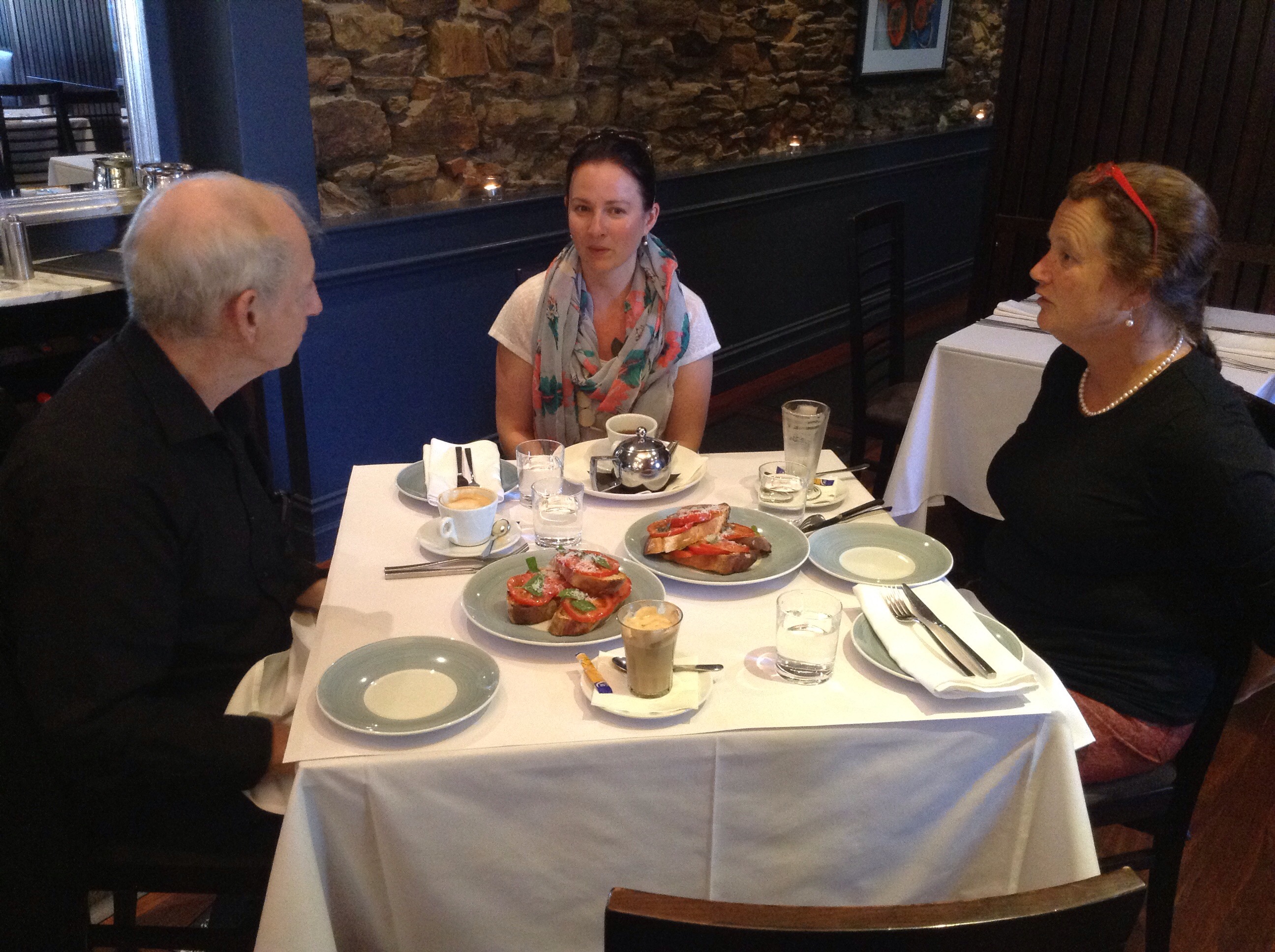
Afterwards, we invited him out for a coffee. We took him to a nearby restaurant and for an hour chin wagged. Can you imagine? Can you possibly imagine how cool it was to actually talk directly to the TPRS guru? We were able to ask him questions about all sorts of details and also listen to his ideas and use them to further gel our understanding of TPRS. Our conversation re-energised us and if anything, made us even more determined to attend some official training somehow, somewhere!! If you would like to join us, write in the comments below and I’ll keep you posted with any plans. A huge conference in Agen, France is already being planned for July 2016. HOw amazing would that be?

 He was so busy, so tired, so jet lagged, yet happily gave up his free time to spend it with us newbie TPRS teachers and for that we will be forever grateful. 
If you’re keen to listen to him actually speak, I highly recommend this podcast: http://www.sourcesandmethods.com/podcast/2015/9/14/sources-and-methods-20-stephen-krashen  He covered so many topics and there is no way I can do them justice. So do yourself a favour, find an hour and sit down and enjoy this podcast. Lots of truly great points raise & relevant to everyone, not just teachers.

Just to finish, here are a few quotes taken from his presentation:

  • There are 3 ways to slow down the onset of dementia:
  1. bilingualism
  2. reading for pleasure 
  3. lots of cofee
      • Through FVR (Free Voluntary Reading) students improve their
      1. reading comprehension skills
      2. writing
      3. vocabulary
      4. grammar knowledge & 
      5. spelling.    (Therefore FVR is the source of most of our literacy development.)
      • If teachers read with their students during SSR for as little as 10 minutes a day over their career, it will amount to 3 months of paid leave!
      • Research demonstrates time and time again, the impact of reading for pleasure on people is far greater than the level of education their parents achieved. 
      • Reading aloud to students is very important for language acquisition in areas of vocabulary, grammar & also develops a love of reading 
      • A love of reading develops empathy. When reading the reader is in the protagonist’s shoes, thus helping readers to have more tolerance for vagueness which is important for problem solving. Readers learn not to reach premature conclusions.
      • Schools are not broken. Just because test scores are low, does not mean that our schools are broken. It is wrong to measure school results by test scores. Instead governments should be addressing the high levels of poverty. Poverty causes poor school results not teachers or schools. 
      • Find your strengths, then get better at it and use it to help others. When you know your strengths, work on it. Don’t focus on your weaknesses, focus on your strengths because its fun. If its not fun, then it is wrong for you. 

      He also included some great quotes from other notable people:

      Picasso ; The meaning of life is to find your gift. The purpose of life is to give it away.

      Mark Twain: The 2 most important days in your life are the day you were born and the day you find out why.

      Zhao: It is difficult to predict what new businesses will emerge and what will become obsolete. Thus, what becomes highly valuable are unique talents, knowledge, skills , the ability to adapt to changes and creativity, all of which calls for a school culture that respects and cultivates expertise in a diversity of talents and skills and a curriculum that enables individuals to pursue their strengths. 
      Isn’t he a legend?

      Indonesian Teachers Meeting With The District Curriculum Advisor

      One of the local Indonesian teachers, Cheryl, organised a meeting with our District Curriculum Advisor , Mel Jones, and generously allowed Hannah (my student teacher) & myself to gate crash the workshop. With the implementation of the Indonesian curriculum (and thus reporting to it) in 2016, our familiarisation time has almost finished. While other teachers seem to have been overwhelmed with curriculum support, there has been little available for language teachers, especially, it seems for regional language teachers. Up to now, the only training we’ve accessed was organised inhouse. We invited Andrea to workshop our hub group last year and Intan also has helped where possible at our Intan conferences and AGM’s. Intan members also received an email this week from our marvelous and generous Intan president, Brent, advertising the following seminar for next Friday:

      At our hub meeting yesterday, we followed the link to the above seminar excitedly, and then groaned as we looked at the price; $286!! With my annual T & D budget of $50, the difference is exorbitant. Hopefully if we ask our principals to contribute the difference with curriculum monies, it might be possible?? My principal in particular has been very supportive considering the inequitable amount of training available for specialist teaching staff.

      So the possibility of sitting down to a locally held workshop specifically for Indonesian teachers to  help us “unpack” the curriculum, assess how well we’ve covered it to date in our classrooms and then design an assessment task that will help with reporting to parents and for moderation was too good to be missed.

      We began by looking at the content descriptors in each of the substrands for F-2 and on a grid, writing the ways in  which they have been covered this year. This is how I filled mine in and considering it was done very quickly and off the top of my head, I was thrilled with the result:

      Socialising – calling the roll daily and asking students ‘apa kabar?’

      – Activities eg listen and draw, arranging song/story lines into the correct order

      – songs

      – brainbreaks iincorporating gestures and movement (eg kasi game, Bu Cathy berkata, )

      – class instructions eg. cari satu teman, matikan lampu, Bu Cathy mau mengabsen, duduk di ekonomi (my room is set up like an airplane – kelas satu, kelas 2 & ekonomi),

      – TPR (Total physical Response)

      Informing – asking/telling stories

      – target structures (new vocabulary) eg finding them in the text

      – rearranging song lines and then singing the song together

      – acting out songs/ stories

      – illustrating song/story phrases

      –  discussing the size of the jacket – terlalu kecil/terlalu besar/pas

      – Movie talk  – eg Mr Bean

      Creating    – acting stories/ songs

      – writing shared class stories

      – TPR

      – songs

      – rearranging the song lines and siunging together

      -making a shared class book – eg Sekolah Saya (year 3’s making it for our partner school)

      Translating – comprehension checks

      – word walls

      – displays eg seragam sekolah, Boleh saya pinjam?, numbers,

      – introducing target structures using visual pictures eg a picture of a cicak with the word  ‘cicak’ written underneath it, the same for dinding, jendela, kursi & pintu.

      –  greeting adults who enter my room Pak/Bu

      – presenting at assembly the different ways in which Indonesians greet each other

      – contributing to class displays of ‘cicak di jendela’ & ‘cicak di dinding’

      – grammar pop ups eg ‘c’ (cicak) is always pronounced ‘ch’

      Reflections – cognates eg pizza, sprite, hotdog, jaket, hamburger etc

      – etiquette eg  mencium means to kiss and to smell, kasi hormat,

      –  cultural manners eg pointing, gesturing come here,

      – the gender vs age difference (we are more focused on gender however age is of greater significance for Indonesians)

      Systems of Language –  TPRS step 1 – introducing  the target structures eg repeat the TS in various voices  modeling the trilling of the ‘r’, the pronouciation of ‘c’, the short vowels etc.

      – personalisation eg jaket Ebony terlalu besar? Ebony pakai jaket?

      – basing stories around high frequency verbs eg makan, minum, pakai, kasi, punya and using these verbs in sentences which are meaningful and relevant to the students.eg Caleb mau  minum sprite? John mau pakai jaket?

      – incorporating question words and negatives into my circling. eg. cicak di dinding. cicak di dinding atau cicak di jendela? cicak di pintu? cicak dimana?

      – introducing conjunctions eg students answering apa kabar? with panas dan haus.

      – using the roman alphabet to write the target structures on the board.

      Language Variation & Change – Students ‘kasi hormat  kepada’ visitors appropriately.

      – All visitors to our room are greeted using Pak/Bu

      – use and discuss the cognates in stories

      – greeting the first class of the day with selamat pagi and the rest with selamat siang. Encouraging students to greet Indonesian teachers out of class reinforces this.

      Role of Language & culture – meeting our many Indonesian visitors throughout the year and understanding that Indonesian is their national language.

      – Asking ‘Boleh saya Bahasa Ingriss?” before using in English in class.

      – playing games like hom pim pah & batu, kertas, gunting to choose participants.

      – choosing texts about cicaks, kancils, orangutan.

      – greeting teachers appropriately eg hand to their forehead.

      How great is that!! TCI, TPRS & TPR complement the Indonesian curriculum beautifully!!

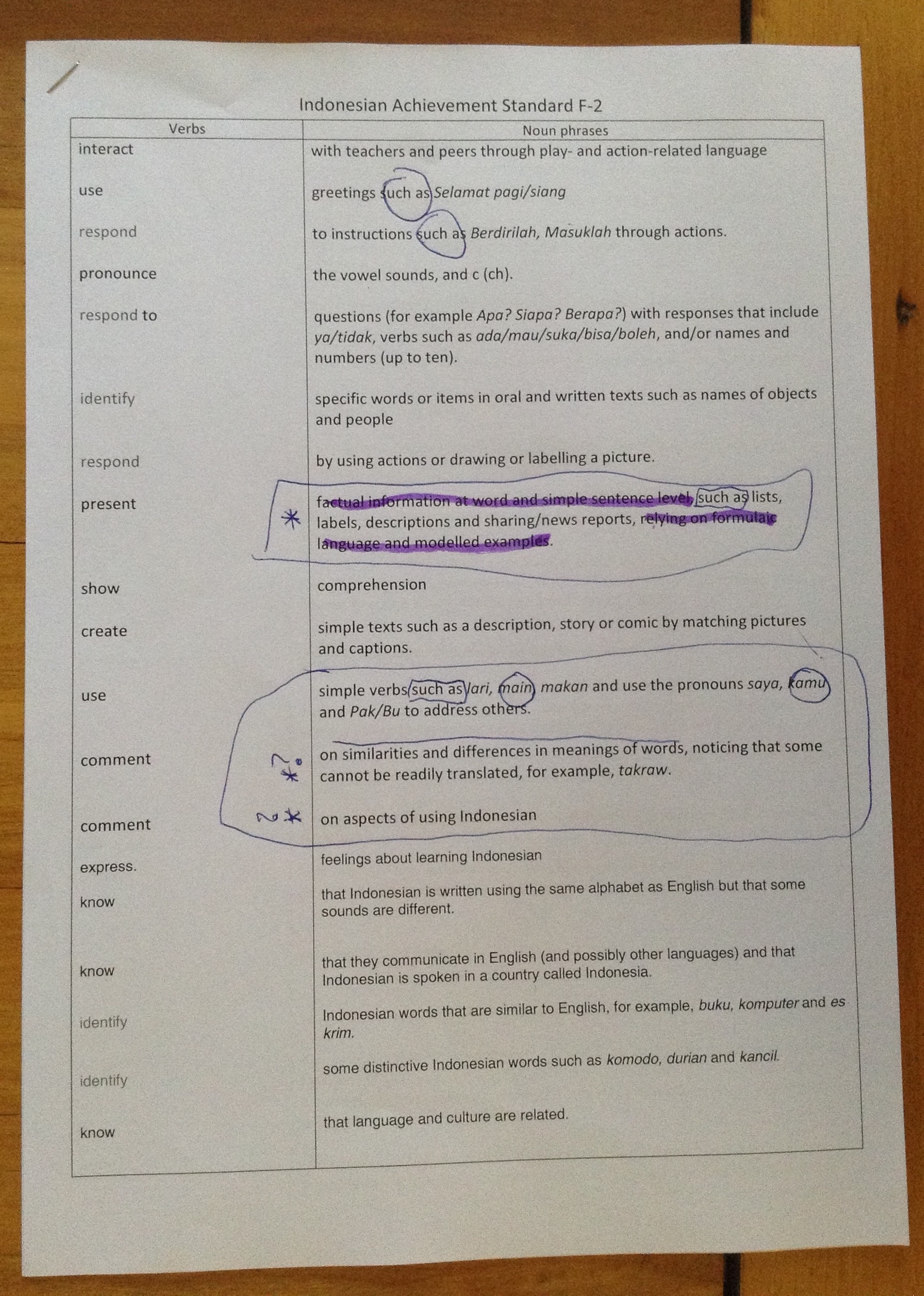
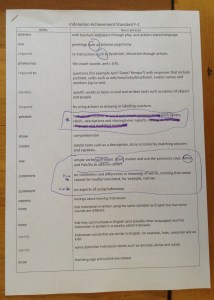
      We next moved onto the Indonesian Achievement Standards. Mel had already ‘unpacked’ it for us and this is what it looks like: (excuse my scribbling!)
      image

      We went through this together and discussed it with Mel. We had several questions for her which she will follow up for us:

      1. Does the wording ‘such as’ mean for example or does it mean that the vocabulary include must be covered?

      2. What does the ‘similarities and differences in meanings of words’ mean?

      3. What does “comment on aspects of using Indonesian’  mean for teaching junior primary students?

      4. We also want to know how a F-2 student can present a news report in Indonesian!!! (more to the point, why?)

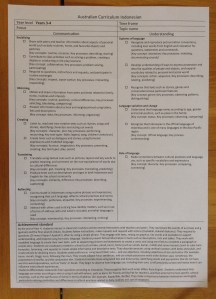
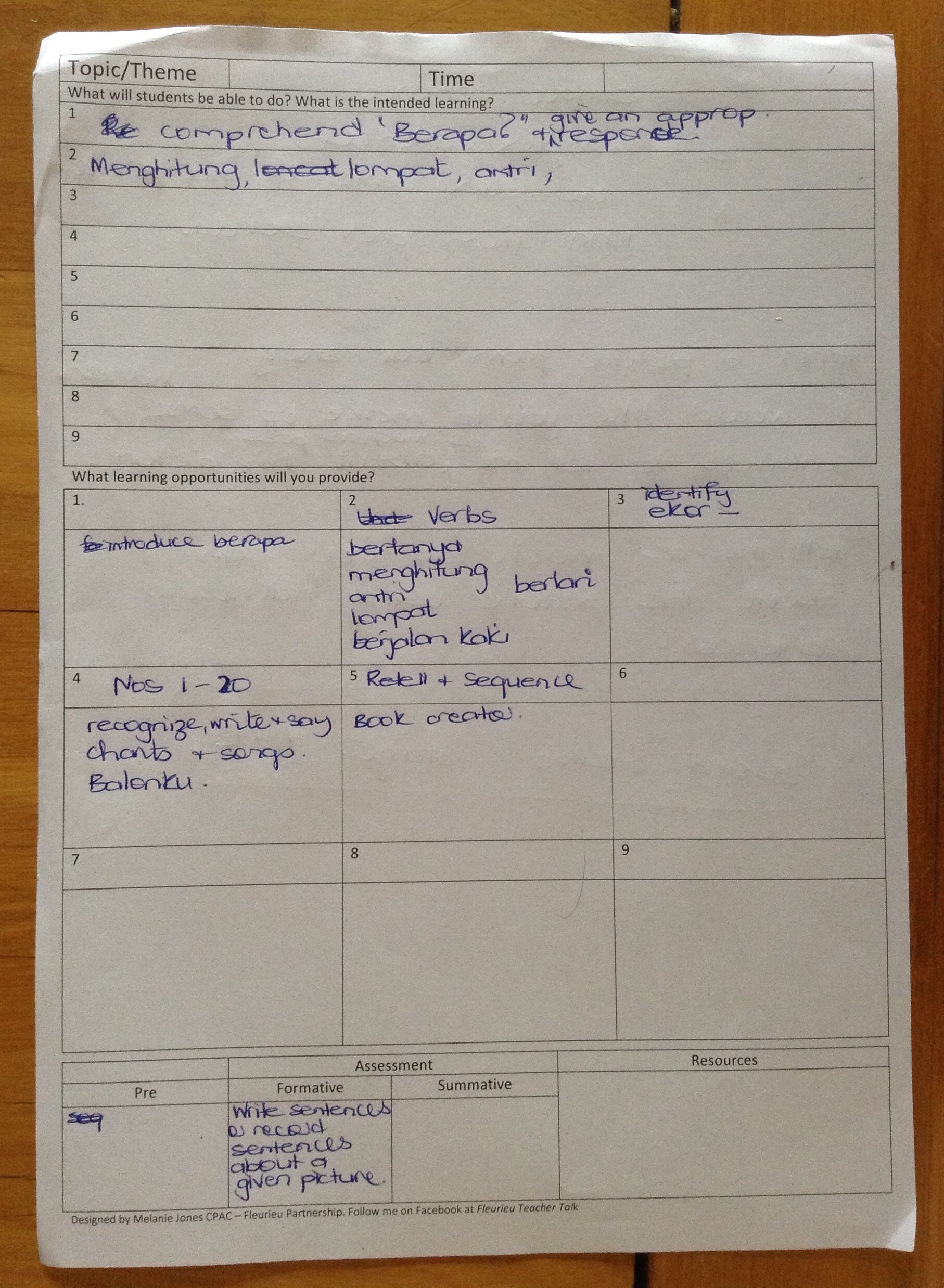
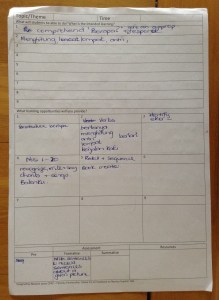
      Following on from understanding the achievement standards, the next component of this workshop was to learn how to use the achievement standards and the content descriptors to plan a unit of work. We realised then that we haven’t yet met to plan term 4. Sharon suggested using a kancil story from Siara Siswa which we all agreed had great potential as students love the wily kancil. Mel gave us a proforma which helped to break down all the aspects of the curriulum that could be covered via the kancil story. Here is my sheet:
      image

      After realising just how much potential this story has, we put our heads together to create an assessment task that is appropriate for F-2 students and will provide them with the opportunity to demonstrate a variety of achievement levels.

      Mel shared this to help us:

      image

      We pointed out that it didn’t truly apply when using TCI to teach Indonesian  For example we took ‘name’ and demonstrated that if we asked a student, “ini pensil atau ini cicak?” while holding up a pencil, how could that be ‘lower intellectually’ challenging for language students? One could argue that circling operates at a lower intellectual challenge level yet because it is all conducted in Indonesian, that surely is requires a higher intellectual challenge!  Still it was food for thought.

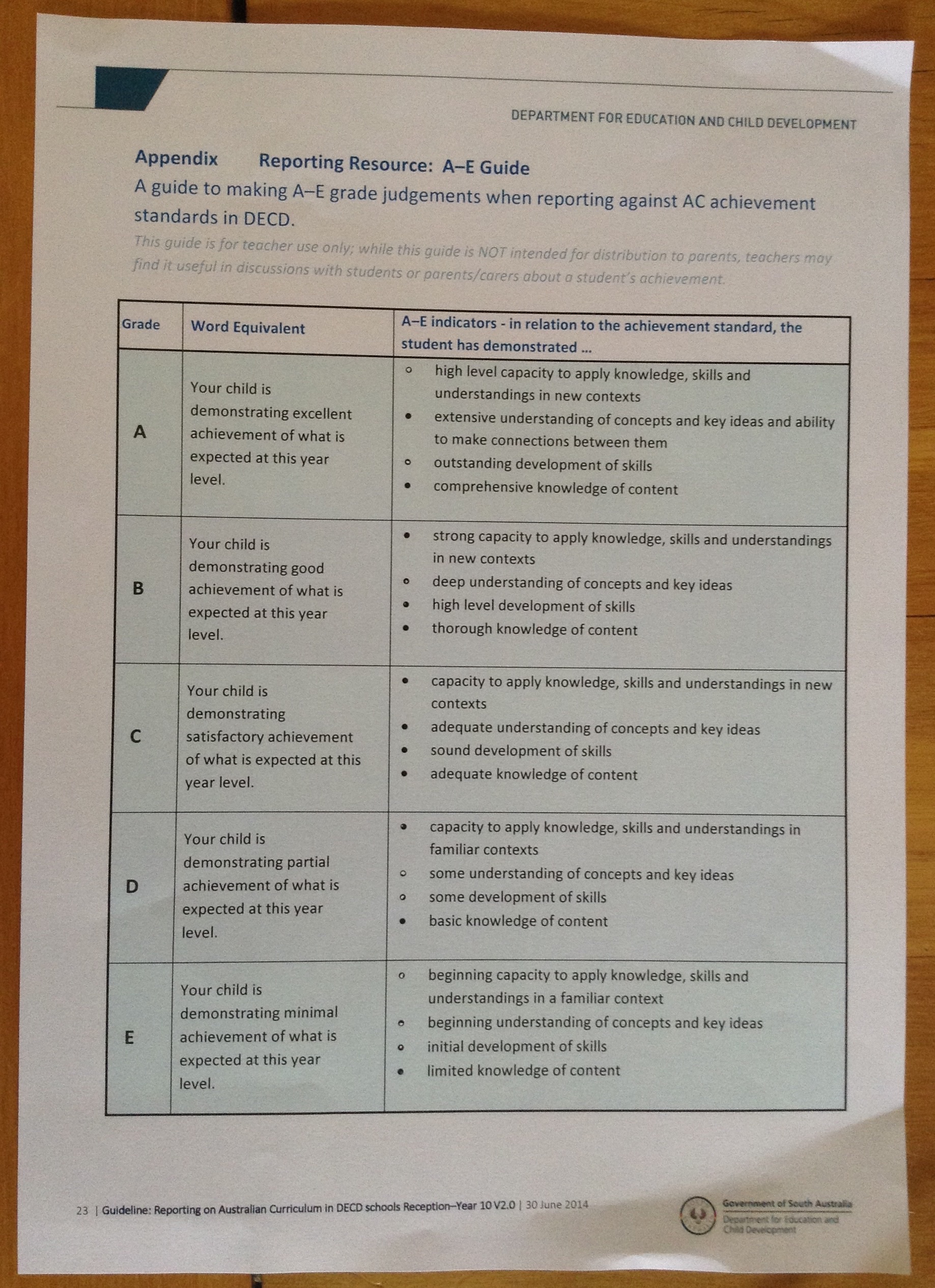
      Creating an assessment task definitely was a higher intellectual challenge!! We could all suggest many ways in which students could demonstrate pproficiency at a ‘C’, yet it was harder to provide students with an assessment task that provided them with the opportunity to demonstrate above average achievement. We wracked our brains and thankfully Sharon suggested showing students a picture from the Kancil story and asking them to tell the teacher as much as possible about the picture using Indonesian. The sentences would be graded:  ‘C’ if the student could accurately describe the picture using simple yet correct sentences, ‘B’ if the student could accurately describe the picture using complex sentences and an ‘A’ if the student accurately described the picture using complex sentences incorporating additional vocabulary from previous stories and class work.

      Other sheets that Mel shared with us included:
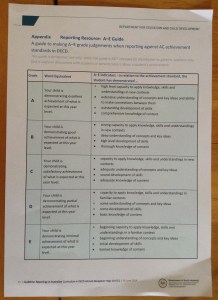
      image image

      The one on the right also comes in all other year levels and will be available soon (hopefully early next year) digitally and the boxes can be checked off!

      If you want any more iinformation  or would like your own copies of any of the handouts we received, please contact Mel on Fleurieu Teacher Talk on Facebook.
       

      Black Box Videos

      Below is a video which I highly recommend if you are interested in learning and understanding more about Krashen’s hypotheses which underpins Teaching with Comprehensibvle Input.

      Videocast 3 – The Comprehensible Input Hypothesis

      The above videocast is the third in a series and below are the first two in the series:

      videocast 2 – Mental Representation & Skill

      videocast 1- Methodological Principles for Language Teaching

      Global Workshop via Skype

      Last Friday, Sharon, Annie & I were again fortunate to have the opportunity to workshop with the marvellous Catharina, an experienced junior primary TCI  practitioner. Due to South Australia leaving summer time and the USA beginning summertime, we met at 9am Friday morning (Aust) and 7:30pm Thursday evening (USA). Catharina’s school year is coming to an end, just4 weeks left of the school year, so we doubly appreciated the time Catharina gave us! Such an exhausting time. Last Friday, we were also joined by Rosslyn from INTAN. Rosslyn is the 2015 (and inaugural) INTAN hub group liaison officer and joined us to see what our hub group gets up to!! 

        
      As always our skype workshop with Catharina left us buzzing. We began by bringing Catharina up to date with recent lesson plans and being the end of week 1, we filled her in with what we had each done in preparation for our new story:

      Ada perempuan.
      Nama perempuan Lucy.
      Lucy dingin.
      Lucy mau pakai jaket.
      Jaket Pak Hudson terlalu besar.
      Jaket bayi terlalu kecil.
      Jaket Bu Cathy pas.
      Lucy berkata, “Terima kasih Bu Cathy.”
      Bu Cathy berkata, “Sama sama.”


      In  my case, I had focussed on the target structures of perempuan & laki laki with my junior primary classes. I once gain used the laminated PQA cards recommended by Catharina during our very first skype workshop. These A4 laminated cards include 2014 school staff photos as well as a few well known identifites like Batman, Spongebob & Harry Potter. I revisited ‘Siapa nama’ as well as asking, “Batman laki laki atau perempuan?” At the end of the lesson, I did a quick listen and draw using the brilliant clear folders. I also incorporated some TPR into the lesson because one of my term goals is to increase student acquisition of classroom instructional vocabulary (sit down, stand up, turn off the lights, sit in a chair etc). We began with duduk, berdiri dan putar and the instructions included sentences such as, “Laki laki duduk’ & “Perempuan berdiri dan putar.” If time, we played a quick game of Simon says (Bu Cathy Berkata) which they all adore and constantly beg for!


      Once we had all finished talking about our week, we began asking Catharina specific questions about using TPRS with junior primary students. Our lessons are much longer than Catharina’s and our class sizes are also double, yet the basic principles remain the same. Catharina stresses that variety is the key when teaching junior primary students. Here are some of the great ideas Catharina shared with us:

      1. Duplo – Have a big pile in the middle of the student circle. Retell the story the class has been working on, sentence by sentence. If the sentence given by the teacher is correct, students may take one piece of duplo from the centre pile. As they collect and listen, they can start building something using their peices of duplo. If the sentence given by the teacher is incorrect and the student took a piece of duplo from the pile, they not only have to return the piece they just took but also get a penalty and have to surrender one of their other pieces too! 
      2. When retelling a story, have the whole class join in with the acting. All students are allotted one of the characters in the story and they each act their part during the retelling. 
      3. TPR – When playing Simon says, give students lives so that they remain involved and continue to respond to the directions rather than sitting out. Don’t forget to trick students by purposely doing the wrong action! 
      4. Throwing & catching a soft ball when asking specific students questions. Allows teacher to differentiate. 
      5. Take photos of students acting to be used later for revision, discussion and retelling!  
      6. Look at the Youtube video Valentines Day – perfect for movie talk. 
      7. Great brain break is to act out the alphabet! Students using their whole body stand up and make each letter of the alphabet while saying each letter. This would be great for familiarising students with the different sounds made by the Indonesian alphabet. 
      8. Catharina presents to each student at the end of each school year, a 1/4 sized A4 book which she has put together herself containing all the stories they have covered through the year! The stories are illustrated with student drawings that she has collected throughpout the year. What a great way to encourage students to read and continue having contact with the language over the holidays. 

      While our skype workshop was only for 50 minutes, we got so much from it. We then moved to a spare classroom to talk to Rosslyn. We gave her some basic information about TPRS/TCI as well as outlining our other collaborative projects. We look forward now to reading her article which will be published in the next INTAN newsletter! My hope is that we can tweak teachers interest in TCI! 

      If you too are interested in learning more about TCI, see this previous post.

      Where To Find Comprehensible Input Inspiration & Information 

      I love reading other peoples blogs and get so much inspiration from them all and it is time to both acknowledge and share with you a selection of the blogs I follow and in doing so recommend that you start following them too!! 

      The top two that are always my first ‘go-to’, are Ben Slavic’s and Martina Bex’s. They are both so comprehensive and up to date. It is so easy to get lost following threads linked to threads collecting inspiration and information along the way.

      Ben Slavic’s WordPress Blog requires the payment of a minimal monthly fee – money well spent in my opinion. It is both a forum and a collection of resources where both newbie TCI teachers and highly experienced TCI teachers ‘meet’ to discuss aspects of CI. The conversations on this blog are fascinating and the support I have received has been awesome. It was here that I met Catharina, my incredible mentor.  


      Martina Bex’s The Comprehensible Classroom is a comprehesive collection of all things related to TCI. It is an amazing blog/website with a vast range of ideas and activities and even though there is a Spanish and largely secondary focus, it is easy to search for lessons and activities which are suited or can be adapted for primary Indonesian. Martina can also be followed on Twitter and Facebook where she uploads recent and archived posts.   


      There are also many other CI blogs that I follow. The below blogs are ones that supplemented and provided another perspective along my TCI journey and will hopefully be helpful for you too. I recommend you look through them and find a few to follow yourself. You can either have their latest posts emailed to you or add them to your reader in WordPress.

      1. Kristin Duncan is a Canadian years 5-12 teacher. Her blog/website is TPRSteacher. Here you can find a great selection of resources for a wide range of languages.   
      2. Another real gem is the Latin Best Practices: Comprehensible Input Resources wordpress blog.  While it states that it is for Latin Teachers, I can reasssure you that like all the others, this is a treasure trove of resources and research. 
      3.  Crystal Barragan is a secondary Spanish teacher and while she doesn’t post that often (her most recent post was Nov 2014), when she does, they are well worth reading. Her blog roll is awesome and includes many TCI legends. Well worth fossicking around here.   
      4. Bryce Hedstrom has a website and it too is well worth exploring.  
      5. Senor Fernie  is a kindegarten to year 8 Spanish teacher who made the transition to TCI this school year too, so his blog is relevant and compelling for many reasons. 
      6. Haiyun’s blog Ignite Chinese is also an amazing place to while away a few hours!! It is refreshing to read posts written by a CI teacher who also teaches an Asian language even though the Chinese and Indonesian languages have little in common! 
      7. Michel Baker’s TPRS & Beyond is another I follow as Michel is also an elementary Languages teacher. 

      While perusing the above sites, I highly recommend you look carefully at their blog rolls and search through the blogs they also follow. Occasionally I have discovered a terrific blog that somehow escaped my notice up till then! Finding your own blog in the blog roll is a blast! 


      Term 1 Reflections

      As term 1 draws to a finish, I have been looking back over my first dedicated block of teaching Indonesian using TCI . It has been a steep learning curve yet at the same time deeply satisfying. I have learned just as much as the students!! Here are the major gems that I would like to share with you from my short journey thus far:

      1. Props – Don’t ever underestimate the power of props. When I copied Sharon’s brilliant idea of using a bottle of Sprite to tell the story: 

      Jessie haus
      Jessie mau minum Sprite
      Ella punya Sprite
      Ella kasih Jessie Sprite
      Jessie minum Sprite.

      I was blown away with the total and utterly mesmorised attention of the classes from year 2 right up to year 7! Even when the Sprite finished, students insisted I refill the bottle with water, so we could continue. Even with water, students were still highly engaged and following the dialogue closely. It not only hooked the actors, but hooked the other students too as they decided whether Ella would give Jessie a drink of Sprite and if not Jessie, then who would be given a small drink of Sprite. It is definitely worth taking the time to organise props for lessons with all year levels. Not only do students beg for repetitions, but it is so much more fun too for everyone. I have never laughed so much with students!! 

          2. Public Holiday Pitfalls  –  Usually I begin my week with the year 4’s and they are a great bunch of students to ‘trial’ my middle/upper lessons with. They give me the opportunity to fine tune my plan before facing the year 6/7’s the following day. While I enjoyed my first Easter long weekend in many years (our Ed Dept usually cleverly incorporates them into our mid semester break), I forgot to keep this in mind and consequently yesterday’s lesson with one of the year 6/7 classes was a disaster. With this class I need to be one step ahead of them. Maybe Trashball or something similar would have been a better plan for a challenging class in week 11.. 

        3. Trial by Error – A exhausting yet necessary aspect of teaching and a fact that I (and any learner) needs to philosphically and practically accept. I’ve read that it can take up to 2-3 years for a teacher to acquire competency using TCI methodology. This is what keeps me going! There are many fantastic blogs and websites full of TCI brilliant ideas and suggestions. Gleaning through them all to find ideas suitable for teaching primary students and then trialling it requires a huge step out of my comfort zone and so much energy. Yet each step is an important and integral aspect of the entire journey.  I must keep reminding myself to continue plodding steadily along the TCI path and not to expect too much too soon! 

      4. Dehydration – TCI requires so much teacher talk and I have discovered that I am so much more dehydrated at the end of my days than I was ever before. I have tried to keep up my fluids over the day but haven’t been successful consistently with this yet. I get so engrossed in the lesson that I totally forget to stay hydrated. The most successful stategy I had was finishing my 750ml drink bottle at the beginning of recess and lunch on my way to the staff room but lately even that has fallen by the wayside. Any suggestions gratefully accepted! 

      5. The Importance of Developing A Personal Learning Networks (PLN) –  The core of my PLN consists of Annie & Sharon, my Indonesian colleagues who teach in nearby schools, together with Catharina, our mentor who teaches French in New Jersey. The middle layer of my PLN consists of teachers who teach Indonesian and have been following this blog or my tweets. Their input has been invaluable and I have truly appreciated their comments and  feedback. While there are common aspects between different languages, there are also certain aspects that are unique and therefore those who teach and  speak Indonesian have that special eye through which to  understand my reflections and experiences. They too are are coming to grips with our new Indonesian Curriculum to be implemented fully in 2016, another valuable persepctive. The outer layer of my PLN consists of all the TCI language teachers who post on their own blogs or on websites like Ben Slavic’s. There is definitely a gap for me between the middle and outer layers purely because most of the teachers in the outer layer are secondary teachers and none of them teach Indonesian. Yet, they are still a major and important part of my PLN as they have such a wealth of knoweldge and experience that I am truly in awe of them. Without this special group of people, my first term of TCI could have finished so differently. Whenever I felt like I had hit a brick wall and I couldn’t see where to go next, someone would be there to encourage and help. Annie and Sharon have been awesome and once again I am so fortunate to work so closely with 2 teachers who readily joined me on this journey. Our frequent Friday meetings were invaluable opportunities to share lessons that worked well and thus give us each the inspiration and encouragement to continue. Our Skype sessions too, with Catharina have been incredible. Each time we all  took copious notes. It is so amazing to have the opportunity to speak with a junior primary teacher about TCI and how to apply it with very young students. Now that term 1 has almost finished, we are really looking forward to our next Skype call with Catharina. While we usually only speak for an hour, each call is jam packed full of awesome suggestions and information. She truly is an amazing and inspirational teacher  to have in my PLN and a huge thankyou must go to Ben Slavic for initially suggesting it! 

      6. Lesson Planning – On looking back through my lesson plans, I have definitely learned that while it is good to have a few brain breaks up my sleeve, it is also important to keep my planning simple. My initial lesson plans from the first weeks were very long and were a great example of over plannning which is a good way to start! I tried to cover everything at first and then realised that it was not only unrealistic but also pushing the students too quickly. Narrow and deep is the TCI catch cry for a very good reason and this is what underpins the success of TCI over the methodologies I used previously. 

      7. Patience is a Virtue – When reading blog posts written by other teachers who also use TCI, I have to keep reminding myself that comparing my students (or their lesson outcomes) with theirs is pointless. My students & i have only just started so it is natural that we can’t yet have impromptu detailed conversation that are 100% comprehensible. It is of greater importance that we start with the Indonesian version of the super list of verbs sourced from frequency lists and accept that initial discussions will be be very basic. 

      8. Humour – At a point about mid-term, I reached a point where everything gelled. Suddenly I relaxed and started to enjoy myself with the students. At that point I realised that it was the first time I have ever laughed so much WITH  my year 7 students. Previously, any hilarity got out of hand and ended with me having great difficulty bringing them back on track without loosing that sense of connection. Yet with TCI, we laugh together at the ridiculous  scenarios the students suggest and then act out. Not only do students have fun, call out and be totally silly, but because it is all in Indonesian, it is amazing and all students are totally mesmorised and engaged thus keeping it manageable!  

      9. Tight Timelines have Vanished – Previously, my term outline was tightly planned and in order for me to achieve my term outcomes, every lesson was precious and heaven help anyone who interfered with my schedule!! Taking sick leave was avoided and any additional offered non contact time was reluctantly refused because my planning didn’t have much flexibility. This has all blown away with TCI as everything is based upon student aquisition which is a  huge unknown. Once we know what the target structures will be, out planning will focus on that until we, the teacher, deem the students ready to progress to the next step. Consequently, with our upcomiing APBIPA visitor, Bu Mia, I feel far more relaxed and am really looking forward to her time in our school. Students will be able to experience a cultural lesson with her and this will also give them impromptu and authentic opportunities to practise and demonstrate their acquired Indonesian to date.

      I am so looking forward to term 2 and having the opportunity to apply all that I have discovered. I also hope that my reflections give other Indonesian teachers the encouragement to consider trialing aspects of TCI in their classrooms. Last year, I dabbled just by experimenting with a few activities that sounded interesting and that is how I urge you to start too. While I am nowhere close to TCI mastery, I am nontheless, very happy to help any Indonesian language teacher if you would like to discover more about TCI. Ask away and if I don’t know the answer,, someone from my amazing PLN will certainly help!!

      Our Week In Sydney with The Bridge Project

      What an amazing week we’ve just had here in Sydney for the Bridge Project. While we sit at the airport waiting for our flight, doing a last minute catch up with Erin and Mel who are also hosting 2 partner teachers from Medan, I’ll try to give you a brief picture of our full on 4 day training and development.
      Marg & I first met our partner teachers, Pak Pahot & Bu Elizawati, in the breakfast queue at the Novatel. Pak Pahot is a year 2 teacher and Bu Elizawati is a year 6 teacher at a school called SDN 025443 Medan Barat which apparently is rated number 1 in Medan. Of the 400 odd students who apply to enrol each year, only 100 are selected!

      IMG_9638-0

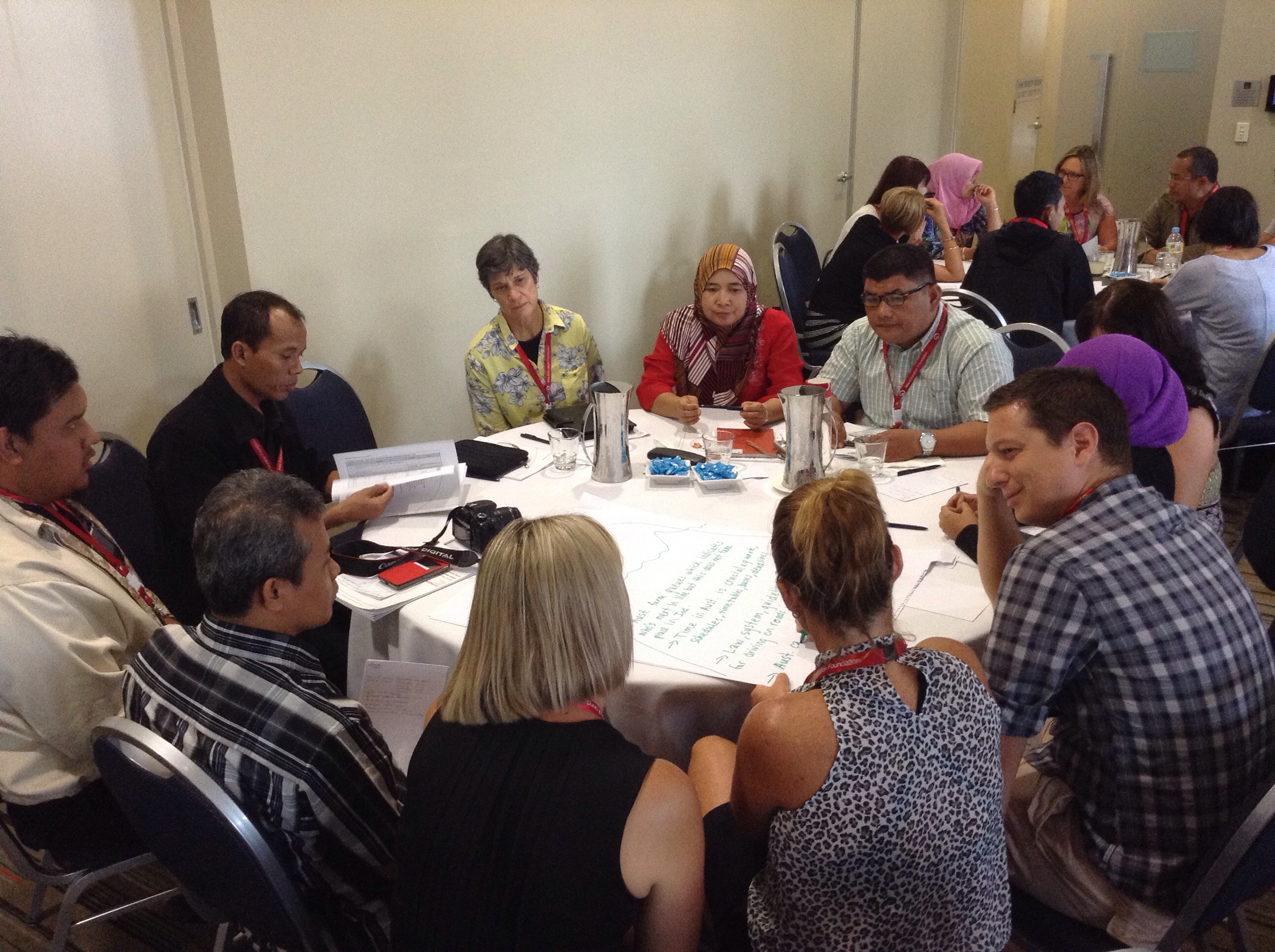
      Over the past 4 days there has been a strong emphasis on collaboration, planning and communication. Presenters recommended a variety of ways in which we can achieve all 3 successfully with our partner schools and time was provided to not only make a start on them but also so that we could familiarise each other with our school calendars, so that any planned projects avoid school holidays, religious festivals and national exams.

      IMG_9639We also spent time discussing cultural differences. Our partner teachers have already noticed differences with punctuality, environmental pride, traffic and the differences between Indonesia and Australia with the use of right hands to pass items.

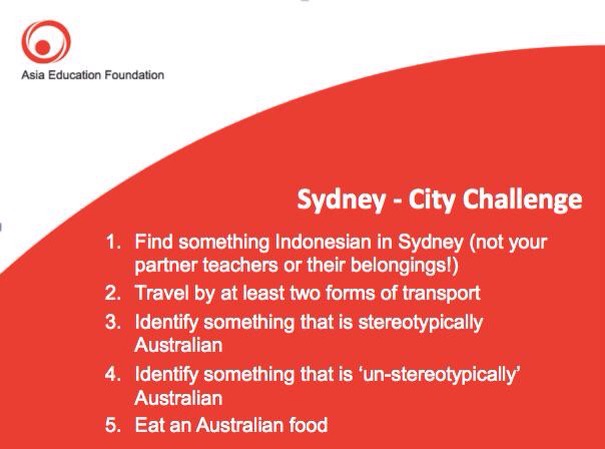
      Thursday afternoon, we were given a challenge:

      IMG_9675This was a brilliant and fun way for all of us to explore Sydney. The resulting photos on Twitter were varied and the shared experiences were vast. Check out #bridgeproject!!

      IMG_9648

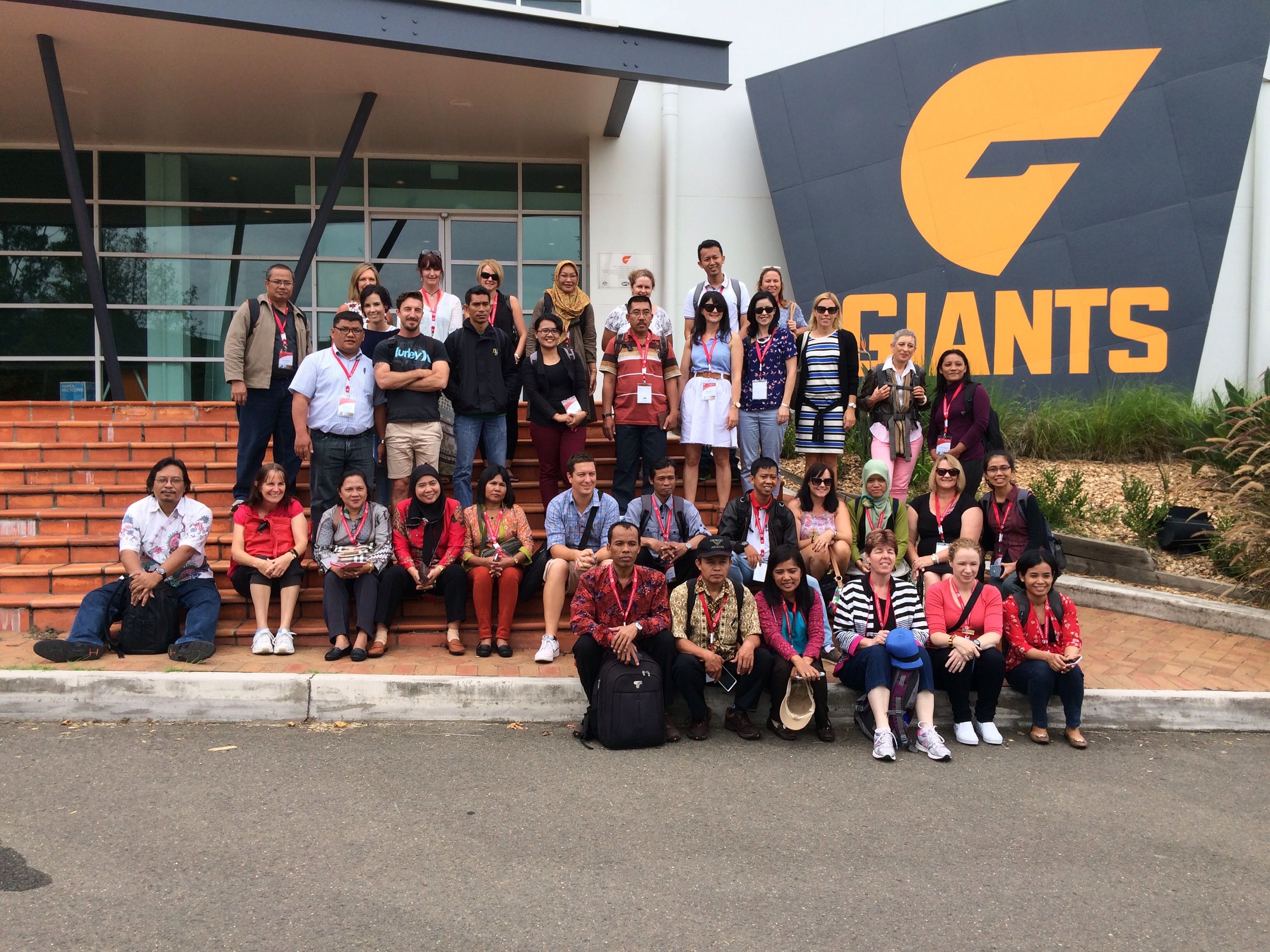
      Another fun outing was lunch at the local Giants stadium.

      IMG_9662After lunch, 2 of the stalwarts (proud muslims) explained about the various programs they run which target disengaged youth and promote education. Very impressive. Afterwards, we enjoyed a tour through the facilities:

      IMG_9664

      IMG_9666

      IMG_9667

      Presenters over the 4 days included Mike Bartlett & Danielle Leggo, education officers from from Sydney Olympic Park (SOP). The program they run there is truly amazing and caters towards both local and distance students. It largely focuses on sport, agriculture & sustainability and can be accessed either face to face or by video conferencing. Thirty thousand students annually access the ranger led Australian curriculum aligned activities learning about the local wetlands and other local habitats and there is also an online Koori classroom! One great suggestion from Michael was to set up a collaborative project to study the migratory birds that fly from Siberia to Australia, transiting Indonesia! For further information about SOP, regardless where you are globally, check out their website and youtube channel. They are currently searching for non Australian classrooms interested in an international 2015 netball challenge.

      Joedy Wallis from AEF, divided the group so that the Australian teachers and the Indonesian teachers could each focus on their own curriculums to identify areas compatible for collaboration as well as identifying goals and outcomes for student learning. She pointed out the areas of the curriculum covered by the bridge project include:
      literacy
      numeracy
      ict capability
      critical and creative thinking
      personal and social capability
      ethical understanding
      ICL (Intercultural Understanding)
      which together create successful learners, confident and creative individuals and active informed citizens.
      Joedy outlined some history behind the inclusion of the ‘Asia and Australia’s Engagement with Asia’ priority in the new Australian curriculum. The global shift which has lead to policy changes and the Melbourne Declaration, first signed in 2008 (changes advocated by AEF) provided the impetuous behind our Bridge partnership meeting this week. This promotes student acquisition of 21st century skills. all beneficial for Australia; socially, culturally and economically.

      IMG_9645
      Joedy promoted twitter to all, encouraging all teachers to sign up and discover just how amazing it is for professional learning and sharing. She also promoted the AEF website (which is currently undergoing a huge update to become even bigger and better), the AEF newsletter and #AEFchat on twitter (details on the website) which currently run monthly but will happen more frequently if the number of teachers on twitter increases.

      Julie Lindsay from Flat Connections presented on Thursday for 2/3 of our day focusing on the challenges connected with our partnership schools beyond face to face and how to sustain global connections and collaborations. She raised an important point about the need for deep global learning and the importance of constructing a legacy. Encouraging teachers to think deeply and creatively so that whatever project our students create, it will be their legacy.
      Julie suggested a variety of online tools through which this could be achieved:
      1. Ning.com (not free) which is a multimedia networking tool was recommended highly by Julie for asynchronis communication if both schools can not be online at the same time.
      2. voicethread.com – highly recommended. students can record their voices along a given video/photo
      3. Wikispacess – where students and teachers can collaborate on projects
      4. blackboard collaborate – students present for 1-2 minutes about their learning to an international audience.
      5. globalyouthdebates.com asynchronous global debates between classrooms
      6. wevideo
      7. Animoto
      8. Edmodo – private; great tool for creating discussions)
      9. Hangouts
      10. Skype
      11. Padlet – a private forum for groups to share

      Before any actual planning, it is critical all teachers agree on a cyber safety policy and have in place an agreement to monitor all students.
      Projects could be based on a range of activities:
      interpersonal
      research (joint?)
      problem solving – kerja sama tentang kebanjiran?? find something in common and explore issues!! eg rivers, sea,
      artifact and co-creating (eg making video alone or by collaborating with partner students)
      connect
      communicate
      collaborate
      create

      Most of the suggested project ideas would be entirely undertaken in English which would create opportunities for deep ICL for classroom teachers. Julie suggested students take the learning home (al la flipped classroom style although she didn’t name it!) which gave me the idea of tasking students to record themselves teaching their parents ‘siapa nama’ & ‘nama saya”. Could create a funny yet educations video about specific target language!
      Other flipped ideas that arose over the 4 days included a flat Stanley project whereby students make a puppet of themselves and then send it to their partner school who then takes it with them in their every day life photographing everything and creating a journal which is then returned to their partner school either digitally or by snail mail. Another idea I really love which would be perfect for a look and discuss activity is called, A View From Your Window. Tasking students to take a photo from a window at home and then writing a caption about it.
      Julie’s presentation was chocker block full of suggestions with little time to fully explore and trouble shoot. Most teachers felt totally overwhelmed and this confirmed for me just how fortunate we are at PEPS to not only have had a ICT Coordinator for the past 3 years but to have someone of Kathy’s high expertise and dedication in the position. Teachers were also concerned about poor tech support on return to their schools, which again for Marg & I, is rarely an issue!! Our highly capable tech team of Darryn & Kathy is second to none! What they don’t know isn’t worth knowing!! One principal told us about a class set of computers still in boxes at their school because they only get 2 hours of tech support per week!!
      The second part of Julie’s time with us was task based. We had to create a digital story with our partner teachers. I quickly wrote a script which I then typed up in Pages and emailed to Marg, Pak Pahot & Bu Eliza. Using Puppet Pals, we quickly made a film entirely in Indonesian about the transport we used in Sydney yesterday which Pak spiced up with some evil laughs!! We uploaded it to Youtube and then pasted the link on the Bridge Padlet to share with everyone.

      IMG_9674

      Pak Donny, the Indonesian translator and coordinator, constantly stressed in his translations, that the partnership is all about our students and should benefit them not the teachers and that all projects must keep that in mind! There was also a huge push to encourage Indonesian teachers to review their learning style (methodology) so as to adopt more western aspects. I can see that encouraging students to ask questions, to be more confident in exchanging opinions has benefits but it is a huge cultural shift and with it comes other aspects of western culture. Other factors which must be considered is that class sizes at our partner school are enormous. Classes range from 34 to 46, Class rooms too are not large and school furniture is also not conducive to more ‘creative’ styles of learning. I can see benefits in encouraging a methodology shift but would like to explore ways in which it can be done that are more sympathetic culturally. It makes me feel like a missionary rather than an educator.
      It had been an amazing week, meeting teachers from almost every state. We have swapped email addresses and Skype handles as well as following each other on twitter so that we can keep in contact and help each other with any upcoming challenges this year as well as sharing our successes. Marg in particular was brilliant with this. She has already arranged a Skype call with Mel & Erin this coming Friday!! Another teacher has offered to set up a Facebook page for us all and Aaron will create another Padlet too. The September study tour will be a reunion for those of us who sign up for it!

      Goodbye Sydney!

      IMG_9673Thank You so much to everyone involved for such a memorable week and in particular to Pak Aaron, Ibu Bonnie & Pak Donni.

      My First TCI Coaching Lesson Over Skype

      Online TPRS/TCI blogs and websites are largely written by and for secondary teachers, so it has been brilliant discovering a forum on Ben Slavic’s website specifically for ‘elementary’ teachers. One of the contributors to this forum is Catharina, an early childhood French teacher who lives and teaches in the USA. Her knowledge and experience of teaching with comprehensible input (TCI) is impressive and I am truly fortunate that she is so willing to share and inspire particularly those of us just beginning our journey. My comments or questions about her posts are received so warmly and with each question/comment, I was further encouraged to ask again! Catharina is a guru in every sense of the word.

      Shortly after my initial requests for further clarification on points that Catharina had raised on various threads, Ben asked everyone for details about the training members have had access to, I outlined how my training is limited to online blogs, his website and the moretprs listserve. This lead to the acknowledgement that those of us in countries where there is no training available are extremely isolated and disadvantaged. Those who have attended any TCI training speak highly of both the training and the presenters and most consider it absolutely essential to understanding the finer details of this pedagogy. Consequently I had been seriously wondering how I could get to the States for one of the major conferences. This is still a pipe dream but so far, it remains just that! One day…..

      Taking up this point, Ben asked Catharina & myself if we’d be interested in trialling the concept of 1:1 online coaching! This would involve us each giving demonstrations of our lessons to each other as well as learning from any following discussions. Thus I would experience a TCI lesson given by a highly experienced practitioner of a language I do not speak as well as having the opportunity to demonstrate my understanding of TCI so far to gain valuable feedback on both the content and delivery of my lesson incorporating advice on how it could be improved. While the idea of demonstrating my embarrassingly basic grasp of TCI was nerve wracking, I was thrilled that Catharina happily agreed to be my coach and so it was with pleasure I also agreed to be involved.

      The initial discussion happened just before Christmas; a short break for teachers in American schools but part of the larger summer break for Australian teachers. Once Catharina was ready, she emailed me and we arranged an initial Skype video call just to meet each other. This was brilliant. We were able to see each other for the first time and put a face to the online name!! We chatted about aspects of our teaching situations which will impact on our lessons, eg. class sizes, year levels, student ages, etc., Whereas I teach all the primary grades, Catharina teaches what we term, junior primary. My junior primary students have one weekly 50 minute lesson, whereas Catharina’s students have 2 weekly 30 minute lessons. We arranged the time & date for our initial coaching session in which I would teach my initial JP lesson to Catharina for the following day; 5:00pm Wednesday (USA) & 9:00am Thursday (Australia).

      This initial contact has been so exciting. With the Australian school year just about to begin, 3 of us local primary Indonesian teachers (all equally keen to learn the skills of TCI) have been meeting weekly to share and plan for this. We are all at different stages of Ben’s book Stepping Stones to Stories thus each with different sections foremost in our memories! We all agree that our junior primary lessons are the ones that will be the most challenging and consequently have spent the majority of our meetings focused on this. We initially agreed to focus our very first lesson on ‘suka’ (likes) because we all love the circling with balls (CWB) lesson that Ben outlined in his book. However, later while mulling over this idea, I returned to Catharina’s post on Ben’s website about where to start with junior primary. Catharina firmly believes that it is best to begin with vocabulary useful for classroom organisation and instructions. As this is the part of the lesson I have the greatest difficulty staying in Indonesian and is language that is repeated in each and every lesson, I can truly appreciate the wisdom of this. So I wrote out a detailed lesson plan for “nama saya” (My name is) as an alternative and also to start thinking about the nuts and bolts of this lesson. My thinking behind this change was twofold. Firstly, I will need to introduce myself to the new receptions, who unless they have older siblings at the school, will find my name (Bu Cathy) unusual by comparison with other female school staff who mostly use “Mrs/Ms”. “Nama saya” is also a phrase which will come up frequently in future stories.

      So, in our first Skype coaching session, I taught this lesson (very woodenly, I confess) to Catharina who willingly responded when required. During my delivery, Catharina checked for pronunciation (speech was slightly distorted in transmission) which allowed me to slow down and find my place in my lesson plan. While I felt like a total goose, presenting a lesson to an adult instead of a room full of active 5, 6 or 7 year olds, it highlighted for me just how overwhelmed past reception students must have been in their initial lesson where so much vocabulary was introduced quickly in an unfamiliar classroom by an unfamiliar teacher. All students at my school attend 3 specialist classes, so the first week must be quite intimidating for them meeting 4 new teachers with their 4 totally different subject areas (PE, Performing Arts, Geography & Indonesian) and teaching styles! . Another realisation also hit me. I am used to junior primary students sitting and listening passively during lessons; participating only when they are invited to e.g. during songs or when asked to echo. Catharina though, participated fully in my lesson; stopping me when I went too fast, when I went out of bounds or when my speech was unclear. I found this both unnerving and exhilarating! A weird combination! Unnerving because it was so alien and exhilarating because I love the idea of students having the confidence to stop me when I am going too fast so that they don’t become overwhelmed.

      After the lesson, Catharina kindly complimented me and then proceeded to read through her notes. Her feedback was encouraging, practical and genuine. I took copious notes and later rewrote the lesson plan thoroughly incorporating them all. Her ideas were all brilliant (who’s surprised about that?) and demonstrated her deep understanding and vast experience. The advice that came through loud and strong was that I need to incorporate many more repetitions of ‘nama saya’ into the lesson. Ideas she gave me on achieving this included:
      1. clapping – clap hands twice and then thighs twice while saying nama saya (insert name of student in class)
      2. when introducing monyet (my cuddly offsider), instead of introducing him outright, make a game of it. E.g. nama saya Big Bird? Nama saya Elmo? Nama saya Biu Cathy?
      3. Have pictures of celebrities, staff and students and hold them up asking, Nama saya Billy? Nama saya Bu _______ (their teachers name).
      4. A great adaption of one of Jim Tripp’s stories called, “Pleased To Meet You.” 2 people meet. The first (a celebrity well known to students) says; Nama saya Lady Gaga. Siapa nama? The second says: Nama saya Billy. The celebrity then says with an amazed voice: Billy? Billy from (dari) ________________ (insert town/suburb or school)? Astaga!! (OMG) autograph?? (holding out their hand & miming holding a pen) then faints!

      Other suggestions Catharina shared include:
      1. including yes/no in this lesson while simultaneously getting more nama saya reps by using the pictures (of staff, students etc,) again. They are all handed out to students and then ask a question about each one; nama sama Lady Gaga? If yes, it is put in the ya pile and if no put in the bukan pile. (As I am focusing on names initially, we decided it was best to start with bukan rather than tidak) Catharina also suggested using the Indonesian flag – with the colours of red and white for the ya and bukan pile.
      2. watching the circling with names youtube video by Dianne Neubauer which not only demonstrates a beautiful introduction for students to their first ever language lesson but also a explanation circling with the vocabulary similar to that which I used.
      3. keeping activities limited to 5 minute chunks to ensure the very young students (receptions) stay engaged and focused.
      4. When singing the song, stretch out each of the words.
      5. Start the next lesson with learning ‘Dimana’ and make that the first question word to focus upon. Do this by pretending that monyet is missing. Make it playful and visual. Look in cupboards, behind curtains, under chairs etc constantly asking, “Dimana monyet?” Then when he is found, scold him, growl at him and make it as entertaining as possible!
      6. Constantly check that students understand. A good way is asking: bukan means what?
      7. Ask students to translate what the teacher says. The teacher says a sentence/phrase in Indonesian and the students choral answer the translation.
      8. Have 3 small colourful boxes with lids. Put a 1 on one, a 2 on another and a 3 on the last. Put something into them and then use them to ask yes/no questions. eg shake the box and ask, monyet?, Bobby?, Bu Cathy? staying inbounds.

      All up, the session went for an hour but we did not stop sharing the entire time! Had I not had another meeting to get to, I’m sure we could have continued for a lot longer. It was brilliant. We have set a date for our next Skype session and this one will be even better as not only will I be joined by my 2 local colleagues, but we get to experience our first ever TCI lesson as students! Fittingly, it is set for the final day of the SA school holidays! What a way to celebrate the end of school holidays and prepare for using TCI in 2015!