iFLT and NTPRS!

Martina Bex's avatarThe Comprehensible Classroom

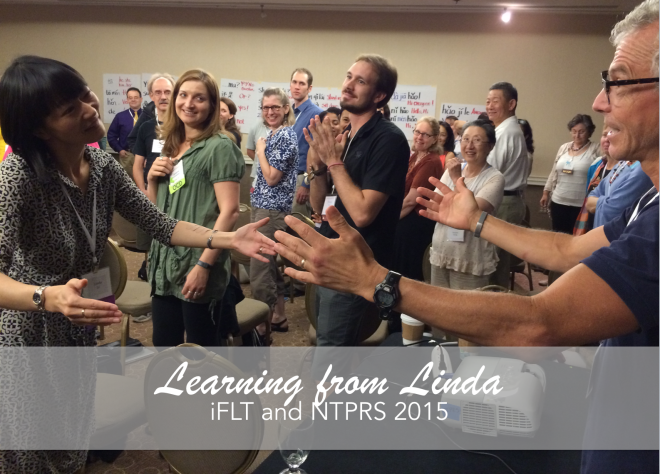
That’s a wrap! The big summer CI conferences are done. It was a busy two weeks for me and for many other presenters and attendees that were present at both conferences. I am exhausted, overwhelmed with new ideas, and nostalgic thinking back on all of the new friends that I made that I won’t see for another year.

I have a few posts planned for some ‘big’ ideas from the conferences, but for now I’ll focus on the basics: how to help your students succeed when you are providing any form of oral input (story asking, PQA, etc.)

Screen Shot 2015-08-06 at 11.40.35 AM

When I first learned TPRS/CI, I did so sitting in Russian demos by Michele Whaley. I always thought that I was really good at learning languages–you know, a really fast processor! As it turns out, Michele is just a really, really great teacher. Over the years, I have discovered that I’m not a fast…

View original post 764 more words

How to do Picturetalk

cstolztprs's avatart.p.r.s. q&a

Other thanMovietalk, Picturetalk is the single-best “add-on” to T.P.R.S., and an amazing strategy for non-c.i. teachers. It reinforces already-taught vocabulary and grammar, and is also a superb way to introduce new vocab pre-story.

Picturetalk– what Ben Slavic calls “Look and Discuss”– is simple, easy, low-prep and effective. Here arethree ways to do Picturetalk.

a) Find a picture online which contains the “things”– people and actions– in your most recent story. So, if your story is about a poor Guatemalan kid who wants something to eat, you find a picture of that, or (say) a picture of a homeless person.

b) If you have never taught the vocab you want to use, write on board (or project it) along with translation. Make sure the kids know what the words mean.

c) Project the picture, make statements, and ask questions about the picture and about the things you’ve said…

View original post 1,008 more words

2015 Intan Conference – Adelaide, SA

Yesterday (last Saturday) saw about 40 – 50 Indonesian teachers gather together at the Education Development Center in Hindmarsh for our annual conference. It was organised, as always, by our hardworking Intan committee and included many wonderful opportunities for us to belajar/mengajar (learn/teach) each other. Bersatu kita maju (United we progress)
The day began with the presentation of a goody bag upon registration. Each year the goody bag is heavier and heavier! This year’s bag contains mostly promotional information. The ones I think look interesting and have earmarked for perusal include :
The guide for the upcoming OzAsia festival,
Two magazines – Indomedia & Indobulletin
Information about the Treasure Ships exhibition at the SA Art Gallery
Outreach Education
Menu for Ketut’s Kitchen 95A O’Connell St, North Adelaide
Notepad from the Credit Union SA
Flyer about the Jembatan Project – a Flinders University initiative
A flyer for Michelle Kohler’s book, Teachers as Mediators in the Foreign Language Classroom (will check my class budget)
Adelindo Flyer – Great to learn there is a local business that repairs angklung! (link)
Flinders University 2016 Postgraduate programs list (definitely on my bucket list)
Language Perfect poster – world championship in 2016!! Offering $25,000 prize money – well worth investigating!!
Amansar journeys of discovery and learning flyer – hopefully soon our short sighted state government will realize the extent to which they are short changing language programs by refusing to sanction school trips to Indonesia. In the meantime, I look at this flyer and imagine a future where I can travel with my students to Indonesia….
Indo Ink order form
Asia Bookroom booklet – particularly interested in the ‘Our Jakarta’ series. Are they anywhere near the quality of the amazing books printed and published through Dyatmika School???
Lote Teaching Aids – catalogue, pen, keychain, bookmarks and sticker selection.
Not bad hey? Bagus kan?
After Brent informed us about the location of the amenities and the evacuation procedures, he welcomed Uncle Frank Wanganeen to welcome us to country.IMG_1975 Uncle Frank spoke briefly about his contact with his language – the Gana Language and his country – Narrunga. He told us that he had grown up in Adelaide during a time when there were unpleasant consequences for those heard speaking in the Gana language. Consequently it wasn’t till he was an adult that he could learn Gana. In the 1980’s there was a conscious movement to revive Aboriginal languages and today there are many resources available specifically aimed at teaching and learning Aboriginal languages, including YouTube videos!! Uncle Frank then acknowledged his ancestors and welcomed us to the land upon which the conference is being held both in the Gana language and in English! A beautiful start to our conference. I always find the welcome to country moving.
After Barbara Hatley was invited to officially start the conference,IMG_1978 Brent outlined all the reasons why the Intan conference is highly valued amongst Indonesian teachers. These reasons include the ability to collaborate, network, for professional development and to discover useful resources. Brent next officially launched the Intan website and outlined a Treasure Hunt competition cleverly designed to motivate us to investigate the website.
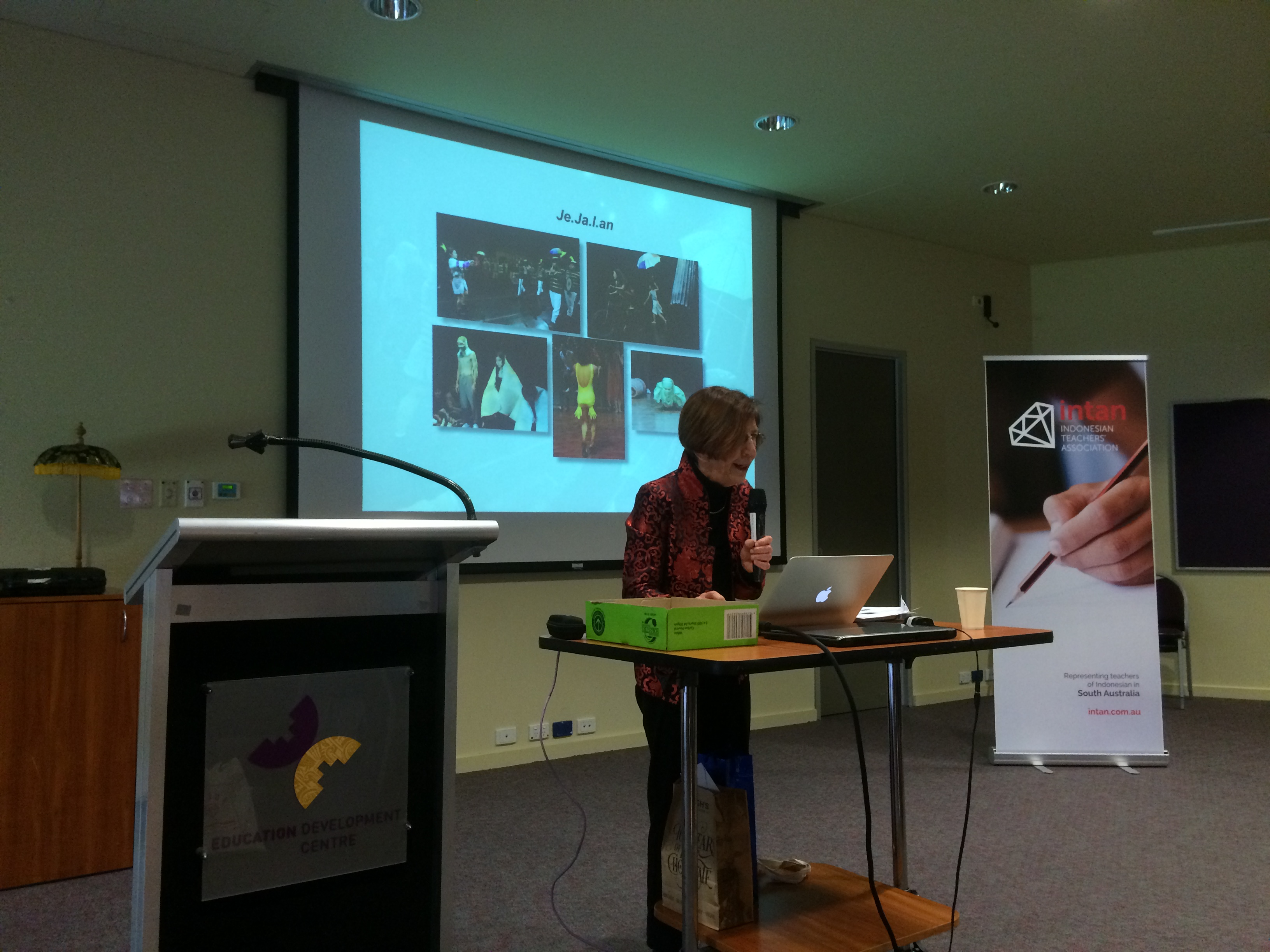
He then again introduced Barbara Hatley from the University of Tasmania IMG_1983who spoke about the role of theater and drama in Indonesian society both historically and in the present day. It was a fascinating presentation including photos and video snippets of a group called Teater Garasi who will be performing in the OzAsia Festival.
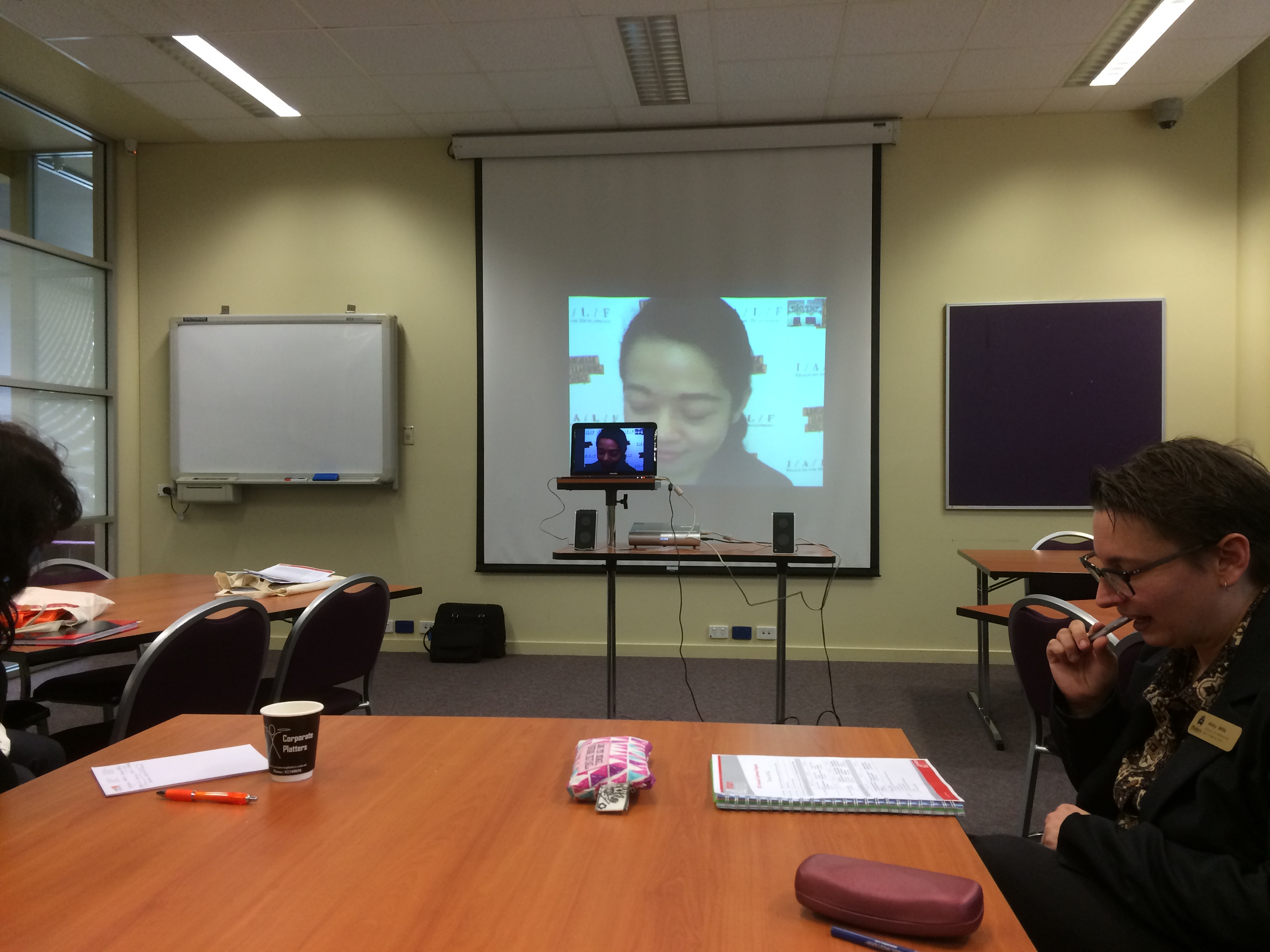
The next sessions were the ‘back by popular demand’ proficiency workshops. This year, the committee was very innovative, as the 3 workshops were provided by the AILF in Bali via Skype! IMG_1990The 3 workshops catered for different levels of proficiency and focused on quite different topics. The novice workshop focused on traditional games, the intermediate workshop topic was the mudik tradition, (the returning home to family after Ramadan), and the advanced workshop focused on modern day slang. As it was hard to choose, Annie, Sharon and I each went to one and on the trip home outlined all that we covered. Each workshop was led by a native Indonesian speaker and other than a few wifi connectivity issues, it was a great initiative. Ibu Putu Ayu Asri who led our session has promised to email a copy of the PowerPoint she used for our session. I am looking forward to receiving it as I only got the main slang words written down! Here are a couple of the ones I loved:
Lo = anda
Rempong = repot
PD = percaya diri
Semangat dong! = cheer up
Ciyus = serious/seriously?
Capcus = cepat, cepat
Sip = right/ok
Cekidot = check it out
KEPO = Knows Every Particular Object (knowitall)
BT = bad tempered
ilfil = ill feeling
ABG = Anak Baru Gede (teenager)
Jomblo = single
Aren’t they seriously bagus banget???
Following straight after the proficiency workshops was the first of 2 lines of available workshops. This first line included the workshop we presented on Teaching Indonesian with Comprehensible Input. This is the first time we have ever presented anywhere, so unsurprisingly we were nervous yet it made such a difference to be presenting together as a team. Our workshop ran for 45 minutes which wasn’t anywhere near long enough to do the topic justice, yet hopefully was long enough to give participants a taste of TCI. The workshop ran smoothly and to be honest, is a blur. We began with Sharon introducing each of us and then giving a bit of history about us and our hub group. We then showed 3 of Diane Neubauers videos (see here, here and here) as we believe that the impact of TCI is stronger with an unfamiliar language. We then began a TPRS lesson from term 1 which centered on Catharina’s Taylor Swift story. Annie demonstrated step 1 and introduced the target structures and modeled how to choose the gestures. Sharon told the story and then I pointed out the new page on my blog where I have been collating a list of TCI activities, some of which are perfect to do after telling the story. I then attempted to give a circling demonstration (which included a total mental blank on how to model 3-1) and then we finished up with questions while a slide show of students learning with TCI activities in our classrooms was projected up behind us. We fielded many questions including
How to extend the 4%ers (gave Diane Neubauer’s suggestion of offering jobs)
How to use TCI in high school where the curriculum is very structured and inflexible (explained that this too is an issue for TCI secondary teachers in the states who have various ways of dealing with this)
Overall the feedback we received afterwards was incredibly warm and encouraging. Following immediately after our session was lunchtime, which we gave us some extra time to chat with those who had more questions. Excitingly for me too, I got to meet 2 of my followers, one of whom has also been trialing TCI in her classroom!! Lovely to put faces and names to a few of my followers!!
We were all treated to a delicious lunch where the carnivores could choose between rendang and ayam goreng while the vegetarians enjoyed tempeh, cap cai and pecel – all served, naturally, with rice.
After this feast, we next could choose to attend a further selection of workshops. Sharon, Annie & I divided ourselves again between Brent’s workshop on assessment and evaluation and Daniel Bradbury’s Number workshop.

IMG_2002Brent’s workshop began with a focus on the aims of the Indonesian Curriculum.
The aims are:
1. Communicate….
2. Understand language & culture……
3. Understand oneself as a communicator…
I understand the first 2 aims and agree they are important aims for a language curriculum but have difficulty getting my head around the third. I need to research it in order to understand exactly what it means and then hopefully it will be clearer as to why it is listed as one of the overall aims. Personally, I feel that it should be in the health curriculum!! What do you think???
Brent then shared with us how he has identified each and all of the Achievement standards and demonstrated how they all link back to the content descriptors. He also shared with us several items developed by staff from his site. These include a very detailed rubric that his school site has put together which they use to grade student work, a suggested F- year 2 curriculum demonstrating how thematic units of work can be devised to achieve curriculum objectives.
The conference finished up with short presentations from various groups.
Pak Budi talked about the Jembatan project which aims to build bridges between Indonesia and Australia. IMG_2015He mentioned that in 2016, 2 internships will be available. Must keep that in mind!!
Chris from Indofest very kindly interrupted his tennis game to speak to us. Indofest, an annual Indonesian festival, has been running since 2008. It is usually held earlier in the year in Rymill Park however this year it will be held on October 5th in the Migration Museum, Art Gallery, State Library, SA Museum precinct and most importantly, there will be free parking in Adelaide all day long.
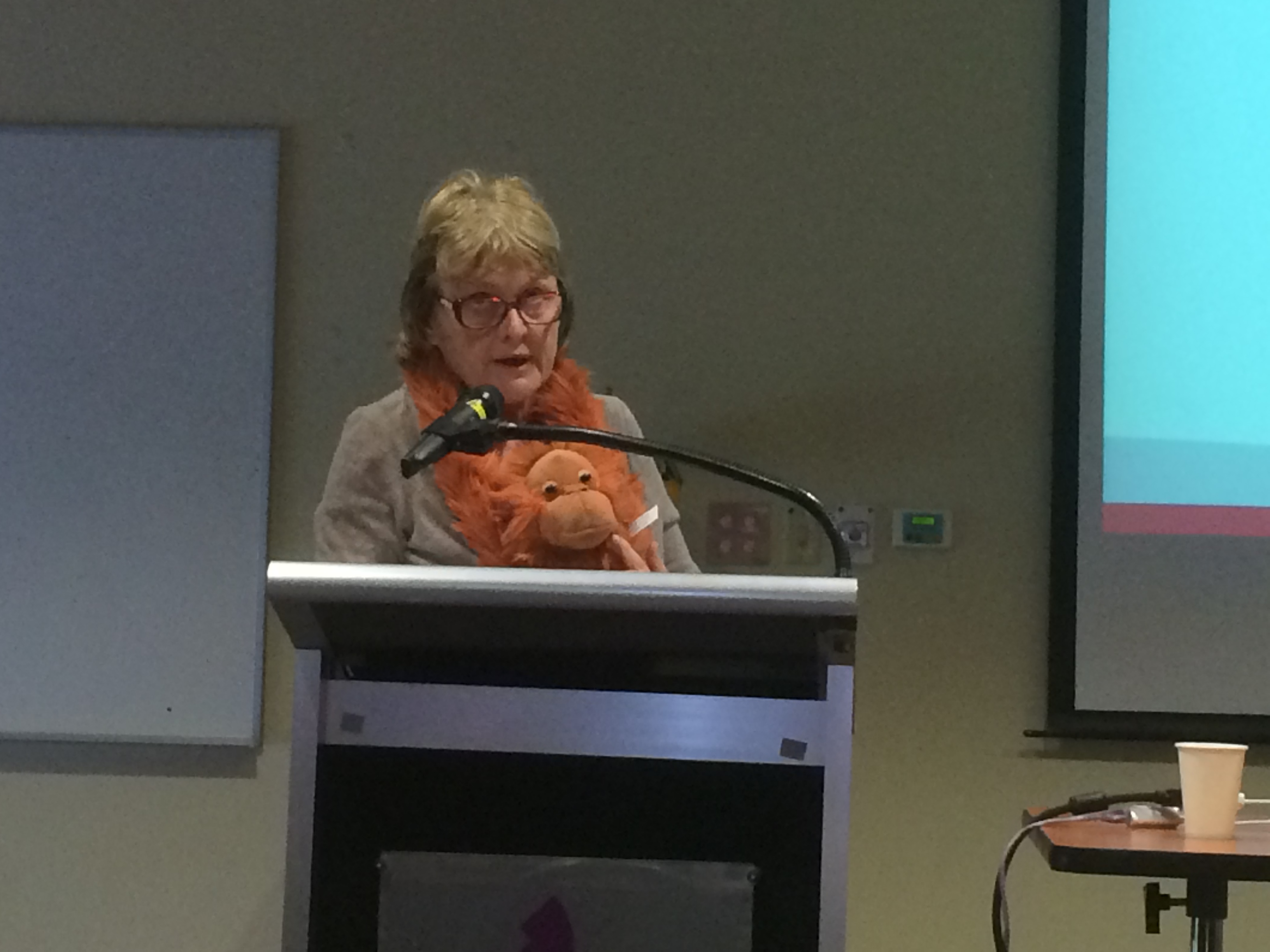
Helen Munro from The Orangutan Project (TOP) spoke. She is the current education officer and is available to visit schools. IMG_2018A variety of programs are available and can be designed to complement a variety of topics and age groups.
Jodie Edwards reminded us about the OzAsia festival which will be held the day before Indofest. This year it includes several exciting Indonesian performances.
Rosslyn Oldfield encouraged us all to get together with our hub groups. Hub Groups are support groups for teachers and are an informal gathering for teachers to support each other and learn from each other! Just like a teachmeet. There is definitely interest for a hub group meeting on the Fleurieu, so we asked people to nominate the best week day and have tentatively organised our next meeting to be in week 5, term 4.
The conference finished up with the drawing of the raffle which is always lots of fun as there were over 25 prizes!! First prize was generously donated by Amansar Travel and Diane was extremely thrilled to win a prize which included various day trips in and around Malaysia.
A huge thank you to the brilliant Intan committee and hats off to acknowledge that yet again, the conference was highly successful. So: yes Brent; it definitely did meet our expectations!
Makasih semua

Black Box Videos

Below is a video which I highly recommend if you are interested in learning and understanding more about Krashen’s hypotheses which underpins Teaching with Comprehensibvle Input.

Videocast 3 – The Comprehensible Input Hypothesis

The above videocast is the third in a series and below are the first two in the series:

videocast 2 – Mental Representation & Skill

videocast 1- Methodological Principles for Language Teaching

Senor wooly – Spanish Teacher Extraordinaire 

How cool is Senor Wooly? He has made lots of resources for students & spanish teachers  who for a fee, can access them all. The videos are fabulous and while designed for high school students, are so humorous, they would appeal to primary students equally.

Have you heard of anyone creating resources such as these for Indonesian students and teachers?  Materials which are engaging and compelling for students and provide the perfect medium for providing comprehensible input in the Indonesian classroom. If so, please add a comment below.

Bisa = Can/ be able to do……..

We are starting off this term with a focus on the target structures ‘bisa’ & ‘tidak bisa’. We asked our mentor, Catharina, for a story and she suggested:

Lucy tidak punya mulut. Kasihan Lucy. Lucy bisa makan? Tidak. Lucy tidak bisa makan. Lucy bisa minum? Tidak. Lucy tidak bisa minum. Lucy bisa berkata? Tidak. Lucy tidak bisa berkata. John punya dua mulut. John beruntung. John bisa makan? Ya John bisa makan. John bisa makan banyak! John bisa makan dua eskrim. John bisa berkata. John bisa menyanyi. John baik hati. John kasi Lucy satu mulut. Jadi, Lucy bisa berkata. Lucy bisa makan. Lucy bisa minum. Dan Lucy bisa mencium John!

I love this story because it not only revisits punya and kasi (useful for new students), there is also plenty of scope for the actors to ham it up and entertain the rest of the class!!

I began my lessons by revisiting the expectations in the Indonesian classroom. I decided upon this mainly as I felt I didn’t have the energy after 2 weeks of being unwell (great way to spend my holidays!), yet funnily enough, I discovered it required more energy to teach a non TCI lesson!! Still it was beneficial to revisit the expectations

1. Look

2. Listen

3. Respond to questions

4. Signal when unclear or too fast

5. Respect everyone and the process

because we have several new students who have started this term.

I then began preparing for the  story by introducing ‘bisa’. I did this by going through the student questionnaires. One of the questions on the questionnaire was

image image image image

I looked for answers that I could either explain with a picture (to make it comprehensible) or the word was a cognate (similar to the English word). I then made up a notebook file for each class. On each page was a picture of the acitivity and underneath it was the Indonesian word. For example, the drum page had an image I found on google images of Animal (from The Muppets) drumming furiously and underneath it I had the Indonesian ‘bermain drum’ written. I then used this file to PQA to get repetitions of bisa. I asked the class, “Siapa bisa bermain drum?” Several hands went up and knowing that it was Jack who had written he could drum, I left him till last. Harry had his hand up, so I asked him, “Harry bisa bermain drum?” Harry answered, “ya”. I responded with, “Murid murid, Harry bisa bermain drum. Harry bisa bermain drum?” The kelas then answered a mixture of ya/tidak. I then handed Harry 2 drum sticks and a practise pad while asking him again, Harry bisa bermain drum?” Harry answered, ‘ya’ and then beat the drum pad with no skill at all!! It cracked us all up. I repeated this with all the others who claimed they could drum and then finally handed the pad over to Jack who wowed us all with a fancy rhythm using rimshots. It was soo coool. Lovely to see him shine in class as he is such a quiet student who is generally happy to leave the limelight to Harry & the others. Other entertaining abilities included menyanyi (students actually got up and sang to us), terbang (the sight of a year 7 boy insisting he could fly and then standing in front of his friend imploring him to help with the demonstration was hilarious), berdansa & gimnastiks (had quite a few students demonstrate back bends and the splits).

Step 1 of TPRS = establish meaning – which incorporates introducing the target structure and selecting a gesture for it. As bisa is such an important and often used word in Indonesian conversation, I felt it vital that the gesture we ended up with was a practical and lasting one. So I left that part of step 1 till the 6/7 lesson. Initally some of the suggested gestures were ridiculous because there was no way they would help us to remember or even think of bisa/can. After a lot of discussion they chose the opening a can gesture, which really works! Thus for that lesson, when I did PQA with them, I gestured each time I said ‘bisa’. It felt so much better doing PQA with a gesture. Gesturing helped with student acquisition because it slowed me down considerably; it was like a visual point and pause.  It felt as though students in the lessons that included the gesture had a deeper level of acquisition than those who have yet to learn the gesture. Very interesting.

How compatible are ACARA & TPRS: Part 1

For me, the most significant sentence in the ACARA document is found on page 14:

Teachers will make decisions about pedagogies that best meet the learning needs of their particular students and the context of their particular program.

In essence, this sentence acknowledge that it is sensible and practical for teachers to make the  decisions necesary for selecting the most suitable pedagogy to use in their classrooms. As long as the needs of the students are met and it matches our teaching objectives, then the choice of ‘how’ is up to us.

So obviously, the next question becomes: can TPRS provide us with a methodology that delivers the curriculum in a way that ‘student needs are met’? To begin to answer this, consider the gist of this sentence found in the same paragraph as the above quote:

……. band descriptions, content descriptions, content elaborations and the achievement standards provide an overall sense of … expectations about language teaching …. (and) provide a reference point for making judgments about students’ progress in learning.

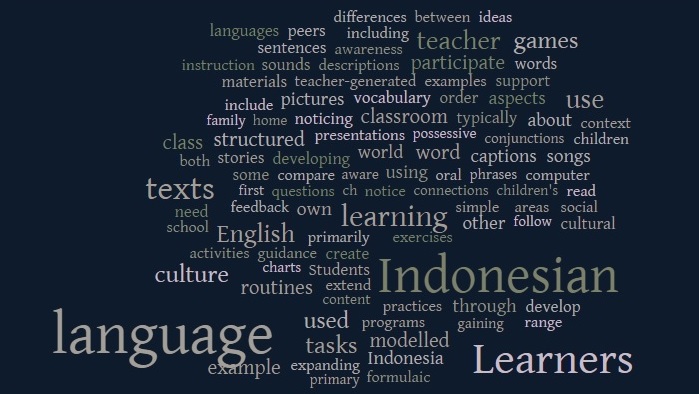
In other words, band descriptions, content descriptions, content elaboratons and achievement standards should all  be considered equally when planning, programming, teaching and assessing (even though my principal added only a copy of the achievement standards with our semester 1 reports). Thus if we create a word cloud of the entire Indonesian Curriculum, we discover the high frequency words used which would, we could argue, illustrate the key points that teachers should consider a priority  when programming.

curriuclum word cloud

From this, I would conclude that the curriculum suppports the teaching of Indonesian language via the use of texts!! Do you agree??

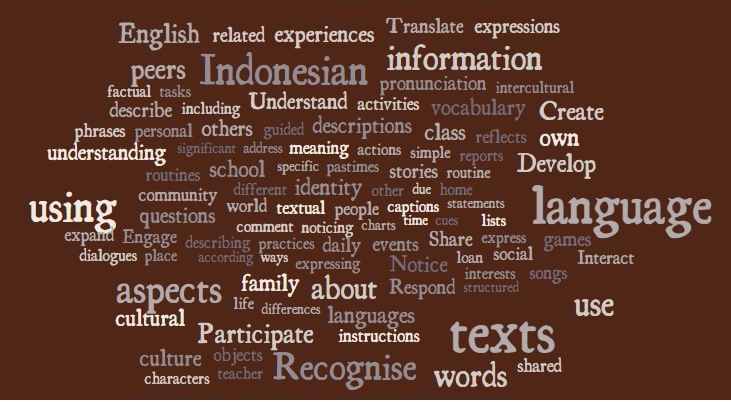
If we break it down though and look at word clouds created from the content descriptions, the band descriptions and the achievement standards, is there a difference?

Band Descriptors

woord cloud band descriptions

(most common word: language)

Content Descriptors

word cloud content descriptions

(most common word: texts)

Achievement standards

word cloud achievement standards

(most common word: Students)

If ‘texts’, ‘Students’ and ‘language’ are the key words, then I can easily argue that TPRS is a pedagogy highly compatible with the Australian Curriculum. Students are provided with language texts constantly!!

Consider the 3 basic steps of TPRS:

  1. Introduce the target structures
  2. Story telling/ story asking
  3. Reading

TPRS is all about presenting our students with compelling Indonesian texts!


Learning how To Circle

At our (Indonesian Teachers Hub Group) last meeting, Annie mentioned that she is focusing on the skill of circling at the moment. Circling is an integral skill in TCI and I suddenly realized that it had not been a focus lately in my recent lessons. I then decided that I too needed to hone my circling skills and so determined to incorporate more circling into my lesson plans.

I refreshed my understanding of it by reading various sites and as always, I started with Martina Bex’s website. There she has a link to a pdf she created about circling. Here are 2 great sentences from the pdf to clarify the definition and purpose of circling:

DEFINITION
Circling is the instructional practice of asking a series of prescribed questions in the target language about a statement in the target language.

PURPOSE
Circling is used to provide students with contextualized repetitions of target structures.

Circling has a recommended format yet it is not set in stone. It must be driven by the students so that teacher input is compelling (i.e. truly interesting) and thus relevant to the students. Here is a recent moretprs post from Dr Krashen about ‘compelling’ and ‘relevance’:
krashen pic

Circling is a powerful TCI strategy which ensures students are engaged and acquire language totally without realising!

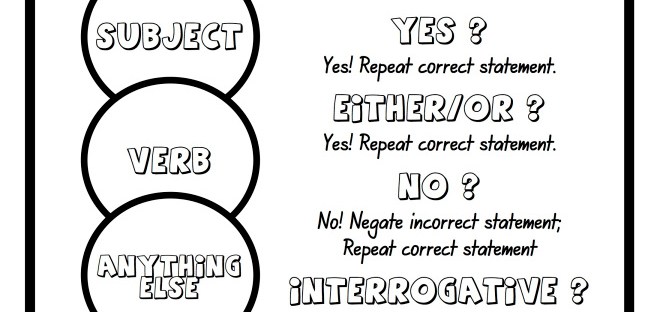
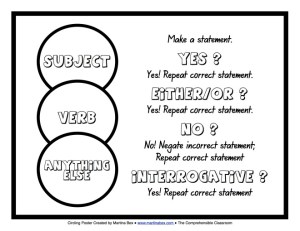
The circling format includes the following:
Statement
Question
Either/or
Negative
3 for 1
Ask a detail
[Optional are:
Who, What, When, Where, Why]
circling

courtesy Martina Bex’s Website


Using this format, I wrote circling questions into my lesson plans focusing on each of the above steps to prompt my memory and help develop my circling proficiency. I tend to find that when I am in front of a class, my mind goes blank whenever improvisation is needed!! Hopefully this is something that will reduce as I gain confidence and experience with TCI methodology.
I initially had the above poster up on the back wall but it didn’t help. For example I would see the word ‘interrogative’ and just freeze like a rabbit in the spotlight! So instead I incorporated a circling mini block into each lesson:

Circling # 1 –

Junior Primary

a) Indie perempuan. (statement)
b) Indie pakai sepatu? (ya) Ya, Indie pakai sepatu.
c) Indie pakai sepatu atau Indie pakai jaket? (either/or) Indie pakai sepatu.
d) Indie pakai topi? (ya/tidak) Bukan. Indie pakai sepatu.
e) Indie minum/makan sepatu? (3 for 1) Bukan! Indie pakai sepatu, Indie tidak minum sepatu!

Middle Primary & Upper Primary
1. Flick berkata. (statement)
2. Flick berkata? (ya) Ya, Flick berkata.
3. Flick berkata kepada Ella. (ya/tidak) Ya. Flick berkata kepada Ella.
4. Flick berkata kepada Ella atau Flick berkata kepada Thomas? (either/or) Flick berkata kepada Ella.
5. Kenapa Flick berkata kepada Ella? (extra detail) Flick berkata kepada Ella karena ? (mau ke McD, dingin,)
6. Circle new detail.
This amount of detail was so helpful. I could refer to my notes at any point to ensure I covered all aspects when/if necessary. Writing it too helped clarify in my mind so that my response should always be either the initial sentence or include the initial sentence!
I felt that at last I was getting a handle on circling! Then with brilliant timing, several TCI teachers wrote blogs posts specifically about circling. Keith Toda posted on his blog, Todally Comprehensible Latin, Circling – The Art of Questioning and Chris Stoltz posted on TPRS Q & A his post  ‘What is Circling and How Do I Do it?’ Both are great and I highly recommend you read them to grasp the finer details of circling.
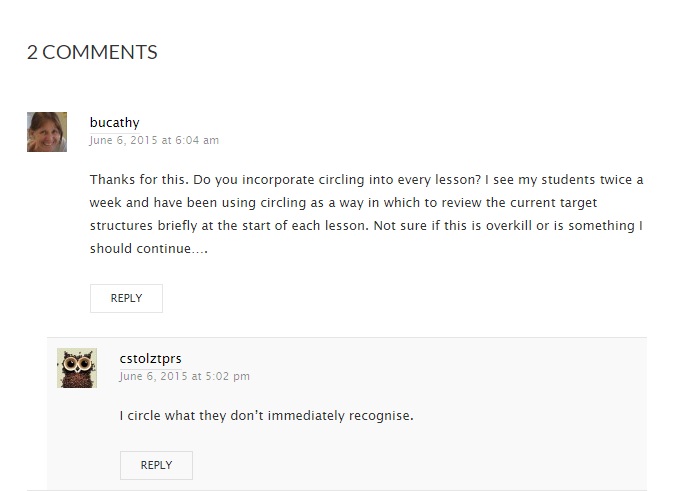
After reading Chris Stoltz’s post I asked him a question and he replied:
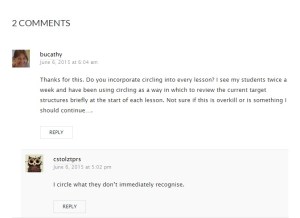
tprs q a

When I first read his reply, I was taken aback by its brevity and once I had recovered,  I started to think about his point. If I was to circle only what students didn’t understand, then I was going about “circling” the wrong way.
The next thing that happened was again by coincidence. I had emailed Ben Slavic about micro stories suitable for primary (elementary) students. He replied with an attachment of his draft chapter called Super Mini Stories. In this chapter, Ben focuses in great detail on the skills needed to tell a story. Reading this with my trusty highlighter was illuminating. Chris’ statement ‘Circle what the students don’t understand” suddenly gelled.
Circling has to be done in context and more importantly, stories must have input from students. This is what makes TCI compelling.

Last week I trialed it and discovered the truth of the above statement. This is how I did it:

With the classes 3-7, I arranged the chairs into a circle and in the middle of the circle I put a pile of clothes for this story: (underlined words signify where I asked for student input.)

Bobby dingin. Bobby berkata kepada Ibu,”Saya dingin.”
Ibu kasih Bobby satu jaket.
Bobby pakai jaket di kaki.

Bobby masih dingin. Bobby berkata kepada Bapak, “Saya dingin.”
Bapak kasih Bobby satu baju.
Bobby pakai baju di kepala.

Bobby masih dingin. Bobby berkata kepada Kakek, “Saya dingin.”
Kakek kasih Bobby dua sepatu.
Bobby pakai sepatu di tangan.
Bobby tidak dingin lagi.

Prior to last week, I’d told the story with actors and the other students just watched and listened. However, this week, I used circling to ask for student input and it was highly compelling. Here is why:
I began with:
Siapa mau menjadi assistan Bu Cathy? (Who wants to be Bu Cathy’s assistant?)
I looked around the circle and chose someone who would be a good actor, someone who could be a ham if necessary and not get embarrassed. I then asked them to ‘berdiri’ (stand.)
Next I asked the class, “Caden perempuan atau Caden laki laki?” The class invariably answered “Caden perempuan.” To which I checked in with my actor, “Caden laki laki atau Liam perempuan?” If he answered, “Caden perempuan”, I would then confirm, “Caden perempuan!” Next I asked students, “Siapa nama Caden? ‘Caden’ nama laki laki!” Sometime, classes came up with a hilarious female version of the name (Luke became Lukette, Kody became Kodella) and sometimes they would come up with a name that has been bandied around lately. For some reason Jeff and Bob are hilarious names!! Go figure!
I then began the story:
Ada perempuan. Nama perempuan Delilah.(students decided that Caden would become his twin sister!)  Delilah dingin. Delilah berkata kepada???? Delilah berkata kepada siapa? (laser pointer to ‘siapa’ poster up above the whiteboard) If students suggested the name of a fellow student, I would answer, “Bukan nama murid di kelas ini.” Because I wanted them to come up with some quirky suggestions. I would settle on the suggestion that got the most catcalls!! Justin Bieber and Tony Abbott were up there!! I next asked, “Siapa mau….. Justin Bieber?” That actor was also asked to ‘berdiri’.
I would then recommence my story from the start to throw in some sneaky repetitions.
Ada perempuan. Nama perempuan Delilah. Delilah dingin. Delilah berkata kepada… Delilah berkata kepada Justin Bieber, “Saya dingin.” Justin Bieber kasi Delilah???? At this point I rummaged through the pile of clothes on the floor and repeated the sentence several times adding the word for the article of clothing I held up, looking at ‘Justin Bieber’ to gauge both his/her reaction and the class’. “Justin Bieber kasi Delilah jaket? Justin Bieber kasi Delilah sarong? Justin Bieber kasi Delilah topi? Justin Bieber kasi Delilah jilbab?” OOnce the class agreed on the item of clothing (majority rules), I then handed the item of clothing to “Justin Bieber” and then turned to the class and asked, “Justin Bieber kasi Delilah satu jilbab atau Justin Bieber kasi Delilah dua jilbab?” Depending on their collective answer (if too noisy, I asked ‘Angkat tangan kalau Justin Bieber kasi Delilah dua jilbab”, repeated sentence again or satu jilbab, while counting in Indonesian the number of hands) then we continued the story:
Justin Bieber kasi Delilah satu jilbab.
I then stopped the acting, asked Justin Bieber to ‘duduk’ then turned around to face the class again and asked, “Delilah pakai jilbab di kaki (pointing to my foot)? Delilah pakai jilbab di tangan (pointing to my hand)? Delilah pakai jilbab di leher (pointing to my neck)?” etc until I got a popular consensus. I then repeated the sentence and the actor acted out the story. In this case it was:
Delilah pakai jilbab di kepala. Delilah masih dingin.
We continued till the end of the story this way. It was hilarious and totally compelling!! I love that TCI provides me with ways in which I can laugh with my students while teaching!!
During the day on Monday, I wrote a few notes in my notebook that I keep handy to record my reflections and this is what I wrote:
1. Circle what they don’t know!!
2. Don’t forget to ask quantity of clothing! E.g. dua sepatu!!
3. Go SLOW!! Don’t rush!! Slow and steady is how students comprehend and acquire the target structures. Make the most of each repeititon.
4. Try to make circling sound like natural speech using familiar vocabulary while incorporating all the facets of circling. E.g. negative, either/or, 3 for 1, asking for extra detail. 

My Deskless Classroom…

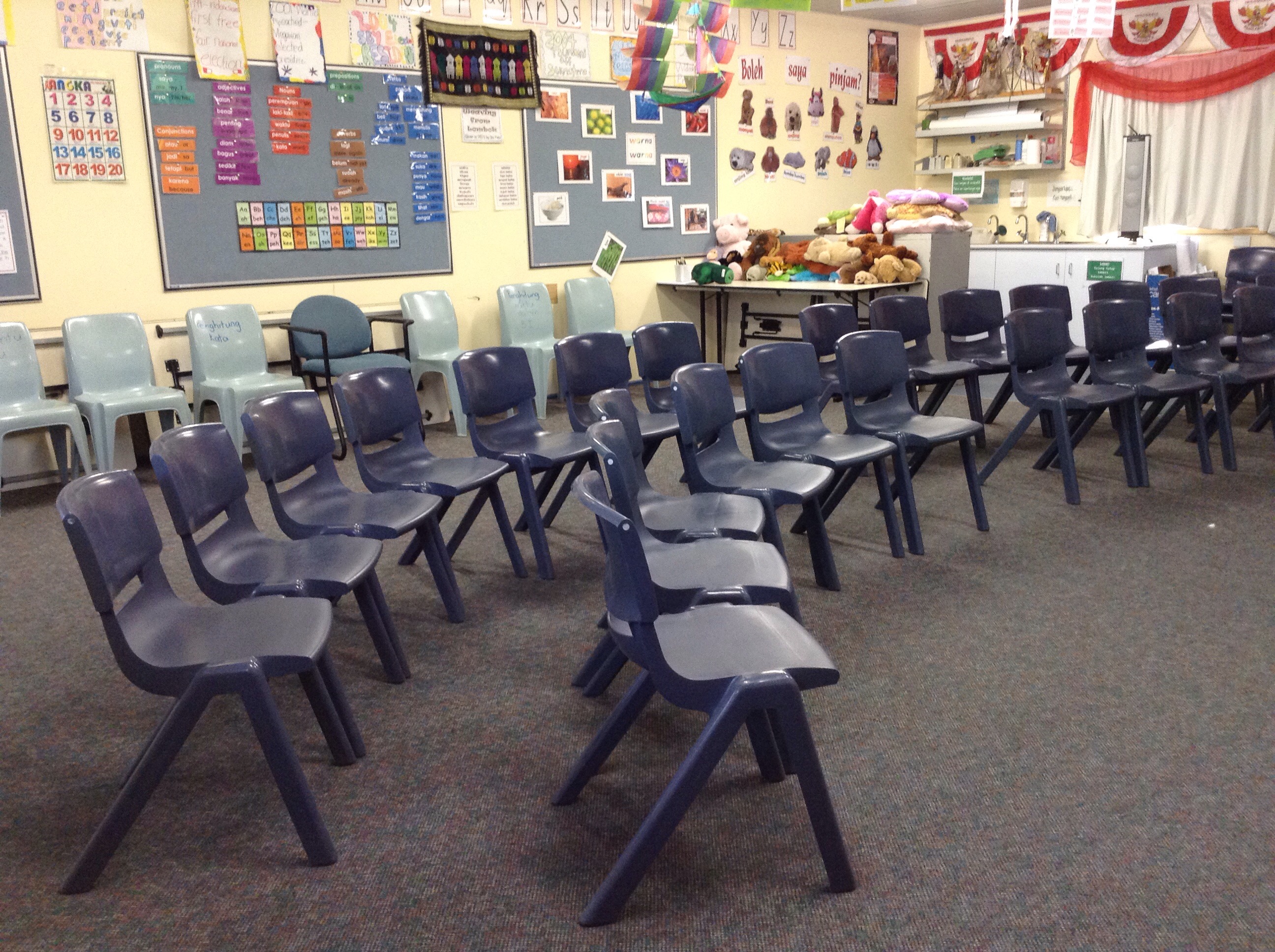
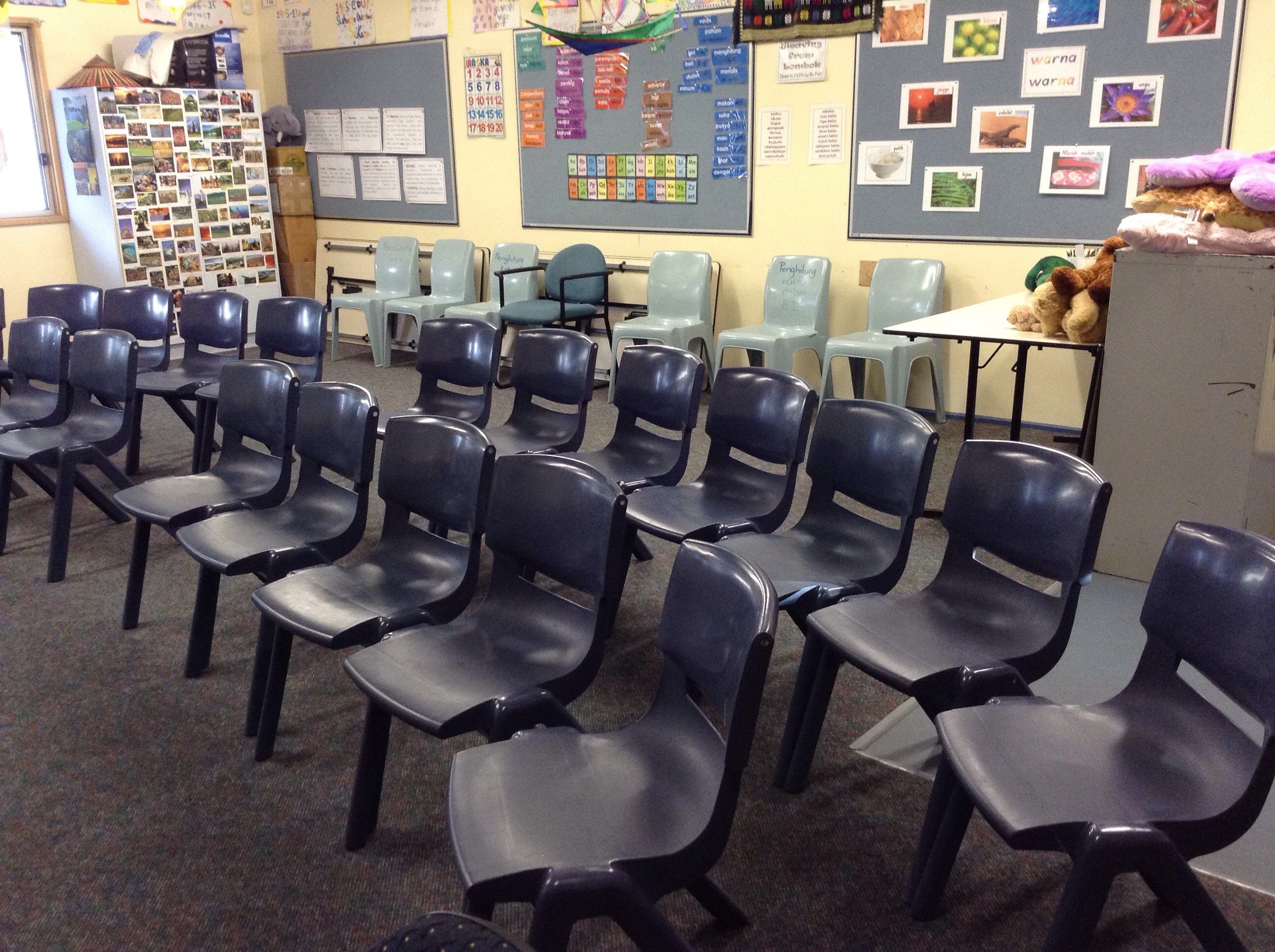
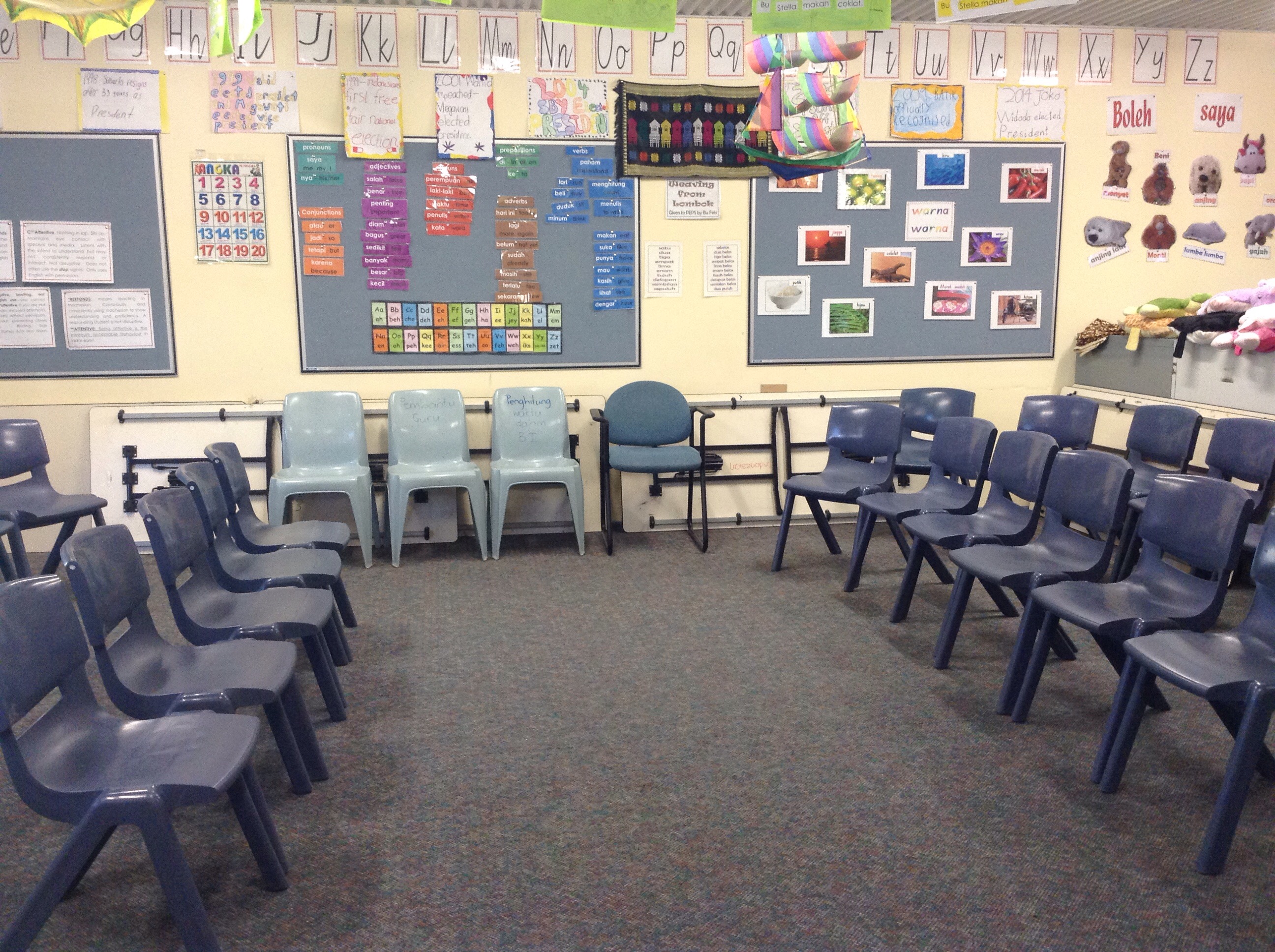
I am very lucky because when we moved to our new site in 2007 each teacher was given the opportunity to choose the furniture they would like to have in their new classroom. I chose trestle tables (which came with a bonus trolley) and stools. I have always loved the flexibility of trestle tables as they fold flat when not being used and are so portable either in the classroom or when transported around the school. 6 students can sit at them comfortably and when pushed up with one end against the wall, it creates an illusion of an open & spacious room.  I chose stools rather than chairs because they are more practical for the range of student sizes and ages (5 to 13 years) I teach each day. My very first classroom at the old site contained a mish mash of tables and chairs of all heights and varieties which in itself spoke volumes about the value of the Indonesian Language program! I was very relieved to be able to leave that cruddy furniture behind! Yet, the very first thing I did when I initially made the decision to attempt TPRS methodology, was to fold up my tables and stack them at the back of the room!! For that lesson I put the stools in a circle which in retrospect was valuable because as soon as students walked into my room, they knew something critical had shifted and it wasn’t just the tables and stools! Students loved too, the privilege of sitting on stools while listening to me; previously they’d sat on the floor and then moved to the tables to complete set tasks. However I soon found that the stools did not work. For all students, the stools weren’t particularly stable, so after a while, I stacked them too at the back of the room and expected students to sit on the floor once again, except for students doing jobs; they could sit on chairs at the back of the room in kelas satu (first class). My room stayed like this for a whole term and then during the last holiday  break, I read about the value of brainbreaks to help students cope with sitting still for large blocks of time. I remembered too sitting in conferences for hours on end and being uncomfortable and imagined that sitting on the floor would be even more uncomfortable. I then also began to realise that it was difficult to dictate student seating when they are sitting freely on the floor. So during that holiday break, I carted all my stools up to the shed and swapped them for upper primary chairs. I firstly set out the chairs in 2 rows in a semi circle facing the white board (kelas dua) and a narrow aisle running up the middle, with kelas satu still along the back wall. The area in front of kelas dua has become ekonomi! I chose the word ekonomi because it is a cognate. Later I want  to investigate the frequency of the word ‘lantai’ (floor) to determine the usefulness of it in the classroom.   Then last weekend I watched a Ben Slavic youtube video and loved the way that the classroom was set up. So I gave it a go last week! While I think the above works well when students need to focus on the white board or smart board, the setup below would be great for story asking.   I asked the students at the end of their lesson for their opinions on the new seating arrangement and overall it got a big thumbs up. I think they too, like me, enjoy a change now and then! Students also commented that if my room is going to be set up like an airplane, then kelas satu should be at the front of the room. I really like that suggestion and will incorporate it when I next use the first chair formation. It makes sense that kelas satu have the prime position!! It will also make it considerably easier for the students to do their jobs.

If you are interested in reading more about this, then I highly recommend Grant Boulanger’s post on his deskless classroom experience.

Why are Frequency Lists Important For Language Teachers?

A frequency list identifies words that occur most frequently in that particular language in everyday conversations. For most languages, frequency lists are easy to find, yet for Indonesian the first one I found was this one and that was thanks to Penny Coutas. There are many sites that offer lists of common Indonesian words. See here, here (my favourite) and here. Look through their word lists and see if you agree that they are in fact a list of the words that you would use the most when communicating in Indonesian.

Ben Slavic says that a language teachers curriula is a list of words and for me this rings true. No matter what methodology you use to teach a language, your lesson is based around a particular group of words. As the goal of language teachers is to provide opportunities for students to develop conversational fluency, it makes sense for teachers to target the specific vocabulary necessary for this. The frequency lists are thus lists of the most frequently used words that occur naturally and regularly in everyday conversations.

From the list of 200 most common Indonesian words, we wanted to determine the Indonesian ‘Super 7” (credit Terry Waltz). To identify the core vocabulary  necessary to ensure 100% comprehensibility in all classroom conversations. Terry Waltz says of her ‘super 7’ that “if you can get novices to really, really, really own these words, they can figure out how to communicate about quite complex things with just a few words.”

So we decided we wanted to determine the Indonesian ‘top 10’. However I do agree with Penny Coutas about sudah/belum, so therefore I personally suggest that the Indonesian list becomes known as the Top 10 + sudah/belum. Knowing our Top 10 + sudah/belum, helps us determine the path necessary for students to develop and improve their proficiency.

So far, in term 1 we covered suka, pakai, punya, kasi, di and mau while this term our target structures have included revising the above as well as ada & pakai. The idea being that once students have thoroughly acquired the Top 10, we can start introducing more complex  target structures.

Elsewhere on Ben Slavic’s blog, he and other experienced TCI teachers advise that frequency lists are a very good place for novice TCI language teachers and learners to start; they are the ‘beginners curriculum’ (Alisa Shapiro). TCI teachers are in favour of a personalised curriculum – that is a curriculum based around the  interests and needs of students. Engaged students are after all far more enjoyable to teach, so it is a win – win!!

The Top 10 + sudah/belum list is always open for discussion and will be revised over and over as time goes by. No doubt, during the next opportunity to speak in Indonesian, I will hear/use a word that will make me stop and wonder whether it too should be a consideration!!