Getting Started

Starting with TCI pedagogy in the Languages classroom is extremely challenging. It can start off well with everything progressing smoothly and then suddenly it falters. It is a tough transition and it takes a bucket load of resilience to continue on the TCI track. If you are one of the many just beginning your journey, it is important to know that an up and down track is completely normal. Everyone has experienced it. PLease don’t give up – the TCI community is like a huge family and there are many places you can go for  help when you hit a rough patch. 

On the moretprs listserve, there was a thread recently called ‘Then What?’ Here are two contributions which hopefully will help you continue past your next roadblock:

New teachers are still concentrating on keeping the many ping-pong balls of TPRS or TCI in the air. Going slow, three-fers, shadow items, checking comprehension, adding a detail, managing behavior, leaving time for assessment, teaching to the eyes…They do not need to have to think about what to teach next; they are still working on how to teach next. This is why I recommend learning classic TPRS and learning it well before “branching out” to other forms of TCI, and why I recommend that new teachers use an existing TPRS textbook if one is available. It is enough to have to worry about maintaining 100% comprehensibility while also managing a roomful of students and dealing with teaching in today’s public schools. Just my opinion, though. 

Terry Waltz

For me, the biggest hurdle to overcome was how to sustain it and how to connect everything that we learned in the series of class stories, and I have often heard the same sentiment echoed by other newbies. Helping teachers to find and work with high frequency word lists is a good starting point; so is connecting them with existing curriculum for those languages for which it exists. A lot of us started out doing random stories and then invested in a curriculum to help guide us before eventually abandoning it as we found our own style and became comfortable working with our own students to create content. As Terry said, just learning and practicing the basic skills is enough to fill a teacher’s plate; so trying to figure out what to do and when and for how long can be REALLY overwhelming and can distract from the road to mastery of those skills. Eventually they too might toss aside the curriculum, and that’s great. It’s important to tell them that they aren’t going to become Master TPRS teachers overnight. I’ve often heard the time period ‘3 years’ tossed around as the amount of time it takes for you to really feel like you’ve got your feet under you (if not longer!). Don’t be too hard on yourself! And expect to feel frustrated and like a failure at times. And when you do, reach out to your PLN to get back on your feet 🙂

Martina E. Bex

World Languages Curriculum Consultant

The Comprehensible Classroom

As Martina stated, your PLN (in my case, my hub group), should be the first place to turn to. For me, my  hub group have been wonderful. When I hit road blocks, Annie & Sharon gave me ideas and encouragement which enabled me to see where to go next. If you don’t have a TCI PLN/Hub Group, then I recommend joining an online PLN. The moretprs listserve is a great place to start but beware, you will be inundated with emails. The trick is to be very selective and delete anything that is not relevant. I  have picked up many ideas through this listserve, even if it seems I am the only Indonesian teacher out of the 7000 members! Most times, if you have a question/comment, long time members are very happy to  help you get started. Another point to be aware of is that almost all members are based in the States, so their needs are 6 months ahead or behind us here in Australia. At the moment they are all focused on starting a new school year and all that entails. 

Another excellent online option, particularly for high school teachers, is Ben Slavic’s website for a small monthly fee. Again based in the States (& now India) and thus can be very quiet over their summer holidays or when their school  year is about to start or finish.

If these options don’t appeal to you, feel free to contact me here on my blog. I am more than happy to help you with aspects of TCI if I can, and if beyond me, I will seek guidance from other experienced TCI practicioners on your behalf.

The most important thing to remember on your TCI journey is that it will be very challenging and it is not a methodolgy that comes easily to us all. Yet, it is such a powerful way to teach languages that it is well worth the rocky, bumpy road. 

Almost Midterm Reflections

The end of week four has just arrived, thankfully, as I am so exhausted. Our community has a variety of nasty viruses in circulation at the moment which has had in some classes, a devastating affect. I just hope the sore throat I feel coming on is just the result of my previous class which consists of several challenging students!

This term, I approached my story slightly differently to how I have done so before. The main target structure for the current story is bisa (can/ to be able to do something) but I also wanted menyanyi (sing) & mencium (kiss/smell) to be taught explicitly too because both are great TPR words. I love the way Eric Herman uses TPR,to introduce target structures and know that I will be able to get good mileage from both words during brain breaks.

I firstly focused on bisa. This took about 2-3 lessons. I began by focusing on the skills and abilities that students identified having and then had a fun lesson asking students, “Siapa bisa handstand?” If students raised their hand, I then asked them, “Billy bisa handstand?” and if they didn’t raise their hand I would go right up to the student, look them in the eye and then ask suspiciously, “Jill bisa handstand?” I then circled their answers briefly before inviting the student to the center of the chairs which were arranged in a U for this lesson. The student then did the handstand and I was able to get many repetitions of bisa. Billy bisa handstand? Billy atau Bobby bisa handstand etc! One class asked me, “Bu Cathy bisa handstand?” To which I answered,”Tidak bisa.” yet they insisted I show them, so we all had a good laugh because I could barely got my feet off the ground. More repetitions of tidak bisa!!  Such a fun and relaxed lesson.

  
My lesson on mencium was a culture break – because it was largely in English. We talked about the differences between mencium and kiss/smell and also why in Indonesian, mencium means to kiss and to smell. This collaborative blog has a post which clearly explains the various ways in which Indonesians greet each other. I had students pair up and practise hand shaking (gentle and finishing on your heart), mencium (cheek to cheek while doing a gentle smell/sniff) and also kasih hormat kepada guru (holding the teachers hand to the students forehead). We also demonstrated all 3 greetings at a whole school assembly with a group of young students finishing up the demonstration by showing respect to our principal. It was a hoot.

I  next did Martina Bex’s wordle activity as outlined in my previous post. The link to this and other activities is on the new TCI activity page, found in the top band of the homepage. All these activities meant the lead in to the story took much longer than it did in terms one and two. Because bisa is such an important word in Indonesia and comes up constantly in a variety of contexts, I really believe it was vital to devote several lessons focusing on it. Also now that I am into my second semester of TCI, I feel a lot less pressure to cover topics/target structures quickly which has been a wonderful revelation. It is so empowering to be able to focus on student acquisition as apposed to keeping up with a rigid term overview. 

Word Race Stories

I had thought I would ask the story early in the term just like I have done in the past and just have the unfamiliar vocabulary written in a list on the board so that when it came up, I could ‘point and pause’ it. At our last hub meeting, Sharon suggested introducing the word ‘bisa’ during the first lesson as a lead up to telling/asking the story in the next. However, with the late introduction of the gesture in week 1, I decided to spend the next lesson on ‘bisa’ as well to introduce and consolidate the target structure and gesture.

My second lesson then became the pre-story lesson with a mini focus on the vocabulary that would be used in the story. I scrolled through the marvellous Martina Bex’s blog, The Comprehensible Classroom, and found her suggested activity called Word Race Stories.

I created a word cloud with the vocabulary from the story:

word cloud bisa story

This activity starts with me calling out a word in English and they had to find its Indonesian equivalent. The competition between the students in their pairs was fierce yet everyone engaged with this activity. Such a fun way to review vocabulary. The first time I played this, it was chaotic as I followed Martina’s suggestions exactly. Sharon’s idea for students to purely point at the word with their finger was heaps more manageable than students trying to be the first to highlight it with their pen!

With my middle primary students, we finished off the activity by each pair looking at the words in the word cloud and then writing a sentence they thought could be in our new story. Yet with my year 6/7’s today, I tried for the first time the followup suggestion that Martina suggested. In their pairs, students had to think about the words in the word cloud and then write a sentence that could start a story using only words from the word cloud. Once everyone had finished their first sentence, they had to swap pages with another pair. Each pair then read the previous sentence and wrote a second sentence below that followed on from the first and used only words found in the word cloud. We then repeated this about 6 times. Each sheet was then returned to the original authors whose job was to edit the story and write the final sentence. I then read out as many stories as I could which everyone enjoyed! This was a very interesting exercise for several reasons even though I need to state that TPRS/TCI programs are about student receiving heaps and heaps of input and activities such as these should not be the backbone of our teaching.

Here are some of the stories that were produced:

story one

John dan Lucy punya hotdog.

Lucy berkata, ‘John, saya mau hotdog.”

John kasih Lucy dua hotdog. 

Lucy tidak mau dua hotdog.

Joh makan satu hotdog.

story two

Ada laki laki.

Nama laki laki Lucy.

Nama perempuan John.

John mau mencium.

Lucy tidak mau mencium

John kurang baik.

story three

Ada laki laki dan perempuan.

Nama laki laki John dan nama perempuan Lucy.

John dan Lucy makan dua hotdog.

Lucy berkata, “Saya mau minum.”

Lucy dan John mencium.

Overall the stories were written with correct word order and demonstrated a good grasp of all vocabulary, even mencium which we haven’t talked about yet. The most interesting point from all the stories was how little ‘bisa’ was used!! In total it was used twice! I wonder if this will change once we have told the story?

Now that we have had 2 lessons focused on bisa, I would like to organise my next lesson on ‘mencium’. The meaning of this word is a great opportunity to talk about intercultural language. While non Indonesians use the word ‘mencium’ to mean to kiss, its meaning is also to smell because that is how female friends traditionally ‘kiss’. You put your cheeks together on one side and sniff gently before repeating on the other side. Have you watched Indonesians smell babies too? Australians do it too, yet we don’t truly inhale the baby scent as an Indonesian does. There is a real skill to it, I believe!!

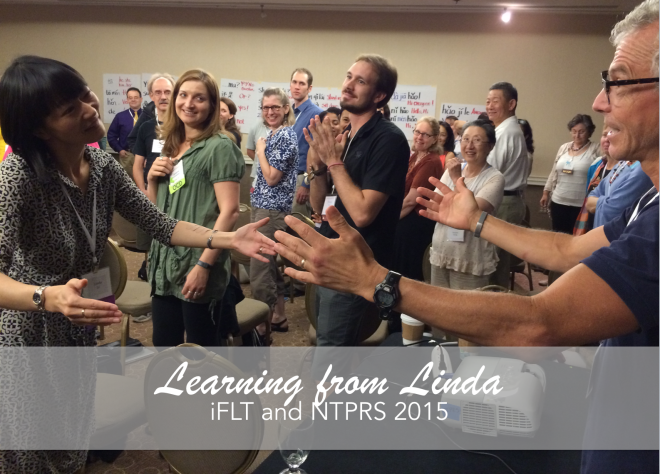
iFLT and NTPRS!

Martina Bex's avatarThe Comprehensible Classroom

That’s a wrap! The big summer CI conferences are done. It was a busy two weeks for me and for many other presenters and attendees that were present at both conferences. I am exhausted, overwhelmed with new ideas, and nostalgic thinking back on all of the new friends that I made that I won’t see for another year.

I have a few posts planned for some ‘big’ ideas from the conferences, but for now I’ll focus on the basics: how to help your students succeed when you are providing any form of oral input (story asking, PQA, etc.)

Screen Shot 2015-08-06 at 11.40.35 AM

When I first learned TPRS/CI, I did so sitting in Russian demos by Michele Whaley. I always thought that I was really good at learning languages–you know, a really fast processor! As it turns out, Michele is just a really, really great teacher. Over the years, I have discovered that I’m not a fast…

View original post 764 more words

How to do Picturetalk

cstolztprs's avatart.p.r.s. q&a

Other thanMovietalk, Picturetalk is the single-best “add-on” to T.P.R.S., and an amazing strategy for non-c.i. teachers. It reinforces already-taught vocabulary and grammar, and is also a superb way to introduce new vocab pre-story.

Picturetalk– what Ben Slavic calls “Look and Discuss”– is simple, easy, low-prep and effective. Here arethree ways to do Picturetalk.

a) Find a picture online which contains the “things”– people and actions– in your most recent story. So, if your story is about a poor Guatemalan kid who wants something to eat, you find a picture of that, or (say) a picture of a homeless person.

b) If you have never taught the vocab you want to use, write on board (or project it) along with translation. Make sure the kids know what the words mean.

c) Project the picture, make statements, and ask questions about the picture and about the things you’ve said…

View original post 1,008 more words

2015 Intan Conference – Adelaide, SA

Yesterday (last Saturday) saw about 40 – 50 Indonesian teachers gather together at the Education Development Center in Hindmarsh for our annual conference. It was organised, as always, by our hardworking Intan committee and included many wonderful opportunities for us to belajar/mengajar (learn/teach) each other. Bersatu kita maju (United we progress)
The day began with the presentation of a goody bag upon registration. Each year the goody bag is heavier and heavier! This year’s bag contains mostly promotional information. The ones I think look interesting and have earmarked for perusal include :
The guide for the upcoming OzAsia festival,
Two magazines – Indomedia & Indobulletin
Information about the Treasure Ships exhibition at the SA Art Gallery
Outreach Education
Menu for Ketut’s Kitchen 95A O’Connell St, North Adelaide
Notepad from the Credit Union SA
Flyer about the Jembatan Project – a Flinders University initiative
A flyer for Michelle Kohler’s book, Teachers as Mediators in the Foreign Language Classroom (will check my class budget)
Adelindo Flyer – Great to learn there is a local business that repairs angklung! (link)
Flinders University 2016 Postgraduate programs list (definitely on my bucket list)
Language Perfect poster – world championship in 2016!! Offering $25,000 prize money – well worth investigating!!
Amansar journeys of discovery and learning flyer – hopefully soon our short sighted state government will realize the extent to which they are short changing language programs by refusing to sanction school trips to Indonesia. In the meantime, I look at this flyer and imagine a future where I can travel with my students to Indonesia….
Indo Ink order form
Asia Bookroom booklet – particularly interested in the ‘Our Jakarta’ series. Are they anywhere near the quality of the amazing books printed and published through Dyatmika School???
Lote Teaching Aids – catalogue, pen, keychain, bookmarks and sticker selection.
Not bad hey? Bagus kan?
After Brent informed us about the location of the amenities and the evacuation procedures, he welcomed Uncle Frank Wanganeen to welcome us to country.IMG_1975 Uncle Frank spoke briefly about his contact with his language – the Gana Language and his country – Narrunga. He told us that he had grown up in Adelaide during a time when there were unpleasant consequences for those heard speaking in the Gana language. Consequently it wasn’t till he was an adult that he could learn Gana. In the 1980’s there was a conscious movement to revive Aboriginal languages and today there are many resources available specifically aimed at teaching and learning Aboriginal languages, including YouTube videos!! Uncle Frank then acknowledged his ancestors and welcomed us to the land upon which the conference is being held both in the Gana language and in English! A beautiful start to our conference. I always find the welcome to country moving.
After Barbara Hatley was invited to officially start the conference,IMG_1978 Brent outlined all the reasons why the Intan conference is highly valued amongst Indonesian teachers. These reasons include the ability to collaborate, network, for professional development and to discover useful resources. Brent next officially launched the Intan website and outlined a Treasure Hunt competition cleverly designed to motivate us to investigate the website.
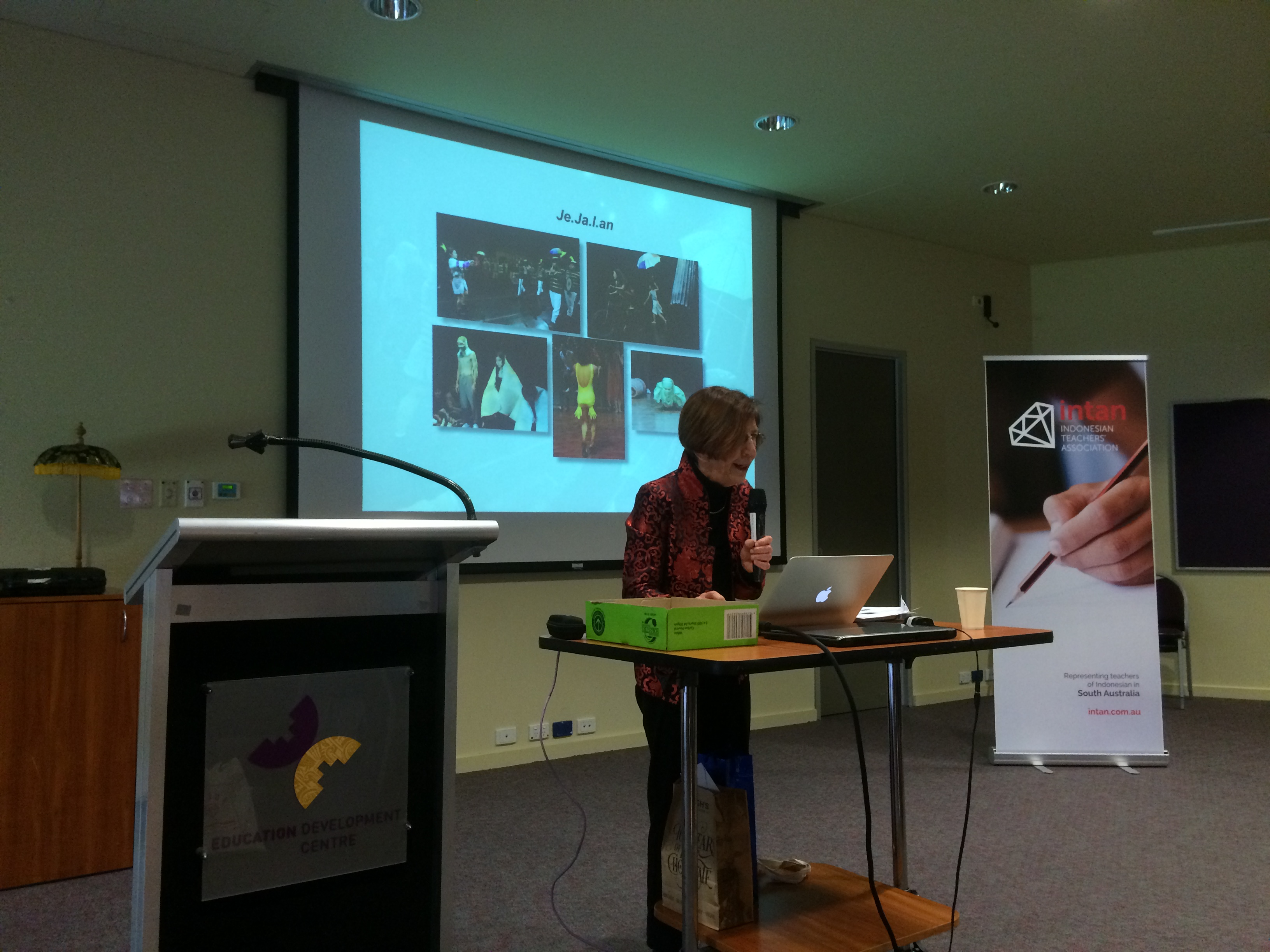
He then again introduced Barbara Hatley from the University of Tasmania IMG_1983who spoke about the role of theater and drama in Indonesian society both historically and in the present day. It was a fascinating presentation including photos and video snippets of a group called Teater Garasi who will be performing in the OzAsia Festival.
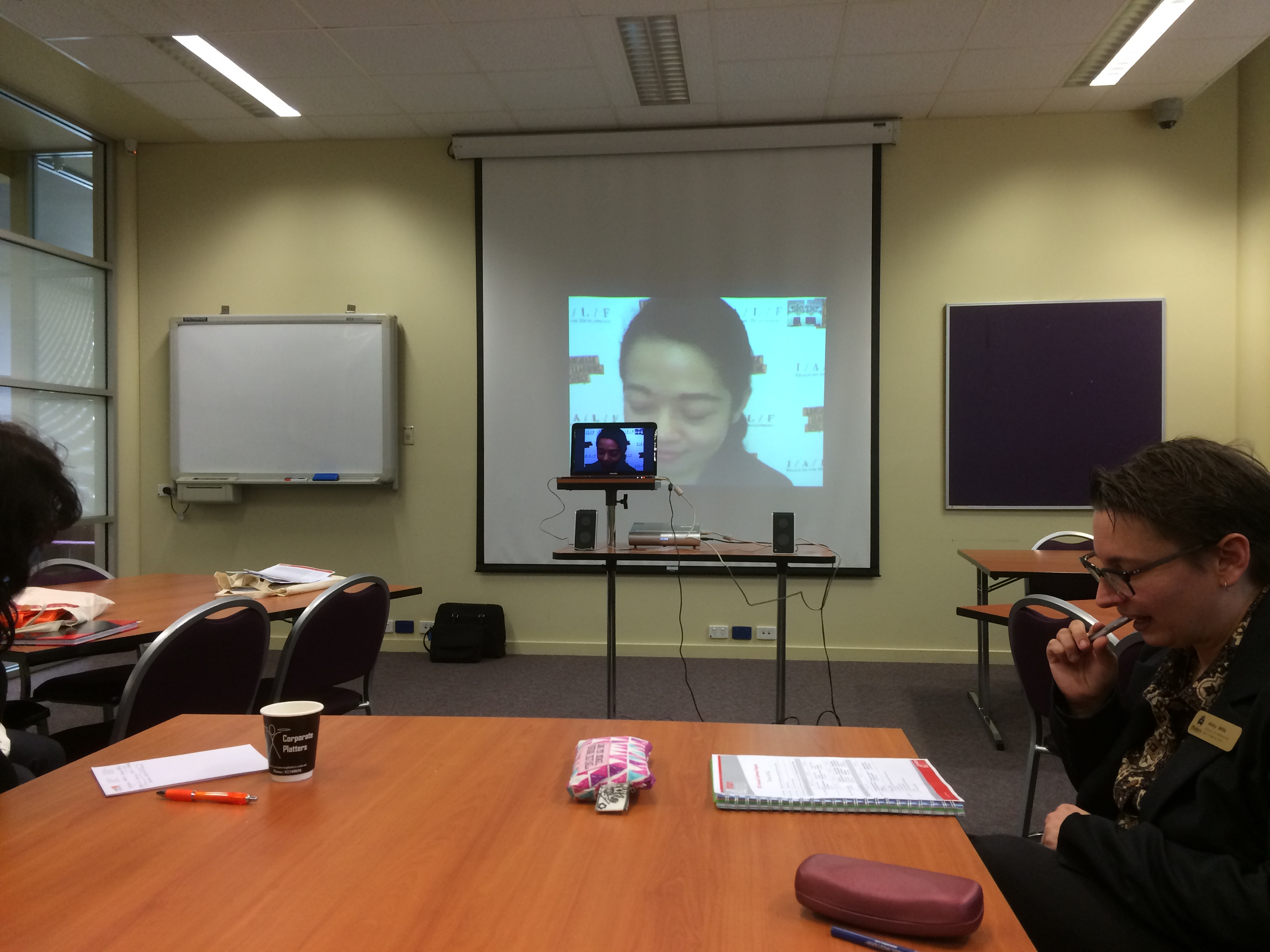
The next sessions were the ‘back by popular demand’ proficiency workshops. This year, the committee was very innovative, as the 3 workshops were provided by the AILF in Bali via Skype! IMG_1990The 3 workshops catered for different levels of proficiency and focused on quite different topics. The novice workshop focused on traditional games, the intermediate workshop topic was the mudik tradition, (the returning home to family after Ramadan), and the advanced workshop focused on modern day slang. As it was hard to choose, Annie, Sharon and I each went to one and on the trip home outlined all that we covered. Each workshop was led by a native Indonesian speaker and other than a few wifi connectivity issues, it was a great initiative. Ibu Putu Ayu Asri who led our session has promised to email a copy of the PowerPoint she used for our session. I am looking forward to receiving it as I only got the main slang words written down! Here are a couple of the ones I loved:
Lo = anda
Rempong = repot
PD = percaya diri
Semangat dong! = cheer up
Ciyus = serious/seriously?
Capcus = cepat, cepat
Sip = right/ok
Cekidot = check it out
KEPO = Knows Every Particular Object (knowitall)
BT = bad tempered
ilfil = ill feeling
ABG = Anak Baru Gede (teenager)
Jomblo = single
Aren’t they seriously bagus banget???
Following straight after the proficiency workshops was the first of 2 lines of available workshops. This first line included the workshop we presented on Teaching Indonesian with Comprehensible Input. This is the first time we have ever presented anywhere, so unsurprisingly we were nervous yet it made such a difference to be presenting together as a team. Our workshop ran for 45 minutes which wasn’t anywhere near long enough to do the topic justice, yet hopefully was long enough to give participants a taste of TCI. The workshop ran smoothly and to be honest, is a blur. We began with Sharon introducing each of us and then giving a bit of history about us and our hub group. We then showed 3 of Diane Neubauers videos (see here, here and here) as we believe that the impact of TCI is stronger with an unfamiliar language. We then began a TPRS lesson from term 1 which centered on Catharina’s Taylor Swift story. Annie demonstrated step 1 and introduced the target structures and modeled how to choose the gestures. Sharon told the story and then I pointed out the new page on my blog where I have been collating a list of TCI activities, some of which are perfect to do after telling the story. I then attempted to give a circling demonstration (which included a total mental blank on how to model 3-1) and then we finished up with questions while a slide show of students learning with TCI activities in our classrooms was projected up behind us. We fielded many questions including
How to extend the 4%ers (gave Diane Neubauer’s suggestion of offering jobs)
How to use TCI in high school where the curriculum is very structured and inflexible (explained that this too is an issue for TCI secondary teachers in the states who have various ways of dealing with this)
Overall the feedback we received afterwards was incredibly warm and encouraging. Following immediately after our session was lunchtime, which we gave us some extra time to chat with those who had more questions. Excitingly for me too, I got to meet 2 of my followers, one of whom has also been trialing TCI in her classroom!! Lovely to put faces and names to a few of my followers!!
We were all treated to a delicious lunch where the carnivores could choose between rendang and ayam goreng while the vegetarians enjoyed tempeh, cap cai and pecel – all served, naturally, with rice.
After this feast, we next could choose to attend a further selection of workshops. Sharon, Annie & I divided ourselves again between Brent’s workshop on assessment and evaluation and Daniel Bradbury’s Number workshop.

IMG_2002Brent’s workshop began with a focus on the aims of the Indonesian Curriculum.
The aims are:
1. Communicate….
2. Understand language & culture……
3. Understand oneself as a communicator…
I understand the first 2 aims and agree they are important aims for a language curriculum but have difficulty getting my head around the third. I need to research it in order to understand exactly what it means and then hopefully it will be clearer as to why it is listed as one of the overall aims. Personally, I feel that it should be in the health curriculum!! What do you think???
Brent then shared with us how he has identified each and all of the Achievement standards and demonstrated how they all link back to the content descriptors. He also shared with us several items developed by staff from his site. These include a very detailed rubric that his school site has put together which they use to grade student work, a suggested F- year 2 curriculum demonstrating how thematic units of work can be devised to achieve curriculum objectives.
The conference finished up with short presentations from various groups.
Pak Budi talked about the Jembatan project which aims to build bridges between Indonesia and Australia. IMG_2015He mentioned that in 2016, 2 internships will be available. Must keep that in mind!!
Chris from Indofest very kindly interrupted his tennis game to speak to us. Indofest, an annual Indonesian festival, has been running since 2008. It is usually held earlier in the year in Rymill Park however this year it will be held on October 5th in the Migration Museum, Art Gallery, State Library, SA Museum precinct and most importantly, there will be free parking in Adelaide all day long.
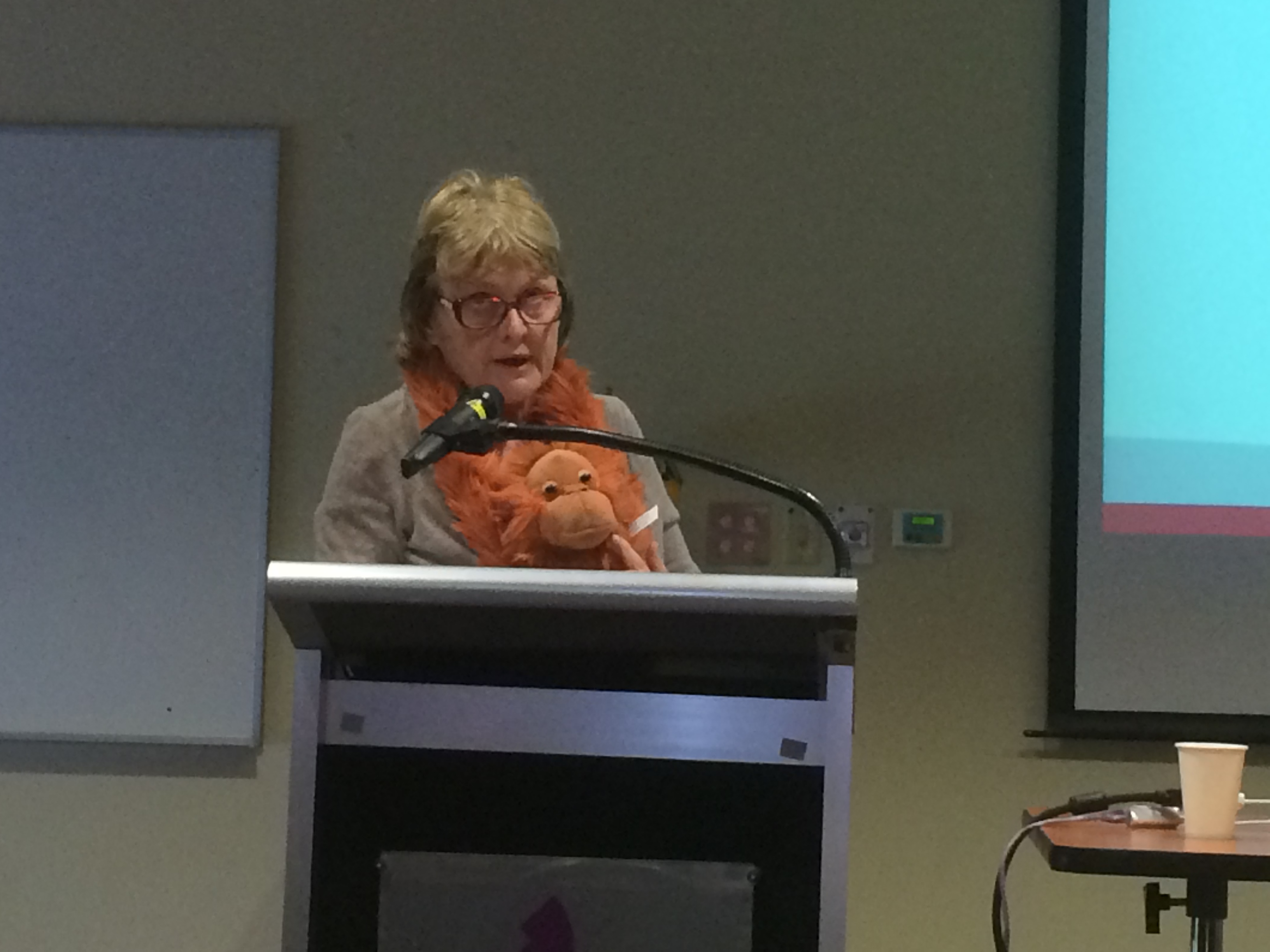
Helen Munro from The Orangutan Project (TOP) spoke. She is the current education officer and is available to visit schools. IMG_2018A variety of programs are available and can be designed to complement a variety of topics and age groups.
Jodie Edwards reminded us about the OzAsia festival which will be held the day before Indofest. This year it includes several exciting Indonesian performances.
Rosslyn Oldfield encouraged us all to get together with our hub groups. Hub Groups are support groups for teachers and are an informal gathering for teachers to support each other and learn from each other! Just like a teachmeet. There is definitely interest for a hub group meeting on the Fleurieu, so we asked people to nominate the best week day and have tentatively organised our next meeting to be in week 5, term 4.
The conference finished up with the drawing of the raffle which is always lots of fun as there were over 25 prizes!! First prize was generously donated by Amansar Travel and Diane was extremely thrilled to win a prize which included various day trips in and around Malaysia.
A huge thank you to the brilliant Intan committee and hats off to acknowledge that yet again, the conference was highly successful. So: yes Brent; it definitely did meet our expectations!
Makasih semua

Black Box Videos

Below is a video which I highly recommend if you are interested in learning and understanding more about Krashen’s hypotheses which underpins Teaching with Comprehensibvle Input.

Videocast 3 – The Comprehensible Input Hypothesis

The above videocast is the third in a series and below are the first two in the series:

videocast 2 – Mental Representation & Skill

videocast 1- Methodological Principles for Language Teaching

Senor wooly – Spanish Teacher Extraordinaire 

How cool is Senor Wooly? He has made lots of resources for students & spanish teachers  who for a fee, can access them all. The videos are fabulous and while designed for high school students, are so humorous, they would appeal to primary students equally.

Have you heard of anyone creating resources such as these for Indonesian students and teachers?  Materials which are engaging and compelling for students and provide the perfect medium for providing comprehensible input in the Indonesian classroom. If so, please add a comment below.

Bisa = Can/ be able to do……..

We are starting off this term with a focus on the target structures ‘bisa’ & ‘tidak bisa’. We asked our mentor, Catharina, for a story and she suggested:

Lucy tidak punya mulut. Kasihan Lucy. Lucy bisa makan? Tidak. Lucy tidak bisa makan. Lucy bisa minum? Tidak. Lucy tidak bisa minum. Lucy bisa berkata? Tidak. Lucy tidak bisa berkata. John punya dua mulut. John beruntung. John bisa makan? Ya John bisa makan. John bisa makan banyak! John bisa makan dua eskrim. John bisa berkata. John bisa menyanyi. John baik hati. John kasi Lucy satu mulut. Jadi, Lucy bisa berkata. Lucy bisa makan. Lucy bisa minum. Dan Lucy bisa mencium John!

I love this story because it not only revisits punya and kasi (useful for new students), there is also plenty of scope for the actors to ham it up and entertain the rest of the class!!

I began my lessons by revisiting the expectations in the Indonesian classroom. I decided upon this mainly as I felt I didn’t have the energy after 2 weeks of being unwell (great way to spend my holidays!), yet funnily enough, I discovered it required more energy to teach a non TCI lesson!! Still it was beneficial to revisit the expectations

1. Look

2. Listen

3. Respond to questions

4. Signal when unclear or too fast

5. Respect everyone and the process

because we have several new students who have started this term.

I then began preparing for the  story by introducing ‘bisa’. I did this by going through the student questionnaires. One of the questions on the questionnaire was

image image image image

I looked for answers that I could either explain with a picture (to make it comprehensible) or the word was a cognate (similar to the English word). I then made up a notebook file for each class. On each page was a picture of the acitivity and underneath it was the Indonesian word. For example, the drum page had an image I found on google images of Animal (from The Muppets) drumming furiously and underneath it I had the Indonesian ‘bermain drum’ written. I then used this file to PQA to get repetitions of bisa. I asked the class, “Siapa bisa bermain drum?” Several hands went up and knowing that it was Jack who had written he could drum, I left him till last. Harry had his hand up, so I asked him, “Harry bisa bermain drum?” Harry answered, “ya”. I responded with, “Murid murid, Harry bisa bermain drum. Harry bisa bermain drum?” The kelas then answered a mixture of ya/tidak. I then handed Harry 2 drum sticks and a practise pad while asking him again, Harry bisa bermain drum?” Harry answered, ‘ya’ and then beat the drum pad with no skill at all!! It cracked us all up. I repeated this with all the others who claimed they could drum and then finally handed the pad over to Jack who wowed us all with a fancy rhythm using rimshots. It was soo coool. Lovely to see him shine in class as he is such a quiet student who is generally happy to leave the limelight to Harry & the others. Other entertaining abilities included menyanyi (students actually got up and sang to us), terbang (the sight of a year 7 boy insisting he could fly and then standing in front of his friend imploring him to help with the demonstration was hilarious), berdansa & gimnastiks (had quite a few students demonstrate back bends and the splits).

Step 1 of TPRS = establish meaning – which incorporates introducing the target structure and selecting a gesture for it. As bisa is such an important and often used word in Indonesian conversation, I felt it vital that the gesture we ended up with was a practical and lasting one. So I left that part of step 1 till the 6/7 lesson. Initally some of the suggested gestures were ridiculous because there was no way they would help us to remember or even think of bisa/can. After a lot of discussion they chose the opening a can gesture, which really works! Thus for that lesson, when I did PQA with them, I gestured each time I said ‘bisa’. It felt so much better doing PQA with a gesture. Gesturing helped with student acquisition because it slowed me down considerably; it was like a visual point and pause.  It felt as though students in the lessons that included the gesture had a deeper level of acquisition than those who have yet to learn the gesture. Very interesting.

How compatible are ACARA & TPRS: Part 1

For me, the most significant sentence in the ACARA document is found on page 14:

Teachers will make decisions about pedagogies that best meet the learning needs of their particular students and the context of their particular program.

In essence, this sentence acknowledge that it is sensible and practical for teachers to make the  decisions necesary for selecting the most suitable pedagogy to use in their classrooms. As long as the needs of the students are met and it matches our teaching objectives, then the choice of ‘how’ is up to us.

So obviously, the next question becomes: can TPRS provide us with a methodology that delivers the curriculum in a way that ‘student needs are met’? To begin to answer this, consider the gist of this sentence found in the same paragraph as the above quote:

……. band descriptions, content descriptions, content elaborations and the achievement standards provide an overall sense of … expectations about language teaching …. (and) provide a reference point for making judgments about students’ progress in learning.

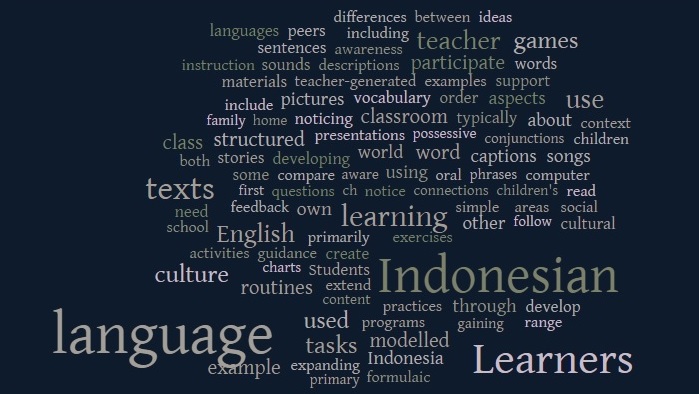
In other words, band descriptions, content descriptions, content elaboratons and achievement standards should all  be considered equally when planning, programming, teaching and assessing (even though my principal added only a copy of the achievement standards with our semester 1 reports). Thus if we create a word cloud of the entire Indonesian Curriculum, we discover the high frequency words used which would, we could argue, illustrate the key points that teachers should consider a priority  when programming.

curriuclum word cloud

From this, I would conclude that the curriculum suppports the teaching of Indonesian language via the use of texts!! Do you agree??

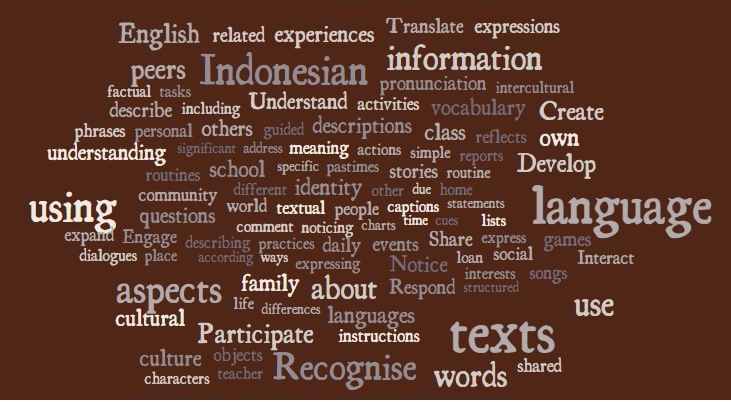
If we break it down though and look at word clouds created from the content descriptions, the band descriptions and the achievement standards, is there a difference?

Band Descriptors

woord cloud band descriptions

(most common word: language)

Content Descriptors

word cloud content descriptions

(most common word: texts)

Achievement standards

word cloud achievement standards

(most common word: Students)

If ‘texts’, ‘Students’ and ‘language’ are the key words, then I can easily argue that TPRS is a pedagogy highly compatible with the Australian Curriculum. Students are provided with language texts constantly!!

Consider the 3 basic steps of TPRS:

  1. Introduce the target structures
  2. Story telling/ story asking
  3. Reading

TPRS is all about presenting our students with compelling Indonesian texts!