Meeting Blaine Ray in Sydney

Annie and I are heading home after 2 unforgettable days in Sydney with Blaine Ray. What an amazing time and I still can’t believe how fortunate we have been.


Firstly how lucky were we to have Blaine Ray to ourselves almost for 24 hours! We did share him on Tuesday with Stef and her son Daniel, but considering that she is heading up to the conference in Brisbane this Friday, this was a bonus! We were able to pepper him with questions and then listen to his explanations while taking notes. It felt like our own personal workshop specifically tailored for our needs and level. Words simply cannot express how amazing this was and we’ll always be indebted to Blaine for his kindness and patience. 

Secondly, we were able to practise our note taking skills ready for next week’s inaugural TPRS conference on the Fleurieu Peninsular with Terry Waltz & Lizette Liebold! It has been fascinating comparing our notes and seeing the huge gaps in my notes where at times I must have become so engrossed in the conversation I forgot to write anything down! Annie has diligently cross referenced both sets of our notes and created a version that incorporates everything and then on top of that has presented it out beautifully.

(This is from Blaine’s advice that whenever you get universal agreement with a response, never accept it. Choose the opposite and surprise them! Never accept the obvious; eliminate the expected!) 

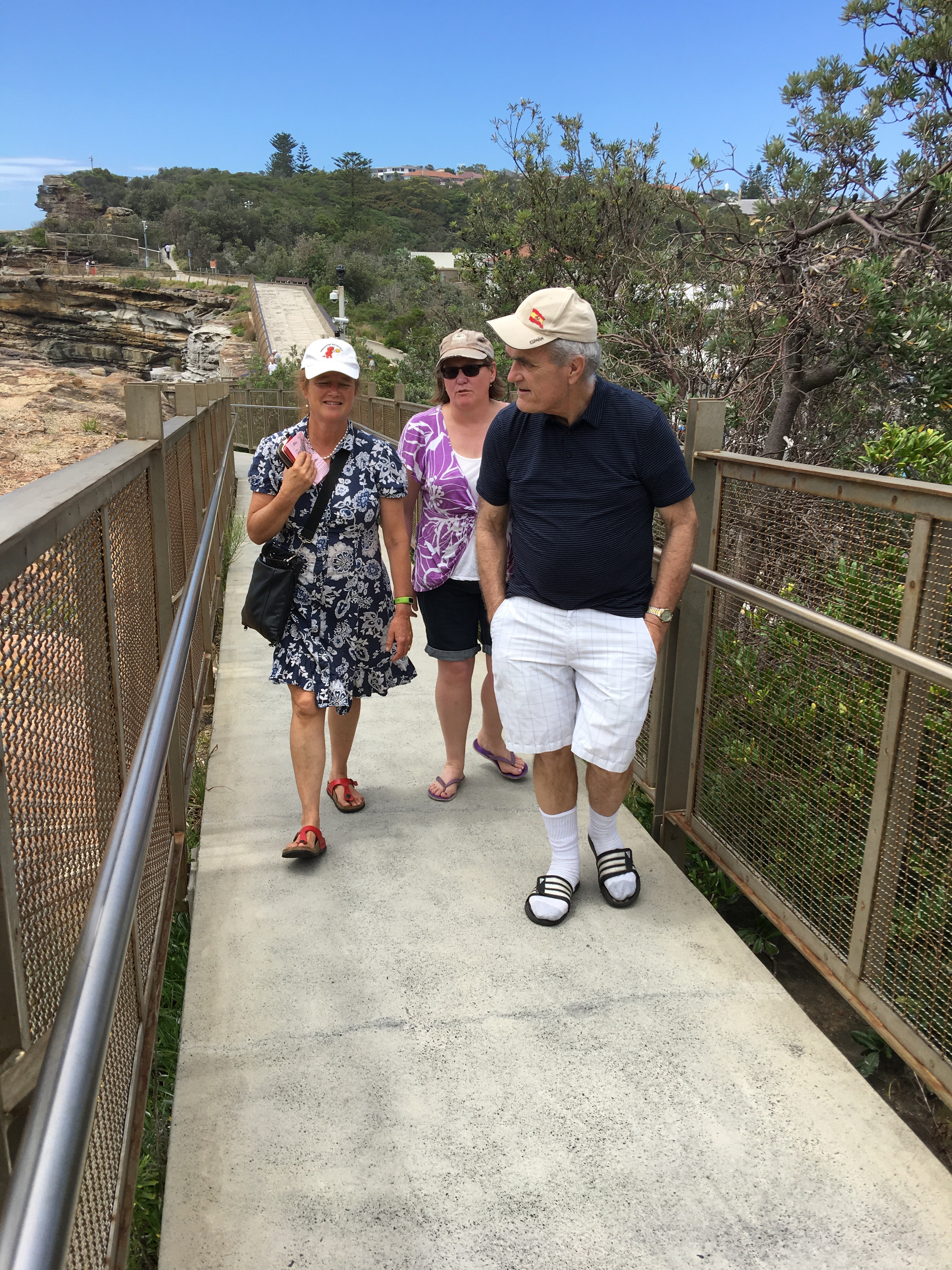
And thirdly, it was simply a lovely break spending 2 nights in Sydney and being a tourist in such a beautiful city with like minded people. We spent most of our time together either walking or eating along the scenic waterfront. Except for the initial trip to our hotel from the airport, all of the travel we (Annie & Cathy) did in Sydney was either by ferry or by train and this is definitely the best way to travel. The ferry system is efficient and relaxed. It was just lovely sitting or standing on the ferries enjoying the gorgeous scenery and the cool breezes with the added occasional bonus of sea spray. The trains too were great. So much quicker and took us directly to the domestic terminal which was in direct contrast to our long and tiring trip on arrival which took at least an hour of zig zagging throughout the CBD streets of Sydney. I’m so grateful that Annie talked me into exploring alternative travel options for our return to the airport!


What a generous and gracious person Blaine Ray is. He happily and enthusiastically shared his knowledge with us and was genuinely impressed to discover that we are 2 of 3 language teachers on the south coast who have been teaching with TPRS in since 2014. He told us afterwards that he had presumed we had only recently heard about TPRS and therefore surmised that our discussions would lack any deep TPRS connection. In fact we spent every single minute chatting about various aspects of TPRS and Blaine answered all of our questions and gave many demos to illustrate his points. He also encouraged us to share all that we learned; a huge relief because I couldn’t wait to write up this post!  I particularly appreciated his personal stories which clearly illustrate his open mindedness towards improving TPRS, unlike others who have created a successful model and then constantly ‘protect’ the model/concept fiercely. Blaine told us of several instances where he had witnessed or discussed with a practising TPRS teacher a successful idea of theirs, which he  immediately saw the value of incorporating it into TPRS procedure and then gave that teacher full credit for that update! Alina Filipescu is one such teacher and after seeing several of her youtube videos, I fully understand why Blaine Ray would be impressed by her teaching.

His explanation and demonstration of the 5 steps of teaching a sentence is a procedure I aim to focus on this upcoming term. I particularly would like to work on this to ensure that I am story asking rather than story listening. I can finally understand how we can create a class story based on the target structure. His advice of writing out a script beforehand with a few planned surprises (should the student ideas be too predictable) would help as my mind goes blank when I am in front of a class. He did reassure us though, by saying that once you get started and students get the hang of suggesting the unexpected, we will begin to build up a bank of great surprises perfect for our cohorts that can be drawn upon when needed. I liked his mantra of rejecting the expected; I can fully understand now that choosing an idea that is sooo off the planet ramps up the class stories to make it even more compelling. Blaine demonstrated this with us all at Watson’s Bay with a sentence about a chicca called Annie. He circled this sentence using his 5 steps with us as the class. Whatever we suggested, he would shake his head and reject it with a disappointed look on his face and so we would dig deeper to outdo each other to come up with even better unpredictable ideas. However he continued to reject our suggestions and would then use his own which were always better than ours. I also loved his comeback when I told him that his story didn’t make sense to me; “This is my story and if you don’t like it, go and write your own story.”

Here are the 5 steps of teaching a sentence:

  1. Annie was a girl.
  2. Annie, are you a girl?
    (If the actor doesn’t have the language to answer in the target language, she/he can either read it or mouth it while the teacher provides the voice.)
  3. Yes, I am a girl.
    (The actor must answer in complete sentences confidently as this provides input for the class and is also a clear indicator of the extent to which the whole class ‘gets it’. Any errors or hesitation are indicators that more repetition is necessary.)
  4. Yes, you are a girl.
    (teacher verifies the response)
  5. Class, Annie was a girl.
    (Teacher speaks to the whole class)


This leads on nicely to Blaine’s comments about actors. He made it very clear that choosing good actors is critical. He explained about having auditions to select the best actor which is an idea I’ve tried but not while focusing on the target structure which would be an awesome way in which to add additional input, rehearse the structure and develop student confidence. A good actor must be enthusiastic, must want to try and must have the mindset that this is a cool class. We loved his line that actors have the opportunity to be in the movie rather than to just watch it!

If however, the actor is not performing (maybe he/she is shy or reluctant to act in an exaggerated fashion), try whispering in their ear hints or even demonstrating the required action and if they are still unable to act in the engaging manner required, it may be necessary to replace them. Choosing a bad actor gives negative messages to all the students about our subject. Blaine’s statement that every teacher has a battle for the students hearts resonates for me in my school where we can have up to 5 specialist teachers on top of their class teacher and other support staff. He says the way to win their hearts is through comprehension and play!


Our meals with Blaine were spent juggling our plates & cutlery with our notebooks & pen. Meal times were perfect times to focus on specific aspects of TPRS. The first evening, Annie took notes while I hesitated to pull out my book. Afterwards back at the hotel, I quickly wrote down all that I could remember and was horrified at how much detail I couldn’t remember. From then on, as soon as Blaine began talking, I would whip out my note book and note down the salient points using some of the shorthand I haven’t used since teachers college lectures! 


Over our first al fresco breakfast in Pyrmont, Blaine discussed circling. Questions are the backbone of TPRS and are the key difference between TPRS teaching and everything else. He told us of studies which showed that TPRS teachers ask 3-4 questions a minute whereas legacy teachers rarely ask ANY questions. Questioning is critical because it gives students the opportunity to rehearse while giving the teacher the opportunity to get repetitions on just one sentence.

Here are his 7 rules of circling:

  • Never circle in the same order (too predictable)
  • Use either/or on any part of the sentence (subject, verb, object)
  • Always have a bias towards asking negative questions as they are more challenging
  • Use your question words and point and pause to give processing time
  • Add information to the sentence to create a new sentence. Either circle the longer sentence or part of the longer sentence; whatever is necessary for your students and this is evident through your actor. Eg. Girl wants a monkey, Girl want a big/small monkey, Girl wants a big monkey that speaks Chinese/dog,
  • add a new character (parallel character)
  • add yourself (teacher)

It’s all about asking different people different questions based on the same structure. If it feels boring, ramp it up by adding another character, a celebrity, a celebrity’s pet cat. Adding something new makes it more interesting. Speak to each character. Eg. Are you a cat? What languages do you speak? You are very clever. Each new piece of information can be added to the sentence being circled or just circle the new addition depending on the level of actor confidence and continue till the actor ‘sooo gets it’! If a student actor hesitates or has errors in their answer, this indicates that the class also needs more circling on that sentence. Blaine requires actors to respond in complete sentences to provide further output for the class however class responses are limited to one word responses. In this YouTube video you can see him demonstrating this:

 https://youtu.be/9DRblDN2sXY

Just as critical though are student responses. He told us about Alina Filipescu who coaches her students to give powerful responses. I am definitely going to investigate that idea as I agree it is a skill that needs explicit teaching. 

Answering questions demonstrates comprehension and understanding.
Blaine has 3 procedures for evidence of student engagement

They are:

  • Respond to new statements with ‘ahh’.
  • If I ask a question, respond in the target language.
  • If I ask a question and you don’t know the answer, guess in the target language. Surprise me with your guess and if you don’t surprise me, I will surprise you!

This conversation led us neatly onto the 2 Rules for Students in class:

  • NO social talking
  • Never speak negatively about this class.Regarding point 2, Blaine recommends teaching early on a phrase such as, “I like this class” (Kelas Bahasa Indonesian keren) and whenever a student speaks negatively about the lesson or class, insist they repeat this phrase while reminding them of rule no 2. Personally I can’t remember anyone stating publicly in class that they dislike my classes or lessons, I just get occasional glowering glares or disengaged expressions which I usually do not draw attention to and work harder to turn their attitude around. For one student this happened when she became the class artist.


A major theme that underlay every discussion we had with Blaine was student confidence and teacher patience. He highly recommends all language teachers experience learning a totally new language to fully enable us to  empathise with our students. Teacher thinking about language learning is usually wrong. We have forgotten just how it feels to be a learner and why students want and need patience from their teacher. Teachers can not make their students learn any faster, the only way we can help with their acquisition is to provide more repetition.

Always respond with love and patience until your students CAN:

C= Confidence

A= Accuracy

N= No hesitation.


We want new language learners (slow processors) to become confident fast processors which is the goal of TPRS. Writing translations up on the board can make a big difference with this. Did you realise that your brain starts from the point where it is confident? How much sense does that make! It explains why we can hear the same talk/ explanation several times and yet pick up different facts each time! This is relevant for language learners too! Each time we repeat a structure, it solidifies in the learners mind and helps them become more confident. Every learner is different and begins at a different point. TPRS students are at one of the following stages:

~ understanding

~ getting it

~ soo getting it.

Obviously it the final stage we are aiming for with our students!
 

Post Script:

This post is my grasp of Blaine’s explanations. I hope it is true to his understandings and should there be any errors, I fully accept that they are evidence of my ongoing and constantly developing comprehension of TPRS. 

Inaugural Australian TCI/TPRS Conference: QLD & SA

Have you heard our exciting news yet?? For the first time ever, a TCI/TPRS conference will be held in Australia! How exciting is that!  Terry Waltz has accepted our invitation to work with us in both Brisbane & here on the Fleurieu Peninsular. This is a dream come true for all Australian TPRS language teachers who for many reasons have yet to fly to America or Europe to attend one of the conferences held there. We are so thrilled that the internationally recognised Terry Waltz will be leading us at the Australian inagural TPRS conference.

terrywaltzauthor

The two conferences will be very similar however a couple of major differences need to be noted. Firstly, the conference on the Fleurieu Peninsular does not include lunch. We plan to include a 2 hour lunch break to give participants the time to walk to the nearby main street with sufficient time to  network and discuss specific details before heading back to begin the afternoon session. Annie attended the Agen conference in July and found this time so useful. Another major difference is that we are limiting the total number of participants to 50. This is for several reasons but  mainly because we wish to recreate the community atmosphere Annie experienced in Agen.

The Fleurieu based conference will be held at Port Eliot Primary School from January 19 – 21. While the program is still being finalised, registrations are open and there is an early bird option available until 9th December 2016 for the South Australian conference. Follow this link to access the registration form:

https://drive.google.com/open?id=0BxtA-NkdsB6hSVhFQ2ZlSDlUMGs

It will be a 3 day conference with the first 2 days relevant for all language teachers regardless of sector or language taught. On the 3rd day participants will be divided into 2 groups:

Group 1 = (Non Roman alphabetic Languages eg Chinese, Japanese, Arabic, Russian) will work with Terry Waltz who will cover specific TPRS topics relevant for scripted languages such as cold character Reading, TOP tonal spelling, directional gestures.

Group 2: (Roman Alphabet Languages. eg Indonesian, Spanish, French) will be invited to attend  & participate in skills labs that focus on specific TPRS skill development. Time will also be available for participants to work together to create the resources necessary for implementing TPRS in their classes from day 1 of the school year.

If you are keen to attend, download the registration form asap. The early bird registration for the Brisbane venue finishes 19 November and for the Port Elliot venue, it finishes 9th December. Once you have completed the registration form and emailed it off with payment, we strongly encourage you to investigate accommodation options. The more popular ones book out early, so be quick.

If you have any questions, either write them below or contact us via the TCI TPRS Teachers Australia group on Facebook.

We really hope to see you at either one of the conference venues. I guarantee you won’t be disappointed! 

ASILE 2016 – Games & Activities for Language Classes

One of the workshops we attended on Sunday was led by Pak Irianto Ryan Tedya. It was a very enjoyable workshop with songs and games, 2 of which would be ideal as a brainbreak or for TPR.

The first game he shared was ‘dam dam sut’ which is his own variation of ‘suten’ (gajah, orang, semut). This game reinforces the target structures:

  1. Kita seri (we draw)
  2. Saya menang (I won)
  3. Saya kalah (I lost)

Each with their own hand gesture:

  1. Hands crossing left to right horizontally palms facing downwards
  2. Hands up in the air, fingers splayed
  3. Hands down wards, palms facing opponent.

The game is played in partners and together players say dam, dam together while clapping and then together say sut and on sut, players choose to either do:

gajah (elephant),

orang (person) or

semut (ant).

When first introducing the game, Pak Irianato recommends just focusing on;

  1. Gajah beats orang (elephant steps on person)
  2. Orang beats semut (person steps on ant)
  3. Semut beats elephant (ant gets into elephants ear and irritates the elephant – ant is small yet powerful)

Pak Irianto asked us to play 3 times with a partner and then swap partners choosing someone new. When he judged that we had mastered that, he asked the whole class to synconize our games; meaning that the entire class clapped & said dam, dam, sut at exactly the same time, starting very slowly and encouraging everyone to keep the rhythm.

Once this is mastered, I would introduce the above target structures yet Pak Irianto encouraged us all to use it right from the beginning. One participant suggested the following rhyme sung to Frere Jacques to consolidate vocabulary:

Saya menang

Saya menang

Saya kalah

Saya kalah

Kita seri

Kita seri

Marilah bermain!

Marilah bermain!

All up, it was a fun game and I loved the way that the game increases in complexity which makes it appealing to all ages of students.

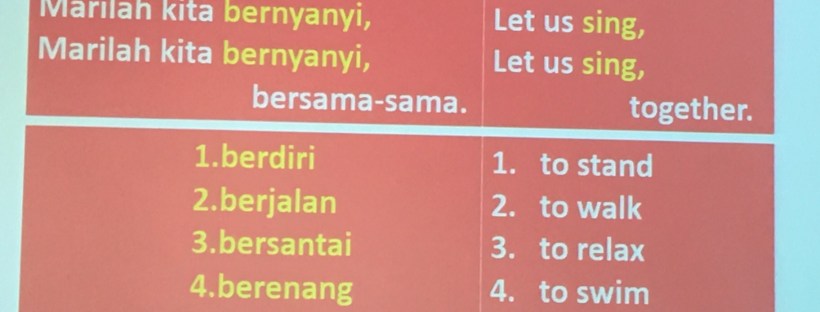
The final activity he did with us was awesome and perfect for TPR. This song could be adapted to any verb. I love the idea of asking students for action suggestions!! I was thinking of how much fun ‘menangis’ (cry) or ‘jatuh’ (fall) would be. Pak Irianto first taught us the song and actions then suggested adding the jumping left, right & centre afterwards to add a further challenge.

I didn’t take any notes, just this video!!

Two Introductory TCI/TPRS Workshops -MLTASA & CLTSA

Over the weekend, Bu Annie, Ibu Sharon & I attended 2 conferences; 1. MLTASA (Modern Languages Teachers Association SA) in the morning and 2. CLTASA (Chinese Language Teachers Assoc) in the afternoon. When we first heard that both associations were holding their annual conference on the same day, we were incredibly disappointed as we were committed to present at MLTASA while Ian & Caitlin (2 TCI Chinese teachers from QLD) were presenting at CLTSA. Luckily our presentations did not clash and we were able to get from EDC to Napier House in good time. However the locked door into Napier House cut short our celebratory hand pumps and thankfully Ian had his phone on! 

The MLTASA conference began with a plenary by Sean Keenihan, who spoke about ‘the role and value of Languages education in schools – a business perspective’. Sean wears many hats and most relate to his Chinese proficiency, dating back to his high school days. When asked how to encourage students to learn a language he reflected with this: after graduation as one of hundreds of lawyers, he was the first from his year to be employed and this was entirely due to his bilingualism. His graphs illustrated recent growth figures in the SA tourism sector and he also talked about the growing state of global business. These two sectors are a just 2 of many that have a huge and growing demand for bilingual employees and thus being bilingual is giving many job seekers  an X factor, making them highly desirable in a competitive job market. Apparently only 30 of the 700 2015 SA lawyer  graduates were employed! I wonder what their X factor was? 

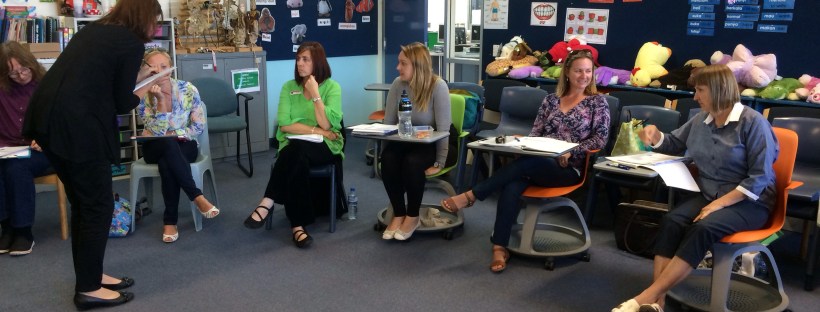
Our workshop, ‘Teaching Languages with TCI/TPRS’ was to be held in the larger room at EDC due to the large number of participants who had signed up for it. What an awesome way to begin!! We began by asking participants to bring their chairs to the front of the room and to sit in a semi circle facing the screen. As this was our first ever presentation and indeed our first ever attendance at MLTASA, we had no idea what to expect. One thing we were looking forward to was an audience of largely non Indonesian speaking teachers, who would experience our demo lesson from a student perspective and therefore hopefully feel the power of TCI even more dramatically than our Indonesian speaking colleagues. Our presentation began with introducing ourselves, outlining our TCI journey, and giving a brief explanaton of the acronyms TCI, TPRS & TPR. Due to the short amount  of time we had available and that we were a little late starting (domino effect of the 2nd plenary speaker running over time), our introduction was minimal. We felt that a demo would be more powerful than heaps of information. 

Our demo focused on the Pleased To Meet You (written by Jim Tripp) story. We began with establishing meaning of the target structures (siapa nama, nama saya, astaga, berkata – what’s your name, my name is, OMG, said), before giving a circling demo on siapa nama & nama saya. Sharon then established the ‘Stop – I don’t understand!’ gesture before telling the story. Afterwards she did a comprehension check and everyone gave her a thumbs up!! We had a little time for questions and we were very relieved that attending MLTASA was a high school French TPRS teacher!! It was awesome to connect with Zelda who has been working alone for 2 years – we take our hat off to you! Zelda was able to respond to questions that came from secondary language teachers – a cohort we have had the greatest difficulty connecting with as we have no secondary experience. Our promise to them that TPRS was designed initially for secondary students by a secondary language teacher rarely helps. Zelda’s contribution and support was invaluable.  

It wasn’t till much later, that Sharon realised that in our nervousness, the reduced workshop time and our determination to leave punctually, we forgot to mention anything about the unit of work we had created around this story to help participants trial a unit in their classrooms!! Oops. So if you were one of those participants and you would like a copy, contact me via my learn link address on the handout and I’ll happily forward it to you. 

We arrived at Napier House just before the post lunch conference sessions were about to begin, to our relief. Ian & Caitlin opened the locked doors which gave us time to quickly introduce ourselves to each other and chat briefly while heading upstairs to the auditorium. The entire afternoon schedule had been assigned to Ian & Caitlin! Imagine your only time constraint being getting to the airport in time for your flight home! We were slightly in awe and also a teeny (OK- a lot) envious!! Maybe next year, we need to ask for a double workshop session? 

Ian & Caitlin spent the first hour talking to a powerpoint which introduced TCI/TPRS to their audience of Chinese teachers. The powerpoint thoroughly explained TPRS, outlined how it differs from traditional/currrent language teaching methods, included several short videos of Ian teaching highly engaged year 7’s, year 10 free writes (290 words) , cold character reading , students talking positively about learning Chinese via TCI methodology, students reading unfamiliar texts fluently and a short yet highly engaging demo by Caitlin establishing meaning for ‘wants to eat’. As a student, I could immediately see the value of having the target structures clearly written on one side of the smartboard page and on the other side were other necessary vocabulary just as Diane Neubauer does.I hadn’t actually understood the beauty of this until that point! I also think I need to investigate buying a clicker gadget next year – it would be so convienent to turn the powerpoint pages from wherever I am in my class room!  

Ian & Caitlin stopped talking after an hour to give everyone a break and they were immediately swamped with people asking questions! The amount of interest was brilliant.  During their presentation, I could hear teachers around me commenting to each other quietly but unfortunately it was all in Chinese. 

During this break, it suddenly became clear, that the next session would have to be shortened significantly to prevent Ian & Caitlin missing their flight home to QLD. Particiapants were quickly called back into the auditiorium to answer any last minute questions. In no time at all, they were being presented with bottles of SA wine and the mad dash to the airport began. 

Thankfully we had offered to take them to the airport as this provided us all with a precious window for solid 2017 planning. We all acknowledge the need to arrange high quality training in Australia asap and are keen to collaborate on this by inviting a guest out to Australia next January to provide us all with much needed expert training before the 2017 school year begins! It would be awesome if the person  who comes out, is happy to travel as then we could offer training in a few states which will be much more affordable to participants! If this all happens, would you be interested in attending and how much would you be prepared to pay to participate? Considering our only option at the moment is a flight to either America or Europe ($$), it would be considerably cheaper and so much easier if this eventuates! Please comment below with any thoughts. We need your feedback! The more interest, the better! 

Observations of a TPRS Colleague

Teachers at my site are encouraged to observe colleagues. Working in a department of 1, there is no one at my school who I can observe meaningfully. Classroom teachers are given a morning for observation and an afternoon for discussion.

So with delight, I accompanied Ibu Anne to Victor Primary R-7,  via Kleinigs Hill,


to spend a day in Ibu Sharon’s classroom last Thursday for my yearly observation day. So brilliant watching a fellow TPRS practioner alongside another TPRS fellow practitioner! We sat side by side at the back of the room taking notes and then chatting about ideas as they came to us and then later during lesson breaks discussed our ideas with Sharon! I was in seventh heaven!!

Sharon began her day with a year 5/6 class. She called the roll by asking the students random Indonesian questions: Siapa nama, apa kabar, Selamat siang, etc to which they students had to reply/respond appropriately. Certainly kept them on their toes and it was inspiring to listen to the majority respond so smoothly.

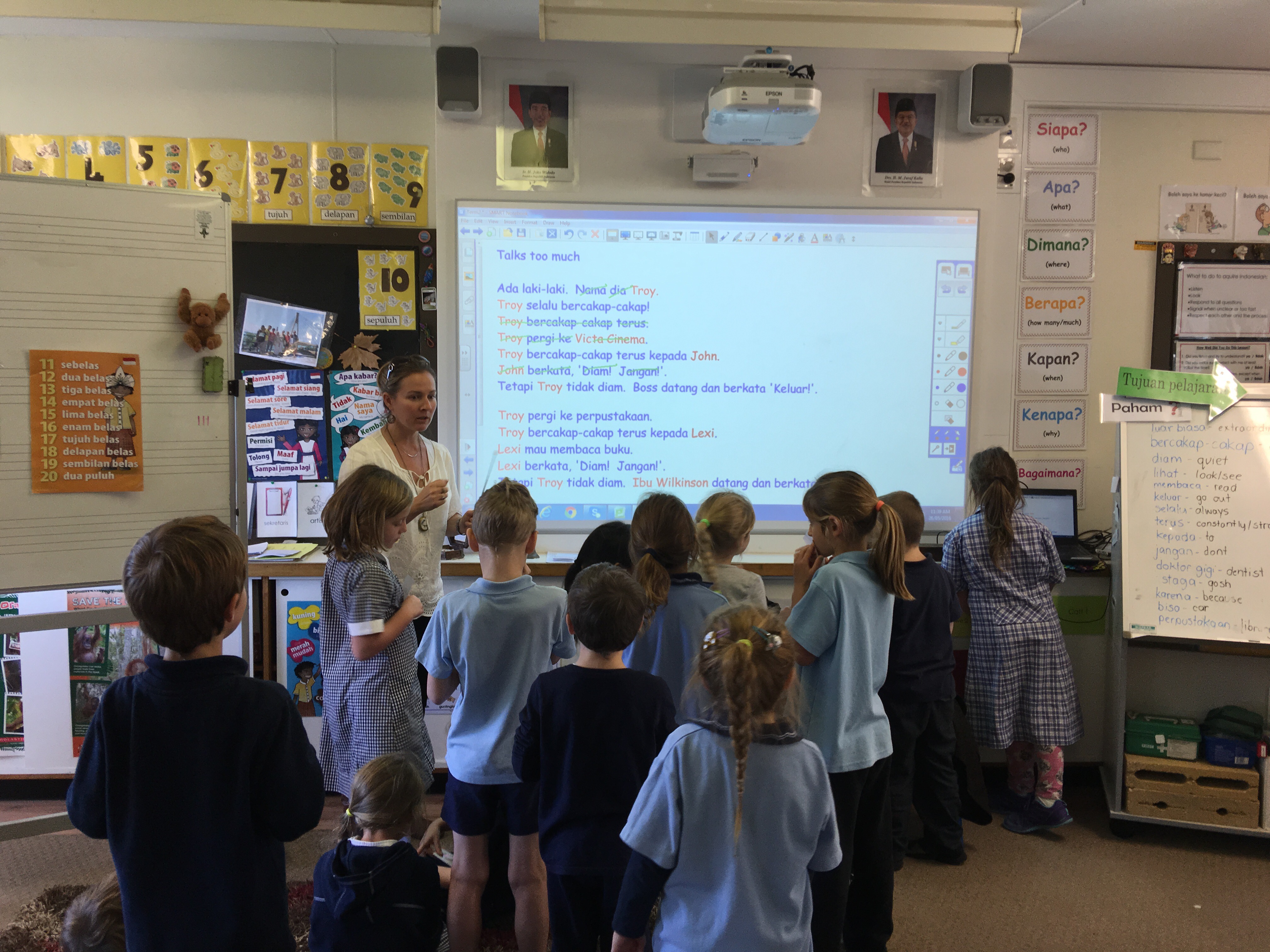
Sharon is focusing on the Talks too Much story by Anna Matava this term with all her classes except Receptions. Sharon identified the unfamiliar vocabulary needed for the story and has spent the past 3 weeks of term focusing on them with JP’s and just this week with MP’s. After the students and Sharon had gone through them together she invited a student to come out the front and stand with their back to the projected words facing the class. Students and Sharon then one by one said a word from the list together with it’s gesture for the brave student to translate. Sharon did this activity with all classes and we were blown away with how solidly they have acquired them. It is such a great way to revise the structures and their gestures while checking on individual students and their progress. The students loved it.

With this class, Sharon trialled the Spelling Battleships pre story activity. The stuents had to choose 5 words from the list and hide them in their grid and then to find the words they had to say the coordinates in Indonesian. We all then circulated to observe and assist. We all discovered that most students were so engaged in the game, they weren’t using Indonesian and their was almost no repetition  of the target vocabulary.


So we brainstormed at recesss to create an improved version! Instead of letters across one axis, write in the top high frequency words. This could be the words that will appear in the story or words that classes have already acquired from previous stories. Then across the number axis, instead of the stock, standard numbers 1-12, include numbers that are appropriate for your classes. They could be in multiples of 10, just the teens, all the fifties etc. We then added the final rule, that each time students discover a letter,  they have to say a word from the list and the gesture to guess what it could be. What a fun way to get in repetitions!!

After recess, Sharon taught 2 junior primary classes. The first class was a year 1. Sharon had already introduced the first paragraph of the Talks Too Much story with the JP’s and for this lesson they revised the vocabulary (in exactly the same way that she did with the 5/6 class), reviewed the first paragraph and then introduced the 2nd paragraph. The first thing I noted during this lesson was the “Spotter”. Sharon chooses a student (alternately boy/girl) to stand out the front. Their job is to watch their classmates for the best gesturer. After 5-10 minutes, Sharon asks who they chose and that person gets a pandai (clever) sticker. I love this idea because it dovetails beautifully with my behaviour management strategy for my JP’s!

With all each class, Sharon demonstrated a different activity so that we could observe a variety of ideas in practise! How thoughtful!! I wish now to apologise to those who have observed my lessons and saw the same lessons over and over!! Anne and I really appreciated the variety of ideas we came home with! I will definitely incorporate this into my day when I am next observed!

The first activity Sharon demonstrated was Reverse Bingo. Each student was given a small rectangle of paper and they had to choose a blue word from the story which was up on the smartboard. (Red words were proper nouns – another cool idea!). When they had written their word down, they returned their pensil to the pot and then stood in front of Sharon. Sharon then read out random sentences from the story and students had to sit if their word was said. She then crossed out the sentences on the smartboard as she said them. The last standing student was the winner.


Students then swapped cards and the game was replayed with a different card! What a fun and active way to play bingo.

Sharon showed us her game “buzzer” with her next class. She put 2 buzzers on the bench out the front of the classroom under the smartboard, divided the class in half and then invited one student from each team to stand in front of their team buzzer. She then asked questions about the story, the vocabulary and the first team to push the buzzer and answer correctly got a point for the team. A student kept score on the mobile white board.  The level of competition between teams was intense!

The final class working on the Talks Too Much story was a year 4 and with this class, Sharon did a TPRS version of a findaword. Instead of students working independently on it, they had to listen to Sharon’s instructions which went like this: Cari bercakap cakap dan mewarnai merah. She then invited students to come out the front and with the magic wand, they put a line through the word on the findaword projected up on the smartboard.

The final class was a R/1 class and they have been working on the Sp0ngebob story.

Spongebob mau makan crabby patty.

Patrick punya crabby patty.

Patrick kasih Spongebob crabby patty.

Spongebob makan crabby patty.

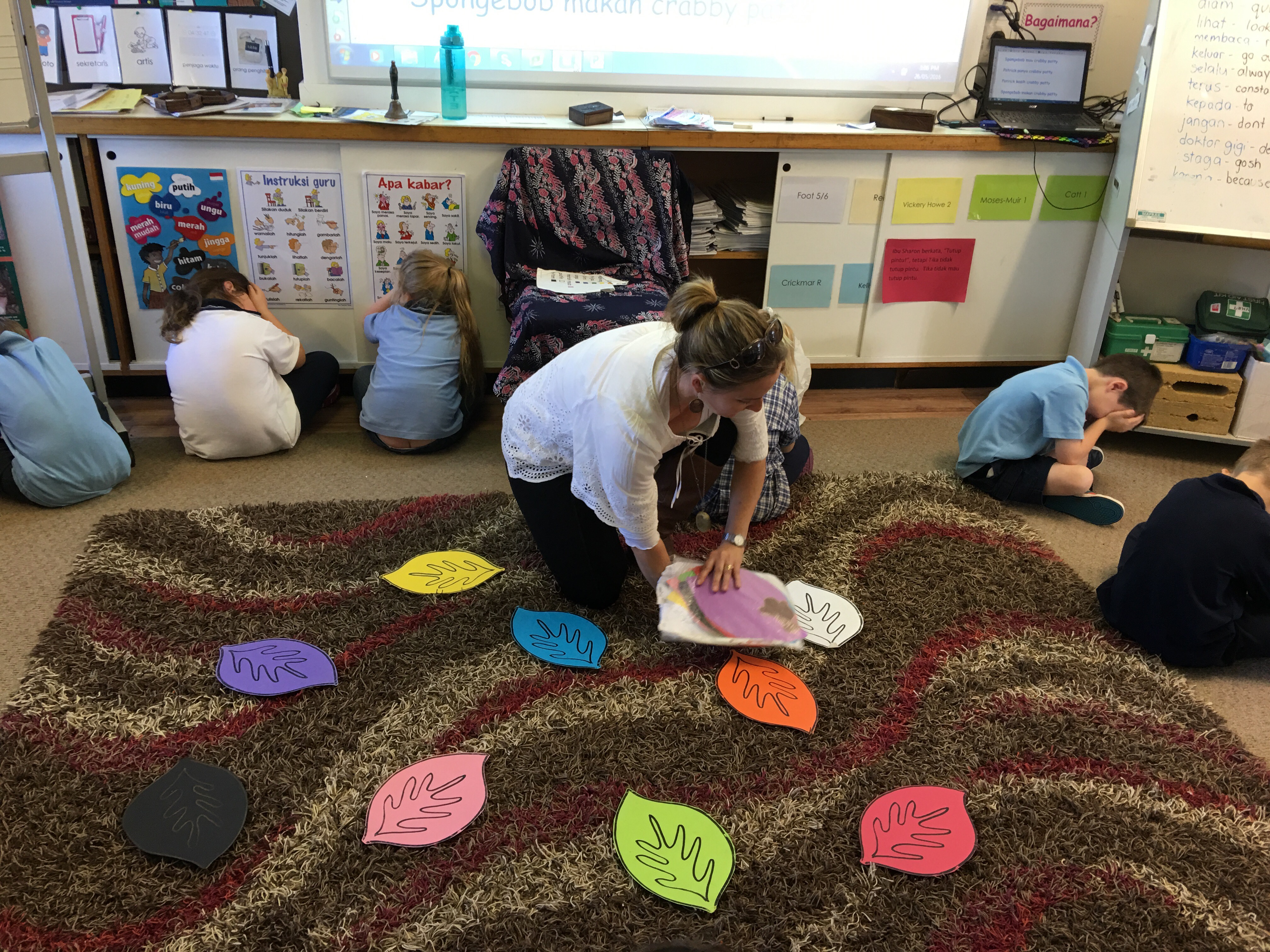
The class read through the story with all students encouraged to do the gestures because the spotter was at work again! The activity for this class was dividing students into small groups who had to work together to arrange the mixed up words of the story into order. To finish the day, Sharon offered to demo “Dimana Bobo?” with this class.  She lay out on the floor different coloured leaves. Students then had to turn around while she hid a laminated monkey (Bobo) under one leaf. Students then vounteered to guess which leaf he was hiding under.

Again, the students loved this game. I loved that it gave repetitions of the question ‘dimana’ (where) as well as colours.

After school we stood around chatting & sharing more games with each other. Anne  had a few number games which we intend to use soon. One was writing a list of numbers on the board:

satu

dua

tiga

empat

lima

On the back of the board, ask the student to write the number if necessary and then ask the class to guess the number. If wrong, the student puts a cross next to the numbers which helps to record guesses.

Another number game that would fit in beautifully with the jacket story because it uses the structures terlalu besar, terlalu kecil dan pas!  Draw on the board a line. Each time a terlalu besar number is suggested, the student writes it above the line, each time a student guesses a number that is terlalu kecil, the number is written below the line and the right number is written on the line! A great way to record the numbers guessed!!

Thankyou so much Sharon for agreeing to host both myself and Ibu Anne last Thursday. It was truly brilliant having 3 TPRS colleagues brainstorming and discussing together best practice which will inevitably benefit not only us as teachers but ultimately our students too. I’ve learned some great ideas and I can’t wait to try them with my students!

I also must thank Ibu Anne for taking a week of her precious LSL to spend a week in SA with us all because from that decision, this awesome day eventuated! Ibu Anne’s visit though is another story!! Read about it on her blog.

Student Free Day notes…..

The day began with an AIM demonstration by Sarah Slee. 

AIM (Accelerated Integrated Method) is a language program which originated in Canada by Wendy Maxwell. On the surface, AIM & TPRS seem quite alike but when you dig a little deeper, as we were generously given the opportunity to do, the differences though subtle, are many. 

Here is the definition for AIM which can be found on the AIM website


Sarah teaches French at a nearby primary school using this methodology and like us, began at the start of 2015. She has the total backing of her school leadership which has been wonderful because the kits do not come cheaply. We drooled over the kits she brought along. Each kit costs around $500 and includes a CD Rom, blackline masters, a teachers handbook and a big book of the story upon which the kit is based upon. Each part of the kit is chocker block full of ideas and suggestions and also comes with a teacher script for each and every lesson as well as a variety of assessment checklists!! The CD Rom includes high quality media resources including songs, story reading/ productions etc which recycle and extend the vocabulary being targeted for each story. The early years kits are based on familiar stories like Henny Penny & The 3 Little Pigs while the kits for older students  are based on unfamiliar stories. AIM kits are available in several languages however Indonesian is not one of them. After watching the introductory video (also available on the website) we participated in a lesson. Sarah sat in front of us (we were in a horsehoe in front of her) with her book open on her lap to the very first lesson as none of us speak a word of French. She then led us through the very beginning of this lesson where she said a word/phrase while simultaneously gesturing and we repeated the phrase/word and copied the gesture. It was very challenging and really gave us a taste of what our lessons are like for our own students! It was a wonderful experience and went much longer than we both anticipated when planning the day! As you can imagine we were all totally blown away by the number of resources available to Sarah in each kit because we have absolutely nothing and have to create everything ourselves using the resources created for other languages as the base line! We also liked the idea of the gesture data bank AIM has as we believe that if we developed something similar, it would help students who move from school to school in our region. There are surprisingly quite a few!! 

The next session was my presentation about circling. I revised what circling is and the prescribed format as per the links I gave in a previous post. We then watched the Blaine Ray/Carla Tarini YouTube video before having a go in pairs with one of the sentences from our ‘Spongebob mau minum’ (Spongebob is thirsty) story. The oppportunity to create a bank of sentences based on the circling format (statement, ask a yes question, ask a no question, ask an either or question and then a question that elicits more detail) with a partner provided a welcome opportunity for discussion which then led to a whole group general discussion about the specifics of story asking. We have, to date, began our stories with a focus on the target structures for several lessons before introducing the story itself. Some students find this excruciating because they enjoy the story telling so much that they become impatient with the percieved unnecessarily long lead in time! So with our next story, we want to see if we can par this down and begin the story asking earlier! Stay tuned for our reflections…….

After lunch, we were joined by Michelle Kohler (Flinders University) to discuss the Australian Curriculum in relation to  designing TPRS assessment tasks. Michelle drove the 1 hour trip to PEPS straight from teaching preservice teachers at Flinders Uni and then headed straight off afterwards for another meeting, so we are incredibly grateful for her finding the time and energy to fit us into her very busy day! Michelle was closely involved with the creation of our Indonesian Languages Curriulum and it was insightful to discuss with her how language teachers are being required to assess and report against it. She was disappointed to hear that most principals are requiring Indonesian teachers to report against the Achievment Statements. She reminded us that ACARA is not an outcomes based document as SACSA was. The Achievement Standards are a reference point for typical student learning. They were not designed to drive assessment. Here is an extract from the DECD Guideline: Reporting on Australian Curriculum in DECD Schools Reception-Year 10 (v2) 

Achievement Standards should be treated holistically, rather than as discrete elements to be achieved.

Michelle then led us through the strands clarifying each:

1.1 Socialising

1.2 Informing

1.3 Creating

1.4 Translating/mediating

1.5 Reflecting

2.1 Systems of language

2.2 Language variation and change 

2.3 Reflecting on the role of language and culture.

.

This gave us an opportunity to look at each from a TPRS/TCI viewpoint. 

This is my extremely brief perception of how we cover each:

1.1 – kursi luar biasa, general story telling/asking, 

1.2 – Movie talk, vPQA,

1.3 – Story asking/telling, free writes, 

1.4 – popcorn reading, paper airplane reading, choral translations, comprehension checks, 

1.5 – grammar pop-ups

2.1 – language discussions (in English) about vocabulary, grammar &/or spelling etc noticed by students in stories/ books. 

2.2 – use and discussion of cognates and the increasing prevalence of English found in modern Indonesian eg kriket, komputer etc

2.3 -informal and formal discussions we have with our students before, during and after school visits by Indonesian nationals to heighten awareness of cultural and religious differences between Australians & Indonesians as well as between Christians & Muslims. 

Please feel free to add to these by commenting below.

As you can probably tell, it was a fantastic day. Having the opportunity to collaborate together about issues relevant to our specialist learning area and invite guest speakers who can help us increase our experitise was so invaluable. My next task  is to survey all who participated for feedback to help plan our next district SFD!

TPRS Indonesian – Find it on Facebook!

Yesterday I finally worked out (with Googles help) how to create a Facebook page! I have been thinking about the value of a Facebook page dedicated to TPRS Indonesian teachers for several months now and finally convinced myself that it was worth a shot! What tipped the balance for me has been the recent posts on various TPRS facebook pages that have been awesome. I realised that we (TPRS Indonesian teachers) need a forum through which we can share useful Facebook posts, our own personal blog posts as well as short personal annecdotes with each other as well as ask each other for help, clarification or feedback specific to teaching Indonesian via TCI. 

So, check it out, like the page and then feel free to contribute in anyway that supports your own understanding of TPRS in the Indonesian classroom! I look forward to seeing you there!

PQA, My Way; By Alina Filepescu

maxresdefault

Here is an amazing post and video by Alina Filipescu. While the post is specifically talking about how she does PQA in her classrooms, there is actually sooo much more in it that we Indonesian teachers here in the southern hemisphere can learn about. Not only has she included an amazing video of herself brilliantly and seamlessly PQA-ing with a primary aged class but she has also included an explanation of what she does to cue her students when she wants them to respond. It is a truly amazing video and post and I highly recommend that you read/watch it to appreciate where we are all heading with our TPRS skills!! I look forward to the day when  my students participate to that extent and are so engaged in my lessons!

Tea With BVP

Each Friday morning at 6am (Australian time) Bill Van Pattern hosts a discussion about second language acquisition with Angelika and Walter.

tea with bvp hosts

Every session has a topic and today’s topic is:

“Are vocabulary and grammar learned differently?

Here are my notes that  I took while listening:

  1. Vocabulary and grammar are learned in essentially the same way.
  2. Acquisition is fundamental as opposed to learning (remember that the only thing that matters is the acquisition of language).
  3. Colourless green dreams sleep furiously. (Chomsky) Gibberish but the words fit grammatically!!
  4. Let’s hope teachers aren’t still asking students to memorise lists of vocabulary.
  5. Thematic conversations are not the same as thematic topics (e.g. restaurant, sport, body parts etc) Carol Gaab
  6. Frequency lists – If we use every day language, then we generate frequency vocabulary naturally.
  7. Verbs account to 20% of language. Nation (1990) 4000 – 5000 most frequent words account for up to 95% of written text & 85% of speech. Carol Gaab
  8. Be aware that context in classroom will be different to context out of classroom. If we prepare for outside experiences out of the classroom, then it is out of context. Stick to what students need in class. Stick to what is important to your cohort of students.
  9. Body parts (as a theme) will come naturally into speech when students need to know that specific vocabulary.
  10. Acquisition is effortless and involuntary – Karen Rowan
  11. You don’t have to talk about grammar unless your students ask for a clarification
  12. Is grammar acquired involuntarily? Word meaning is thought about consciously but grammar is not, by language learners.


As Bill is a professor of second language acquisition at Maine University, his knowledge of relevant theory and practice is prodigious. He would be a compelling lecturer because he sprinkles irreverent comments throughout which at first seem bizarre but once attuned to his sense of humour, listening to him becomes very entertaining.

The conversation between the 3 presenters is largely theory based but it is balanced practically by Walter & Angelika as well as the many language teachers who contribute to the discussion either on Twitter, Mixlr, by email, or by calling in and talking directly to the panel.

The conversations can either by listened to live however if that isn’t possible, then go to the TeawithBVP website and listen via links to past episodes on sound cloud.

Every week there is a SLA Challenge Quiz – a multiple choice quiz with prizes (coasters today) depending on the number of questions you get correct. Those listening on MIxlr generally help who ever is taking the quiz by posting answers. A true example of the collegiality that exists amongst TCI practitioners!

Here is a taste of the SLA Quiz!

Q1 just like grammar that has syntax and morphology, vocab is largely is largely acquired by

  1. ?
  2. Interaction with input
  3. knowledge of the first language
  4. Examining Trumps speeches


Q2 Researchers refer to vocabulary as?

  1. A morphological units
  2. The mental lexicon
  3. The syntactic and network
  4. One fish red fish blue fish


Q3 words can be changed not only from one meaning to another but also from a found to an adverb. How do we refer to how a word changes from one category to another?

  1. Inflection
  2. Extension
  3. Derivation
  4. Freudian catharsis


If you are keen to learn more, then sign up for the newsletter on the “Tea with BVP” website.

Another option is to listen to BVP talking about aspects of second language acquisition. Here is the first in a series and this one is titled “What Everyone Should Know About Second Language Acquisition.”

https://youtu.be/X1LRoKQzb9U?list=PL7AsHYMEToB7gSRuN1WBRF4hL6QOSLagr