An Overview of the 2017 Agen Conference

Here I sit on the plane heading back to Australia after the amazing Agen TPRS conference. While I have been away for almost a month and I’ve seen and done a million things, the conference has definitely been the highlight of the entire trip. Can you imagine 6 and a half days of meeting and chatting and learning from a broad group of TPRS/CI experts? I hardly know how I can possibly give you a complete picture of the week and then do it justice!

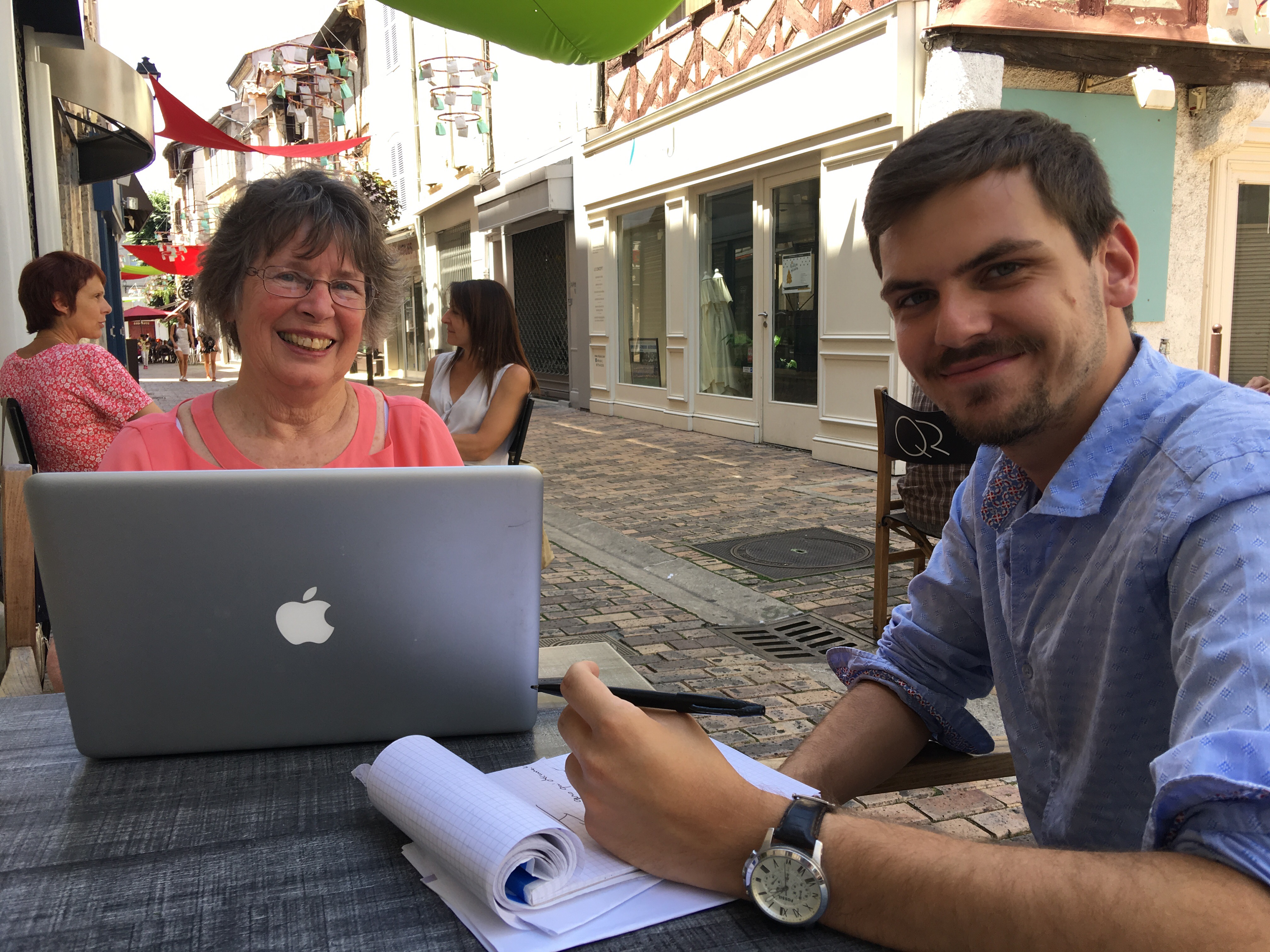
I arrived into Agen by train a week before the conference began with the idea that I could enjoy familiarising myself with Agen at a relaxed pace before the conference which, I rightly guessed, would be full on and exhausting. Several times during this week, I met up with Judy Dubois, the conference convenor, which I truly appreciated as I was quite nervous. Even though I knew Annie was soon joining me, I was incredibly apprehensive with the realisation that I was on the threshold of actually meeting face to face TPRS people I had only ever ‘talked’ with online. Having this time with Judy beforehand was wonderful because she is so down to earth and calm. I am in awe of her calmness! Now that the conference is over, I can only guess at the million thoughts that must have been going through her mind during this week, yet she still found time to meet me for lunch, give me snippets of Agen history while walking through the streets and showed me several places that provide a decent cuppa!  It was truly wonderful. I was even invited to sit in on her interview with a young newspaper journalist about the conference and then had my name mentioned in the article!

IMG_4221.JPG

Two days before the conference began, I moved from my Airbnb accomodation to the Stim’Otel where many conference attendees and presenters would also be staying. While this totally blew my budget, the early morning breakfast chats with Teri Wiechart, the freedom of having my own space (where I could follow my own body clock without bothering a room mate who would no doubt go to bed later than me and wake later than me – ie., most of the human race) as well as having my own private bubble where I could regroup when needed and also having the privacy to hang my laundry up anywhere and everywhere, was worth every cent.

On the Saturday afternoon before the Coaching for Coaches workshop, Annie & I walked together to the train station to meet and greet our wonderful mentor from New Jersey, Catharina. Catharina had decided at the very last minute to join us in Agen as she was going to be in Europe for summer anyway, visiting family, which for us both was simply the icing on the big TPRS cake for us both. After 3 years of speaking and listening to Catharina on Skype, it was brilliant to meet her face to face at last. If you have ever joined us for a Skype session with Catharina, I can assure you that she is just as bubbly and passionate face to face as she is online! It was so great that she was at the conference for so many reasons. Catharina has been to many more TPRS conferences than we could ever dream of getting to and it was invaluable being able to chat with her throughout the day about the sessions we attended from a junior primary aspect. Catharina saw everything in perspective and could align the pieces together perfectly smoothly whereas I was madly scrambling to process a ton of information in a short amount of time and throughly appreciated having my own personal guide who explained patiently how everything meshed together with what I know and do in my classroom. Thank you so much Catharina!

For about 20 of us, the conference began a day earlier on the Sunday with the Coaching for Coaches (C4C) workshop. This was the first time that the C4C workshop had been held at the Agen conference and I am so grateful that I could participate. It also provided us with a bonus gift in that it gave us all a useful pair of ‘glassses’ (lens) that enhanced our attendance and uptake over the next 5 days at the conference. The C4C workshop was held in the building where Judy teaches English in Agen which in itself I loved because now when I read her posts or tweets about teaching, I can picture her classroom! We were led by a fantastic group of experienced coaches including Kristin Plante, Teri Wiechet, Robert Harrell, Carol Hill, Laurie Clarq and Paul Kirschling who gently guided us by consistently demonstrating how important kindness and a low effective filter is for both the coaches and the teachers. The morning session included a Krashen refresher, which was an excellent place to start. We were each given 5 post it notes and on each wrote a sentence regarding one of the hypotheses. When we had finished, we stuck each on the wall around the pertinent hypothesis poster before walking around and reading everyone else’s to clarify our understandings. This was  such a terrific idea because I realised that I did not fully understand the monitor hypothesis and so I had the opportunity to ask Catharina for clarification before going over to that poster and reading what everyone else had written to clarify my understanding before writing my own!

Krashen’s 5 hypotheses:

  1. The Acquisition Learning hypothesis – there are two ways of developing language ability: by learning (conscious) or by acquisition (sub-conscious).
  2. The Input hypothesis – We acquire language in one way only; when we are exposed to input (written or spoken) that is comprehensible to us.
  3. The Monitor hypothesis – We are able to use what we have learned about language rules to self correct language output.
  4. The Natural Order hypothesis – Language is acquired in a predictable order by all learners.
  5. The Affective Filter hypothesis – the variables that interfere with language acquisition and they include anxiety, self confidence and motivation.

Here are two gold nuggets (terminology credit Teri) from this day:

  • TPRS teachers accept that the above 5 hypotheses are essential for language acquisition.
  • If you are connecting with your students and making your language 100% comprehensible, TPRS/CI will follow.

After lunch we were divided into 2 groups and given the opportunity to practise coaching, but in order to practise coaching, we needed teachers. This will continue to be important for Annie and myself once back in Australia. If you are willing to help us practise and develop our coaching skills we will be incredibly grateful and can guarantee that you too will gain from the teaching experience!

The Agen TPRS Conference did not officially start until after lunch on Monday, however I headed over to the Lycée at 8:30am because I wanted to watch how Daniel Dubois connected with his students during their very first lesson. The morning block on each day of the conference was an opportunity for us to observe TPRS teachers in action with their students. In total there were 5 language labs:

  • Daniel Dubois teaching Breton
  • Rosanna teaching Spanish
  • Judith teaching English
  • Paul teaching French
  • Diane Nuebauer teaching Mandarin
  • Charlotte teaching English

Mandarin and Breton were the only 2 options for beginners, so Annie joined Diane Nuebauer’s classes and I joined Daniel Dubois’.

Breton is the language spoken in Brittany, France and Daniel often began his morning classes with a brief introduction to the language and/or its history. Apparently the Breton in the north differs from that spoken in the south yet being of Celtic origin, both have quite a lot in common with the Celtic languages of the UK. At various times over the week we were joined by those familiar with Scottish Gaelic, Irish Gaelic and Welsh and all 3 people enjoyed recognising familiar words in the Breton language. The history of  Breton dates back to the invasion of the Anglo Saxons into Britain. Speakers of Gaelic either fled west to Ireland and Wales, north to Scotland or East to France. Daniel also talked about languages with ‘consonant mutation’. Have you ever heard of that before? The Celtic languages, including Cornish, are languages with consonant mutation because the initial consonant often changes depending on the grammatical context of the sentence. Is this ringing bells for those familiar with Indonesian? That evening I did some research on this concept and discovered that there are 2 other languages alongside the Celtic languages that incorporate consonant mutation and I bet you can now guess what they are! Indonesian and Malay! How about that?

After my first morning of watching (in awe) Daniel teaching, IMG_4453I deliberated about what I was going to do the rest of the week. I was torn between the opportunity to watch Daniel for the entire week or to take the opportunity to spend time in a variety of classes. I was worried about what I could be missing. Later that evening at dinner, I asked Carol Hill for her advice. She reminded me of FOMO – Fear Of Missing Out – and asked me to think about what I needed rather than worrying about what I would miss out on! After some thought, I realised there was a greater value for me observing one teacher – to see how he manages the day to day realities of teaching; e.g..

  • bringing new students and absent students up to date with all that they had missed,
  • differentiating where necessary for:
    • the fast processors,
    • those with previous Breton knowledge/experience,
    • the slow processors.
    • different learning styles,
    • students with no French (me) or no English (Evelyn).
  • Techniques to keep lessons in the target language
  • Ensuring all students feel valued and that their contribution is important.

The list goes on to include the many juggling balls (credit Terry Waltz) that Daniel successfully kept up in the air and I am incredibly grateful to Carol for her advice. My week with Daniel was amazing – he is a brilliant and talented TPRS teacher and staying with him for the entire week was undoubtedly the best decision.

The Language Labs were followed by a 2 hour lunch. Most people gathered in the courtyard and then went off in varying sized groups to a nearby restaurant or cafe for lunch. IMG_4419While 2 hours sounds like plenty of time, it actually went very quickly and we often were scrambling to get back in time for the afternoon sessions.

The first session back was always a plenary led by a different yet amazing and brilliant person each day. We heard Blaine Ray, Stephen Krashen, Beniko Mason, Robert Harrell/Dianne Nuebaeur, Teri Wiechart and Laurie Clarq speak about a variety of significant TPRS/CI topics.

Blaine Ray led the first plenary for the conference and it was great listening to him again. I will never forget meeting him earlier this year when he so generously gave Annie & I our own personal workshop while touring around Sydney by ferry! Much of what he said in Agen was a refresher for what he had shared with us in Sydney but I still took pages and pages of notes. Probably the most exciting thing I watched Blaine do was a choral circling exercise with everyone! IMG_4328He gave us all a sentence then did a brief demo of the circling basics and then we all stood up and together chanted the yes, no, either/or circling teacher options and the student responses for that English sentence. It sounds slightly bizarre but I actually loved it. There was a sense of connection and support amongst all those chanting and gesturing the ‘ahhhh’ and while it was definitely output, it was so heavily scaffolded that I felt very comfortable joining in. I can definitely see how this could be incorporated into upcoming TPRS workshops in Australia.

The following day’s plenary was titled How to Talk About TPRS and Comprehensible Input with your administration, your colleagues and the parents of your students and was led by Robert Harrel and Diane Neubauer. While I am incredibly fortunate to work at a site where leadership, colleagues and parents are 100% supportive of TPRS/CI, I still found this session incredibly valuable. I realised that I take my school community’s support and encouragement for granted and that I should demonstrate my appreciation more often! Robert & Diane gave us some tips on how to do this and I have every intention of trialling some of their suggestions. Robert and Diane also talked about the value of observations and the value of meeting before and after observations. These meetings provide teachers with the opportunity to briefly explain the philosophy of second language acquisition, backing it up with relevant research if necessary. These meetings also provide the teacher being observed to provide the observer with a checklist of skills to specifically look for. Bryce Hedstrom has a checklist on his website that is a good one to start with. Specific skills you could ask the observer to look for could include:

  • What percentage of the lesson did the teacher stay in the target language?
  • How did I check for understanding?
  • What were the target structures focused on in the lesson?
  • How did the students show that they were engaged?
  • What classroom procedures helped with behaviour management?
  • Comment on the relationship between students and the teacher.

NB A greeter would be a great student job to support the observer during the lesson, especially if not fluent in the language of instruction.

With parents, Robert and Diane recommended informing them that our goal is for students to be able to communicate in the target language and clarify the similarity between learning our first language and then our second language. IMG_4359Specifically that in order to communicate, students have to firstly  listen to large amounts of input and only then will they be able to speak (initially with single words, then phrases and finally sentences), read and then write in that order. If given the opportunity and have the time, a good demo for parents would be one based on the target structure ‘to drink’ with the options including cognates (coffee & beer if doing Indonesian). We also need to ensure that parents feel comfortable to visit out classrooms at any time!

Laurie Clarq’s plenary session was about her passion: Embedded Reading. I was thrilled to hear her talk about this as it is something I have tried unsuccessfully in my classroom and was very keen to hear about it from the master. Laurie expertly wove a true story about someone who could dance one dance very well and how they learned several other dances. I will save the details of this session for another post because it had so many facets to it and it would be impossible to do it justice with a brief synopsis.

Thursday’s plenary was with the indomitable Dr Stephen Krashen. IMG_4545Unfortunately the weather was getting warmer and maybe also because he was wearing several layers of black, Dr Krashen began to melt in front of our eyes. He was a total professional though and continued speaking about The Theories of Second Language Acquisition while mopping up the sweat dripping down his face and neck. Considering too that he only flown in from the US the day before, the heat must have been quite a shock to his system. Thankfully the following day he looked significantly  healthier! His plenary began with an explanation on the 40 year war! The war between the following two hypotheses;

  1. Comprehension Hypothesis – input and unconscious skill acquisition
  2. Skill Building Hypothesis – conscious learning and practise via output

Dr Krashen then provided many case studies that support his hypothesis. A story he shared with us was about Armando, a man who acquired Hebrew while working with Hebrew native speakers in an Israeli restaurant. For 2-3 years, he simply listened to his colleagues chatting to each other in Hebrew. He was never forced to speak in Hebrew and developed a friendly rapport with the staff, owners and Hebrew speaking customers. He not once in this time studied Hebrew grammar nor read any Hebrew. Once he began speaking Hebrew, his vocabulary was corrected occasionally but his grammar was never corrected. Dr Krashen recorded him speaking Hebrew and then played it to other fluent Hebrew speakers asking their opinion of his speech. All were highly impressed with his Hebrew and one even thought he was a native speaker! However the true difference in the hypotheses is summarised by Hemingway in the book “In Another Country”

The major… did not believe in bravery and spent much time while we same in the machines correcting my grammar. He had complimented me on how I spoke Italian and we talked together very easily. One day I had said that Italian seemed such an easy language to me that I could not take a great interest in it; everything was so easy to say. “Why, them, do you not take up the use of grammar?” So we took up the use of grammar and soon Italian was such a difficult language that I was afraid to talk to him until I had the grammar straight in my mind.

The final plenary was co-presented by Dr Krashen & Dr Beniko Mason and was titled “The Importance of Reading”. This topic needs little explanation for TPRS teachers but I still took heaps of notes. IMG_4529Essentially no-one should underestimate the power of reading and Dr Mason provided us with her study based on a group of Japanese students. Through a comprehensive reading for pleasure program, she was able to match the English acquired by Japanese students living in America with Japanese students living in Japan! How impressive is that! Together also Krashen & Mason collaborated on a study that demonstrated that 5-8 hours of reading for pleasure in English over a year provided gains of up to 200 points for those taking the TOEIC test which far outstripped the gains acquired through conversing with native speakers.

On our final day, we all attended a bonus workshop to listen to Dr Beniko Mason talk about Story Listening, a technique she is famous for. I was very excited to have the opportunity to listen to Dher talk about this topic as there has been so much debate and discussion about Story Listening amongst TCI teachers recently. She explained the difference between story telling and story asking. IMG_4579While the difference is largely around the method, it also takes into account the purpose (in our case, it’s for language acquisition), and the audience. Dr Mason advises that fairytales and folktales are best because they have a universal interest, provide a rich compelling story and invoke emotion. Beniko then gave a demonstration using a totally unfamiliar (to me) Grimms fairytale about 2 dissimilar sisters. The version of the story that is told will vary according to the level of students (does that even need saying?) and incorporates labelled illustrations to assist with comprehension. fullsizeoutput_99bWhile her demonstration was in English, I’ve since watched other demonstrations in languages I don’t know and I was entranced! The power of illustration is extraordinary – especially considering how it slows the speaker down and supports comprehension. After a story listening, Dr Mason then asks her students to write a summary of the story in their first language using the illustrations and language structures on the board which provides a further opportunity for input!! More information about story listening can be found here on Dr Beniko Mason’s website.

Immediately after the plenary sessions were a selection of 3 workshops, one of which was generally a coaching session for teachers and coaches to practise a skill. IMG_4358

Annie and I got together before the conference and identified the sessions most relevant to us and then nominated which ones we would each go to. This way we covered most of the workshops but there were still a few that unfortunately we didn’t get to. Maybe next year?

I hope to post about the workshops I attended at a later date because they were each amazing and informative.

The workshops I attended were:

  • The Mafia Game – Diane Nuebauer
  • Creating a Positive Classroom Environment – Alina FilipescuIMG_4384
  • Using Film with CI – Judith Dubois
  • In Praise of Difference – Jayne Cook
  • Teaching a Text; Reading Activities – Robert HarrellIMG_4472
  • To Target or Not to Target – Dr Stephen KrashenIMG_4481
  • Fluency Writing – Judith Dubois
  • Improvising a Story with No Script – Tamara GalvanIMG_4553
  • Breaking Down the Barriers – Charlotte DincherIMG_4567


Which one would you like me to post about first?

Stay tuned….

Meeting Judith Dubois in Agen 

I’m sitting in a cobbled street at Quarts Coffee Kitchen enjoying the cool breeze blowing from behind me. It’s a very warm day today – probably around the mid thirties. The chair and table I’ve chosen is out of the sun and smaller than the others. I was offered the option of directors chairs with a larger table but because I am unsure which way the sun will move (nor how to ask the lovely waitress this question) I chose to sit here. I am waiting for Judith Dubois to join me. She is due any minute from the 12:30 train. This meeting is momentous for me because it marks my  unofficial beginning of the TPRS conference – the whole reason I am here in Agen. Judith will be the first of many TPRS legends whom I will meet face to face for the very first time, with the only exceptions being Stephen Krashen & Blaine Ray, who I very fortunately met during their recent visits to Australia. 
The next day……

Wow! Wow! Wow! Can’t believe how generous Judith is! With less than a week leading up to a major international conference with a million thoughts chasing around in her head and a list of jobs a mile long, she took time out to warmly (literally – both from her heart and on a 35+C day) welcome me to Agen and show me around while seemlessly ticking off a few of the jobs from her job list. 

After a delicious lunch with Judith at Quarts Coffee Kitchen, we met a journalist from a local paper who interviewed Judith (in French) about the upcoming conference. It was fascinating ‘listening’ to the conversation which included an explanation of TPRS. Listening to a conversation about a familiar topic in an unfamiliar language! I could pick out a few familiar words and draw some dots but it was hard work sitting there in the heat concentrating on a largely incomprehensible conversation. My experiences as a beginner language learner have definitely begun!! 

After the interview and a few other jobs, we enjoyed a cuppa (pot of earl grey tea) in an air conditioned cafe (boy was the air-conditioning welcome!) and a terrific conversation about several TPRS topics including teaching adults (4-6 is the ideal class size), teaching word order via ‘Kim’s Game’ ala Rudyard Kipling (also known as ‘memory’). 

Judith explained how perfect Kim’s Game is for repetitive & correct noun/adjective word order input. I hope I have interpreted her instructions correctly! 

Put together a collection of props that are similar except for size and colour! How awesome is this!  Eg. A big red snake. A small pink snake. A big red shoe. A small red and blue shoe. A large red pencil. A small blue pencil. A large pink monkey. A small blue monkey. Etc. Put them all together in a covered basket/container. One by one, take one out and circle it focusing on reps of noun/adjective word order. Once the basket is empty, pick up the props one by one again, repeat what is (a big blue hat) and then return it to the basket. Once all the props are back in the basket, ask the class if they can remember what is in the basket. As a prop is suggested by a student, pull it out and once again confirm it’s description to consolidate further the noun/adjective word order! 

This would be an engaging activity for all students and a great way to get reps on not only word order but also any nouns covered in stories. 

A huge thank you to Judith for spending time  with me yesterday. I thoroughly enjoyed meeting you at last and truly appreciated that you took an entire afternoon out from your hectic schedule to spend time with me. I thoroughly enjoyed our various TPRS related conversations and the impromptu history tour! Merci beaucoup!! 

Speaking Indonesian in France 

I am in 7th heaven because today I enjoyed 2 Indonesian conversations!! To be honest, they both were achieved intentionally. Since booking my trip to France, I wondered about my chances of meeting an Indonesian person. This curiosity increased with my nervous first attempts using French. It’s so foreign for me to be overseas and to be unable to communicate smoothly. As soon as I get flustered, Indonesian just pops out of my mouth! So one of the first things I did on my first jet lagged day in Paris was to google Indonesian restaurants in Paris and was thrilled to discover there are 4 listed on TripAdvisor. 

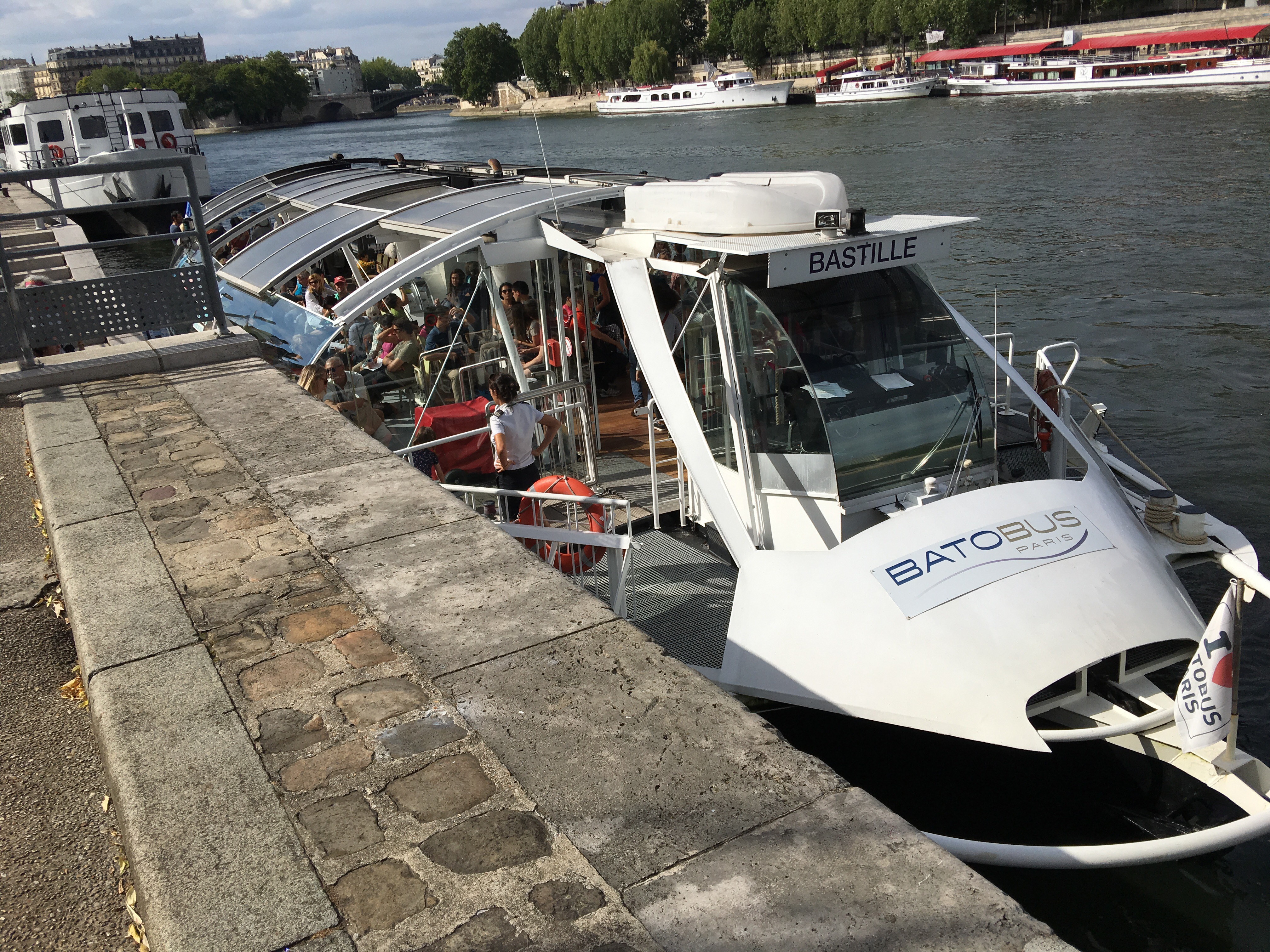
Today while traveling on the batobus, I noticed Indonesian writing on a fellow passengers t-shirt. Feeling like a stalker, I wandered over to where he was seated and sat next to the 2 women travelling with him. I introduced myself in Indonesian and when they both did a double take, I enjoyed their reaction!! They were all from Jakarta, although one lives and works in Denmark now! It was so lovely chatting with them both before getting off at the next stop. They happily permitted me to video them introducing themselves to my students!! Their kindness and generosity in providing me with a much appreciated Indonesian language fix will stay with me for a long time. 

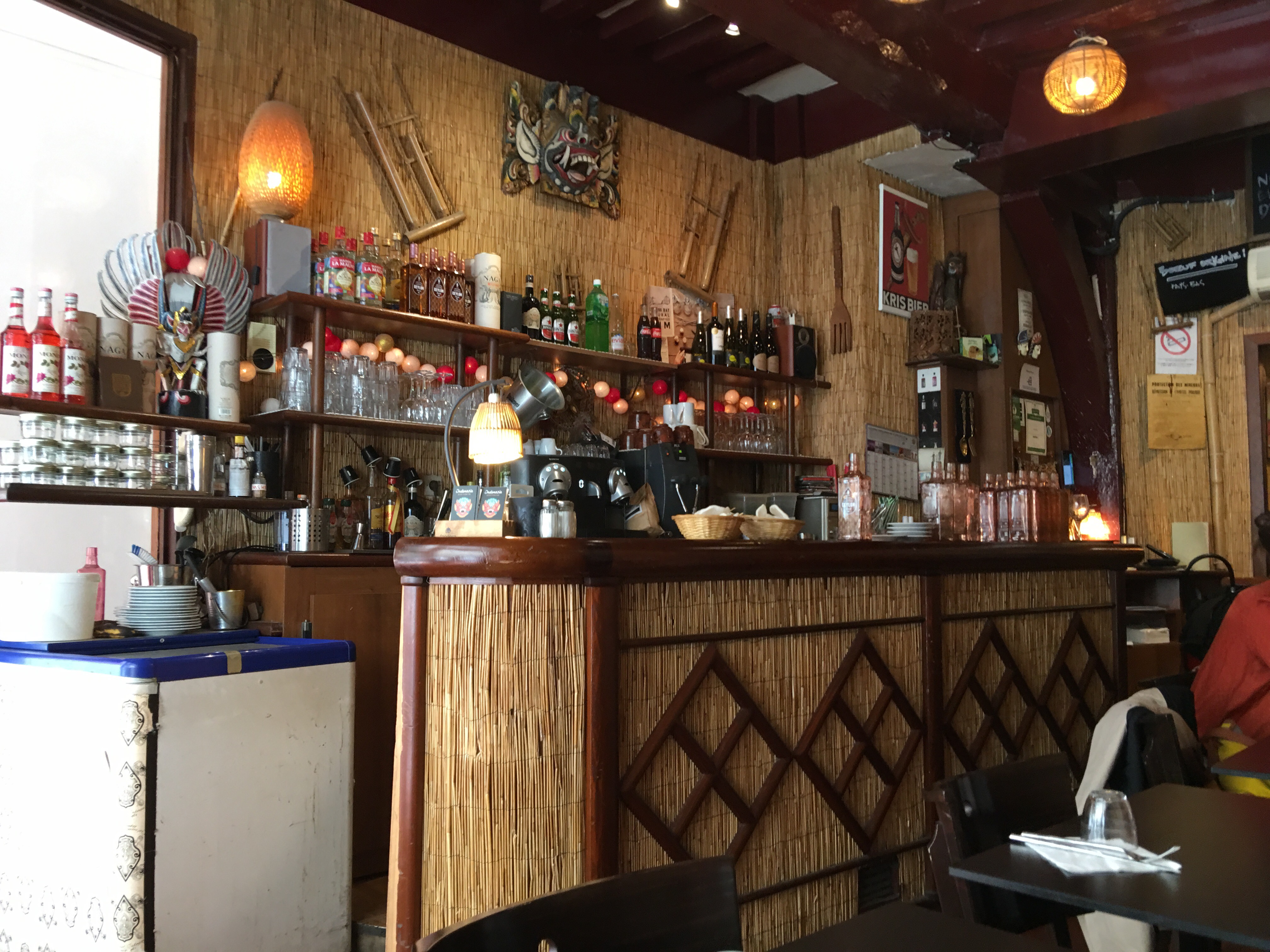
​Mid afternoon, feeling hungry, I decided to try to locate one of the Indonesian restaurants I’d discovered online. I chose Restaurant Indonesia because it looked the most straight forward to get to from the Batobus circuit. I headed up Rue Saint Michel towards the Luxembourg Gardens and found it easily on a side street. It has a small alfresco area outside – largely smokers – as well as a row of tables inside. The decor is definitely Indonesian although slightly dated. I saw the waiter and spoke to him in Indonesian. He stated matter of a factly that the only languages he can speak are French and English and that the only person here who speaks Indonesian is the chef! I was taken aback with his abrupt response. I found a seat close to the front windows and sat down before asking for the menu which listed a variety of delicious traditional Indonesian dishes including nasi goreng, soto ayam, sate, lumpia and pepes ikan. I ordered urap and gado gado both of which were absolutely delicious even though the vegetables used were unusual. The urap used long thin carrot ribbons and was arranged on a bed of baby spinach but the spices were truly amazing. 

Half way through my meal, I asked the waiter if he would ask the chef if she had any time to chat with me. He strutted out to the kitchen and relayed my request. The chef came out immediately and we chatted for ages in Indonesian. Sheer bliss!! Her family have lived here in France since 1965, a significant date that fully explains her family’s unspoken backstory. The restaurant, the very first Indonesian restaurant in France, is run by a cooperative and has done so ever since it was opened by her father 35 years ago. All profits are shared equally amongst those on the cooperative and they also happily provide work opportunities for people with minimal experience. The waiter would definitely be a recipient of this. His waiting skills were definitely lacking. The most bizarre thing he did was ignore totally a broken glass jar that fell off the bench onto the floor. He purely walked over it crunching the glass up underfoot each time. 

Enjoy my video of Ibu Anita introducing herself and speaking about her restaurant:

I’ve since reflected upon my desire to speak Indonesian so early into my trip and I’m still not exactly sure why I needed it so urgently. It’s funny that I craved an Indonesian conversation rather than an Australian one!! I’ve heard and seen a few Aussies but the idea of starting up a conversation with them is not appealing at all. Was it my way of dealing with culture/ language shock? A self confidence booster? I don’t speak French but I can speak another (not English) language? Whatever the underlying reason, since leaving the restaurant, I felt significantly more comfortable with my lack of French. Which is why, no doubt, that I had a whole conversation at a boulanger all in French on the way back home!! It went something like this: Bonsoir. Un baguette s’il vous plaît. Merci. Au revoir. I floated on air all the way back to my Airbnb thanks to the lovely encouraging lady at the boulanger. 

Sorry – I don’t speak French! 

After a mammoth flight via Singapore & New Delhi, I am finally here in Paris. I can’t believe that I am so much closer to Agen and super ready for the TPRS conference. 

Leading up to my departure, I was very excited until the week before when I remembered that  my knowledge of French is almost zilch. I suddenly became incredibly nervous about not being able to communicate in French. While everything I’ve read assured travellers to France that English is widely spoken here, I still dreaded my arrival into Charles de Gaul airport where I was convinced I would need help. It was the first flight ever that I wished would not end but of course it did!! I deplaned and was immediately surrounded by people chatting in French. My bag was one of the last to appear on the conveyor belt and it was with relief I spotted it because the idea of talking about lost baggage could have tipped me over.  

It has been fascinating, in a macabre fashion, observing my reactions to upcoming conversations. My knowledge of French is simply bonjour, merci and une baguette.  The first 2 picked up through reading and the last from my previous trip to France in 1991. While in the almost 2 days I’ve been on French soil, not one person has spoken rudely or impatiently with me yet the idea of speaking has me quaking. I open my mouth to speak and my brain scrambles to work out what to say. Several times a mixture of Indonesian and English have come out! It is so stressful yet as a language teacher, a valuable and interesting experience. 

Today my plans have all changed due to Versailles nor opening on Mondays, thunderstorms and the Bibliotheque Francois Mitterrand (National French Library) not opening till mid-afternoon. I found through TripAdvisor, a small cafe close to my airbnb and walked through the rain arriving a few minutes before it opened. It is so warm and dry inside and I’m enjoying my first coffee – latte with late de soja- perfect for a wet, cool day. It’s lovely sitting down and letting the French conversation flow around me although the English music in the background seems strange and is definitely unwanted ‘noise’. 

Why do most language teachers expect and demand that their students speak? When I open my mouth to speak French, my affective filter is ramped up to the highest level because I expect to fail. A little while ago, when ordering coffee, the lovely girl behind the counter preempted the coffee, but adding the soya milk detail flustered me. I was confident that I would mispronounce the word (it was written up on the menu board) and I did! It took me several goes before she worked out what I was asking. Even though the failing was no surprise, it justified my lack of confidence. If just a phrase has that much impact, imagine how much worse it would be reading a sentence!! One error after another. Guaranteed! 

Excuse me for a minute, I need to ask for the wifi password. Hang on. There’s a few things I need to sort out beforehand…. firstly;  how do I get the girls attention politely? Secondly, is ‘wifi’ the same in French? Thirdly I must remember to say merci!! Right? Ready? Come on! It’s not that difficult. Stop stalling. You can do it!! I’ll just wait a little longer because she is busy serving.  Right, here goes. 

Ok, that wasn’t hard. Drats. I forgot to say merci! 

Tea With BVP with Blaine Ray

Yesterday, I headed into Adelaide for the first time in months and as usual for my hour long drive, I listened to a BVP podcast

However instead of listening to episode 53, I skipped ahead to episode 57; featuring Blaine Ray.  I have been looking forward to hearing this episode ever since I heard that he had been a special guest on Tea With BVP!

It was fantastic listening to Blaine Ray again and what he had to say totally resonated with me and helped to consolidate my understandings of TPRS! My only grumble is that Bill told Blaine Ray that he hasn’t spoken to anyone from Australia yet!! How could he possibly have forgotten my call in January when we spoke about Terry Waltz presenting at the inaugural Australian TPRS conference?😜

I loved listening to this episode so much, that I listened to it again later at home so I could take notes to consolidate what I learned and to share with you all. However my notes have run to several pages, so instead I will just pull out the major points that I believe are particularly worthwhile and encourage you to listen to the full podcast yourself to fill in the gaps!!

After talking generally about the steps leading to Blaine’s discovery of Stephen Krashen’s book, The Natural Approach and the light bulb moment Blaine had reading the sentence,

Language is acquired by comprehensible input.’,

Bill made a profound statement;

Teachers not using TCI are teaching language teachers out of existence.

Isn’t that a powerful statement? It truly resonates with me because evidence shows that this is exactly what’s happening. My students move firstly to a local high school where the numbers of students choosing to continue with Indonesian are not many.  They then may choose to enrol at one of our state universities where again students are generally not choosing to continue with languages beyond semesters 1 & 2. This information was provided by an Adelaide University French lecturer, John Sooby-West, at a recent training and development meeting earlier this year specifically for language teachers. He spoke frankly about the heavy load that his beginning French language students have which has lead to significant student drop out rates. Their language work load (one that at times is equivalent to the combined work load of all their other subjects) are so onerous and unappealing that drop out rates have led to language program cut backs and in some Australian universities, whole courses have been abolished. So sad to think that all this could easily be addressed through CI. I look forward to the day when Australian language students discover how language learning can be fun, engaging and considerably less onerous.

SLA Question: This weeks SLA question was about intake which according to Corder (1967)  is the amount of input/communication that learners attach form and meaning to. It’s important to realise that while CI and TPRS maximise intake, it is not always 100% comprehensible. Student intake increases with repetition and by minimising noise (going out of bounds). Bill added that you can’t throw input at learners and hope it sticks. Teachers must manage learning time to ensure that learners gain the maximum amount of intake.

A further point of Blaine’s is timely for me, even though I’ve heard it several times; “The goal of TPRS is not to finish anything!” Blaine clarifies that the biggest enemy for teachers is teacher type thinking. Teachers have been trained to cover the curriculum – to finish chapter 10 by the end of term 2. This encourages a focus on ticking curriculum checklists off rather than truly catering for student needs. We must think more like our learners who are saying to us, “I can’t get enough repetitions & I can’t hear that sentence too many times.” I personally am sooo guilty of this. I will write this into each of my lesson plans in big bold lettering!! It’s sad how finishing a story becomes the goal of a lesson rather than teaching to the eyes and checking in with the barometer student to measure if they have ‘soooo got it’. As Blaine rightly reminds me here; the goal of a lesson is not to finish a chapter, a book or a story. Our goal is teach a sentence by focusing on that sentence by circling and adding characters to give students maximum opportunity to experience the feeling that ‘I am sooo getting this’ which is much better than just, ‘I am getting this.’

When Bill asked Blaine about the relationship between CI and TPRS, I was keen to hear the answer. Blaine believes that the main difference is that TPRS teachers focus on one sentence so that students feel that ‘I’m soooo getting it’ unlike CI teachers who go from sentence to sentence with minimal repetition. TPRS is one of the ways teachers can provide their students with CI.  CI is successful for some students and its highly likely that for those students, they will be successful regardless of the method! TPRS, however, is successful for everybody because of the emphasis on the sentence. The teacher doesn’t have to worry about individual differences because the net is cast so wide and so broad that every learner type, visual, auditory, kinetic, etc is successful. TPRS really is one of the most broad based and student based approaches. Everybody is getting it and everyone is engaged!

Bill rightly then makes an important point regarding watching very experienced presenters demonstrating techniques & skills that appear easy. This happened to me after the January Fleurieu conference where we were incredibly fortunate to watch Terry Waltz demonstrating circling! While she spoke to us later about the dialogue going through her head during the demos, all we saw at the time was a flawless and effortless demonstration of circling which to this day, I have yet to replicate. We have to accept that we aren’t like Terry YET! (Acknowledgment – Carol Dwek)

Tea With BVP finished with Blaine asking Bill 2?great questions. The first was about timed writes which from a teachers perspective are invaluable because they provide teachers with an insight into student proficiency through a simple word count.

Did you know that by the end of:

-Spanish 1, students can do about 70-80 words in 10 minutes.

-Spanish 2 – students can do about 100 words in 10 minutes.

Bill then clarified that timed writes don’t violate the input hypothesis because the teacher is not using the timed writes to teach language; they are an assessment tool useful to demonstrate improving levels of language fluency to leaders, parents and students themselves.

The second question Blaine asked Bill was regarding ”forcing output” in reply to the recent criticism of Blaine & other TPRS teachers encouraging actors to answer teacher circling questions in complete sentences. According to Krashen’s theory, second language students should not be forced to produce language until they are ready to do so. Blaine ask Bill to clarify how asking student actors to speak during role playing (e.g. asking, “Are you a boy/ Am I a boy?”) fits in with Krashen’s hypothesis.  Blaine explained that he expects full sentence responses from his actors for 2 compelling reasons. Firstly, to provide fellow students with ‘I/you’ input and secondly to assist teachers recognise when more repetition/input is necessary should actor responses be hesitant thus easily matching the required quality and quantity of input students receive with what is required.

Bill’s answer to this question clarified that this practise is not ‘forced output’ as defined by Krashen. Firstly, it’s the difference between talking at students and talking with students. TPRS exemplifies teaching with students. Secondly, because the teacher is not forcing the student to create language; they are merely reproducing a heavily scaffolded sentence that is visually available to them either on a sheet of paper or on the board, it is not forced output. The important distinction to make is that asking actors to speak in complete sentences is not making students talk to learn, but rather students are talking to show teachers what they’ve learned. It is an assessment tool that informs their teacher about whether to move on or to work further on that sentence.

One final point I enjoyed and would like to add from this episode was:

Irony = novice TPRS teachers need TPRS input to comprehend TPRS! 

A picture is worth a thousand words. Feeling the method as a student is the key.

Hosting The State Education Minister – The Honorable Susan Close – in The Indonesian Classroom

What an experience it was teaching with the state education minister, her entourage, both our PEPS school leaders and several SRC representatives in my classroom!

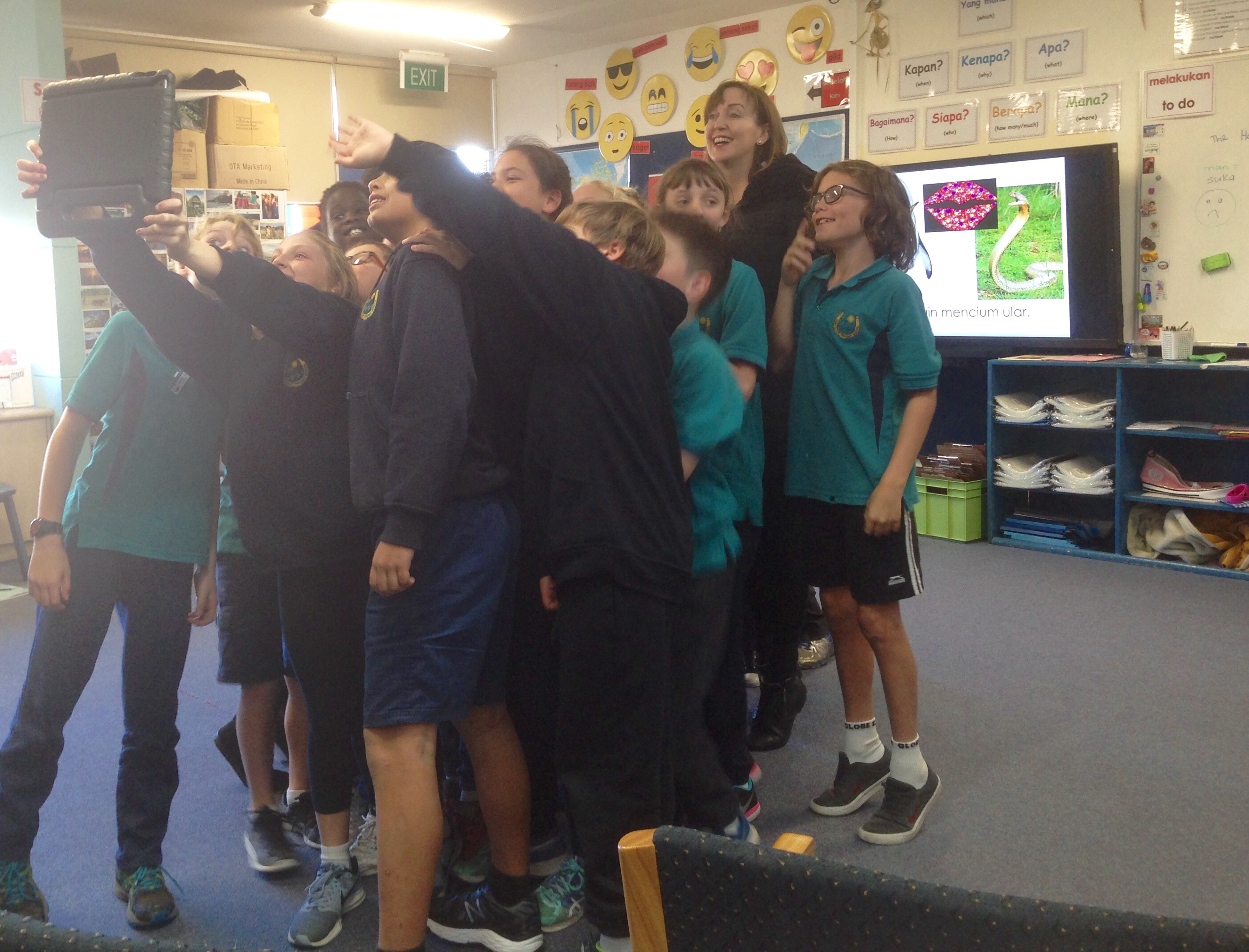
Before the arrival of Susan Close (SA’s education minister), to the Indonesian room, I pre-warned my 5/6 class that during their Indonesian lesson, the education minister would be visiting to observe them learning Indonesian via TPRS/CI. With Marg’s (their teacher) help, we provided the ketua kelas & the tukang foto time to practice their jobs. The ketua kelas needed to ensure that he addressed the minister correctly incorporating an Indonesian twist: “Murid- murid berdiri dan kasih hormat kepada The Honorable Bu Susan Close”. The tukang foto’s job included taking photographs of the minister chatting with Lincoln – our host (pemandu)  and then ensuring the visit finished with a class selfie. The whole class then practised all of this a few times which was lots of fun.

We then returned to our current story, ‘Dua Mulut’ (2 Mouths)  beginning with a PowerPoint reading ala Terry Waltz as she demonstrated at the SA 2017 Fleurieu Conference. Unfortunately the minister missed this and arrived just after we began the post story activity.

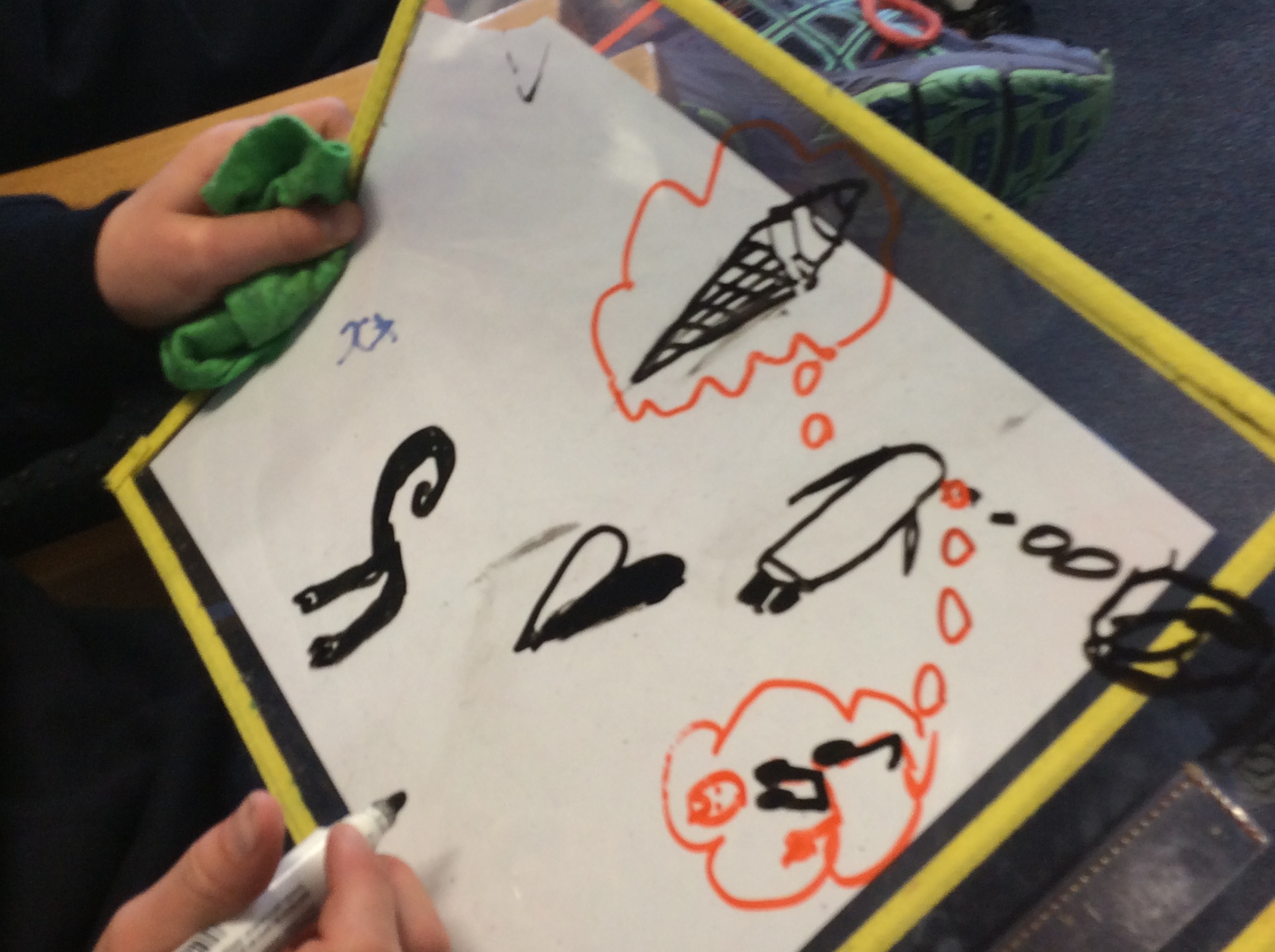
The activity I taught was one that I had read recently on the iFLT/NTPRS/CI Teaching Facebook PLN group. Students listened to and then illustrated 3 sentences read to them 1 by 1, from the story. They then swapped their clearboard with a friend. I repeated these 3 sentences many times incorporating reps and circling while students double checked that everything I’d said was included into the illustration given them by their friend. If the illustration was incomplete, they had to add the missing details. I then slowly read to them 1 by 1 three new sentences (that followed on from the previous sentences). Students listened to each sentence and added the new detail to the clearboard before swapping again with a new friend. I then repeated all the sentences, starting with the initial sentences getting as many reps as possible while students double checked again and added any missing detail to the illustration.

As Susan Close stepped through the doorway, the ketua kelas led the class greeting which appeared to blow her away.  Lincoln then stepped up and introduced himself and explained his role as host and translator. 

The lesson then continued with Lincoln translating and explaining to my left and the entourage standing along one side of my room and overflowing out the door!

While I was teaching, I was able to focus on my students and block out the fact that there were many extra bodies in our room. However as soon as the activity finished, I looked up and without intending to, made eye contact with the onlookers.  My mind instantly went blank!! That terrifying moment when self doubt creeps in and the could’ve/ should’ve list begins. Did the activity demonstrate #TPRS well? Should I have demonstrated kursi luar biasa? Did I incorporate enough circling? Etc etc All I could process was that the tukang foto had yet to arrange the class selfie which in hindsight was a good idea because Susan Close must have been in the Indonesian for way longer than the tight schedule had originally set out!! 

Later at recess when I thanked her for spending so much time in my room, she confessed that the TPRS observation had been what she’d been looking forward to the most!! What diplomacy. One of her comments that I loved was how amazed she was with the almost entire lesson being conducted in Indonesian. I truly hope that she appreciated the amount of communication in Indonesian that was happening as opposed to lots of talking about Indonesian in English as used to happen in my room!!

I would also like to acknowledge Margaret Roberts (back left in class selfie) for staying with me during the observation (her non- contact time) and supporting not just one of her colleagues, but also the TPRS Indonesian program.  After the minister left, Marg provided us all with a much appreciated brainbreak leading her students and me all in a quirky chant. Just what we needed. Terima kasih Ibu Marg; you are luar biasa!

Teaching Songs through TCI – Lupa Lupa Ingat

Lupa, Lupa Ingat (also know as Lupa Lupa tapi Ingat) is a brilliant song for using in the Indonesian Language classroom because of the minimal number of words in the lyrics as well as the constant repetition. The two main target structures are ‘lupa’ (forget) & ‘ingat’ (remember) – two very useful words!!

The song is sung by a band originally called Kuburan (The Grave – as in cemetery grave) however in 2011, they changed their name to The Kubs. They are a Gothic band and were originally  heavily influenced by Kiss which is very obvious when you watch their official clip! While the song itself would be appropriate for all year levels, I tend to use it only with year 6/7’s because the clip could be a little too confronting for younger students.

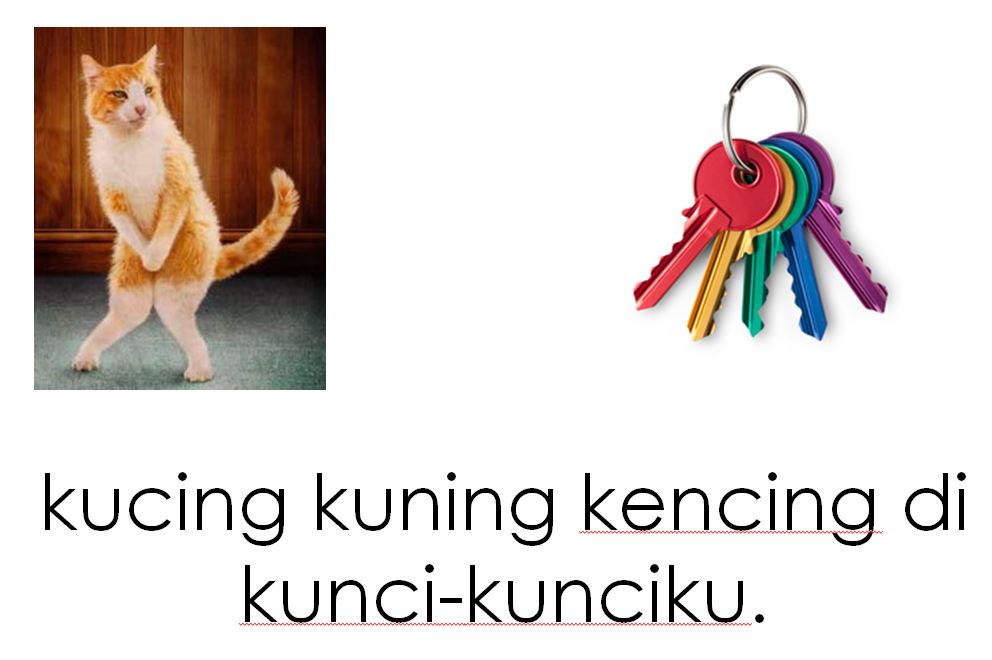
Teaching this song using TCI/TPRS has been heaps of fun. Whereas previously I relied on the quirkiness of the clip to engage students, it hasn’t been at all necessary this time. In fact, most classes have yet to see the clip! I am planning to save that for the finale. Instead of the song clip, I’ve been using a karaoke clip that just has the lyrics written up on the screen. The beauty of this, is that the focus is purely on the lyrics with no visual distractions. There are quite a few posts around with activity/lesson ideas and here are a few of the suggestions I have trialed successfully after pre-teaching the 2 main target structures. I decided to do this using tongue twisters as they are good fun and yet tricky to remember! It was awesome too, providing opportunities to those clever 4%-ers to shine!!

The tongue twisters I chose were:

and

I chose these 3 because they were short, quirky and each contained at least one familiar word. The final one in particular was chosen because it could be expanded to include the word ‘kunci’ which is one of the words from the song lyrics!

The above images are from a PowerPoint I  made using images from Google images. I then incorporated a slow fade for the text, so that when students felt that they could ‘remember’ the tongue twister well enough to repeat it, I tapped the board and the text vanished slowly giving them the opportunity to restate the tongue twister from memory!

After this, I found a few blogs that had ideas for teaching songs. The best (as usual) was Martina Bex‘s The Comprehensible Classroom, I found this post with heaps of ideas. Admittedly the majority of the ideas in this post are aimed at more complex song lyrics and also for older students, but none the less, I still got quite a few terrific ideas here.

Following are some of the successful ideas I used for teaching this song:

  1. Group singing: Put the students into groups of 4. In their groups they had to nominate one part of the song. (I divided up the song into 3 parts – firstly the verse about lupa, secondly the verse about ingat and finally the chorus) I then played the song and asked each group to focus on just singing their verse lyrics. We did that a few times and then I ramped it up by asking each group to stand and sing when it was their verse! If there was a verse/chorus that no one chose, then we all sang together! This song is so catchy that it is impossible not to join in!!
  2. Song Cloze: I did this today and it was very successful for getting heaps of repetitions. The cloze was handed out to individual students. They were asked to each fill in as many of the blanks as possible by themselves without asking for help from anyone. When they had done as much as they could, they had to turn their sheet over and doodle. This showed me who was finished and also kept the noise level down! I then asked them to get into pairs to compare their answers and then when they had all agreed on the correct answers, to turn their sheet over and doodle again. Finally I asked pairs to combine with another pair and again go through the lyrics and check their answers. When this was finished, I then played the first verse of the song. I asked students to circle the incorrect words and tick the line if they got all the words correct. Each group then had to reconvene and erase the incorrect words and replace it with the correct word, again from memory!  This part was awesome. I loved listening to the discussions – talk about focused debate!! I played the verse once more and each group listened again and by this time they had all lines correct. We then repeated this process again for the second verse and then the chorus.
  3. Divide the students into teams. Play the song and stop at a random spot. Groups have to confer and agree on what the next line is in the song. The first team where everyone puts up their hand gets to sing the next line. After they had sung it to the class, we listened to the next line and decided if they were correct. If so, they got a point. With the 3 classes I did this with, I was gobsmacked at how well the boys did with this activity. Whether it was the added level of competition or just that they were less shy about singing, I’m not sure, but it was delightful to see boys fist pumping when they got the song line correct!!


Here are a few more of the ideas from Martina Bex’s blog that I hope to try next:

  • Give students a list of lines from the song with a few imposters, and have them mark off lines as they hear them. The end goal is to identify lines that DON’T appear in the song.
  • Give students a lyrics sheet with mistakes in it, and have students correct the errors as they listen.
  • Give students a brief list of words that may or may not be in the song, and have them skim the lyrics to see how quickly they can identify which ones appear and which ones do not.
  • Draw a mural while you listen–draw any concept that you hear and can illustrate!
  • Physically arrange cut-up lines from the song on desks to put them in the correct order.
  • Cross off words from a sheet as they hear them sung in the song. (As the word count in this song is very low, a word cloud wouldn’t work!)
  • Do a dictation with lines from the song.


PS: A great tip for avoiding pesky/ inappropriate advertising that we get when using YouTube clips in class – ViewPure is your answer. I have a ‘purify’ tab bookmarked and it is awesome. When I find a video I want to show in class, I just purify it, save to the appropriate folder and then its ready to go. The other bonus of this, is that I can load it up at the beginning of the day, and it sits waiting for me to push play. After showing, it also stops right there – it doesn’t go on to play another clip which is another potential hazard with You Tube!


Where Am I Going Wrong?

I had a truly tough week the week before last – one of those weeks where every day was a struggle. After nights of tossing and turning in bed, I woke each morning, dreading the day ahead feeling little motivation or excitement for what I’d planned. Each afternoon, as the final bell rang, I’d sigh with relief and head home as quickly as possible to collapse on my bed. Why? All due to a horrible combination of back pain and sleep deprivation! Incredibly debilitating.

The final straw for me was when the last class of that week (year 6/7’s) arrived into my room pleading not to ‘do any more stories’. That statement gutted me. However, I deftly avoided any discussion about it because I wasn’t in the right place to deal with it rationally and instead asked them what they would prefer to do, insisting that all suggestions had to be language orientated. It came down to a vote between grudge ball and Bop! & grudge ball won. I couldn’t find their story, so instead used another class’ story (same target structures based on the same movie talk) asking for translations of random sentences into correct English. It was still worthwhile and enjoyable, although in hindsight I should have also randomly awarded points to various groups for behaviours such as having a go, working as a team, staying positive etc. because as soon as one group appeared to be too far in the lead, several students found it difficult to remain positive!

Since that lesson, I have been self-evaluating to try to understand why stories have become boring &/or unappealing. Now that the pain and lack of sleep fog have reduced (thanks to my wonderful physio and remedial masseuse – you both rock) there are several issues that I have to address in order to get myself and my students back on the fun and enjoyable TPRS train.


Student Motivation

While this is the start of their 3rd year of TPRS, older students have just as much need for up/down based lessons as do the younger students. Expecting them to sit for the majority of their lesson (movie talks, story asking) has been unrealistic. I honestly believed that student performances would be sufficiently compelling and engaging to counter balance this but it just isn’t the case. My students would benefit from and appreciate a variety of frequent activities incorporating movement and unpredictability that provide more repetitions of the target structures. Whereas brain breaks provide learners with time out from heavy duty concentration, active tasks provide students with kinesthetic ways in which to consolidate language acquisition. These tasks need to become an integral part of my lessons. My aim now is to search for suitable activities that would serve this purpose and if you look back on the home page, you’ll see that I’ve added a new page titled ‘Target Structure CI Activities’ and as I find them, I’ll add new ones to the collection (any help building up this collection will be greatly appreciated).


Classroom Management

My classroom management system has relied up till now on students and has been in place with minimal changes for 2 years. I offer a variety of jobs that students can try out for and these include sekretaris, polisi, mendistribusi kertas, pensil dan clipboard, menghitung waktu, tukang foto, menghitung kata just to name a few. The polisi is tasked with monitoring the blurting yet this is not happening consistently across all classes. I need to incorporate a few more classroom management ideas to ramp it up. I really like Annabelle Allen’s idea of having a competition between teacher & class. I am definitely going to trial it next week. However, do I offer a reward if the students win? If so, what could it be? Or do I save this for later in the term/year in case once again, I need to ramp things up again to increase student engagement?

Another idea I have used in the past (I’m sorry that I can’t remember where I read this and thus can’t credit them) is to have an object (soft toy/prop) that is passed around the class to the person who blurted last. The idea being that whoever is holding it when the lesson finishes has a consequence. When I first used this idea, I struggled with the consequence but not anymore. I am going to bite the bullet, be tough and insist on output from that student! If that student has so much to say, then they can do a 5/10 minute free write or even better, record their voice reading/retelling the class story in their own time. Hopefully this will give me a sneaky insight into their level of acquisition in a way that also gives me the opportunity to speak to them about their behaviour and how it impacts on other students.

One further aspect that requires immediate action is ensuring that job holders understand that they play a vital role in our lessons. They are there to help us to be successful in Indonesian lessons (both teachers and students!) and if they are not able to do that, then there are plenty of others who would happily replace them. This would require me to be firmer and clearer with the expectation of those interested in filling these roles with the ultimate consequence being that students will be sacked if they are not consistently fulfilling their obligations. (By the way, how do I say in Indonesian, “You’re fired!”?)


Brain Breaks

I also must incorporate more brain breaks into my lessons for a variety reasons. Not only will this increase student activity but also give students a chance to relax, take a break and have fun. All students appreciate fun, regardless of their age! There is no good reason why brain breaks are an important component of my junior primary lessons and yet not for my older students. Up till now, I have tended to include a list of brain break ideas at the bottom of each lesson plan just in case students need one. The main reason (I think) that I have avoided incorporating more brain breaks into my older students lessons is that I worry about ‘wasting’ their precious lesson time. Some classes only get one 50 minute lesson per week and therefore each minute is precious. I need to turn that thinking around and acknowledge the value of frequent & short brain breaks and be prepared to relinquish class time in order for students to learn the skills necessary for seamlessly moving into and out of brain breaks. Surely the benefits in the long run outweigh the negatives. Maybe I could tie it in with Annabelle Allen’s classroom behaviour management technique? Adding tally points to me if they are too slow or for the students if they regroup quickly and quietly afterwards. I now understand her comment that brain breaks should be done before they are needed and if you wait till students need the break, you waited too long.


Setting Class Expectations

As usual during week one, the specialist teachers at my school all combined and addressed this as one team to students via games and activities in the gym. In week 2, I jumped straight into a movie talk, which I continued over the next few weeks, in between various absences due to my back. It was a hodgepodge start to the year. Some classes didn’t have an Indonesian lesson until week 4! While we are always wiser in hindsight, I realise now that this was a shabby start to the new school year especially considering I attended a TPRS conference during the holidays! I should have known better. One should never assume anything and as a consequence, I will need to go right back to basics starting next week. I plan to do that by reminding them of how they can become successful language learners  and then regularly asking them to show me a quick honest self-assessment using their fingers (out of 5) to show how many of the questions below were ya.  This will also include the reminder to job holders of their responsibilities and the possible consequences should they be failing this.

Student Success

I’ve just finished a webinar with Terry Waltz which for me mid-way through writing this post, was very timely! I did feel guilty at first for taking one of the very limited spots, but now I am very grateful that I did. One point she raised which fits perfectly into this post is about students feeling successful with their language acquisition. Terry suggested this could be done through exit quizzes, quick quizzes etc where the students always do well because for TPRS, its all about setting our students up for success. There is never a focus on incorrect answers, incorrect pronunciation, incorrect word order etc. It’s all about positive reinforcement and student high fives and it’s the major reason I heart TPRS. Students are never asked to revisit mistakes, never made to feel ‘dumb’ unlike in other subject areas where students are asked to walk through back their mistakes to understand where they went wrong! This is reflected in our class ‘bell curves’ when plotting data, because they are never ‘normal’. TPRS bell curves are heavily weighted towards the higher end of available grades/percentages unlike other subjects where it is more central.


Deconstructing Student Plea of ‘No More Stories Today!’

While spending quite a few hours trawling through fantastic TPRS blogs this morning (including those by Martina Bex & Keith Toda) looking for novel activities to get reps on target structures, it suddenly dawned on me that it wasn’t the story itself that the students were objecting to! It was all of the above issues that together created endless & predictable lessons with minimal spontaneity. Martina mentioned in one of her posts that all CI activities should not last more than 10 minutes, Terry Waltz also mentioned it yesterday in her webinar – I’ve heard and read this many times yet why do I feel compelled to keep going even when all the signs are telling me to STOP? It’s for a multitude of reasons yet the best thing of all is that I’ve finally realised what I believe was the unspoken message underlying my students plea.  I can now begin to address improving my effectiveness as an Indonesian teacher through incorporating more variety and movement into my lessons and thus re-engage my students.


NB: New goal – Overhaul lesson plans to incorporate all of the above points.


One Off Reduced Class Lesson Ideas- Silent Movies

Anne Cedeno shared this on the CI Liftoff Facebook page today for those days when class sizes are drastically reduced due to inexplicable school events:

This idea came from Sr. Wooly’s workshop at NTPRS last summer, and might be fun and better managed with the reduced group size: Each team of 3 kids needs one video recording device (smart phone or iPad will work well); one student will film and the other two will be actors. Focus on basic verbs (super 7, sweet 16, etc.) student plan a simple, school appropriate plot for a SILENT MOVIE they can film at school during your class, using features of the school (stairway, cafeteria, window, etc) and simple props that you might provide or they can bring in if they plan one day and film the next. Filming happens in short (max 6-10 second) clips (using iMovie or AdobeClip). plot needs to focus on simple things like where the actor is, what they have, what they want (the problem) and where they go (to try to solve the problem). Since no voices are recorded, it totally eliminates bad pronunciation, and puts the emphasis on the kids to show emotion and plot through facial expression and gestures. Then the video clips need to get shortened down to the essence of what shows the essential plot and the product is a 1-2 minute silent movie for you use for movie talk, staring your own students – My kids recently got iPads, so I’m planning on doing this soon. School-appropriate humor, unexpected surprises/plot twists will be encouraged:) In years past, when my students filmed each other acting out scenes from a novel, etc. the downside was always the pressure they felt about their pronunciation in L2, which lead to many many retakes – but Sr. Wooly’s idea to make it a silent movie eliminates that pressure and lets the kids focus on the fun/teamwork to create the movie and then as a whole class we can Movie Talk 🙂

Wow TPRS Sounds Awesome But Where do I Start? 

Over the past 2 years that I’ve been using TPRS in my Indonesian classroom, I’ve used many different stories, most of which have been suggested by Catharina, our wonderful mentor. We are so fortunate to have been introduced to such a highly experienced Early Years TPRS mentor who has a wealth of story recommendations focusing on any given target structure! Any story recommended by Catharina is a guaranteed ‘home run’!

After all the workshops or the conference I attended or presented at, the inevitable question from interested participants was always; “Where do we start?” This was where Catharina was initially extremely helpful for us when we first began TPRS. Each time we reached a road block and became puzzled about our future direction, she would gently and positively guide and nudge us back on track with constructive feedback, sharing ideas and activities from her own classroom practise.

This post hopefully will give you an idea of where to start if you are at the beginning of your TPRS journey. I teach students from Reception (Prep/Transition) to year 7 and as most TPRS stories are written for middle years students, the cohort we initially had the greatest difficulty adapting TPRS to were the junior primary students, hence my focus in this post. However, don’t change the channel just yet, because first time learners are largely the same regardless of their age. The major difference, I’m sure you will all agree,  is their attention span! Everything else remains identical. 

My stories are in Indonesian (what a surpise) however they can easily be translated (back) into other languages using google translate. We received them in a variety of languages before translating them into Indonesian incorporating high frequency vocabulary where possible and eliminating any language we felt our students were not ready for or that did not work in Indonesian. Also, if the story is too simplified for your cohort, add detail and language to ensure it is more suitable yet remember to always keep it comprehensible with no more than 1 – 3 (unfamiliar) target structures. NO MORE THAN 3!

The first ever story we started with is Catharina’s adaptation of Jim Tripp’s, “Nice to Meet You.” This story is without doubt, in my humble opinion, the best place to begin a CI journey for either students for whom this is their first ever contact with the language you are teaching OR for a teacher who lacks confidence in his/her CI skills &/or language skills & is about to begin their first ever CI unit of work.

The original story:

Target structures: 

-meets

-My name is ______ 

-gets really nervous 

-nice to meet you 

Lindsey meets Channing Tatum. Lindsey says to him, “Hi, my name is Lindsey.” Channing Tatum says nervously, “Nice to meet you.” He gets more nervous and says, “My name is Luke Skywalker.” Lindsey says to him, “Nice to meet you Luke.”

The simplified adapted version:

Target Structures;

  • berkata,
  • nama saya,
  • siapa nama?

Other: di, dari, astaga (point & pause only)

Taylor Swift di MacDonald’s.

Bu Cathy di MacDonald’s

Tayor Swift berkata, “Nama saya Taylor Swift. Siapa nama?”

Bu Cathy berkata, “Nama saya Bu Cathy.”

Taylor Swift berkata,”Bu Cathy? Bu Cathy dari PEPS?”

Astaga!

Autograf!!

(Taylor Swift faints)

Suggested sightly more difficult version:

Kemarin, Taylor Swift di Macdonald’s.

Kemarin, Bu Cathy di Macdonald’s juga.

Tayor Swift berkata, “Nama saya Taylor Swift. Siapa nama?”

Bu Cathy berkata, “Nama saya Bu Cathy.”

Taylor Swift berkata,”Bu Cathy? Bu Cathy dari PEPS?”

Astaga!

Autograf!!

(Taylor Swift faints)

As you can see the original version is not suitable for young learners because there are significantly more than 3 target structures for students to acquire. I also like the way Catharina has tweaked it to make it more appealing. Adding a faint at the end is ingenious! I have story asked this story with staff too at a staff meeting! It is such an awesome story for beginner learners and appeals to all ages with its simple language and unexpected ending!

Once you have chosen your new story and identified the target structures, you are ready to start. At the conference, Terry began by story asking mini stories based on each of the target structures, focusing on one at a time. I personally prefer a technique I read about on Ben Slavic’s website called Visual Personalised Questions and Answers (VPQA).  This has been very engaging for my students and is also helpful for teachers new to circling and story asking because VPQA provides teachers with our own personal brain break!! It relieves some of the stress by giving a tiny breather in which we can regroup and get the TPRS juggling balls back in the air again. 

If the target structure is ‘berkata,’ I start by  creating a powerpoint. I begin with a google image search for quirky images that will appeal to my students and give me opportunities to ask my students personalised questions and answers. This upcoming week, my reception students will be revising Nama saya (my name is) & Siapa nama? (what’s your name?) while introducing ‘berkata’ (said/say/says). Using Ibu Sharon’s awesome idea, I have found pictures of characters familiar to my young students (Elsa, Pikachu, Donkey, Bob the Builder – to name a few) all of whom have a phrase that they are known for saying. E.g. Elsa berkata, “Let it go.” On each page is a picture of the character with his/her/its given phrase. This allows me to ask, “Siapa nama?” and then circle the name (Nama saya Elsa? Nama saya Bob the builder atau/or Nama saya Elsa?) I can then circle the target structure; “Dory berkata, ‘Keep on swimming” atau Elsa berkata, “Keep on swimming”? Because each picture is different, VPQA keeps them on the edge of their seat wondering what the next picture will be! While PQA & VPQA is technically personalised questions about the students, at this early stage, to keep the language in bounds it may be necessary to restrict the circling just for now to just ask about the characters on the screen. I would definitely not recommend using any new question words this early in their learning! The language used must, must, must be in bounds. To ask, “Pak Taylor berkata apa?” will immediately raise their affective filter and could potentially derail that lovely calm, comprehensible atmosphere you have created. If Pak Taylor does have a phrase that he is well known for, then ask, Pak Taylor berkata, “Let it go?” atau Pak Taylor berkata, “Howzat?” Ya, Pak Taylor berkata, “Howzat!” (Does Mr Taylor says, “Let it go” or does Mr Taylor say, “Howzat?”) Stick to the language they know!! It is too early (especially for very young learners) to toss them new and unfamiliar vocabulary. 

Once I feel that students have  largely acquired the target structures, I move to story asking. I don’t worry too much if there are students who have not fully acquired the target structures yet for several reasons. Firstly we will hit them (oops – the target structures!) repeatedly during the story asking process and secondly most target structures will be repeated over and over in future stories. This would have to be the single best factor of TPRS and is why it triumphs over the way I used to teach. The structures we target now are specifically chosen for communication in a classroom context (and hopefully useful on their next family holiday to Bali) and thus will be used often unlike previously where from term to term, my thematic vocabulary was rarely revisited.
The above stories are the skeleton and all the words underlined are the words you can ask for student input depending on their age. Usually I ask for an ‘aktor’  and then ask the class, “Laki laki atau perempuan?” before asking, “Siapa nama?” However for my young (brand new to school)  reception students, I have planned to tell their first ever  story to them using cut out pictures with magnets on the back moving them around on my mobile white board. Then, once they are more familiar with me and my teaching style, I will ask for their input — usually they’ll be ready by the next story!

When planning for young students, the best advice I ever received was to plan activities so that the students move up, down, up, down throughout the lesson. The younger they are, the more frequently the teacher changes the activity. Thus, once the story has been asked (a ‘down’ activity), it is time for the students to stand up and do an ‘up’ activity. This can either be a brain break, TPR or could be an activity based on the story. My favourite activity post story asking is called ‘all the worlds a stage”. Students get into pairs and duduk (sit). I then explain (in English for now but soon will be in Indonesian) that one of them is Pak Hudson (our school principal) and one of them is Superman (the 2 characters in our story). I will then say, “Superman berdiri. Superman duduk. Pak Hudson berdiri. Pak Hudson duduk.” This incorporates TPR and also ensures that each pair has agreed on who is each character. At this point there will inevitably be a pair who both want to be the same character. At this point I promise the whole class that we will be doing this activity twice and the second time they will be changing characters. I then allocate characters to the pair who need help, reassuring the one who compromised, their turn is coming next! Depending on their level of compliance with my decision, I distract them totally by choosing them to be my demo pair which is usually a highly successful tactic! I then say the first  line from the story and ask them to act it out, giving them pandai points for great acting, for only acting out what I said and for not going ahead or adding in their own details. All very important information that needs to be clarified right from the beginning. If my demo pair demonstrated that they understood the task, I invite all the Superman’s and Pak Hudson’s to berdiri and then we begin again right from the beginning. It will probably be chaotic the first time we do this activity, but it is well worth persevering because later in the year with practise it becomes smoother and is such an excellent ‘up’ activity while getting in heaps of repetitions of the story and with comprehension checks!

One final note: If you absolutely need to say a word students have yet to acquire, say it in English for this first story. This is how I tackle the ‘other’ word list. I need these words for the story but they are not target structures. The first time I story ask, I say the ‘other’ words in English. Then slowly introduce them in Indonesian, quickly followed by a comprehension check. If the comprehension check is met with blank confused looks, I know immediately they are not ready for it yet – the students need more repetitions of the story – and I’ll try again later. 

This is the very first TPRS story I started with and initially taught it to all year levels. It worked with all my classes. Now, though, I just use it with my reception classes. I still remain totally convinced that it is the best story to start with, regardless of the age of the students.

Do you have a favourite story you begin with? I’d love to hear it. Feel free to write it below in the comments!