Category: **
Playing around with Zaption
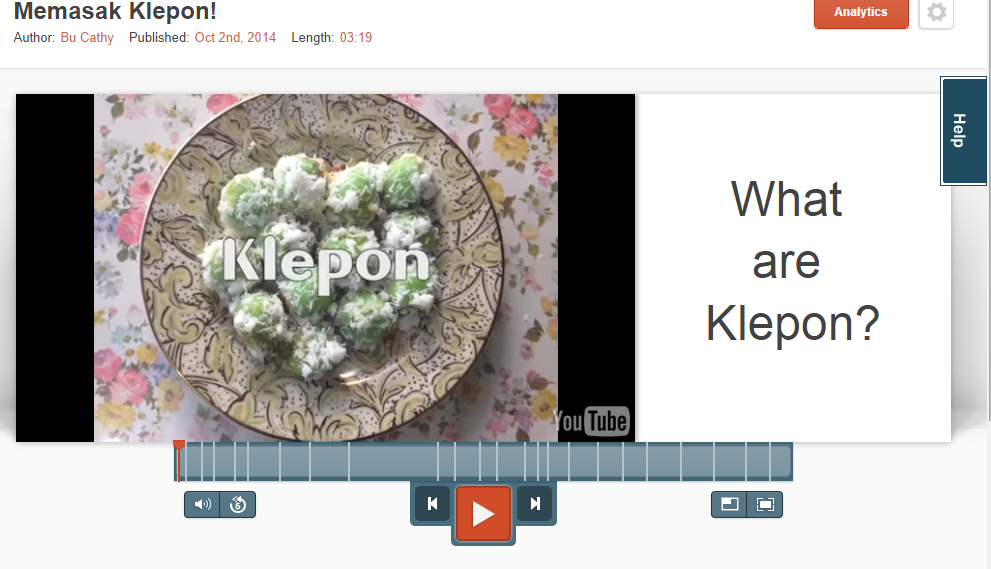
Have you discovered Zaption yet? It is a fun way to present a video and has heaps of potential for Language classrooms. I love that you can choose whether the video stops, or the text just goes over the top while the video continues. There is also a blackout option, which is really handy when you find the perfect clip but it has a tiny unsuitable part that needs cropping out.
Here is a one of mine that I have created for my upper primary students, who are about to embark on a cooking theme.
However, I have a feeling you may have to login first:
Pabrik Rotan Di Cirebon Ludes Terbakar
Here is a fantastic example of authentic text. Could it be of use to high school Indonesian Language teachers? Lots of really interesting and well written articles on this blog! Check it out!
Parents Information Evening – ICT
On Thursday evening a group of 3 teachers & our principal invited our parents to come and learn about how teachers are using ICT in the classroom. We promoted the event through our newsletter, word of mouth & on our school Facebook page. 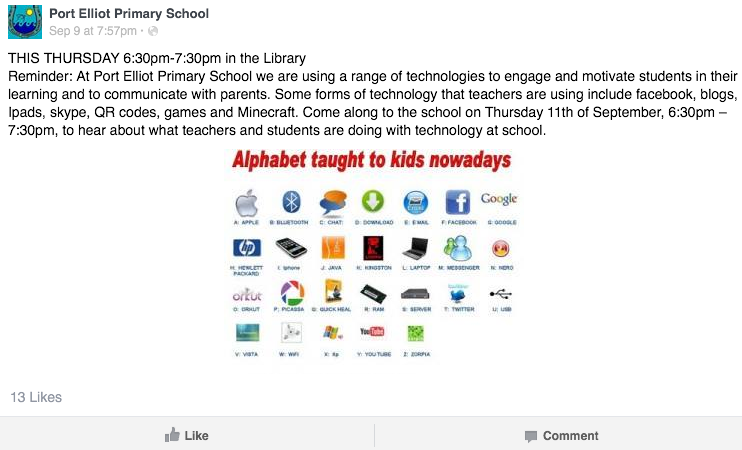
The 3 teachers were Sandy, a year 3 teacher, Kathy, a year 7 teacher & ICT coordinator and myself, so we were a pretty good cross section of teachers from PEPS. We were all there early to prepare for our presentations and Kathy also set out a great display of recent purchases that have been very popular with students.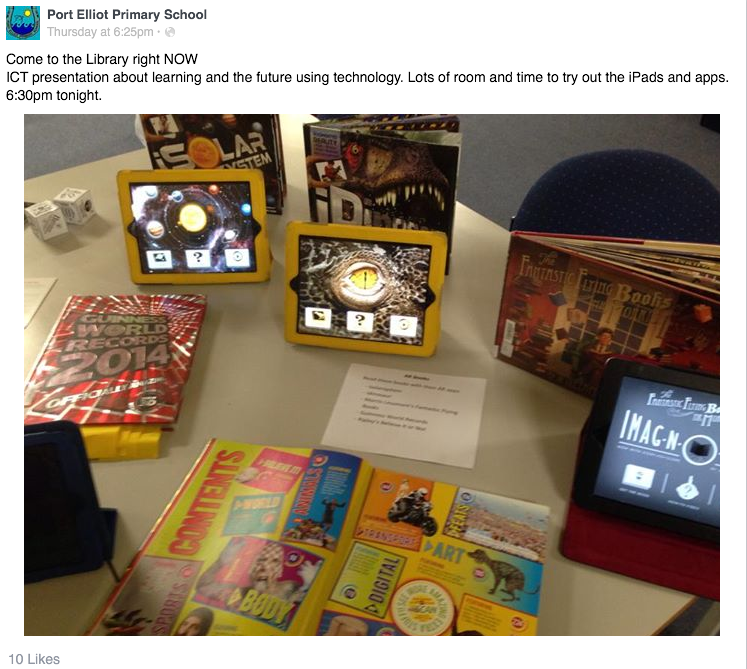 Our first families to arrive went straight to this table where the children had heaps of fun coordinating the ‘dinosaur’ to munch on Mr Hudson (our principal)!

While the number of parents who turned up wasn’t overwhelming, it was a lovely, cozy group, representing all year levels, which created a warm and friendly atmosphere.
Brenton welcomed everyone and then gave a brief presentation which included his wish to create an innovative school which focuses on teaching 21st century skills to students whose future will require skills and knowledge we can barely even imagine.
Kathy next outlined the DECD policy and how we implement and enforce it in our school to ensure students develop cyber safety skills.
 Kathy also talked about the various class blogs that teachers have created. We have links to most of them on our website and I too was amazed to learn just how many PEPS teachers have blogs! She next mentioned our Facebook page before talking about how teachers use Youtube in the classroom. Some of us have our own Youtube channel which is where we upload work completed in the classroom. (I too have one in my name – Bu Cathy- which also has quite a few videos I made last year while traveling specifically for the Indonesian classroom)

Sandy next took the stage and shared with the parents the various ways in which she has used technology in her classroom.
We saw on of the films that several students made using imovie,
 talked about the ipad app book creator,
 and she shared a fantastic app that she uses as part of the daily 5
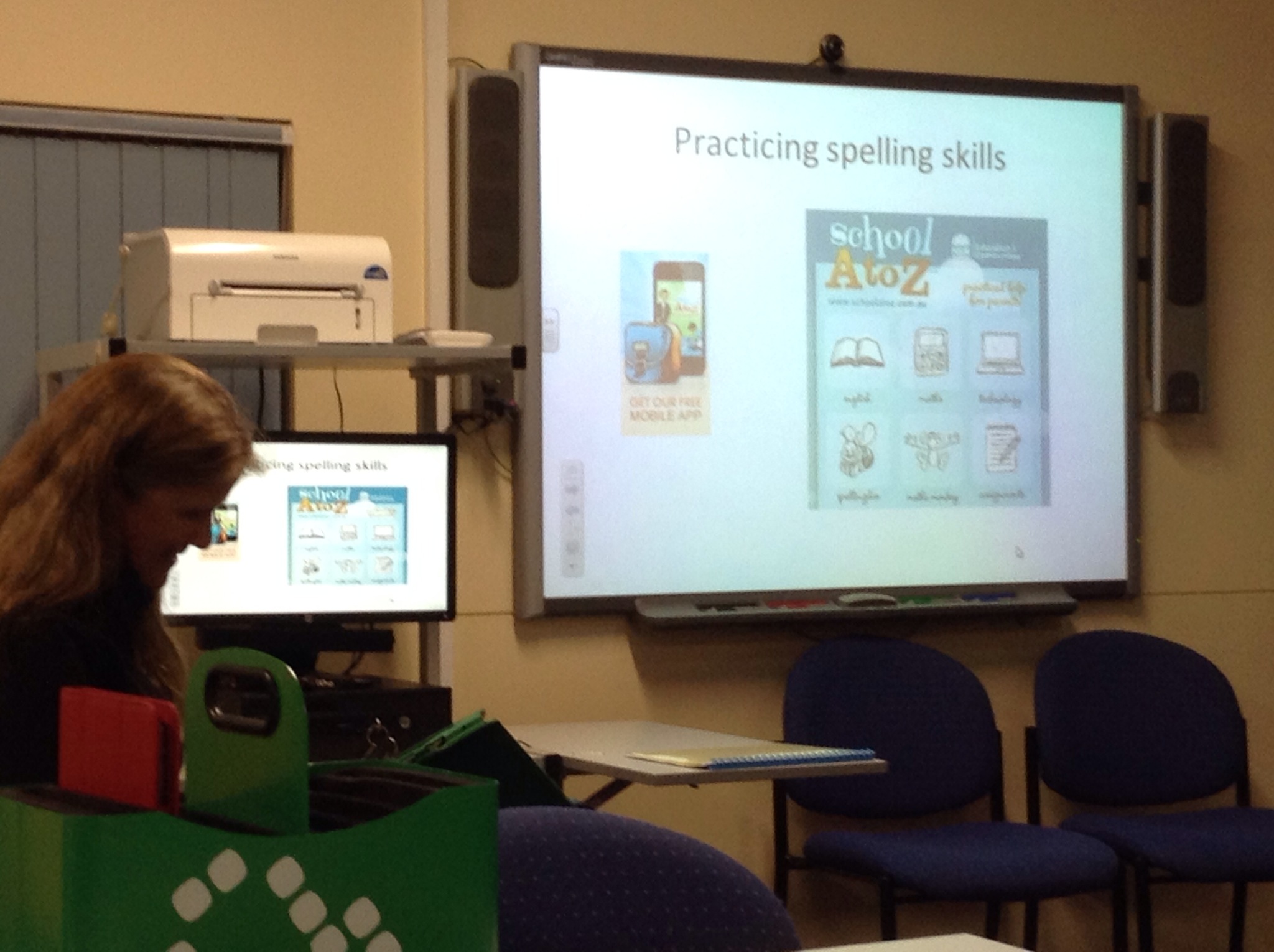 Parents enjoyed a demonstration of how students use it to learn their spelling words.
 Sandy also shared a recording of a student demonstrating his ‘paddleboat’ creation made from plastic bottles before sharing with parents her class blog. As Sandy finished up saying, these are just a few of the ways in which ICT is incorporated into her classroom!
It was my turn next. I had planned for a friend in Indonesia to be available to do a mystery Skype with the parents so they could experience the fun firsthand.
 However as the parents walked in the door, I received a message from her apologising that she could no longer participate. So instead, I shared a video I have put together using footage from the Mystery Skype the Year 6’s did last week with BIS in Bali. In retrospect, this worked even better, because it was provided a brief snap shot yet captured the real excitement and collaboration involved.
Kathy concluded the evening with a video she had put togther highlighting the various projects currently being undertaken in various rooms including minecraft, stop animation and puppet pals. It was a great way to finish on a high note. It was brilliant being involved and I was truly chuffed to be invited to speak to the parents about what has been happening in the Indonesian room lately. The following morning, one of the parents caught me to express her thanks and appreciation to us all for holding the event and she told me that she was gobsmacked at what teachers at PEPS have been doing with ICT in our rooms with our students. What great feedback!

Mystery Skype With Year 5 From BIS
This term, all upper primary classes were hoping to mystery Skype and their term outline mirrored this. Of the 4 UP classes at PEPS, two were side tracked with other projects – Year 5’s planned and hosted our amazing Indonesian Independence Day Assembly and the Year 5/6 class continue to work on an ongoing project- investigating and comparing sport, hobbies and recreation with our sister school, Bakti Mulya 400 (more on this later).
The remaining 2 UP classes (a year 6 and a year 6/7) have each lesson, walked into class asking, “Are we Mystery Skyping today?” and each lesson I have had to sadly inform them that yet again I have failed to find a class in a suitable time zone that is free to Mystery Skype with them. While the search was on for that elusive class, each lesson was instead used to prepare for the eventual mystery Skype. None of us gave up hope! Students planned and wrote presentations about our local area to share after the mystery Skype, they worked and reworked jobs that would be useful, twittered to their readiness to the universe and also participated in a face to face Mystery Skype with international ( Indonesian) visitors. While disappointing, in retrospect, each of these steps was valuable and helped prepare them.
It was so exciting when I finally found a teacher & her class who were interested. One of the many teachers listed on the Mystery Skype website whom I had contacted, recommended I contact Nadia. I was delighted to receive an email back immediately from Nadia. She had never heard of Mystery Skype but liked the sound of it and was keen to give it a go. Wow – don’t you just love working with people like that!!
The day before D-Day (or should that be M-S Day?), we Skyped each other to iron out any last minute glitches. This gave us the opportunity to finally ‘meet’ each other, double check the time difference, and for me to share the list of jobs the students were going to use. Her class is a year 5 which matched age wise our year 6’s. I am so glad we did this as I had difficulty logging onto Skype through my school PC, so after our Skype call finished, I quickly ran over to Darryn (our marvelous & brilliant tech support guru) who easily fixed the problem for me. He also tried to replace the globe in my smart board too in preparation for the Mystery Skype, however as this globe is one of the older models, we are still awaiting their delivery. So Darryn replaced the globe and foolishly, I didn’t turn it on while he was in the room. The first thing I discovered the next day was that the smart board was not working!! Oh well, at least Skype was working on my PC, and also the 2 newly set up PC’s were on the server (& internet) were working as they are so much better for using google earth than the iPads.
When the year 6’s arrived into class, before they had a chance to open their mouths and ask the well worn question, I announced that their mystery Skype was about to happen and they needed to get organised asap. The excitement in the air was palpable, it was awesome. Teams were quickly setup and the 2 question askers/greeters sat themselves at my desk while I pressed the red phone symbol on the Skype website.
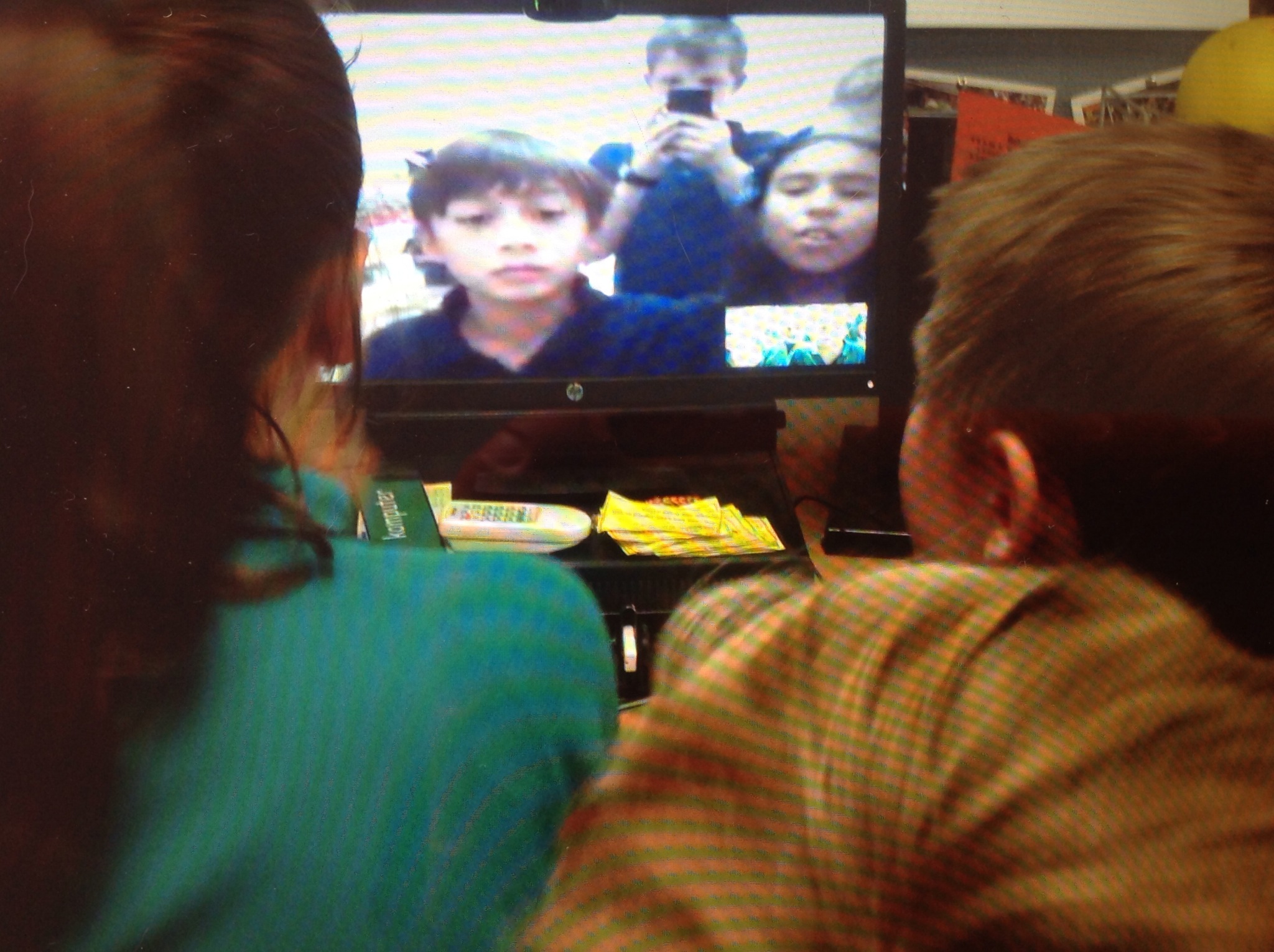
Harry & Ruby introduced themselves and we were off. Whereas they quickly guessed we were from Australia (our accents were a dead give away), the year 6’s were side tracked early by the percieved American accent of their greeters. Thankfully they quickly reigned themselves in and returned to a better opening question to determine which hemisphere they live in.
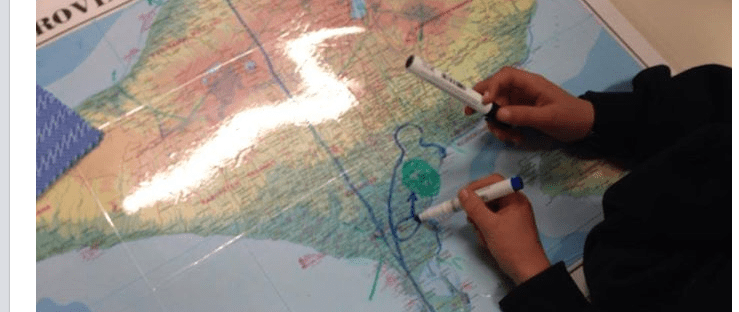
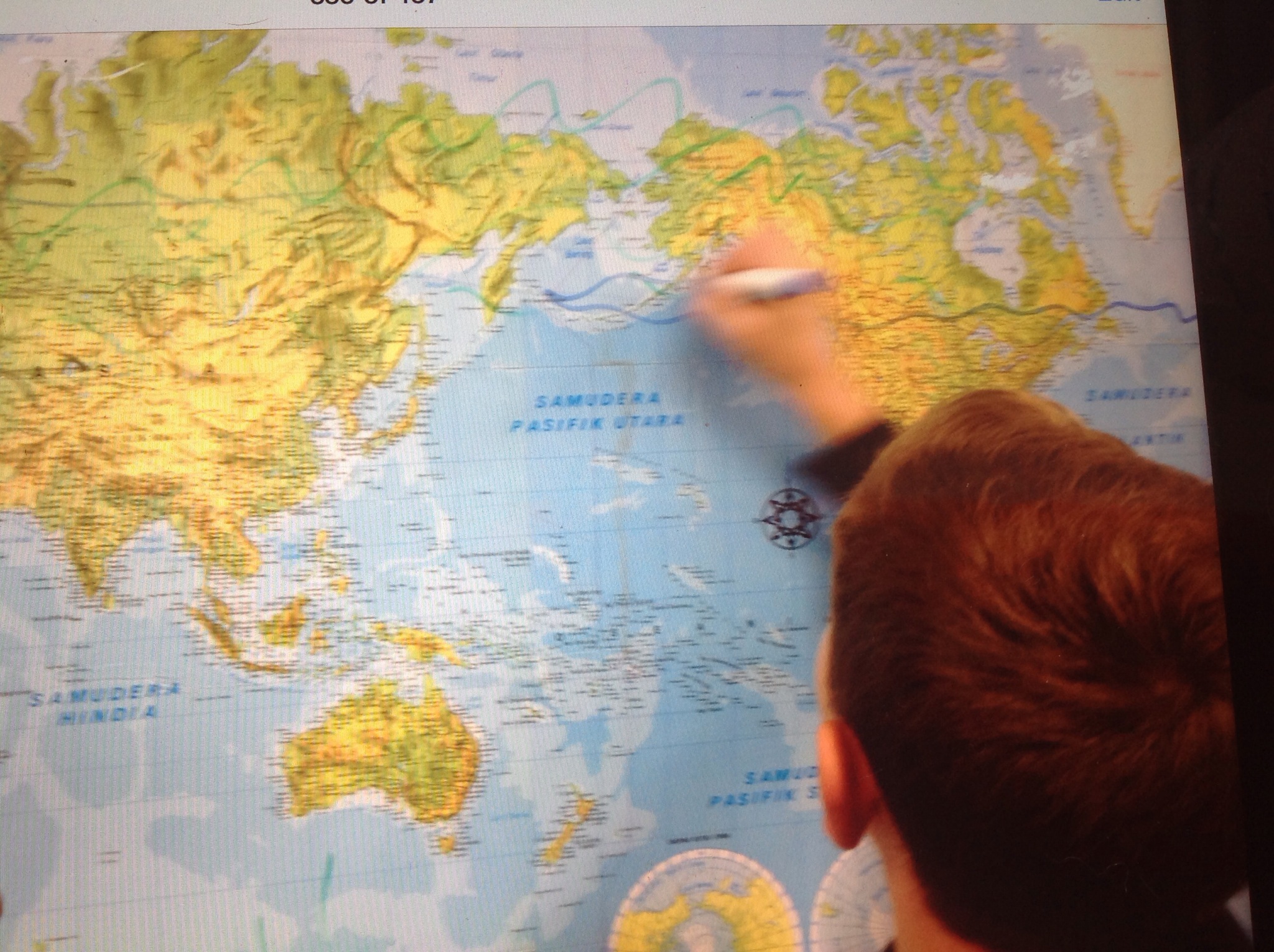 The mappers began with the map of the world on the back wall, progressing to the maps of South East Asia and eventually to the large map of Bali. I was again amazed that the maps seemed to be the ‘atlas’ of choice over the Google Earth. Our year 7 teacher/ICT coordinator, Kathy, joined us for the Mystery Skype and we discussed this interesting development. Maybe when we Skype a non-Indonesian country and I don’t have detailed maps for them to use, Google Earth might be more popular. It was great having another adult in the room to discuss it all with and to soak up the atmosphere together. It really was electric and unless you have experienced a mystery Skype, it is so hard to explain or describe it without sounding like a total nerd.
The logical reasoning team did a brilliant job, dealing with the high pressure both from themselves and others. The right question was finally asked, “Are you in Sanur?” before unfortunately our lunch bell rang, so we had to being it all to a very abrupt end. We just had enough time to share with them our location and for Harry to ask Lachie for his Instagram name before saying goodbye.

It was an absolutely brilliant experience and in retrospect a great way for 2 classes to meet each other. Nadia and I are really keen to continue the link between these two classes and have them investigate aspects of culture together about which I am sooo excited. It will be a very Interesting study for both groups and should blow quite a few myths out of the water!
A truly awesome experience. Thanks to Year 6 PEPS & Year 5 BIS for making it so.
iMovie Trailers – A Fun & Easy Icebreaker!
What a fantastic idea to use next week with a group of visiting Indonesian students and teachers. They will be in our school for just the afternoon and working with 2 different classes as a once off. I have been wracking my brains to come up with a project idea whereby students collaborate together on the iPads. This is perfect! Thanks & great timing!


iMovie trailers on iPad/iPhone/iPod touch
Here is a great ice breaker activity for you if you have a few iPads to use in your classroom. iMovie comes free from Apple with new devices. If you have an older iDevice, it will cost you $4.99USD.
You will need around one iPad per group of 2-6 students. Or, if you only have one iPad, create a trailer as a class.
iMovie trailers is a very fun and easy way to create awesome short videos. Your class will probably be able to finish within one to two hours.
Note that you don’t need to worry about any spoken lines. Have your students first choose a theme, then figure out the written parts either before or during filming.
How to film, step-by-step
Have groups of 2-4. Students should take turns filming and make sure each person is featured in the movie.
1. Open iMovie…
View original post 667 more words
Jalanan ; A Movie About Busking in Jakarta
While traveling in Indonesia last year, I caught many buses. Throughout Java and Bali, I frequently had buskers jump on board and serenade us before handing out the lolly bag to collect donations. Read my post here. What a fascinating topic for a film and one I really hope to get a chance to see it one day!
https://theconversation.com/jalanan-busking-and-dreaming-in-the-city

Have a look at this Youtube promo:
http://youtu.be/TtIOFyNyF6U
Jalanan: Busking and dreaming in the city
AUTHOR – Eric Sasono
By telling the stories of Boni, Titi and Ho, Jalanan brings to the screen the hardships and precarious lives of marginalised people in one of the most economically promising Asian countries. Courtesy of Jalanan Movie Team
Daniel Ziv’s documentary feature Jalanan (Streetside), currently screening at the Melbourne International Film Festival, is a film that seeks to move its audience.
Documentaries sometimes invite viewers to social and political engagement. To do this, they might put viewers into uncomfortable situations. Jalanan, the story of three Jakarta buskers, Boni, Titi and Ho, is this kind of film.
Ziv, an Indonesia-based Canadian filmmaker, filmed the three street singers for six years. He pointed his camera at their reality and homed in on the social and political forces that shaped it.
By telling the stories of Boni, Titi and Ho, Jalanan brings to the screen the hardships and precarious lives of marginalised people in one of the most economically promising Asian countries. Jalanan presents the three as aspiring individuals with self-actualisation needs amid the hardship they encounter on a day-to-day basis.
Everyone is looking for something
Boni, an illiterate “singer-songwriter”, has been living in a canal tunnel with his wife, Rita for ten years. He dreams of a proper home yet all he can do is paint the word “Hyatt” on the tunnel wall.
Titi is a mother of three. Her children are scattered in three different cities. She sends money for her sickly father’s medication and for her child’s education in the village. Titi stresses how important it is that her children “not be a busker” as she is, signifying the importance of making the leap in social class.
The other busker, Ho, sings his political songs with a rugged voice, suggesting that his listeners “hang the corruptors”. He lives alone and tries to find true love.
Jalanan is screening at this year’s Melbourne International Film Festival.
With these aspirations, the documentary subjects qualify as protagonists in a neo-classic Hollywood story: an individual tries to achieve something and faces obstacles in the process. Jalanan benefits from this model of storytelling. It avoids didactic forms and, rather, asserts some kind of audience self-identification. Wanting a better place to live, improving social status and finding true love are universal aspirations.
Just like in Hollywood, Jalanan also brings closure to the protagonists’ venture, keeping the audience from seriously questioning what happens to them after the screening.
Beyond the film, the filmmakers have started a crowd-funding initiative to provide houses for the buskers.
Watching poverty in luxurious malls
Viewers in Indonesia won’t escape the irony when they go to cinemas in luxurious shopping malls to watch Jalanan. But filmmakers have no choice but to screen their work in this way if they want their films to reach a larger audience in Indonesia. Gentrification of Indonesian movie theatres since the 1990s has seen small cinemas fold and mega-cinemas thrive.
Jalanan provides enlightenment and entertainment, of some sort, for the middle and upper class of Jakartans who are willing to spend their money on a diverting spectacle. In Indonesia, it has a limited distribution in 21 Cinepelex, the cinema chain that dominates the country’s film distribution.
From the screen to public policy
Despite its limited distribution, Jalanan has benefited from its status as a documentary film. Audiences often perceive arguments presented in a documentary as undeniable truths. Sometimes, the documentary form can prompt viewers’ social and political engagement.
Jalanan managed to do this when acting Jakarta governor Basuki “Ahok” Tjahaja Purnama watched the film with his staff (the governor, Joko Widodo, now president-elect, was taking leave for his presidential election campaign). Ahok saw many things that fell under his responsibility go wrong in the documentary. Seeing the “jail”, which is actually a social rehabilitation institution where Ho was locked up, disturbed Ahok. In the film, Jakarta public order officers arrested Ho for busking and for not having his identification card.
According to Rolling Stone Indonesia, Ahok immediately discussed with his staff what he saw in the documentary. He instructed them to close down the “jail”, expedite the development of apartments for the poor and ease regulations for newcomers to get their Jakarta ID card. He also ordered his staff to eradicate corruption in public offices, especially the religious affairs agency responsible for providing marriage certificate.
Jalanan’s influence on public policy in Jakarta might be a one-off. It’s hardly a typical outcome for a documentary, after all. Documentary films work hard to promote social or political engagement – or at least an awareness – with their subject. For the next level of engagement, it helps to have “reformist” public officials in the audience.
The Melbourne International Film Festival 2014 runs until Sunday August 17.
Throwback Thursday: 15 Games for the FL Class


Since I have been blogging for a little bit, I find it can be cumbersome to visit all of the archives to get ideas. This is my attempt to consolidate these ideas bit by bit. First up are 15 games for the FL classroom. I have this as a Google Doc link, so I can modify it as time goes on. Most of these are not my ideas, and I tried to give credit where credit was due. I also added on some extra games that were not originally on my blog for those that have read all of my games. Enjoy!
Gunung Api
This semester, much to their delight, junior primary classes are learning about volcanoes. It is a topic that students have asked to do for quite a while. When I first covered this topic many years ago, I bought a plastic model of a volcano.

It used to sit on a shelf behind my desk and was constantly drawing comments and requests from students. It now sits in my cupboard with my enormous dice which also piqued student curiosity!
Can you imagine their delight when it emerged from the cupboard and not only that, I opened it (not easy as the tabs fit so snuggly) and we then talked about the parts of a volcano. My students are full of questions about volcanoes and for the first time, I am not being the font of all knowledge. I am trialling the idea of putting our questions up onto twitter or putting the onus back on the students to help find the answers. With the first batch of questions, I have recorded them and we should be able to tick off a few now. Here are the questions from one of our reception classes:
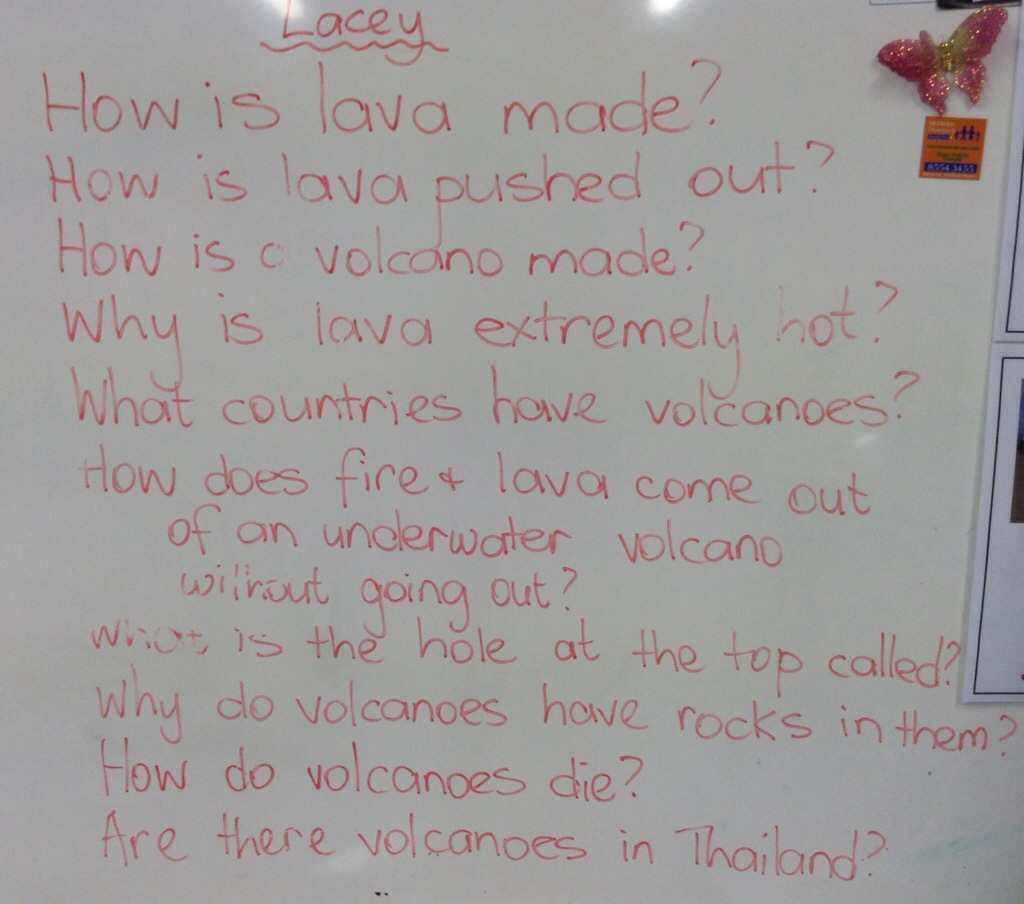
After tomorrows lesson we should be able to tick off some.
This week, I wanted to incorporate some Indonesian language into a topic that has been largely conducted in English so far. We revised the terms we learned last week (magma chamber, vent, ash cloud & lava) through a great youtube video (Geography lesson: What is a Volcano) and then students worked collaboratively in groups to create a volcano using construction paper & Brenex squares. I explained that they had to decide as a group how they created the picture, the only thing that had to do was correctly affix the labels ‘gunung api’ & ‘lahar’.
The results are amazing and make a very colourful display!

Giving a Presentation in a Foreign Language
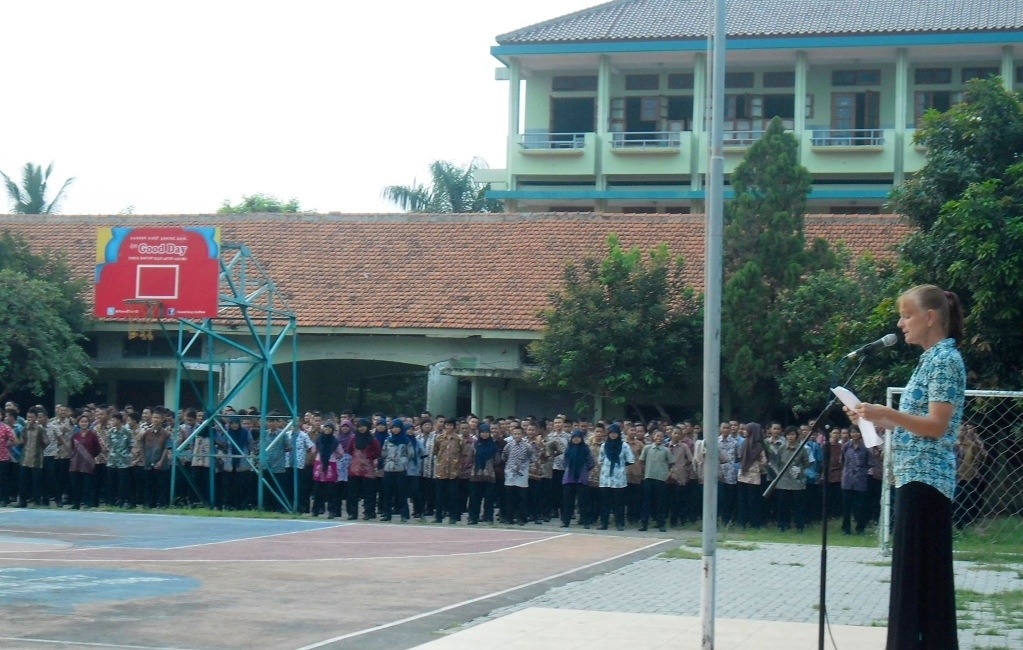
What fantastic advice! Last year while traveling around Indonesia, I gave several speeches in Indonesian, all of which were nerve wracking. In each case, I wrote out my speech and then read it to my audience (which was usually the staff and students from an entire school!) verbatim. It is definitely a skill I need to perfect and one I actually want to perfect. >
6 Must-Know Tips for Giving a Presentation in a Foreign Language
Posted on 14. Oct, 2013 by meaghan in Language Learning
Speaking in a foreign language can be a challenge in and of itself—giving a presentation in a foreign language makes that challenge even more…. well, challenging. Whether you’re presenting to your classmates, your co-workers, or your community, you’ll want to practice a little harder than normal. These tips will help you perfect your presentation, leaving minds blown rather than tongues tied.
6 Must-Know Tips for Giving a Presentation in a Foreign Language from Transparent Language, Inc.
1. Don’t script yourself.
Practice, practice, practice—but don’t memorize. Scripting yourself is a terrible idea for any presentation, regardless of language. It doesn’t make for a very compelling or natural presentation, and you might panic if you forget or veer away from your script, especially if it’s in another language!
Instead, narrow your focus. Acquire the specific vocabulary you need to discuss your topic, but rely on what you already know to fill in the gaps. Practice speaking about your topic out loud to yourself, so you’ll be prepared to improvise when all eyes are on you.
2. Prepare notes.
Didn’t I just tell you not to script your presentation? Yes I did, but here’s the loophole: prepare notes! Add speaker notes to your slides or jot down major points on a set of notecards. Do not read directly off these notecards! The less you look at them, the better.
The placebo effect of notecards is powerful—knowing you have an important statistic or difficult word in the language written down in front of you should make you less nervous that you’ll forget it. And just in case you do forget it, voila, there it is.
3. Practice speaking.
This is an obvious one, but seriously, if you’re preparing to speak in front of people for an extended period, you need to be comfortable speaking in the language in general.
You want to be comfortable speaking about your specific topic, but also in using the language fluidly and confidently. Talk out loud to yourself in your second language as much as you can—around the house, in the shower, while driving, etc. Say whatever it is you want! Rage about that guy who cut you off on the drive home, talk about what you want to do this weekend, make up a story about your neighbors who just walked by. Get comfortable pronouncing the language and speaking it fluidly. Then practice the specifics of your presentation.
4. Keep it simple.
When you present, you want to sound intelligent and compelling. There’s nothing wrong with that. But when you present in another language, focus first on being understood and making your point.
Trying to sound sophisticated only works if you actually sound… sophisticated! But if you mispronounce the big words you insisted upon using and mumble through those prolific examples you just had to include, you’re actually hurting your cause. Keep it simple and within the reach of your current language skills. Impress people with your message itself, not the way you phrase the message. Besides, giving a presentation in your second language is impressive enough as it is.
5. Don’t apologize. (In Indonesia, disregard the first part of this. I learned that it is considered good manners to begin speaking with a rider – Mohon maaf kalau ada yg salah)
Do not start off by apologizing for your language skills (or lack thereof). Instead of making that excuse for yourself, be aware of your shortcomings and address them without drawing attention to them.
If you have a thick accent when speaking in your second language, speak slower than you normally would so your audience can understand you. If you mispronounce a word, don’t get flustered or laugh it off—say it again once or twice so your listeners can catch on. Writing off your mistakes to the fact that “this is your second language” won’t challenge you to get better and do it right.
6. Be culturally appropriate.
This isn’t related to the language, but it’s just as important as the advice above. Unless it’s a class assignment, chances are you’re giving your presentation in another language because you’re abroad. If that’s the case, research the culture of your audience.
Be aware of hand gestures or facial expressions that are potentially offensive. Figure out if humor is well-received, or if you should show your personality in another way. Speak to colleagues or native speakers who are aware of the culture—and while you’re at it, practice giving your presentation to them!
 Indonesian Teacher Reflections