Kursi Luar Biasa Update…

A few posts ago, I shared with you my adaptation of Bryce Hedstroms special person idea. Here is an update on how this has been going so far this term:

The kursi luar biasa (special chair) is definitely the most popular chair in my room! Students make a bee line to it when they arrive. They sit their expectantly, waiting for the spot light to shine on them and the 2 times I got carried away with other things and didn’t get around to interviewing them, they were soooo disappointed! However their frowns turned upside down when I promised them in front of the class that they would have first choice of sitting in the kursi next lesson!  

This week my questions finally began to gell and my peseverence is beginning to pay off. While the students in the kursi luar biasa love the attention, it remains tricky trying to keep the others engaged. Occasionally we get a student who has quirky answers to which we all listen avidly and intently but this doesn’t happen often mainly because I am still learning how to ask the right questions in the way that facilitates this! Then this week, I discovered that asking students to raise their arm instead of stand up keeps the discussion moving a lot smoother. Some students enjoy zoning out and regard it as passive defiance when I ask a question like, berdiri kalau tinggal di Port Elliot (stand if you live in PE) and then remain seated enjoying the quizzical looks of classmates. However asking questions like; angkat tangan kalau tinggal di Port Elliot, angkat tangan kalau tinggal di Goolwa etc (raaise your hand if you live in PE), has increased student focus while getting in multiple repetitions on key structures and has more students responding. Is this because I am trying something different or is it because it requires less effort from the students? For me too, it just flows so much better.  Try it!! 

Another positive has come with the introduction of the word ‘tahun’. This week I decided to have a subtle focus on the word tahun during kursi luar biasa when asking the student how old they were. I put it up on the board, and after asking the question, berapa umur? (How old are you) I repeated what the student said adding the word tahun. Using ‘tahun’ wasn’t a requirement for the student, I just wanted to put the word out there in case it came up in future coversations with Indonesian  (native speaker) visitors. Then I had a brain wave! With the word tahun, I could ask students a follow up question to tinggal dimana? (Where do you live?) with “Sudah berapa tahun tinggal di _______?” (How many years have you lived in ____)  With the older students, these questions that are a bit more challenging really keep them all focused. You  can almost hear the cogs turning in their heads and the satisfaction that comes with comprehension. 

I just love the way that kursi luar biasa covers so much of the Australian Curriulum requirements regarding student interests, family, pets, hobbies, etc.  It is such a great way to cover those topics in a personlised and meaningful way for students and also in a way that is narrow and deep! When I think of all the years I used to teach “kenalkan” (let me introduce myself) as my term 1 theme and then feel disheartened with how little my students retained from year to year,  it confirms for me the benefits made from making the switch to TPRS in my classroom.  

Fleurieu Hub Group Teachmeet

The members of our hub group are all implementing TPRS in their classrooms which is soo exciting! We agreed this year to meet once a term to discuss aspects of TPRS to help each other deepen our understanding of using TPRS in our classrooms. Attending our first Teachmeet were 9 teachers; 5 from local schools, one teacher on leave, one all the way from the other side of Adelaide and a teacher from Victoria via Skype! 

Our first meeting focused on assessment strategies. We had also wanted to discuss the report format but as that is something that each school decides upon and that we ran out of time, it was only touched upon briefly. Enough to realise though, that each school reports very differently and the Indonesian section of our reports varies hugely. From one school requiring just an overall grade each for effort & achievement to another school where the teacher has to write a personal comment for each student as well as a grade each for effort & achievement. One of our schools requires the Indonesian teacher to report specifically against all the ACARA achievement standards which I’m sure was not what the achievement standards were designed for.

At our previous meeting, we brainstormed for assessment strategies we’d like to share and then everyone volunteered to take one and explain it to evryone else:

1. Quick Quizzes – at the end of a lesson, ask 5 – 10 questions about the story you’ve created with your students. The answers can either be ya/tidak or benar/salah. Sharon shared how she has also uses quick quizzes to check comprehension by asking students to write down the English word for targt structures covered.

2. Plickers – Ann shared an online assessment tool called Plickers. This app uses only one ipad which is held by the teacher to scan students answers to teachers questions. 


Here is a pic from google to show what it looks like in a classoom: 

 
3. Ya/Tidak cards – Carmel shared her red & white laminated yes/no cards which she has yet to use because she feels that handing them out and using them would be too much of a distraction this early in the year. They looked fantastic. The idea is that the teacher askes a question and students answer using the cards. Great repetition for ya/tidak.

4. Listen & Draw – On a sheet divided into 4 or 6, students listen to the teacher and then illustrate the sentence in the specified square. While the students are drawing, the teacher repeats the sentence over and over again, getting as many repetitions  in as possible.

5. TPR  (Total Physical Response) – Teacher says a word and students do the actions. Great for introducing verbs in a fun and kinesthetic way. It is also perfect for introducing classroom phrases like duduk, berdiri, kasih hormat, kasi, pakai topi etc. Simon says is a popular TPR game to play and is loved by all primary students. TPR is a good brain break too. Asking students to close their eyes while doing TPR helps the teacher to identify which target structures need more repetitions!!

6. Dictation – As a post story activity, students write silently the sentence the teacher says. The sentence is then shown to the students via smartboard or data projector and any errors are fixed by rewriting the word/sentence on the next line. On the third line, the sentence is translated into English. A space is then left before beginning the next sentence.

We then discussed a behaviour management technique that Sharon shared with us previously. We are calling it ‘pandai/nakal’ to get repetitions of pandai (term 4 2015 kancil & Buaya story) and nakal (term 1 2016 tutup pintu story). The teacher takes a name of a student randomly (either by paper or paddle pop sticks) and puts it somewhere visible without showing anyone whose name it is. On the board is written pandai & nakal side by side and throughout the lesson, tally each time students are pandai or nakal. At the end of the lesson, if the tally marks for pandai are greater than those for nakal, theatrically announce the name of the student and present them with a reward. If the tally is the reverse, the name goes back in the pot/hat without mentioning the name. Hannah tried it this week and said it worked beautifully for her younger students!! 

We finished up by agreeing to meet again in March on our regional training and development day to ensure we have access to relevant and meaningful training. Topics to be covered include designing an open ended assessment task, how to record student progress & how to circle. I have also invited an AIM French teacher to come and do a demo lesson with us so we can experience AIM methodologies. 

Kata Sandi – Passwords

Bryce Hedstrom has been updating frequently his blog post about secret class passwords and I’m curious! Would it work in the primary school? Would it work with large classes? 

  
The idea is that the teacher meets the  students at the classroom door before each lesson and like entering a secret clubhouse, students say the class password before entering. Passwords can either just be a fun word, a phrase or a response to a set teacher question (eg siapa nama?). The password can be changed as frequently as is necessary and this would depend on how often the teacher sees each class per week. For me, I teach some classes once a week and some twice, so I would start with a weekly password.  The passwords that Bryce has used cover a huge range of words/phrases and his latest additions includes morals like ‘slow and steady wins the race’. 

  
For my students, though, I can see the benefits of this idea with:

  1. Kenalkan questions eg siapa nama, tinggal dimana, berapa umur, suka warna apa etc
  2. Slang exclamations which would be useful/cute during story asking eg NGP (gay-en-peh –  gue nggak peduli)
  3. Repetition opportunity for target structures

  
Go to Bryce’s website and read what he has written so far and then enjoy fossicking around all the other fantastic resources and suggestions he has shared. 

Martina Bex is Luar Biasa!

Are you thinking that maybe you might like to dip your toes in the TCI/TPRS ocean this year? If so, then Martina Bex has a brilliant series about how to do this. Her latest post is called ‘TPRS 101 : Give it a Try’ and you can read it here. I highly recommend this post because she has clearly outlined the steps to follow for your first ever lesson. The only thing to keep in mind is that this is for secondary language teachers, so the questions I would ask  my primary students would be based entirely on language they are already familiar with mixed together with lots of cognates. Eg where did you go yesterday, who did you see yesterday, what did you eat, what did you drink? My students understand the Indonesian concept of ‘yesterday’ meaning sometime in the past, it might have actually been yesterday or it might have been last month. Very useful when simplifying language and keeping it comprehensible. 

For my students I could introduce the target structure ‘dapat’ (am thinking dikasih may be too confusing. ) ‘Dapat apa?’ And then ask that student ‘Dapat Xbox tetapi mau apa?’ Which uses all familiar language except ‘dapat’ which is the vocabulary being targeted and has to be used repetively to ensure acquisition. 

What other questions could we ask Indonesian students whose vocabulary is very limited? Feel free to add in the comment section below. 

Reporting and Assessing to the Australian Curriculum

On Wednesday last week, the Indonesian teachers met again with Mel Jones, the Coordinator for Primary Australian Curriculum (CPAC) for our region. The purpose of our meeting was to focus on reporting and moderation. Attending included Cheryl & Sharon from VH R-7, Jemma from C.A.S., Annie from G.P.S. and myself from P.E.P.S.

The meeting was brilliant on so many levels but mostly because we were able to attend training specific to the teaching of Indonesian with other local Indonesian teacher colleagues. Non-metropolitan language teachers know how rare these opportunities are! In fact ‘rare’ doesn’t even come close to counting the times! Let’s just acknowledge that this is the second time that we have been provided by DECD Indonesian language teacher specific training in our local area!! Let’s hope there are many more!

Our meeting began with the awesome question: How can sites that provide students with less than the recommended number of minutes of Indonesian instruction per week cover the curriculum and therefore report accurately against it? We discovered that several sites within our district are way under quota for no other reason than that the program is not supported nor valued by leadership. In both cases, the staff and principals have been lobbied, both verbally and in writing, offering various solutions to rectify the issue, yet it all seems to have been conveniently swept under the carpet. To return to the burning question, do teachers who cover less than half the amount of the curriculum due to time limitations, give their students ‘D’ & ‘E’’s or do they shift the goal posts and create their own bell curve? What is your take? We all agreed it was tough to grade the students poorly because of an administrative oversight/decision.

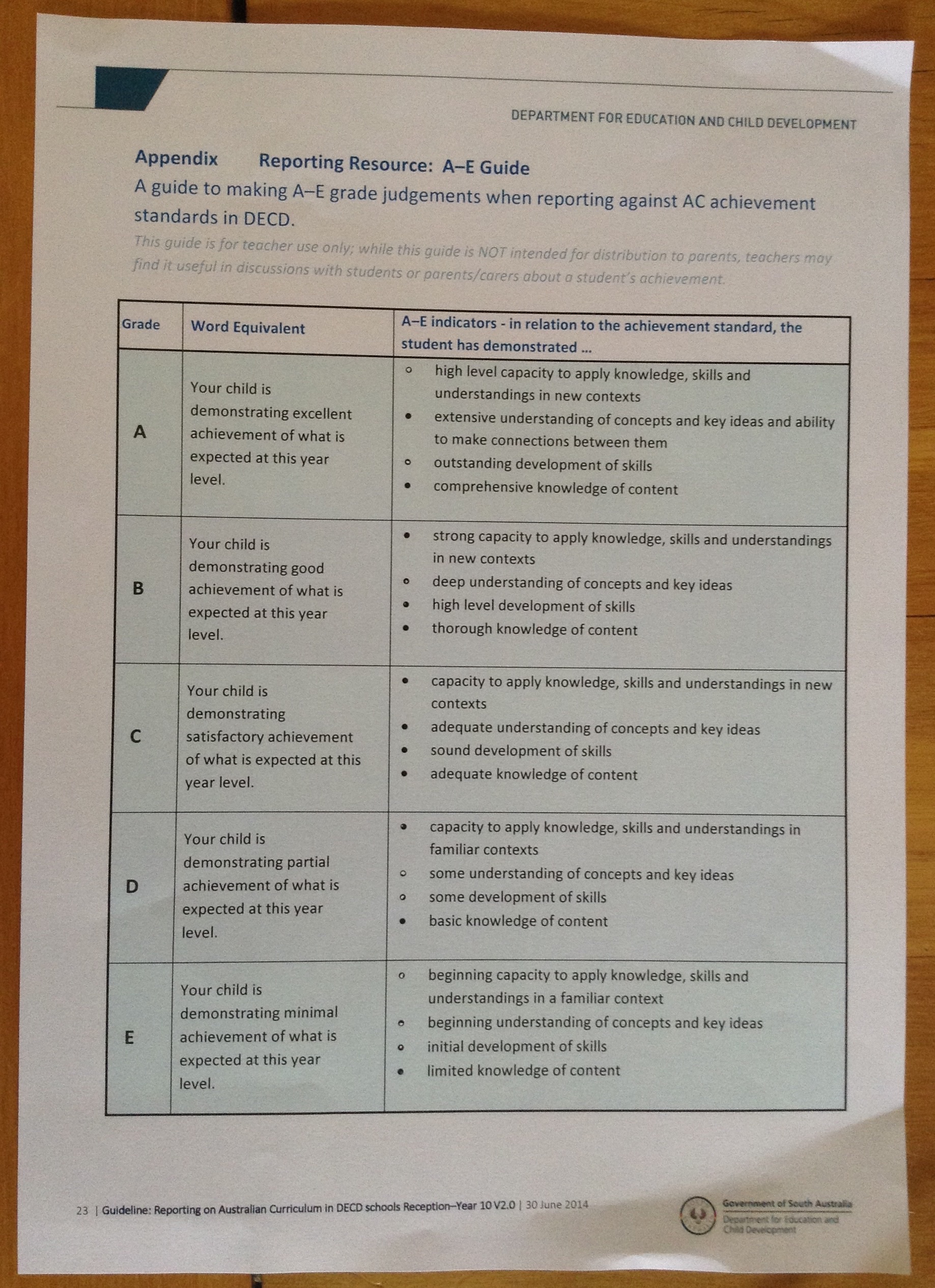
Mel then introduced the Reporting Resource: A-E Guide (see below)

reporting resource A - E Guide

as a baseline for devising a grading system relevant for assessing Indonesian language students. We spent quite a bit of time on this as between the 5 of us, 3 teachers use TPRS methodology and the other 2 use traditional methods. This lead to some interesting discussions and ensured the guide we agreed to was inclusive of both methodologies. Yet once, we started looking at student work against our determined criteria, we discovered that it didn’t completely recognize the Achievement Standards which students had acquired. For example, one piece of work we gave a ‘C’ using this criteria yet when we looked at it against the Achievement Standards, the work sample ticked more than 50% of the points, so how could it only be given a ‘C’? So we went back to the drawing board and agreed that the reporting guide is actually quite accurate as it stands and all we had to do was remove the ‘in new contexts’ for the grades ‘A’, ‘B’ & ‘C’ and then we were all satisfied with it.

Sharon began first with her writing samples from a free write she had done with her year 2’s. We all agreed the samples were amazing. Jemma was blown away and instantly wanted to know more about TCI methodology because if this is what year 2’s are producing, TPRS/TCI must be worth investigating! We discussed the task itself (write as much as you can about this picture –a picture from the folk story we have been focusing on this term – Kancil dan Buaya) and realized that we should have given the students more detailed instructions to ensure they were clear on how they could incorporate vocabulary from previous stories into their writing and thus achieve an ‘A’ for the task. For example, students could have included colours , numbers, body parts, clothing (kancil tidak pakai sepatu) etc.

We next looked at Cheryl’s task which was based on her terms focus on the Daniel Bradbury book, “Ada Berapa?” a beautiful counting book. She had created an A3 sheet with 5 pictures taken from the book and students had to write sentences about the pictures using the language modeled in the text. Cheryl was very apprehensive sharing her results after Sharon, which is understandable, yet for me, the student work she presented demonstrates clearly that TPRS/TCI methodology assists student language acquisition far greater than traditional methodology. Cheryl also asked for more information about TPRS/TCI and is keen to look at the Ben Slavic book, “TPRS in a Year”. We suggested she develop each skill one by one, so it is less intimidating. I really hope she does because it will help both her and her students enormously. We all start with baby steps.

We all agreed it was brilliant to have time to collaborate with colleagues in preparation for the 2016 implementation of the Indonesian languages curriculum.  For me, I was especially thankful for the chance to look once again at the curriculum through reporting eyes and be involved with the creation of a grading guide which is highly compatible for all language methodologies.

Sharing Awesome Links – Membagi Ide Luar Biasa….

One of the blogs I follow is Brilliante Viernes by Maris Hawkins and often she shares links to sites she  has discovered. It is such a cool idea!! Lately I have found so many brillant posts and sites, that I really want to share them with you. If you like this format, let me know in the comment section below!

  1. My student teacher, Hannah, is keen to try a movie talk this week with our junior primary classes to introduce the target structures ‘bisa berenang’ and ‘bisa melompat’. We found a funny video of a dog (link to be added soon) jumping into a pool which will be the basis for the movie talk. Just by chance there is a current thread on moretprs about movietalk which included a link to this amazing video of Eric Herman giving a movie talk demo. I love the way he tells the story as well as seemlessly asking questions. I can’t wait to try another movie talk now!
  2. Other movie talk links include a handout by Eric Herman and posts by Chris Stoltz and glesismore. Sharon Hellman has also recommended a lovely video which I love.
  3. Look at all these amazing demo videos by Eric Herman! The reason I recommend Eric Herman is that he teaches both primary level students as well as high school students.
  4. Senor Fernie has recently published a post about story telling & writing with primary students. It includes some awesome ideas I can’t wait to try next term.
  5. I love this number lesson idea on the Adventuras Nuevas blog.
  6. This is a video demonstrating a story telling technique that I want to watch in full when I have some time because I think aspects of it could be applicable in the primary classroom!!
  7. The Indoinspired blog post about kancil’s. There is also a facebook page you can follow/like which I recommend  because  you’ll find all sorts of gems there!! You can also follow indoinspired on Twitter! 
  8. Did you hear about the tiny ‘dragon‘ discovered in Indonesia?
  9. I read this article about traveling by angkot on Twitter and Facebook. It’s a great read!
  10. Margaret & I head off next week to Sumatra to visit our partner school in Medan for the first time. We aim to develop ways our students can connect via the internet as well as explore the feasibility of organising a staff trip in 2016. Follow my travel blog (written for my students) to read about our experiences! We will be staying a week in Medan before heading off on a study tour to Jakarta & Jogjakarta. Ayo….

    Indonesian Teachers Meeting With The District Curriculum Advisor

    One of the local Indonesian teachers, Cheryl, organised a meeting with our District Curriculum Advisor , Mel Jones, and generously allowed Hannah (my student teacher) & myself to gate crash the workshop. With the implementation of the Indonesian curriculum (and thus reporting to it) in 2016, our familiarisation time has almost finished. While other teachers seem to have been overwhelmed with curriculum support, there has been little available for language teachers, especially, it seems for regional language teachers. Up to now, the only training we’ve accessed was organised inhouse. We invited Andrea to workshop our hub group last year and Intan also has helped where possible at our Intan conferences and AGM’s. Intan members also received an email this week from our marvelous and generous Intan president, Brent, advertising the following seminar for next Friday:

    At our hub meeting yesterday, we followed the link to the above seminar excitedly, and then groaned as we looked at the price; $286!! With my annual T & D budget of $50, the difference is exorbitant. Hopefully if we ask our principals to contribute the difference with curriculum monies, it might be possible?? My principal in particular has been very supportive considering the inequitable amount of training available for specialist teaching staff.

    So the possibility of sitting down to a locally held workshop specifically for Indonesian teachers to  help us “unpack” the curriculum, assess how well we’ve covered it to date in our classrooms and then design an assessment task that will help with reporting to parents and for moderation was too good to be missed.

    We began by looking at the content descriptors in each of the substrands for F-2 and on a grid, writing the ways in  which they have been covered this year. This is how I filled mine in and considering it was done very quickly and off the top of my head, I was thrilled with the result:

    Socialising – calling the roll daily and asking students ‘apa kabar?’

    – Activities eg listen and draw, arranging song/story lines into the correct order

    – songs

    – brainbreaks iincorporating gestures and movement (eg kasi game, Bu Cathy berkata, )

    – class instructions eg. cari satu teman, matikan lampu, Bu Cathy mau mengabsen, duduk di ekonomi (my room is set up like an airplane – kelas satu, kelas 2 & ekonomi),

    – TPR (Total physical Response)

    Informing – asking/telling stories

    – target structures (new vocabulary) eg finding them in the text

    – rearranging song lines and then singing the song together

    – acting out songs/ stories

    – illustrating song/story phrases

    –  discussing the size of the jacket – terlalu kecil/terlalu besar/pas

    – Movie talk  – eg Mr Bean

    Creating    – acting stories/ songs

    – writing shared class stories

    – TPR

    – songs

    – rearranging the song lines and siunging together

    -making a shared class book – eg Sekolah Saya (year 3’s making it for our partner school)

    Translating – comprehension checks

    – word walls

    – displays eg seragam sekolah, Boleh saya pinjam?, numbers,

    – introducing target structures using visual pictures eg a picture of a cicak with the word  ‘cicak’ written underneath it, the same for dinding, jendela, kursi & pintu.

    –  greeting adults who enter my room Pak/Bu

    – presenting at assembly the different ways in which Indonesians greet each other

    – contributing to class displays of ‘cicak di jendela’ & ‘cicak di dinding’

    – grammar pop ups eg ‘c’ (cicak) is always pronounced ‘ch’

    Reflections – cognates eg pizza, sprite, hotdog, jaket, hamburger etc

    – etiquette eg  mencium means to kiss and to smell, kasi hormat,

    –  cultural manners eg pointing, gesturing come here,

    – the gender vs age difference (we are more focused on gender however age is of greater significance for Indonesians)

    Systems of Language –  TPRS step 1 – introducing  the target structures eg repeat the TS in various voices  modeling the trilling of the ‘r’, the pronouciation of ‘c’, the short vowels etc.

    – personalisation eg jaket Ebony terlalu besar? Ebony pakai jaket?

    – basing stories around high frequency verbs eg makan, minum, pakai, kasi, punya and using these verbs in sentences which are meaningful and relevant to the students.eg Caleb mau  minum sprite? John mau pakai jaket?

    – incorporating question words and negatives into my circling. eg. cicak di dinding. cicak di dinding atau cicak di jendela? cicak di pintu? cicak dimana?

    – introducing conjunctions eg students answering apa kabar? with panas dan haus.

    – using the roman alphabet to write the target structures on the board.

    Language Variation & Change – Students ‘kasi hormat  kepada’ visitors appropriately.

    – All visitors to our room are greeted using Pak/Bu

    – use and discuss the cognates in stories

    – greeting the first class of the day with selamat pagi and the rest with selamat siang. Encouraging students to greet Indonesian teachers out of class reinforces this.

    Role of Language & culture – meeting our many Indonesian visitors throughout the year and understanding that Indonesian is their national language.

    – Asking ‘Boleh saya Bahasa Ingriss?” before using in English in class.

    – playing games like hom pim pah & batu, kertas, gunting to choose participants.

    – choosing texts about cicaks, kancils, orangutan.

    – greeting teachers appropriately eg hand to their forehead.

    How great is that!! TCI, TPRS & TPR complement the Indonesian curriculum beautifully!!

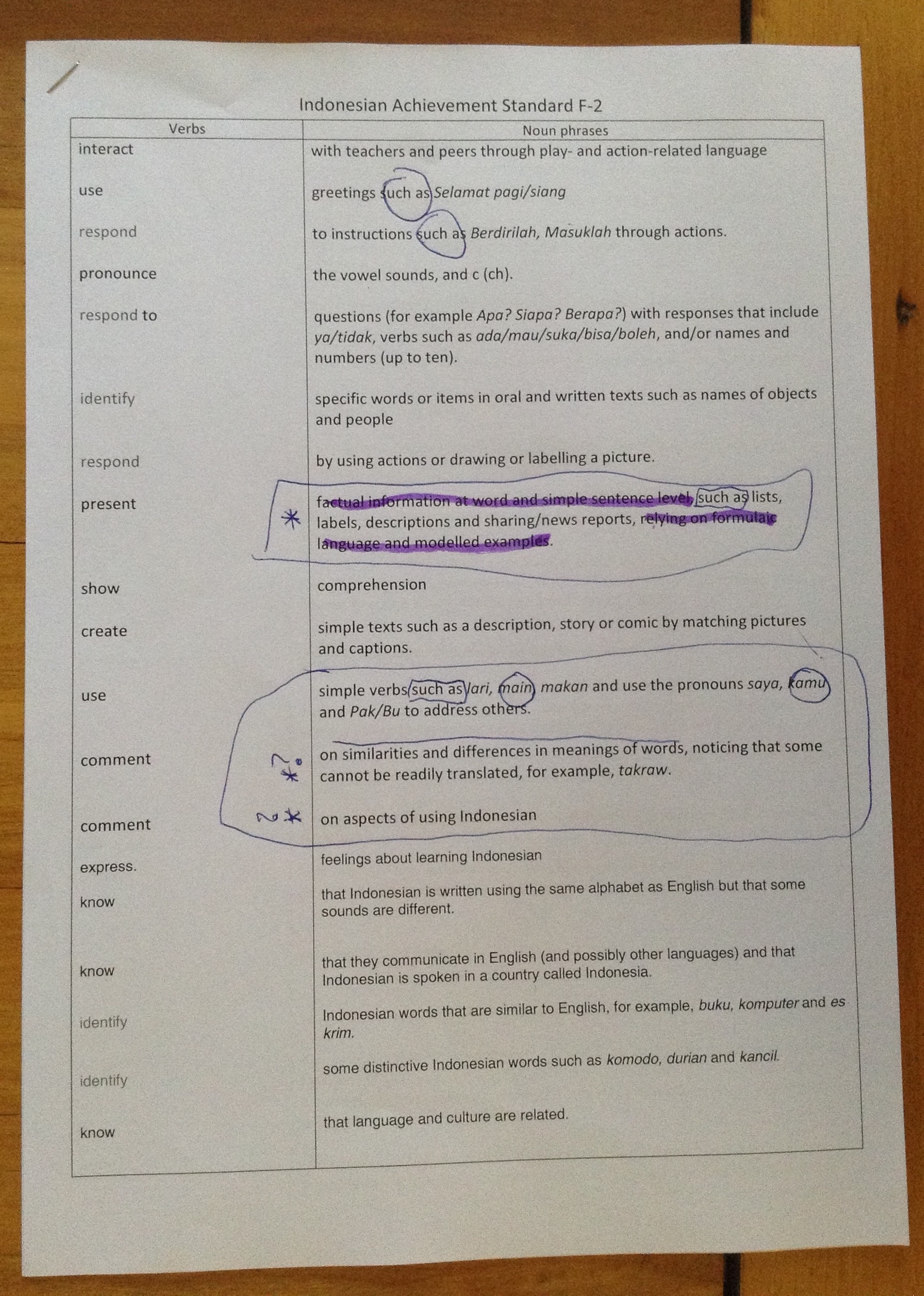
    We next moved onto the Indonesian Achievement Standards. Mel had already ‘unpacked’ it for us and this is what it looks like: (excuse my scribbling!)
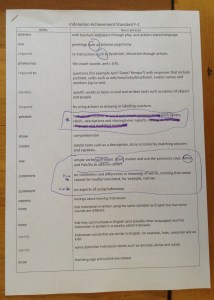
    image

    We went through this together and discussed it with Mel. We had several questions for her which she will follow up for us:

    1. Does the wording ‘such as’ mean for example or does it mean that the vocabulary include must be covered?

    2. What does the ‘similarities and differences in meanings of words’ mean?

    3. What does “comment on aspects of using Indonesian’  mean for teaching junior primary students?

    4. We also want to know how a F-2 student can present a news report in Indonesian!!! (more to the point, why?)

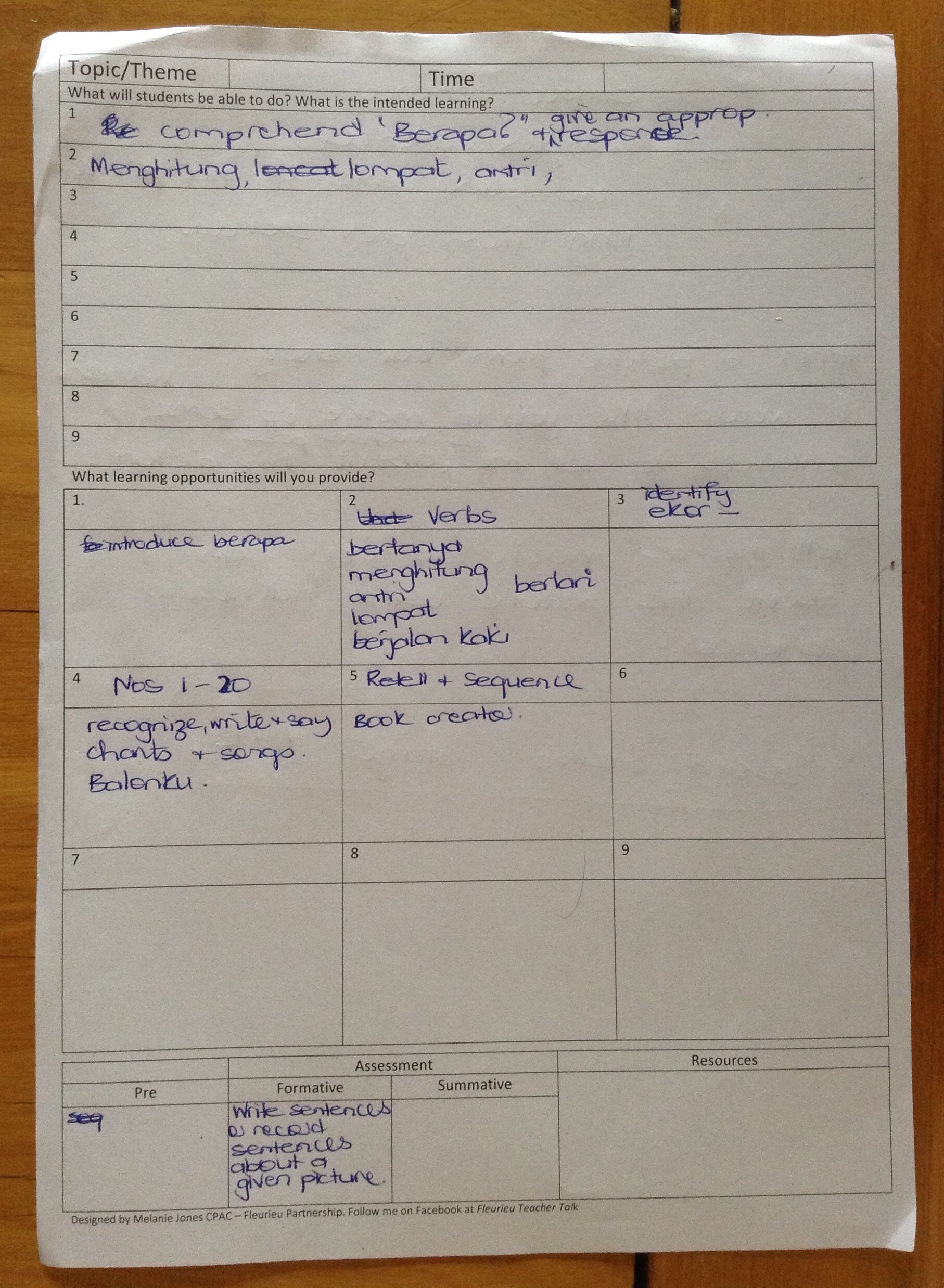
    Following on from understanding the achievement standards, the next component of this workshop was to learn how to use the achievement standards and the content descriptors to plan a unit of work. We realised then that we haven’t yet met to plan term 4. Sharon suggested using a kancil story from Siara Siswa which we all agreed had great potential as students love the wily kancil. Mel gave us a proforma which helped to break down all the aspects of the curriulum that could be covered via the kancil story. Here is my sheet:
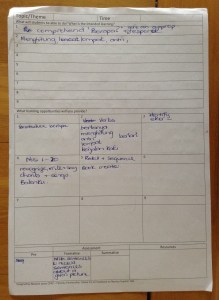
    image

    After realising just how much potential this story has, we put our heads together to create an assessment task that is appropriate for F-2 students and will provide them with the opportunity to demonstrate a variety of achievement levels.

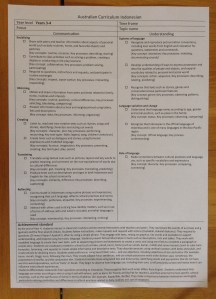
    Mel shared this to help us:

    image

    We pointed out that it didn’t truly apply when using TCI to teach Indonesian  For example we took ‘name’ and demonstrated that if we asked a student, “ini pensil atau ini cicak?” while holding up a pencil, how could that be ‘lower intellectually’ challenging for language students? One could argue that circling operates at a lower intellectual challenge level yet because it is all conducted in Indonesian, that surely is requires a higher intellectual challenge!  Still it was food for thought.

    Creating an assessment task definitely was a higher intellectual challenge!! We could all suggest many ways in which students could demonstrate pproficiency at a ‘C’, yet it was harder to provide students with an assessment task that provided them with the opportunity to demonstrate above average achievement. We wracked our brains and thankfully Sharon suggested showing students a picture from the Kancil story and asking them to tell the teacher as much as possible about the picture using Indonesian. The sentences would be graded:  ‘C’ if the student could accurately describe the picture using simple yet correct sentences, ‘B’ if the student could accurately describe the picture using complex sentences and an ‘A’ if the student accurately described the picture using complex sentences incorporating additional vocabulary from previous stories and class work.

    Other sheets that Mel shared with us included:
    image image

    The one on the right also comes in all other year levels and will be available soon (hopefully early next year) digitally and the boxes can be checked off!

    If you want any more iinformation  or would like your own copies of any of the handouts we received, please contact Mel on Fleurieu Teacher Talk on Facebook.


    The Australian Curriculum – Indonesian

    I have spent numerous hours looking through the new ACARA Indonesian curriculum using a TPRS/TCI headset. The more I explore it the happier I am, particularly because of the high frequency of the word ‘communication’. 

    In the Preamble:

    Rationale

    Through learning languages, students acquire:

    communication skills in the language being learnt

    -an intercultural capability, and an understanding of the role of language and culture in communication

    – a capability for reflection on language use and language learning.

    And:

    Learning languages:

    • extends the capability to communicate and extends literacy repertoires.
    • strengthens understanding of the nature of language, of culture, and of the processes of communication
    • develops intercultural capability
    • develops understanding of and respect for diversity and difference, and an openness to different experiences and perspectives
    • develops understanding of how culture shapes worldviews and extends learners’ understanding of themselves, their own heritage, values, culture and identity
    • strengthens intellectual, analytical and reflective capabilities, and enhances creative and critical thinking.

    The overall Aims are given as:

    Aims

    The Australian Curriculum: Languages aims to develop the knowledge, understanding and skills to ensure students:

    • communicate in the target language
    • understand language, culture, and learning and their relationship, and thereby develop an intercultural capability in communication
    • understand themselves as communicators.

    Then in the explanation of strands and sub strands, while ‘communication’ is the first of the two strands of language learning, it begins to become clear that the Indonesian curriculum reinforces the belief that comprehension is achieved through analysing aspects of language:

    Strands and sub-strands

    The content of the Australian Curriculum: Languages is organised through two interrelated strands which realise the three aims. The two strands are:

    • Communicating: using language for communicative purposes in interpreting, creating and exchanging meaning
    • Understanding: analysing language and culture as a resource for interpreting and creating meaning.

    The strands reflect three important aspects of language learning:

    • communication
    • analysis of aspects of language and culture
    • reflection that involves
      • reflection on the experience of communicating
      • reflection on comparative dimensions of the languages available in students’ repertoires (for example, the first language in relation to second language and self in relation to others).

    One puzzling fact about the Indonesian curriculum though is that while it recognises the importance of communication, the word ‘proficiency’ does not appear anywhere and the word ‘fluency’ appears just once for students in years F-7:

    Years 5 and 6

    Years 5 and 6 Band Description

    Indonesian language learning and use

    ….. They (students) extend their oral fluency by focusing on sentence-level intonation and stress.

    Surely the goal of a language program is to develop proficiency in that language?

    Songs for Primary Students

    Walking along with a bucket the other day, the song, There’s a hole in My Bucket came into my mind. As I was singing it, It dawned on me just how repetitious this song is. I immediately started playing with it to see if I could rewrite the song for Indonesian students. 

    As our students learned the target structure ‘terlalu besar’ in term 1, this could be an extension idea for next year when I revisit this story! 

    Here is a version using that target structure:

    Saya lapar! Pak Agus, Pak Agus, Pak Agus. Saya lapar Pak Agus, Pak Agus. Saya lapar!

    Ayo makan, Bu Eliza, Bu Eliza, Bu Eliza. Ayo makan, Bu Eliza, Bu Eliza, makan!

    Makan apa? Pak Agus, Pak Agus, Pak Agus. Makan apa Pak Agus, Pak Agus, makan apa?

    Makan pizza, Bu Eliza, Bu Eliza, Bu Eliza, Makan pizza Bu Eliza, Bu Eliza makan pizza!

    Terlalu besar! Pak Agus, Pak Agus, Pak Agus. Terlalu besar Pak Agus, Pak Agus, terlalu besar!

    Makan spaghetti, Bu Eliza, Bu Eliza, Bu Eliza, Makan pizza Bu Eliza, Bu Eliza makan spaghetti!

    Terlalu panas! Pak Agus, Pak Agus, Pak Agus. Terlalu besar Pak Agus, Pak Agus, terlalu panas!

    Makan eskrim, Bu Eliza, Bu Eliza, Bu Eliza, Makan pizza Bu Eliza, Bu Eliza makan es krim!

    Terlalu dingin! Pak Agus, Pak Agus, Pak Agus. Terlalu besar Pak Agus, Pak Agus, terlalu dingin!

    Makan permen, Bu Eliza, Bu Eliza, Bu Eliza, Makan pizza Bu Eliza, Bu Eliza makan permen!

    Terlalu kecil! Pak Agus, Pak Agus, Pak Agus. Terlalu besar Pak Agus, Pak Agus, terlalu kecil!

    Makan nasi Bu Eliza, Bu Eliza, Bu Eliza, Makan pizza Bu Eliza, Bu Eliza makan nasi!

    Dan kecap manis!! Pak Agus, Pak Agus, Pak Agus! Dan kecap manis Pak Agus, Pak Agus kecap manis!! 

    Ya enak!! Bu Eliza, Bu Eliza, Bu Eliza! Ya enak Bu Eliza, Bu Eliza Enak!!

    Terima kasih! Pak Agus, Pak Agus, Pak Agus. Terima kasih Pak Agus, Pak Agus Terima kasih!!

    Sama sama Bu Eliza, Bu Eliza, Bu Eliza, Sama sama Bu Eliza, Bu Eliza sama sama!!
    What do you think??  Do you have suggestions for another version?