PQA, My Way; By Alina Filepescu

maxresdefault

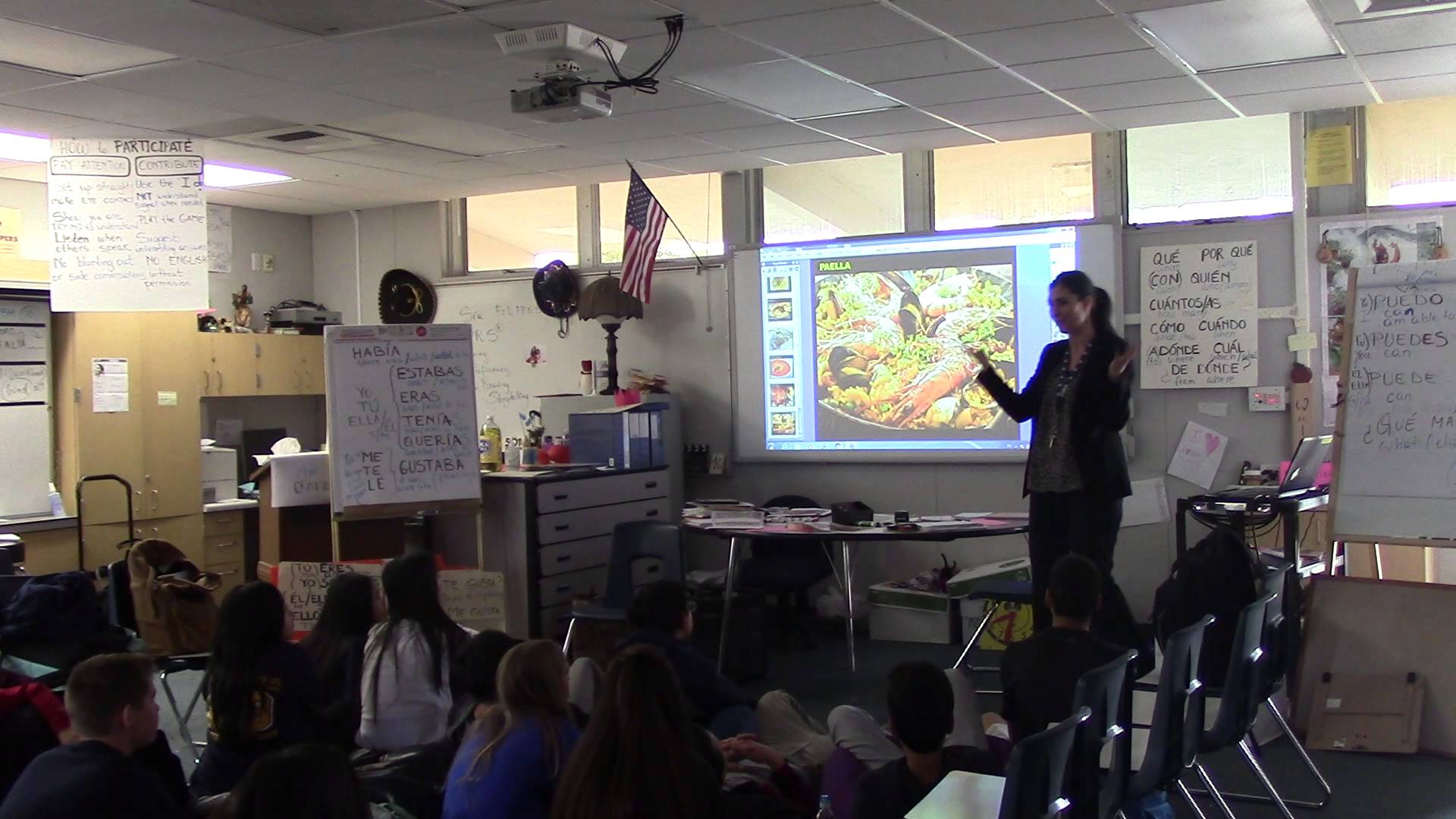
Here is an amazing post and video by Alina Filipescu. While the post is specifically talking about how she does PQA in her classrooms, there is actually sooo much more in it that we Indonesian teachers here in the southern hemisphere can learn about. Not only has she included an amazing video of herself brilliantly and seamlessly PQA-ing with a primary aged class but she has also included an explanation of what she does to cue her students when she wants them to respond. It is a truly amazing video and post and I highly recommend that you read/watch it to appreciate where we are all heading with our TPRS skills!! I look forward to the day when  my students participate to that extent and are so engaged in my lessons!

Kata Sandi – Passwords

Bryce Hedstrom has been updating frequently his blog post about secret class passwords and I’m curious! Would it work in the primary school? Would it work with large classes? 

  
The idea is that the teacher meets the  students at the classroom door before each lesson and like entering a secret clubhouse, students say the class password before entering. Passwords can either just be a fun word, a phrase or a response to a set teacher question (eg siapa nama?). The password can be changed as frequently as is necessary and this would depend on how often the teacher sees each class per week. For me, I teach some classes once a week and some twice, so I would start with a weekly password.  The passwords that Bryce has used cover a huge range of words/phrases and his latest additions includes morals like ‘slow and steady wins the race’. 

  
For my students, though, I can see the benefits of this idea with:

  1. Kenalkan questions eg siapa nama, tinggal dimana, berapa umur, suka warna apa etc
  2. Slang exclamations which would be useful/cute during story asking eg NGP (gay-en-peh –  gue nggak peduli)
  3. Repetition opportunity for target structures

  
Go to Bryce’s website and read what he has written so far and then enjoy fossicking around all the other fantastic resources and suggestions he has shared. 

Specialist Teachers Unite!

For the very first week of the year, the 5 specialist teachers at my school collaborated to present a united program to students. The 5 specialist are

  1. Performing Arts
  2. Digital Technology
  3. PE
  4. Geography
  5. Indonesian

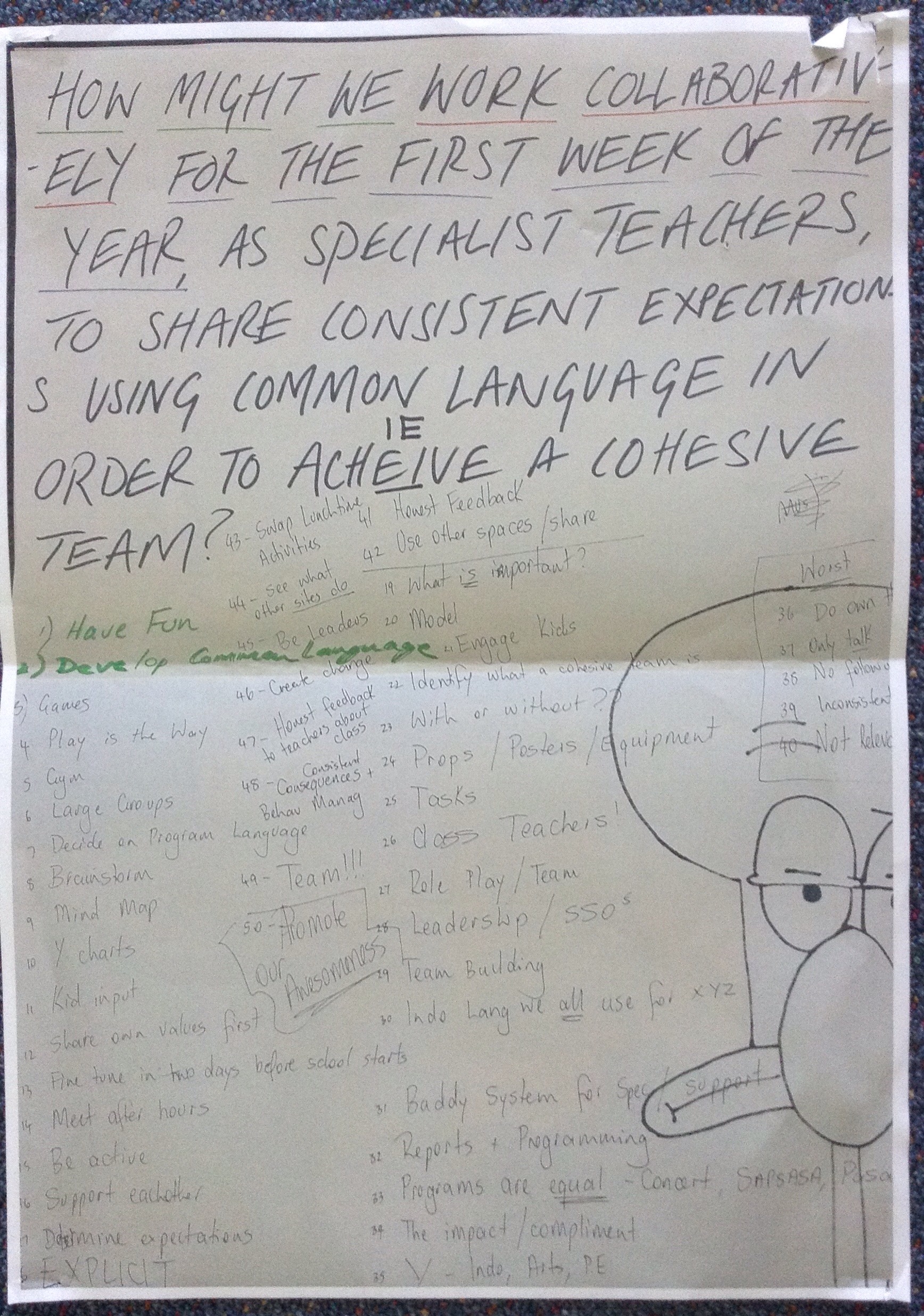
We first discussed the idea during a No Tosh workshop last year with the idea being that instead of students coming to each one of our classes in the first week of school and hearing the same message over and over again from each one of us, we would collaborate and clarify our expectations together. Here are our initial notes:

 We met during the holidays and excitedly agreed to trial the program. The idea was that we all came to our timetabled lessons in the gym with a short activity prepared for a large group of combined class levels. The activities had to provide us all with the springboard to discuss group skills & minor problem solving through our school values of community, confidence & respect.

As none of us work full time and our days are spread evenly over the week, it meant that each day we either had 2, 3 or 4 teachers on deck at any one time working with 2, 3 or 4 classes respectively. Two junior primary classes received our combined spiel 5 times and the remainder received it 4 times yet because the teachers each day were never exactly the same and the classes who came were also never exactly the same, the dynamics changed significantly each lesson.

We began each lesson with our shared expectations and communicated to students clearly that this year there will be significantly more communication between class teachers, leadership and specialist teachers  through a new monitoring system we will hope staff will support to ensure that behaviours in our classes are followed up on.  Other issues we talked about included the fact that our lessons are only 50 minutes and thus all students to repsect the learning of others so that time isn’t wasted.

We then shared the microphone around and led an activity each. It was brilliant being able to focus on group skills and problem solving repeatedly with mixed group levels. We would ask students to get into groups and then after a few minutes, ask everyone to stop. This gave us the opportunity to talk about the confidence needed to be proactive and approach a group and ask to join their group, how the request needs to be answered respectfully and diplomatically, to be resilient and persist till you join a group, make strong choices about who you group up with etc. We did this over and over again in various ways all from our own specialist subject viewpoint and students definitely improved over the week.

My activities included Bu Cathy Berkata (simon says), kancil, buaya, mangga (get into groups of 3 and decide who will be kancil, who will be buaya and who will be the mangga. Berjalan kaki around the gym in your group and each time I say ‘buaya/ mangga/kancil’ the kancil stands with their hands cupped on their head for ears, the buaya lies on the ground and the mangga curls into a ball) and on the last day I extended the language by asking students to ‘cari satu teman – satu perempuan dengan satu laki laki’ and it was fantastic that students used the stop gesture (tidak paham) and others could translate for them.

The geography teacher came up with her own activity which involved rings of students representing different aspects of the globe and then the finale was asking them each to turn either clockwise or anticlockwise. The final movement was amazing and I filmed it which should be good for a future brain break! It truly demonstrates why the weather is never  predictable.

Natalie, our performing arts teacher did one activity where she divided the students by gender. Each group had to put themselves into a line in order of birthdate and then she turned on some very loud music. Each group did well with only a couple of errors (not bad for 2 groups about 40 students) and afterwards she sat them down and discussed with them the impact of noise, congratulated the studetns who had shown leadership & asked the groups to explain the methods used. It was a brilliant activity for upper primary.

Evan brought ipads to the gym and asked the students to get into teams of 10. Each team had to take one continous video on an ipad which was passed respectfully clockwise around the circle and each person had to film the person on their left saying one positive thing about the who was person filming them. The groups that worked collaboratively and respectfully completed the task had time to watch their film yet the groups that did not collaborate well had many disappointed team members who didn’t get a chance to use the ipad. IMG_1615

We met on Thursday afternoon to review the program and we all agreed the week had been a huge success and one we’d be keen to repeat in 2017.  The comments from staff were also incredibly positive noting that the sense of community created in the gym felt very real. We found it a great way to start the year because it gave us a chance to meet the new students and learn their names as well as the names of a few of our many new reception students. It gave Evan and Les some breathing space in which they could learn about our school and students in a collaborative atmosphere before we all go it alone next week . All up the sense of community was strong not just for students but also for the 5 specialist teachers!

IFLT/NTPRS/CI Teaching- How To Involve The Whole Class When Storytelling

A great thread appeared overnight on the iFLT/NTPRS/CI Teaching Facebook page Have you joined yet? If not, I highly recommend it. It is a global  community totally dedicated to all levels and aspects of TCI. Your own personal PLC where you can comment on other posts or ask questions about teaching with Comprehensible Input and TPRS. For those of us here in Australia, where TCI is only just taking off, this group is awesome. Whether you prefer to be a lurker or a contributor makes no difference because the other teachers here bring a wide variety of experiences and the knowledge they share is impressive. They too cover the spectrum of experience and once you take the first step and. join, you will discover what a warm and generous community it is. My only word of caution though is: go with your gut feeling. Remember that we Australians aren’t the only ones frustrated by the lack of training available here and thus interpretations of TCI vary. If a suggestion sounds a little off centre, don’t worry or stress; it is most likely because of a different understanding of what TCI actually is. If you need clarification, ask openly on the page and no doubt an experienced practioner will chime in and clarify. There are certain names to look out for and you’ll recognise them from all your readings. 

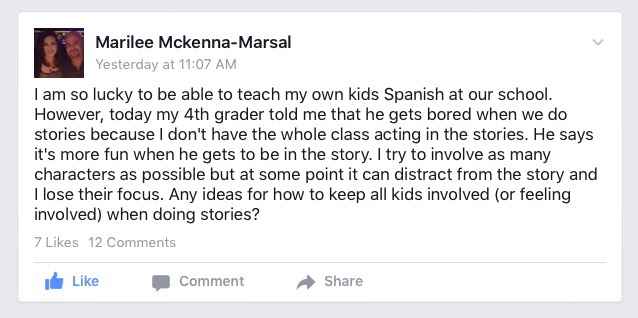
The thread I enjoyed reading this morning asked how to involve more students when reviewing a story. It was posted by a parent/teacher who has a child in one of her classes.  I remember the pros and cons of teaching my own children and this was definitely one of the pros. I totally appreciated the insights into both my teaching and the students in the classes. 

Here is her question: 

 
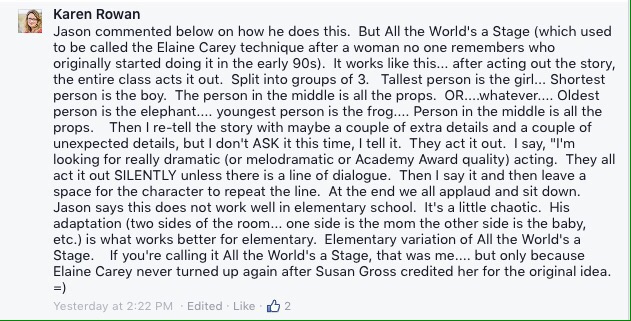
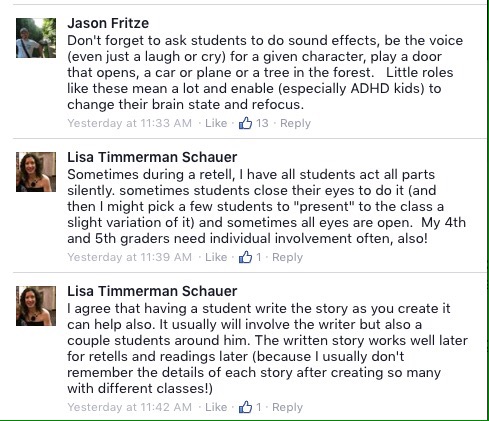
The answers to the question were awesome and most of them are worth sharing becausse they would work very well in our primary classrooms. Interestingly though, is that secondary teachers have also shared here!  

   
The answer below by Karen Rowan actually fits in after Grants initial comment above.


So many great ideas here to not only gets heaps of repetitions but also to keep our students engaged in the story.

Dadar Gulung

Traditionally in term 4, my year 7 classes study a cooking recipe before cooking it in groups because, lets face it, anything to do with cooking is popular and it’s a positive note for them to finish on after 8 years of learning Indonesian at primary school. This year, the challenge for me was adapting such a unit of work to be compatible with TCI methodology.
As usual, I began the term by asking the students in each class to vote for the food their class woud like to cook. Each class narrowed their wishlist down to 2; a savoury and a sweet recipe. Previously I split the 9 week term in half, with classes studying recipe #1 for the first 4 weeks, before focusing on recipe #2 over the final 4 weeks. The final week is always a right-off with graduation, class  parties etc and it’s nice to have a week up my sleeve just in case! I quickly discovered though that attempting two recipes was one recipe too many. Thus for the majority of the term we focused on the one recipe that both classes had chosen: Dadar Gulung.


In adapting this unit of work, my first task was to simplify the ‘authentic’ recipe drastically to reduce the large amount of unfamiliar and unnecessary vocabulary. This turned out to be even easier than I imagined. Yet, what I couldn’t avoid was the long list of ingredients, mostly low frequency vocabulary except for maybe water. Here is my recipe  in English and following it is the CI version.

Here is my simplified recipe:dadar gulung recipe
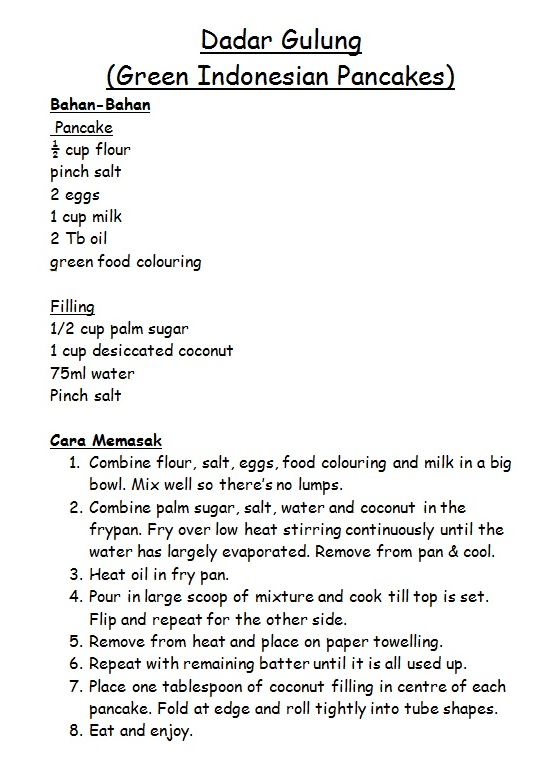
Here’s my adapted version of the method:

  1. Campurkan gula dan kelapa. Goreng dan aduk. Angkat.
  2. Campurkan tepung, gula, garam, telur, pandan dan susu di mangkok besar. Aduk.
  3. Panaskan minyak.
  4. Kasih satu sendok besar campuran dadar dan goreng dua menit.
  5. Balik dadar dan goreng satu menit lagi.
  6. Angkat.
  7. Ulangi.
  8. Taruh campuran kelapa/gula di dadar. Lipat dan gulung.
  9. Selamat makan!

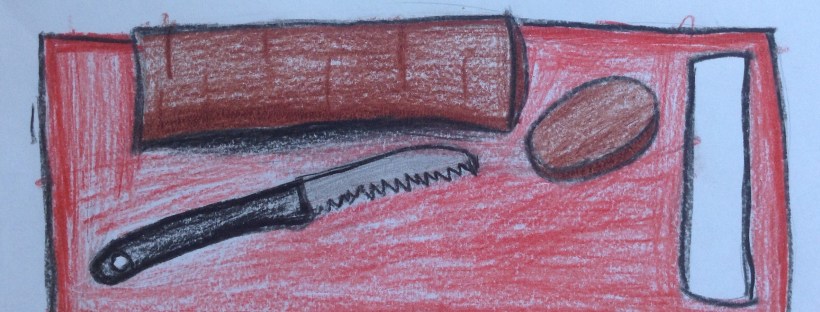
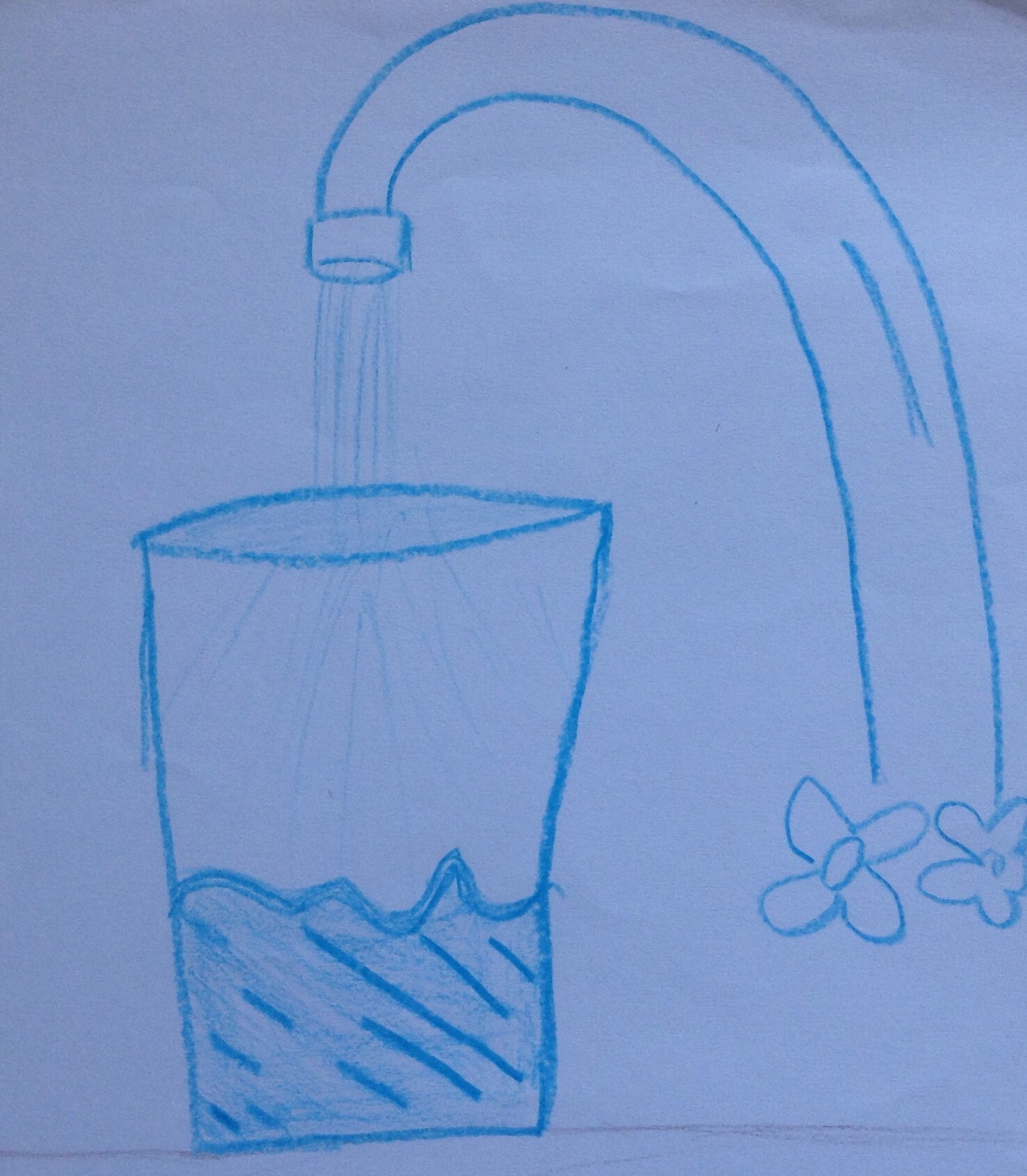
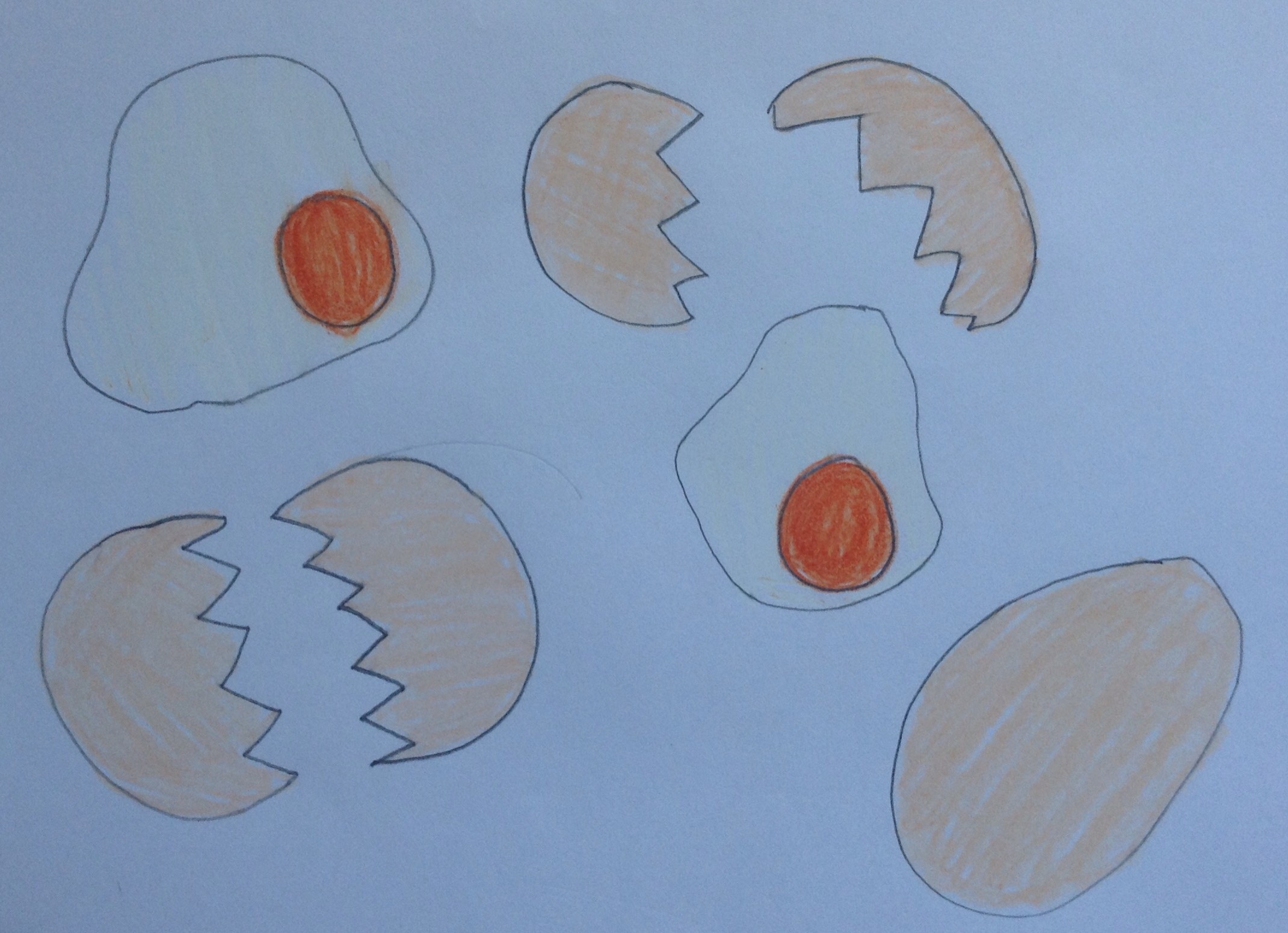
I decided to tackle the ingredients first with the thought that as soon as they were acquired,  the method would be largely (although still not i+1) comprehensible. I began with a google search for images and found a large image of each ingredient. I then printed an A4 copy of each and laminated them. I didn’t label (ie write the Indonesian on) the pictures which at times was useful and other times frustrating. Probably should have though to assist with acquisition. I began by introducing this new vocabulary and encouraging students to come up with ways they could remember each. Both classes suggested remembering ‘minyak’ (oil) is  easy because it is yuck (yak)!! Next students got into 6 groups (the number of trestle tables in my room). Each group was given 11 sheets of A5 paper & 11 laminated cards, each with one of the ingredient words on it. As a team, each ingredient had to illustrated, one per piece of paper. Here are just a few of them:
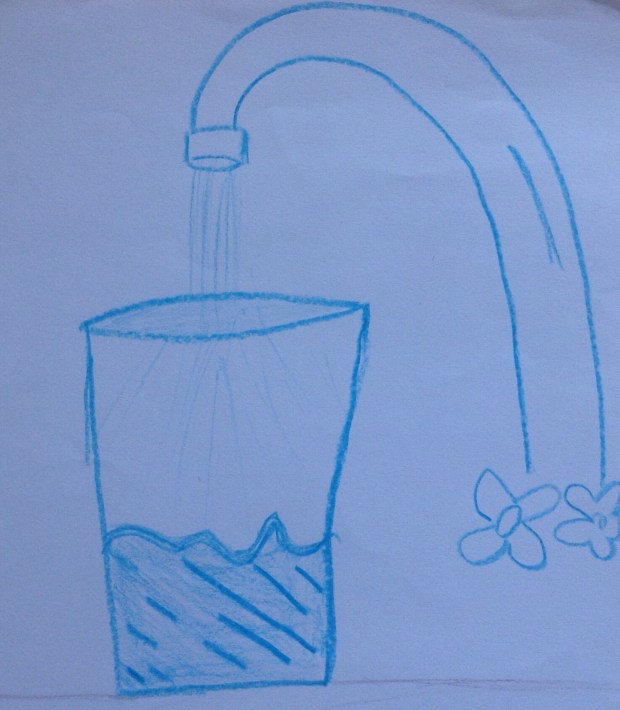
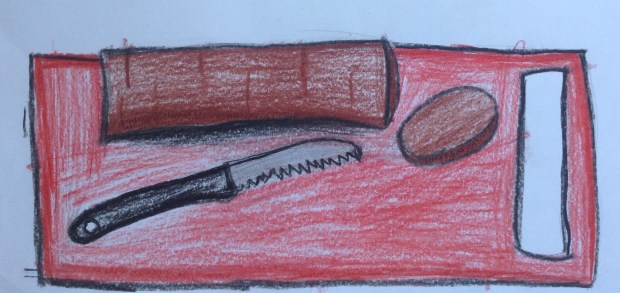


We then played a game to get as many repetitions of this new vocabulary  as possible: all picture sheets and cards were turned upside down and mixed together in the centre of the table. On go, teams had to turn everything over and then match up the illustration with the word card. When groups had played this several times with their own pictures, they were asked to stand and rotate to another table and we replayed with the pictures from another team. This was hilarious because some of the pictures were left field. You can imagine what some teams thought of some of the gula merah pics!! When the teams were at the final table, I then added a further variation to the game by asking the teams to nominate their best 2 players to play off against the other teams and after that round asked the groups to nominate the 2 players who had participated the least for a final competition. In each team there were passive team members, some were lacking in confidence while others were over ruled by more dominant team members, so this gave them a chance to participate and shine. My instruction to the non-players insisted that their hands remain under the table and to only speak in Indonesian! This worked beautifully! More repetitions!! From me and their fellow students!

From that lesson onwards, I began lessons with a vocabulary review by asking students to tell me what the ingredients are for dadar gulung. (Dadar gulung pakain apa?)The only word which stumped them right to the end was kelapa parut!! Considering most of the language used in this unit is low frequency, it will be interesting to see how much is retained long term.

The next lesson I planned to teach included a cooking demo so that the students could both watch the method and listen to the recipe in context while completing a listen and draw however it was precisely that week I fell sick. Such a bummer. Unfortunately by the time I was well again, end of year interruptions and severe depletion of energies resulted in this not happening. Instead students did the listen and draw without the demo, cloze and a ‘unjumble the sentences’ type of activity. It was very rushed towards the end due to the loss of time which was such a shame.

I also had to squeeze in a very quick introduction to the 2nd recipe the classes were each cooking. One class chose Mie Goreng Telur Ala Ibu MIa (which was perfect because I coud recycle most of the dadar gulung method vocabulary) and the other class had chosen mie goreng. In those lessons, we also had to finalise groups  (students choose their own) and determine the equipment needed to cook the recipes. It was very rushed but thankfully it all finished well.

When classes cook, I provide the ingredients and students have to bring in the equipment as they will be cooking the recipes by themselves in their group. I do it this way for several reasons – the main reason being that I firmly believe students should take equal responsibility in preparing for this. It also weeds out the apathetic students who have in the past sabotaged the experience for the others in their group.  These non contributing students are divided out amongst the junior primary classes to ‘help’. This year though, for the first time ever, every student cooked!! The one student who didn’t bring anything in had spoken to me privately explaining how difficult this would be for him, and he was fortunately in a group being supervised by one of their Mums who knew him and his circumstances well.  Phew, because this was the only thing we did all year that he showed any interest in and it was great for him to finish up on a positive note. A final bonus for doing it this way is that students take home all the dirty dishes and I don’t get left with the washing up!

I encourage groups to invite a ‘supervisor’ for several reasons. The supervisor can be a parent, an older brother or sister (lovely opportunity to catch up with ex students who themselves get a kick out of revisiting an Indonesian cooking lesson) or a responsible family member/friend. Having community members is great for PR but more importantly, the electricity board in my room cannot support more than 4 electric frypans at any one time.  Thus a supervisor enables groups to cook elsewhere in the school, either in our canteen, the staffroom or even in their own classroom. The added bonus of this is that I usually end up with only 1 or 2 groups cooking in the Indonesian classroom!!  Bliss.

I begin the cooking lesson by handing out copies of the recipes and then standing back as the groups organise their ingredients.
Here are a few photos taken from one of the classes:

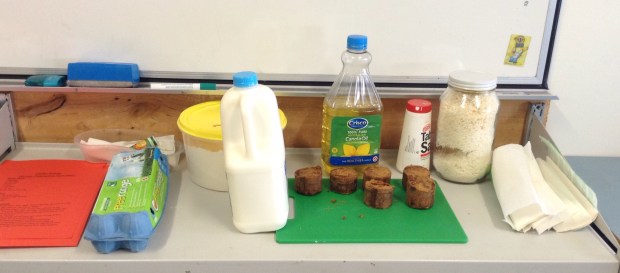
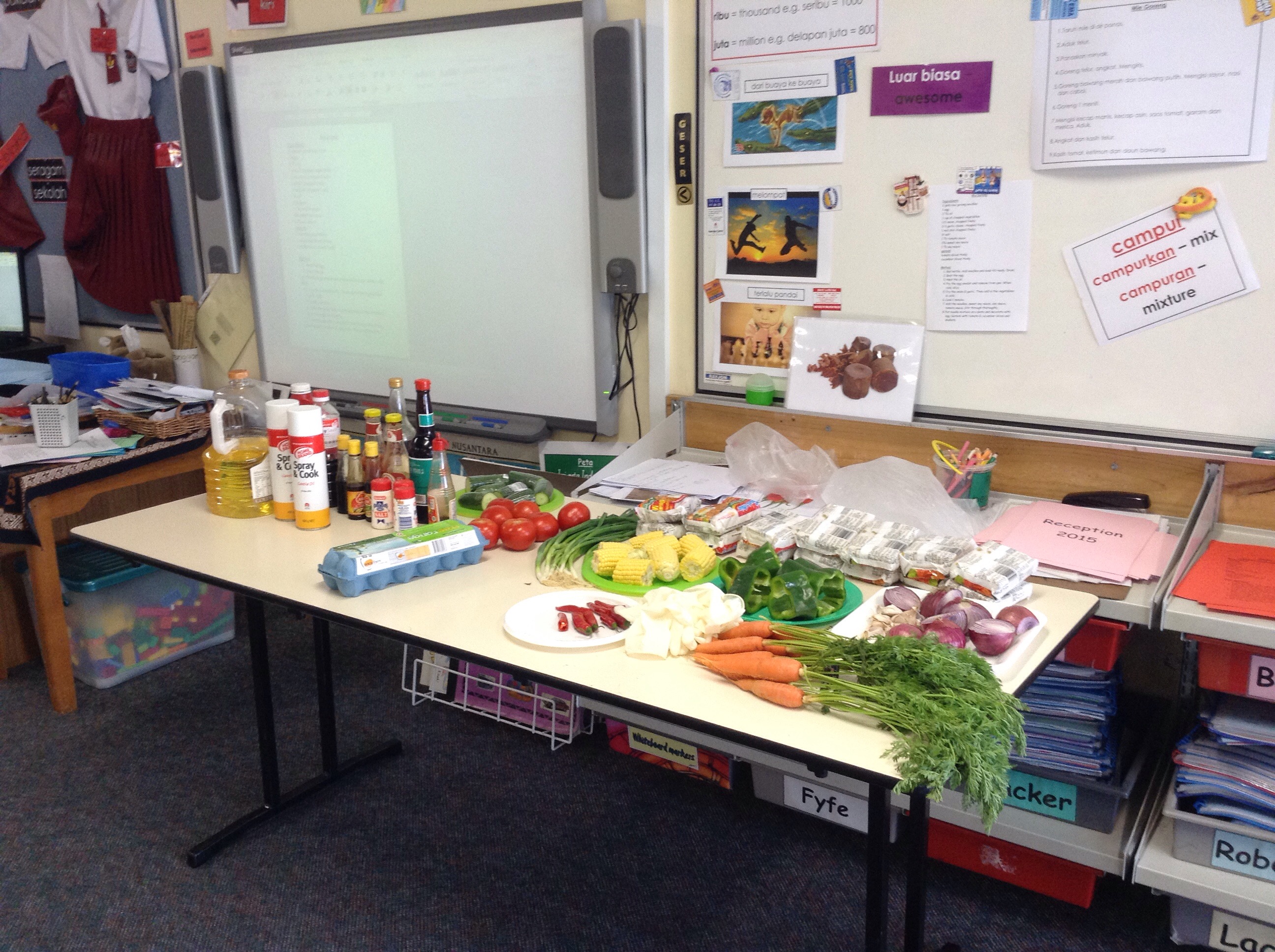
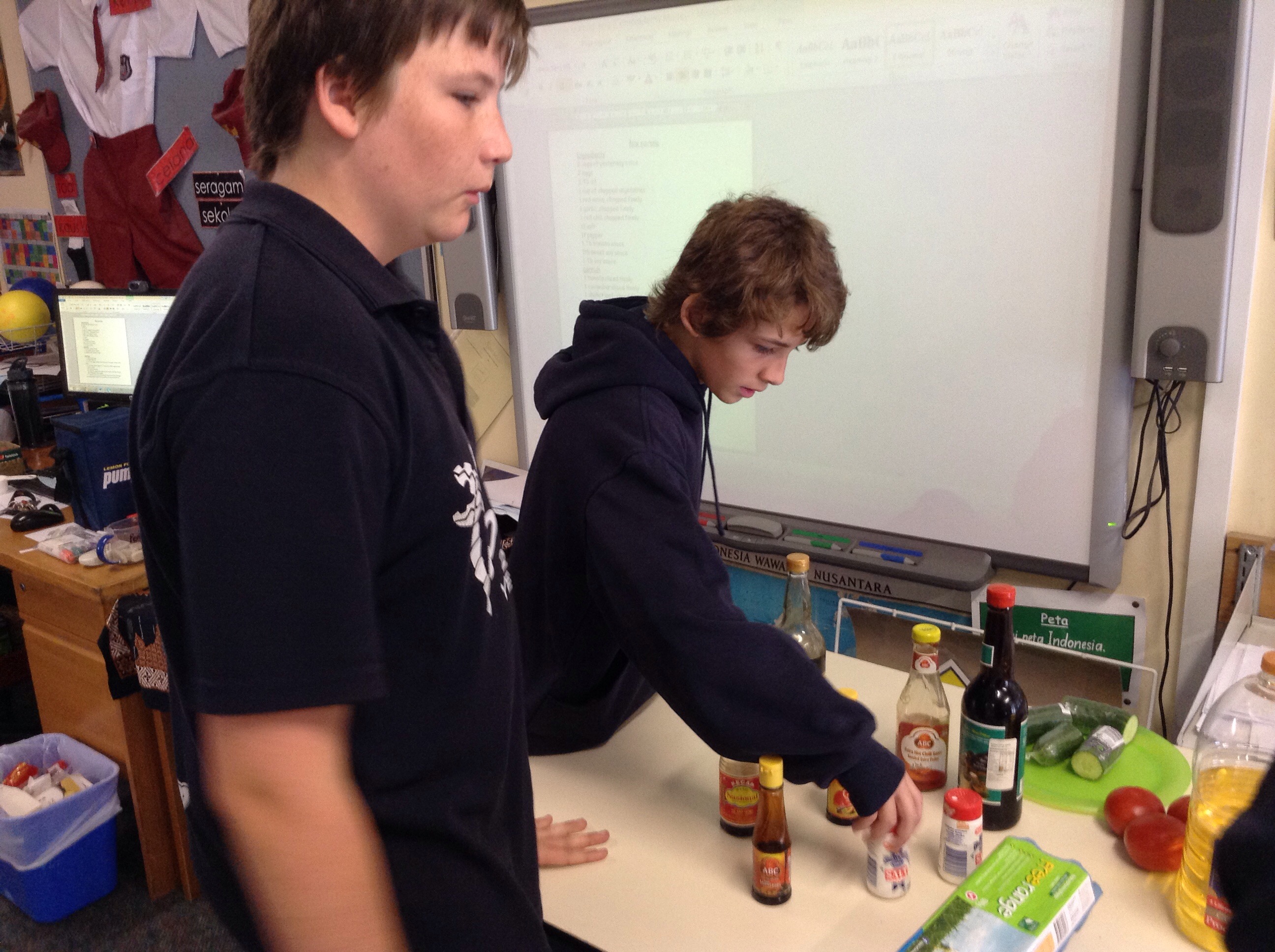
Firstly, the ingredients as I set them out. Some are portioned already and some aren’t.

Students helping themselves to the ingredients
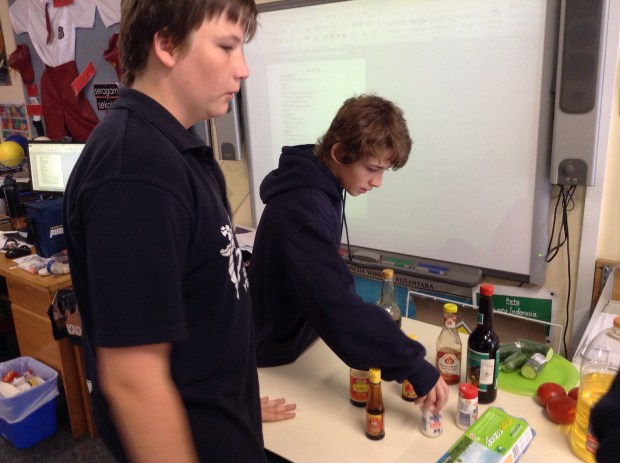
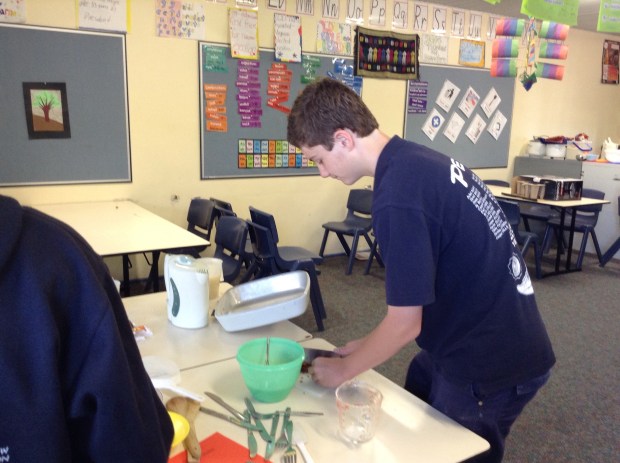
Students cooking:


The unit of work was finished with a Kahoot! challenge.  What an amazing and engaging way to complete the unit. As I said in my previous post, I had issues with lagging which we still haven’t been able to trouble shoot even with Kahoot! support. Quite a shame really because it has so much potential. I intend to investigate it further next year in the computer room and see if by eliminating the ipads, the lagging stops. It was such a fun way to wrap up the unit with a concentration on structures. Even kelapa parut was learned by the end!

Overall, in reflection, I feel that this topic was more of a ‘bail out’ and whether this was due to insufficient time or that it still needs a lot of tweaking, I’m not quite sure. Also at this time of the year, it is more important to do what is manageable because of the sheer number of balls teachers juggle with end of year requirements.  Another issue is that the year 7’s in term 4 are challenging and the sooner the  SA government moves them to high school in line with other states and our national curriculum the better, but that’s a whole different topic!
My Deskless Classroom…

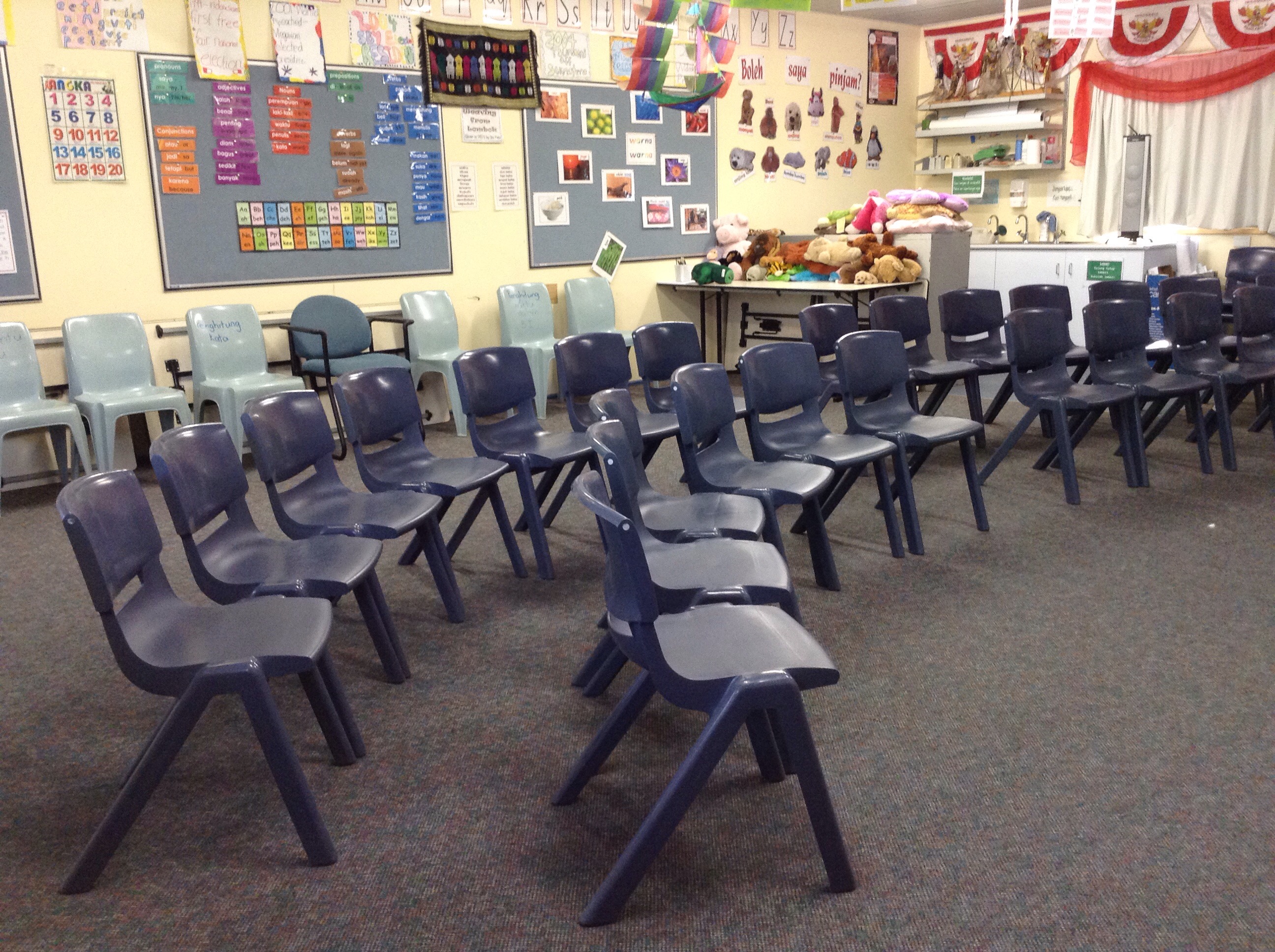
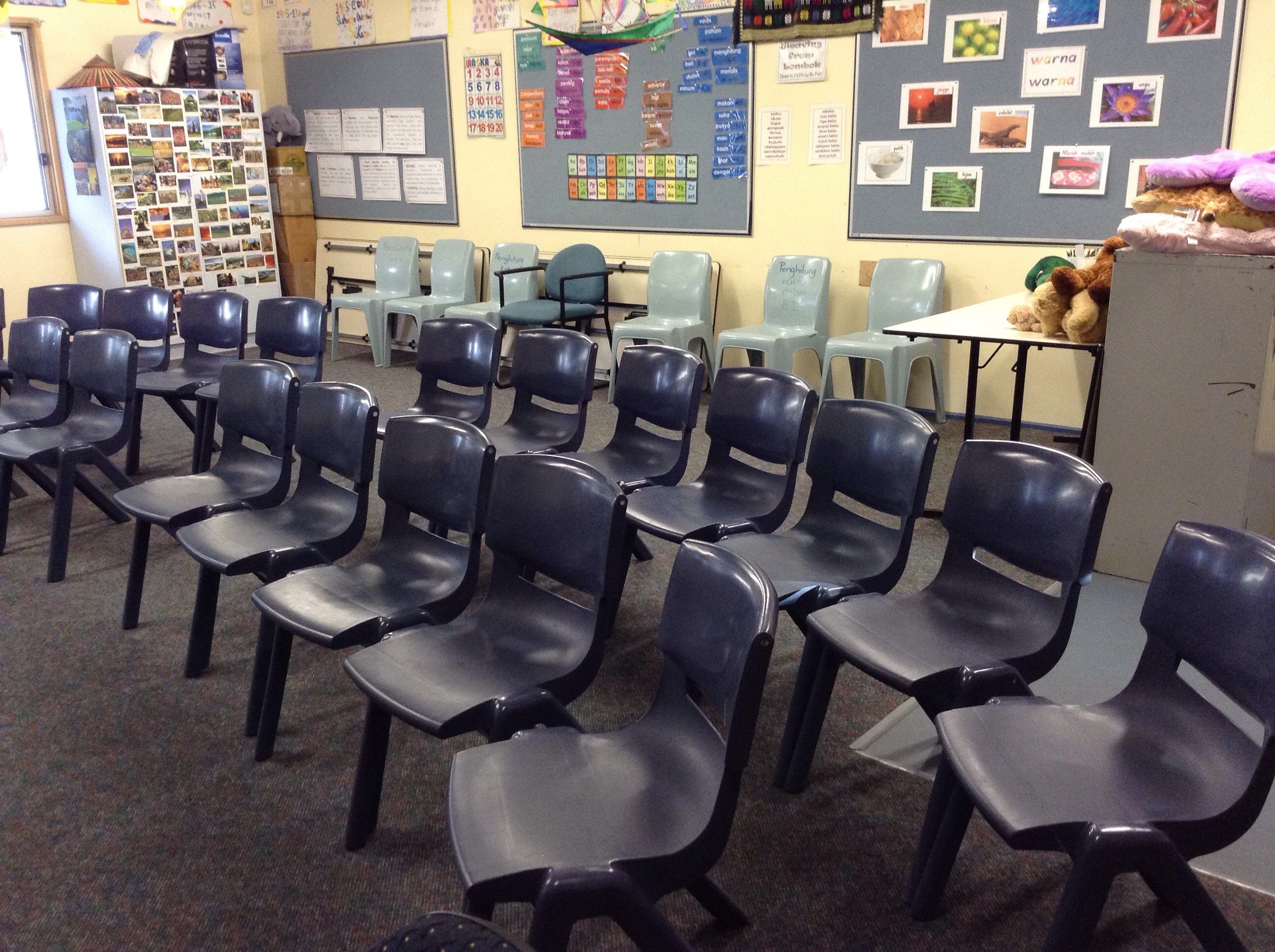
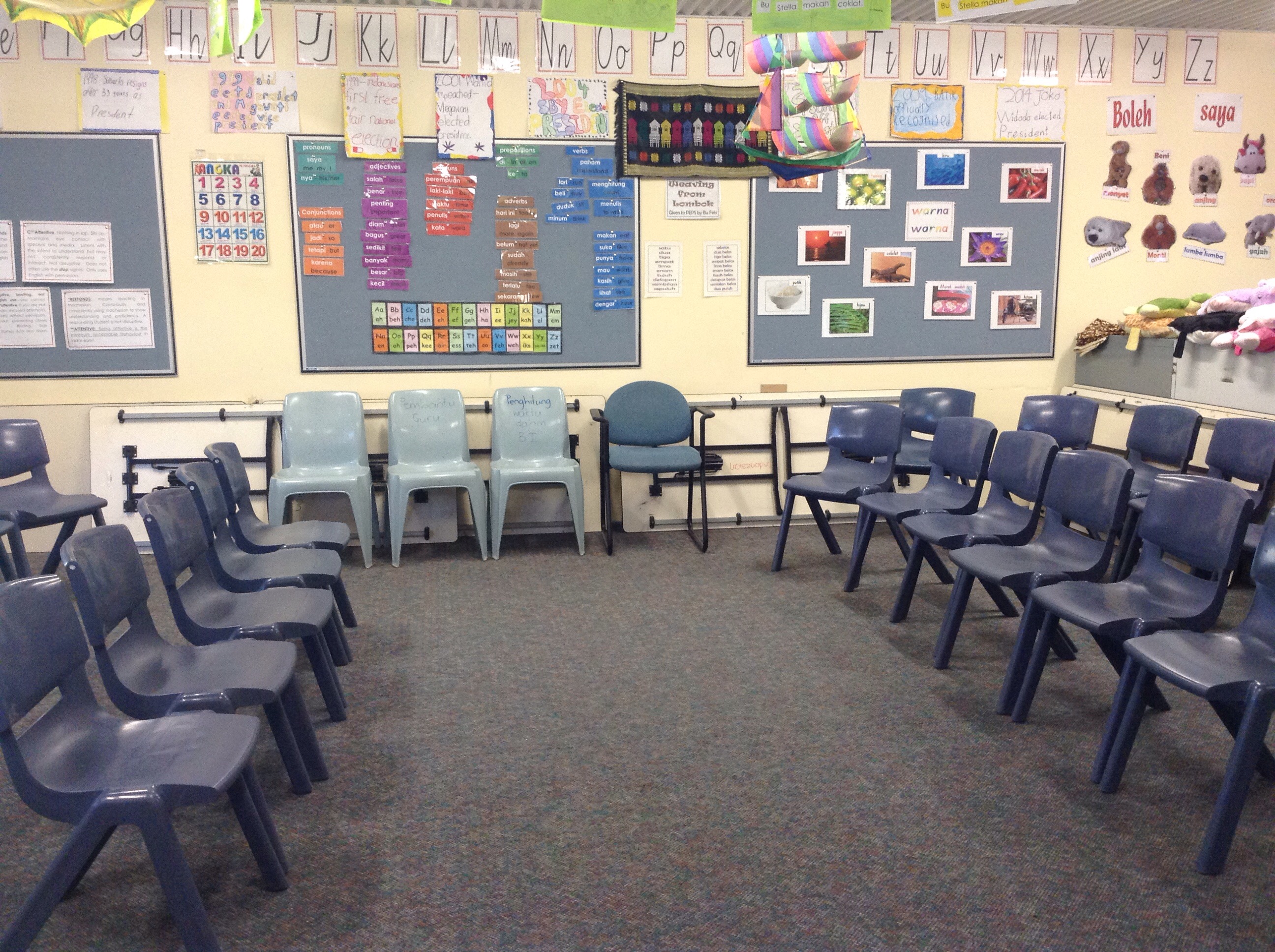
I am very lucky because when we moved to our new site in 2007 each teacher was given the opportunity to choose the furniture they would like to have in their new classroom. I chose trestle tables (which came with a bonus trolley) and stools. I have always loved the flexibility of trestle tables as they fold flat when not being used and are so portable either in the classroom or when transported around the school. 6 students can sit at them comfortably and when pushed up with one end against the wall, it creates an illusion of an open & spacious room.  I chose stools rather than chairs because they are more practical for the range of student sizes and ages (5 to 13 years) I teach each day. My very first classroom at the old site contained a mish mash of tables and chairs of all heights and varieties which in itself spoke volumes about the value of the Indonesian Language program! I was very relieved to be able to leave that cruddy furniture behind! Yet, the very first thing I did when I initially made the decision to attempt TPRS methodology, was to fold up my tables and stack them at the back of the room!! For that lesson I put the stools in a circle which in retrospect was valuable because as soon as students walked into my room, they knew something critical had shifted and it wasn’t just the tables and stools! Students loved too, the privilege of sitting on stools while listening to me; previously they’d sat on the floor and then moved to the tables to complete set tasks. However I soon found that the stools did not work. For all students, the stools weren’t particularly stable, so after a while, I stacked them too at the back of the room and expected students to sit on the floor once again, except for students doing jobs; they could sit on chairs at the back of the room in kelas satu (first class). My room stayed like this for a whole term and then during the last holiday  break, I read about the value of brainbreaks to help students cope with sitting still for large blocks of time. I remembered too sitting in conferences for hours on end and being uncomfortable and imagined that sitting on the floor would be even more uncomfortable. I then also began to realise that it was difficult to dictate student seating when they are sitting freely on the floor. So during that holiday break, I carted all my stools up to the shed and swapped them for upper primary chairs. I firstly set out the chairs in 2 rows in a semi circle facing the white board (kelas dua) and a narrow aisle running up the middle, with kelas satu still along the back wall. The area in front of kelas dua has become ekonomi! I chose the word ekonomi because it is a cognate. Later I want  to investigate the frequency of the word ‘lantai’ (floor) to determine the usefulness of it in the classroom.   Then last weekend I watched a Ben Slavic youtube video and loved the way that the classroom was set up. So I gave it a go last week! While I think the above works well when students need to focus on the white board or smart board, the setup below would be great for story asking.   I asked the students at the end of their lesson for their opinions on the new seating arrangement and overall it got a big thumbs up. I think they too, like me, enjoy a change now and then! Students also commented that if my room is going to be set up like an airplane, then kelas satu should be at the front of the room. I really like that suggestion and will incorporate it when I next use the first chair formation. It makes sense that kelas satu have the prime position!! It will also make it considerably easier for the students to do their jobs.

If you are interested in reading more about this, then I highly recommend Grant Boulanger’s post on his deskless classroom experience.

Why are Frequency Lists Important For Language Teachers?

A frequency list identifies words that occur most frequently in that particular language in everyday conversations. For most languages, frequency lists are easy to find, yet for Indonesian the first one I found was this one and that was thanks to Penny Coutas. There are many sites that offer lists of common Indonesian words. See here, here (my favourite) and here. Look through their word lists and see if you agree that they are in fact a list of the words that you would use the most when communicating in Indonesian.

Ben Slavic says that a language teachers curriula is a list of words and for me this rings true. No matter what methodology you use to teach a language, your lesson is based around a particular group of words. As the goal of language teachers is to provide opportunities for students to develop conversational fluency, it makes sense for teachers to target the specific vocabulary necessary for this. The frequency lists are thus lists of the most frequently used words that occur naturally and regularly in everyday conversations.

From the list of 200 most common Indonesian words, we wanted to determine the Indonesian ‘Super 7” (credit Terry Waltz). To identify the core vocabulary  necessary to ensure 100% comprehensibility in all classroom conversations. Terry Waltz says of her ‘super 7’ that “if you can get novices to really, really, really own these words, they can figure out how to communicate about quite complex things with just a few words.”

So we decided we wanted to determine the Indonesian ‘top 10’. However I do agree with Penny Coutas about sudah/belum, so therefore I personally suggest that the Indonesian list becomes known as the Top 10 + sudah/belum. Knowing our Top 10 + sudah/belum, helps us determine the path necessary for students to develop and improve their proficiency.

So far, in term 1 we covered suka, pakai, punya, kasi, di and mau while this term our target structures have included revising the above as well as ada & pakai. The idea being that once students have thoroughly acquired the Top 10, we can start introducing more complex  target structures.

Elsewhere on Ben Slavic’s blog, he and other experienced TCI teachers advise that frequency lists are a very good place for novice TCI language teachers and learners to start; they are the ‘beginners curriculum’ (Alisa Shapiro). TCI teachers are in favour of a personalised curriculum – that is a curriculum based around the  interests and needs of students. Engaged students are after all far more enjoyable to teach, so it is a win – win!!

The Top 10 + sudah/belum list is always open for discussion and will be revised over and over as time goes by. No doubt, during the next opportunity to speak in Indonesian, I will hear/use a word that will make me stop and wonder whether it too should be a consideration!!


PQA & Direct Instruction in the TCI Classroom

Last week, 2 important aspects of TCI gelled for me. The first was the true understanding of the Personalised aspect of PQA (Personalised Questions & Answers), and then experiencing how it transforms discussion. Read this and/or this to learn more about PQA. Ben Slavic also has published a book called PQA In A Wink which I am reading at the moment and can highly recommend. 

Over the holidays, I created a notebook file full of quirky pictures to support the acquisition of 

‘terlalu’ besar’ (too big)
‘terlalu kecil’ (too small) &
pas (just right/perfect).

As the class was looking at the pictures on the smart board during the first day of school, it became clear that once the novelty of the pictures wore off, I lost the students. I puzzled over this during my evening dog walk that evening. I revisited in my mind all that I had done in the lessons, trying to pinpoint where I had stumbled. It suddenly dawned on me that PQA was not asking about the colour of the jacket nor whether the bike was big or small. That was incredibly boring because, honestly, who cares if the bike is red or green! Ho Hum… PQA is asking questions that relate directly to the students.  I was so excited to finally get this that I couldn’t wait for school the next day to give it a go! 

The following day I had great success and students were thrilled that I was asking them questions about their own personal lives, their likes/dislikes etc. For example, one of my pictures was a pictures of a man in a pink tutu riding a tiny bike with the word ‘sepeda’ typed and an arrow pointing to the bike. I asked questions such as:

  1. Siapa punya sepeda? (while pointing at the word sepeda with my magic laser pointer) then asking the student who had responded:
  2. John punya berapa sepeda? and then asking: 
  3. Sepeda John terlalu besar, terlalu kecil atau pas? I then moved on to asking about the bikes of their siblings which also apparently, is mesmorising! 

Another picture was of a tiny turtle dwarfed by a strawberry with the turtle labeled kura kura & the strawberry labelled arbei. For this picture I asked:

  1. Siapa suka arbei? ( One year 4 boy answered, saya suka makan arbei dan kura kura! It was pure gold!) 
  2. Siapa tidak suka arbei?
  3. Siapa allergi dengan arbei?
  4. Siapa suka makan arbei dengan es krim?

I am still amazed at just how much questions such as these are engaging for our students. My only concern was that general questions to the class evoked an incredibly enthusiastic response which was at times deafening. Awesome that everyone is so engaged but so hard to manage and keep students focussed without lapsing into English.

Then after school Wednesday, I watched a webinar from the TPRS Publishing website which led to my second realisation thanks to Carol Gaab. The beauty of this webinar is that it is specifically for elementary language teachers. I have seen it several times and each time I watch it I learn something incredibly useful. I was delighted this time when Carol outlined several techniques she uses to minimise students calling out during PQA. She recommends asking students to do a given action if they agreed/disagree with a statement, eg berdiri kalau suka arbei, angkat tangan kalau tidak punya anjing. Once again, I couldn’t wait to try this idea and again, it worked so well and made such a difference. 

So this week (week 2) I combined asking personal questions together with asking the students to reply to questions by standing/ sitting/ raising their hand etc and it was brilliant. One of my year 6/7 classes today arrived to class in an unusually unfocused fashion. They fussed around getting jobs allocated and with the delay became even further unsettled. Yet as soon as I started PQAing the pictures on the smartboard, they were suddenly quiet and hanging off every word. At one point I asked whoever had 3 dogs to stand up, I then asked each of the students standing what their dogs names were. This produced some  hilarious names which had the students in stitches. However when I tried to move on to another question, the students quickly reminded me that I had yet to ask Winter about her dogs, who was not fussed at all that she didn’t get to share!!! We also had a giggle when Connor told me that he had 13 dogs but he couldn’t keep a straight face and then quickly confessed that he actually only had one! 

A truly terrific week due to finally experiencing the power of the ‘P’ in PQA and learning techniques which help to keep us all in Indonesian!! My next personal goal is to learn how to incorporate awesome student contributions into our class stories! Imagine the story we could have created involving a turtle  hamburger!


Written by the Penulis Twitter


Term 1 Reflections

As term 1 draws to a finish, I have been looking back over my first dedicated block of teaching Indonesian using TCI . It has been a steep learning curve yet at the same time deeply satisfying. I have learned just as much as the students!! Here are the major gems that I would like to share with you from my short journey thus far:

  1. Props – Don’t ever underestimate the power of props. When I copied Sharon’s brilliant idea of using a bottle of Sprite to tell the story: 

Jessie haus
Jessie mau minum Sprite
Ella punya Sprite
Ella kasih Jessie Sprite
Jessie minum Sprite.

I was blown away with the total and utterly mesmorised attention of the classes from year 2 right up to year 7! Even when the Sprite finished, students insisted I refill the bottle with water, so we could continue. Even with water, students were still highly engaged and following the dialogue closely. It not only hooked the actors, but hooked the other students too as they decided whether Ella would give Jessie a drink of Sprite and if not Jessie, then who would be given a small drink of Sprite. It is definitely worth taking the time to organise props for lessons with all year levels. Not only do students beg for repetitions, but it is so much more fun too for everyone. I have never laughed so much with students!! 

    2. Public Holiday Pitfalls  –  Usually I begin my week with the year 4’s and they are a great bunch of students to ‘trial’ my middle/upper lessons with. They give me the opportunity to fine tune my plan before facing the year 6/7’s the following day. While I enjoyed my first Easter long weekend in many years (our Ed Dept usually cleverly incorporates them into our mid semester break), I forgot to keep this in mind and consequently yesterday’s lesson with one of the year 6/7 classes was a disaster. With this class I need to be one step ahead of them. Maybe Trashball or something similar would have been a better plan for a challenging class in week 11.. 

  3. Trial by Error – A exhausting yet necessary aspect of teaching and a fact that I (and any learner) needs to philosphically and practically accept. I’ve read that it can take up to 2-3 years for a teacher to acquire competency using TCI methodology. This is what keeps me going! There are many fantastic blogs and websites full of TCI brilliant ideas and suggestions. Gleaning through them all to find ideas suitable for teaching primary students and then trialling it requires a huge step out of my comfort zone and so much energy. Yet each step is an important and integral aspect of the entire journey.  I must keep reminding myself to continue plodding steadily along the TCI path and not to expect too much too soon! 

4. Dehydration – TCI requires so much teacher talk and I have discovered that I am so much more dehydrated at the end of my days than I was ever before. I have tried to keep up my fluids over the day but haven’t been successful consistently with this yet. I get so engrossed in the lesson that I totally forget to stay hydrated. The most successful stategy I had was finishing my 750ml drink bottle at the beginning of recess and lunch on my way to the staff room but lately even that has fallen by the wayside. Any suggestions gratefully accepted! 

5. The Importance of Developing A Personal Learning Networks (PLN) –  The core of my PLN consists of Annie & Sharon, my Indonesian colleagues who teach in nearby schools, together with Catharina, our mentor who teaches French in New Jersey. The middle layer of my PLN consists of teachers who teach Indonesian and have been following this blog or my tweets. Their input has been invaluable and I have truly appreciated their comments and  feedback. While there are common aspects between different languages, there are also certain aspects that are unique and therefore those who teach and  speak Indonesian have that special eye through which to  understand my reflections and experiences. They too are are coming to grips with our new Indonesian Curriculum to be implemented fully in 2016, another valuable persepctive. The outer layer of my PLN consists of all the TCI language teachers who post on their own blogs or on websites like Ben Slavic’s. There is definitely a gap for me between the middle and outer layers purely because most of the teachers in the outer layer are secondary teachers and none of them teach Indonesian. Yet, they are still a major and important part of my PLN as they have such a wealth of knoweldge and experience that I am truly in awe of them. Without this special group of people, my first term of TCI could have finished so differently. Whenever I felt like I had hit a brick wall and I couldn’t see where to go next, someone would be there to encourage and help. Annie and Sharon have been awesome and once again I am so fortunate to work so closely with 2 teachers who readily joined me on this journey. Our frequent Friday meetings were invaluable opportunities to share lessons that worked well and thus give us each the inspiration and encouragement to continue. Our Skype sessions too, with Catharina have been incredible. Each time we all  took copious notes. It is so amazing to have the opportunity to speak with a junior primary teacher about TCI and how to apply it with very young students. Now that term 1 has almost finished, we are really looking forward to our next Skype call with Catharina. While we usually only speak for an hour, each call is jam packed full of awesome suggestions and information. She truly is an amazing and inspirational teacher  to have in my PLN and a huge thankyou must go to Ben Slavic for initially suggesting it! 

6. Lesson Planning – On looking back through my lesson plans, I have definitely learned that while it is good to have a few brain breaks up my sleeve, it is also important to keep my planning simple. My initial lesson plans from the first weeks were very long and were a great example of over plannning which is a good way to start! I tried to cover everything at first and then realised that it was not only unrealistic but also pushing the students too quickly. Narrow and deep is the TCI catch cry for a very good reason and this is what underpins the success of TCI over the methodologies I used previously. 

7. Patience is a Virtue – When reading blog posts written by other teachers who also use TCI, I have to keep reminding myself that comparing my students (or their lesson outcomes) with theirs is pointless. My students & i have only just started so it is natural that we can’t yet have impromptu detailed conversation that are 100% comprehensible. It is of greater importance that we start with the Indonesian version of the super list of verbs sourced from frequency lists and accept that initial discussions will be be very basic. 

8. Humour – At a point about mid-term, I reached a point where everything gelled. Suddenly I relaxed and started to enjoy myself with the students. At that point I realised that it was the first time I have ever laughed so much WITH  my year 7 students. Previously, any hilarity got out of hand and ended with me having great difficulty bringing them back on track without loosing that sense of connection. Yet with TCI, we laugh together at the ridiculous  scenarios the students suggest and then act out. Not only do students have fun, call out and be totally silly, but because it is all in Indonesian, it is amazing and all students are totally mesmorised and engaged thus keeping it manageable!  

9. Tight Timelines have Vanished – Previously, my term outline was tightly planned and in order for me to achieve my term outcomes, every lesson was precious and heaven help anyone who interfered with my schedule!! Taking sick leave was avoided and any additional offered non contact time was reluctantly refused because my planning didn’t have much flexibility. This has all blown away with TCI as everything is based upon student aquisition which is a  huge unknown. Once we know what the target structures will be, out planning will focus on that until we, the teacher, deem the students ready to progress to the next step. Consequently, with our upcomiing APBIPA visitor, Bu Mia, I feel far more relaxed and am really looking forward to her time in our school. Students will be able to experience a cultural lesson with her and this will also give them impromptu and authentic opportunities to practise and demonstrate their acquired Indonesian to date.

I am so looking forward to term 2 and having the opportunity to apply all that I have discovered. I also hope that my reflections give other Indonesian teachers the encouragement to consider trialing aspects of TCI in their classrooms. Last year, I dabbled just by experimenting with a few activities that sounded interesting and that is how I urge you to start too. While I am nowhere close to TCI mastery, I am nontheless, very happy to help any Indonesian language teacher if you would like to discover more about TCI. Ask away and if I don’t know the answer,, someone from my amazing PLN will certainly help!!