ASILE 2016 – Games & Activities for Language Classes

One of the workshops we attended on Sunday was led by Pak Irianto Ryan Tedya. It was a very enjoyable workshop with songs and games, 2 of which would be ideal as a brainbreak or for TPR.

The first game he shared was ‘dam dam sut’ which is his own variation of ‘suten’ (gajah, orang, semut). This game reinforces the target structures:

  1. Kita seri (we draw)
  2. Saya menang (I won)
  3. Saya kalah (I lost)

Each with their own hand gesture:

  1. Hands crossing left to right horizontally palms facing downwards
  2. Hands up in the air, fingers splayed
  3. Hands down wards, palms facing opponent.

The game is played in partners and together players say dam, dam together while clapping and then together say sut and on sut, players choose to either do:

gajah (elephant),

orang (person) or

semut (ant).

When first introducing the game, Pak Irianato recommends just focusing on;

  1. Gajah beats orang (elephant steps on person)
  2. Orang beats semut (person steps on ant)
  3. Semut beats elephant (ant gets into elephants ear and irritates the elephant – ant is small yet powerful)

Pak Irianto asked us to play 3 times with a partner and then swap partners choosing someone new. When he judged that we had mastered that, he asked the whole class to synconize our games; meaning that the entire class clapped & said dam, dam, sut at exactly the same time, starting very slowly and encouraging everyone to keep the rhythm.

Once this is mastered, I would introduce the above target structures yet Pak Irianto encouraged us all to use it right from the beginning. One participant suggested the following rhyme sung to Frere Jacques to consolidate vocabulary:

Saya menang

Saya menang

Saya kalah

Saya kalah

Kita seri

Kita seri

Marilah bermain!

Marilah bermain!

All up, it was a fun game and I loved the way that the game increases in complexity which makes it appealing to all ages of students.

The final activity he did with us was awesome and perfect for TPR. This song could be adapted to any verb. I love the idea of asking students for action suggestions!! I was thinking of how much fun ‘menangis’ (cry) or ‘jatuh’ (fall) would be. Pak Irianto first taught us the song and actions then suggested adding the jumping left, right & centre afterwards to add a further challenge.

I didn’t take any notes, just this video!!

Brainbreaks

My most popular brainbreak video last semester was senam penguin which I mainly showed to junior primary students, but it turns out the older students enjoyed it too one day when I was absent!

https://www.youtube.com/watch?v=U-5mX1KfErE


However it is now time to give senam penguin a break so I started looking for a new senam brainbreak video and I think I’ve found it! This will be be perfect for all students especially those who have been enjoying Pokemon G!  What do you think?

https://www.youtube.com/watch?v=C7l_JPT8xA8


Don’t forget you can purify these videos to remove any advertising!!


A terrific Brainbreak For All Year Levels

Students need constant brain breaks to help them both lower their affective filter and also to literally give their poor brain a break. I found the following YouTube clip and it translates beautifully into Indonesian and it is a great break which has been enjoyed by all ages. When I first introduced it to one of my year 7 classes, I tried to do the whole game – starting with introducing all the movements just as the fellow does in the clip:

– berjalan kaki (walk) & stop

– berdansa (dance) & melompat (jump)

– nama (name) & tepuk tangan (clap)

These structures are all 100% familiar to my students through TPR (Total Physical Response) and TPRS (Teaching Proficiency through Reading & Storytelling), but to be honest, any verb you have focused on or even one you would like to focus on, could be used instead (although jatuh *fall over* may not work well haha) 

I then began to introduce reversing the word pairs. I began with reversing berjalan kaki & stop which was highly successful probably because one of the words is a cognate. It added a new level of fun & challenge which the older students really enjoyed but when I reversed the next pair, the brainbreak quickly became hard work & student engagement dropped instantly. I defintely recommend saving that aspect of the brainbreak until much later when students are familiar with the instructions and only introduce one reversal at a time and just with classes who know these structures inside out! 

It is so cool when a whole class calss out the name at the same time!!  

A great Brain Break from Bu Anne

This term my junior primary students are learning target structures for Catherina’s snake story. This week we focused on ular (snake). After showing a PowerPoint of pictures of ular’s which included pictures of worms & cicak’s (geckos) all ways to get repetitions of the structure ular, I finished with a few pages of ular’s hiding in environments and asked the students, “Dimana ular? (Where is the snake)  They absolutely loved this although the touch TV screen was challenging!

Untitled

Afterwards I tried a fantastic TPR game that Bu Anne wrote about recently and it was a big hit. I asked the students to stand up and spread out around the room. We then revised the positions needed for the 3 words in the game. The 3 words this time are: sekolah (school), cicak (gecko) and ular (snake). If I said ular, the students lay on the ground like a snake, if I said sekolah, they stood tall with a roof over their head and if I said cicak, they got down on their hands and knees. It is good to choose 3 words that give you 3 levels of movement and also ensure that the only unfamiliar  word is the target structure and the other 2 are familiar from previous stories.

Once the students were familiar with the game, I added various levels of complexity. Firstly I said just 2 words (ular/cicak) about 3 times each and once they were in a rhythm, I tricked them by repeating the last word! eg ular, cicak, ular, cicak, ular, cicak, cicak! Another way to ramp it up was to say it again without any gestures and finally to really ramp up the listening, use the wrong gestures!! All classes absolutely loved this TPR brainbreak.

JP Indonesian Brainbreaks

Baby TV – A variety of videos for young learners of Indonesian. You will need to scroll through them to find ones that aren’t too fast or that go out of bounds, but a few have great potential. One I particularly liked was the 5 monkeys one which is highly repetitive and would be a good followup for target structures melompat and counting to 5.

Senam penguin – a fun quick brainbreak dance. Murid murid mau berdansa?

Specialist Teachers Unite!

For the very first week of the year, the 5 specialist teachers at my school collaborated to present a united program to students. The 5 specialist are

  1. Performing Arts
  2. Digital Technology
  3. PE
  4. Geography
  5. Indonesian

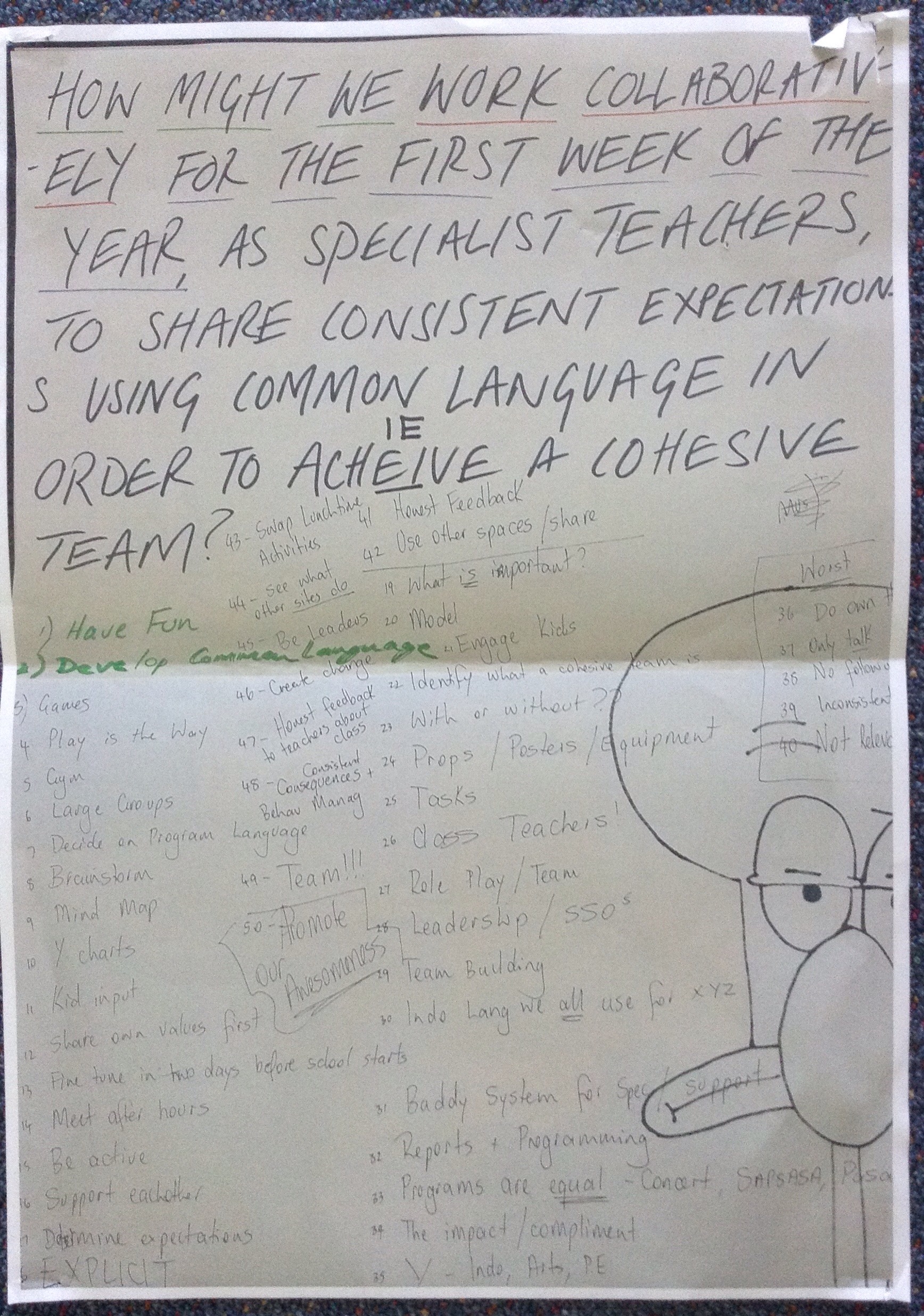
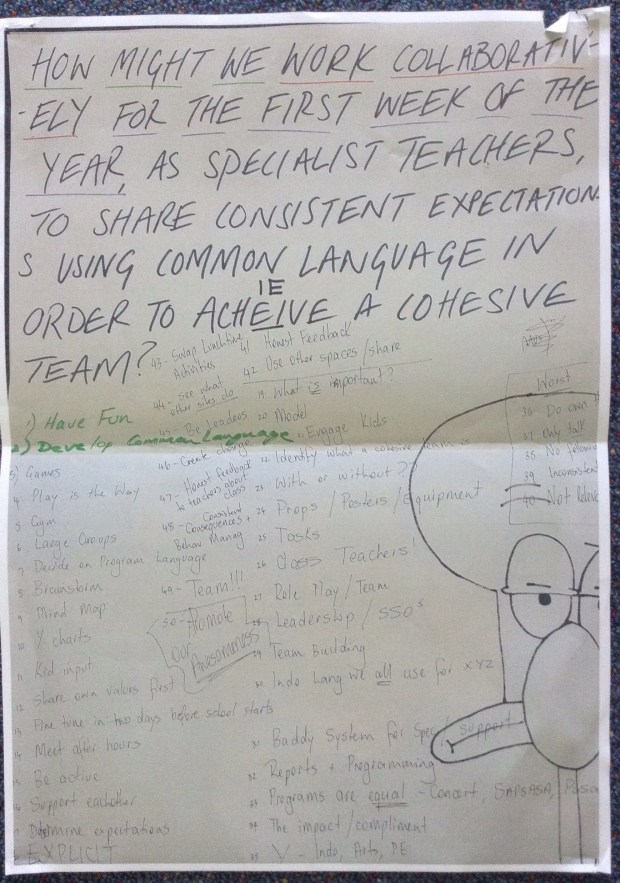
We first discussed the idea during a No Tosh workshop last year with the idea being that instead of students coming to each one of our classes in the first week of school and hearing the same message over and over again from each one of us, we would collaborate and clarify our expectations together. Here are our initial notes:
 We met during the holidays and excitedly agreed to trial the program. The idea was that we all came to our timetabled lessons in the gym with a short activity prepared for a large group of combined class levels. The activities had to provide us all with the springboard to discuss group skills & minor problem solving through our school values of community, confidence & respect.

As none of us work full time and our days are spread evenly over the week, it meant that each day we either had 2, 3 or 4 teachers on deck at any one time working with 2, 3 or 4 classes respectively. Two junior primary classes received our combined spiel 5 times and the remainder received it 4 times yet because the teachers each day were never exactly the same and the classes who came were also never exactly the same, the dynamics changed significantly each lesson.

We began each lesson with our shared expectations and communicated to students clearly that this year there will be significantly more communication between class teachers, leadership and specialist teachers  through a new monitoring system we will hope staff will support to ensure that behaviours in our classes are followed up on.  Other issues we talked about included the fact that our lessons are only 50 minutes and thus all students to repsect the learning of others so that time isn’t wasted.

We then shared the microphone around and led an activity each. It was brilliant being able to focus on group skills and problem solving repeatedly with mixed group levels. We would ask students to get into groups and then after a few minutes, ask everyone to stop. This gave us the opportunity to talk about the confidence needed to be proactive and approach a group and ask to join their group, how the request needs to be answered respectfully and diplomatically, to be resilient and persist till you join a group, make strong choices about who you group up with etc. We did this over and over again in various ways all from our own specialist subject viewpoint and students definitely improved over the week.

My activities included Bu Cathy Berkata (simon says), kancil, buaya, mangga (get into groups of 3 and decide who will be kancil, who will be buaya and who will be the mangga. Berjalan kaki around the gym in your group and each time I say ‘buaya/ mangga/kancil’ the kancil stands with their hands cupped on their head for ears, the buaya lies on the ground and the mangga curls into a ball) and on the last day I extended the language by asking students to ‘cari satu teman – satu perempuan dengan satu laki laki’ and it was fantastic that students used the stop gesture (tidak paham) and others could translate for them.

The geography teacher came up with her own activity which involved rings of students representing different aspects of the globe and then the finale was asking them each to turn either clockwise or anticlockwise. The final movement was amazing and I filmed it which should be good for a future brain break! It truly demonstrates why the weather is never  predictable.

Natalie, our performing arts teacher did one activity where she divided the students by gender. Each group had to put themselves into a line in order of birthdate and then she turned on some very loud music. Each group did well with only a couple of errors (not bad for 2 groups about 40 students) and afterwards she sat them down and discussed with them the impact of noise, congratulated the studetns who had shown leadership & asked the groups to explain the methods used. It was a brilliant activity for upper primary.

Evan brought ipads to the gym and asked the students to get into teams of 10. Each team had to take one continous video on an ipad which was passed respectfully clockwise around the circle and each person had to film the person on their left saying one positive thing about the who was person filming them. The groups that worked collaboratively and respectfully completed the task had time to watch their film yet the groups that did not collaborate well had many disappointed team members who didn’t get a chance to use the ipad. IMG_1615
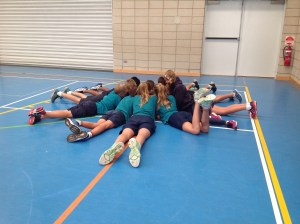
We met on Thursday afternoon to review the program and we all agreed the week had been a huge success and one we’d be keen to repeat in 2017.  The comments from staff were also incredibly positive noting that the sense of community created in the gym felt very real. We found it a great way to start the year because it gave us a chance to meet the new students and learn their names as well as the names of a few of our many new reception students. It gave Evan and Les some breathing space in which they could learn about our school and students in a collaborative atmosphere before we all go it alone next week . All up the sense of community was strong not just for students but also for the 5 specialist teachers!
Sharing Great Ideas – Membagi Ide Bagus

Due to a nasty virus, I’ve lately had plenty of ‘rest’ time enjoying interesting online articles. I’ve also discovered the ‘add to reading list’ button at the top right corner of my ipad which has been very handy for bookmarking and saves me having to go backwards and forwards between apps and safari. 

Here are a couple (tongue in cheek) that I would like to share with you all:

  • Have you heard of contextualised chanting? Read this blog post by Michel and learn about it. What a great way of having a brain break and getting some bonus repetitions in!
  • I got a lovely surprise yesterday when following a link to this google doc listing CI reading activities on the Tristate TCI – Teaching World Languages with Comprehensible Input facebook page, included  a link to this blog!! 
  • Also on that facebook page was this video demonstrating the airplane activity, another  ‘post story’ activity.
  • Have you discovered Senor Fernie’s blog? I love it because it has an elementary/primary school aged focus. He has just finished a series of posts dedicated to junior primary story telling.Here is the the first one: Enjoy
  • Have you watched any of the Musicuentos Black Box podcasts yet? I’ve seen a few and each one has been fascinating. They only go for about 5 or so minutes and give a good general overview of the topic being discussed. Here is videocast number 7 (Overcoming Resistance to 90% Target Language Use) and number 6 (The Inescapable Case For Extensive Reading).
  • Somewhere to share posted recently a fun story review game. I think the game has great potential but I wonder how to avoid students recognising each others handwriting? Could the story sentences be typed up by the teacher beforehand and distributed randomly or selectively? 
  • Here are a few videos I bookmarked. 1. Willy Winako & Dara singing Suara Perjuangan. 2. A fun video illustrating how some well known western words would sound if pronounced ‘properly’ (can only find the link on facebook, but hopefully soon it will be on youtube!) and is an edited version of the original. 3. Another video from facebook which thankfully has a youtube link – about a current topic – the Indonesian forest fires, and finally 4. Goodnews Indonesia
  • I am following Martina Bex on facebook which randomly promotes links to previous blogposts. This one came up last week and could be useful for term 4 if you are looking for ways in which to add some TPRS fun to the end of the year. It is all about the many ways we can use songs in the Languages classroom. 
  • Have a look at this amazing collection of brainbreaks. While not all are appropriate, there are enough great ones here to make it worthwhile. Some of the video links are hilarious and I am sure could easily be adapted to Indonesian. How about this one for example? Imagine the language repetition for a short target structure? 
  • Creative Language Class posted recently about how she teaches her school curriculum using TPRS pedagogy. I love the way she identifies the key skills and then lists ideas of how this could be achieved.
  • Saving the best till last –  the link to the most recent edition of the IJFLT (The International Journal of Foreign Language Teachers).  This contains many interesting articles by a selection of well known TCI/TPRS teachers. Past issues are also available.

Happy reading and hopefully I haven’t included too many links? Maybe add some of them to your ‘reading list’ for the upcoming holidays which will be here faster than we can imagine!

Amazing Indonesian brain break – Hit Like A Girl!

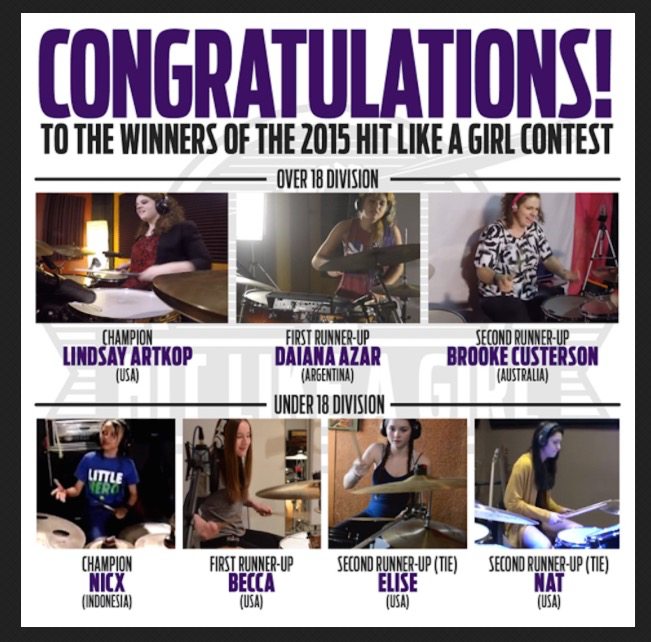
I know I have already posted today but this is so exciting, I can’t help but share it immediately. I have just had a email from a friend who teaches in Bandung. She is so proud because one of her students has been announced as the under 18 winner of an international competition – Hit Like A Girl.


I cannot wait to show my upper primary students this amazing clip of Nicx, who by the way is only 10 and won the under 18 category! She has such a future!!

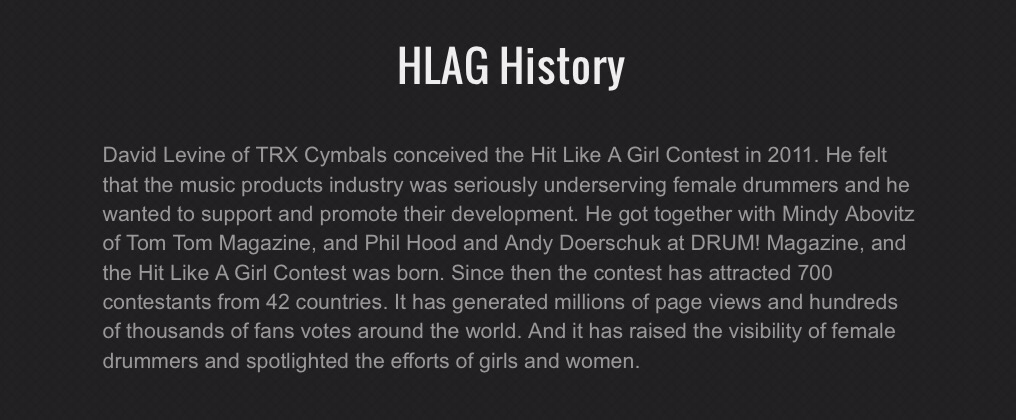
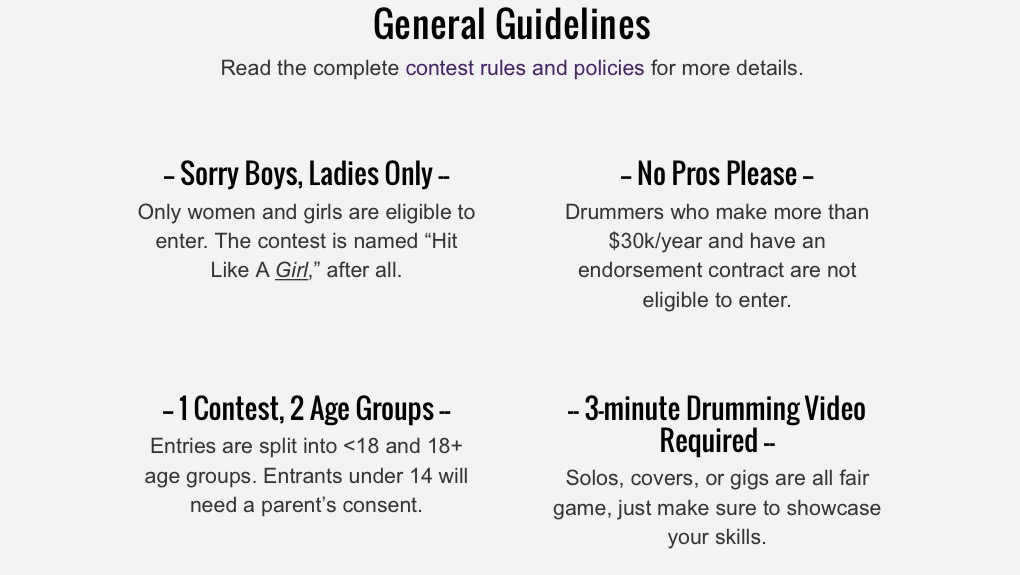
Here’s some more information about the competition: