Kursi Luar Biasa – Jawaban Benar atau Kreatif? (True or Creative Answers?)

Usually in Kursi Luar Biasa, (literally – the amazing chair [special student interviews]), I ask students personal questions about themselves (age, likes, pets etc) followed by a quiz. The quiz is a benar/salah style quiz. I began at first by asking students to stand if the statement I said about the ‘amazing student’ was true or sit if it was false, however I soon discovered that this became a sheep following exercise; if one stood/ sat then the majority followed suit without any thought. So the quiz became, stand if it is true for you and sit if it is false for you – as this requires greater focused listening & personal accountability. So if I say, ‘Susan tinggal di Victor Harbor’ (repeating one fact that Susan had told us about herself), the students who also live in Victor, stand. If I say, ‘Susan tidak tinggal di Mount Compass’, then all the students who don’t live in Mount Compass would stand, while those who do, sit!

As Kursi Luar Biasa (KLB) is largely a short one on one conversation with just the occasional questions addressing or about other students (to ensure comprehensibility and/or to encourage listening), engagement levels from the older students have decreased noticeably this semester. I have racked my brain for ways to ramp it up. I scoured Bryce Hedstrom’s Persona Especial posts for suggestions appropriate for this age level as well as being suitable for Bahasa Indonesia (the Indonesian language) and tried those that had potential (see past posts) but there were still students using this session as a zone out time. As they are generally quiet, I’ve accepted it because it has allowed me to focus on the ‘awesome’ person and to keep the spotlight right on the student who chose to sit in the chair! I also justify it to myself with the thought that while they are not listening with the intent to understand, they are still being exposed to Indonesian.

Yesterday, a year 7 boy, J, changed all that! He had us all following closely his hilarious answers and the entire class was 100% engaged and following the discussion closely! After The interview  had finished (stopped by the recess bell), I asked the class for a rating out of 5 (using their fingers) and 98%  rated it 5/5 while 2-3 rated it 4/5. I got exactly the same score for overall comprehension of the entire conversation!  J began by telling us where he lived and about the people in his family (great opportunity to revise one of the new target structures from the story that lesson) and then when I asked him about the sport he plays, we learned that he plays centre forward for Goolwa Hockey Club and is the leading goal scorer (dua juta gol!). A student who actually does play for Goolwa, was shaking her head and making it clear with body language that J does NOT play hockey for Goolwa!!  He started wildly embellishing (when asked what team he plays in, he stated the under 18’s – a grade that doesn’t exist in our local association), he had everyone’s attention.  We also learned that he plays in the AFL for Port Power and after pulang sekolah (another target structure from the earlier story – go home from school), he eats and then goes to Adelaide to train! He also claimed that he was a talented surfer, almost as good as Mal (a fellow student who is an extremely talented surfer and has participated at the national level). This last claim had his friends rolling on the floor with laughter!! He also made ridiculous claims about playing in the NBL! It was the most enjoyable KLB interview I’ve had in a long time and one I encouraged the students in that class try again!

Previously, I have discouraged students from stating fictitious information about themselves because I’ve always considered this part of the lesson as an awesome way for me to get to know my students better. However, my brain is generally on overload and I am finding, I’m embarrassed to admit, that unless a student tells me something really unusual or moving, my back to back lessons all merge into a vague hodgepopdge and I forget who said what. Yet I still see a value in beginning this way, especially with the middle primary year levels. It is a safe way in which to support students with repetitions of the vocabulary and language structures needed to answer personal questions or to talk about themselves to others. It provides them with a solid foundation upon which, when they are older, they can start being creative and quirky!!

I am so looking forward to next week when I can encourage the other year 67 classes to be wild and wacky.
Brainbreaks

My most popular brainbreak video last semester was senam penguin which I mainly showed to junior primary students, but it turns out the older students enjoyed it too one day when I was absent!

https://www.youtube.com/watch?v=U-5mX1KfErE


However it is now time to give senam penguin a break so I started looking for a new senam brainbreak video and I think I’ve found it! This will be be perfect for all students especially those who have been enjoying Pokemon G!  What do you think?

https://www.youtube.com/watch?v=C7l_JPT8xA8


Don’t forget you can purify these videos to remove any advertising!!


A terrific Brainbreak For All Year Levels

Students need constant brain breaks to help them both lower their affective filter and also to literally give their poor brain a break. I found the following YouTube clip and it translates beautifully into Indonesian and it is a great break which has been enjoyed by all ages. When I first introduced it to one of my year 7 classes, I tried to do the whole game – starting with introducing all the movements just as the fellow does in the clip:

– berjalan kaki (walk) & stop

– berdansa (dance) & melompat (jump)

– nama (name) & tepuk tangan (clap)

These structures are all 100% familiar to my students through TPR (Total Physical Response) and TPRS (Teaching Proficiency through Reading & Storytelling), but to be honest, any verb you have focused on or even one you would like to focus on, could be used instead (although jatuh *fall over* may not work well haha) 

I then began to introduce reversing the word pairs. I began with reversing berjalan kaki & stop which was highly successful probably because one of the words is a cognate. It added a new level of fun & challenge which the older students really enjoyed but when I reversed the next pair, the brainbreak quickly became hard work & student engagement dropped instantly. I defintely recommend saving that aspect of the brainbreak until much later when students are familiar with the instructions and only introduce one reversal at a time and just with classes who know these structures inside out! 

It is so cool when a whole class calss out the name at the same time!!  

A great Brain Break from Bu Anne

This term my junior primary students are learning target structures for Catherina’s snake story. This week we focused on ular (snake). After showing a PowerPoint of pictures of ular’s which included pictures of worms & cicak’s (geckos) all ways to get repetitions of the structure ular, I finished with a few pages of ular’s hiding in environments and asked the students, “Dimana ular? (Where is the snake)  They absolutely loved this although the touch TV screen was challenging!

Untitled

Afterwards I tried a fantastic TPR game that Bu Anne wrote about recently and it was a big hit. I asked the students to stand up and spread out around the room. We then revised the positions needed for the 3 words in the game. The 3 words this time are: sekolah (school), cicak (gecko) and ular (snake). If I said ular, the students lay on the ground like a snake, if I said sekolah, they stood tall with a roof over their head and if I said cicak, they got down on their hands and knees. It is good to choose 3 words that give you 3 levels of movement and also ensure that the only unfamiliar  word is the target structure and the other 2 are familiar from previous stories.

Once the students were familiar with the game, I added various levels of complexity. Firstly I said just 2 words (ular/cicak) about 3 times each and once they were in a rhythm, I tricked them by repeating the last word! eg ular, cicak, ular, cicak, ular, cicak, cicak! Another way to ramp it up was to say it again without any gestures and finally to really ramp up the listening, use the wrong gestures!! All classes absolutely loved this TPR brainbreak.

A Great Reading Activity For Pre-Literate Students

Have you seen the oral cloze retell idea by Eric Herman on my TCI/TPRS activities page which is found on my homepage up the top in the header?

Here it is:

On subsequent retells you can erase more and more words to give more advanced students a greater challenge and eventually erase the entire story and have superstars retell the entire story without any written support.

Example:

There is a boy. His name is Bob. He likes pizza.

There is ___ boy. His name __ Bob. He likes _____.

There __ ___ boy. ___ name __ Bob. He ____ ____.

There __ ___ ___. ___ name __ Bob. __ ____ _____.


I tried it today with a year 1/2 class as well as a reception class and it was awesome!

I began by asking 2 students to act out the story while I retold it. By now, I’ve lost count of the number of times they have heard it, but it never hurts to get in one more retell!! I then dragged over my mobile white board and asked the class to tell me the story again. It was brilliant how well they could retell the story! I wrote down the first 5 sentences on the board.

Buarlapar.

Buaya lihat Elsa.

Buaya mau makan Elsa.

Elsa berlari ke Horseshoe Bay.

We all then read the story together using hand gestures. At the end of the first reading, I rubbed out one word and in its place I drew a contrasting coloured line. We then read through it again together, however before we all read it, I explained that the next person to rub out a word would be someone who is both reading and gesturing beautifully. Boy – that ramped up the participation and engagement!!

We continued this until there was nothing left of the story and all that was there were red lines where the words used to be!! Both classes absolutely loved it and were so fluent by the time we rubbed out the last word!

IMG_1636[1]


IMG_1637[1]

IMG_1638[1]


Reading With Pre-literate Students

After watching Carol Gaab, I tried something new with my junior primary students this week that I would like to share with you.

Last week with my younger students, I started the Carol Gaab story that Bu Anne posted about on her blog. I have tweaked it slightly to minimize the amount of new vocabulary. Instead of a harimau (tiger) I have a buaya (crocodile) because most students know buaya from our kancil and buaya unit last year. I also believe that tree, mountain  (&?) are very low frequency nouns in a classroom, so I changed it to Horseshoe Bay, sekolah (school) & kelas (class).

My version goes like this:

Buaya lihat Elsa

Buaya lapar.

Buaya mau makan Elsa.

Elsa berlari ke Port Elliot.

Buaya berlari ke Port Elliot.

Elsa berlari ke sekolah.

Buaya berlari ke sekolah.

Elsa berlari ke kelas.

Buaya berlari ke kelas.

Buaya makan Elsa.

To support this story and its new target structures of ‘buaya’ (crocodile) & ‘berlari’ (run), I searched for a well known rhyme that I could adapt. Browsing on Pinterest I found the 5 Little Monkeys rhyme! This not only provided me with the perfect vehicle for ‘berlari’ & ‘buaya’ but also gave me the opportunity to introduce ‘jatuh’ (fall) & ‘menangis’ (cry). Here it is:

Lima buaya berlari di kelas.

Satu jatuh dan menangis.

Bu Cathy berkata, “Kasihan!”

Tidak pandai berlari di kelas.

Thinking back on our conversations with Catharina, the various posts I’ve read & my recent talks with Bu Anne, I liked the idea of introducing jatuh & menangis which we hear often in the junior primary classroom, especially after recess & lunch!

On Monday, I began introducing the rhyme but students weren’t particularly engaged and I considered disregarding the whole thing but yesterday morning as I turned on my computer at school, I remembered something I had seen Carol Gaab do. She had replaced the words of the story with illustrations. I immediately did the same using clipart images. Not only did it look more appealing to me, but it did for my students as well.

buaya 1

buaya 2

Then when I added acting into the equation, I was blown away with the increased level of student engagement. I firstly trialled the idea with a reception class, most of whom are pre-literate. They loved it and all read along with me! I then asked them to ‘cari empat teman dan duduk’ (find 4 friends & sit) doing a comprehension check firstly that they understood that you + four friends = groups of 5 and then they acted it out in their groups. Sharons ‘mata-mata’ (spotter) concept was brilliant here because invariably there were a few students above the multiple of 5. They went from feeling rejected to feeling very special when I asked them to be my mata mata! At the end of each acting of either the first half of the rhyme or the entire rhyme, each mata mata could choose a new mata mata and swap with that person.

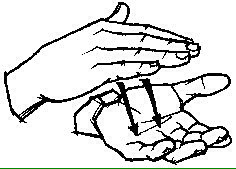
One more point I’d like to add is that of hand gestures. Our PLC members work at schools that are not particularly far from each other and we have a few students moving between our schools for various reasons. We have discussed several times how much smoother the transition would be for those students if our had gestures were similar. One idea that appeals to us all is the use of AusLan or ASL. When looking for gestures for sekolah, kelas, menangis & jatuh, I investigated several websites. I believe that all gestures mustache  be meaningful as they are clues which help students comprehend. The sekolah and kelas AUSLan & ASL signs were not useful at all.


So I asked students and we made up our own for sekolah & kelas. However I found great ones for jatuh and menangis.

Membagi Ide Bagus – Pleased to Meet You (Jim Tripp)

The first ever story I do with my JP students is a mini version of Pleased To Meet You (thanks to our wonderful mentor Catharina for this pared down version).  

This post from Creative Language Class complements this story beautifully and would suit my year 1 and 2’s perfectly who first encountered the story in Reception (Prep/Transition) and would enjoy this extension idea as well as learning ‘suka’. It would also be great for older students just starting out on their TPRS learning journey.

Get to know each other using the TL!.

Bop! From TPRS Teacher (Keith Toda)

The students and I had fun this week trying a new game called Word Bop and a link to it can be found in the TPRS/TCI activities link in the header of this blog. 

I did play it slightly differently and in hindsight this variation was a good way to familiarise them with the game before we play the version as is found on Keith’s blog. I picked about 20 words from our upcoming story (Troy talks too much/ Troy bercakap-cakap terus) and put them into a wordle. We began by playing Martina Bex’s word race stories – a favourite with my students. 

I next asked them to choose one word from the wordle and write it on a folded A5 piece of paper. This probably isn’t that important a step yet it did give the students a visual prompt during the game when their minds went blank! As there were only 20 words and in most classes there are 30 students, there was naturally some doubles but as this was purely a task to get as many reps, it didn’t matter. When the students were ready to start, they had to put everything away except for their piece of paper and then arrange themselves into a circle.  I then asked them to practise saying their word very quickly, then asked them to say it quickly followed by the English translation. I next asked them to say both words faster followed by the name of a student sitting on the opposite side of the circle. By this time they were ready to start the game. Here is where the fun began. I asked one student to put their paper on their chair/pillowpet, take hold of the large stuffed gajah (elephant) and stand in the centre of the circle. I began the game by saying a students name. The student named had to say their 3 words very fast before the middle student holding gajah located them & threw gajah at them. If they achieved the task of saying their 3 words before being bopped by gajah, the student whose name had been said had to say their 3 words too before the gajah landed on them. So it went something like this:

Sam: berkata, said, Tom

Tom: astaga,OMG, Lilly

Lilly: pergi, went, Bobby

Meanwhile the gajah is flying around the room trying to catch up with the speakers. When it eventually does, the thrower sits back in their chair/pillowpet and the person to their immediate right (or left!) stands and takes their place. This last idea came from one of my students who noticed that the fast speakers didn’t get a go throwing the gajah otherwise! No one is allowed to touch the gajah except the thrower, which added a nice twist when it was accidently thrown outside the circle giving the next participant welcome thinking time. A few students (years 6/7) asked about being allowed to dodge the gajah which allowed a new level of hilarity as they toyed with the thrower only to move out of the way at the last moment! 

Week one back at school was uncharacteristically exhausting with unusually restless and chatty students. This game required them to listen closely as well as the opportunity for lively and entertaining movement.  It saved my sanity! Who knows what next week has in store for us all with both swimming for years R – 4 and NAPLAN! Yikes! 

Listen, Write, Illustrate

This week, I tried something new….

I have been ready to move on to a new target structure and with only 4 short weeks left of term 1, I didn’t want to begin anything major. This type of window provides the perfect opportunity to trial an idea and if it works, its a bonus and if it flops, then there’s absolutely no harm done and we can merely chalk it up as experience.

Our stories have usually focused on structures that help us stay in Indonesian when communicating with each other in the classroom. The story this term introduced the phrases, open the door & close the door which are both very handy in summer and winter! ‘buka’ &’tutup’ are useful in themselves too and it wasn’t till we added them to our repertoire, that I discovered just how useful they could be. Another verb that I really need to is ‘get’ (ambil). I often ask students to get a clipboard, a pensil, a penghapus etc. So last week, I set out with that intention.

I began with having the word up on the board and asking students to copy me saying it a million times using a variety of voices. I love doing this and wish I had a greater ability to mimic well known characters! I also love singing the words because this gives me the opportunity to stress syllables slowly and clearly. Students just love opera singing!! Its hilarious watching them doing this! Maybe they get just as much enjoyment from watching me!! Following this is an explaination of  what ‘ambil’ means along with asking for a hand gesture which clearly demonstrates its meaning. I only choose one gesture for the entire school, so I encourage students in each class to demonstrate their suggested gesture repeatedly while I search for the student whose gesture is either identical to or very similar to the initial gesture that I chose during the very first lesson of the week. I then give kudos to the student whose gesture was ‘chosen’ by looking them in the eye and giving them a big smile! It truly makes their day! We then as a whole class practice their gesture while simultaneously  verbalising the structure chorally.

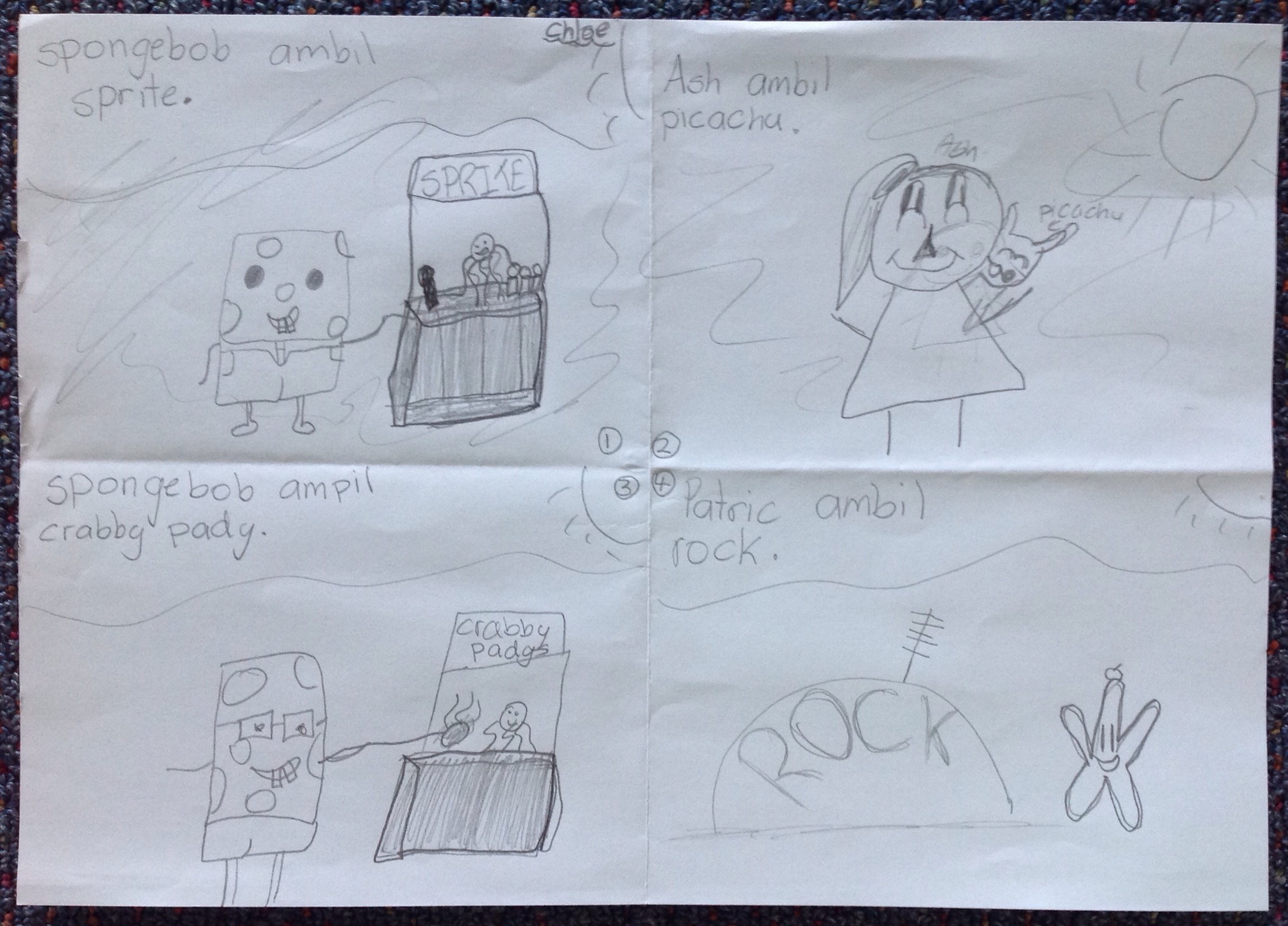
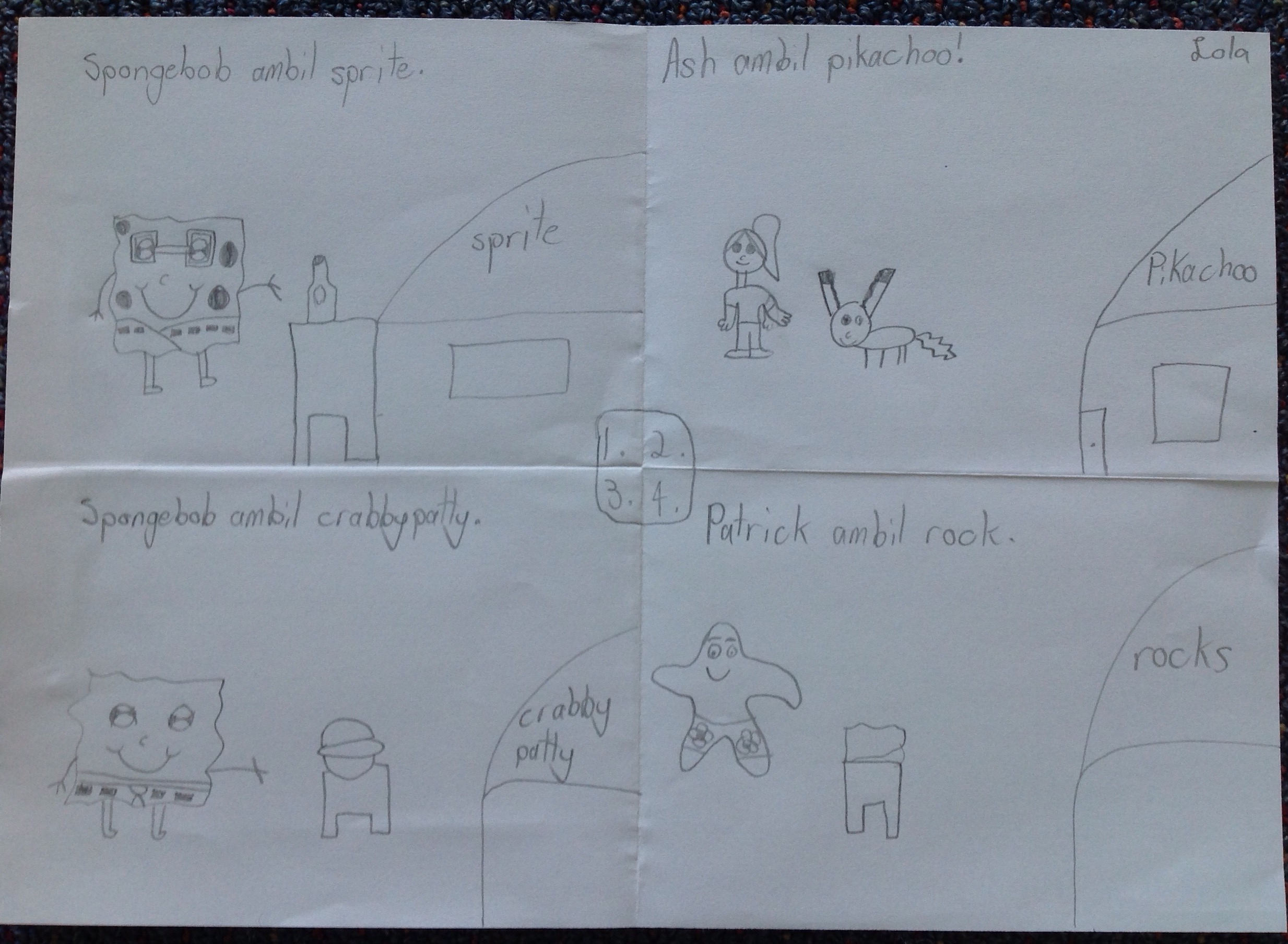
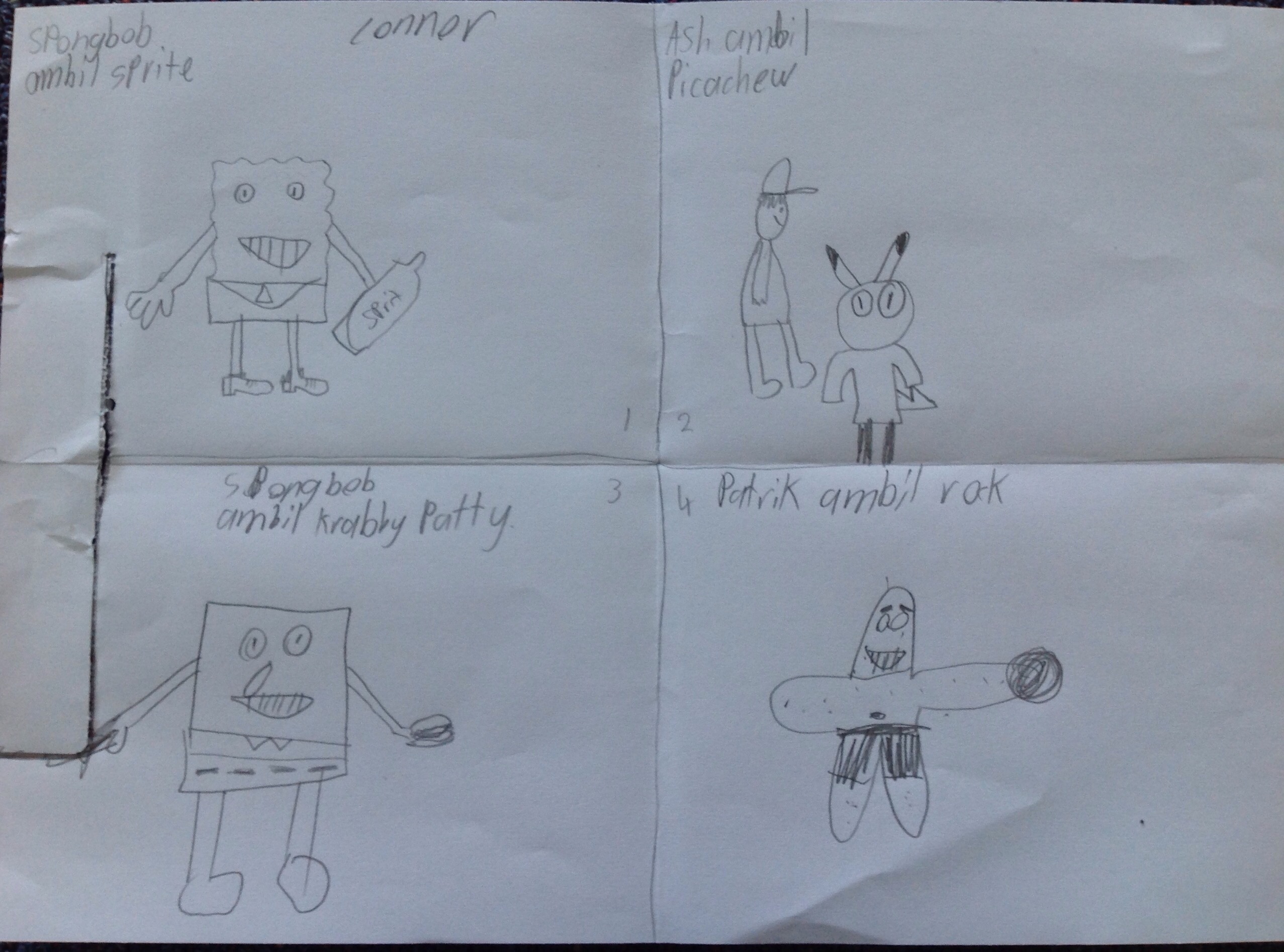
Then instead of circling to chase those repetitions, using either a picture, powerpoint or student, my distributors handed out a pensil, clipboard dan kertas to each student. Then I asked students to lipat (fold) then lipat again (while demonstrating to minimize using English). I could then ask students to ‘buka kertas’ ( open the paper – got a rep of buka in- what a bonus!) and number each quarter. I then gave the instructions while gesturing to clarify my meaning: Bu Cathy berkata dan murid menulis. After clarifying the meaning of menulis (write), I said the sentence, “SpongeBob ambil sprite.” and students wrote it in square nomor satu. I clarified that only the Indonesian must be spelled correctly!! Then  I asked students to menggambar SpongeBob ambil sprite.

I got so many repetitions of ‘ambil’ and students through illustrating each of the 4 sentences truly demonstrated that they understood and comprehended it. It was a fun way of having all students fully focused and on task. They loved it. 

Enjoy the following selection of work from one of the year 5 classes.


Paper Airplane Reading

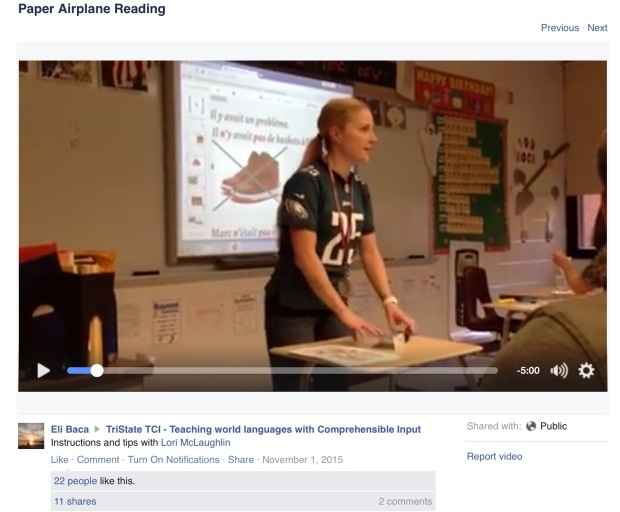
The following screen shot comes from a video which was shared a couple of weeks ago on the Ohio TCI Facebook page and seems not available anywhere else! 

image
As soon as I watched it, I was determined to give it a go. I love trying new TCI activities!

The first time I tried it (week 5), it became quickly apparent that I had not prepared my students well enough by providing them with sufficient reading opportunities because for this activity to succeed, students must know the story very well. So, to achieve this, students did a listen and draw and played strip bingo which provided students opportunities to hear the story repeatedly.

Then this week we attempted paper plane reading once again and it was a hoot. Giving the instructions was largely done in English, which was frustrating, however one class did not give me permission to speak in English, and we didn’t do too badly, even though with the final instructions and clarifications, we did use English!

The two best things about paper airplane reading, is that movement is interspersed with reading and that students are asked to make paper planes; something which has never been encouraged in my lessons befre!!

Here are the instructions that I used in my year 3 – 7 lessons:

Hand out a sheet of paper to each student with the class story printed on one side, as well as a clipboard & a lead pencil.

1. We first chorale translated the story together. My instructions to students were: Bu Cathy membaca pakai Bahasa Indonesia dan murid murid membaca pakai Bahasa Indonesia.  Murid murid ekho Bu Cathy. (Ekho – one of the new words I learned this week from our visitors Yoedha, Dian & Zvana!!) I then read the sentences one by one and asked the students to choral read once I paused. If we came to a word I knew would be tricky or if students were skipping a word then I broke that sentence up into a phrase.

2. I then asked the students to read the story and choose one sentence from the story that they could translate easily but not to mark in any way the location of that sentence on the sheet of paper. They then had to turn the sheet over and at the top, write in ENGLISH the translation for that sentence. I then gave an example using the first sentence in their story. I chose the first sentence (Ada perempuan dan nama perempuan Harry Potter) because students are often muddling up the word ‘ada’ (there is) with ‘apa’ (what?) and we translated it together. I then gave everyone time to choose a sentence and write its translation on the blank side of the sheet of paper.

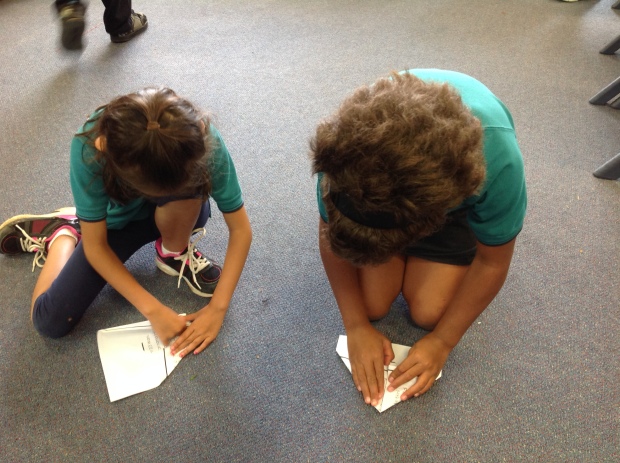
3. While students were finishing step 2, I explained, “Kalau sudah, clip board dan pensil dibawah kursi” (clipboards & pencil under you chair) and then asked them to make a paper airplane from their sheet. It was surprising both the variation of paper airplane designs we got and that there were a few in every class who did not know how to make a paper airplane. It worked well to encourage those who knew how to make a paper airplane to help those who didn’t by demonstrating the steps with their own paper so that their friend could do the same with theirs. This way, we all finished about the same time.image

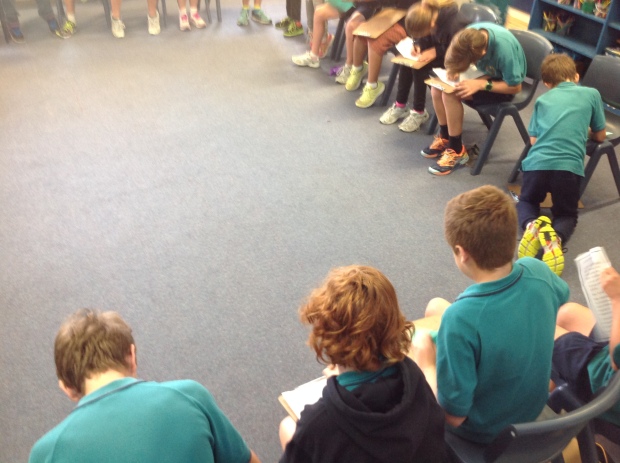
4. “Murid murid, berdiri kalau sudah punya airplane.” (Stand if you have a plane) I decided not to teach the word for plane as it is not a cognate and these days, the word plane would be largely understood in Indonesia anyway. While we waited for everyone to finish up and stand, I explained the next step in English to ensure that students understood completely and every lesson, there were a few who did not. I drew their attention to the loud speaker outlet in the ceiling which is in the very centre of the classroom ceiling. I explained that I would count to tiga and on tiga, students would launch their planes at the speaker and that we needed to do it together for safety. I pointed out that only those wearing glasses had eye protection (which chuffed those students!) so we needed to ensure we aimed upwards. Then, students had to find an airplane that was not their own. They had to buka kertas (open the page) and read the English sentence on the back before turning over the sheet and locating the Indonesian translation in the story. They then had to translate into English the very next sentence of the story before recreating the plane and launching again. image Continue reading