Listen, Write, Illustrate

This week, I tried something new….

I have been ready to move on to a new target structure and with only 4 short weeks left of term 1, I didn’t want to begin anything major. This type of window provides the perfect opportunity to trial an idea and if it works, its a bonus and if it flops, then there’s absolutely no harm done and we can merely chalk it up as experience.

Our stories have usually focused on structures that help us stay in Indonesian when communicating with each other in the classroom. The story this term introduced the phrases, open the door & close the door which are both very handy in summer and winter! ‘buka’ &’tutup’ are useful in themselves too and it wasn’t till we added them to our repertoire, that I discovered just how useful they could be. Another verb that I really need to is ‘get’ (ambil). I often ask students to get a clipboard, a pensil, a penghapus etc. So last week, I set out with that intention.

I began with having the word up on the board and asking students to copy me saying it a million times using a variety of voices. I love doing this and wish I had a greater ability to mimic well known characters! I also love singing the words because this gives me the opportunity to stress syllables slowly and clearly. Students just love opera singing!! Its hilarious watching them doing this! Maybe they get just as much enjoyment from watching me!! Following this is an explaination of  what ‘ambil’ means along with asking for a hand gesture which clearly demonstrates its meaning. I only choose one gesture for the entire school, so I encourage students in each class to demonstrate their suggested gesture repeatedly while I search for the student whose gesture is either identical to or very similar to the initial gesture that I chose during the very first lesson of the week. I then give kudos to the student whose gesture was ‘chosen’ by looking them in the eye and giving them a big smile! It truly makes their day! We then as a whole class practice their gesture while simultaneously  verbalising the structure chorally.

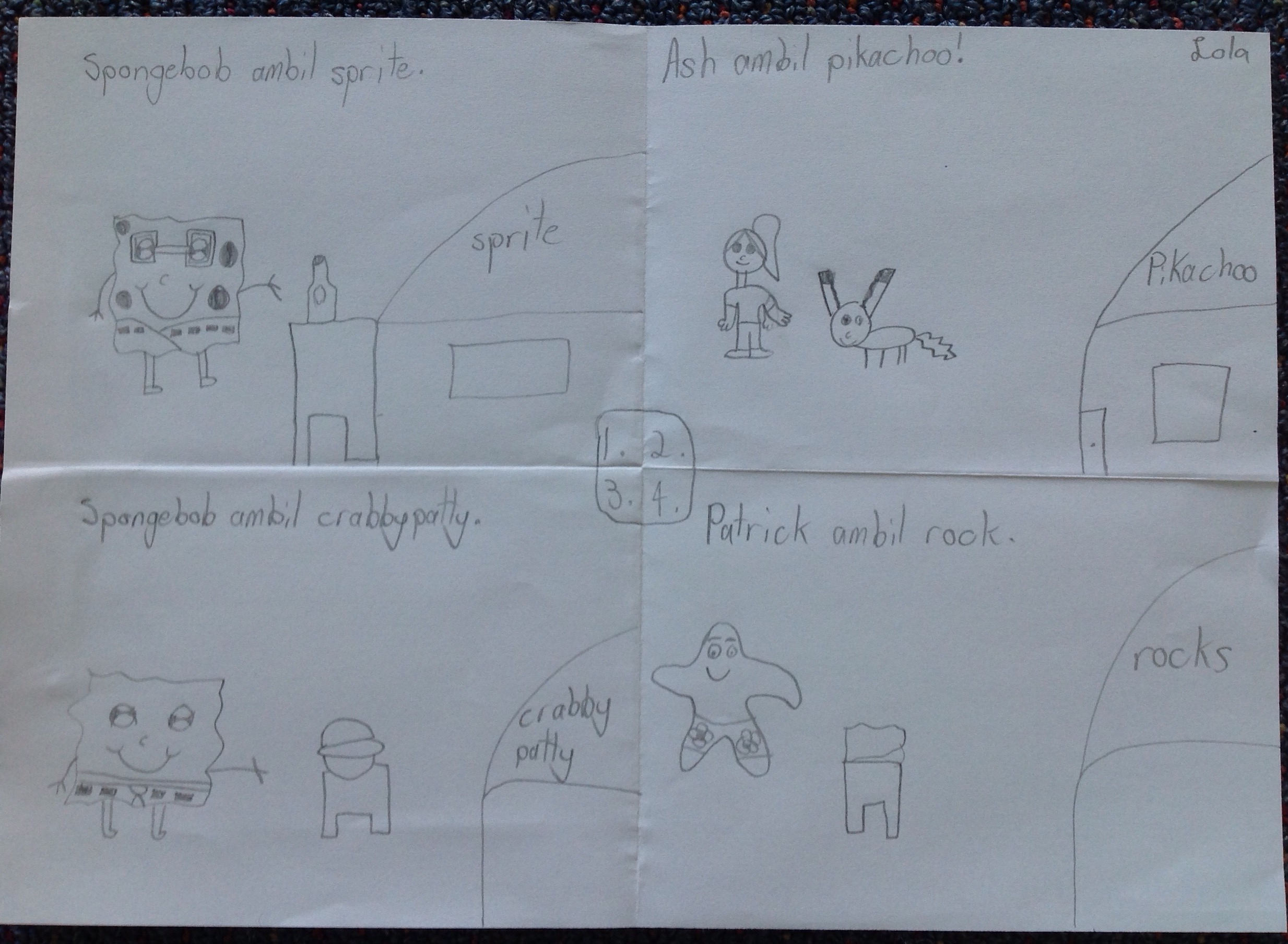
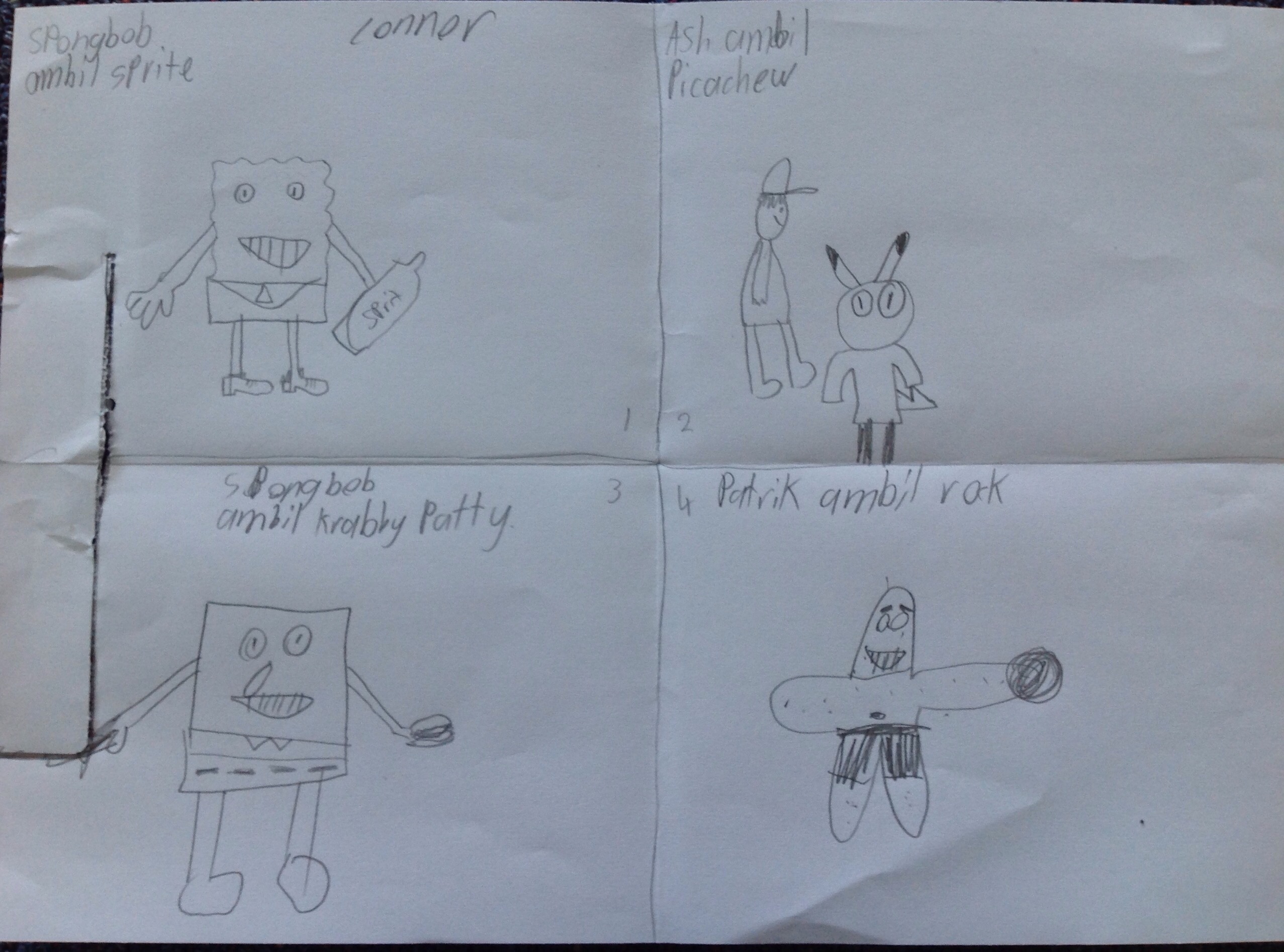
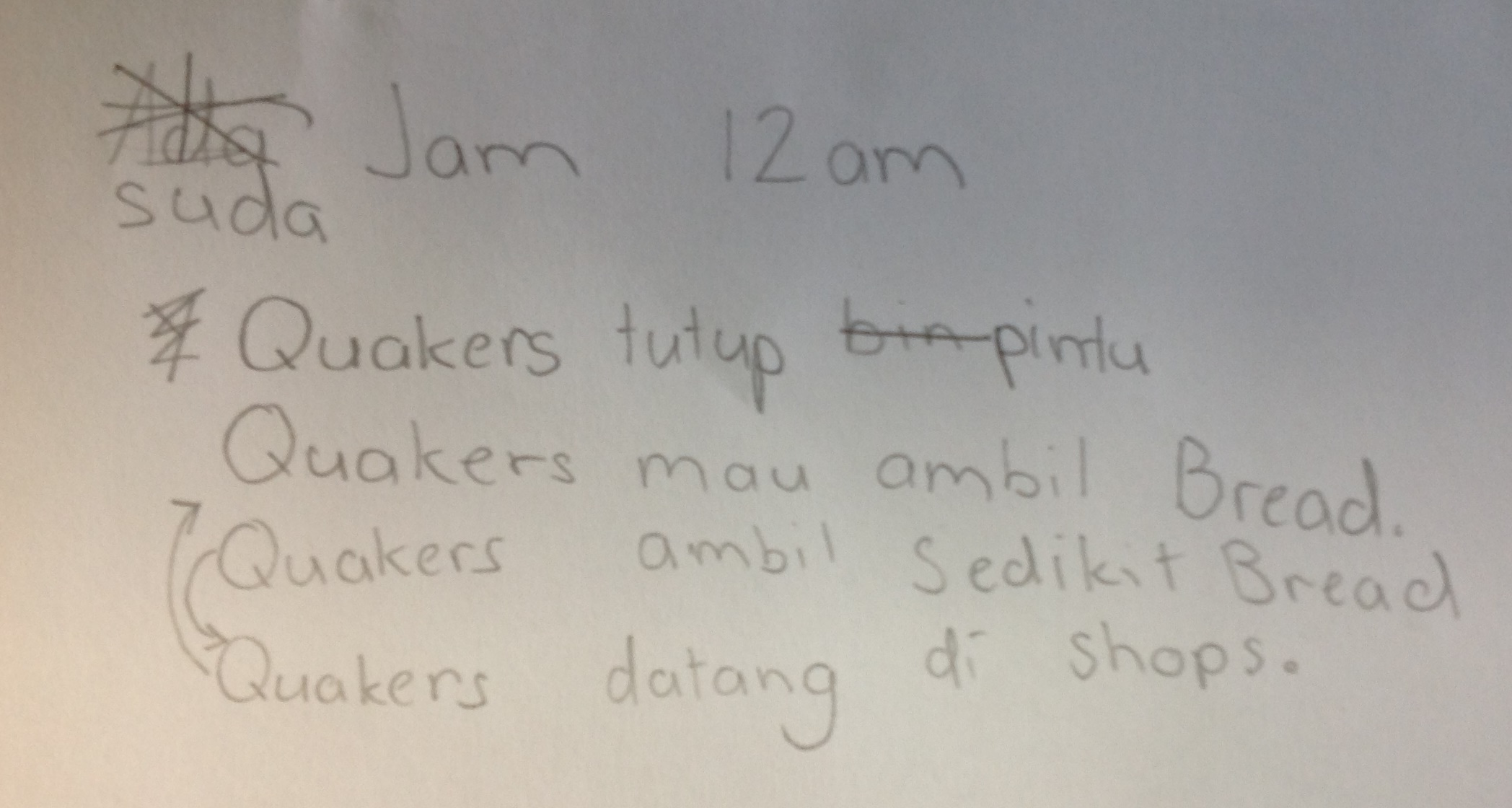
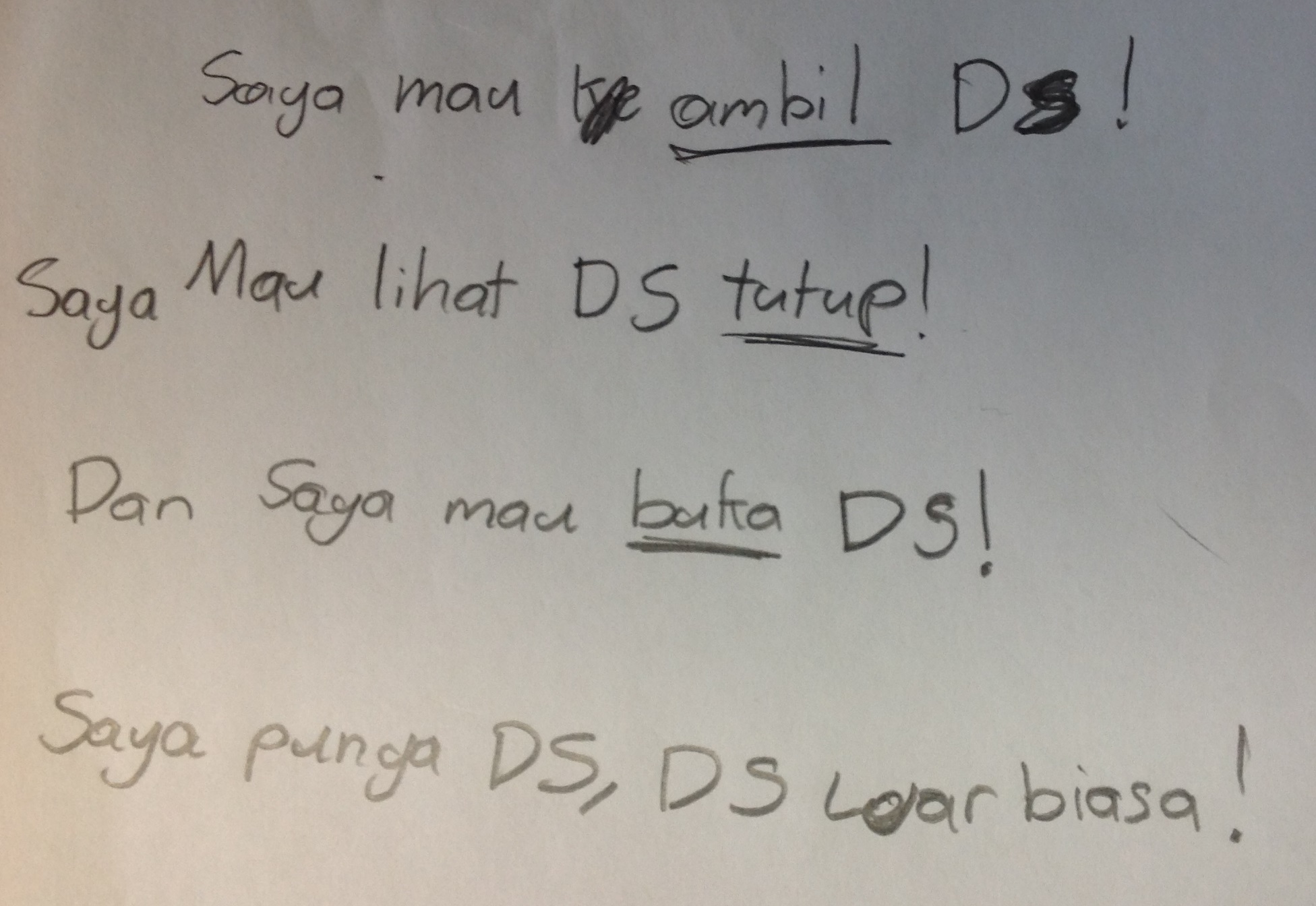
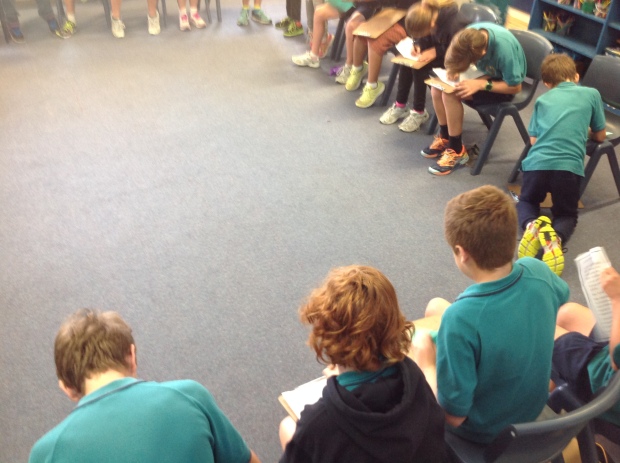
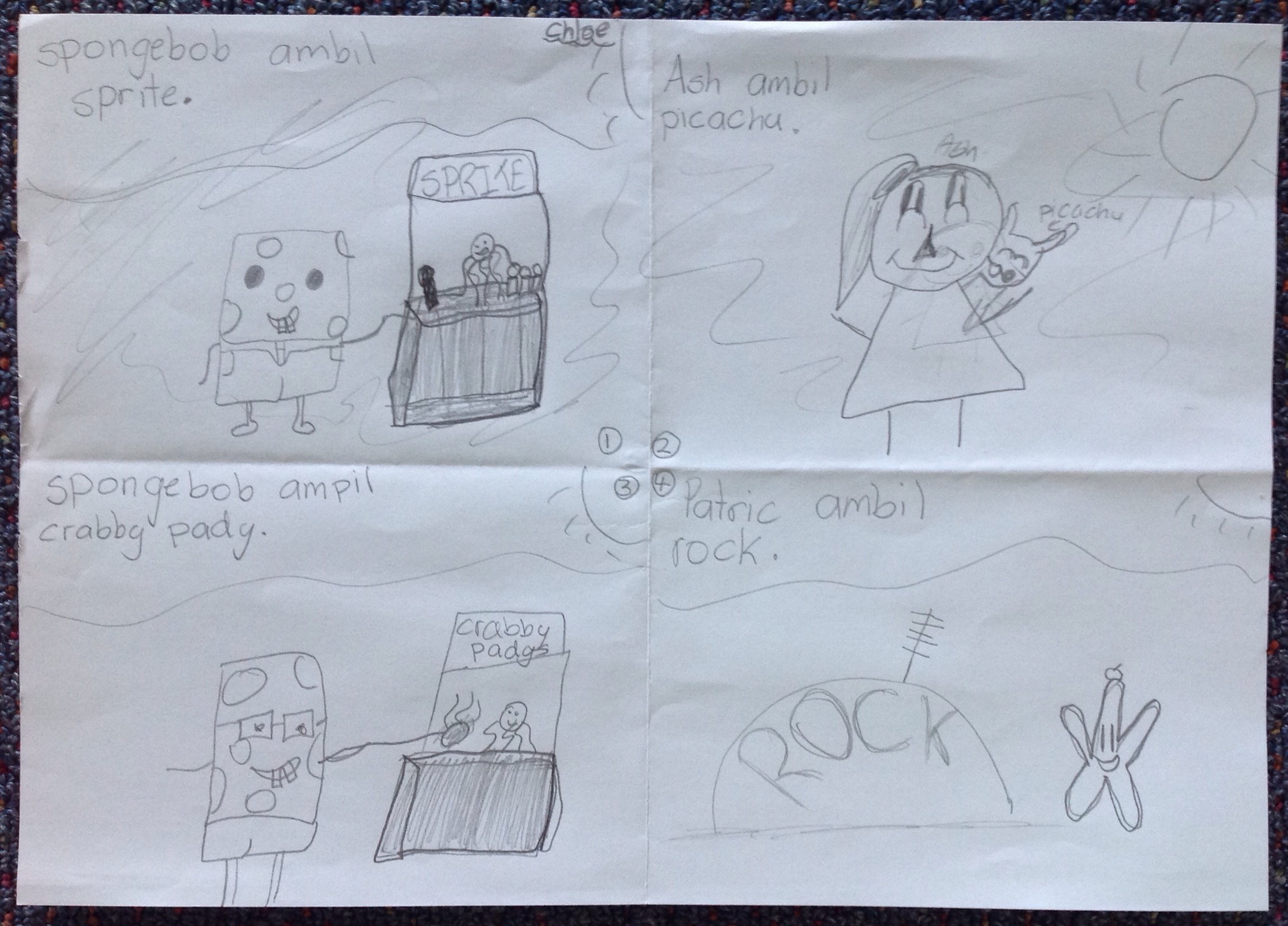
Then instead of circling to chase those repetitions, using either a picture, powerpoint or student, my distributors handed out a pensil, clipboard dan kertas to each student. Then I asked students to lipat (fold) then lipat again (while demonstrating to minimize using English). I could then ask students to ‘buka kertas’ ( open the paper – got a rep of buka in- what a bonus!) and number each quarter. I then gave the instructions while gesturing to clarify my meaning: Bu Cathy berkata dan murid menulis. After clarifying the meaning of menulis (write), I said the sentence, “SpongeBob ambil sprite.” and students wrote it in square nomor satu. I clarified that only the Indonesian must be spelled correctly!! Then  I asked students to menggambar SpongeBob ambil sprite.

I got so many repetitions of ‘ambil’ and students through illustrating each of the 4 sentences truly demonstrated that they understood and comprehended it. It was a fun way of having all students fully focused and on task. They loved it. 

Enjoy the following selection of work from one of the year 5 classes.


Student Free Day notes…..

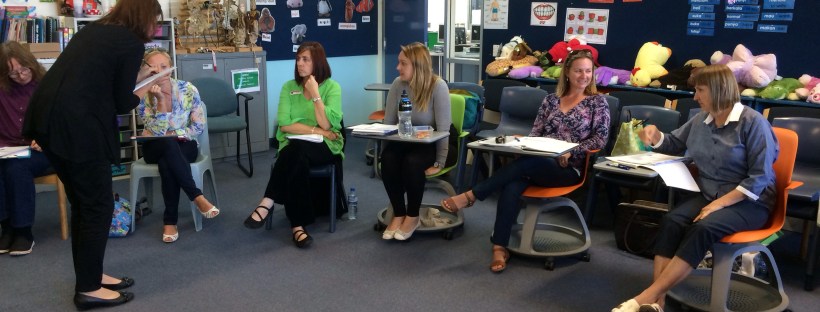
The day began with an AIM demonstration by Sarah Slee. 

AIM (Accelerated Integrated Method) is a language program which originated in Canada by Wendy Maxwell. On the surface, AIM & TPRS seem quite alike but when you dig a little deeper, as we were generously given the opportunity to do, the differences though subtle, are many. 

Here is the definition for AIM which can be found on the AIM website


Sarah teaches French at a nearby primary school using this methodology and like us, began at the start of 2015. She has the total backing of her school leadership which has been wonderful because the kits do not come cheaply. We drooled over the kits she brought along. Each kit costs around $500 and includes a CD Rom, blackline masters, a teachers handbook and a big book of the story upon which the kit is based upon. Each part of the kit is chocker block full of ideas and suggestions and also comes with a teacher script for each and every lesson as well as a variety of assessment checklists!! The CD Rom includes high quality media resources including songs, story reading/ productions etc which recycle and extend the vocabulary being targeted for each story. The early years kits are based on familiar stories like Henny Penny & The 3 Little Pigs while the kits for older students  are based on unfamiliar stories. AIM kits are available in several languages however Indonesian is not one of them. After watching the introductory video (also available on the website) we participated in a lesson. Sarah sat in front of us (we were in a horsehoe in front of her) with her book open on her lap to the very first lesson as none of us speak a word of French. She then led us through the very beginning of this lesson where she said a word/phrase while simultaneously gesturing and we repeated the phrase/word and copied the gesture. It was very challenging and really gave us a taste of what our lessons are like for our own students! It was a wonderful experience and went much longer than we both anticipated when planning the day! As you can imagine we were all totally blown away by the number of resources available to Sarah in each kit because we have absolutely nothing and have to create everything ourselves using the resources created for other languages as the base line! We also liked the idea of the gesture data bank AIM has as we believe that if we developed something similar, it would help students who move from school to school in our region. There are surprisingly quite a few!! 

The next session was my presentation about circling. I revised what circling is and the prescribed format as per the links I gave in a previous post. We then watched the Blaine Ray/Carla Tarini YouTube video before having a go in pairs with one of the sentences from our ‘Spongebob mau minum’ (Spongebob is thirsty) story. The oppportunity to create a bank of sentences based on the circling format (statement, ask a yes question, ask a no question, ask an either or question and then a question that elicits more detail) with a partner provided a welcome opportunity for discussion which then led to a whole group general discussion about the specifics of story asking. We have, to date, began our stories with a focus on the target structures for several lessons before introducing the story itself. Some students find this excruciating because they enjoy the story telling so much that they become impatient with the percieved unnecessarily long lead in time! So with our next story, we want to see if we can par this down and begin the story asking earlier! Stay tuned for our reflections…….

After lunch, we were joined by Michelle Kohler (Flinders University) to discuss the Australian Curriculum in relation to  designing TPRS assessment tasks. Michelle drove the 1 hour trip to PEPS straight from teaching preservice teachers at Flinders Uni and then headed straight off afterwards for another meeting, so we are incredibly grateful for her finding the time and energy to fit us into her very busy day! Michelle was closely involved with the creation of our Indonesian Languages Curriulum and it was insightful to discuss with her how language teachers are being required to assess and report against it. She was disappointed to hear that most principals are requiring Indonesian teachers to report against the Achievment Statements. She reminded us that ACARA is not an outcomes based document as SACSA was. The Achievement Standards are a reference point for typical student learning. They were not designed to drive assessment. Here is an extract from the DECD Guideline: Reporting on Australian Curriculum in DECD Schools Reception-Year 10 (v2) 

Achievement Standards should be treated holistically, rather than as discrete elements to be achieved.

Michelle then led us through the strands clarifying each:

1.1 Socialising

1.2 Informing

1.3 Creating

1.4 Translating/mediating

1.5 Reflecting

2.1 Systems of language

2.2 Language variation and change 

2.3 Reflecting on the role of language and culture.

.

This gave us an opportunity to look at each from a TPRS/TCI viewpoint. 

This is my extremely brief perception of how we cover each:

1.1 – kursi luar biasa, general story telling/asking, 

1.2 – Movie talk, vPQA,

1.3 – Story asking/telling, free writes, 

1.4 – popcorn reading, paper airplane reading, choral translations, comprehension checks, 

1.5 – grammar pop-ups

2.1 – language discussions (in English) about vocabulary, grammar &/or spelling etc noticed by students in stories/ books. 

2.2 – use and discussion of cognates and the increasing prevalence of English found in modern Indonesian eg kriket, komputer etc

2.3 -informal and formal discussions we have with our students before, during and after school visits by Indonesian nationals to heighten awareness of cultural and religious differences between Australians & Indonesians as well as between Christians & Muslims. 

Please feel free to add to these by commenting below.

As you can probably tell, it was a fantastic day. Having the opportunity to collaborate together about issues relevant to our specialist learning area and invite guest speakers who can help us increase our experitise was so invaluable. My next task  is to survey all who participated for feedback to help plan our next district SFD!

OWAT -One Word At a Time

I read recently a post on Keith Toda’s blog, Todally Comprehensible about OWAT’s and while I agree OWAT is an activity for advanced students, I was still curious to see if my upper primary students could manage this. Last week was an extremely short week for us with Monday being a public holiday and Tuesday a student free day; so it seemed a perfect window to try OWAT with the 4 upper primary classes I taught. 

I chose the following vocabulary which are both a mixture of vocabulary just covered and totally new words as well as a mix of verbs and adjectives:

Ambil -get

Nakal – naughty

Buka – open

Tutup – close

Lucu – funny

Sekarang – now

Jam – time

Besok – tomorrow

Sedikit – a few/ a little bit

Datang – arrived, came, come

.

I printed the words off onto card, cut them out and then wrote on the back the translation. For the word ‘jam’ I also put it into 2 sentences to demonstrate how it can be used: What is the time? (Jam berapa?) & It is 2 oclock (Jam 2). On the back of the lucu card, I wrote funny (haha) to distinguish it from funny (strange) and in retrospect adding the words ‘haha’ was confusing and I should have just left it as ‘funny’ which was clear enough. I then laminated the cards but in future I don’t think that is totally necessary. 

I lay the cards Indonesian side up on the shelf under my whiteboard, asked the students to “Cari satu, dua atau tiga teman” (get into groups of 2,3 or 4) and then explained the process:

1. One student from each group comes to the front and chooses one card. Before looking at the back, check to see if anyone in your group knows the meaning.

2. Together as a team, create a sentence using that word.

3. When the sentence is finished, put up your hand and I will check your sentence. (Check for grammar- pop-up only)

4. If I like it and tell your group bagus sekali, then return your card and choose another.

5. Repeat with the next card and this time, the next sentence must follow on from the first to create a story. Do not write 10 unconnected sentences. 

When there were only about 5 minutes remaining of the time, I asked the students to finish the sentence they were working on and then write the resolution for the story. 

I collected them and then read them out to the class correcting any grammatical errors as I went. This was an extremely challenging exercise for my students and a few groups created stories they were truly proud of. The groups had some fantastic discussions which must have included many repetitions of each new word because while I read the stories out, I added a few comprehension checks and students could confidently translate the new words. In contrast, the last lesson of the day was with a year 6/7 class who staggered into the Indonesian room and collapsed on the floor. They had come from PE where they had played dodge ball so they were very hot and exhausted! They begged to just lie down and do ‘relaxation like a reception class’!! I explained the task and offered that we could do it as a whole class instead if they preferred. Of course they jumped at this. Together they created a funny story about Cody falling over at KFC. I would be interested now to see which classes learned (not yet aquired) the new words best; those that worked in small groups where the words were repeated many times or as a whole class where the words were held up, spoken by just a few and then put into sentences. In reflection it is clear I should have circled to address this however everyone (including me) was too hot and tired and maybe we should have all just enjoyed free reading time? Oh wel…….

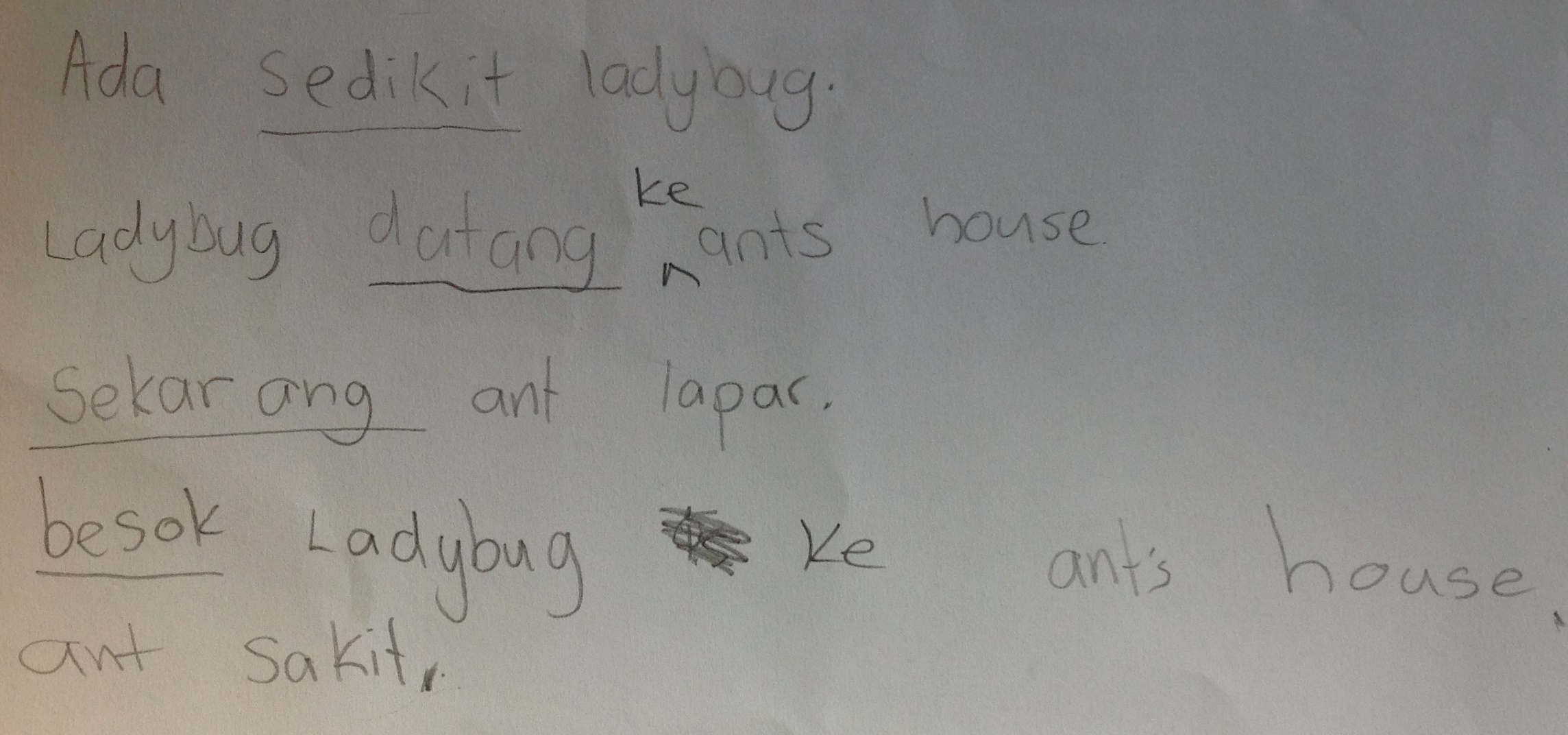
Here are a few of the stories from the year 5, & 6/7 classes:

1

2

3

4

5

6

8

9

While very challenging, there is definitely merit to this exercise and I am wondering if students will improve and more groups will create even better stories next time. It is truly rigorous! I loved that students worked collaboratively to create sentences, because I feel it helped those students who find free writes (fluency writes) challenging. Sometimes during free writes, I have students sitting facing the word wall overwhelmed, so this hopefully gave them an opportunity to be involved in the process of creating sentences and or stories.

I also believe that OWAT has postential for those of us in Australia struggling to create/design open ended assessment tasks that align with TPRS. The chosen words could be taken straight from the story just covered with students having the option to recreate the story exactly, recreate the story with a few added details or rewrite a totally new story.

How do OWAT’s align with ACARA- The Australian Curriculum?

1.1 Socialising – Interacting orally and in writing to exchange ideas, opinions, experiences, thoughts and feelings and participating in planning, negotiating, deciding and taking action.

1.3 Creating – Engaging with imaginative experience by participating in, responding to and creating a range of texts such as stories, songs, drama and muisc. 

1.4 Translating – Moving between languages and cultures orally and in writing, recognising different interpretations and explaining these to others. 

2.1 – Systems of Langauage – Understanding language as a system, including sound, writing, grammatical and textual conventions.

Membagi Ide Bagus – Student Free Day Links for Circling & Assessment

I would like to share with you a variety of links which we will either be covering at our PLC Student Free Day or will be useful as a follow-up afterwards. This hopefully will make it easier if all the links are together so that we can refer back to it later or pass on to others who were unable to join us.

Our schedule for the day will be:

8:30 – 9:00am meet and greet, grab a cuppa

9am  Aim (French) demo with Sarah Slee

10am Circling workshop

11am break

11:30am Strategies to assist with recording student progress

1pm Lunch

1;45pm Assessment & ACARA
– Assessment and reporting parameters and issues
– Designing assessments to reflect the AC intentions and AS
– Connections between TPRS & the AC

4pm finish


Links include:

Circling

1, Martina Bex has a great post entitled, What is Circling and it includes a free PDF hand out.

2. Terry Waltz has  circling cards available through her website, Mandarin Through Comprehensible Output as well as a Prezi demonstrating how to use them.

3. TPRS Q & A also has a post called What is Circling And How to do It?

4. TPRS Q & A is a great blog and this post entitles What Does the Goddess Laurie Clarq say about Circling is well worth reading.

5. A French Demo At a Blaine Ray Workshop – Carla Tarini is being coached by Blaine Ray on how to circle.

6. Circling does not always go smoothly or predictably which can be said of just about anything involving children and/animals, so they say! Keith Toda wrote a blog entitle Circling Troubleshooting which will help you identify why your circling efforts may not feel successful!

7. Here is another great video! This one is of Terry Waltz working with students for their first Chinese lesson. Here you can see Terry demonstrate a multitude of skills one of which is circling!

8. TPRS Lesson Demonstration – Great PDF which breaks down of circling

Assessment

1. Martina Bex posted recently, End of Term Assessments which although definitely aimed at high school teachers, included some great ideas & interesting clarifications.

2. Fluency Writes (Free Writes) by Judith Dubios on her fantastic blog called TPRS Witch can be read here: http://tprs-witch.com/fluency-writing-2/ This post explains both what fluency writes are and why they are so useful.

3. Bryce Hedstrom’s Blooms Taxonomy for Foreign Language Instruction


Looking forward to our Student Free Day!! See you there and thank-you for supporting it!

Paper Airplane Reading

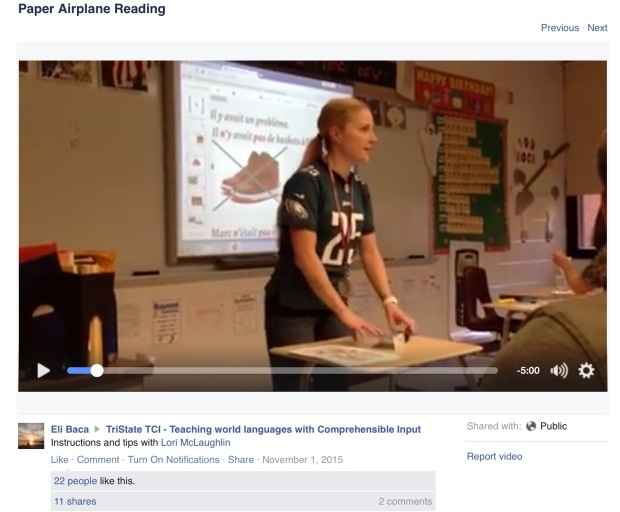
The following screen shot comes from a video which was shared a couple of weeks ago on the Ohio TCI Facebook page and seems not available anywhere else! 

image
As soon as I watched it, I was determined to give it a go. I love trying new TCI activities!

The first time I tried it (week 5), it became quickly apparent that I had not prepared my students well enough by providing them with sufficient reading opportunities because for this activity to succeed, students must know the story very well. So, to achieve this, students did a listen and draw and played strip bingo which provided students opportunities to hear the story repeatedly.

Then this week we attempted paper plane reading once again and it was a hoot. Giving the instructions was largely done in English, which was frustrating, however one class did not give me permission to speak in English, and we didn’t do too badly, even though with the final instructions and clarifications, we did use English!

The two best things about paper airplane reading, is that movement is interspersed with reading and that students are asked to make paper planes; something which has never been encouraged in my lessons befre!!

Here are the instructions that I used in my year 3 – 7 lessons:

Hand out a sheet of paper to each student with the class story printed on one side, as well as a clipboard & a lead pencil.

1. We first chorale translated the story together. My instructions to students were: Bu Cathy membaca pakai Bahasa Indonesia dan murid murid membaca pakai Bahasa Indonesia.  Murid murid ekho Bu Cathy. (Ekho – one of the new words I learned this week from our visitors Yoedha, Dian & Zvana!!) I then read the sentences one by one and asked the students to choral read once I paused. If we came to a word I knew would be tricky or if students were skipping a word then I broke that sentence up into a phrase.

2. I then asked the students to read the story and choose one sentence from the story that they could translate easily but not to mark in any way the location of that sentence on the sheet of paper. They then had to turn the sheet over and at the top, write in ENGLISH the translation for that sentence. I then gave an example using the first sentence in their story. I chose the first sentence (Ada perempuan dan nama perempuan Harry Potter) because students are often muddling up the word ‘ada’ (there is) with ‘apa’ (what?) and we translated it together. I then gave everyone time to choose a sentence and write its translation on the blank side of the sheet of paper.

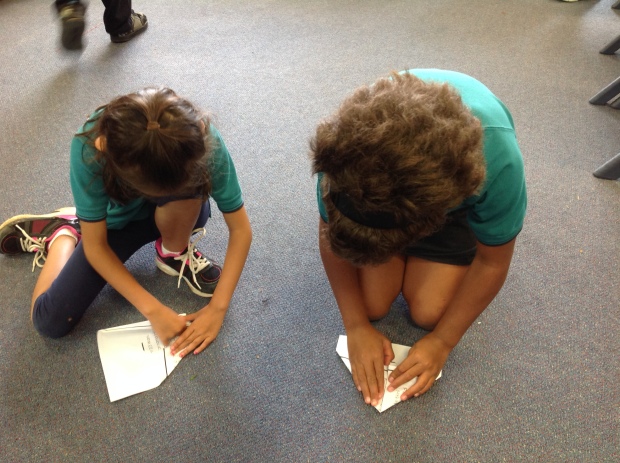
3. While students were finishing step 2, I explained, “Kalau sudah, clip board dan pensil dibawah kursi” (clipboards & pencil under you chair) and then asked them to make a paper airplane from their sheet. It was surprising both the variation of paper airplane designs we got and that there were a few in every class who did not know how to make a paper airplane. It worked well to encourage those who knew how to make a paper airplane to help those who didn’t by demonstrating the steps with their own paper so that their friend could do the same with theirs. This way, we all finished about the same time.image

4. “Murid murid, berdiri kalau sudah punya airplane.” (Stand if you have a plane) I decided not to teach the word for plane as it is not a cognate and these days, the word plane would be largely understood in Indonesia anyway. While we waited for everyone to finish up and stand, I explained the next step in English to ensure that students understood completely and every lesson, there were a few who did not. I drew their attention to the loud speaker outlet in the ceiling which is in the very centre of the classroom ceiling. I explained that I would count to tiga and on tiga, students would launch their planes at the speaker and that we needed to do it together for safety. I pointed out that only those wearing glasses had eye protection (which chuffed those students!) so we needed to ensure we aimed upwards. Then, students had to find an airplane that was not their own. They had to buka kertas (open the page) and read the English sentence on the back before turning over the sheet and locating the Indonesian translation in the story. They then had to translate into English the very next sentence of the story before recreating the plane and launching again. image Continue reading

Embedded Reading Questions

Here it is: Sunday evening before we begin week 6 of our longest term of the year. Dinner is in the oven and the dogs are lying down exhausted nearby after their long beach walk. This part of the week always finds me with mixed feelings. Part of me is really excited for the week ahead as I contemplate (with fingers crossed) the lessons planned for the classes while the other major feeling is regret – another weekend is almost finished. I really enjoy my weekends as they give me the time and space to reflect back upon the past week’s lessons, the opportunity to catch up on all those boring jobs that mount up over the week as well as catch up with friends & family and hear how their week went. 

This term, as already mentioned, the older students have been working on the tutup pintu (close the door) story. I tried to do an embedded reading style approach where I simplified the story initially for their first time with the story and then added some extra detail the second time around.  To do this, I made a powerpoint of the Harry Potter version created by one of my classes but found that other classes were not so keen on a version that wasn’t of their own creation. In fact that is putting it mildly! It flopped big time. So instead I reverted to what I have done in the past and simply re-asked the story inviting class input with 

1. Characters (who)

2. Place (where) &

3. Reasons (why) to try and elicit extra details. 

While some classes came up with some brilliant and creative characters & other details, the stories were still pretty basic and I am at a loss as to how I could move on and use them for embedded readings in a way that is both engaging and develops students acquisition of Indonesian. If anyone has any suggestions, I’m all ears!! 

I read on Laurie Clarq’s Embedded Reading website that:

An embedded reading is three or more scaffolded versions of a text. It is designed to prepare students to comprehend text that the students perceive to be beyond their capability.

Embedded readings provide information in the target language in a way that actually develops the students’ reading skills. Using embedded readings not only allows students to acquire language, it provides a framework for improving reading abilities.

The first version of the text, or the baseline version, is at a basic level, easy for any student in the class to understand. It is a summary or an outline that provides a strong foundation for success. Each succeeding version of the text contains additional words, phrases or sentences that provide new information and/or details. The final version of the text is the most challenging. However, each and every version of the Embedded Reading contains the baseline version, and each subsequent version created, within it. The scaffolding of the versions builds success, confidence and interest.

It all sounds so easy and such a brilliant concept but I haven’t yet worked out how to actually implement it successfully with my students. How do I add detail to a story that isn’t mine in the first place? Students do not take kindly to anyone tampering with their story!! 

So my questions are this:

1. Are ’embedded readings’ more suitable for secondary students or at least those students who have had more years of input than mine?

2. Do they work best with stories that are not generated by the students?

3. How on earth do teachers re-present a story with added detail in a way that is engaging for primary students other than just projecting it up on to a screen? 

4. Am I expecting too much of my students?

All feedback gratefully received! 

TPRS Indonesian – Find it on Facebook!

Yesterday I finally worked out (with Googles help) how to create a Facebook page! I have been thinking about the value of a Facebook page dedicated to TPRS Indonesian teachers for several months now and finally convinced myself that it was worth a shot! What tipped the balance for me has been the recent posts on various TPRS facebook pages that have been awesome. I realised that we (TPRS Indonesian teachers) need a forum through which we can share useful Facebook posts, our own personal blog posts as well as short personal annecdotes with each other as well as ask each other for help, clarification or feedback specific to teaching Indonesian via TCI. 

So, check it out, like the page and then feel free to contribute in anyway that supports your own understanding of TPRS in the Indonesian classroom! I look forward to seeing you there!

Kursi Luar Biasa Update…

A few posts ago, I shared with you my adaptation of Bryce Hedstroms special person idea. Here is an update on how this has been going so far this term:

The kursi luar biasa (special chair) is definitely the most popular chair in my room! Students make a bee line to it when they arrive. They sit their expectantly, waiting for the spot light to shine on them and the 2 times I got carried away with other things and didn’t get around to interviewing them, they were soooo disappointed! However their frowns turned upside down when I promised them in front of the class that they would have first choice of sitting in the kursi next lesson!  

This week my questions finally began to gell and my peseverence is beginning to pay off. While the students in the kursi luar biasa love the attention, it remains tricky trying to keep the others engaged. Occasionally we get a student who has quirky answers to which we all listen avidly and intently but this doesn’t happen often mainly because I am still learning how to ask the right questions in the way that facilitates this! Then this week, I discovered that asking students to raise their arm instead of stand up keeps the discussion moving a lot smoother. Some students enjoy zoning out and regard it as passive defiance when I ask a question like, berdiri kalau tinggal di Port Elliot (stand if you live in PE) and then remain seated enjoying the quizzical looks of classmates. However asking questions like; angkat tangan kalau tinggal di Port Elliot, angkat tangan kalau tinggal di Goolwa etc (raaise your hand if you live in PE), has increased student focus while getting in multiple repetitions on key structures and has more students responding. Is this because I am trying something different or is it because it requires less effort from the students? For me too, it just flows so much better.  Try it!! 

Another positive has come with the introduction of the word ‘tahun’. This week I decided to have a subtle focus on the word tahun during kursi luar biasa when asking the student how old they were. I put it up on the board, and after asking the question, berapa umur? (How old are you) I repeated what the student said adding the word tahun. Using ‘tahun’ wasn’t a requirement for the student, I just wanted to put the word out there in case it came up in future coversations with Indonesian  (native speaker) visitors. Then I had a brain wave! With the word tahun, I could ask students a follow up question to tinggal dimana? (Where do you live?) with “Sudah berapa tahun tinggal di _______?” (How many years have you lived in ____)  With the older students, these questions that are a bit more challenging really keep them all focused. You  can almost hear the cogs turning in their heads and the satisfaction that comes with comprehension. 

I just love the way that kursi luar biasa covers so much of the Australian Curriulum requirements regarding student interests, family, pets, hobbies, etc.  It is such a great way to cover those topics in a personlised and meaningful way for students and also in a way that is narrow and deep! When I think of all the years I used to teach “kenalkan” (let me introduce myself) as my term 1 theme and then feel disheartened with how little my students retained from year to year,  it confirms for me the benefits made from making the switch to TPRS in my classroom.  

PQA, My Way; By Alina Filepescu

maxresdefault

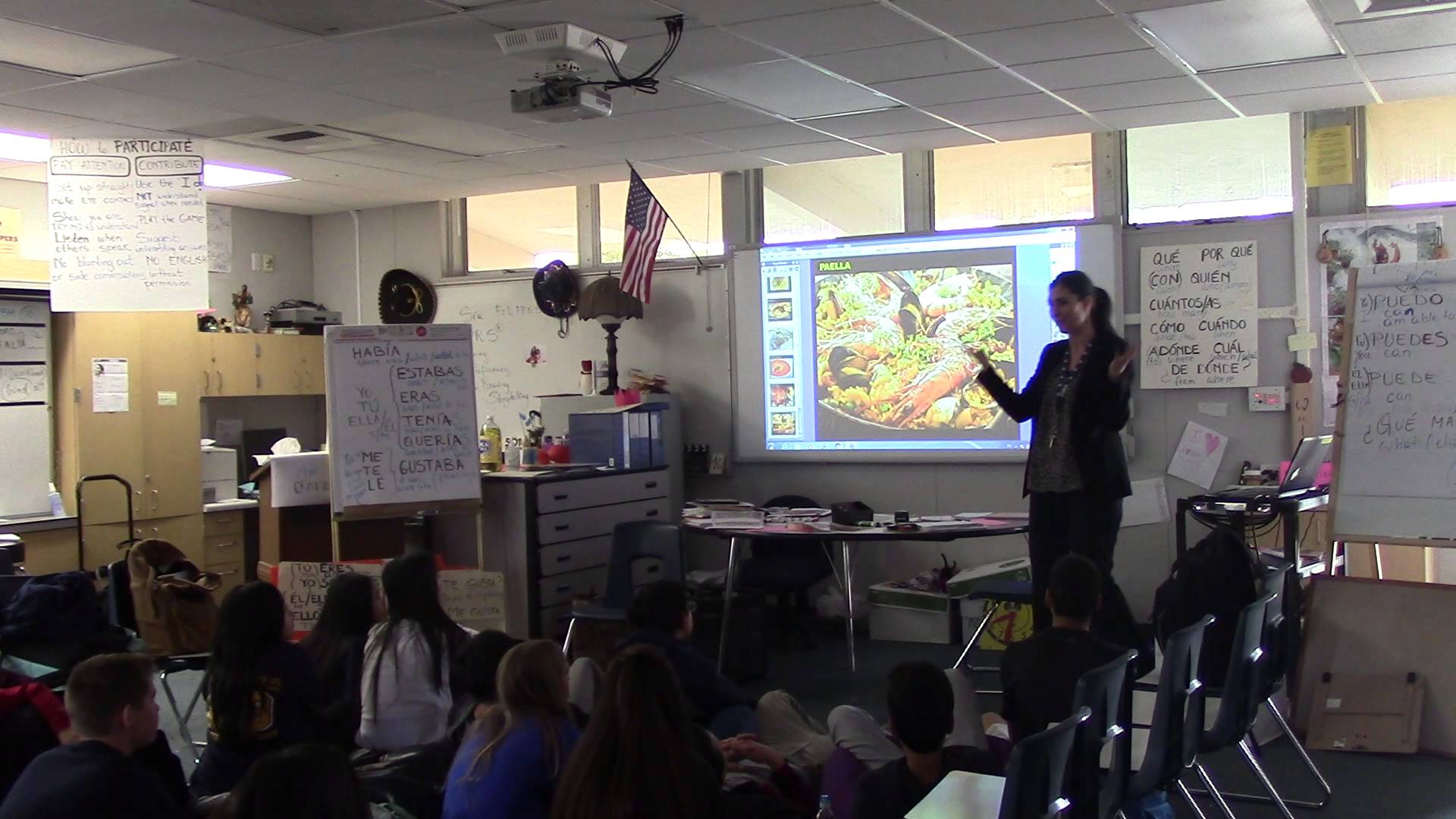
Here is an amazing post and video by Alina Filipescu. While the post is specifically talking about how she does PQA in her classrooms, there is actually sooo much more in it that we Indonesian teachers here in the southern hemisphere can learn about. Not only has she included an amazing video of herself brilliantly and seamlessly PQA-ing with a primary aged class but she has also included an explanation of what she does to cue her students when she wants them to respond. It is a truly amazing video and post and I highly recommend that you read/watch it to appreciate where we are all heading with our TPRS skills!! I look forward to the day when  my students participate to that extent and are so engaged in my lessons!