Bring on 2015……

I am so fortunate to ‘work’ with such a wonderful group of Indonesian teachers. “Work” is in inverted commas because as Senorfernie puts it, we are largely “departments of 1″and work at different school sites. Fortunately the primary Indonesian teachers down here in our neck of the woods are just as passionate about teaching Indonesian as I am. All the more impressive as they also manage family commitments and businesses on top of their teaching load! I salute them.
Our hub group meets every holiday to plan upcoming units of work, to share ideas and resources and for Australian Curriculum training & development. We have noticed how our sharing has changed significantly over the past few years. Originally we would come to our meetings laden with text books, worksheets and video/DVD’s. Now we bring laptops and/or iPads and everything we swap is digital! Sharon introduced us all to the beauty of hard drives and now we can’t imagine how we coped previously without one!
We met yesterday (mid term!) for ACARA T & D. Our mission was to plan a unit of work that aligns with our new curriculum for term 1 2015, so that we can collect work samples from our students for moderation. When Annie first raised the plan, I had misgivings because I was unsure how it would fit in with my TPRS plans for 2015. I was worried that I would have to choose between collaborating and TPRS. Then I changed my mind and considered the possibility and benefits of being able to collect data to compare TPRS methodology with traditional non-TPRS methodology.
Imagine my surprise and delight when all teachers present at the hub group meeting yesterday expressed interest in learning more about TPRS and are really keen to start incorporating it into their teaching in 2015!! A fellow teacher who has also recently discovered TPRS has described our passion for TPRS as bordering on obsessive and that we are more like evangelists. Even though I was severely sleep deprived yesterday, advocating TPRS proved to be an instant antidote!
Together we planned an 8 lesson unit which will lend itself beautifully to a TPRS introduction as well as consolidating the language students will need for introducing themselves during skype sessions with our sister school that we are hoping to participate in ahead of their visit in September. The assessable task we have planned is for students to create a dialogue using specific targeted language and then in groups of 3 make an iMovie which will be assessed by their peers.
It aligned beautifully with the Indonesian Curriculum and the discussion we had finalising this was useful as it helped us all refresh our knowledge of the new curriculum terminology as well as sharing pointers we have picked up recently at either conferences or from school based training.
The day flew by and when Sharon mentioned she would have to leave soon to do the school pick up run, we all were amazed to realise that except for a very brief lunch interlude (thank you Annie for the delicious chickpea salad) we had been working solidly for 5 hours!

Term 4 Teachmeet

I can’t believe we thought holding our second Teachmeet in term 4 was a good idea! Not only that, but in week 5!! I had 4 teachers RSVP to say they would be able to attend and I also had a few RSVP to say that couldn’t due to teaching commitments. Those of us that did turn up agreed that we are all exhausted and while it is valuable to meet and share, we all had to dig deep to do so. Consequently, we agreed that once a semester is enough and our next Teachmeet will be week 5, term 1 in 2015 and the final one for 2015 will be week 5, term 3.
While the topic was; bring along something you have used successfully in your classroom, our focus mostly centred on using iPads in the classroom.

Sharon shared the following apps:
Languages Online – very large app but useful because you can track student progress.

IMG_0877.PNG
https://appsto.re/au/U2RO0.i

Sharon also mentioned that she had noticed that there were recent Indonesian story apps available. Kris immediately searched and found:

IMG_0878.PNG if you search cerita anak, the number is very impressive and most are free!! Just need to download them and assess their suitability now…… Definitely a summer holiday job!!

Other apps Sharon recommended include
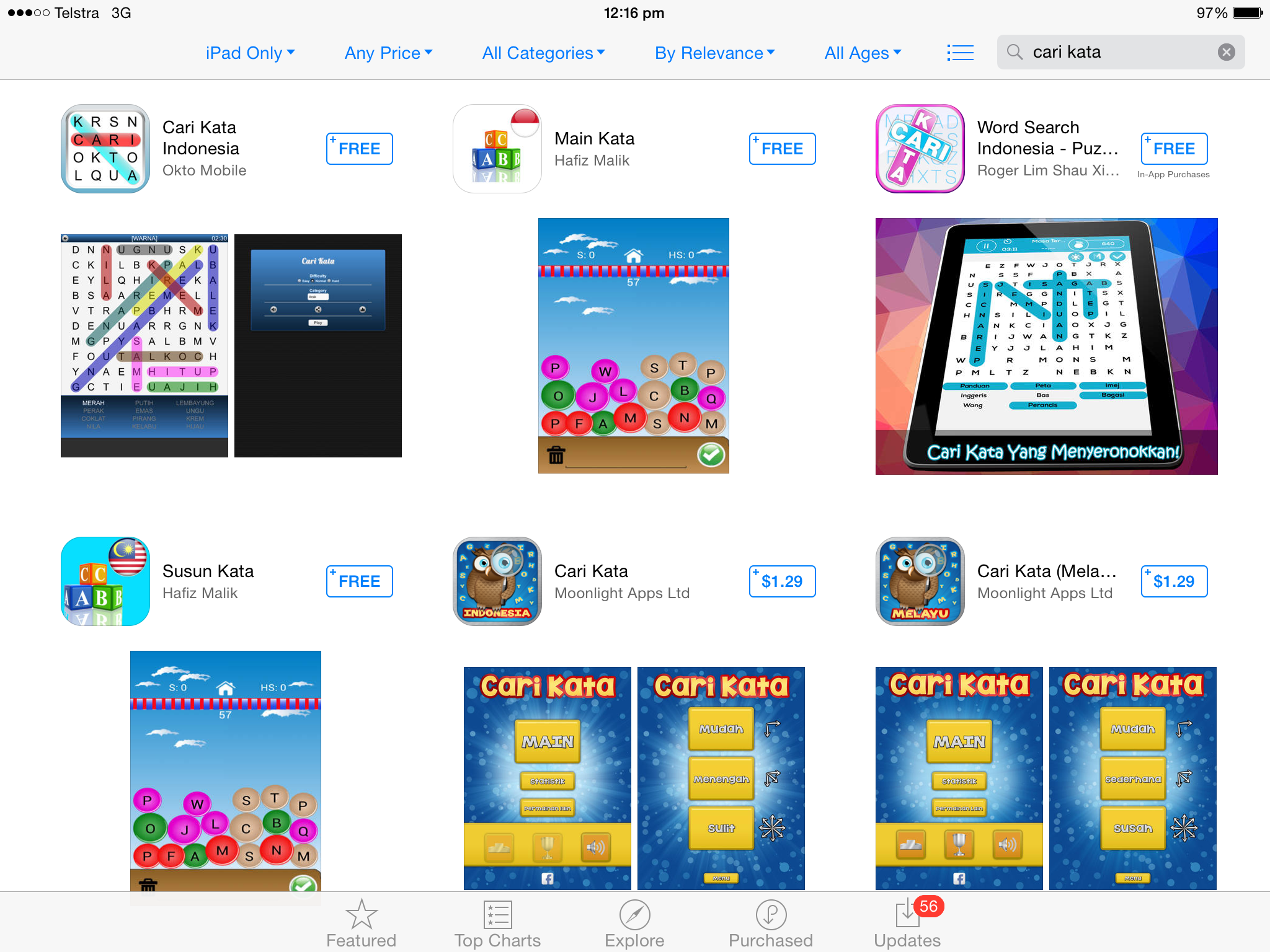
Cari kata and Indonesian word search:

IMG_0879.PNG
Moji Jam

IMG_0880.PNG
TeacherTools

IMG_0884.PNG
Buzz Monster – made by the same people who made Futaba, so guaranteed to be worth the cost.

IMG_0883.PNG

Kris shared next:
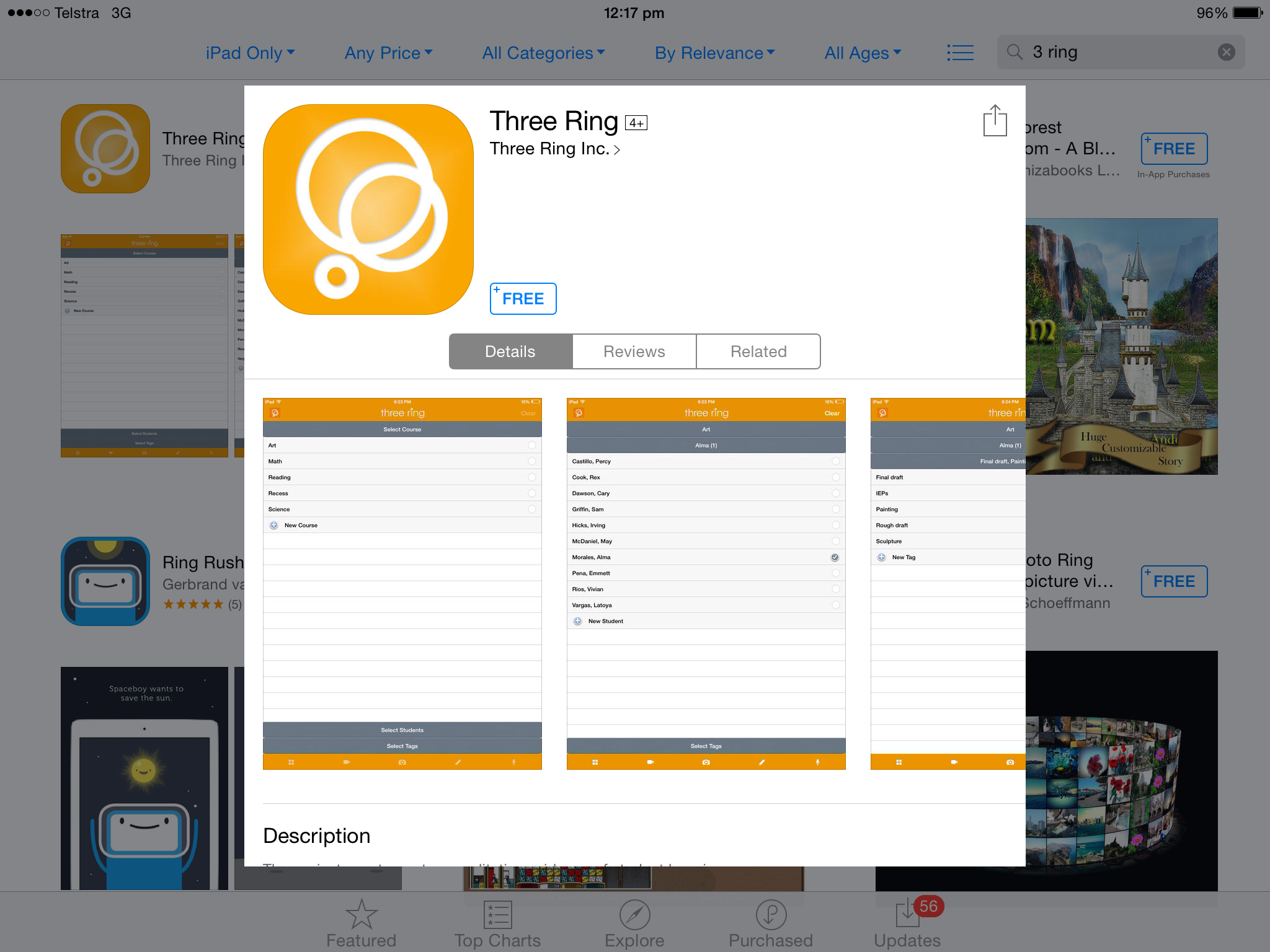
Three ring – good for collecting and storing student assessment data.

IMG_0881.PNG
Pass the parcel- looks like a fun game-

IMG_0882.PNG

Kris also reminded us about the Web2 for Language Teachers wikispace she developed and now maintains. If you have any suggestions (apps etc) that could be included, don’t hesitate to contact her. http://web2-4languageteachers.wikispaces.com

IMG_0885.PNG

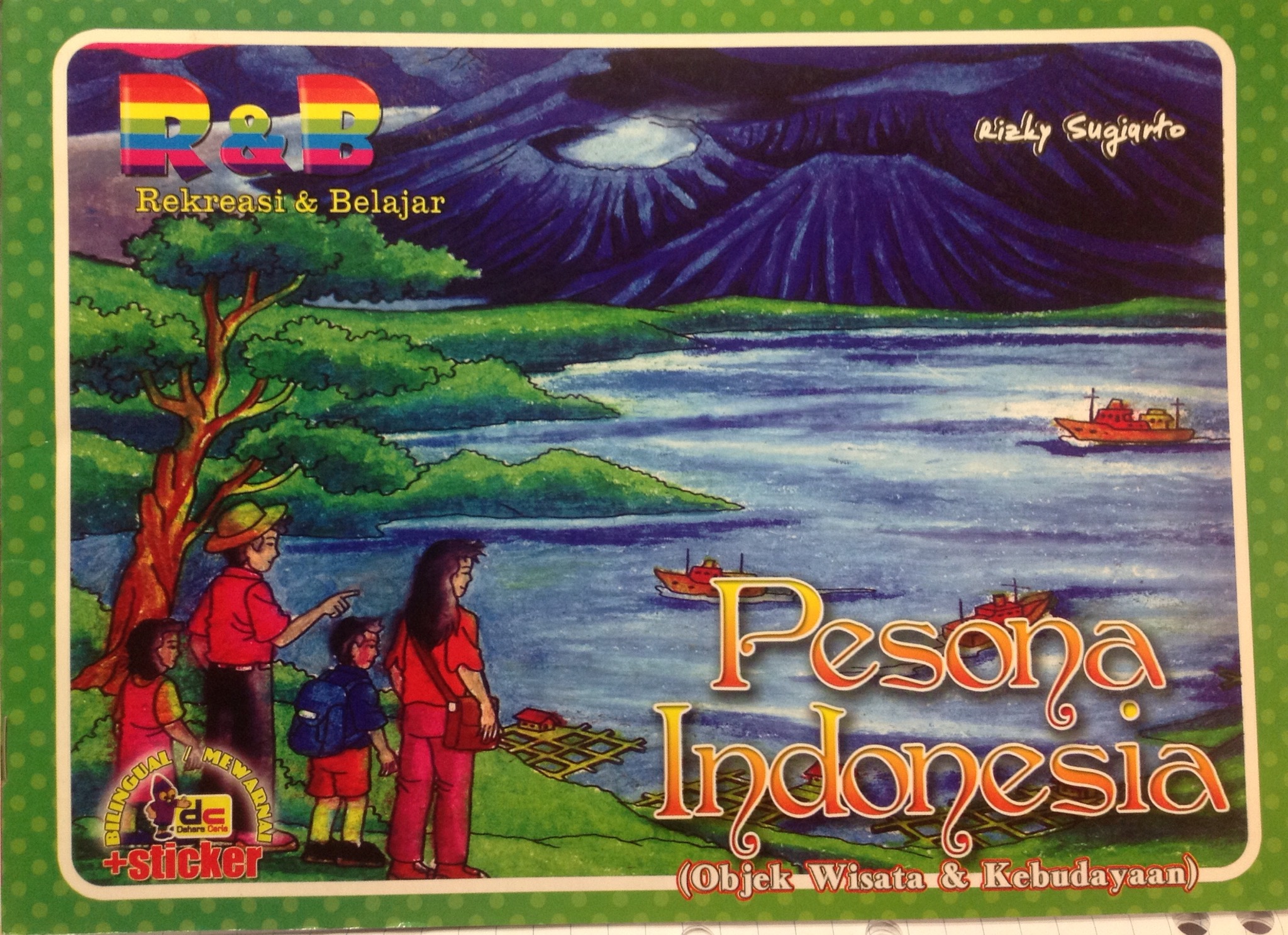
Sharon next shared a few resources she found on her recent visit to Bali. First she shared a book she’d found which has great illustrations about significant cultural events from all over Indonesia.

IMG_0875.JPG
And also a DVD called Didi Tikus. We watched part of the first episode which would definitely appeal to young students. The videos have very little language, are slap stick and reminded us all of Mr Bean.

IMG_0876.JPG

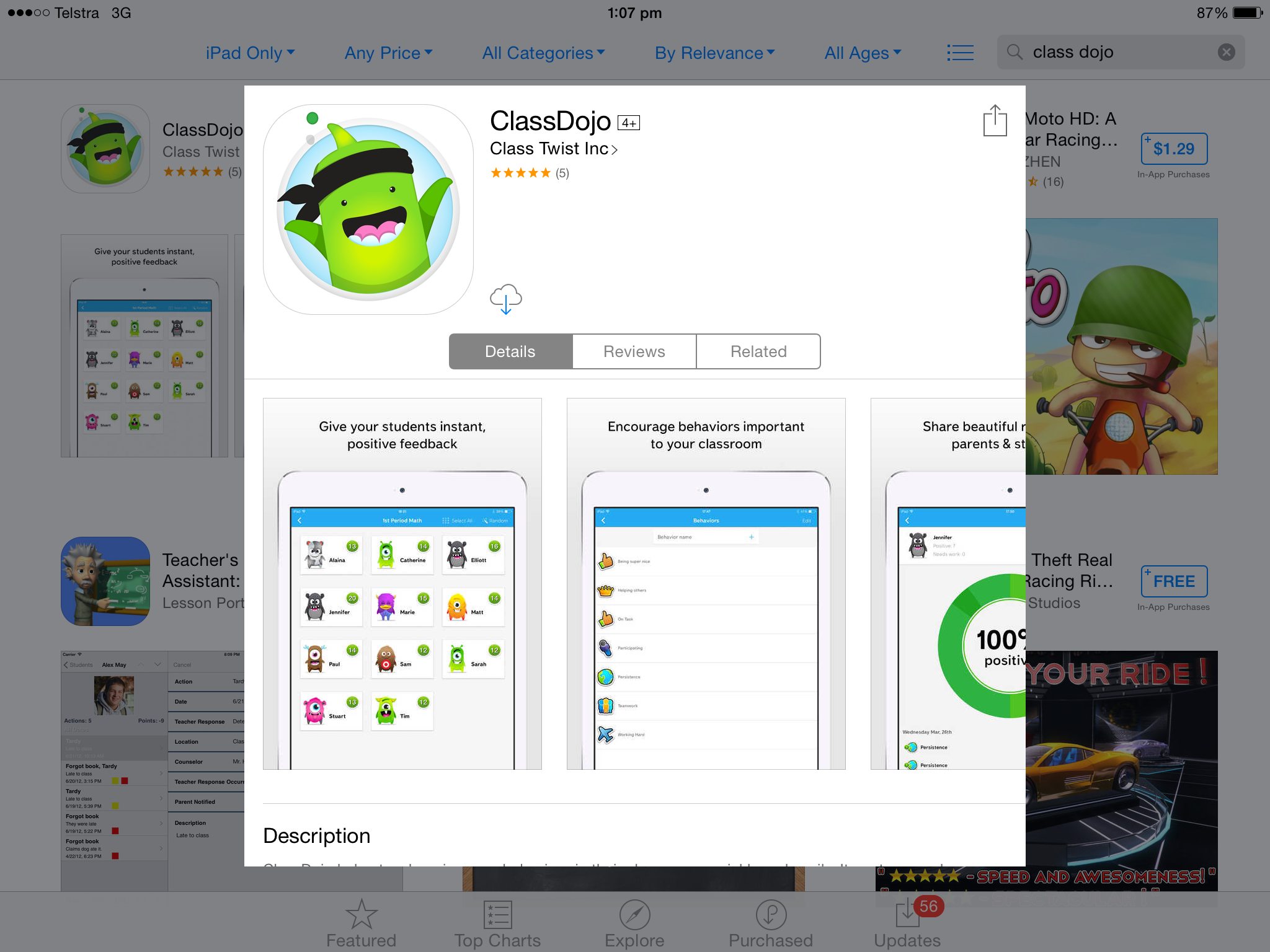
I shared how I use class dojo in my classroom. Up until recently, I called the roll myself asking every student, “Apa kabar?”. Previously in term 4 of every year, students would be invited to call the roll, but it was agonising as it took so long. So I came up with the idea of timing students and having each class work together to achieve the school record. It has worked very well. So, now individual students call the roll using class dojo; one student asks everyone in their class, “Apa kabar?” while I time and record their answers. The fastest time is held by the year 7’s with 32 seconds! The student then completes the absences, lateness and assists me during the lesson recording points.

IMG_0886.PNG

Week 4 Reflections

For various reasons, I wasn’t able to pre-read my scripts before each of the TPRS lessons last week. Usually, I sit in my classroom over lunch and refresh in my mind both my pre written scripts (see last weeks post) and watch TPRS YouTube videos which both helps me focus on the TPRS skill I will be targeting as well as confirming for me the benefits of TPRS. However last week, the year 6/7 classes were cooking (klepon) and while this only involved 2 classes, the running around ensured I clocked up well over 10,000 steps those days!
Facing year 5’s and 6’s holding my script in one hand while furiously trying to remember the gist of it so I didn’t have to keep looking at it and at the same time keeping the momentum going was very challenging. In fact so challenging, I felt very flat after both lessons (which were back to back lessons). On review, I realised I had failed everyone with my total dependence on my scripts ; both myself and the students. It had been a hodgepodge.
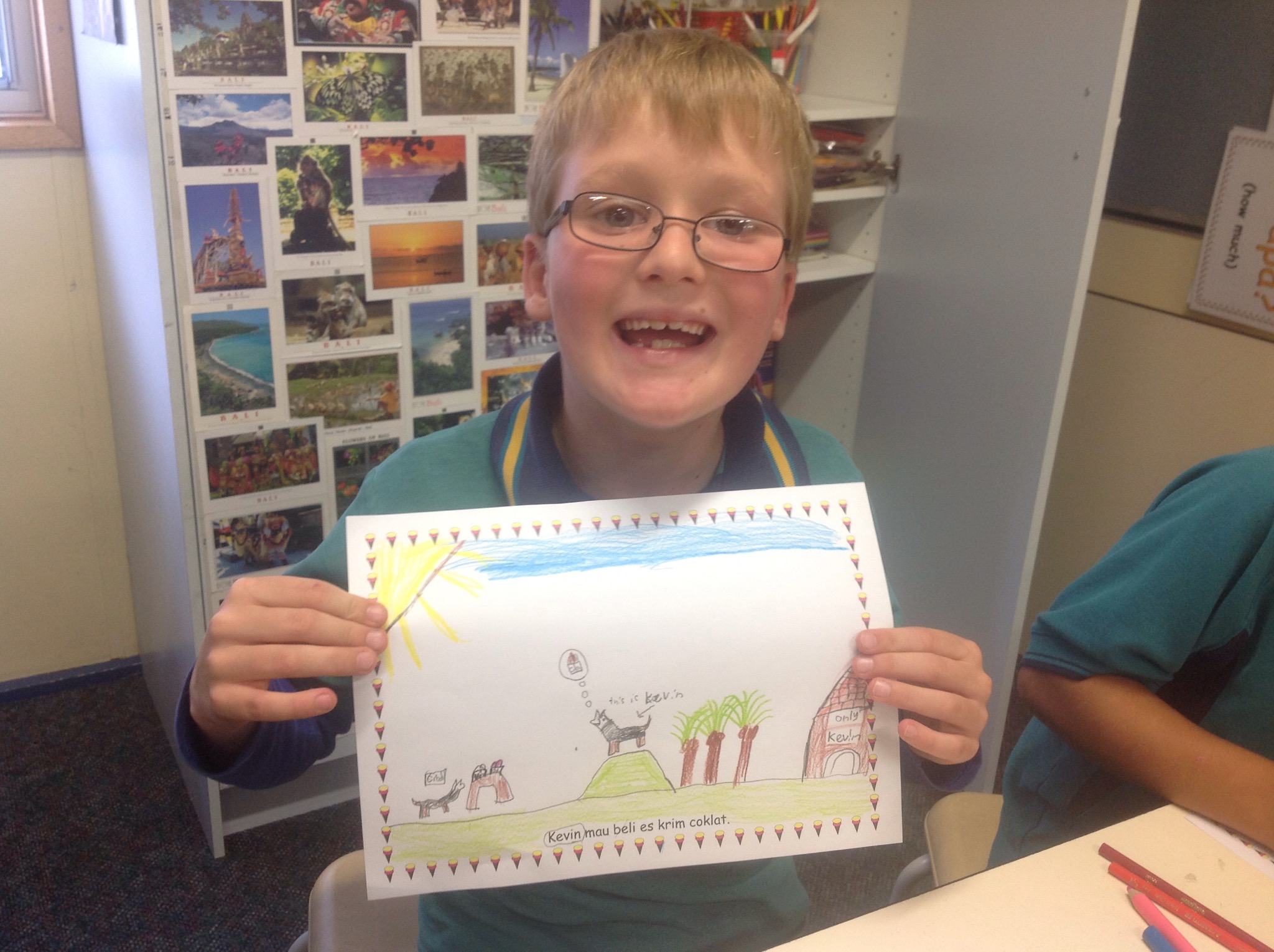
So for their next lessons, I ditched my scripts and followed my gut. I like to think I have a reasonable feel for the basic (VERY BASIC) concepts of PQA, so instead of focusing on my script, in both lessons, I was confident enough to build a dialogue using student input. My first request was to give our actor a name. Suggestions included many names I have never heard before. I went with one because I liked the sound of it; Stampy Longnose. Apparently he is a well known YouTuber! With the structure being ‘mau beli’ (wants to buy), we decided where Stampy Longnose wanted to go and what he wanted to buy. It was loads of fun and lots of laughs. I found that lesson so much more enjoyable.
With my second class, I tried something very different. After reviewing together the language structure (same as first class), I asked them to pair up and create a shopping dialogue. I gave them some planning and rehearsal time and then we listened to those who wanted to share. I gave no other information and interestingly not one pair used paper to create their dialogue. I was blown away by their grasp of all the language we have covered this term. One student, who has previously consistently struggled in Indonesian lessons, excelled. She worked with a partner who was absent last week, so their dialogue reflected mainly her learning and it was brilliant. She even used ‘terlalu mahal’ (too expensive) appropriately and with no prompting!! When I consider students like E, who are blossoming with TPRS pedagogy, it reinforces to me the huge positives of teaching a language this way.

Next week I want to focus on:
1. Teaching to the eyes
2. Determining the ‘Barometer Student’ in each class &
3. Speaking sllllooooowwwwlllllyyy…….

How was your week?

A Brief Introduction to the Guru, Stephen Krashen……

Last week, in my step 9 review meeting with my principal, we discussed my use of TPRS/CI in my Indonesian Language classroom and my desire to further develop TPRS proficiency in 2015.

He alikened TPRS with immersion, which was a light bulb moment for me. I suddenly realised that so far in my blogging, I haven’t introduced you to Stephen Krashen or his theories which underpin every aspect of TPRS.

Who is Stephen Krashen?
Stephen Krashen is professor emeritus at the University of Southern California, who moved from the linguistics department to the faculty of the School of Education in 1994. He is a linguist, educational researcher, and activist.
Source: Wikipedia

Watch this short clip taken from a lecture Stephen Krashen gave university students demonstrating the difference between ‘immersion’ and ‘TPRS/CI’.

Krashen’s theory of Language Acquisition is based on the following five hypotheses:
1. The Acquisition-Learning hypothesis
2. The Monitor hypothesis
3. The Input hypothesis
4. The Natural Order hypothesis
5. The Affective Filter hypothesis.

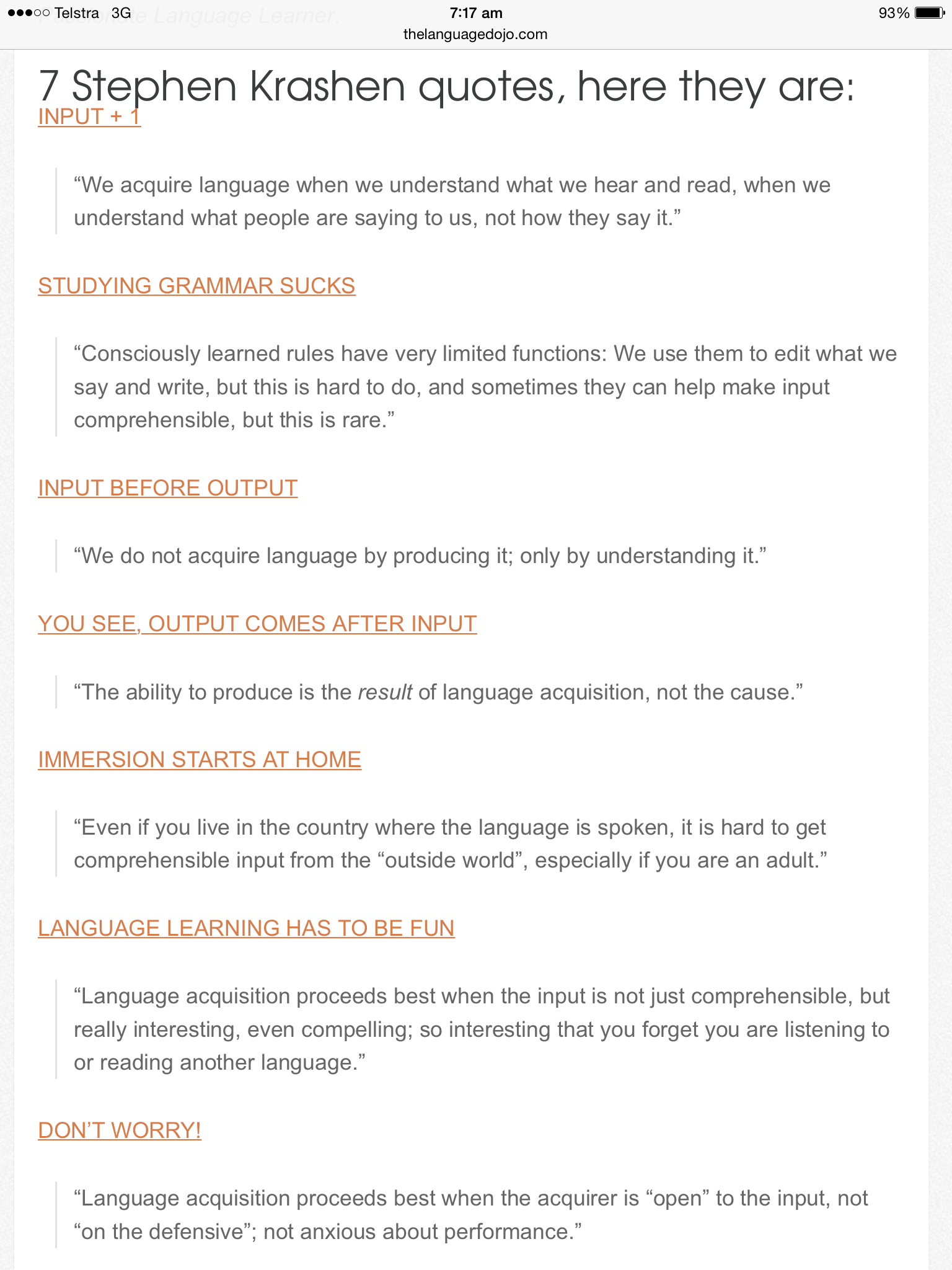
Across the Internet, many people quote Krashen:

IMG_0868.PNG Source: http://thelanguagedojo.com/2012/09/7-awesome-dr-stephen-krashen-quotes/

I hope you have found this post interesting. Hopefully this major jigsaw puzzle piece contributes to your understanding of TPRS and also helps clarify the big difference between ‘immersion’ and TPRS/CI; two entirely different pedagogies.

If you are interested in learning more about Stephen Krashen, I highly recommend this article:
http://www.teslcanadajournal.ca/index.php/tesl/article/viewFile/951/770

Using Chatterboxes In Indonesian Lessons

What a great idea this is! Imagine the questions that could be written under the flaps and also the range of possibilities for the top 2 flaps. The possibilities are endless and have so much potential.
I now want to make my own YouTube video with a native Indonesian speaker making a chatterbox and giving the instructions in Indonesian. Great for a focus on language structures such as lipat, menulis dan potong,.

Most of us remember these from our childhood. But how many of us remember what they are called. I asked my facebook followers what names they used for this in English or Spanish. Here’s what we got:

http://spanishplans.org/2014/11/04/making-a-fortune-teller/

PQA, Point & Pause, Circling – Weeks 1-3

This term I have been exploring the TPRS/CI pedagogy with my year 5’s and the year 5/6’s- basing it all around Ben Slavic’s book, “TPRS in a Year”. I read somewhere, probably in his book, a good way to start is to focus on new aspect/skills, one by one, and in doing so, one hopefully can develop a basic level of proficiency within a year.
My first week’s focus was PQA – Personalised Questions and Answers. This skill is important for getting to know the students personally and is especially valuable at the start of a new school year with brand new students. Interestingly, even though I have been teaching most of my students all of their primary years, there is still a lot I don’t know about each of the three hundred and thirty five students I teach. This understanding of PQA only gelled recently and thus instead of PQA in my first week, I mistakenly focused on circling. Last week my focus was ‘point and pause’. When pointing to new structures or the important question word posters, give students the time to grasp the word and its meaning by not speaking for at least 4-5 seconds. I could actually hear the ‘kerthunk’ Ben Slavic talks about when pointing and pausing for students. This week, I will be focusing on circling again however this time I have added a few extra pointers to help develop it even further.
Each weekend in preparation for the upcoming weeks lessons, I write a mini script for my TPRS lessons based on a segment of the master dialogue that I wrote in the holidays. The master is a work in progress and goes roughly like this:
S (Seller)- Good morning
C (Customer) – Good morning
S How are you
C good thanks
S What would you like to buy?
C I would like to buy fried rice
S OK
C How much is fried rice?
S ten dollars
C OMG. That is too expensive.
S How much?
C five dollars.
S OK. How many would you like?
C two please. How much is that?
S ten dollars.
C Ok, Thank you
S You’re welcome
C/S Goodbye

In week one, the target structures were:
1.mau beli apa? – What do you want to buy?
2. Saya mau beli ….. – I want to buy …….
3. penjual – seller/shop keeper

In week two, the target structures were:
1. berapa – how many
2. katanya – he/she said

And in week three the target structures will be:
1.terlalu mahal – too expensive
2.berapa satu? – how much for one?

Student progress has been very slow so far but I only have two fifty minute lessons with each class per week and one of those lessons clashes with choir which affects a handful of students. At the beginning of the term, I explained that any work missed due to choir, was not going to be revised in any great depth during the following lessons and if students thought this was going to be too difficult then they would need to think very carefully before deciding to continue with choir. Several of them wisely made the decision to drop choir, but there are still about four from one class and two from the other. I also have to keep reminding myself that my students are only ten years old and that going slowly is VERY important. It is far more important to have comprehensible input than rush to meet the looming deadline of having the entire script completed by the end of term.
My weekly scripts take a small section of the above dialogue and focus on just that part. Here is my teacher script for next week to give you an idea of what I am talking about.
Lesson # seven
Focus Structures: Berapa satu – how much for one (fried rice)
Astaga. Terlalu mahal – OMG, that is too expensive

Good morning students.
I want to go to market. oooh
Who wants to go to market?
That’s right, Bu Cathy wants to go to market.
Where do I want to go?
That’s right, Bu Cathy want to go to market.
At the market, I want to buy fried rice. ooooh
What do I want to buy?
That’s right students, Bu Cathy wants to buy fried rice.
Do I want to buy fried rice or yellow rice?
That’s right students. Bu Cathy wants to buy fried rice.
Why do I want to buy fried rice?
Ss to suggest a reason to which I will rephrase in a complete sentence eg That’s right, I am hungry.
Ask the students, How much for one fried rice? Choose the most ridiculous answer.
One fried rice is one hundred dollars. oooh
How much is the fried rice students?
That’s right, The fried rice is one hundred dollars.
What do you think, is that good or not?
That’s right students, one hundred dollars is too expensive
OMG, that is too expensive.
Where is the rice seller? Choose a student to be the seller and call them to the front.
repeat dialogue:
C Good morning Mrs/Mr
S Good morning. What would you like to buy?
C I would like to buy fried rice. How much for one fried rice?
S one hundred dollars.
C OMG That is too expensive. How about (5) dollars?
S OK. gives fried rice to customer and receives money
C Thank you
S You’re welcome
C/S Goodbye

Repeat this dialogue using hands as puppets a la Senor Howard.

~~~~~~~~*******~~~~~~~~~*******~~~~~~~~*******~~~~~~~~~~~*****

I have found that I need my script to be extremely detailed and also close to hand for when I reach a point and forget what comes next because my mind has gone blank. I learned that the hard way. I also read through the script just before the lessons which luckily are back to back, to have it fresh in my mind as well. If during class, I walk off without my script and backtrack for it, not one student has made a comment. They understand that I am a learner too and need my notes which is lovely.

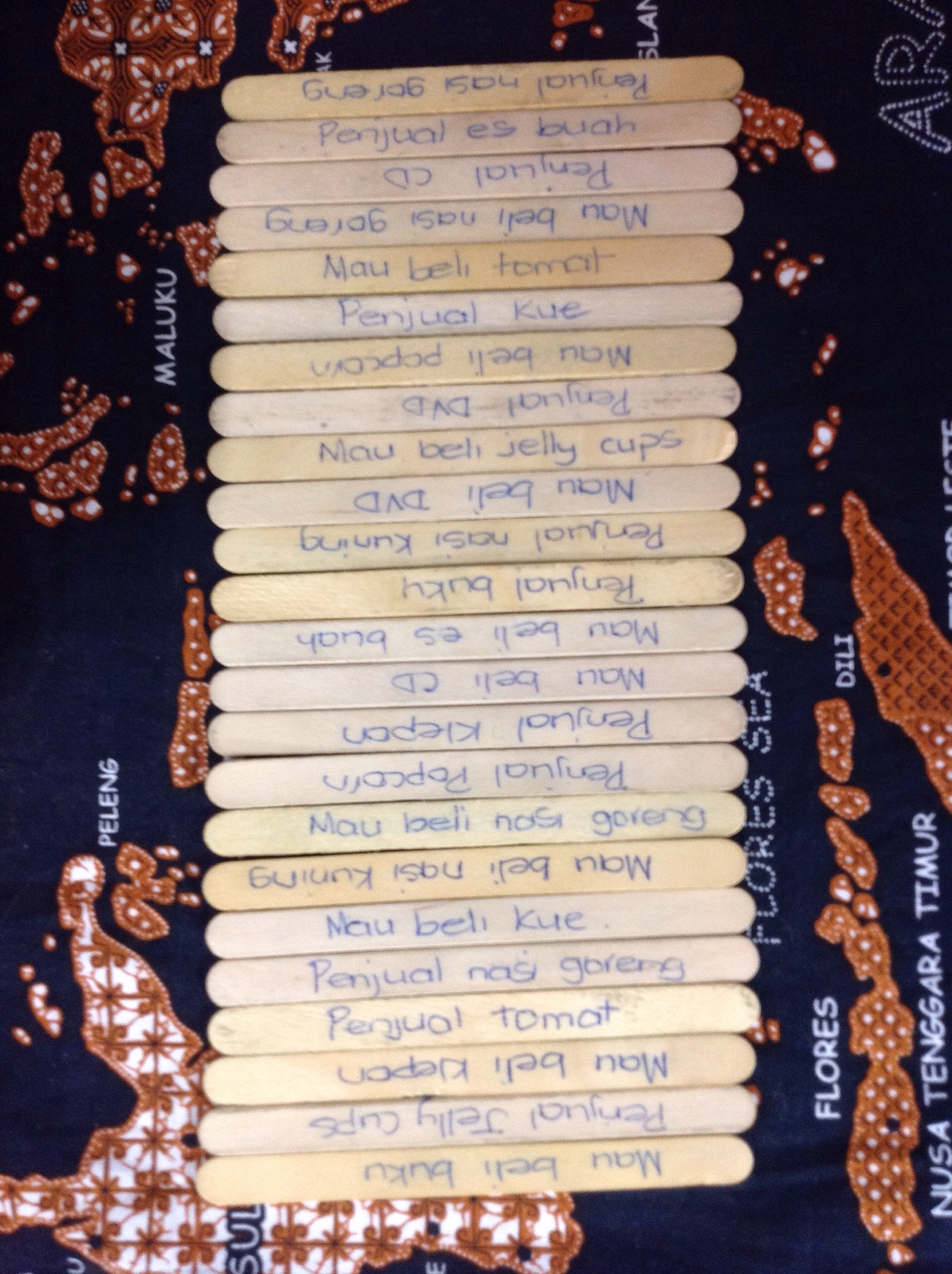
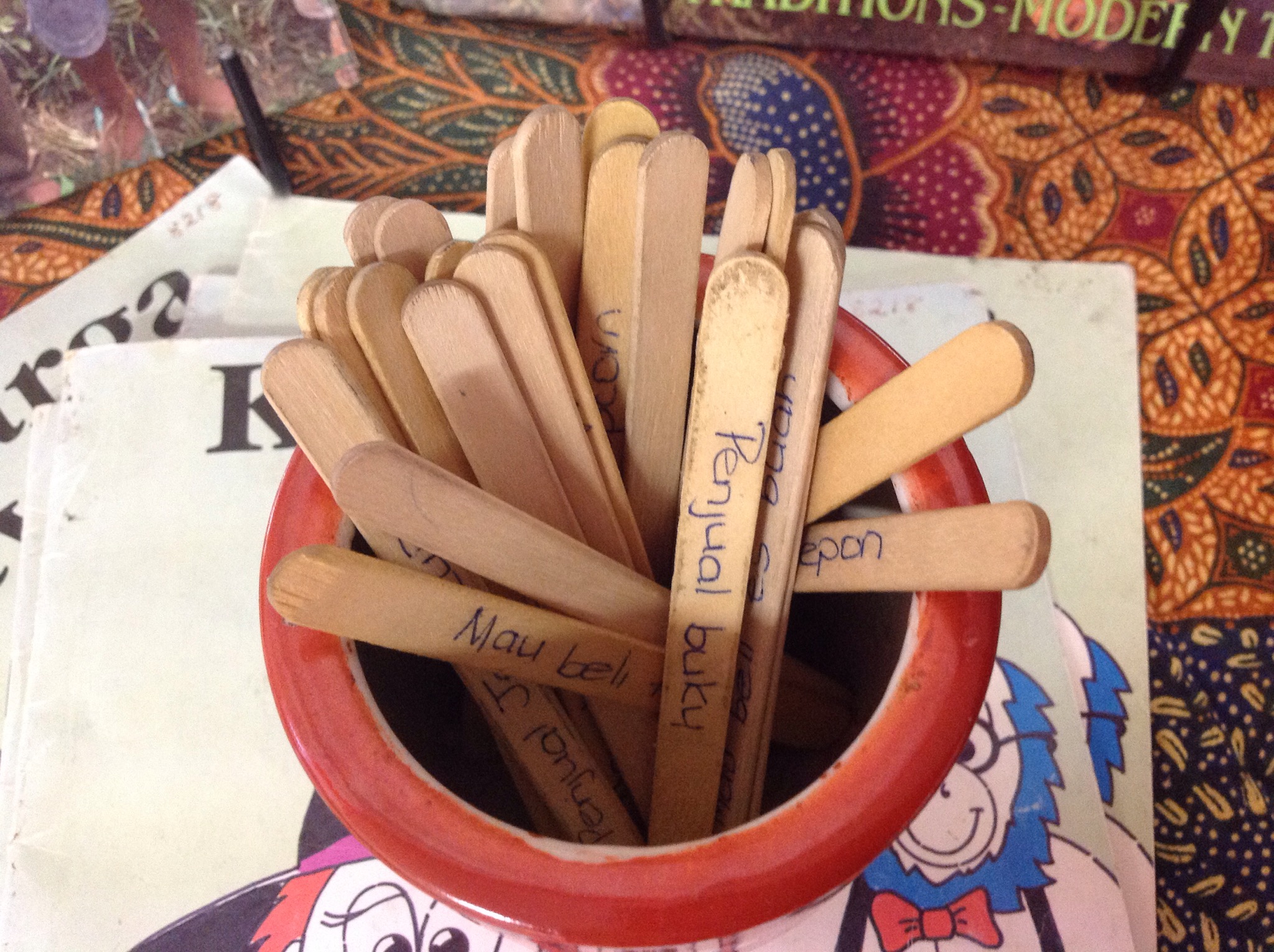
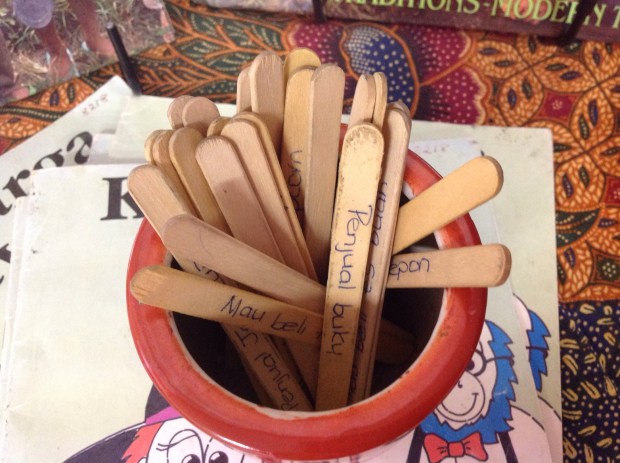
In the very first lesson, I planned a brain break activity to get students up and moving after sitting and listening for so long and it turned out to be a huge winner. It is so incredibly popular that it is now requested at the start of every lesson by both classes. I wrote on paddle pop sticks either penjual …….. or mau beli ………… ensuring that there is a pair for each item.

IMG_0828.JPG
The vocabulary for the items is lifted straight from the pasar stalls that classes are each organising for the end of the term. The paddle pop sticks are in a jar and students choose a random stick.
IMG_0825.JPG
If they are a penjual they sit at a table and wait for a customer and if a customer, sit on the floor and wait till everyone is ready. Customers then have to move around to converse with each seller until they find the seller selling the item they are looking for. Students converse using the dialogue covered earlier in the lesson repetitively. When they find their pair, they complete the dialogue and then the customer chooses either sits on the floor waiting for the others to finish or continues asking other sellers to practise further the structures.
So easy to organise and so much fun. I usually join in if there are left over pop sticks which gives me the perfect way to assess the language of individual students.

It’s Not Personal!

I want to apologise to friends and family for my recent preoccupation and online silence. I confess that it is entirely due to my latest obsession; TPRS/CI. Getting my head around this pedagogy has been so absorbing and has left little spare time for anything else. It’s all I can think about! Scary. I rarely drop into Facebook these days, Pinterest friends haven’t seen me for over a month, WWF games are nowhere near as frequent and at school recesses and lunch times are the perfect time to quickly watch a troubleshooting youtube video pinpointing the skill I am currently focusing on and needing extra clarification.

This is largely because in the school holidays I discovered two yahoo groups; one called moretprs

IMG_9111.PNG
and another called elementarytprs.

IMG_9112-0.PNG
The former is full on and if I don’t check my emails regularly, I can be overwhelmed by up to 50 emails weekly. While most who post on this yahoo group are American high school Spanish teachers, often the big names of TPRS also check in and add their perspectives which is really cool. The elementarytprs group is very quiet by comparison which is a shame as I think I would connect more with other language teachers applying TPRS with younger students who have limited TL vocabulary.
The topics currently being covered by the moretprs group are largely above my TPRS head, however they none the less help slowly but surely fill in the gaps of my TPRS knowledge. Up until very recently, acronyms such as ACTFL, FVR, TPRS/CI & PQA were foreign but are now meaningful, thanks to this group. Trending topics currently include the usefulness of language labs (most agree iPads/iPods are far more versatile), the value of teaching thematically (not recommended by TPRS guru’s) and the recommended rules to implement during storytelling. Another aspect of this group I really like is the balance of theory and practice and how each supports each other. Here is a great blog post which demonstrates this.
Once my emails are checked, I then open my WordPress blog reader. Here I read the latest posts written by language teachers from all over the world who are all at different milestones on their TPRS/CI journey. Each post has its own focus and inevitably includes links to other blogs and so my blog roll constantly increases! I love discovering new WordPress blogs because they are the easiest to follow but more and more bloggers are choosing other platforms which are not and some don’t even include the option to follow! So I have bookmarked them however have yet to work out how to check them regularly. There are definitely not enough hours in the day!
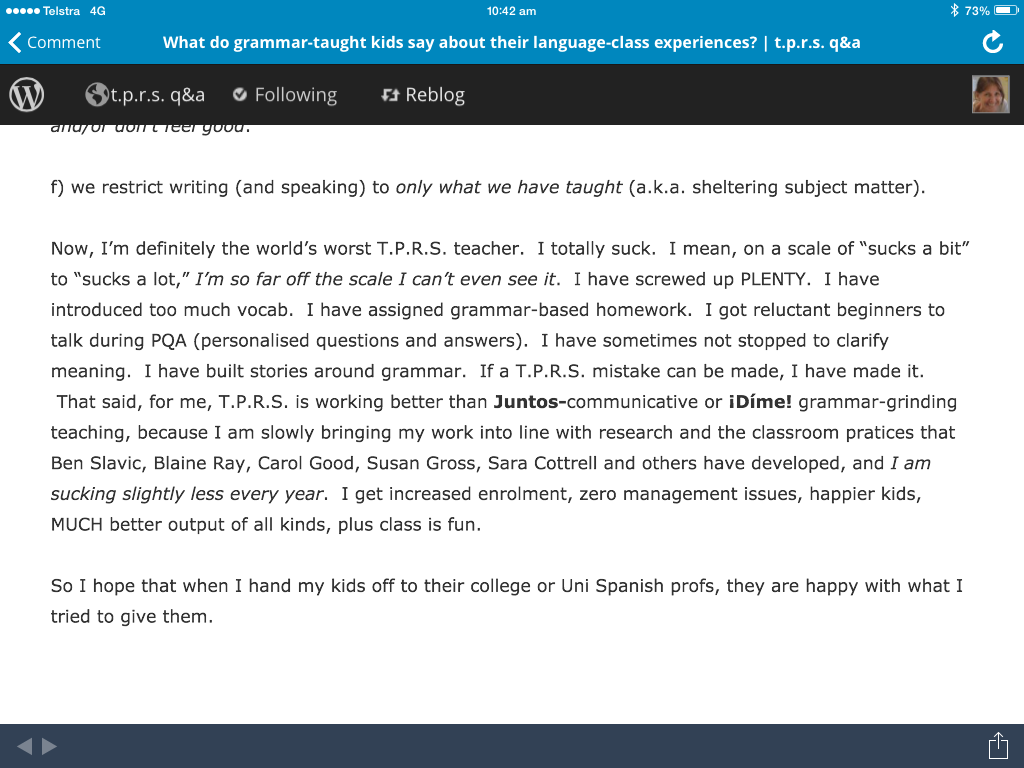
While it is great to read about other teachers and their successes, as a newbie with no local (let alone national that I know about) support network, I was becoming discouraged as I feel like I am going around and around in circles (no pun intended!!) and not sure how or where I can improve. So it made a huge impression on me when I read this blog post which finished with the following:

IMG_9110.PNG

I immediately responded to which she replied with the encouragement for me to keep plugging away because while experts agree that it can take up to 3 years to develop proficiency with TPRS, bad TPRS is still significantly better than the alternative! Music to my ears and balm for my soul.

So, now my friends, hopefully you have a clearer understanding of why I have been ‘offline’ lately and can understand why my routine has changed! It’s not personal!

Halo Boss – English Borrowings In Indonesian by Ivana Amerl

I highly recommend this link if you are interested in the language of Indonesia. I discovered it when searching for cognates!!

It is very interesting and includes information about the following:

• A brief history
• Indonesian in the 3rd millennium
Era globalisasi and international words in Indonesian
• Modern living and English loan words
• What’s your name?
• False friends
• Further reading
• Next in the series

Friday’s Featured Language: Indonesian

Wouldn’t something simple like this be great on school websites to not only promote our Language programmes but also to give some background and history.

polyglossic's avatarpolyglossic

I am very excited to present my newest regular feature: Friday’s Featured Language! Every Friday I will be featuring an audio clip and text translation from a real native speaker of a language.  This will give speakers an opportunity to share a little bit about their language with us, and will give us an opportunity to hear what the language really sounds like!  Did I mention I’m really excited about this project? (Sorry for the excessive use of exclamation points in this post!)

My very first featured speaker is Thiyani, a native speaker of Indonesian (or bahasa Indonesia).  Thiyani grew up monolingual in Indonesia and now lives in the USA.  She speaks English in her day-to-day life, but in her home she speaks English, Indonesian, and Javanese.  She says what she likes about language in general is “its connection to culture.”

Indonesian is the national language of Indonesia, where…

View original post 272 more words