Astaga! What A Story!
On a high after my first lessons exploring TPRS pedagogy, I was really motivated to take it one step further and explore the skill of storytelling. A google search quickly confirmed that I would need to write my own story (Mainly Spanish and European Language stories available) so that it contained the exact language I wanted to target as well as incorporating already familiar vocabulary and sentence structures from previous unit of work.
After much thought, the story came to me one evening while walking the dogs! This is always the perfect time for me when thinking about any aspect of my writing, I work through blog posts, student dialogues, film scripts, in fact, just about anything and everything – and the best thing is that because it is just me with the dogs, once the idea has gelled, I can then say it aloud and hear how it sounds.
I wanted my story to ;
1. incorporate some language from terms 1 & 2 (myself & school),
2. incorporate some of the language we had circled the previous week (kenalkan),
3. be succinct
4. incorporate students
5. have a twist at the end
6. be easily performed
When it came together, I was so excited. I quickly returned home so that I could write it down while it was still fresh in my mind.
Here it is:
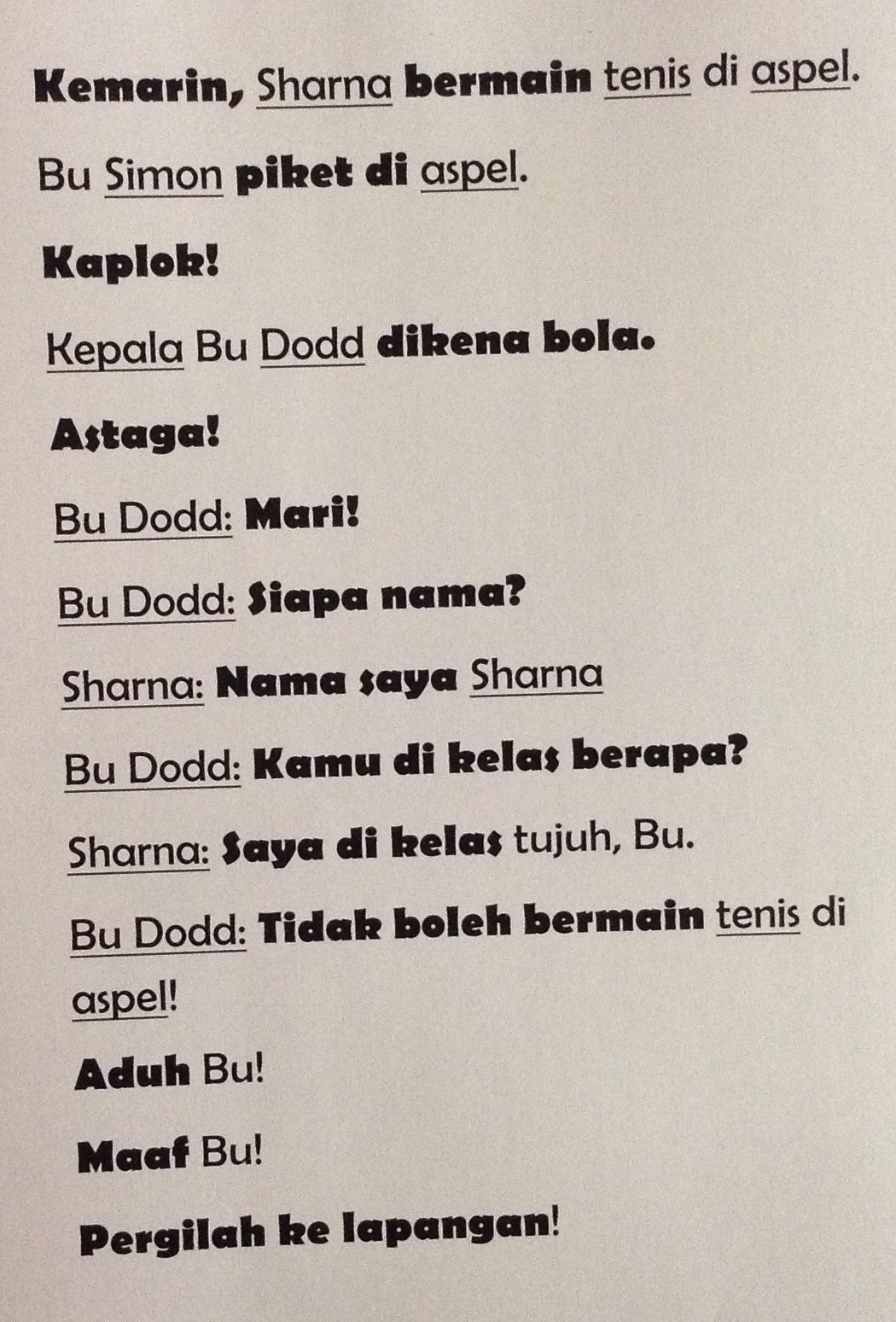
Before the first lesson, I identified the vocabulary that would be unfamiliar yet vital for comprehension:
dikena
pergilah
piket
tidak boleh
bermain
mari &
kamu
and wrote them up on the board before students arrived for class.
We then began the first lesson by focusing on the pronunciation of these new words. I next wrote the meaning for each word alongside it and asked the class to suggest a gesture for each. This was lots of fun and students were very creative. The gesture I particularly liked was for ‘piket’ (yard duty) which was the enactment of putting the duty vest on. Simple yet effective. Once the gestures were each firmed in our minds, I began circling with, “Saya bermain hoki.” Colby bermain kriket? Tayla bermain apa? Once students had relaxed with this familiar line of questioning, I invited a student to become my first actor, with, “Mari!” I then asked him, “Oscar bermain apa?” to which he replied, “Saya bermain futball.” As a class we then repeated this using gestures for each word. I then began the story and asked Oscar to mime each sentence. The first sentence included the word, “aspel” (asphalt) – vocabulary from 2nd term – and at that point in time I was surprised that not one student remembered this word which to my ears, even sounds like asphalt!! However later it became clear that as they knew it was against the rules to play football on the basketball court, they had automatically disregarded that option!! Funny really as this was the basis of my story!! (i.e. A student doing the wrong thing!)
Next, a second actor was invited to the ‘stage’ and we began the 2nd line of the story. As a class we agreed on which teacher the actor was portraying and then she mimed the gestures as I spoke the next aspect of the story.
The third line, being an action word, also hadn’t been added to the initial list of vocabulary because it was oenapapatic and I had correctly assumed that students would easily work out its meaning.
At this point in the story, I stopped and repeated these 3 lines of the story with a fresh couple of actors. Once the first actors had demonstrated the action, others became keener to volunteer which was pleasing. For the next actors, we changed the sport, the teacher on duty (pop-up for Pak & Bu with this point) and the location.
This repetition was valuable, however as our lessons are 50 minutes, I started to run out of time. So unfortunately the latter half of the story was not circled anywhere near enough for my satisfaction and consequently we didn’t even cover the final stage of the story where the twist was! Oh well….
For the second lesson (and final lesson for term 3), I instructed students to form groups of 2-3, and then gave each a cloze of the first part of the story.
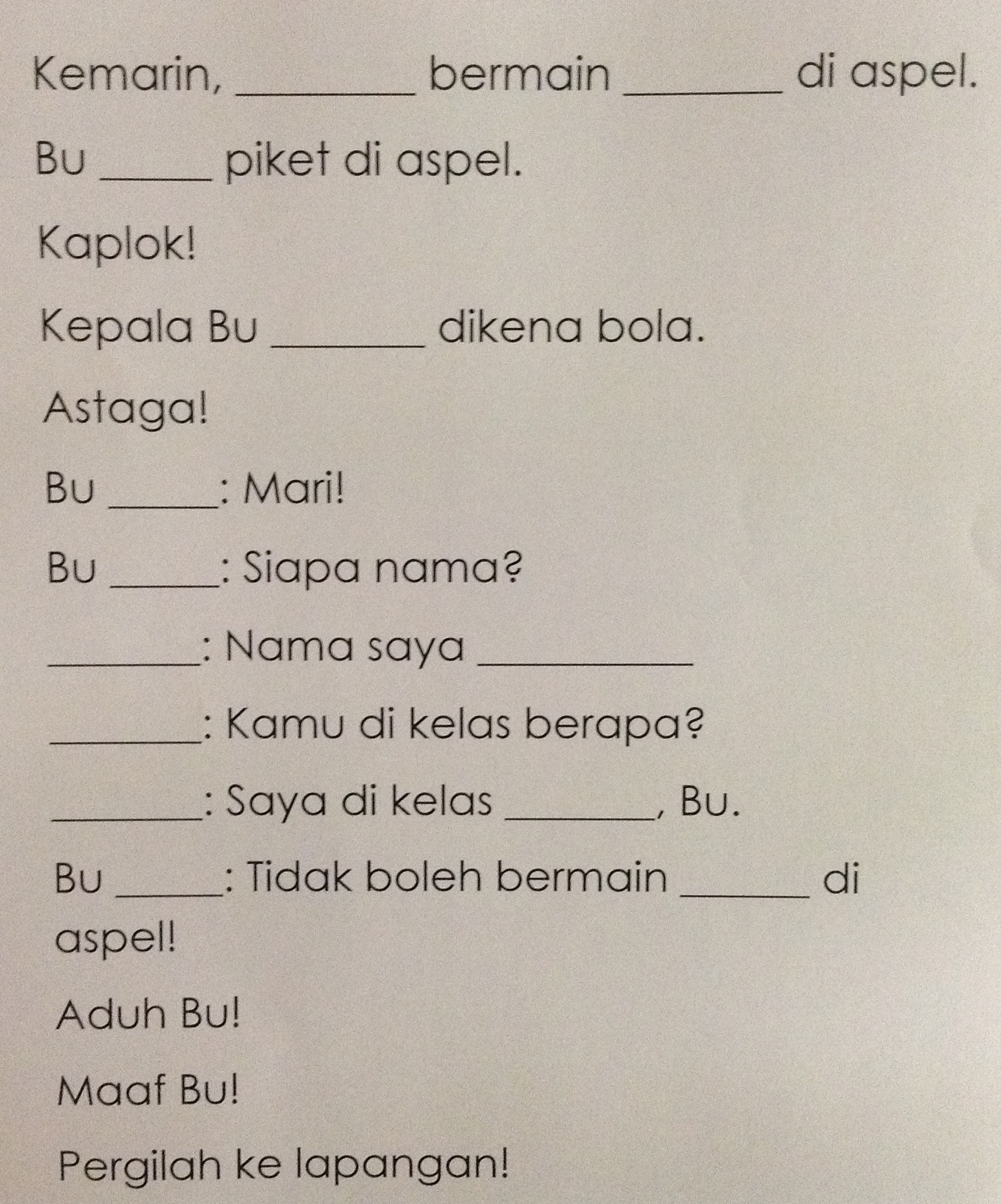
Even though I only had this one lesson of 50 minutes to achieve quite a lot, I have discovered that having a tight timeline when working with iPads, actually motivates most students to stay on task.
Their task for the lesson was:
complete the cloze
use the app puppet pals to create an enactment of the dialogue.
use themselves as the characters (not the clipart looking characters provided by the app)
upload to camera roll when finished.
Overall, I was extremely satisfied with this extension activity with the story – mainly because of the enormous amount of oral language each student was uttering. While most groups did not finish the task, I wasn’t too disappointed with that aspect. For me, the main aim of this lesson, was to provide students with an engaging way of manipulating and repeating the sentence structures we had worked on till it became firmly entrenched in their minds. Walking around and listening to groups recording their voices reinforced just how successful iPads can help in achieving this. Some groups edited and edited and edited, each time having to repeat their lines over and over and over again until each group member was satisfied with not only the pronunciation and expression but also importantly that the actions matched the words! Even now, 3 weeks on, students still remember lines from the story. Yesterday Jamie, clutched his leg and claimed, “Saya dikena Oscar!”. How awesome is that! (linguistically not the fact that Oscar had actually deliberately bumped his leg!)
Now enjoy a few of the finished projects:

My Initial Attempt with TPRS
I discovered TPRS (Teaching Proficiency Through Reading & Storytelling) towards the end of last term on Martina Bex’s blog. She is a Spanish teacher working in Alaska and is regarded highly amongst her peers in the field of language teaching.
This pedagogy resonates with me for several reasons. Firstly, I remember how important sentence and word repetition is for young students learning how to read and write. It has been a constant source of frustration for me that there are limited Indonesian storybooks/texts which incorporate predictable and repetitive sentence structures. The Seri Mari Membaca books are brilliant for this and are leveled but unfortunately they are the only book series I have discovered and not only are all the authors definitely not native speakers but the illustrations, while of Indonesian people, are totally out of date and old fashioned and reinforce culturally inappropriate and inaccurate stereotypes! 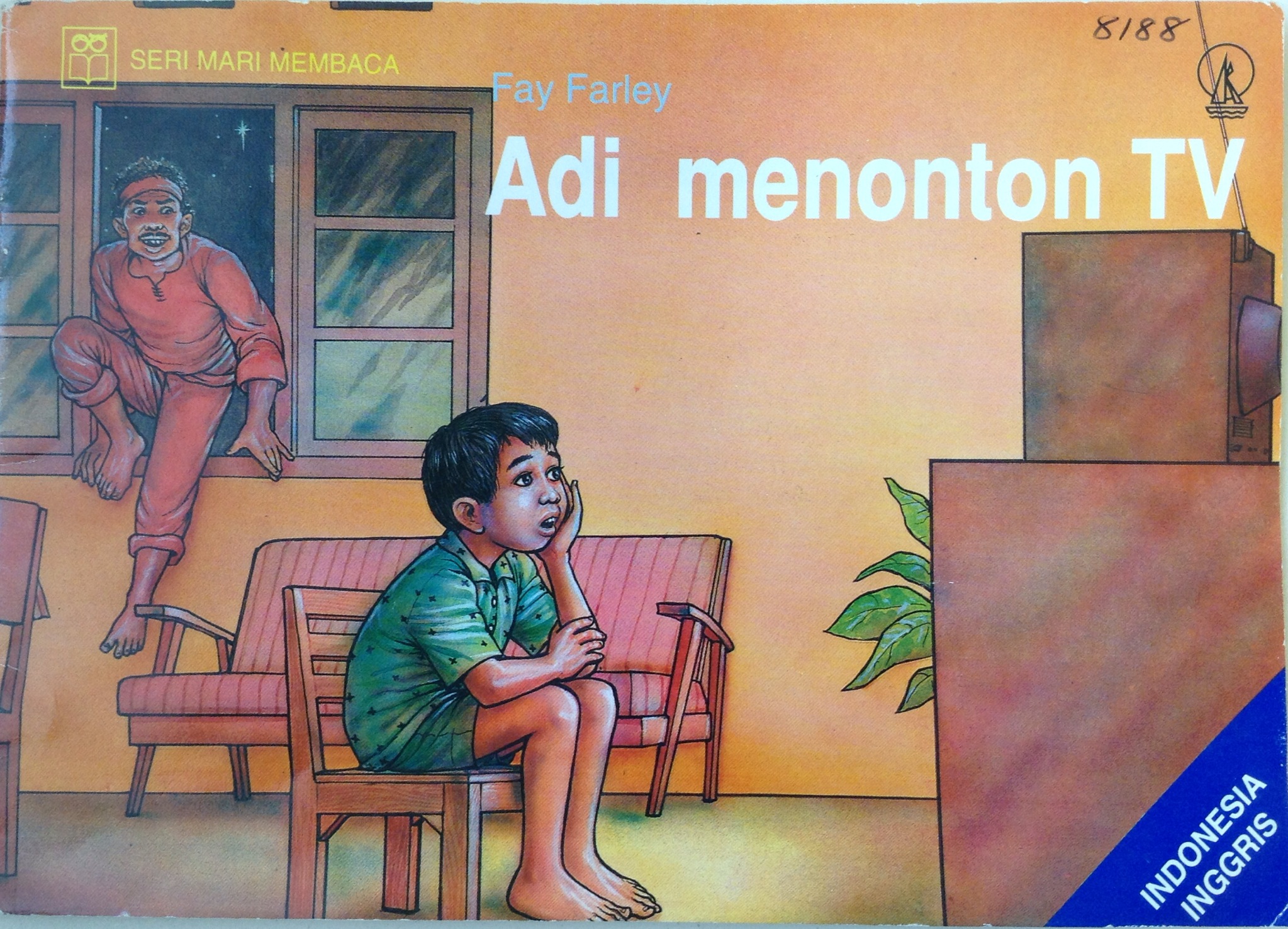
Secondly, TPRS is a pedagogy that for me, addresses an issue first raised by Bu Febi when she visited us in 2011. One day after our lessons had finished and we were chatting generally about my Language program, Bu Febi offered me some advice. She recommended that I needed to incorporate more spoken Indonesian into my lessons. She was right! 98% of the language in my room at that point was English. I agonised over this for years because I knew I should reverse this but I couldn’t see how I could. Finally, the last point which makes TPRS a style of teaching I want to explore in more depth, is the recent approval of the new (Australian) Indonesian Curriculum. I have attended workshops and conferences devoted to familiarising teachers with our new curriculum, however I still remember my very first introduction to it with Andrea Corston. What jumped out initially for me was the amount of spoken language teachers were now expected to incorporate into their teaching. These 3 points have been recently niggling in the back of my mind while on Pinterest or Twitter or while searching for language teacher’s blogs.
Once I began researching TPRS in greater detail, it became clear just how well TPRS addressed all these issues. I then watched a few YouTube videos and I was instantly hooked. I couldn’t wait to try it with my students. About week 8 last term, and at a point where the upper primary classes – whose term outline and planning had gone down the gurgler because of the difficulty of finding mystery Skype partners in Indonesia or Asia (school holidays, Ramadan, new school year)- I was provided with the perfect opportunity to trial TPRS.
I first started with the year 5’s and 6’s. I even pushed all the desks to the back of the room and had them sitting in a semi circle on our stools, which actually worked well because it emphasised that we were about to embark on something totally different. To start with, I focused entirely on ‘Kenalkan’ (introducing oneself) language which was for several reasons. Firstly, it was personal; an important aspect of TPRS, and secondly I could begin with a topic that would be based on vocabulary students were already familiar with and therefore hopefully would be less threatening for them. The new words I did introduce were:
tidak (no/not),
paham (do you get it?/ understand?),
Astaga (OMG),
laki-laki, perempuan (boy/girl),
kamu (you),
dia (he/she) and
kami (we).
It was exhausting but oh so exhilarating. After the first class, I asked students what they’d thought of it and they admitted that at first when I’d stated that we would only be using Indonesian in that lesson, they’d been concerned but once we got going, they just loved it. The only negatives were that at times I went too fast and that sometimes students got too carried away shouting ASTAGA to encourage each other!! Their positive feedback blew me away.
However I knew my toughest and most honest critics would be the year 6/7 class (11 – 13 year olds), so I dug deep and led them through a lesson too. Considering that in the class that week was a student on exclusion and 2 other reasonably recent transfers, all from the same school, (where they too have an awesome Indonesian language program) and therefore included 3 students who do not have the same depth of relationship with me that the others have, the lesson went smoothly. I began with asking individual students, “Nama saya Bu Cathy, siapa nama?” (My name is Bu Cathy, What’s your name?) a format they are all familiar with but then I began PQA, eg, “Ini Mitchell?” to which they could answer ya or tidak. At this point, I realised that I should have also incorporated mentioning ‘bukan’ into my circling script but as it was my first lesson, I hadn’t thought that part though beforehand. Hopefully one day I will be able to seamlessly incorporate successfully a grammar ‘pop-up’ within a lesson! I next progressed to, “Saya tinggal di Port Elliot” and after that, “Umur saya dua belas.” I then called for 2 volunteers – Flynn & Oscar- and we did some more PQA about the 2 boys. With the other classes, I usually stopped there, but with this older class, they then had to write non stop for 7 minutes using only Indonesian. This was very interesting. I gave no direction, only that if they couldn’t write sentences, they could just list words, it just had to be 100% Indonesian. Surprisingly, only a few wrote a paragraph about themselves, they mostly wrote unrelated sentences or words. After the 7 minutes were up, I then asked them to count the number of words they had written and then give me some feedback on the lesson. I asked for a positive comment and a negative comment. Here are their responses:
Positives
Loved having the oportunity to talk in Indonesian 4
Enjoyed learning new words 6
Enjoyed watching Flynn & Oscar perform 2
Enjoyed being brave & Performing inn front of peers 2
Enjoyed writing in Indonesian 3
It was funny & fun 3
I sort of understood everything 2
Negatives
Did not like having to write 6
There were too many new words 4
Not fun 1
Didn’t like the audience whispering during the performance 2
It went for too long 2
We don’t do enough writing in Indonesian lessons 1
Isn’t that fascinating! For me, their feedback clearly demonstrates that their introduction to TPRS was largely enjoyable and definitely worth repeating.
The other feedback that comes through loudly and clearly is that I expected them to learn too many new words in one lesson and did not circle them enough. If I look back at the basics of TPRS, I can see that I tried to cover all 3 steps in just one 50 minute lesson!! I also need to incorporate more activities into the lesson like brain breaks, so that students are not sitting still for so long.
Playing around with Zaption
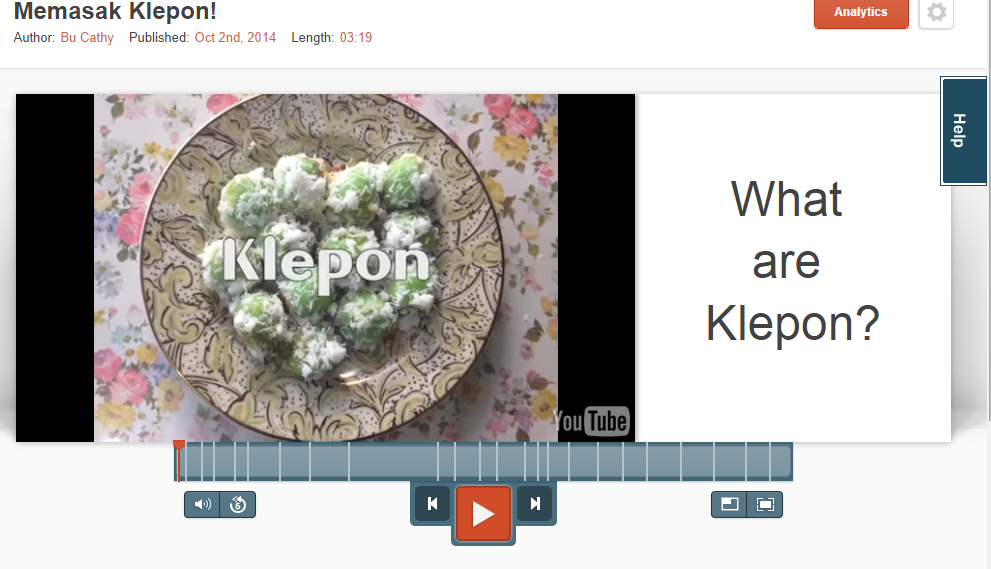
Have you discovered Zaption yet? It is a fun way to present a video and has heaps of potential for Language classrooms. I love that you can choose whether the video stops, or the text just goes over the top while the video continues. There is also a blackout option, which is really handy when you find the perfect clip but it has a tiny unsuitable part that needs cropping out.
Here is a one of mine that I have created for my upper primary students, who are about to embark on a cooking theme.
However, I have a feeling you may have to login first:
TEACHING INDONESIAN IN SOUTH AUSTRALIA
I have just found this article on the APBIPA website which was written several years ago. It is quite timely as both Ibu Sharon & Ibu Trees are currently visiting Pak Agus in Singaraja and working with the students at his school! The lasting effects of such a visit are never ending not only for the adult participants but even more importantly, for their students.
Fourteen Days of Teaching Indonesian in South Australia
Agus Jaya Parhyuna (SMKN 1 Singaraja)
Usman Ismail (SMKN 1 Kota Bima)
The following is a short report on a two-week teaching experience in four schools Adelaide by Pak Agus and Pak Usman. They joined our new program: Indonesia-Australia School Attachment Program – specially designed for SMK, SMA and SMP teachers. This is a joint program between APBIPA Bali and SMKN 3 Denpasar (representing Directorate of Vocational High School), Ministry of Education and culture. The first part of teh report is by Pak Agus and the second is by Pak Usman.
It is very interesting to know not only what they experience in Australia but also how they have felt about Bahasa Indonesia and about being a native speaker of Indonesian in the middle of Australians teachers and students of Bahasa Indonesia.
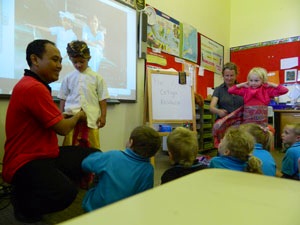
1. “I would like to tell you about my experiences with the Indonesia-Australia School Attachment Program on the Fleurieu Peninsular, South Australia. Before going overseas I needed to catch up with current trends teaching methodology of Indonesian as a second or foreign language (known as BIPA), the Australian cross cultural issues, 4 different schools where I would teach Indonesian and typical Australian way of life.
It was like a dream visiting that giant continent for the first time. There were many and long steps I went through to be admitted in the program including: applying for my visa and passport, organizing a letter of invitation from the school in Adelaide and a sponsor letter from SMKN 1 Singaraja. I would never have imagined how I could manage all these just by myself considering I am only a high school teacher. Fortunately, there is an association in Bali (APBIPA Bali) that assisted me with all the necessary preparation, e.g., BIPA teaching methodology courses, introduction to Australian culture, child protection programs and many kinds of Indonesian teaching techniques and games.
I was so lucky to be hosted by three kind and friendly families. They live in a beautiful, quiet coastal, rural area in South Australia. Sometimes the sea breezes cooled me while I was fishing during my spare time. Moreover, almost all families have pets and look after them as they look after each other. They feed and bath their pets regularly. Every day I ate something different and I really appreciated their willingness to help me learn about Australian cooking. I enjoyed trying so many new types of fresh fruits and vegetables.
School started at 8.55am and finished at 3:00pm on Monday to Friday. Some students walked to school, others were driven by their parents. Punctuality is valued and mandatory for all staff and students. There is a high commitment among students and teachers in the process of teaching and learning. Staff and students bring their own lunch from home. We ate our lunch together at lunch time in the staff room with a cup of tea or coffee or a glass of water or milk. Staff and students rarely buy food from the school canteen for price and health reasons. Students learn Mathematics, English, Indonesian, Sport, History, Performing Arts, Visual Art, Spelling, Society and Environment, Science, and well as many other subjects. The teachers are so warm and friendly towards each other and towards students. Assessment is done compassionately as is student punishment for those who don’t follow the school rules.
The people on the Fleurieu Peninsular live in harmony with their environment and each other including Aboriginal peoples, animals, and many kinds of native plants. Everything is so different, but the differences shouldn’t create conflicts. Instead, they create a wonderful and harmonious rainbow in the sky. I am so grateful and blessed to have experienced these all.”
2. “Puja dan puji syukur kami panjatkan kehadirat Tuhan yang Maha Esa, karena kami telah dengan sukses kembali ke Negeri ini setelah melaksanakan satu tugas mulia: memperkenalkan bahasa dan budaya Indonesia kepada sejumlah siswa di Adelaide. Saya dan dua teman lain (Pak Agus dari Bali dan Ibu Indra dari Palembang) mendapat kesempatan mengajar di empat sekolah: Port Elliot Primary School, Victor R-7 School, Goolwa Primary School dan Victor Harbor High School.”
Kami tiba pada hari Minggu, 11 Maret 2012 dan dijemput oleh Ibu Trees dan Ibu Katty di bandara Adelaide dengan sangat luar biasa setelah melakukan perjalanan selama 7 jam 30 menit dari Denpasar via Sydney. Selanjutnya, kami dijamu makan siang oleh Pak Tony, keluarga besar dari Ibu Katty, dan dari sini kami dijemput oleh keluarga angkat masing-masing.
Selama satu minggu pertama di host kami masing-masing dilayani dengan baik dan dihormati. Mereka megganggap kami sebagai satu keluarga besar. Kami diperkenalkan pada seluruh keluarga besarnya dijamu makan malam dan diperkenalkan budaya mereka dan terjadi diskusi tentang budaya kita dan mereka yang berhubungan dengan lingkungan tempat tinggal dan lingkungan sekolah. Di rumah begitu hangatnya perbincangan kami sewaktu makan bersama, sebuah perbincangan tentang lingkungan di mana manusianya betul-betul saling menghargai, saling percaya, dan menghormati.
Kami bertiga bergiliran mengunjungi empat sekolah yang berbeda selama dua minggu. Kami bersepakat bahwa para siswa di ke empat sekolah sangat antusias berbahasa Indoensia dengan kami, penutur asli yang khsus datang untuk mereka. Kami senang bisa melihat penerapan prinsip dan norma pendidikan yang berjalan dengan sangat baik. Prinsip ‘reward and punishment’ juga dikelola dengan sangat apik.
Ruang kelas untuk Bahasa Indonesia ditata sedemikian rupa yang menggambarkan peta budaya Indonesia dari Sabang sampai Merauka. Kami pun menangis terharu dan merinding karena mereka begitu menghargai Bahasa dan budaya bangsa kita, Indonesia. Ternyata di ruang ini kami bisa merasakan sisi-sis indah Indonesia yang sebenarnya.
Kesan penting lainnya adalah bahwa mereka menyatakan program ini sangat singkat sehingga mereka berharap agar program seperti ini akan berlanjut.”
Original source of article:http://www.apbipabali.org/home/2-blog/74-teaching-indonesian-in-adelaide.html
Pabrik Rotan Di Cirebon Ludes Terbakar
Here is a fantastic example of authentic text. Could it be of use to high school Indonesian Language teachers? Lots of really interesting and well written articles on this blog! Check it out!
Parents Information Evening – ICT
On Thursday evening a group of 3 teachers & our principal invited our parents to come and learn about how teachers are using ICT in the classroom. We promoted the event through our newsletter, word of mouth & on our school Facebook page. 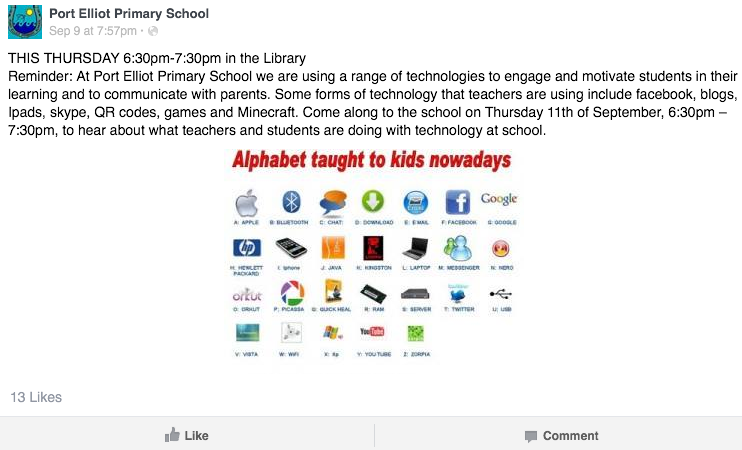
The 3 teachers were Sandy, a year 3 teacher, Kathy, a year 7 teacher & ICT coordinator and myself, so we were a pretty good cross section of teachers from PEPS. We were all there early to prepare for our presentations and Kathy also set out a great display of recent purchases that have been very popular with students.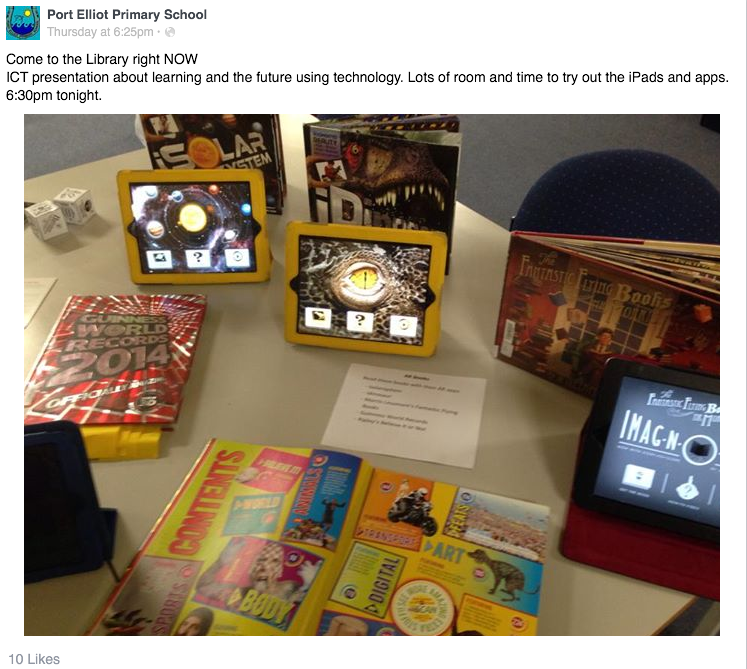 Our first families to arrive went straight to this table where the children had heaps of fun coordinating the ‘dinosaur’ to munch on Mr Hudson (our principal)!

While the number of parents who turned up wasn’t overwhelming, it was a lovely, cozy group, representing all year levels, which created a warm and friendly atmosphere.
Brenton welcomed everyone and then gave a brief presentation which included his wish to create an innovative school which focuses on teaching 21st century skills to students whose future will require skills and knowledge we can barely even imagine.
Kathy next outlined the DECD policy and how we implement and enforce it in our school to ensure students develop cyber safety skills.
 Kathy also talked about the various class blogs that teachers have created. We have links to most of them on our website and I too was amazed to learn just how many PEPS teachers have blogs! She next mentioned our Facebook page before talking about how teachers use Youtube in the classroom. Some of us have our own Youtube channel which is where we upload work completed in the classroom. (I too have one in my name – Bu Cathy- which also has quite a few videos I made last year while traveling specifically for the Indonesian classroom)

Sandy next took the stage and shared with the parents the various ways in which she has used technology in her classroom.
We saw on of the films that several students made using imovie,
 talked about the ipad app book creator,
 and she shared a fantastic app that she uses as part of the daily 5
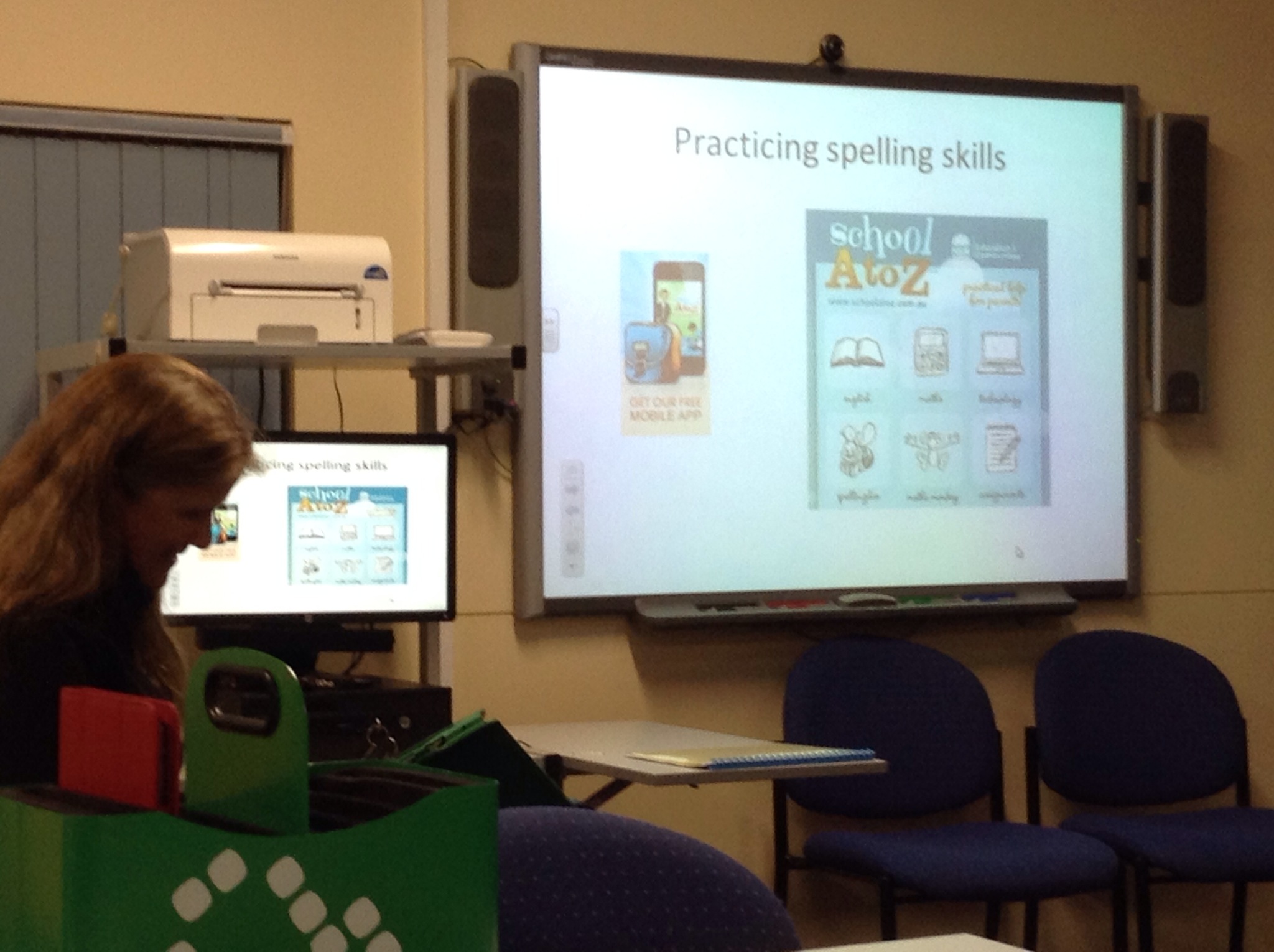 Parents enjoyed a demonstration of how students use it to learn their spelling words.
 Sandy also shared a recording of a student demonstrating his ‘paddleboat’ creation made from plastic bottles before sharing with parents her class blog. As Sandy finished up saying, these are just a few of the ways in which ICT is incorporated into her classroom!
It was my turn next. I had planned for a friend in Indonesia to be available to do a mystery Skype with the parents so they could experience the fun firsthand.
 However as the parents walked in the door, I received a message from her apologising that she could no longer participate. So instead, I shared a video I have put together using footage from the Mystery Skype the Year 6’s did last week with BIS in Bali. In retrospect, this worked even better, because it was provided a brief snap shot yet captured the real excitement and collaboration involved.
Kathy concluded the evening with a video she had put togther highlighting the various projects currently being undertaken in various rooms including minecraft, stop animation and puppet pals. It was a great way to finish on a high note. It was brilliant being involved and I was truly chuffed to be invited to speak to the parents about what has been happening in the Indonesian room lately. The following morning, one of the parents caught me to express her thanks and appreciation to us all for holding the event and she told me that she was gobsmacked at what teachers at PEPS have been doing with ICT in our rooms with our students. What great feedback!
Masterchef Unit?
This post was originally uploaded last year as a page and in a reorganisation of my blog, I have decided to delete the page and reload this as a post.
How about a unit on cooking incorporating iPads and interactive smart boards? How fantastic. Have just stumbled across a Spanish teachers blog which included a fantastic idea for doing just this. The unit starts with simple cooking recipe YouTube videos. So i guess, my first task is to track some Indonesian cooking youtube videos down and if none are there, then add that to my list of resources to collect while in Jakarta with Bu Valentina or Kalimantan with Bu Arfa.
After watching one, The students then use an app on the iPad to complete a cloze. So much more motivating than doing it on paper. Although, how do i keep a digital copy of it? And how do i manage this with only 6 iPads? Maybe in groups, 1 student has the iPad and the others do the task on paper?
The lesson then proceeds to use the smart board for students to make their own cooking tutorial video! Sounds amazing however i think we may have copyright issues about using google images. If so, then either i will have to photograph the ingredients and utensils myself or students will have to take their own photos beforehand! Can’t wait to investigate this use of the smart board!
Look here to see the original post.
| Penny |
Hi Bu 🙂 I’ve been enjoying following your jalan2 blog! So much so that I have sung its praises on the wa-indon mailing list. Hopefully others will follow along too! Particularly enjoying your adventures in Kalimantan – somewhere I’ve always wanted to visit. Ahhhh!! To hop on a plane right now! I really love your photos and seeing things with a “teacher’s eye”. 🙂 I aim the MasterChef unit at yr8s in second semester. Once the Year 12s finish Term 4, we can access the cooking room and so I aim to do one “practical” lesson per week and one “theory” lesson 🙂 When we enter the cooking room, we -only- speak Indonesian (so classes are quite quiet… heh) but I find that the change in environment has a huge impact on kids’ willingness to speak the TL and creates a pretty clear boundary. Practical, hands-on lessons are also easier to facilitate in the TL I find, and the iPads come in handy because we can “beam” the action from the back of the room to the front of the room using AppleTV and a projector. Last year we just spent Term 4 on “Masterchef” because we looked at the Olympics term 3, but this year we’re exploring it for the whole semester. It’s soooo much fun! I like styling lessons after the “challenges” on the show – mystery boxes, skills tests, invention tests, masterclasses, team challenges etc. and because students are playing a role they’re more likely to play along 🙂 We watch the show quite a bit but also do a lot of vocab building activities. We also have an immunity pin challenge – whoever gets the highest score in Language Perfect for the month wins a garuda pin and gets to trade it in for a “free lesson” of their choosing. They can go to the library for free time, or (if they give me advance notice) join another class. If we have a test on that day, they don’t have to re-take it at a later date. In previous years, no-one actually traded in their pin – they enjoyed wearing it too much and didn’t want to miss a lesson 😉 Tweet or email me your email addy and I can pass along some tasks if you like. It’s all a bit here and there, I keep promising myself to sit down and put it together properly, but that’s teaching for you! We have a blog at http://www.indo5.net and “signature dish” recipes (their major assignment) are at http://www.indo5.net/masterchef 🙂 We also published a bilingual cook book last year in collaboration with SAIMS, our sister school in Surabaya. Phew!! Now if only I could sell them… |
 bucathy bucathybucathy.wordpress.com casibly@yahoo.com 112.215.36.143 |
Submitted on 2013/09/30 at 3:01 pm | In reply to Penny.
I am really interested in your master chef unit. What year level do you aim it at? I have just watched a current master chef episode and I can see how students would enjoy it as the formular is identical to what our students would be familiar with in Australia. |
 Penny Pennyindo5.net p.coutas@gmail.com 202.89.183.245 |
Submitted on 2013/09/30 at 10:09 am
I’ve been doing a MasterChef Indonesia unit of work for 3yrs now – more than happy to share!! The 3rd season is all (legitimately) on YouTube and is fab! It’s sooooo drawn out that students follow along and don’t get overwhelmed because the format is incredibly familiar (and one if the judges is from Sydney!) |
Twitter Time
So many ideas here for me to reflect on. I have an Indonesian language class Twitter account which some classes adore using, but it seems there are a million other ways to utilise it in my classroom which would make it equally engaging for other classes. Do other Indonesian teachers have twitter accounts and how do you use it? So far, I have mainly used it as a tool for classes to reflect upon and then summarise the learning we have done in class that lesson. With the Junior primary classes, I encouraged them to use Twitter to tweet their inquiry questions about volcanoes. This was not so successful except for one of our amazing fathers who is following us and together with his daughter, they would go online and then tweet back the answers. How awesome is that!!

It makes my heart happy to see so many teachers creating class Twitter accounts. Having a one has created some wonderful learning opportunities for my students over the past two years. I’ve learned a few things (sometimes the hard way) so thought I’d share some things in the hope that it can help others.
One of the first things to you need to do is create a Twitter handle – I chose @Millgrove4H. I would probably use something different now because I’ve learned to
- pick a name that will last
- keep it short
- make it memorable
When selecting a name, try to choose something suitable that will continue through the years. As teachers, we often change grades and even schools. (As well, we discovered that using a school name can make your site simple to find during a Mystery Skype). It’s a good idea to try to keep…
View original post 1,047 more words

Mystery Skype With Year 5 From BIS
This term, all upper primary classes were hoping to mystery Skype and their term outline mirrored this. Of the 4 UP classes at PEPS, two were side tracked with other projects – Year 5’s planned and hosted our amazing Indonesian Independence Day Assembly and the Year 5/6 class continue to work on an ongoing project- investigating and comparing sport, hobbies and recreation with our sister school, Bakti Mulya 400 (more on this later).
The remaining 2 UP classes (a year 6 and a year 6/7) have each lesson, walked into class asking, “Are we Mystery Skyping today?” and each lesson I have had to sadly inform them that yet again I have failed to find a class in a suitable time zone that is free to Mystery Skype with them. While the search was on for that elusive class, each lesson was instead used to prepare for the eventual mystery Skype. None of us gave up hope! Students planned and wrote presentations about our local area to share after the mystery Skype, they worked and reworked jobs that would be useful, twittered to their readiness to the universe and also participated in a face to face Mystery Skype with international ( Indonesian) visitors. While disappointing, in retrospect, each of these steps was valuable and helped prepare them.
It was so exciting when I finally found a teacher & her class who were interested. One of the many teachers listed on the Mystery Skype website whom I had contacted, recommended I contact Nadia. I was delighted to receive an email back immediately from Nadia. She had never heard of Mystery Skype but liked the sound of it and was keen to give it a go. Wow – don’t you just love working with people like that!!
The day before D-Day (or should that be M-S Day?), we Skyped each other to iron out any last minute glitches. This gave us the opportunity to finally ‘meet’ each other, double check the time difference, and for me to share the list of jobs the students were going to use. Her class is a year 5 which matched age wise our year 6’s. I am so glad we did this as I had difficulty logging onto Skype through my school PC, so after our Skype call finished, I quickly ran over to Darryn (our marvelous & brilliant tech support guru) who easily fixed the problem for me. He also tried to replace the globe in my smart board too in preparation for the Mystery Skype, however as this globe is one of the older models, we are still awaiting their delivery. So Darryn replaced the globe and foolishly, I didn’t turn it on while he was in the room. The first thing I discovered the next day was that the smart board was not working!! Oh well, at least Skype was working on my PC, and also the 2 newly set up PC’s were on the server (& internet) were working as they are so much better for using google earth than the iPads.
When the year 6’s arrived into class, before they had a chance to open their mouths and ask the well worn question, I announced that their mystery Skype was about to happen and they needed to get organised asap. The excitement in the air was palpable, it was awesome. Teams were quickly setup and the 2 question askers/greeters sat themselves at my desk while I pressed the red phone symbol on the Skype website.
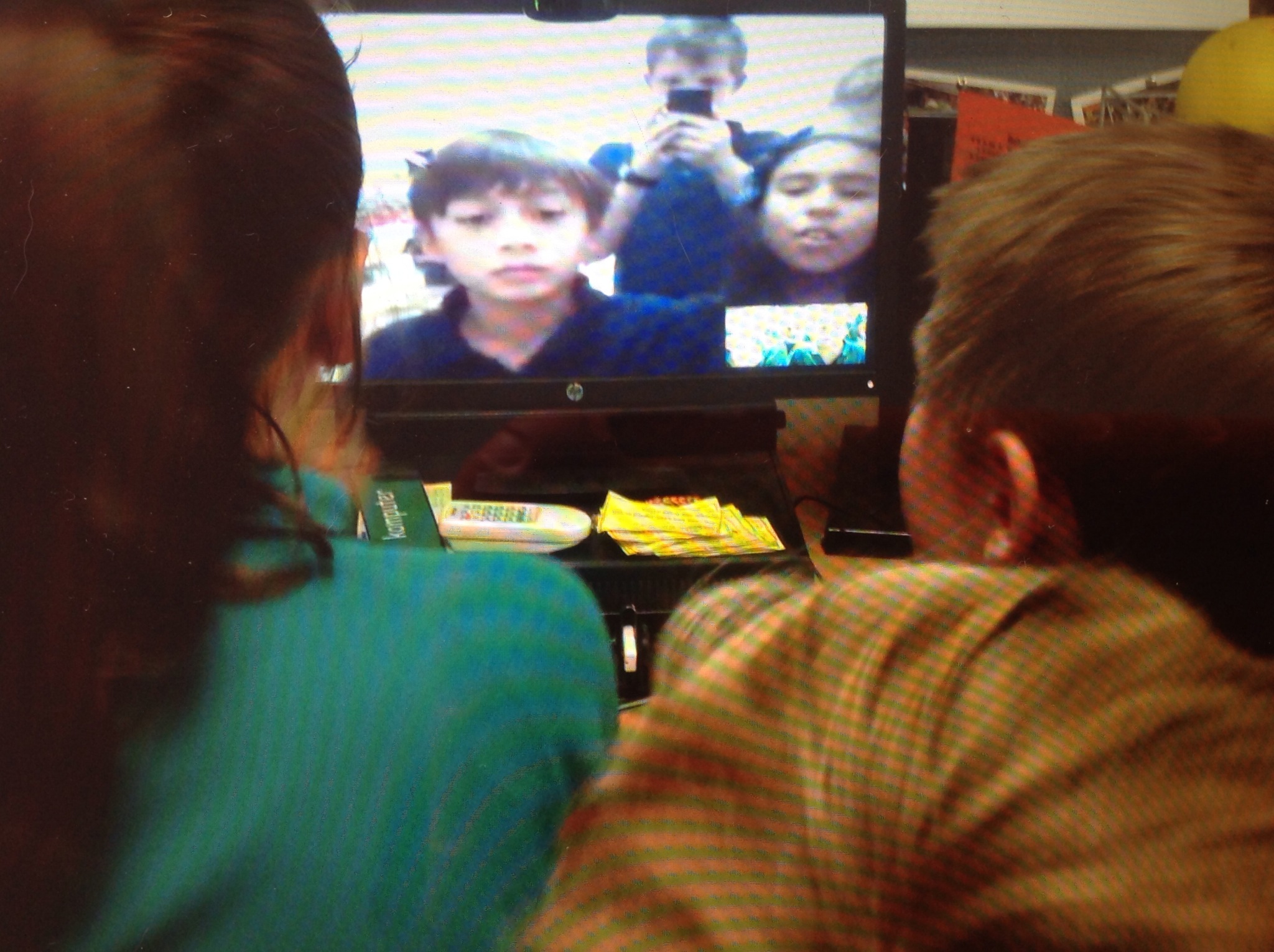
Harry & Ruby introduced themselves and we were off. Whereas they quickly guessed we were from Australia (our accents were a dead give away), the year 6’s were side tracked early by the percieved American accent of their greeters. Thankfully they quickly reigned themselves in and returned to a better opening question to determine which hemisphere they live in.
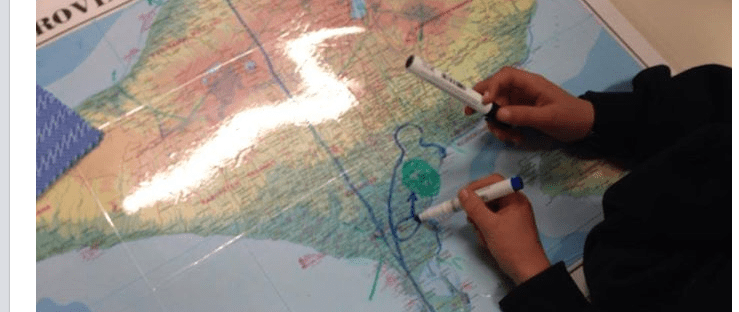
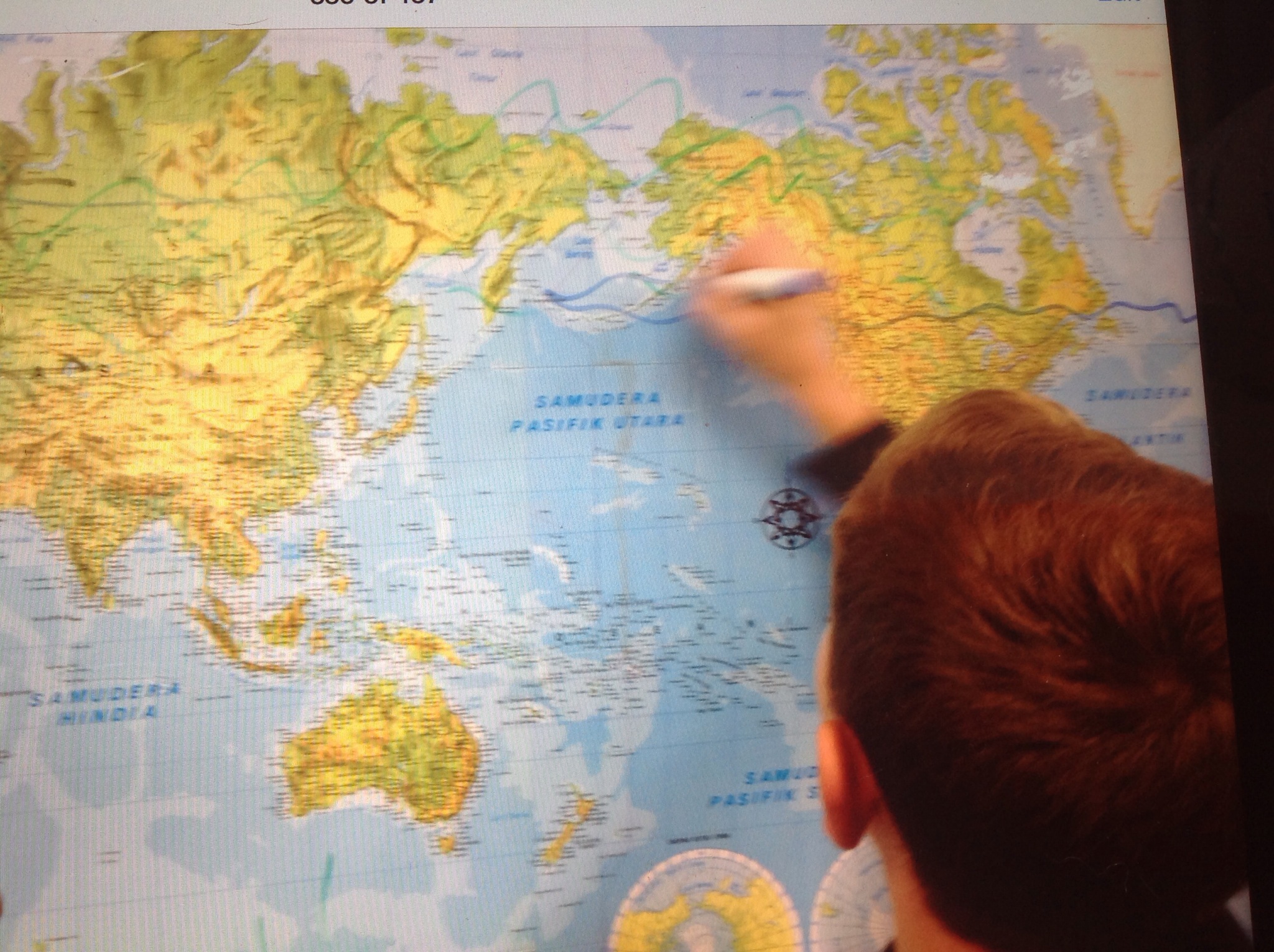 The mappers began with the map of the world on the back wall, progressing to the maps of South East Asia and eventually to the large map of Bali. I was again amazed that the maps seemed to be the ‘atlas’ of choice over the Google Earth. Our year 7 teacher/ICT coordinator, Kathy, joined us for the Mystery Skype and we discussed this interesting development. Maybe when we Skype a non-Indonesian country and I don’t have detailed maps for them to use, Google Earth might be more popular. It was great having another adult in the room to discuss it all with and to soak up the atmosphere together. It really was electric and unless you have experienced a mystery Skype, it is so hard to explain or describe it without sounding like a total nerd.
The logical reasoning team did a brilliant job, dealing with the high pressure both from themselves and others. The right question was finally asked, “Are you in Sanur?” before unfortunately our lunch bell rang, so we had to being it all to a very abrupt end. We just had enough time to share with them our location and for Harry to ask Lachie for his Instagram name before saying goodbye.

It was an absolutely brilliant experience and in retrospect a great way for 2 classes to meet each other. Nadia and I are really keen to continue the link between these two classes and have them investigate aspects of culture together about which I am sooo excited. It will be a very Interesting study for both groups and should blow quite a few myths out of the water!
A truly awesome experience. Thanks to Year 6 PEPS & Year 5 BIS for making it so.
 Indonesian Teacher Reflections