Maths Skills Vs The Ethics of Queueing

I found this really interesting article on Facebook, I think, posted by a teacher in Indonesia.

A teacher in Australia once told me: “It is much more important that our students know how to line up, than to be good at maths.”To which my reaction was, “Wow, teachers are allowed to think like that?”, because the exact opposite happens in our country (Indonesia).

When I asked her why, this was the Australian teacher’s answer:

It only takes each teacher about 3 months of intensive work to ensure students grasp maths skills, however, over the students’ 12 years of schooling, teachers also need to train students how to line up and appreciate the valuable lesson behind queueing.

Not all students will choose to work in professions that require maths skills beyond addition, subtraction, division and multiplication. Some will be dancers, olympic athletes, singers, musicians, artists etc. Only a very small number of students from any one class will choose a profession requiring a high level of maths. Whereas every student would benefit throughout their entire life from the moral and ethical skills learned through queueing.
Indeed, what other life skill is more important than queueing? There are many valuable lessons to be learned from queueing.

Time Management – Those students who want to be at the front of the line needs to be organised so they can be first in line.
Respect For Others – They learn to respect the rights of others, to acknowledge that those who line up first, get to stand towards the front. To consider others and not just focus on themselves.
Discipline – Student learn discipline, order and conformity so that they don’t impinge on the rights of others.
Creativity – Students think creatively about ways in which to avoid boredom while queueing. (In Japan, students read while queueing)
Socialisation – Students learn how to socialise by greeting and chatting with others in line.
Patience – Students learn resiliency and patience while queueing.
Cause & Effect – Students learn about consequences; if they are the last to line up, the consequence is that they will be right at the end of the line.
Disgrace – Students will be shamed by their peers if they try to jump the queue or push in.
Collaboration – Student learn to collaborate with the students immediately around them in the line; for example, if one needs to go the toilet, the others will hold their place for them.
Honesty – Students learn honesty both in relation to themselves and others.

The Australian teacher then said that there are many more benefits from queueing, and invited me to discover them for myself. Her explanation startled me and gave me something to consider.

Soon afterwards, I took my children to Kids Zania in Jakarta. Whenever we had to wait our turn in a queue, we saw parents and their children having serious issues with the aspects of queueing. There were parents who encouraged their children to sneak to the front of the line, thus taking the place of someone who had been waiting patiently, while telling their child, it’s ok to pretend that you don’t know any better. Another parent growled at their child and called them a coward because their child wouldn’t jump the queue. Another parent used a million excuses to justify why their child should be allowed to jump the queue – still young, tired of waiting in line, they live far away and have to leave soon etc. Another parent was furious because he was accused by one of the children in the line of queue jumping.
There were lots of foreigners also at Kids Zania and goodness only knows what they were thinking watching this all.

So sad that parents, teachers and the Department of Education focus solely on literacy, numeracy etc. Even though advanced countries have realised that teaching morals and ethics are much more important than just learning how to count.
Why is this country distancing itself from ethical and moral practices? What does the future hold for us if it is those children who queue jump their whole life, become our future leaders?

This should be a valuable lesson for all parents and educators in our beloved country. We need to realise that while queueing in itself is simple, within it are many life skills that will benefit children and should be practiced until they become second nature for all Indonesian children.

Come on, let’s teach our younger generation how to queue, for a better Indonesia.

I love it more for the Indonesian perspective on queueing rather than for the strange claims made by an “Australian teacher”.
Soon after reading this article, I then found this post on an American blog which seemed timely. It contains a list of ideas shared by teachers on ways they use to help with teaching their students about lining up and moving about the school thoughtfully. It certainly is a skill valued by our society, however not sure that it is more important than numeracy and literacy!!

Jalanan ; A Movie About Busking in Jakarta

While traveling in Indonesia last year, I caught many buses. Throughout Java and Bali, I frequently had buskers jump on board and serenade us before handing out the lolly bag to collect donations. Read my post here. What a fascinating topic for a film and one I really hope to get a chance to see it one day!
https://theconversation.com/jalanan-busking-and-dreaming-in-the-city

IMG_8294.PNG
Have a look at this Youtube promo:
http://youtu.be/TtIOFyNyF6U

Jalanan: Busking and dreaming in the city

AUTHOR – Eric Sasono

By telling the stories of Boni, Titi and Ho, Jalanan brings to the screen the hardships and precarious lives of marginalised people in one of the most economically promising Asian countries. Courtesy of Jalanan Movie Team
Daniel Ziv’s documentary feature Jalanan (Streetside), currently screening at the Melbourne International Film Festival, is a film that seeks to move its audience.

Documentaries sometimes invite viewers to social and political engagement. To do this, they might put viewers into uncomfortable situations. Jalanan, the story of three Jakarta buskers, Boni, Titi and Ho, is this kind of film.

Ziv, an Indonesia-based Canadian filmmaker, filmed the three street singers for six years. He pointed his camera at their reality and homed in on the social and political forces that shaped it.

By telling the stories of Boni, Titi and Ho, Jalanan brings to the screen the hardships and precarious lives of marginalised people in one of the most economically promising Asian countries. Jalanan presents the three as aspiring individuals with self-actualisation needs amid the hardship they encounter on a day-to-day basis.

Everyone is looking for something

Boni, an illiterate “singer-songwriter”, has been living in a canal tunnel with his wife, Rita for ten years. He dreams of a proper home yet all he can do is paint the word “Hyatt” on the tunnel wall.

Titi is a mother of three. Her children are scattered in three different cities. She sends money for her sickly father’s medication and for her child’s education in the village. Titi stresses how important it is that her children “not be a busker” as she is, signifying the importance of making the leap in social class.

The other busker, Ho, sings his political songs with a rugged voice, suggesting that his listeners “hang the corruptors”. He lives alone and tries to find true love.

Jalanan is screening at this year’s Melbourne International Film Festival.
With these aspirations, the documentary subjects qualify as protagonists in a neo-classic Hollywood story: an individual tries to achieve something and faces obstacles in the process. Jalanan benefits from this model of storytelling. It avoids didactic forms and, rather, asserts some kind of audience self-identification. Wanting a better place to live, improving social status and finding true love are universal aspirations.

Just like in Hollywood, Jalanan also brings closure to the protagonists’ venture, keeping the audience from seriously questioning what happens to them after the screening.

Beyond the film, the filmmakers have started a crowd-funding initiative to provide houses for the buskers.

Watching poverty in luxurious malls

Viewers in Indonesia won’t escape the irony when they go to cinemas in luxurious shopping malls to watch Jalanan. But filmmakers have no choice but to screen their work in this way if they want their films to reach a larger audience in Indonesia. Gentrification of Indonesian movie theatres since the 1990s has seen small cinemas fold and mega-cinemas thrive.

Jalanan provides enlightenment and entertainment, of some sort, for the middle and upper class of Jakartans who are willing to spend their money on a diverting spectacle. In Indonesia, it has a limited distribution in 21 Cinepelex, the cinema chain that dominates the country’s film distribution.

From the screen to public policy

Despite its limited distribution, Jalanan has benefited from its status as a documentary film. Audiences often perceive arguments presented in a documentary as undeniable truths. Sometimes, the documentary form can prompt viewers’ social and political engagement.

Jalanan managed to do this when acting Jakarta governor Basuki “Ahok” Tjahaja Purnama watched the film with his staff (the governor, Joko Widodo, now president-elect, was taking leave for his presidential election campaign). Ahok saw many things that fell under his responsibility go wrong in the documentary. Seeing the “jail”, which is actually a social rehabilitation institution where Ho was locked up, disturbed Ahok. In the film, Jakarta public order officers arrested Ho for busking and for not having his identification card.

According to Rolling Stone Indonesia, Ahok immediately discussed with his staff what he saw in the documentary. He instructed them to close down the “jail”, expedite the development of apartments for the poor and ease regulations for newcomers to get their Jakarta ID card. He also ordered his staff to eradicate corruption in public offices, especially the religious affairs agency responsible for providing marriage certificate.

Jalanan’s influence on public policy in Jakarta might be a one-off. It’s hardly a typical outcome for a documentary, after all. Documentary films work hard to promote social or political engagement – or at least an awareness – with their subject. For the next level of engagement, it helps to have “reformist” public officials in the audience.

The Melbourne International Film Festival 2014 runs until Sunday August 17.

Throwback Thursday: 15 Games for the FL Class

marishawkins's avatarMaris Hawkins

Screen Shot 2014-08-07 at 2.43.40 PM

Since I have been blogging for a little bit, I find it can be cumbersome to visit all of the archives to get ideas.  This is my attempt to consolidate these ideas bit by bit.  First up are 15 games for the FL classroom.  I have this as a Google Doc link, so I can modify it as time goes on.  Most of these are not my ideas, and I tried to give credit where credit was due.  I also added on some extra games that were not originally on my blog for those that have read all of my games.  Enjoy!

View original post

Using the Book Creator app in the Indonesian Classroom

Last term, the middle primary classes continued their focus on our school with the aim of creating a digital book about PEPS for our sister school. After listening to recommendations from other teachers about the best app to use, I settled on Book Creator for several reasons. A main one being that one of the teachers who recommended it was also using it, so it made sense that we explored it together.

Each of the 4 classes had specific areas of our school to focus on, to ensure that each area was covered. Then, from those, students could chose one for their own writing. Each class then brainstormed for ways in which to incorporate a verb in a very simple sentence about school areas. I wrote them all down and then as a class, we translated each of the sentences. Most classes ended up with a sentence similar to, “I like playing in the gym” which translates nicely: ‘Saya suka bermain di aula’. Each class then voted on the sentence they preferred and they then had to write a sentence about their area using the model that they had both chosen & translated! This worked very well because it gave the more capable students scope for imagination and creativity and for those struggling with aspects of literacy, provided them with a sentence they could either use entirely or change very slightly.

I then introduced the iPads that I had bought with my grant monies. With the first class, I walked them through the basics of Book Creator, but luckily the following day we had a student free ICT focus day where we discussed how students can develop 21st Century skills by working it out by all themselves. So with the next class, I gave out the iPads and the only heads up I gave them was the name of the app and what had to be included in their book – a front cover, their sentence written in English & Indonesian and a recording of them saying their sentences. I encouraged them to firstly try themselves, if that failed, then to try 2 more things before asking a friend. I was the absolute last option – mainly because I was also learning how to use it. For the first Book Creator lesson with each class, I finished the lesson with the students all sitting on the floor in a circle with the iPads. This allowed those still working to continue working while listening. In this forum, students who either were still stumped on an aspect had the opportunity to ask publicly or even better, for students who had discovered something really cool, to share it with the others. I remember vividly one class where a student had worked out how to enlarge the text, change the font and change the colour of a page and as that student shared, everyone was following along and experimenting with their own ‘book’! It was so exciting.

Students very quickly grasped the finer points of Book Creator. Students originally were in teams of 2-4 as there are only 5 iPads in the Indonesian classroom. I did this mainly to encourage collaboration, but with a task such as this was, more than 2 students to an iPad meant that the waiting time was too for some of them, so I ended up borrowing the recently purchased bank of 8 which improved the student/iPad ratio significantly.
It wasn’t till the holidays that I had a chance to look at the final products. I then learned that one of the features available in Book Creator is that the books can be combined, so I had this great idea where I could amalgamate all the books into one large book, but this great idea was disbanded very quickly when I discovered that to combine books, all books had to have the same page format and be on the same iPad. I also discovered that to combine, the first book has to include the front cover for them all as all subsequent front covers are not included.Still, it is a great idea and one that could be very useful.

Following are some of the things I love about using Book Creator in the classroom:
– If project has sound, it can be exported entirely to ibooks, the camera roll or even emailed (the quality deteriorates with this last option)
– airdropping to another iPad’s camera roll is possible & very easy
– If exported as a PDF, sound is lost
– Not only can students record their voices, they can also video themselves and import that into a project!
-Students can import photos or draw pictures
– to add to a blog, upload straight to Youtube!

If I could change aspects of Book Creator, all I would do is:
-To export projects from iPad to iPad so that projects can be combined

Finally here is a note to self for the next time I use Book Creator in the Indonesian Classroom:
1. Remind students not to use their surnames
2. Have students using the same iPad to use the same page for each project, so the combine pages is an option.
3. The title of a book must reflect the content of the book and the title and author names also need to be written underneath each project.
4. Each project would look finished with a back cover – maybe incorporating a kenalkan!

Have you used Book Creator in the Indonesian classroom successfully? My students all absolutely loved it and have repeatedly asked when we are next using iPads again!

Gunung Api

This semester, much to their delight, junior primary classes are learning about volcanoes. It is a topic that students have asked to do for quite a while. When I first covered this topic many years ago, I bought a plastic model of a volcano.

20140804-160233-57753067.jpg
It used to sit on a shelf behind my desk and was constantly drawing comments and requests from students. It now sits in my cupboard with my enormous dice which also piqued student curiosity!
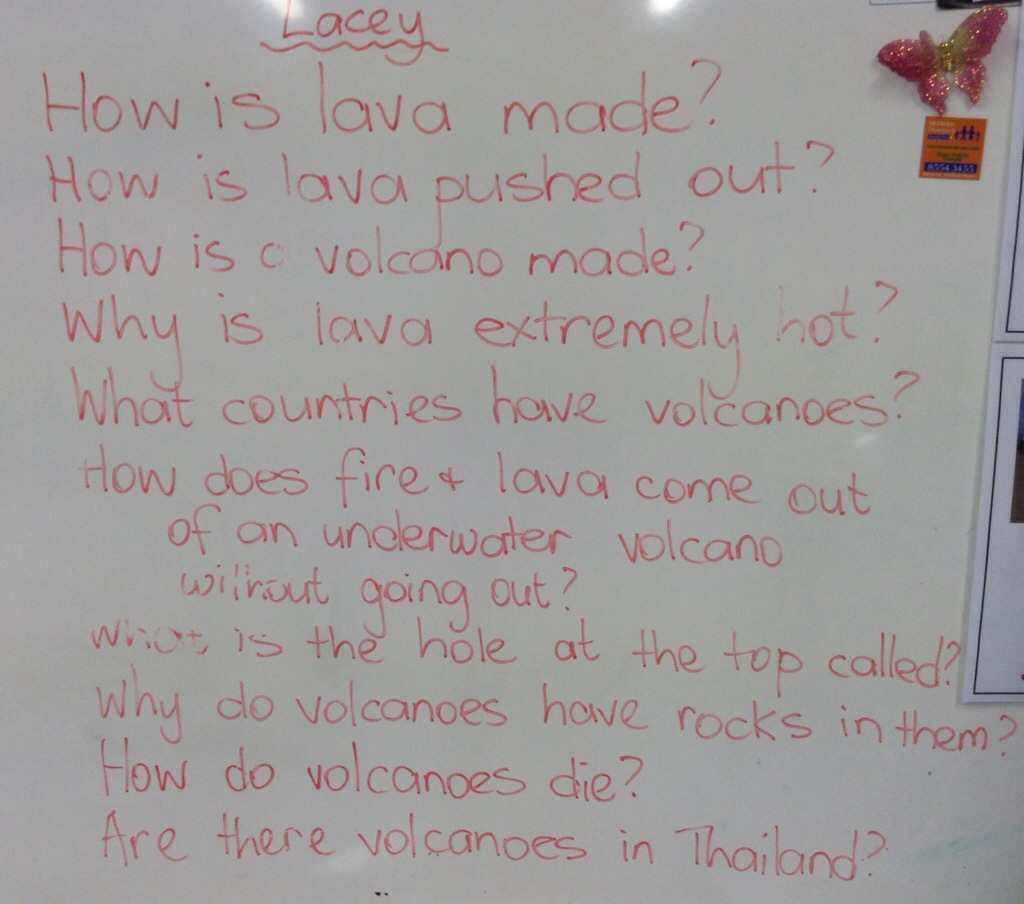
Can you imagine their delight when it emerged from the cupboard and not only that, I opened it (not easy as the tabs fit so snuggly) and we then talked about the parts of a volcano. My students are full of questions about volcanoes and for the first time, I am not being the font of all knowledge. I am trialling the idea of putting our questions up onto twitter or putting the onus back on the students to help find the answers. With the first batch of questions, I have recorded them and we should be able to tick off a few now. Here are the questions from one of our reception classes:

20140804-160959-58199834.jpg
After tomorrows lesson we should be able to tick off some.
This week, I wanted to incorporate some Indonesian language into a topic that has been largely conducted in English so far. We revised the terms we learned last week (magma chamber, vent, ash cloud & lava) through a great youtube video (Geography lesson: What is a Volcano) and then students worked collaboratively in groups to create a volcano using construction paper & Brenex squares. I explained that they had to decide as a group how they created the picture, the only thing that had to do was correctly affix the labels ‘gunung api’ & ‘lahar’.
The results are amazing and make a very colourful display!

20140804-161417-58457315.jpg

Giving a Presentation in a Foreign Language

What fantastic advice! Last year while traveling around Indonesia, I gave several speeches in Indonesian, all of which were nerve wracking. In each case, I wrote out my speech and then read it to my audience (which was usually the staff and students from an entire school!) verbatim. It is definitely a skill I need to perfect and one I actually want to perfect. >

20140801-110426-39866072.jpg

6 Must-Know Tips for Giving a Presentation in a Foreign Language
Posted on 14. Oct, 2013 by meaghan in Language Learning

Speaking in a foreign language can be a challenge in and of itself—giving a presentation in a foreign language makes that challenge even more…. well, challenging. Whether you’re presenting to your classmates, your co-workers, or your community, you’ll want to practice a little harder than normal. These tips will help you perfect your presentation, leaving minds blown rather than tongues tied.
6 Must-Know Tips for Giving a Presentation in a Foreign Language from Transparent Language, Inc.

1. Don’t script yourself.
Practice, practice, practice—but don’t memorize. Scripting yourself is a terrible idea for any presentation, regardless of language. It doesn’t make for a very compelling or natural presentation, and you might panic if you forget or veer away from your script, especially if it’s in another language!
Instead, narrow your focus. Acquire the specific vocabulary you need to discuss your topic, but rely on what you already know to fill in the gaps. Practice speaking about your topic out loud to yourself, so you’ll be prepared to improvise when all eyes are on you.

2. Prepare notes.
Didn’t I just tell you not to script your presentation? Yes I did, but here’s the loophole: prepare notes! Add speaker notes to your slides or jot down major points on a set of notecards. Do not read directly off these notecards! The less you look at them, the better.
The placebo effect of notecards is powerful—knowing you have an important statistic or difficult word in the language written down in front of you should make you less nervous that you’ll forget it. And just in case you do forget it, voila, there it is.

3. Practice speaking.
This is an obvious one, but seriously, if you’re preparing to speak in front of people for an extended period, you need to be comfortable speaking in the language in general.
You want to be comfortable speaking about your specific topic, but also in using the language fluidly and confidently. Talk out loud to yourself in your second language as much as you can—around the house, in the shower, while driving, etc. Say whatever it is you want! Rage about that guy who cut you off on the drive home, talk about what you want to do this weekend, make up a story about your neighbors who just walked by. Get comfortable pronouncing the language and speaking it fluidly. Then practice the specifics of your presentation.

4. Keep it simple.
When you present, you want to sound intelligent and compelling. There’s nothing wrong with that. But when you present in another language, focus first on being understood and making your point.
Trying to sound sophisticated only works if you actually sound… sophisticated! But if you mispronounce the big words you insisted upon using and mumble through those prolific examples you just had to include, you’re actually hurting your cause. Keep it simple and within the reach of your current language skills. Impress people with your message itself, not the way you phrase the message. Besides, giving a presentation in your second language is impressive enough as it is.

5. Don’t apologize. (In Indonesia, disregard the first part of this. I learned that it is considered good manners to begin speaking with a rider – Mohon maaf kalau ada yg salah)
Do not start off by apologizing for your language skills (or lack thereof). Instead of making that excuse for yourself, be aware of your shortcomings and address them without drawing attention to them.
If you have a thick accent when speaking in your second language, speak slower than you normally would so your audience can understand you. If you mispronounce a word, don’t get flustered or laugh it off—say it again once or twice so your listeners can catch on. Writing off your mistakes to the fact that “this is your second language” won’t challenge you to get better and do it right.

6. Be culturally appropriate.
This isn’t related to the language, but it’s just as important as the advice above. Unless it’s a class assignment, chances are you’re giving your presentation in another language because you’re abroad. If that’s the case, research the culture of your audience.
Be aware of hand gestures or facial expressions that are potentially offensive. Figure out if humor is well-received, or if you should show your personality in another way. Speak to colleagues or native speakers who are aware of the culture—and while you’re at it, practice giving your presentation to them!

Source: http://blogs.transparent.com/language-news/2013/10/14/6-must-know-tips-for-giving-a-presentation-in-a-foreign-language/

20140801-103305-37985388.jpg

Mystery Skype – Can It Be Successful In Australia?

I recently bought 4 iPads using the SA e-partnerships with our sister school grant monies and these have increased my total number of iPads in the Indonesian room to 5, which although is awesome, still means a 1:6 ratio of iPads to students. Our one Skype session with our sister school was very successful and after reading about one class having several Skyping conversation happening simultaneously in a classroom, I have visions of that happening in the Indonesian classroom before the end of the year with our sister school, Bakti Mulyar 400, using the iPads!

But in the meantime, I began exploring another way to use Skype in the Indonesian classroom. Early this term, 3 fellow teachers and our principal attended the EduTech conference in Qld and their tweet about mystery skype appealed to me. I immediately went online and read up about it.

20140712-113826-41906445.jpg
How exciting. Asking yes/no questions to discover the location of another class! I could instantly see the benefits of undertaking this with students or an individual in Indonesia. It sounded brilliant, so I began the next step of finding a Mystery Skype partner.
I firstly looked at the pages of those in Indonesia who had listed themselves as being interested in Mystery Skype.
20140712-181943-65983292.jpg I chose all up about 10 and sent them all either an email or a tweet. Not one replied.
It seemed that finding someone in Indonesia to mysteryskype is not straight forward and that is for many reasons. Foremost because I began as the Indonesian school year was about to finish hence all schools, staff & students were caught up with national exams, report writing and end of year functions. Then, as soon as the school year finished, Ramadan and school holidays began!

Selamat menjalankan bulan suci Ramadhan untuk semua keluarga saya yang beragama muslim dan untuk semua temanku tersayang.. semoga kalian semua mendapatkan berkat terbaik dibulan puasa ini.

Thanks to the wonderful Ayu Ambrini for the awesome translation.
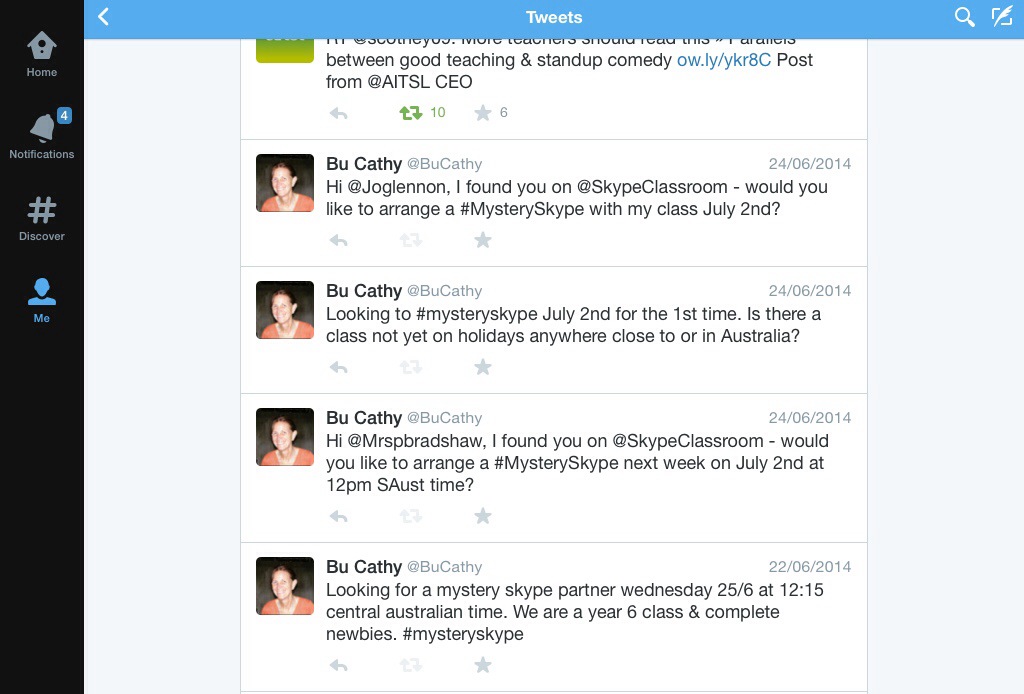
So, to get around this, I next wrote a generic invitation on Twitter using the hashtag #mysteryskype.

20140712-182542-66342548.jpg And again no one except for @MysterySkype replied and they were just reminding me where to look for partners, but that was all. So disappointing but I persevered.
At this point I realised that I probably should consult with the 2 upper primary classes I had in mind for mystery skyping and determine their level of enthusiasm. They agreed it was amazing and are very keen to try it but you could have knocked me over with a feather when both classes unanimously decided to delay mystery skyping till term 3 so that they could complete their current project! My constant reminders of time management must have had some impact!
This took the pressure off, but I continued to stalk @mysteryskype on Twitter and finally I made contact with a teacher in Beijing which was sooo exciting. No sooner had I shared the exciting development with colleagues, it fell through. That teacher is off to Poland now, so unless his class are happy to mystery skype at some ungodly hour, I will have to sadly pass on his offer of giving it another go.
I then had the brainwave of finding an Indonesian class somewhere else in Australia. I contacted Penny Coutas, a high school Indonesian and ICT teacher in WA, only to discover that WA and many other state education departments block Skype!! Here is a QLD Languages teachers blog post about this.
It is now the mid year holidays in Australia and it feels teachers all around the world are currently on holidays! While Australian teachers are busy with midyear planning, American teachers are busy preparing mysteryskype sessions for their new school year. So strange!
On appsgonefree today I found the time.is app which is fantastic for discovering the cities and countries that are the best time wise for us to mystery skype with. Interestingly Vladivostok would be perfect!! Wonder what their internet connection is like! 20140712-110720-40040239.jpg

So I am going to continue my search for classes or individuals who are not on school holidays and hopefully have the opportunity to organise a mystery Skype lesson for later in the term.

One of the aspects of mystery Skyping that I just love the sound of and am so keen to explore is that it relies heavily on student collaboration. The idea of having all students working together in ‘committees’ with a student supervisor overseeing it all is something I can’t wait to both witness and experience. I also acknowledge that this is not something that all students will comprehend nor be entirely comfortable with, so am prepared to work with classes beforehand to ensure its success. If only I could be more confident about locating people to mystery Skype with because, I could easily do a whole terms work on it. It fits in beautifully with the Languages Curriculum in regard to creating global citizens.
I am really interested to hear from other Australian teachers who have successfully Mystery Skyped.

Australian Blog Honour Roll – What Would The Criteria Be?

As I was checking my Twitter account, I followed a link leading to an EdTech’s (Must Read) K – 12 Blog Honor (sic) Roll.’ ‘ Here it is.
I looked at a few of the blogs on the list and they are amazing but with a definite North American view.
It really started me thinking. Firstly do we have quality EDTechies blogging to create an Australian Honour Roll? Of course we do!! While I love the enthusiasm of the USA blogs, I would prefer blogs relevant to me, to my teaching and most importantly based on the Australian Curriculum.
So I tweeted to ask just that question and within minutes had my first reply!:

20140702-092611-33971319.jpg
I next thought about what criteria I would consider to be of value to someone like me; i.e. a practicing teacher. What would I find of value to read about in blogs?
Following are the dot points I came up with:
-Australian
-High focus on using technology to support Australian Curriculum
-current practicing teacher or one who is working with teachers
-focus on global learning
-creating digital citizens
-grappling with the Australian Curriculum
-A Languages & Culture focus (would be awesome!)
-Great ideas on how to achieve all of the above

So maybe if I am searching for such a blog, others are too? Could this be the direction this blog could head in because surely I am not the only (Languages) teacher out there searching for blogs that include all of the above dot points! While I am in no way an EDTech guru, I am happy to share my explorations but would love to share with others at the same skill level but more importantly would love to read blogs from those with more EDTECH skills and knowledge and working in the classroom.

Any other ideas to add to my list of criteria? Add a comment!!

Using ICT with the Australian Curriculum T & D

My head is still spinning after a fantastic day full of pedagogically challenging ideas. Congratulations and kudos to Kathy Turley, Sandy Warner, Brenton Hudson & Jodie Allsop for their efforts and organisation.

20140617-191015-69015637.jpg

The day was divided up into 3 sessions. Selena Woodward led the first 2 sessions which left me totally exhausted physically and mentally! She began with a prezi presentation which I especially enjoyed as it is the first time I have seen one ‘in action’. The main focus of the first session was Google Earth and how to use it in the classroom to support the Geography and History curriculums. We learned how to create a tour, how to tweak the available properties, how to save it and then enjoyed sitting back and looking at the tours made by others. Writing it down like that makes it sound so straight forward and easy, yet I was totally washed out at lunch and could barely summon the energy to enjoy the delicious wraps provided!
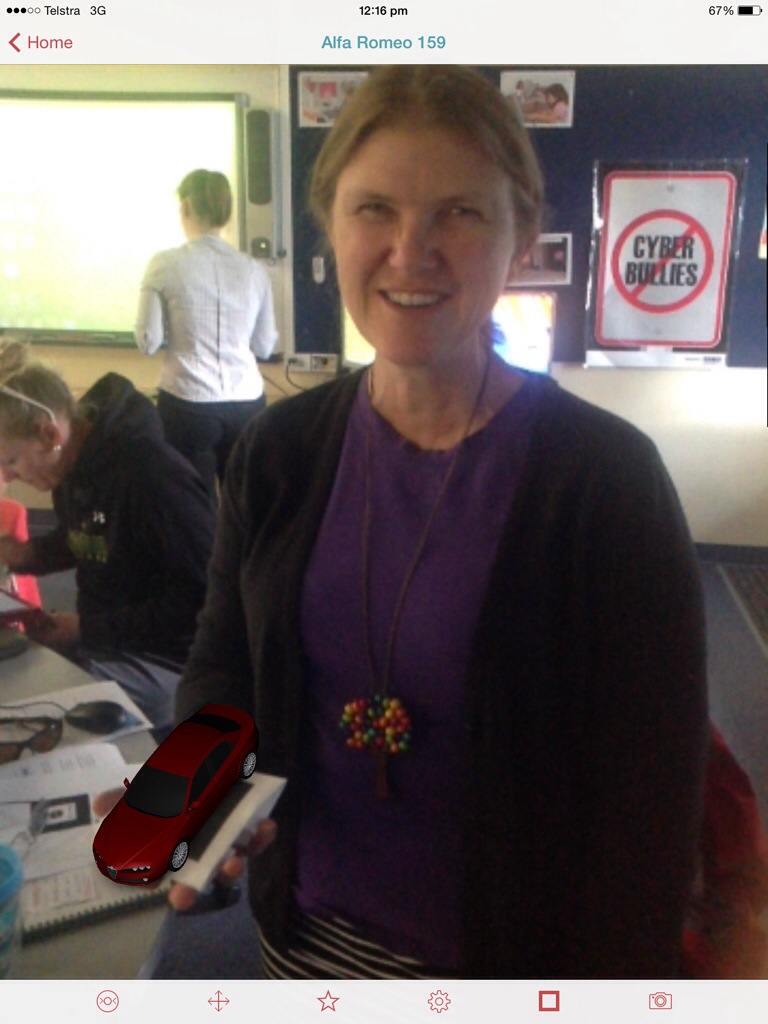
During the 2nd session, we had planned to explore timelines, yet all agreed it was better to use the time to better master Google Earth. Right at the end of her session, Selena introduced us to AR Media Player which gave most of us our first ever opportunity to explore ‘augmented reality’. It was soooo cool. Using the ARPlayer app, we viewed this graphic

20140617-133307-48787261.jpg

and suddenly on top of the graphic, a beautiful alfa romeo appeared.
Here is a photo of Sandy holding it!

20140617-191103-69063873.jpg

Turns out there are a variety of options available, yet sadly none are directly authentically Indonesian however there is also an option to create your own, so that would have to be the next obvious direction worth exploring! The shark one was awesome and we discovered that once the shark image is on the screen, you can rotate the image using your fingers!

The afternoon session was led by our PEPS team fresh back from the EduTech conference and all bursting with wonderful experiences to share with us all. We began with a drawing exercise which demonstrated very well how teacher can sometimes unwittingly stiffle creativity. Next we watched a Sugata Mitra video from TedTalk (totally recommend that you google this) about his computer hole in the wall experiment which naturally would be fascinating to replicate in Indonesia! We were also given the opportunity to think about our classroom spaces and how we could improve them to further foster creativity & collaboration.

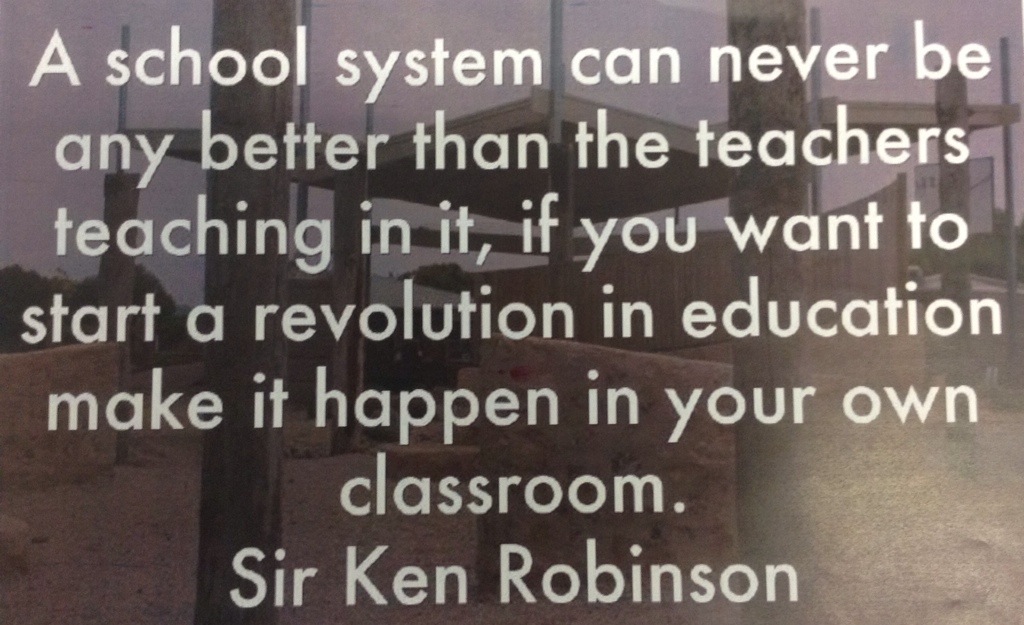
However it was the session run by our principal which really hit the spot for me. He posted a quote in last weeks staff bulletin:

20140617-160954-58194092.jpg
which really challenged me as a language teacher. How can a language teacher not teach content? How do we develop student proficiency without teaching content? He then introduced the concept that teaching today is not about imparting information, it is all about teaching 21st Century skills.
We were then invited to look at the General Capabilities, focusing on the Key Processes. We underlined all the key processes and I ended up with a list of words like:
reproduce
recognise
develop
understand
observe,
imitating
describing
predicting
comparing
translating
connecting
experimenting
reflecting
monitoring
performing.
Focusing on these words, it became clearer for all of us that any program based on these skills would be incredibly engaging and far more relevant for todays students than purely focusing on the content. It also ties in beautifully with globalisation and creating world citizens which is what underpins the entire Australian Curriculum.
What a fantastic day and perfect timing for me, with our time spent with Andrea only a few weeks ago!

20140617-161523-58523233.jpg