Brainbreaks

My most popular brainbreak video last semester was senam penguin which I mainly showed to junior primary students, but it turns out the older students enjoyed it too one day when I was absent!

https://www.youtube.com/watch?v=U-5mX1KfErE


However it is now time to give senam penguin a break so I started looking for a new senam brainbreak video and I think I’ve found it! This will be be perfect for all students especially those who have been enjoying Pokemon G!  What do you think?

https://www.youtube.com/watch?v=C7l_JPT8xA8


Don’t forget you can purify these videos to remove any advertising!!


A terrific Brainbreak For All Year Levels

Students need constant brain breaks to help them both lower their affective filter and also to literally give their poor brain a break. I found the following YouTube clip and it translates beautifully into Indonesian and it is a great break which has been enjoyed by all ages. When I first introduced it to one of my year 7 classes, I tried to do the whole game – starting with introducing all the movements just as the fellow does in the clip:

– berjalan kaki (walk) & stop

– berdansa (dance) & melompat (jump)

– nama (name) & tepuk tangan (clap)

These structures are all 100% familiar to my students through TPR (Total Physical Response) and TPRS (Teaching Proficiency through Reading & Storytelling), but to be honest, any verb you have focused on or even one you would like to focus on, could be used instead (although jatuh *fall over* may not work well haha) 

I then began to introduce reversing the word pairs. I began with reversing berjalan kaki & stop which was highly successful probably because one of the words is a cognate. It added a new level of fun & challenge which the older students really enjoyed but when I reversed the next pair, the brainbreak quickly became hard work & student engagement dropped instantly. I defintely recommend saving that aspect of the brainbreak until much later when students are familiar with the instructions and only introduce one reversal at a time and just with classes who know these structures inside out! 

It is so cool when a whole class calss out the name at the same time!!  

A great Brain Break from Bu Anne

This term my junior primary students are learning target structures for Catherina’s snake story. This week we focused on ular (snake). After showing a PowerPoint of pictures of ular’s which included pictures of worms & cicak’s (geckos) all ways to get repetitions of the structure ular, I finished with a few pages of ular’s hiding in environments and asked the students, “Dimana ular? (Where is the snake)  They absolutely loved this although the touch TV screen was challenging!

Untitled

Afterwards I tried a fantastic TPR game that Bu Anne wrote about recently and it was a big hit. I asked the students to stand up and spread out around the room. We then revised the positions needed for the 3 words in the game. The 3 words this time are: sekolah (school), cicak (gecko) and ular (snake). If I said ular, the students lay on the ground like a snake, if I said sekolah, they stood tall with a roof over their head and if I said cicak, they got down on their hands and knees. It is good to choose 3 words that give you 3 levels of movement and also ensure that the only unfamiliar  word is the target structure and the other 2 are familiar from previous stories.

Once the students were familiar with the game, I added various levels of complexity. Firstly I said just 2 words (ular/cicak) about 3 times each and once they were in a rhythm, I tricked them by repeating the last word! eg ular, cicak, ular, cicak, ular, cicak, cicak! Another way to ramp it up was to say it again without any gestures and finally to really ramp up the listening, use the wrong gestures!! All classes absolutely loved this TPR brainbreak.

A Great Reading Activity For Pre-Literate Students

Have you seen the oral cloze retell idea by Eric Herman on my TCI/TPRS activities page which is found on my homepage up the top in the header?

Here it is:

On subsequent retells you can erase more and more words to give more advanced students a greater challenge and eventually erase the entire story and have superstars retell the entire story without any written support.

Example:

There is a boy. His name is Bob. He likes pizza.

There is ___ boy. His name __ Bob. He likes _____.

There __ ___ boy. ___ name __ Bob. He ____ ____.

There __ ___ ___. ___ name __ Bob. __ ____ _____.


I tried it today with a year 1/2 class as well as a reception class and it was awesome!

I began by asking 2 students to act out the story while I retold it. By now, I’ve lost count of the number of times they have heard it, but it never hurts to get in one more retell!! I then dragged over my mobile white board and asked the class to tell me the story again. It was brilliant how well they could retell the story! I wrote down the first 5 sentences on the board.

Buarlapar.

Buaya lihat Elsa.

Buaya mau makan Elsa.

Elsa berlari ke Horseshoe Bay.

We all then read the story together using hand gestures. At the end of the first reading, I rubbed out one word and in its place I drew a contrasting coloured line. We then read through it again together, however before we all read it, I explained that the next person to rub out a word would be someone who is both reading and gesturing beautifully. Boy – that ramped up the participation and engagement!!

We continued this until there was nothing left of the story and all that was there were red lines where the words used to be!! Both classes absolutely loved it and were so fluent by the time we rubbed out the last word!

IMG_1636[1]


IMG_1637[1]

IMG_1638[1]


Reading With Pre-literate Students

After watching Carol Gaab, I tried something new with my junior primary students this week that I would like to share with you.

Last week with my younger students, I started the Carol Gaab story that Bu Anne posted about on her blog. I have tweaked it slightly to minimize the amount of new vocabulary. Instead of a harimau (tiger) I have a buaya (crocodile) because most students know buaya from our kancil and buaya unit last year. I also believe that tree, mountain  (&?) are very low frequency nouns in a classroom, so I changed it to Horseshoe Bay, sekolah (school) & kelas (class).

My version goes like this:

Buaya lihat Elsa

Buaya lapar.

Buaya mau makan Elsa.

Elsa berlari ke Port Elliot.

Buaya berlari ke Port Elliot.

Elsa berlari ke sekolah.

Buaya berlari ke sekolah.

Elsa berlari ke kelas.

Buaya berlari ke kelas.

Buaya makan Elsa.

To support this story and its new target structures of ‘buaya’ (crocodile) & ‘berlari’ (run), I searched for a well known rhyme that I could adapt. Browsing on Pinterest I found the 5 Little Monkeys rhyme! This not only provided me with the perfect vehicle for ‘berlari’ & ‘buaya’ but also gave me the opportunity to introduce ‘jatuh’ (fall) & ‘menangis’ (cry). Here it is:

Lima buaya berlari di kelas.

Satu jatuh dan menangis.

Bu Cathy berkata, “Kasihan!”

Tidak pandai berlari di kelas.

Thinking back on our conversations with Catharina, the various posts I’ve read & my recent talks with Bu Anne, I liked the idea of introducing jatuh & menangis which we hear often in the junior primary classroom, especially after recess & lunch!

On Monday, I began introducing the rhyme but students weren’t particularly engaged and I considered disregarding the whole thing but yesterday morning as I turned on my computer at school, I remembered something I had seen Carol Gaab do. She had replaced the words of the story with illustrations. I immediately did the same using clipart images. Not only did it look more appealing to me, but it did for my students as well.

buaya 1

buaya 2

Then when I added acting into the equation, I was blown away with the increased level of student engagement. I firstly trialled the idea with a reception class, most of whom are pre-literate. They loved it and all read along with me! I then asked them to ‘cari empat teman dan duduk’ (find 4 friends & sit) doing a comprehension check firstly that they understood that you + four friends = groups of 5 and then they acted it out in their groups. Sharons ‘mata-mata’ (spotter) concept was brilliant here because invariably there were a few students above the multiple of 5. They went from feeling rejected to feeling very special when I asked them to be my mata mata! At the end of each acting of either the first half of the rhyme or the entire rhyme, each mata mata could choose a new mata mata and swap with that person.

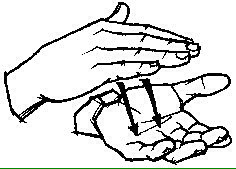
One more point I’d like to add is that of hand gestures. Our PLC members work at schools that are not particularly far from each other and we have a few students moving between our schools for various reasons. We have discussed several times how much smoother the transition would be for those students if our had gestures were similar. One idea that appeals to us all is the use of AusLan or ASL. When looking for gestures for sekolah, kelas, menangis & jatuh, I investigated several websites. I believe that all gestures mustache  be meaningful as they are clues which help students comprehend. The sekolah and kelas AUSLan & ASL signs were not useful at all.


So I asked students and we made up our own for sekolah & kelas. However I found great ones for jatuh and menangis.

Observations of a TPRS Colleague

Teachers at my site are encouraged to observe colleagues. Working in a department of 1, there is no one at my school who I can observe meaningfully. Classroom teachers are given a morning for observation and an afternoon for discussion.

So with delight, I accompanied Ibu Anne to Victor Primary R-7,  via Kleinigs Hill,


to spend a day in Ibu Sharon’s classroom last Thursday for my yearly observation day. So brilliant watching a fellow TPRS practioner alongside another TPRS fellow practitioner! We sat side by side at the back of the room taking notes and then chatting about ideas as they came to us and then later during lesson breaks discussed our ideas with Sharon! I was in seventh heaven!!

Sharon began her day with a year 5/6 class. She called the roll by asking the students random Indonesian questions: Siapa nama, apa kabar, Selamat siang, etc to which they students had to reply/respond appropriately. Certainly kept them on their toes and it was inspiring to listen to the majority respond so smoothly.

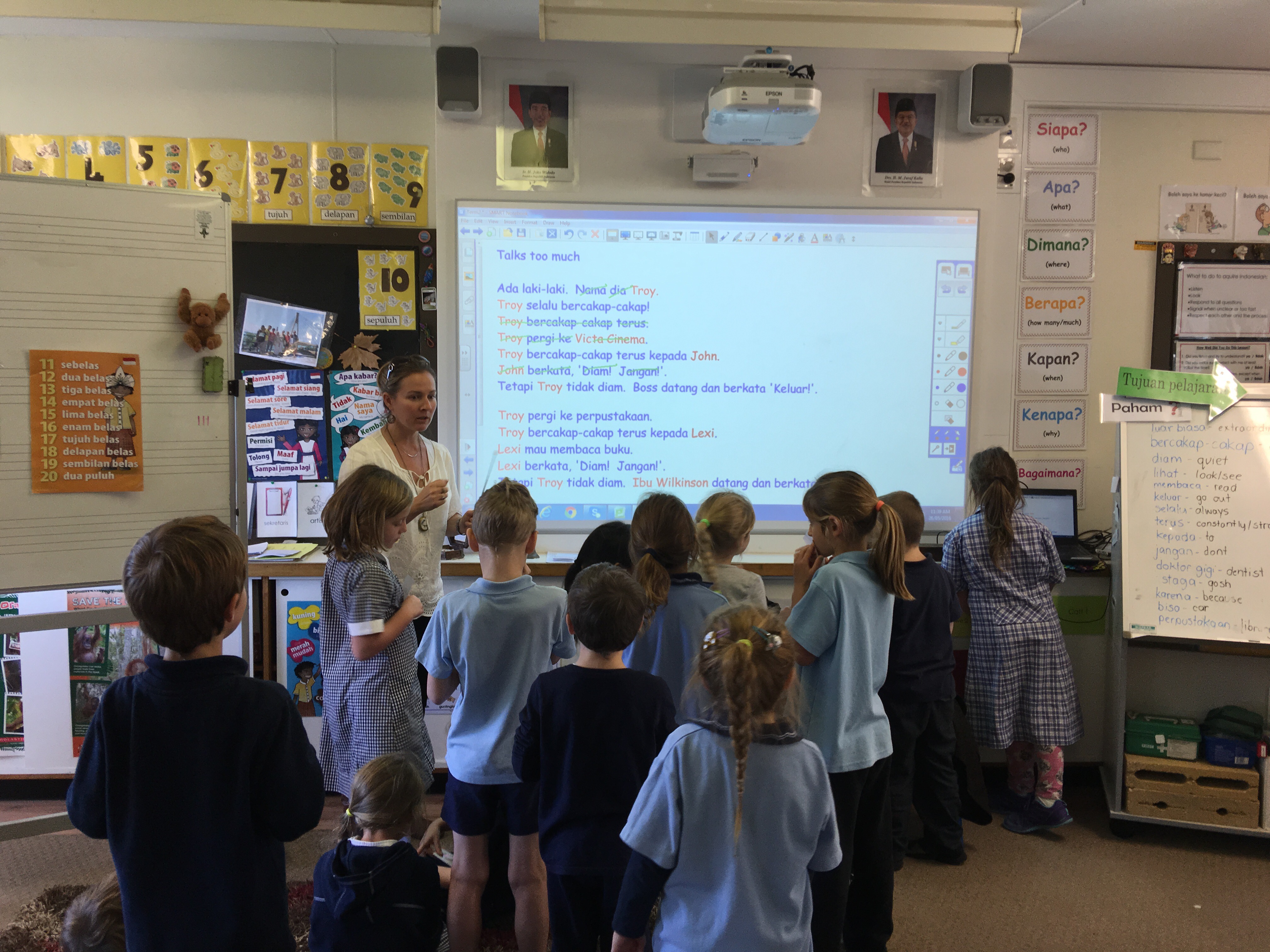
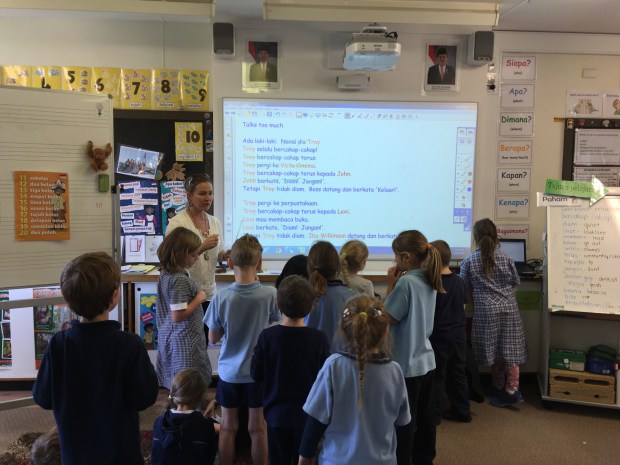
Sharon is focusing on the Talks too Much story by Anna Matava this term with all her classes except Receptions. Sharon identified the unfamiliar vocabulary needed for the story and has spent the past 3 weeks of term focusing on them with JP’s and just this week with MP’s. After the students and Sharon had gone through them together she invited a student to come out the front and stand with their back to the projected words facing the class. Students and Sharon then one by one said a word from the list together with it’s gesture for the brave student to translate. Sharon did this activity with all classes and we were blown away with how solidly they have acquired them. It is such a great way to revise the structures and their gestures while checking on individual students and their progress. The students loved it.

With this class, Sharon trialled the Spelling Battleships pre story activity. The stuents had to choose 5 words from the list and hide them in their grid and then to find the words they had to say the coordinates in Indonesian. We all then circulated to observe and assist. We all discovered that most students were so engaged in the game, they weren’t using Indonesian and their was almost no repetition  of the target vocabulary.
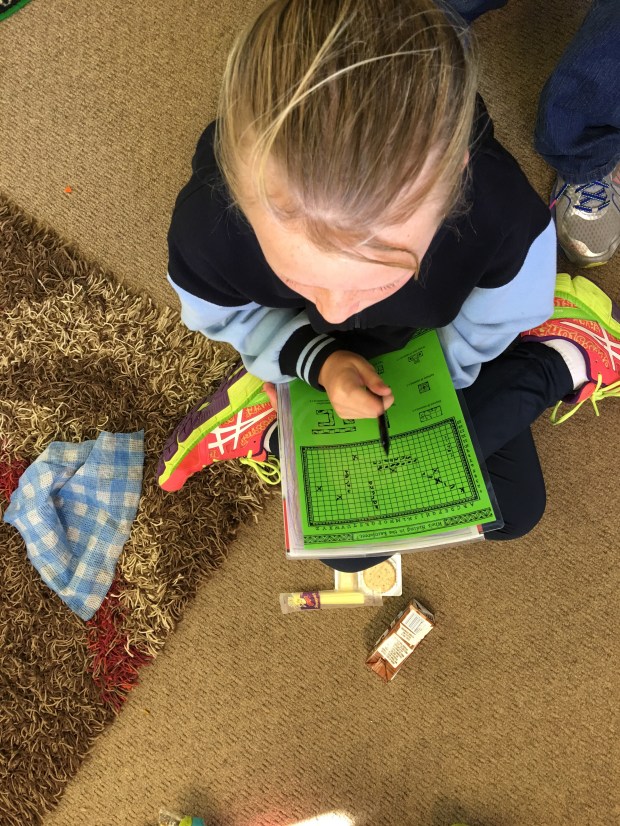

So we brainstormed at recesss to create an improved version! Instead of letters across one axis, write in the top high frequency words. This could be the words that will appear in the story or words that classes have already acquired from previous stories. Then across the number axis, instead of the stock, standard numbers 1-12, include numbers that are appropriate for your classes. They could be in multiples of 10, just the teens, all the fifties etc. We then added the final rule, that each time students discover a letter,  they have to say a word from the list and the gesture to guess what it could be. What a fun way to get in repetitions!!

After recess, Sharon taught 2 junior primary classes. The first class was a year 1. Sharon had already introduced the first paragraph of the Talks Too Much story with the JP’s and for this lesson they revised the vocabulary (in exactly the same way that she did with the 5/6 class), reviewed the first paragraph and then introduced the 2nd paragraph. The first thing I noted during this lesson was the “Spotter”. Sharon chooses a student (alternately boy/girl) to stand out the front. Their job is to watch their classmates for the best gesturer. After 5-10 minutes, Sharon asks who they chose and that person gets a pandai (clever) sticker. I love this idea because it dovetails beautifully with my behaviour management strategy for my JP’s!

With all each class, Sharon demonstrated a different activity so that we could observe a variety of ideas in practise! How thoughtful!! I wish now to apologise to those who have observed my lessons and saw the same lessons over and over!! Anne and I really appreciated the variety of ideas we came home with! I will definitely incorporate this into my day when I am next observed!

The first activity Sharon demonstrated was Reverse Bingo. Each student was given a small rectangle of paper and they had to choose a blue word from the story which was up on the smartboard. (Red words were proper nouns – another cool idea!). When they had written their word down, they returned their pensil to the pot and then stood in front of Sharon. Sharon then read out random sentences from the story and students had to sit if their word was said. She then crossed out the sentences on the smartboard as she said them. The last standing student was the winner.

Students then swapped cards and the game was replayed with a different card! What a fun and active way to play bingo.

Sharon showed us her game “buzzer” with her next class. She put 2 buzzers on the bench out the front of the classroom under the smartboard, divided the class in half and then invited one student from each team to stand in front of their team buzzer. She then asked questions about the story, the vocabulary and the first team to push the buzzer and answer correctly got a point for the team. A student kept score on the mobile white board.  The level of competition between teams was intense!

The final class working on the Talks Too Much story was a year 4 and with this class, Sharon did a TPRS version of a findaword. Instead of students working independently on it, they had to listen to Sharon’s instructions which went like this: Cari bercakap cakap dan mewarnai merah. She then invited students to come out the front and with the magic wand, they put a line through the word on the findaword projected up on the smartboard.

The final class was a R/1 class and they have been working on the Sp0ngebob story.

Spongebob mau makan crabby patty.

Patrick punya crabby patty.

Patrick kasih Spongebob crabby patty.

Spongebob makan crabby patty.

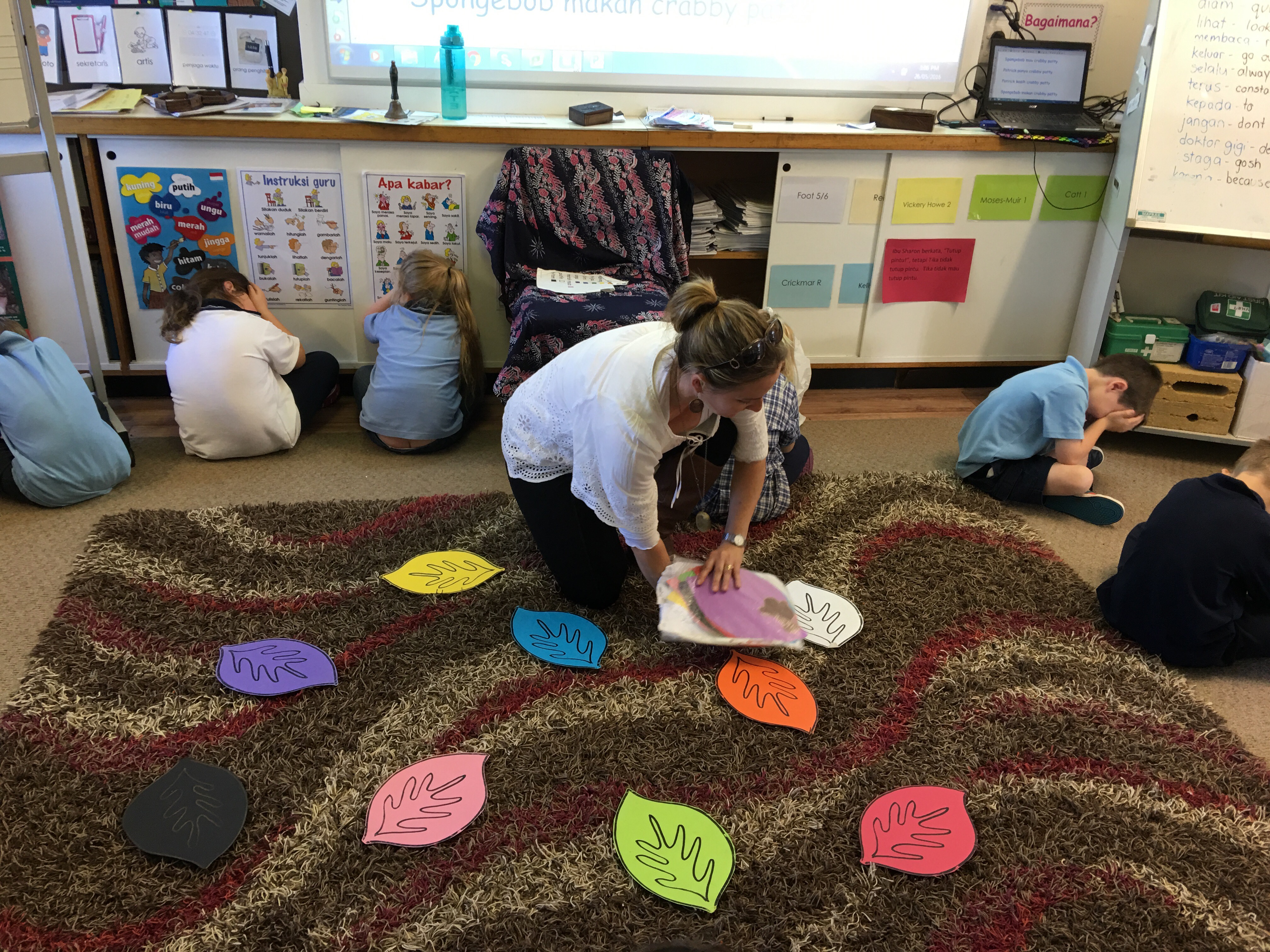
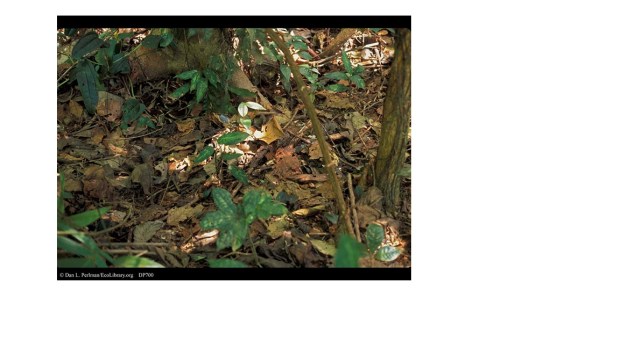
The class read through the story with all students encouraged to do the gestures because the spotter was at work again! The activity for this class was dividing students into small groups who had to work together to arrange the mixed up words of the story into order. To finish the day, Sharon offered to demo “Dimana Bobo?” with this class.  She lay out on the floor different coloured leaves. Students then had to turn around while she hid a laminated monkey (Bobo) under one leaf. Students then vounteered to guess which leaf he was hiding under.

Again, the students loved this game. I loved that it gave repetitions of the question ‘dimana’ (where) as well as colours.

After school we stood around chatting & sharing more games with each other. Anne  had a few number games which we intend to use soon. One was writing a list of numbers on the board:

satu

dua

tiga

empat

lima

On the back of the board, ask the student to write the number if necessary and then ask the class to guess the number. If wrong, the student puts a cross next to the numbers which helps to record guesses.

Another number game that would fit in beautifully with the jacket story because it uses the structures terlalu besar, terlalu kecil dan pas!  Draw on the board a line. Each time a terlalu besar number is suggested, the student writes it above the line, each time a student guesses a number that is terlalu kecil, the number is written below the line and the right number is written on the line! A great way to record the numbers guessed!!

Thankyou so much Sharon for agreeing to host both myself and Ibu Anne last Thursday. It was truly brilliant having 3 TPRS colleagues brainstorming and discussing together best practice which will inevitably benefit not only us as teachers but ultimately our students too. I’ve learned some great ideas and I can’t wait to try them with my students!

I also must thank Ibu Anne for taking a week of her precious LSL to spend a week in SA with us all because from that decision, this awesome day eventuated! Ibu Anne’s visit though is another story!! Read about it on her blog.
Membagi Ide Bagus – Pleased to Meet You (Jim Tripp)

The first ever story I do with my JP students is a mini version of Pleased To Meet You (thanks to our wonderful mentor Catharina for this pared down version).  

This post from Creative Language Class complements this story beautifully and would suit my year 1 and 2’s perfectly who first encountered the story in Reception (Prep/Transition) and would enjoy this extension idea as well as learning ‘suka’. It would also be great for older students just starting out on their TPRS learning journey.

Get to know each other using the TL!.

Bop! From TPRS Teacher (Keith Toda)

The students and I had fun this week trying a new game called Word Bop and a link to it can be found in the TPRS/TCI activities link in the header of this blog. 

I did play it slightly differently and in hindsight this variation was a good way to familiarise them with the game before we play the version as is found on Keith’s blog. I picked about 20 words from our upcoming story (Troy talks too much/ Troy bercakap-cakap terus) and put them into a wordle. We began by playing Martina Bex’s word race stories – a favourite with my students. 

I next asked them to choose one word from the wordle and write it on a folded A5 piece of paper. This probably isn’t that important a step yet it did give the students a visual prompt during the game when their minds went blank! As there were only 20 words and in most classes there are 30 students, there was naturally some doubles but as this was purely a task to get as many reps, it didn’t matter. When the students were ready to start, they had to put everything away except for their piece of paper and then arrange themselves into a circle.  I then asked them to practise saying their word very quickly, then asked them to say it quickly followed by the English translation. I next asked them to say both words faster followed by the name of a student sitting on the opposite side of the circle. By this time they were ready to start the game. Here is where the fun began. I asked one student to put their paper on their chair/pillowpet, take hold of the large stuffed gajah (elephant) and stand in the centre of the circle. I began the game by saying a students name. The student named had to say their 3 words very fast before the middle student holding gajah located them & threw gajah at them. If they achieved the task of saying their 3 words before being bopped by gajah, the student whose name had been said had to say their 3 words too before the gajah landed on them. So it went something like this:

Sam: berkata, said, Tom

Tom: astaga,OMG, Lilly

Lilly: pergi, went, Bobby

Meanwhile the gajah is flying around the room trying to catch up with the speakers. When it eventually does, the thrower sits back in their chair/pillowpet and the person to their immediate right (or left!) stands and takes their place. This last idea came from one of my students who noticed that the fast speakers didn’t get a go throwing the gajah otherwise! No one is allowed to touch the gajah except the thrower, which added a nice twist when it was accidently thrown outside the circle giving the next participant welcome thinking time. A few students (years 6/7) asked about being allowed to dodge the gajah which allowed a new level of hilarity as they toyed with the thrower only to move out of the way at the last moment! 

Week one back at school was uncharacteristically exhausting with unusually restless and chatty students. This game required them to listen closely as well as the opportunity for lively and entertaining movement.  It saved my sanity! Who knows what next week has in store for us all with both swimming for years R – 4 and NAPLAN! Yikes! 

Listen, Write, Illustrate

This week, I tried something new….

I have been ready to move on to a new target structure and with only 4 short weeks left of term 1, I didn’t want to begin anything major. This type of window provides the perfect opportunity to trial an idea and if it works, its a bonus and if it flops, then there’s absolutely no harm done and we can merely chalk it up as experience.

Our stories have usually focused on structures that help us stay in Indonesian when communicating with each other in the classroom. The story this term introduced the phrases, open the door & close the door which are both very handy in summer and winter! ‘buka’ &’tutup’ are useful in themselves too and it wasn’t till we added them to our repertoire, that I discovered just how useful they could be. Another verb that I really need to is ‘get’ (ambil). I often ask students to get a clipboard, a pensil, a penghapus etc. So last week, I set out with that intention.

I began with having the word up on the board and asking students to copy me saying it a million times using a variety of voices. I love doing this and wish I had a greater ability to mimic well known characters! I also love singing the words because this gives me the opportunity to stress syllables slowly and clearly. Students just love opera singing!! Its hilarious watching them doing this! Maybe they get just as much enjoyment from watching me!! Following this is an explaination of  what ‘ambil’ means along with asking for a hand gesture which clearly demonstrates its meaning. I only choose one gesture for the entire school, so I encourage students in each class to demonstrate their suggested gesture repeatedly while I search for the student whose gesture is either identical to or very similar to the initial gesture that I chose during the very first lesson of the week. I then give kudos to the student whose gesture was ‘chosen’ by looking them in the eye and giving them a big smile! It truly makes their day! We then as a whole class practice their gesture while simultaneously  verbalising the structure chorally.

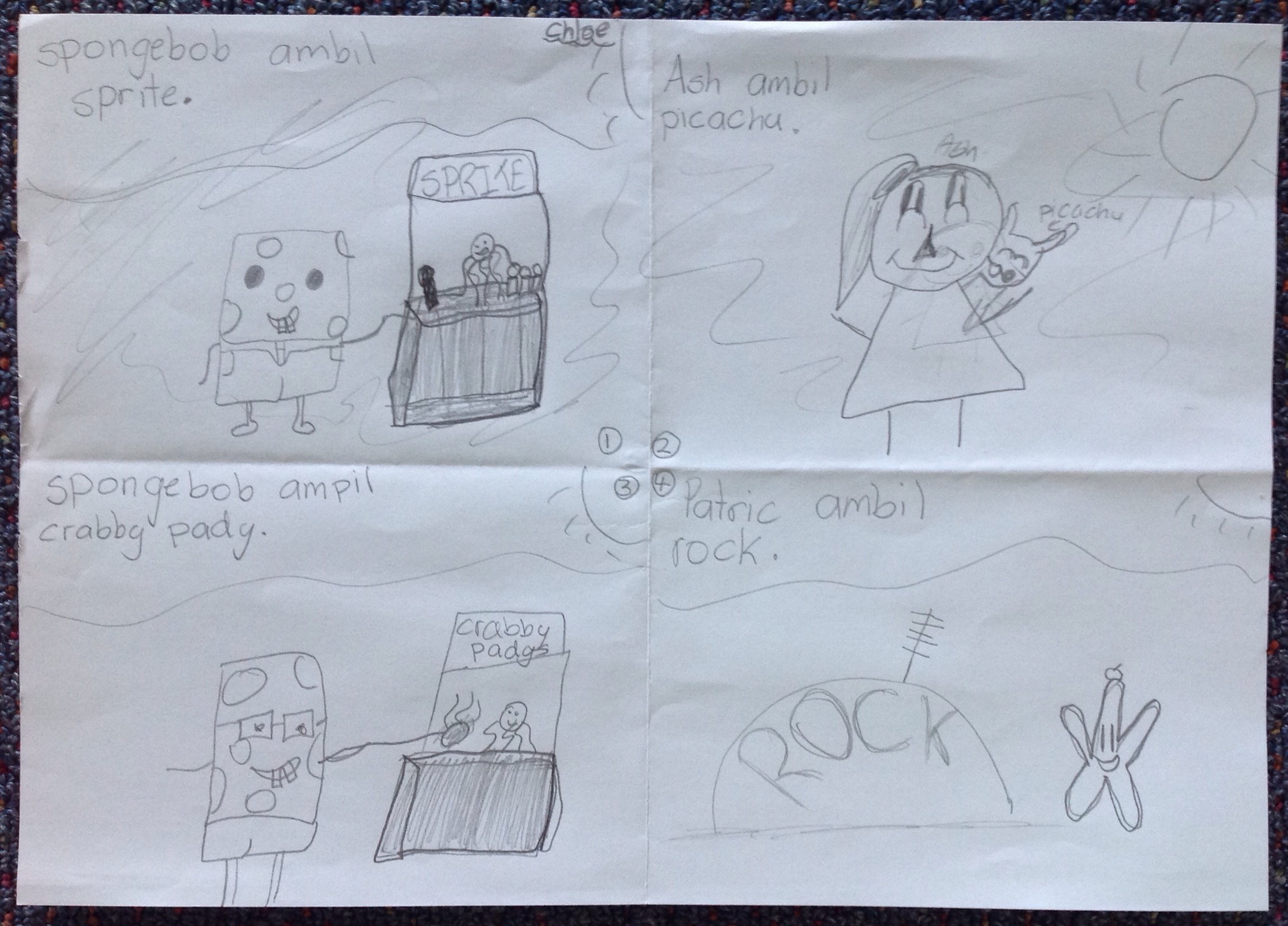
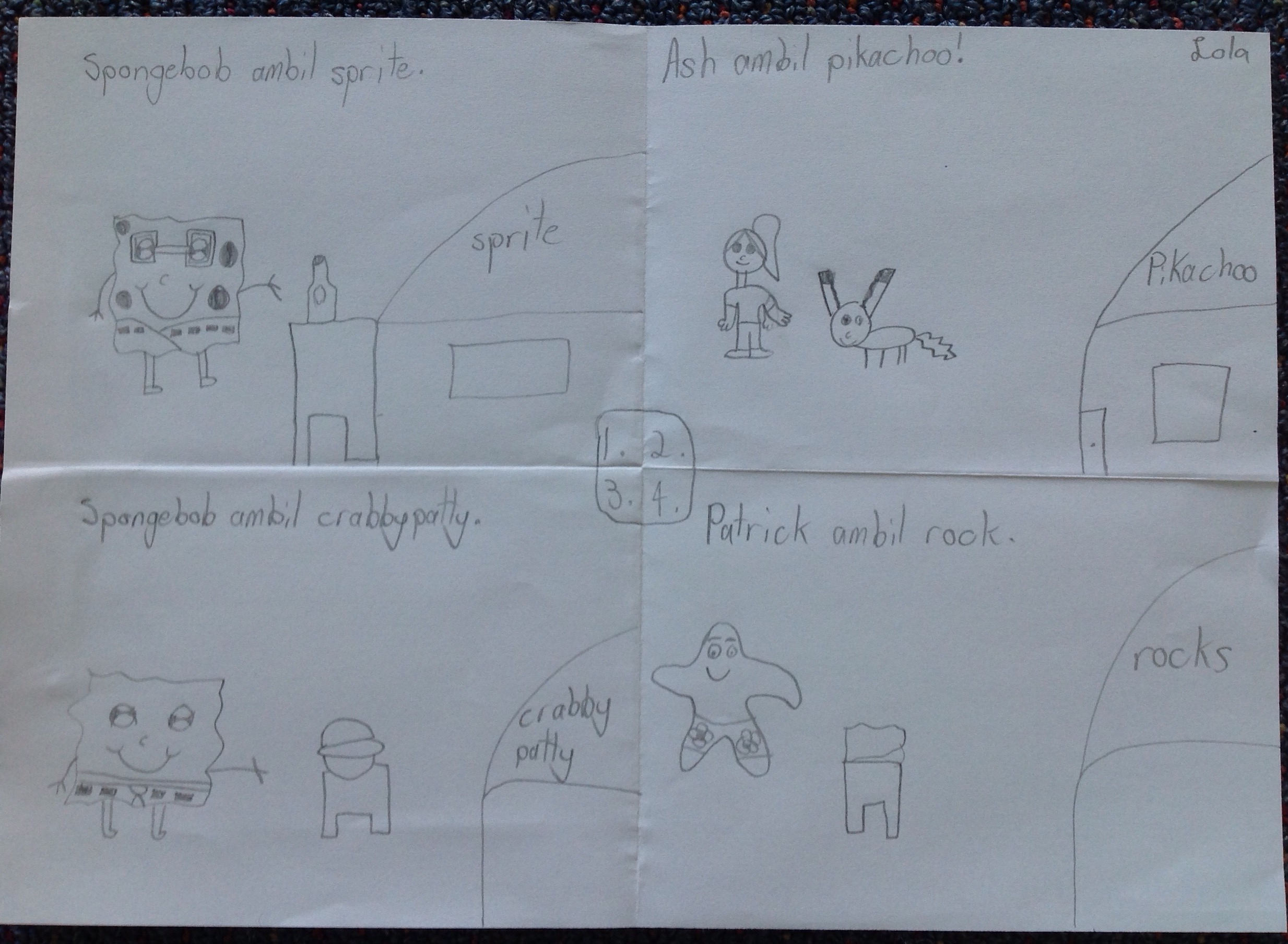
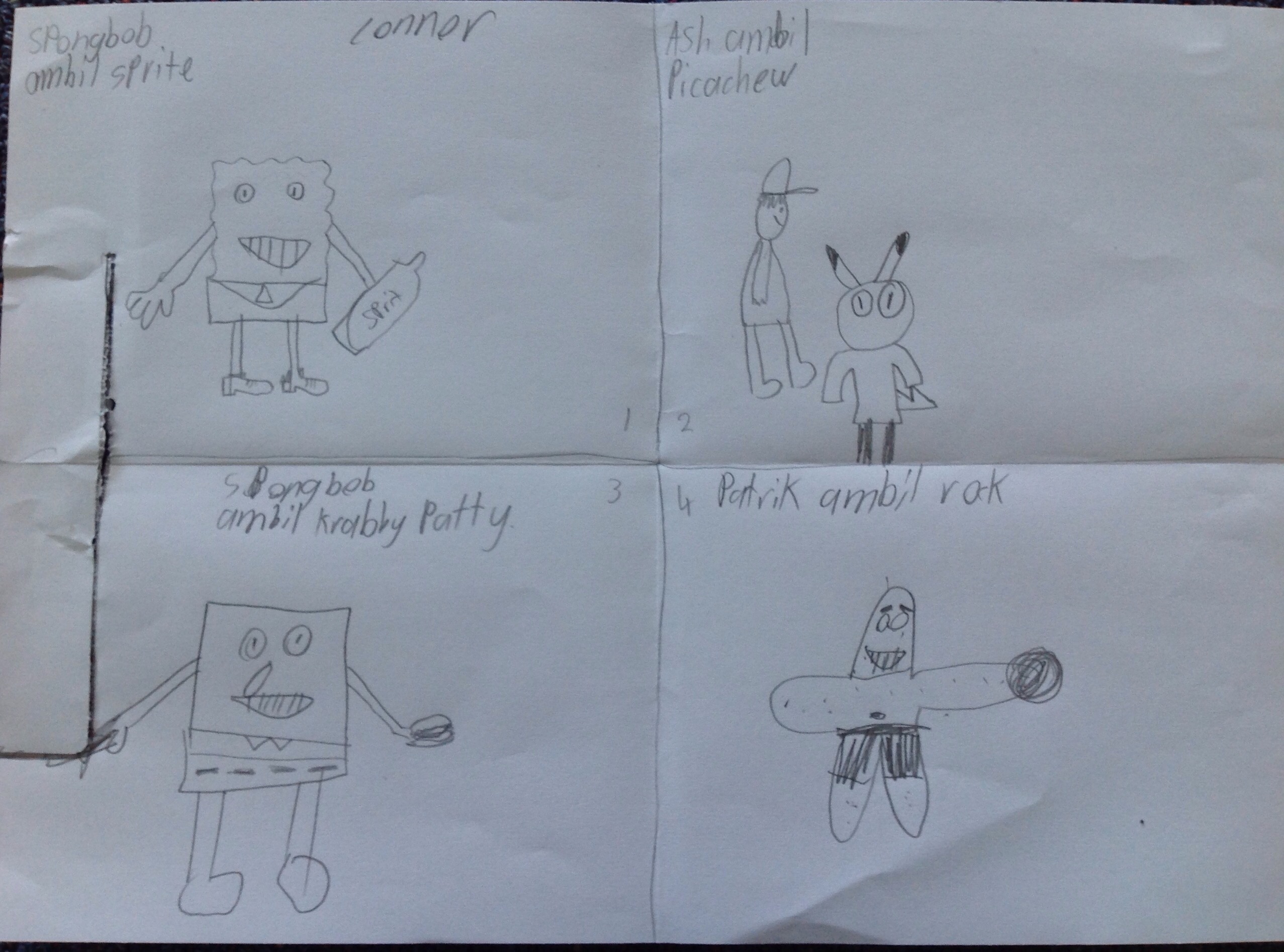
Then instead of circling to chase those repetitions, using either a picture, powerpoint or student, my distributors handed out a pensil, clipboard dan kertas to each student. Then I asked students to lipat (fold) then lipat again (while demonstrating to minimize using English). I could then ask students to ‘buka kertas’ ( open the paper – got a rep of buka in- what a bonus!) and number each quarter. I then gave the instructions while gesturing to clarify my meaning: Bu Cathy berkata dan murid menulis. After clarifying the meaning of menulis (write), I said the sentence, “SpongeBob ambil sprite.” and students wrote it in square nomor satu. I clarified that only the Indonesian must be spelled correctly!! Then  I asked students to menggambar SpongeBob ambil sprite.

I got so many repetitions of ‘ambil’ and students through illustrating each of the 4 sentences truly demonstrated that they understood and comprehended it. It was a fun way of having all students fully focused and on task. They loved it. 

Enjoy the following selection of work from one of the year 5 classes.


Student Free Day notes…..

The day began with an AIM demonstration by Sarah Slee. 

AIM (Accelerated Integrated Method) is a language program which originated in Canada by Wendy Maxwell. On the surface, AIM & TPRS seem quite alike but when you dig a little deeper, as we were generously given the opportunity to do, the differences though subtle, are many. 

Here is the definition for AIM which can be found on the AIM website


Sarah teaches French at a nearby primary school using this methodology and like us, began at the start of 2015. She has the total backing of her school leadership which has been wonderful because the kits do not come cheaply. We drooled over the kits she brought along. Each kit costs around $500 and includes a CD Rom, blackline masters, a teachers handbook and a big book of the story upon which the kit is based upon. Each part of the kit is chocker block full of ideas and suggestions and also comes with a teacher script for each and every lesson as well as a variety of assessment checklists!! The CD Rom includes high quality media resources including songs, story reading/ productions etc which recycle and extend the vocabulary being targeted for each story. The early years kits are based on familiar stories like Henny Penny & The 3 Little Pigs while the kits for older students  are based on unfamiliar stories. AIM kits are available in several languages however Indonesian is not one of them. After watching the introductory video (also available on the website) we participated in a lesson. Sarah sat in front of us (we were in a horsehoe in front of her) with her book open on her lap to the very first lesson as none of us speak a word of French. She then led us through the very beginning of this lesson where she said a word/phrase while simultaneously gesturing and we repeated the phrase/word and copied the gesture. It was very challenging and really gave us a taste of what our lessons are like for our own students! It was a wonderful experience and went much longer than we both anticipated when planning the day! As you can imagine we were all totally blown away by the number of resources available to Sarah in each kit because we have absolutely nothing and have to create everything ourselves using the resources created for other languages as the base line! We also liked the idea of the gesture data bank AIM has as we believe that if we developed something similar, it would help students who move from school to school in our region. There are surprisingly quite a few!! 

The next session was my presentation about circling. I revised what circling is and the prescribed format as per the links I gave in a previous post. We then watched the Blaine Ray/Carla Tarini YouTube video before having a go in pairs with one of the sentences from our ‘Spongebob mau minum’ (Spongebob is thirsty) story. The oppportunity to create a bank of sentences based on the circling format (statement, ask a yes question, ask a no question, ask an either or question and then a question that elicits more detail) with a partner provided a welcome opportunity for discussion which then led to a whole group general discussion about the specifics of story asking. We have, to date, began our stories with a focus on the target structures for several lessons before introducing the story itself. Some students find this excruciating because they enjoy the story telling so much that they become impatient with the percieved unnecessarily long lead in time! So with our next story, we want to see if we can par this down and begin the story asking earlier! Stay tuned for our reflections…….

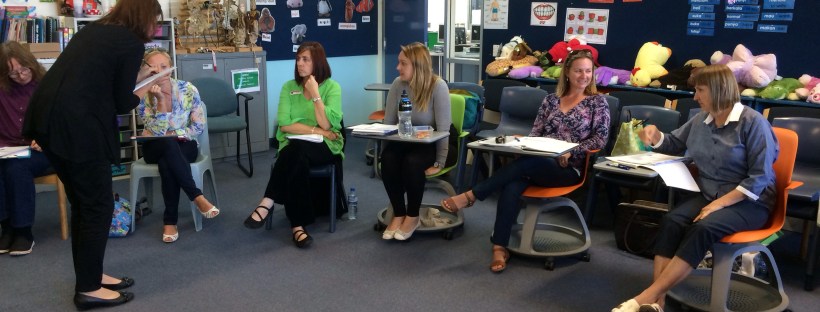
After lunch, we were joined by Michelle Kohler (Flinders University) to discuss the Australian Curriculum in relation to  designing TPRS assessment tasks. Michelle drove the 1 hour trip to PEPS straight from teaching preservice teachers at Flinders Uni and then headed straight off afterwards for another meeting, so we are incredibly grateful for her finding the time and energy to fit us into her very busy day! Michelle was closely involved with the creation of our Indonesian Languages Curriulum and it was insightful to discuss with her how language teachers are being required to assess and report against it. She was disappointed to hear that most principals are requiring Indonesian teachers to report against the Achievment Statements. She reminded us that ACARA is not an outcomes based document as SACSA was. The Achievement Standards are a reference point for typical student learning. They were not designed to drive assessment. Here is an extract from the DECD Guideline: Reporting on Australian Curriculum in DECD Schools Reception-Year 10 (v2) 

Achievement Standards should be treated holistically, rather than as discrete elements to be achieved.

Michelle then led us through the strands clarifying each:

1.1 Socialising

1.2 Informing

1.3 Creating

1.4 Translating/mediating

1.5 Reflecting

2.1 Systems of language

2.2 Language variation and change 

2.3 Reflecting on the role of language and culture.

.

This gave us an opportunity to look at each from a TPRS/TCI viewpoint. 

This is my extremely brief perception of how we cover each:

1.1 – kursi luar biasa, general story telling/asking, 

1.2 – Movie talk, vPQA,

1.3 – Story asking/telling, free writes, 

1.4 – popcorn reading, paper airplane reading, choral translations, comprehension checks, 

1.5 – grammar pop-ups

2.1 – language discussions (in English) about vocabulary, grammar &/or spelling etc noticed by students in stories/ books. 

2.2 – use and discussion of cognates and the increasing prevalence of English found in modern Indonesian eg kriket, komputer etc

2.3 -informal and formal discussions we have with our students before, during and after school visits by Indonesian nationals to heighten awareness of cultural and religious differences between Australians & Indonesians as well as between Christians & Muslims. 

Please feel free to add to these by commenting below.

As you can probably tell, it was a fantastic day. Having the opportunity to collaborate together about issues relevant to our specialist learning area and invite guest speakers who can help us increase our experitise was so invaluable. My next task  is to survey all who participated for feedback to help plan our next district SFD!