This idea could word well with the prepositional language I am planning to introduce this week to uper primary students! as well as reviewing classroom objects. Imagine a picture of “pena diatas lem”
This is one of my favorite party games, which Ashley VanHemert so brilliantly reminded me to use in the classroom! She heard of the idea from Amy Wright at UAF. This is an excellent activity for Preferred Activity Time.
STEP ONE: Give each student one side of this form (I put two forms/page to save paper):
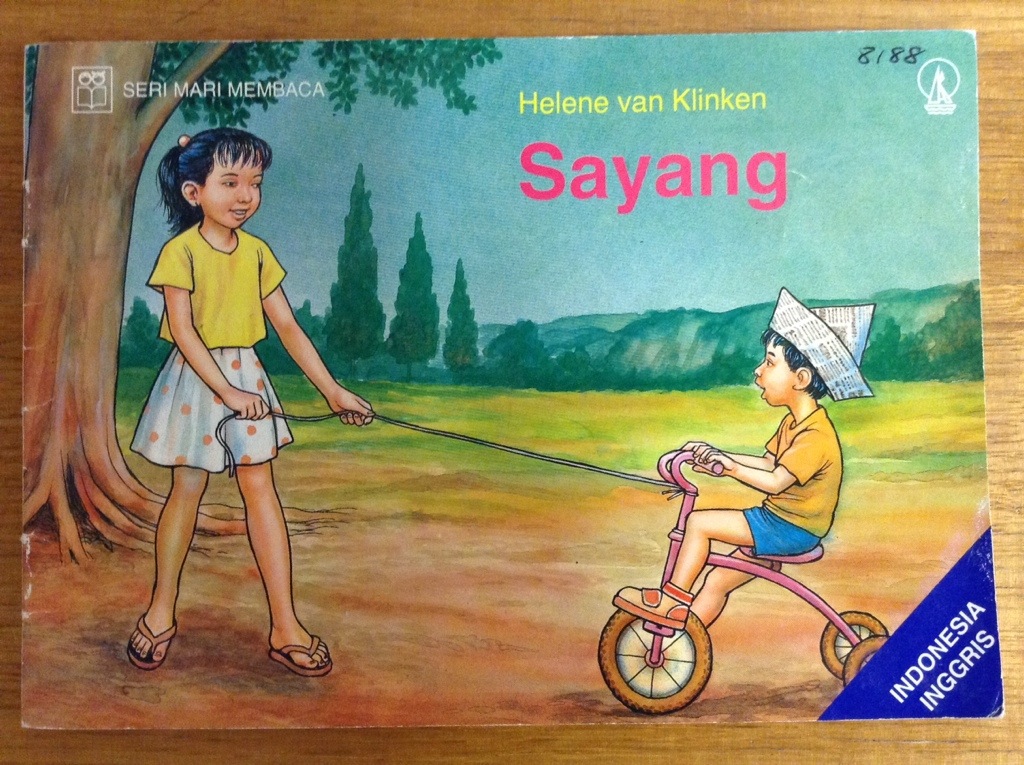
Last term, the junior primary classes looked at the text, “Sayang” as part of their study about keluarga. The book is one of books in the Seri Mari Membaca, a series which I believe is out of print now.
The illustrator of “Sayang” is Sutarno and it is the illustrations that I love most about this book.
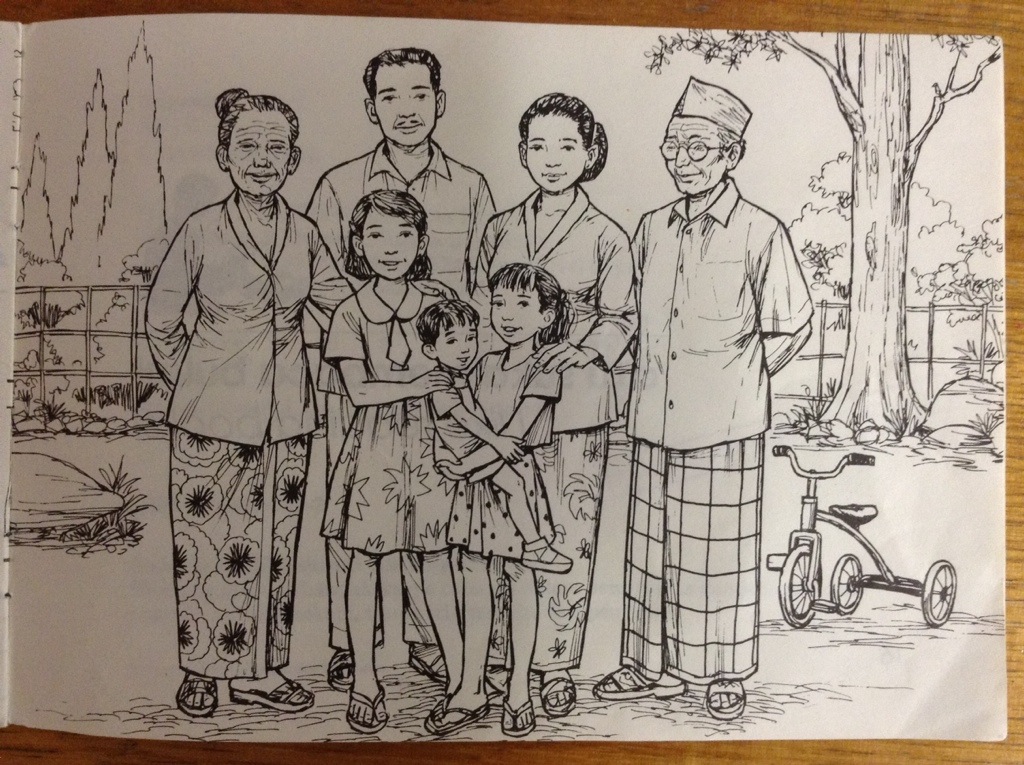
I love that the illustrations are of Indonesian people in an Indonesian setting and they are not westernised. I acknowledge that they are a bit stereotyped however, as it is not a negative stereotyping, it should provide a good opportunity for discussion.
The text in my copy has been altered by a previous Indonesian teacher who seemingly wasn’t comfortable introducing the word “aku”!
As these books are tiny (21cm x15cm), I decided to create a notebook file of the story for my students to make it more appealing. I photographed each illustration and then wrote my own text as I wanted to utilise the opportunity to introduce verbs, names and keluarga vocabulary. As Helene van Klinken has done in all her books, I kept the text repetitive to make the text as comprehensible as possible. For example, for the page about her mother, I wrote;
Ini Ibu saya.
Namanya Setia.
Ibu memasak di dapur.
Saya sayang Ibu.
I then asked an Indonesian friend to read the story while I recorded her doing so and attached each segment to the relevant page. This was a brilliant idea on so many levels. Firstly, my students were able to listen to a native speaker, which they absolutely loved. Secondly, Bu Mei read the last sentence of each page by putting stress on “sayang” (just as we would say, I loooove my mum) which fortunately emphasised the very word that was the point of the story! Thirdly, it was brilliant because it saved my voice! I could sit back for each of the 6 classes and just click on the picture and Bu Mei’s voice would fill the room and had us all spell bound!
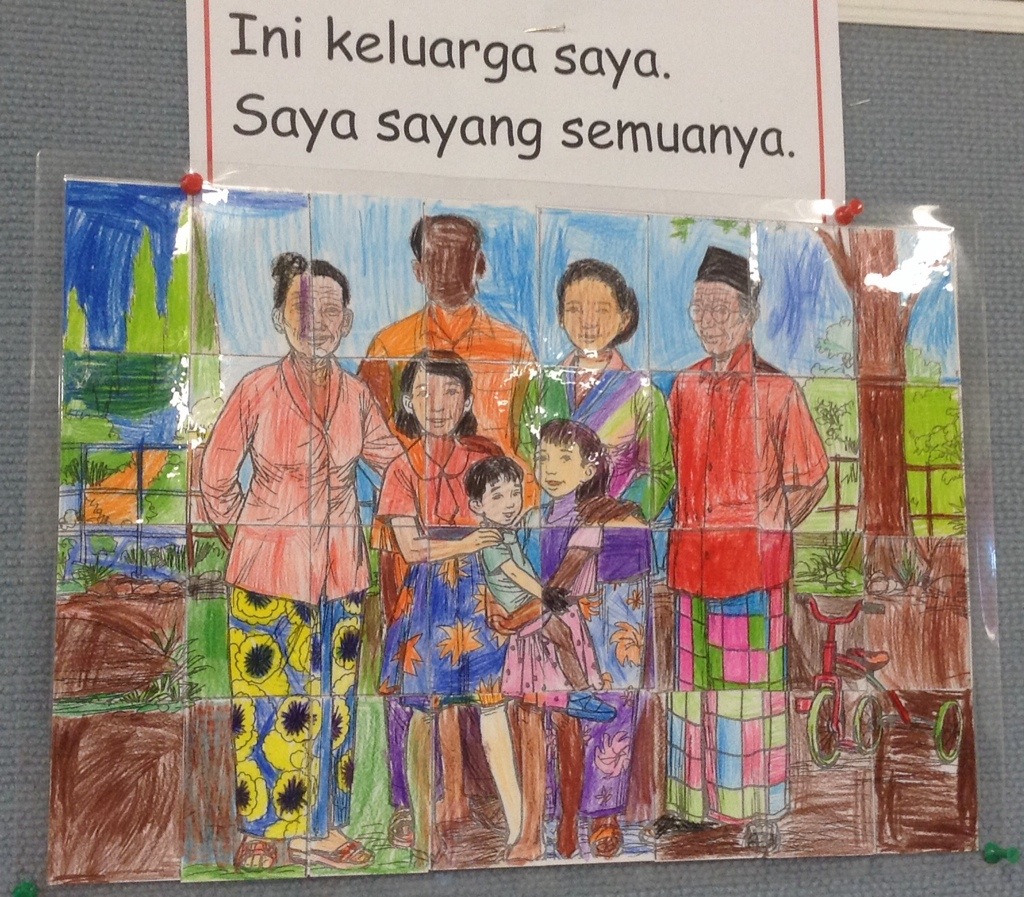
Each time we focused on this story, students commented on the lack of colour in the pictures, so during week 10, I photocopied each illustration and enlarged it to A3. I then drew an 8×4 grid over each one and this was photocopied again as the master. Each class was assigned one of the picture grids, which was cut up into 32 rectangles. Each student was given one of the rectangles to colour in. The first class to complete this task provided me with the best example of why it is important to sit with others who are working on the same part of the picture!! Some of the following classes did an excellent effort and worked so cooperatively together. The pictures have all been laminated and are now up on a display board above a table where I often heard students discussing them while working on their work last week.
This post makes me think how asking students to write a review as an end of term assessment would make an awesome post and a good opportunity for them to review and evaluate the unit of work from their perspective. Wish I had done this last term actually!! A few hiccups last term with students using ipads inappropriately was disappointing but was also a valuable opportunity to reiterate iPad usage rules and expectations!
I have been plugging away on my blended class for next year. I have planned some more journaling ideas for my students. These could be used for a blog or a paper journal. I always give my students the option to write about any topic that is important to them as well. I want to help those that need a little inspiration each time.
¿Te gusta viajar en avión? ¿Por qué?
¿Cuáles son tus preferencias cuándo viajas en avión? ¿Te gusta hablar con las personas durante el viaje? ¿Te gusta ir por el control de seguridad? ¿Cuál bebida bebes en el avión? ¿Dónde te gusta comer en el aeropuerto?
Mi película favorita es…
Yo pienso/no pienso que hay extraterrestres (aliens) porque…
Estoy contento/a cuando…
Si eres un animal en el zoológico, ¿cuál eres? ¿Por qué?
Term 1 began with a high awareness of the importance of discovering which of our students have permission to have their image uploaded onto the internet. I began my search in the front office to discover that while we had lists of who can have their image uploaded, there were no lists of the opposite. So I scanned the lists against my class lists for every class and came up with the students I needed to target. Turns out this list was also hugely popular with class teachers, especially ones who have class blogs!
This process also highlighted that we as a school needed to update the wording on our enrollment forms for new students, which was done almost immediately. Previously the permission focussed on publishing images in newspapers and newsletters and only vaguely covered class blogs, the school Facebook page, specialist teacher blogs, teacher youtube channels etc., so a more up to date and succinct edit was undertaken. Yeah!
My next step was to target students who were on my reverse list. I began by approaching parents I have know a long time to ask them why they had not given permission for their child’s image to be uploaded. The answer I commonly received was that when they first enrolled their child (6 years ago in some cases), the internet was only just being used in schools and they were unsure of the impact of it, so to be safe, they ticked the ‘no’ box. However, all agreed that now they would happily sign a permission form reversing this decision.
An email was then sent out to all teachers about permission letters currently in use to achieve this purpose! No point reinventing the wheel!! 2 teachers replied and kindly gave me permission to tweak their permission letters. I love the professional sharing amongst colleagues the happens at our school!!
This letter, was approved by my principal, run off on letterhead and now sits on my desk in a plastic sleeve. As students are photographed, filmed or recorded in any way, I check their name and if still on my reverse list, I ask them if they would like their photo/ film to be uploaded onto my blog and if they do, I hand them a copy of my letter. So far I have had 3 returned and I have also been able to scratch a few more off my lists as class teachers are also going through this process for their own blogs.
While the reverse list wasn’t that long, most classes only had about 5 names on the list, it has been a real thorn in my side as all of my upper primary classes have done some amazing work this term which I am itching to share but as I am still waiting for 1 or 2 students, I am debating whether to continue being patient and continue to speak to those students or just go ahead and edit them out of the photo/film. I am leaning towards the second option because I know that once I start a new topic, a new term, new projects, I will find it very difficult to look backwards and find the time and energy to complete it. Guess then, what I will be doing today ready for term 2 tomorrow??? And in the meantime, I will continue to blur faces using a new app I recently discovered.
First term was a very long 11 weeks. It began with me readjusting to teaching 4 days a week as opposed to traveling 7 days a week and finding time to blog was challenging and the longer I left it, the easier it was to find reasons why I was too busy! So here goes….
My first 5 weeks back are a bit of a blur as that was how long it took me to get back on my feet and cope with the exhaustion of both teaching and doing the preparation needed to teach. It also took me 5 weeks to rediscover the balance of what was needed for a 50 minute lesson with each year level!
HIghlights for the term include the following:
1. Bu Maylanny’s visit.
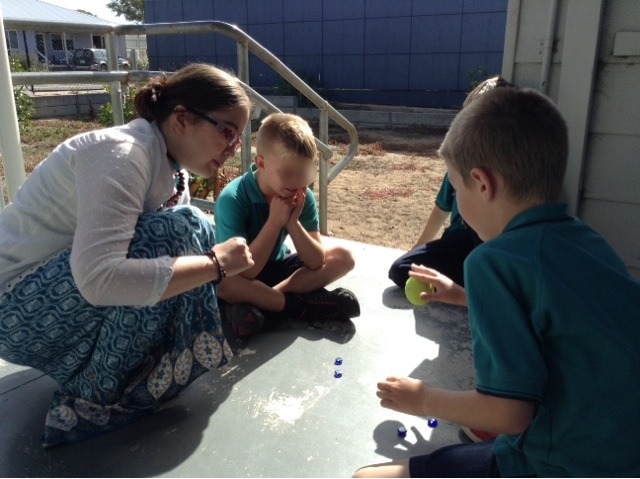
Bu Maylanny is a university lecturer from Bandung (West Java) and her 2 week stay was nowhere near long enough. Her visit was organised by the wonderful Pak Nyoman at APBIPA. She spent 2 days with us at PEPS and I still have students telling me how disappointed that they missed working with her in class. She taught us how to play bekel ( an Indonesian game very similar to knuckles except with a ball).
We played this with several classes and they all really enjoyed the challenge. Very tricky picking up beads with one hand and bouncing and catching a ball in the other!
2. Hearing Impaired Worksop; “Supporting Students With Hearing Impairment”
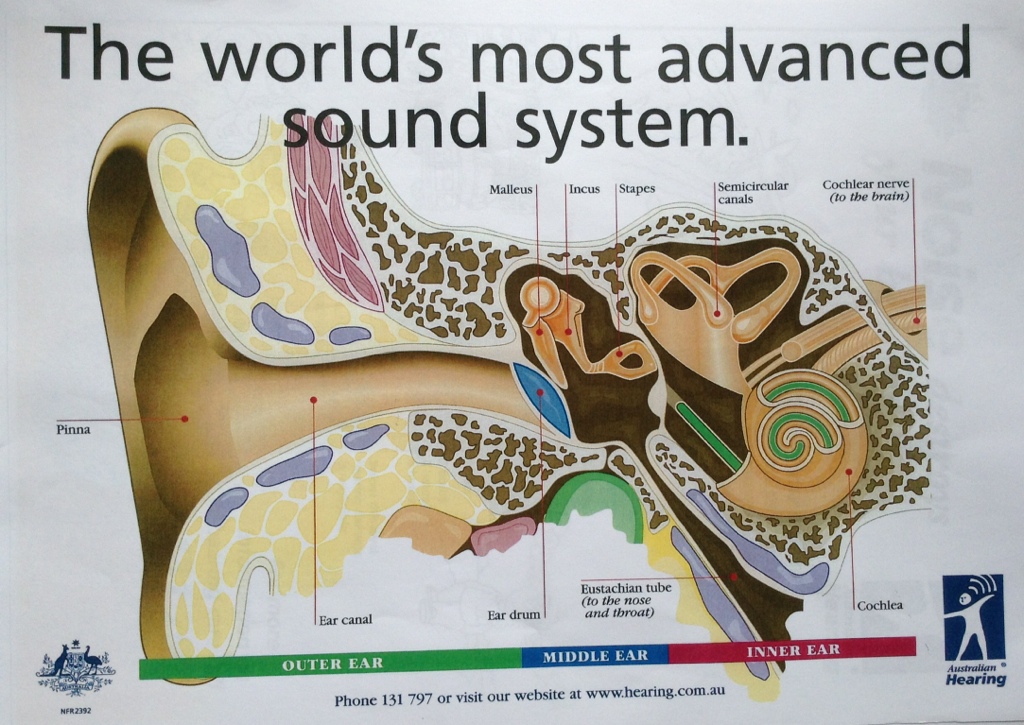
I am very lucky to have a sound field system in my classroom complete with microphone. There are several hearing impaired students at our school however I find that using the sound field system benefits everyone as when learning new vocabulary every one can hear clearly and it also benefits my voice enormously as I can just speak normally instead of having to talk loudly all day. I used to have huge problems with my throat and voice and thanks to the sound field system, this has largely been eliminated.
The one thing that I brought away with me from the workshop regarded the use of smart boards. I use mine constantly both for introducing and revision and it was pointed out to us at the workshop that smart boards are usually used in darkened rooms. My room has blockout curtains on one side and there is no doubt my hearing impaired students would have difficulty trying to lip read to support their hearing while simultaneously looking at the smart board!! Can’t believe I hadn’t considered this already!
3. State Grant for Establishing a Sister School
The schools on the south coast all applied for this grant and we were all successful which is sooo exciting. We each won $2000 which will go towards buying ipads so that students can communicate with our sister school next term about “sekolah”.
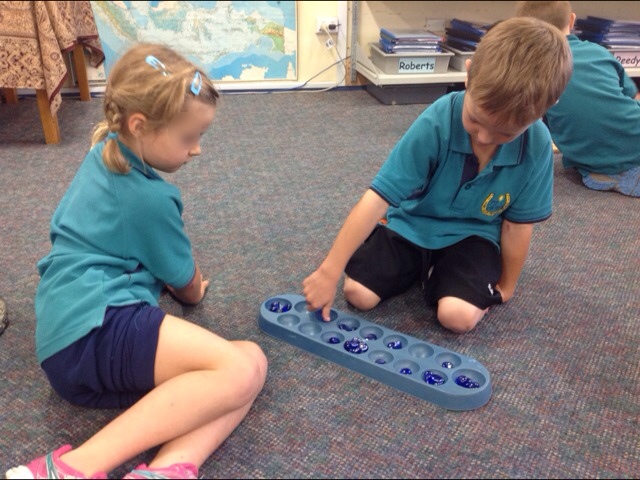
4. Congklak
This term I finished up with teaching all the junior primary and middle classes how to play congklak. It is a game I have only usually taught upper primary students but have realised that years 1-3 can also play it and enjoy it. It was hugely popular with all students!
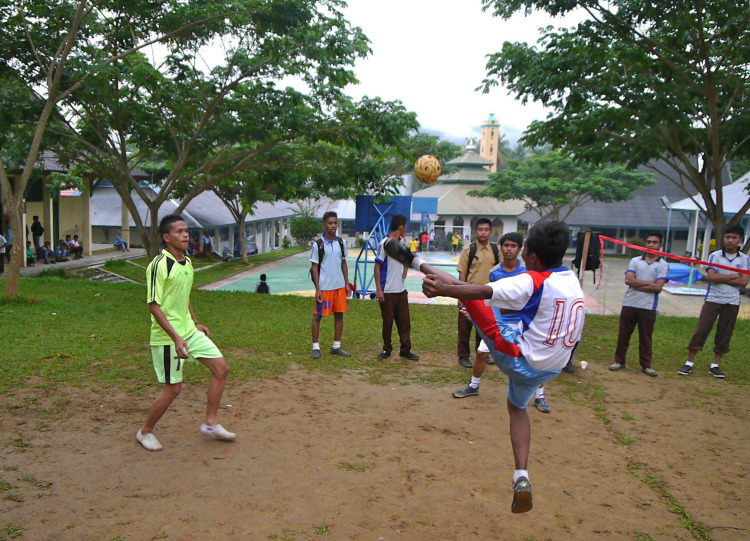
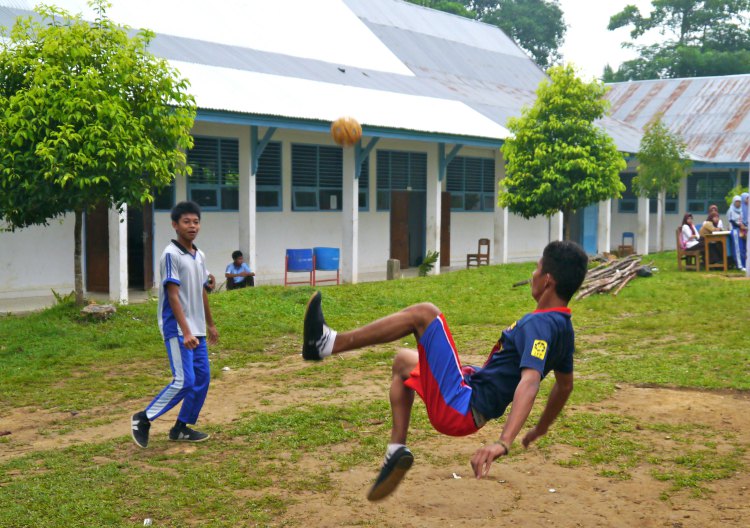
“While walking through campus at SMAN 7, Kendari in Southeast Sulawesi, it’s difficult not to notice the sprawling scissor -kicks and diving headers of the students playing Sepak Takraw. Sepak Takraw, meaning “kick ball” in Malay, is not a competition for the uncoordinated and inflexible. The game is played similarly to volleyball, with a single-point system, rectangular court and elevated net; however, unlike volleyball, a player cannot use their hands. Thereby, the three participants on each team have to relay the ball over the net (without it touching the ground, or going out of bounds) using a combination of feet, legs, chest and head.”
“The ball used in Takraw has a circumference of 17 inches and is woven out of a material called rattan. The rattan ball has a hard surface, but is very forgiving with its lightweight and hollow center. The game begins when a player on the serving team…
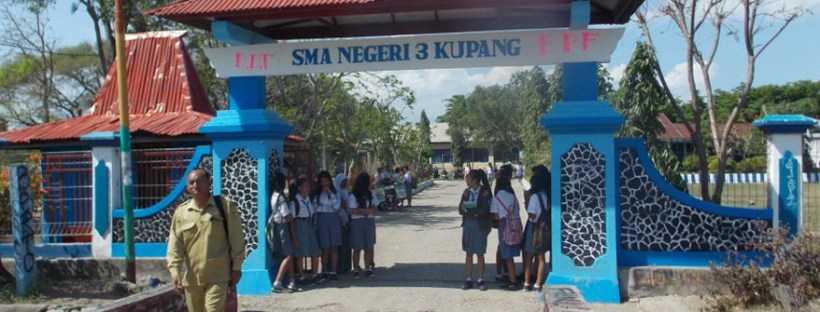
The main entrance to SMA Negeri 3 Kupang, one of the best public schools in the city.
It’s a common sight in Kupang—a thirteen or fourteen-year-old boy collecting fare money from uniformed school children as they pile out of his crowded bemo. The boy, like many others his age or even younger, works as a konjak, riding around on the bemo (minivans that serve as Kupang’s public transit system) that buzz around the city, hanging out the open side door, collecting fares from passengers, and trying to cram as many people into the vehicle as possible.
These konjak perform their duties with great enthusiasm. They shout at idle pedestrians as their bemo speeds past, jump out of the still-moving van to usher passengers inside when they call for a ride, and show hesitant customers where the few inches of free space are on the deluged benches inside the car…
I have just found an amazing video about Jakarta which will be perfect for preparing my students for our Jakarta visitors later this term. Have a look at this! This video not only gives students a fantastic idea of Jakarta but it also explains why it is a mega city! I thoroughly recommend it for just about all ages. Even very young students will gain something from the visual feat which are excellent and provide many opportunities for extra curricula discussions.
Well, here I am back in Australia after my amazing journey around Indonesia! While traveling around Indonesia I always had it in the back of my mind that the new Australian Curriculum for Languages would be implemented in 2014. It feels weird that I have been excited about implementing the new curriculum but I truly regard it as both an exciting teacher challenge and hopefully also the springboard from which to launch a thoroughly inspirational Indonesian Program so that I can share a fraction of my 7 months of complete Indonesian language and culture immersion with my students.
I am very fortunate to be a member of a very active and committed local hub group called The Fleurieu Peninsular Indonesian Teachers Hub Group. There is a very strong core within our group and together we have been responsible for a variety of amazing programs. I love the way we work together as a team and that everything we do benefits all our students equally and is never about personal accolades. Our hub group is truly amazing and even though we work individually at separate sites, the sharing and support we give each other more than makes up that. So it wasn’t that surprising that even before I returned to Australia, I received an email from Ibu Sharon suggesting dates for a hub meeting to discuss planning for 2014 and entwined in that planning is the implementation of the Indonesian Curriculum.
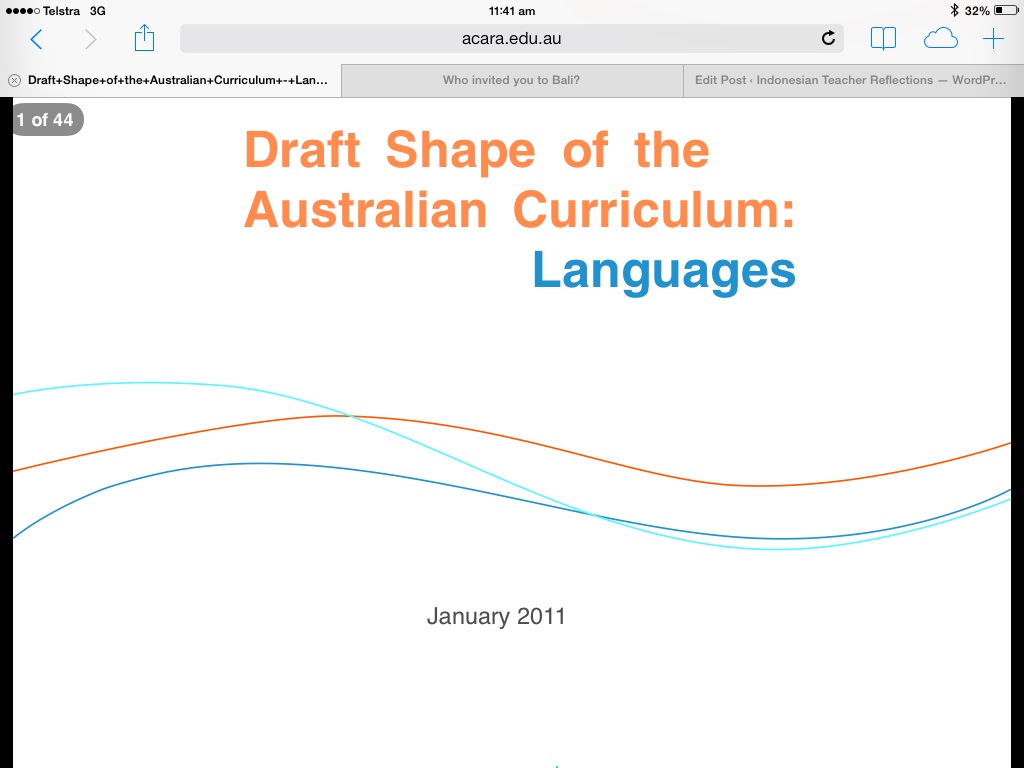
Once the date of our hub meeting was finalised (tricky finding a date that fitted in with family and business commitments), I began my research so that I would be ready for the largest dot point on our agenda: Planning for 2014 using ‘The LOTE Curriculum’. I opened my trusty iPad and in the safari browser typed in ‘Australian LOTE curriculum’ and this is what came up:
Upon looking at the first link I discovered a document dating back to 2011 and obviously one of the original planning documents with nothing about the nuts and bolts of the Australian Curriculum for languages.
I then opened the 2nd link which contained many further weblinks but none of them included the draft Indonesian curriculum so then I looked more closely at the timeline right at the top of the page.
It appears that the curriculum is yet to be approved and implementation is expected to be in May 2014.
So I decided to consult a true ‘guru’, Andrea Corston, a great friend of mine who is also the 2013 vice president for INTAN (Indonesian Teachers Association SA).
Hi Andrea, I guess you are back in Australia by now too! Sorry to email you about work things, but hopefully my questions are simple and don’t need too much thought! I am curious to know where we are up to with the LOTE curriculum. I have just looked at the ACARA website and it seems that implementation isn’t till May 2014. Is this true? Also I can’t find a copy of the LOTE curriculum with a list of outcomes. Is this because it hasn’t been done yet or is it because it won’t include such a list? Our hub group are meeting soon to plan for 2014 and I would love to know where to start!!
Her detailed answer demonstrates why she is a ‘Guru’:
The Australian Curriculum for languages which have already been written and are currently being finalised (including Indonesian) will be released for a familiarisation year in 2014. See Attachment 4, page 30 of the DECD Guidelines for the implementation of the Australian Curriculum in DECD schools: Reception – Year 10 for these timelines http://www.decd.sa.gov.au/teachingandlearning/files/pages/Guidelines_for_the_Impleme.pdf
That is, there will be Professional Learning offered to help teachers and school leaders to understand the new Languages curriculum requirements throughout 2014 – this could be offered through DECD, CEASA, MLTASA and hopefully INTAN, so it is highly advisable for all South Australian Languages teachers to be linked in to their professional networks so they don’t miss these opportunities. Indonesian and other languages currently being developed will be ready for implementation in 2015.
So although the Indonesian curriculum should be released by ACARA by May (and possibly before), there is no requirement to teach to it in 2014 as it will take some time for teachers to get their heads around the new orientation. There are no outcomes in the new Australian Curriculum for any Learning Area, as assessment will be described against Achievement Standards as for English, Maths, etc.
The most recent November ACARA update (attached) describes the revised Strands and Sub-strands for all Languages, on which the Language-specific curricula will be based.
Andrea Corston
INTAN Vice-President
Wasn’t that a comprehensive update! I am slightly relieved and also slightly disappointed that the LOTE curriculum is not ready for an immediate start but in reality the delay allows me to be more prepared for it’s impending implementation next year.
I am finally feel prepared for the first point on our agenda for the next Indonesian Teachers Fleurieu Hub Group meeting!! I now need to make a start on the others but that will be another post!!

 This is one of my favorite party games, which Ashley VanHemert so brilliantly reminded me to use in the classroom! She heard of the idea from Amy Wright at UAF. This is an excellent activity for Preferred Activity Time.










 Indonesian Teacher Reflections